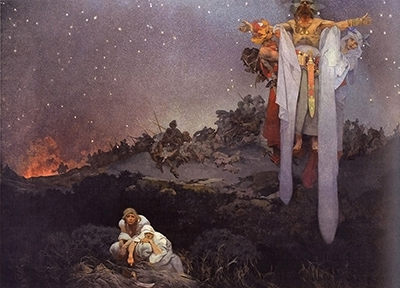
The Slavs in Their Original Homeland (1912), the first canvas in Mucha’s Slav Epic.
Buy Art Prints Nowfrom Amazon
* As an Amazon Associate I earn from qualifying purchases.
 by Tom Gurney
Tom Gurney BSc (Hons) is an art history expert with over 20 years experience
Page Created on / Page Updated on
Email: tomgurney1@gmail.com / Phone: +44 7429 011000
The Slavs in Their Original Homeland by Alphonse Mucha: The Slav Epic Begins
Two people crouch low in a dark hollow. A fire burns at the far left, mounted figures move across the middle distance, and an enormous group of symbolic figures rises against a star-filled sky at the right. Alphonse Mucha made this contrast of human vulnerability and imagined power the opening of his twenty-painting Slav Epic. The Slavs in Their Original Homeland is No. 1 in the cycle and its first completed canvas, painted in 1912.[1][4]
The long catalogue title names an era between the third and sixth centuries AD. That is the historical setting Mucha chose, not the date when he worked on the canvas. He did not reconstruct a recorded encounter between named people at a known site. He built a large allegorical scene in which a frightened pair, an attack and figures for war and peace introduce the questions that recur across the Epic.[1][2]
At a Glance
- ArtistAlphonse Mucha
- CycleThe Slav Epic, No. 1 of 20[1][4]
- Full catalogue titleThe Slavs in Their Original Homeland. Between the Turanian Whip and the Sword of the Goths (between the 3rd and 6th centuries AD)[1]
- Painting date1912[1]
- MediumMucha Foundation: egg tempera on canvas; Prague City Gallery exhibition: egg tempera and oil on canvas; Berger's technical survey confirms early tempera but does not detect egg-yolk proteins in tested samples[1][6][9]
- Dimensions610 × 810 cm, for the finished canvas[1]
- Related studyoil on canvas, c.1910–12, 38 × 45 cm[3]
The first Epic canvas in Mucha’s career
Contents
- A small refuge beneath a large sky
- War and peace above the attack
- An opening chapter, not an archaeological map
- What “original homeland” can and cannot locate
- From a study to the first finished canvas
- Reading the first canvas beside the last
A small refuge beneath a large sky
The eye can enter the painting through its smallest people. Near the bottom, a couple press themselves into a low pocket of land. Their pale clothing separates them from the dark grasses and soil, yet it also makes them exposed. One looks outward while the other folds inward. Mucha places the people closest to us but gives them little physical command over the scene. The viewer meets fear before seeing any triumphant protagonist.[1][2]
Behind them, ground rises toward a band of figures and animals. A distant rider and the rough movement of the group suggest the attack described by the Mucha Foundation. At the far left, an orange fire marks the village burning on the horizon. The fire is visually small, but its colour punctures the otherwise cool, dark setting. A viewer may miss it on the first glance, then return to it once the couple's fear has made the distant event matter.[1]
The Prague City Gallery describes the pair as survivors and the middle-distance movement as an assault on their community.[2] The picture supplies no map, place name or date for a particular raid. Its long subtitle invokes broad threats to an early Slavic homeland. That distinction matters: Mucha is using a historical imagination to establish vulnerability, not providing an eyewitness illustration of one documented incident. The details function within his story about the Slavs' past.
Much of the canvas is open night sky. Stars scatter across it while the land below stays dark. This empty-looking expanse slows the eye between the hiding people and the far larger figures above. It creates a pause in the action, a space in which fear can become a question about what will happen next. That question is central to a painting designed to begin a much longer sequence.[1][2]
War and peace above the attack
At upper right, a bearded figure stretches out both arms. The Mucha Foundation identifies him as a pagan priest and the two youths beside him as symbols of war and peace.[1] The Prague City Gallery adds that the armed young man in red stands for war, while the girl in white stands for peace.[2] They are larger and more luminous than the people sheltering below. Their size signals an allegorical layer rather than ordinary figures occupying the same patch of land.
The priest's extended arms gather the two possibilities into a single group. Red and white fabric descend through the dark space, making the symbolic figures visible from a distance. Below, the couple can only hide; above, the painting imagines an argument about the response to danger. The Foundation reads the figures as a forecast of freedom reached through conflict.[1] The Prague City Gallery phrases the tension as the need for protection alongside the possibility of flourishing only in peace.[2] Neither interpretation makes the attack itself a victory.
The vertical movement is important. The threatened people are pressed into earth, while the allegory seems suspended among stars. Mucha's viewer must hold both planes at once: a bodily experience of being hunted and a symbolic idea about a collective future. Reducing the canvas to a simple battle scene would miss that gap. So would reading the priest's gesture as a promise already fulfilled. At this first stage of the Epic, the future is a possibility posed above frightened people.
An opening chapter, not an archaeological map
The painting's subtitle uses the period and terms of Mucha's historical framing. The Foundation describes early agricultural communities in marshy lands between major rivers and seas, exposed in his narrative to attacks from different directions.[1] The Prague City Gallery likewise treats the landscape and attack as an image of a threatened original homeland.[2] The old word “Turanian” is part of the artwork's catalogue title; using that title here does not make it a precise present-day description of a people or place. The Czech Prague City Gallery exhibition text expands the painted story with named peoples, marshy settlement and captives taken to a slave market.[6] Those details are a curatorial account of Mucha's historical imagination. The canvas itself does not identify an archaeological site or the attackers' ethnicity.
The historical distance is greater than the subtitle can suggest. A University of Warsaw archaeological reference says the name Slavs first appears clearly in Greek and Latin texts in the sixth century, particularly in accounts associated with Jordanes and Procopius. Those authors distinguish Sclavenes and Antes, but their texts do not document the specific raid Mucha painted.[7] Archaeologists also debate how to connect material remains, language spread and migration. In a 2024 study, Florin Curta questions whether the archaeological evidence supports a single sixth-century migration from an identifiable homeland to the lower Danube.[8] A subsequent ancient-DNA study provides substantial evidence of migration in sampled regions but does not settle the identity of Mucha's painted people or the site of this imagined attack.[10]
What “original homeland” can and cannot locate
The evidence available to historians now is more varied than the map implied by a single origin scene. Written sources tell us when outside observers began using names for Slavic groups. Archaeology describes settlements, burials and artefacts. Historical linguistics reconstructs relationships among languages. Ancient DNA tracks biological ancestry in sampled remains. None of those methods by itself identifies the language spoken by every buried person or turns a painted couple into identifiable sixth-century individuals. The authors of a 2025 study in Nature explicitly warn against treating archaeological, linguistic and genetic patterns as interchangeable definitions of a coherent people.[10]
The study analysed genomes from 555 ancient people, including 359 from contexts associated archaeologically with Slavs, and found large-scale movement from Eastern Europe during the sixth to eighth centuries in its sampled areas. It estimates major ancestry change in eastern Germany, Poland and Croatia, while finding different mixtures with earlier populations in different regions.[10] These results strengthen the case for substantial demographic movement. Curta's challenge to a single homeland-to-Danube route remains a distinct archaeological argument. The genetic results do not demonstrate one uniform movement out of a precisely bounded homeland. The authors say their best spatial proxy for the sampled ancestry lies around southern Belarus and northern Ukraine, but they lack ancient DNA from that proposed source area and period; the timing of movement may involve more than one pulse.[10]
That qualification matters to the painting. Mucha's full title makes the “homeland” a single narrative setting, with threats imagined on opposing sides. Research instead describes several kinds of evidence that reach different places and centuries. The genetic study's earliest Slavic-associated sampled individuals date from the seventh century, while the title stretches back to the third. Its results therefore cannot verify the raid, name its attackers or put the hiding pair on an archaeological map. Mucha's image can be read as a 1912 statement about collective danger and survival without asking it to act as a field report about early medieval populations.[1][7][10]
The study also notes that the modern idea of a common Slavic identity carried particular weight in nineteenth- and twentieth-century nationalism and Pan-Slavism.[10] Mucha's “original homeland” belongs to that later cultural project as well as to his proposed ancient setting. His pair stand for a community imagined across later nations; they are not a genetic sample or a securely attested tribe. The distinction helps preserve the painting's historical interest. It tells us how a Czech artist at the start of the twentieth century wanted to frame a shared Slavic past, even where early medieval evidence cannot substantiate the exact scene.[1][4][10]
Mucha needed an opening with enough emotional force to sustain the later scenes. The couple gives a human starting point. The fire, riders and darkness make vulnerability visible without naming every participant. The allegorical trio then broadens the canvas beyond one family's escape. When he later turned to language, faith, dynasties and political freedom, he could return to the same large questions: how communities survive violence, how they organise, and what kind of peace they seek.[1][4]
This is also a striking choice for a monumental first painting. At 610 × 810 cm, it could have celebrated a ruler or an army at the outset. Instead, the central human experience is fear. The physical size does not make the couple powerful; it makes their smallness within the composition harder to ignore. A modern viewer can appreciate the image's empathy while still recognising that its proposed historical origin is Mucha's constructed narrative.[1]
From a study to the first finished canvas
The Foundation records an oil-on-canvas study, approximately 38 × 45 cm, dated around 1910–12 and related to this painting.[3] It also records the much larger finished canvas as egg tempera on canvas in 1912.[1] The Czech exhibition text, however, catalogues the finished work as egg tempera and oil while agreeing on its 610 × 810 cm size.[6] The catalogue disagreement concerns the large painting's material description; it is not resolved simply by pointing to the separate oil study. The two objects and their measurements should not be merged. They show distinct objects, materials and scales. A small preparatory work could help Mucha plan relationships between masses of dark ground, open sky and the high allegorical group before he carried the design into a monumental format.
Conservator Tomáš Berger's published survey of the twenty canvases gives this question a material basis. His examination places The Slavs in Their Original Homeland among the works painted principally in tempera during the Epic's first years. The study found protein binders in early paintings, but its analytical methods did not detect egg-yolk proteins. This does not prove that Mucha never used egg in any passage; it does mean that “egg tempera” should not be presented as a laboratory-confirmed description of every layer of this canvas. Berger also proposes that Mucha may have added oil glazes to some early tempera paintings when he revisited them. The proposal could help account for the Prague City Gallery's combined-medium label, but the study does not establish an oil glaze at every point in this particular work.[9]
One sample comes from the light on the reeds in this painting. Laboratory analysis identified zinc white and synthetic ultramarine in differing proportions across its paint layers, over a beige ground of calcium carbonate and zinc white. Berger's caption for a separate examination of the canvas describes blue strokes of similar apparent colour, but different chemical composition, layered to make the grassy landscape under night light. These are findings about a particular passage, not a recipe for the entire sky or every dark part of the canvas.[9] They show that the night effect depended on controlled variation within a narrow-looking range of blues, rather than a single uniform wash.
The study also reports a two-thread cross-weave in the canvas. Berger relates the Epic's thin grounds and thin paint layers to the fabric support and to the practical need to move the enormous pictures rolled. That broader account suggests why a painting conceived on a monumental scale could still have a comparatively delicate surface. It does not identify the exact binder in every section of The Slavs in Their Original Homeland.[9]
Berger connects Mucha's first sketches for this subject with work around 1909 on the Prague Municipal House. That is earlier than the Foundation's approximate 1910–12 dating for its particular oil study. There need be no contradiction: “first sketches” and one surviving, catalogued study are different claims about different stages of preparation. The date 1912 remains the date of the finished painting.[1][3][9]
The Foundation says Mucha worked on the Epic in a spacious studio at Zbiroh Castle, made possible by Charles Richard Crane's financial support.[4] The first canvas was finished in 1912. Its number also tells us its place in the story Mucha arranged, but that numbering is not a diary of the order in which every canvas was painted. Later-numbered subjects could be painted earlier than some of their neighbours in the sequence.[4]
The Foundation timeline provides a more exact account of the first group. It places Mucha at Zbiroh after his return to Prague and Crane's promise of support, while his Municipal House decoration occupied part of the same early period. In 1912, he completed and presented to the City of Prague the first three Epic canvases together: this opening scene, The Celebration of Svantovít and The Introduction of the Slavonic Liturgy.[11] The first painting thus belonged to a planned sequence from the start. Its threatened community, the next work's pagan religious world and the third work's language and Christian worship gave the new cycle several kinds of subject immediately, rather than waiting for a later chronological march through rulers and battles.
The same timeline dates Mucha's further research trip to Russia for the nineteenth-numbered subject to 1913, after those three canvases had been presented.[11] That order is a concrete reason to separate the Epic's numbered narrative from its production history. It also shows why a study dated around 1910–12 cannot by itself fix every stage of this canvas's planning: early sketches, the catalogued oil study, monumental execution and the civic presentation are related but distinct events.[3][9][11]
The study is a useful research comparison, not an image reproduced on this page. The Foundation marks its displayed photograph © Mucha Trust. The inherited images here show the finished composition and are retained as existing local media; no newly sourced study image has been copied into the site.[1][3]
Reading the first canvas beside the last
The Slav Epic guide sets out all twenty subjects. Its last canvas, Apotheosis of the Slavs, was painted in 1926 and turns toward independence and a brightly lit gathering.[4][5] The first work hides a pair in darkness; the last places many people in light. Comparing them reveals the broad arc Mucha intended, from danger toward freedom. It does not make the intervening history a smooth ascent. Several paintings in the middle return to conflict, coercion and uncertainty.
Look again at the first scene after seeing the final one. The opening is not merely a grim preface to a happy conclusion. Its frightened pair remain particular people within a huge historical scheme. The war-and-peace allegory offers a way to read the rest of the cycle, but the figures below keep the cost of that story in view. Mucha began with a question that a monumental conclusion cannot completely settle: what safety and freedom mean to those who have the least power in the scene.[1][2][5]
Watch: Alphonse Mucha
Place Mucha’s Czech and Slavic projects beside his better known Paris work.
Prague’s Art Nouveau, Mucha, and the Slav Epic
A short view of Mucha’s Prague legacy and the Slav Epic cycle.
Watch on YouTubeArtworks directory
| Name | Date | Medium |
|---|---|---|
| 'Accept Love and Enthusiasm from Your Son, Mother of the Holy Nation': study for the mural 'By Own Strength III' at the Lord Mayor's Hall, Obecní Dům, Prague | 1910-1911 | Pencil and charcoal on canvas |
| 'By force towards freedom, with love towards unity!': study for the mural 'By Own Strength II' at the Lord Mayor's Hall, Obecní Dům, Prague | 1910-1911 | Pencil and charcoal on canvas |
| 'The Passing Wind Takes Youth Away': design for a fan and the façade of the 'Pavilion of Man' (unrealised) | 1899 | Colour lithograph |
| 'Through humiliated and tortured, you will live again, my country!': study for the mural 'By Own Strength II' at the Lord Mayor's Hall, Obecní Dům, Prague | 1910-1911 | Pencil and charcoal on canvas |
| 1918-1928: Poster for the 10th Anniversary of the Independence of the Republic of Czechoslovakia | 1928 | Colour lithograph |
| 6th Sokol Festival | 1912 | Colour lithograph |
| 8th Sokol Festival | 1925 | Colour lithograph |
| After the Battle of Grunwald | 1924 | egg tempera on canvas |
| After the Battle of Vitkov Hill | 1923 | egg tempera on canvas |
| Age of Love | 1936–1938 | |
| Age of Reason | 1936–1938 | |
| Age of Wisdom | 1936–1938 | |
| Amants | 1895 | Colour lithograph |
| Apotheosis of the Slavs | 1926 | Egg tempera on canvas |
| As Hamlet | 1899 | colour lithograph |
| Au Quartier Latin | 1898 | Magazine cover |
| Banknotes of Czechoslovakia, designed by Mucha: 500 crown; 50 Crown; 10 Crown | 1929 | Banknotes |
| Bieres de la Meuse | 1897 | Colour lithograph |
| Biscuits Champagne Lefevre Utile | 1896 | Colour lithograph |
| Biscuits Lefevre Utile | 1896 design for 1897 calendar; Foundation object/Carnavalet 1897 | Colour lithograph |
| Blessed are the Pure in Heart | 1906 | Printed magazine illustration |
| Bleu Deschamps | 1903 (deposit) | Colour lithograph |
| Bosnia & Herzegovina Pavilion - illustration featured in 'Le Figaro Illustré' (1 March 1900) | 1900 | Reproduction from Le Figaro Illustré after watercolour original |
| Bosnia-Herzegovina Pavilion: cartoon for the mural 'The Roman Period and the Arrival of the Slavs' | 1899-1900 | ink and crayon on paper |
| Bosnia-Herzegovina Pavilion: fragment of the upper frieze featuring Ivo and Anica, characters from Bosnian legends | 1899-1900 | tempera and watercolour on canvas |
| Bosnian Legends: Death of Hasanaga's Bride | 1899 | Charcoal on paper |
| Bosnian Legends: Murcia - The Plague Lady | 1899 | Charcoal on paper |
| Bosnian Pavilion Restaurant at the Paris Exhibition 1900: design for the menu | 1900 | Pencil and watercolour on paper |
| Boutique Fouquet (interior design) | 1901 | Shop interior design |
| Boutique Fouquet: sketches of the shop's signboard and decorative details | c.1900 | Pencil, ink and watercolour on paper |
| Box for Lefèvre-Utile biscuits: Gaufrettes Vanille | c.1900 | Tin box covered with lithographed label |
| Box for Lefèvre-Utile biscuits: Madère | c.1900 | Tin box covered with lithographed label |
| Brightness of the Day | 1899 | Colour lithograph |
| Broach with Pendant | 1900 | Gold, ivory, mother-of-pearl and semi-precious stones |
| Byzantine Head - The Blonde | 1897 | Colour lithograph |
| Byzantine Heads (pair) | 1897 | Colour lithograph |
| Byzantine Heads: Brunette | 1897 | Colour lithograph |
| Bénédictine | 1898 (BnF deposit); Hamburg 1899; MNAC 1896 or 1898 | Colour lithograph |
| Champagne Ruinart | 1896 | Colour lithograph |
| Chocolat Ideal | before or in 1897 (catalogue conflict) | Colour lithograph |
| Chocolat Masson (1897 calendar) | 1896–1897 | Colour lithograph |
| Choirboys at Petrov Church, Brno | 1905 | Watercolour on cardboard |
| Cloches de Noel | 1900 | Illustrated book |
| Comedy: study for a mural for the German Theatre, New York | 1908 | Oil on canvas |
| Cours Mucha: poster advertising Mucha's art classes held at the Académie Colarossi, Paris | 1900 | colour lithograph |
| Creative Force - Jan z Pernštýna: study for a pendentive of the Lord Mayor’s Hall, Obecní Dům, Prague | 1910-1911 | Oil on canvas |
| Crucifixion | c.1868 | Pencil, crayon and watercolour on paper |
| Cycles Perfecta | 1897 or 1902 (catalogue conflict) | Colour lithograph |
| Dance | 1898 | Colour lithograph |
| Dead Couple - Abandoned | c.1899-1900 | Charcoal and pastel on blue paper |
| Defense of Sziget against the Turks by Nicholas Zrinsky | 1914 | egg tempera on canvas |
| Design for a champagne poster | c. 1896 | Charcoal and pastel on paper |
| Design for a display stand at the Paris Exhibition 1900 | c.1899-1900 | Pencil and wash on paper |
| Design for Champagne Ruinart | c. 1896 | Pencil, watercolour and gold leaf on paper |
| Design for the cover of the magazine 'Fantaz' | 1882 | Ink and watercolour on paper |
| Design for the heading of the cover of the magazine 'Krokodil' | 1885 | Pen and ink on cardboard |
| Design for the poster for the Mucha Exhibition at the Brooklyn Museum, New York, January-February 1921 | 1920 | Pen and ink and watercolour on paper |
| Designs for cutlery | c.1900 | Charcoal and white on card |
| Designs for tableware | c.1900 | Charcoal, coloured pencil and white on card |
| Diadem for 'La princesse lointaine' | 1895 | metal and pearls |
| Diploma of Ivančice: Mock diploma honouring a local celebrity, with illustration of the first line of 'May', a poem by Karel Hynek Mácha | 1882 | Pen and ink and watercolour on paper |
| Documents décoratifs: designs for a watch and accessories (unused) | 1901-1902 | Pencil, ink and white on paper |
| Documents décoratifs: final study for Plate 25, featuring studies of lily | 1901-1902 | Pencil on paper |
| Documents décoratifs: final study for Plate 43 | 1901-1902 | Pencil, ink and wash, heightened with white on paper |
| Documents décoratifs: final study for Plate 49 | 1901-1902 | Pencil and white on paper |
| Documents décoratifs: final study for Plate 50 | 1901-1902 | Pencil and white on paper |
| Documents décoratifs: final study for Plate 60 | 1901-1902 | Pencil, ink and wash, heightened with white on paper |
| Documents décoratifs: final study for Plate 63 | 1901-1902 | Pencil and white on paper |
| Documents décoratifs: final study for Plate 67 | 1901-1902 | Pencil and white on paper |
| Documents décoratifs: final study for Plate 71 | 1901-1902 | Pencil and white on paper |
| Documents décoratifs: final study for Plate 72 | 1901-1902 | Pencil and wash, heightened with white on paper |
| Documents décoratifs: line drawing for Plate 33, featuring lily motifs | 1901-1902 | Pencil, pen and ink on paper |
| Documents décoratifs: Plate 54 | 1902 | Lithograph |
| Dreaming of Freedom: study for a Panel of the Small Reception Room at the Lord Mayor’s Hall, Obecní Dům, Prague | 1910-1911 | Pen and ink and watercolour on paper |
| Dusk | 1899 | Colour lithograph |
| Evening | 1899 | Colour lithograph |
| F. Champenois (Rêverie imprint) | 1898 | Colour lithograph |
| F. Guillot-Pelletier calendar (1898) | 1897–1898 | Colour lithograph |
| Feather | 1899 | Colour lithograph |
| Figures décoratives: final study for Plate 2 | 1904-1905 | Pencil and white on paper |
| Figures décoratives: final study for Plate 3 | 1904-1905 | Pencil and white on paper |
| Figures décoratives: final study for Plate14 | 1904-1905 | Pencil with white on paper |
| Figures décoratives: sketch study for Plate14 | 1904-1905 | Blue pencil on paper |
| Flirt Lefevre Utile | 1899 (Foundation design); BnF legal deposit 1900 | Colour lithograph |
| Flower | 1897 | Colour lithograph |
| Flower: final study for decorative panel | 1897 | Pencil, ink and watercolour on paper |
| France Embraces Bohemia | 1918 | oil on canvas |
| Fruit | 1897 | Colour lithograph |
| Georges Fouquet (1858-1929), Paris, after design by Mucha: Ornamental Chain with pendants | 1900 | Gold, enamel, fresh-water pearls, mother of pearl and semi-precious stones |
| Georges Fouquet (1858-1929), Paris, after Mucha design: 'Peacock' Ring (Exhibited at the Paris Exhibition 1900) | 1900 | Opal and gold |
| Girl Weeping | c.1899-1900 | Black chalk and pastel on paper |
| Girl with Loose Hair and Tulips | 1920 | Oil on canvas |
| Gismonda | 1894 | Colour lithograph |
| Head of a Girl, statue for the stand of the Houbigant Perfumery at the Paris Exhibition 1900 | 1900 | Bronze, silver and parcel gilt |
| Head of Sarah Bernhardt: Study for 'Lorenzaccio' | 1896 | Pencil on paper |
| Heather from Coastal Cliffs | 1902 | Colour lithograph |
| Heidsieck & Co | 1901 | Colour lithograph |
| Holy Mount Athos | 1926 | Egg tempera on canvas |
| Ilsée, Princesse de Tripoli | 1897 | Illustrated book |
| In the Desert: Study for an illustration for the Světozor magazine | 1889 | Pencil, watercolour and gouache on paper |
| Incantation (Salammbô) | 1897 | Lithograph |
| Independence - Jiří z Poděbrad: study for a pendentive of the Lord Mayor’s Hall, Obecní Dům, Prague | 1910-1911 | Oil on canvas |
| Interior and furniture designs | c.1900 | Pencil on paper |
| Interior of Boutique Fouquet: design for a wall-mounted display cabinet with statuette and mirror | c.1900 | Pencil on paper |
| Interior of Boutique Fouquet: design for the fireplace with statuettes, mirror, and the ornamental details of the wall | c.1900 | Pencil and watercolour on cardboard |
| Interior of Boutique Fouquet: sketches of the fireplace with statue, mirror, display cabinet, and the ornamental details of the wall | c.1900 | Pencil, pen and ink on paper |
| Ivy | 1901 | Colour lithograph |
| Jan Milic of Kromeriz | 1916 | egg tempera on canvas |
| Jaroslava and Jiří, the Artist’s Children | 1918 | Oil on canvas |
| JOB poster | 1896 | Colour lithograph |
| Judgement of Paris (calendar for Vieillemard printing company) | 1895 | Colour lithograph |
| Justice - Master Jan Hus: study for a pendentive of the Lord Mayor's Hall, Obecní dům, Prague | 1910-1911 | Oil on canvas |
| L'Annee Qui Vient | 1897 | red chalk on paper |
| L'Illustration magazine - cover for Christmas 1896/1897 | 1896 | Magazine cover |
| L'Illustré Soleil du Dimanche | 1897 | Magazine cover |
| La Dame aux Camélias: designs for cover and interior of special programme | 1896 | Pencil and watercolour on paper |
| La Nature | 1899-1900 | Bronze and amethyst |
| La Plume | 1897 | Magazine cover |
| La Samaritaine | 1897 | colour lithograph |
| Lance Parfum Rodo | 1896; Albertina print c. 1900 | Colour lithograph |
| Laurel | 1901 | Colour lithograph |
| Le Monde Illustré | 1900 | Magazine cover |
| Le Pater | 1899 | Illustrated book |
| Le Pater: early study for the 1st allegorical scene 'Our Father who art in Heaven' (1899) (Mucha Foundation object 300) | 1899 | Pencil on paper |
| Le Pater: early study for the 1st allegorical scene 'Our Father who art in Heaven' (1899) (Mucha Foundation object 302) | 1899 | Pastel on paper |
| Le Pater: study for the 6th allegorical scene 'Forgive us our debts, as we forgive our debtors' | 1899 | Charcoal and ink wash on paper |
| Lefevre Utile | 1904 | Advertisement |
| Leslie Carter | 1908 | Colour lithograph |
| Letem Českým Světem | 1898 | Printed book |
| Lorenzaccio | 1896 | Colour lithograph |
| Luchon poster (attributed to Mucha) | 1895 | Colour lithograph |
| Madonna of the Lilies | 1905 | Tempera on canvas |
| Master Jan Hus Preaching at the Bethlehem Chapel | 1916 | egg tempera on canvas |
| Maude Adams | 1908 | Lithograph, hand-coloured in watercolour and gouache |
| Maude Adams as Joan of Arc | 1909 | Oil on canvas |
| Medea | 1898 | Colour lithograph |
| Menu for the Bosnian Pavilion Restaurant at the Paris Exhibition 1900 | 1900 | Colour lithograph |
| Militancy - Jan Žižka: study for a pendentive of the Lord Mayor's Hall, Obecní dům, Prague | 1910-1911 | Oil on canvas |
| Military Camp in Winter, near a City on Fire | c.1899-1900 | Pastel on paper |
| Moet et Chandon | 1899 | Colour lithograph |
| Monaco Monte Carlo | 1897 | Colour lithograph |
| Moon | 1902 | |
| Moravian Teachers' Choir | 1911 | Colour lithograph |
| Morning Alphonse Mucha Painting / AlphonseMucha.org | 1899 | Colour lithograph |
| Morning Star | 1902 | Colour lithograph |
| Moët & Chandon White Star | 1899 | Colour lithograph |
| Mrs Mucha’s Necklace | 1906 | gold, enamel and semi-precious stones |
| Mural for the Bosnia-Herzegovina Pavilion: The Roman Period and the Arrival of the Slavs | 1900 | tempera and watercolour on canvas |
| Murals by Mucha in the Lord Mayor's Hall, Obecní Dům (Municipal House), Prague (1910-1911) | ||
| Music | 1898 | Colour lithograph |
| Nativity | c. 1934 | oil on canvas |
| Nestle's Food for Infants | 1897 | Colour lithograph |
| Night | 1899 | Colour lithograph |
| Nude on a Rock | 1898-1899 | Bronze |
| Official Banquet of the Paris Exhibition 1900: design for the menu featuring a fashionable woman wearing a Mucha-style jewellery | 1900 | Pencil, gouache and wash on grey paper |
| Ornamental motifs designed for 'Combinaisons Ornementales se Multipliant à l'Infini à l'Aide du Miroir' (1901) | c.1900-1901 | Blue and red pencil on paper |
| Packaging for 'Savon Mucha Violette' | 1906 | Colour lithograph |
| Packaging for Lefèvre-Utile biscuits: Boudoir | 1901 | Colour lithograph |
| Page's Costume: study for an illustration for 'Le Costume au Théâtre' | 1890 | Pencil and watercolour on cardboard |
| Painting | 1898 | Colour lithograph |
| Peonies | 1897–1898 | Ink and watercolour |
| Petr Chelcicky at Vodnany | 1918 | egg tempera on canvas |
| Poetry | 1898 | Colour lithograph |
| Portrait of Jaroslava | c.1927-1935 | Oil on canvas |
| Portrait of Josephine Crane Bradley as Slavia | 1908 | Oil and tempera on canvas |
| Portrait of Marie Chytilová (Maruška), Mucha's Future Wife | 1903 | pastel on paper |
| Portrait of Mucha's Sister, Angela | c.1880 | Oil on canvas |
| Portrait of Mucha's Sister, Anna | c.1885 | Oil on canvas |
| Portrait of Mucha's Son, Jiří | 1925 | Oil on canvas |
| Portrait of Mucha's Wife, Maruška | 1908/17 | Oil on canvas |
| Portrait of Woman | c. mid 1910s - 1925 | Blue pastel on grey paper |
| Poster for 'Hommage Respectueux de Nestlé' (the Nestlé Company's tribute to Queen Victoria's 60th Jubilee) | 1897 | Colour lithograph |
| Poster for 'Imprimerie Cassan Fils' | 1896 | Colour lithograph |
| JOB poster (1898) | 1898 | Colour lithograph |
| Poster for 'La Dame aux Camélias' | 1896 | Colour lithograph |
| Poster for 'La Tosca' | 1899 | Colour lithograph |
| Poster for 'Regional Exhibition at Ivančice 1913' | 1912 | Colour lithograph |
| Poster for 'The Slav Epic Exhibition, Brno, 1930' | 1928-1930 | Colour lithograph |
| Poster for 'Waverley Cycles' | 1898 | Colour lithograph |
| Poster for the 'Lottery of the Union of Southwestern Moravia' | 1912 | Colour lithograph |
| Poster for the Austrian Pavilion at the Paris Exhibition 1900 | 1900 | Colour lithograph |
| Prague Subjugated: study for a Panel of the Small Reception Room at the Lord Mayor’s Hall, Obecní Dům, Prague | 1910-1911 | Pen and ink and watercolour on paper |
| Primrose | 1899 | Colour lithograph |
| Primrose and Feather (paired image) | 1899 | Colour lithographs (paired image) |
| Princess Hyacinth (Princezna Hyacinta) | 1911 | Colour lithograph |
| Print proof for the Biscuits Lefèvre-Utile tin | 1899 | Lithograph |
| Reverie | 1898 | Colour lithograph |
| Russia Restituenda [Russia Must Recover] | 1922 | Colour lithograph |
| Salome | 1897 | Colour lithograph |
| Salon des Cent | 1896 | Colour lithograph |
| Salon of the Hundred | 1897 | Colour lithograph |
| Sarah Bernhardt - La Princesse Lointaine - Lefevre Utile | 1903 | Colour lithograph |
| Sarah Bernhardt as La Princesse Lointaine: poster for 'La Plume' magazine | 1897 | Colour lithograph |
| Sarah Bernhardt in the role of the Duc de Reichstadt in L’Aiglon | 1900 | Pencil on paper |
| Sarah Bernhardt: study of her full-standing figure | c.1896 | Pen and ink on paper |
| Savonnerie de Bagnolet calendar | 1898 (calendar) | Printed advertising calendar |
| Self-portrait (1899) | 1899 | Oil on board |
| Self-portrait (1907) | 1907 | Blue and white crayon on blue Ingres paper |
| Self-portrait, sketching in his apartment, Paris | late 1880s | oil on canvas |
| Sketches of flowers for Documents décoratifs | c.1900-1901 | Pen and ink on paper |
| Slavia insurance poster | 1907 | Poster |
| Slavs in their Original Homeland | 1912 | Egg tempera on canvas |
| Snake Bracelet with a Ring | 1899 | Gold, enamel, opal, ruby and diamond |
| Société Populaire des Beaux Arts | 1897 | Colour lithograph |
| Song of Bohemia | 1918 | oil on canvas |
| St. Vitus Cathedral Stained-glass Window, Prague: final design for the central panels, featuring SS Cyril and Methodius | 1931 | Ink and watercolour on paper |
| St. Vitus Cathedral Stained-glass Window, Prague: final design for the central panels, featuring St. Ludmila | 1931 | Ink and watercolour on paper |
| St. Vitus Cathedral Stained-glass Window, Prague: final design for the central panels, featuring St. Wenceslas (Duke of Bohemia) kneeling next to his Grandmother, St. Ludmila | 1931 | Ink and watercolour on paper |
| St.Vitus Cathedral Stained-glass Window, Prague: final design for the bottom left panels | 1931 | Ink and watercolour on paper |
| St.Vitus Cathedral Stained-glass Window, Prague: final design for the bottom right panels | 1931 | Ink and watercolour on paper |
| Stained-glass Window designed by Mucha at St. Vitus Cathedral, Prague | Early 1930s | N/A |
| Study for 'The Age of Reason' | 1936-1938 | Pencil and watercolour on paper |
| Study for 'The Slav Epic cycle' No.19: The Abolition of Serfdom in Russia | 1913-1914 | Watercolour and gouache on paper |
| Study for 'The Slav Epic' cycle No.14: The Sacrifice at Szigetvár by Nikola Zrinski | c.1913-1914 | Photographed drawings stuck together, tinted with watercolour and gouache |
| Study for 'The Slav Epic' cycle No.17: The Holy Mount Athos (1926) | c.1925-26 | Charcoal heightened with white on cardboard |
| Study for 'The Slav Epic' cycle No.18: The Oath of Omladina under the Slavic Linden Tree | c.1925-1926 | Pencil and watercolour on paper |
| Study for 'The Slav Epic' cycle No.1: The Slavs in Their Original Homeland (1912) | c.1910-1912 | Oil on canvas |
| Study for 'The Slav Epic' cycle No.2: The Celebration of Svantovít | c.1910-1912 | Oil on canvas |
| Study for 'The Slav Epic' cycle No.7: Jan Milíč of Kroměříž | c.1915-1916 | Oil on canvas |
| Study for 'The Slav Epic' cycle No.9: Master Jan Hus Preaching at the Bethlehem Chapel. The Magic of the Word: Truth Prevails (1412). | c.1915-1916 | Oil on canvas |
| Study for 'The Three Ages' triptych: Reason, Wisdom and Love [unfinished project] | 1936-1938 | Pencil and watercolour on paper |
| Study for 'Woman in the Wilderness' (c. 1922-1923) (Mucha Foundation object 315) | c. 1922-1923 | oil on canvas |
| Study for 'Woman in the Wilderness' (c. 1922-1923) (Mucha Foundation object 316) | c. 1922-1923 | oil on canvas |
| Study for Savon Notre Dame | c. 1896 | pencil and watercolour on paper |
| Study for the poster 'Russia Restituenda [Russia Must Recover]' | 1922 | Pen and ink and watercolour on paper |
| Study of a Male Nude | 1885-1887 | Oil on canvas |
| The Abolition of Serfdom in Russia | 1914 | Egg tempera on canvas |
| The Arts (series) | 1898 | Colour lithograph |
| The Arts: study for 'Dance' | 1898 | Pencil and watercolour on paper |
| The Arts: study for 'Music' | 1898 | Pencil and watercolour on paper |
| The Arts: study for 'Painting' | 1898 | Pencil and watercolour on paper |
| The Arts: study for 'Poetry' | 1898 | Pencil and watercolour on paper |
| The Bohemian King Premysl Otakar II | 1924 | egg tempera on canvas |
| The Bulgarian Tsar Simeon | 1923 | egg tempera on canvas |
| The Burr McIntosh Monthly, 1907 | 1907 | Magazine cover |
| The Celebration of Svantovit | 1912 | egg tempera on canvas |
| The Coronation of the Serbian Tsar Stefan Dusan as East Roman Emperor | 1923 | egg tempera on canvas |
| The Devil and Mr Twardowsky: study for an illustration for 'The Tale of Pan Twardowsky' (a variation of 'Faust') | c.1887-1888 | Charcoal on paper |
| The Flowers (series) | 1898 | Colour lithographs |
| The Flowers: Carnation | 1898 | Colour lithograph |
| The Flowers: Iris | 1898 | Colour lithograph |
| The Flowers: Lily | 1898 | Colour lithograph |
| The Flowers: Rose | 1898 | Colour lithograph |
| The Hussite King Jiri of Podebrady | 1923 | Egg tempera on canvas |
| The Introduction of the Slavonic Liturgy | 1912 | egg tempera on canvas |
| The Last Days of Jan Amos Komensky (Comenius) in Naarden | 1918 | Egg tempera on canvas |
| The Light of Hope | 1933 | Oil on canvas |
| The Meeting at Krizky | 1916 | egg tempera on canvas |
| The Months (January-June) | 1899 | Colour lithograph |
| The Months (July-December) | 1899 | Colour lithograph |
| The Moon and the Stars (four-panel montage) | 1902 | Colour lithographs (four-panel montage) |
| The Moon and the Stars (series) | 1902 | Colour lithograph |
| The Moon and the Stars: study for 'The Evening Star' | 1902 | Ink and watercolour on paper |
| The Moon and the Stars: study for 'The Pole Star' | 1902 | Ink and watercolour on paper |
| The New York Daily News art supplement | 1904 | Printed art supplement |
| The Oath of Concord of the Slavs (unfinished) | 1939 | oil on canvas |
| The Oath of Omladina under the Slavic Linden Tree | 1926, unfinished | Egg tempera on canvas |
| The Precious Stones (four-panel montage) | 1900 | Colour lithographs (four-panel montage) |
| The Precious Stones (series) | 1900 | Colour lithograph |
| The Precious Stones: Amethyst | 1900 | Colour lithograph |
| The Precious Stones: Emerald | 1900 | Colour lithograph |
| The Precious Stones: Ruby | 1900 | Colour lithograph |
| The Printing of the Bible of Kralice in Ivancice | 1914 | egg tempera on canvas |
| The Seasons (series) | 1896 | Colour lithograph |
| The Seasons (series) (1900) | 1900 | Colour lithograph |
| The Seasons (variation in screen format) | 1896 | Colour lithograph |
| The Seasons: Autumn (1896) | 1896 | Colour lithograph |
| The Seasons: Autumn (1900) | 1900 | Colour lithograph |
| The Seasons: Spring | 1900 | Colour lithograph |
| The Seasons: Spring (1896) | 1896 | Colour lithograph |
| The Seasons: Summer | 1900 | Colour lithograph |
| The Seasons: Summer (1896) | 1896 | Colour lithograph |
| The Seasons: Winter | 1900 | Colour lithograph |
| The Seasons: Winter (1896) | 1896 | Colour lithograph |
| The Slavonic Concord: study for the ceiling painting for the Lord Mayor's Hall, Obecní Dům, Prague | 1910-1911 | Oil on canvas |
| The Threat | 1912 | Colour lithograph |
| The Times of the Day (series) | 1899 | Colour lithograph |
| The West End Review | 1897 (Foundation); 1898 promotional cover | Colour lithograph |
| Thistle from the Sands | 1902 | Colour lithograph |
| Théâtre de la Renaissance: design for poster advertising Sarah Bernhardt's theatre | c.1895 | Pen and ink on paper |
| Tin for Lefèvre-Utile biscuits | 1899 | Circular tin with lid and handle; colour print on metal |
| Topaz | 1900 | Colour lithograph |
| Tragedy - study for a mural for the German theatre New York | 1908 | Oil and tempera on canvas |
| Trappistine Liquors | 1897 | colour lithograph |
| Wiener Chic | 1905 | Magazine cover |
| Woman in the Wilderness | 1923 | Oil on canvas |
| Woman masked in white head-scarf - study for the illustration of the Bosnia & Herzegovina Pavilion featured in 'Le Figaro Illustré' (1 March 1900) | 1899 | Pencil and wash heightened with white on paper |
| Woman with a Daisy - textile designed by Mucha | 1900 | Printed upholstery fabric |
| Zdenka Cerny | 1913 | Colour lithograph |
| Zodiac (La Plume calendar) | 1896–97 | Colour lithograph |
| Zodiac (textless decorative panel) | 1896 | Colour lithograph |
| ‘At the sight of the two storks the owl rose.’ Study for an illustration for Contes de Grand-mères | 1891 | Watercolour and gouache on paper |
Frequently Asked Questions
When was The Slavs in Their Original Homeland painted?
What do the figures above the couple mean?
Is the related study the same painting?
Discussion
The first Epic canvas places a frightened pair beneath a large allegorical group.
The distance between the people, the attack and the starry sky can change how its story feels.
Reader Insights
Where does your eye settle first: the couple, the fire or the figures above?
How does the dark hollow affect your sense of the couple’s safety?
What do the figures for war and peace add to this opening scene?
Join the Conversation
Share what you notice in the painting’s scale, distance and contrasts.
References
- Mucha Foundation, “The Slav Epic cycle No. 1: The Slavs in Their Original Homeland,” object 212, finished-canvas identity, date, medium, dimensions and iconography. View source.
- Prague City Gallery, “Slavs in Their Original Homeland,” collection interpretation presented through Google Arts & Culture. View source.
- Mucha Foundation, “Study for The Slav Epic cycle No. 1,” object 177, c.1910–12 oil study. View source.
- Mucha Foundation, “Slav Epic,” twenty-canvas cycle, patronage, production chronology and purpose. View source.
- Mucha Foundation, “The Slav Epic cycle No. 20: Apotheosis,” object 231, final canvas. View source.
- Prague City Gallery / Moravský Krumlov exhibition, Czech text for Slované v pravlasti, on the allegorical narrative and its egg-tempera-and-oil material listing. View source.
- University of Warsaw, “The Migration Period in the Oder and Vistula Basin”, Polish archaeological reference entry on sixth-century Greek and Latin references to Sclavenes and Antes. View source.
- Florin Curta, “Migration and Common Slavic: Critical Remarks of an Archaeologist,” Linguistica Brunensia 72, no. 2 (2024), an archaeological challenge to a single sixth-century homeland-to-Danube migration model. View source.
- Tomáš Berger, “Alfons Mucha: Slovanská epopej. Technologický a restaurátorský průzkum,” Staletá Praha 35, no. 1 (2019), pp. 98–137. Conservation survey, early tempera and binder findings, first sketches, and canvas-specific captions and sample 13. View source.
- Joscha Gretzinger et al., “Ancient DNA connects large-scale migration with the spread of Slavs,” Nature 646 (2025), 384–393, original genome-wide study and its explicit limits on linking ancestry, language and identity. View source.
- Mucha Foundation, timeline, 1910–13 entries on Zbiroh, presentation of the first three canvases to Prague in 1912, and later research for the nineteenth-numbered subject. View source.