


 by Tom Gurney
Tom Gurney BSc (Hons) is an art history expert with over 20 years experience
Published on June 19, 2020 / Updated on October 14, 2023
Email: tomgurney1@gmail.com / Phone: +44 7429 011000
Who designed the Delacre poster?
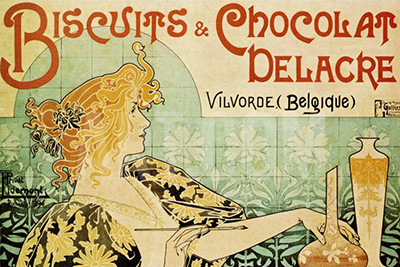
The 1896 Biscuits & Chocolat Delacre poster was designed by the Belgian artist Privat-Livemont (Privat Antoine Théodore Livemont, 1861–1936), not by Alphonse Mucha. The Brussels regional heritage inventory identifies the artist and transcribes the printed signature “Privat Livemont Bruxelles 1896”. A separate Flemish heritage dossier also attributes the Delacre lithograph to him. The old “Delcare” spelling and Mucha credit were errors that obscured the work's Belgian identity.
The poster's own wording anchors its commercial setting. The heading advertises “Biscuits & Chocolat Delacre” and gives “Vilvorde. (Belgique)”, the French spelling of Vilvoorde. Another inscription names the Brussels lithographic presses of J. L. Goffart. These are more useful identifying details than the resemblance between the flowing, decorative line of different Art Nouveau poster artists. The inventory catalogues its Schaerbeek-held sheet as a lithograph on paper, 55.6 by 81.2 centimetres, inventory number 1605. Those dimensions describe that particular surviving sheet, not a fixed measurement for every impression of the design.
The Royal Library of Belgium's federal catalogue separately records a Delacre poster by Livemont under shelfmark S.II 117730. It dates the Brussels lithograph to 1896 but gives no usable dimensions in its public description. The Schaerbeek inventory and the library catalogue thus identify separately held Delacre material with the same artist, title and year; their public text does not establish whether the sheets are identical impressions or variants. The measurements and inventory number on this page apply only to Schaerbeek's copy. The library entry also retains “Vilvorde (Belgique)” in its title, confirming that this locality was part of the poster's identity in another institutional record.
A third institutional publication identifies another surviving example: the King Baudouin Foundation’s 2012 Tables en majesté captions a 1896 Delacre advertisement by Privat-Livemont in Antwerp’s Letterenhuis. It supplies no sheet dimensions or inventory number there, so the caption establishes a further documented collection location without proving how that copy relates to the Schaerbeek and Royal Library sheets. A 2025 Arenberg sale catalogue, lot 349, describes yet another framed chromolithograph by Goffart, signed, dated and located on the stone. Its **54.3 × 80.2 cm visible area** and recorded edge damage belong to that offered object; a visible-area measurement cannot be substituted for Schaerbeek’s 55.6 × 81.2 cm sheet dimensions.
A painting scene instead of a product display
According to the inventory's detailed description, the horizontal composition shows a blonde young woman in profile painting a vase. Her flowered dress has full sleeves, while plant motifs repeat across the tiled background. The advertised biscuits and chocolate appear in the wording, but not as pictured goods. The woman is occupied in a cultivated domestic pastime rather than holding or eating the product. The relationship between image and advertisement therefore depends on association: a purchaser reads the brand above a scene of leisure and refined surroundings.
The Brussels catalogue interprets that choice as a way of giving Delacre's products the social associations of a prosperous bourgeois household. That is a reading of the poster's marketing strategy, not evidence that its audience reacted in one uniform way. The catalogue also describes Privat-Livemont as a colour lithographer who could produce varied tones with a limited number of colours, including stippled gradations. This craft context helps explain why the sheet belongs to the history of printed advertising as well as to Art Nouveau design. A poster could build a recognizable atmosphere through colour, patterned surfaces and figure drawing without illustrating the thing for sale.
A French critic writing in the 1897 Les Affiches étrangères illustrées called a Livemont advertisement for Chocolat Delacre an affiche d’intérieur, an indoor advertisement, and praised its drawing and subtle colour. The critic did not transcribe the full Biscuits & Chocolat heading or give measurements, so the exact relationship to the Schaerbeek-held sheet remains a textual identification question. The account is contemporary evidence of how a Delacre design was classified and received, not a surviving commission instruction or proof of every place where copies were displayed.
Delacre and Belgian poster culture
The same heritage entry identifies Charles Delacre as a Brussels pharmacist who promoted chocolate, became a royal supplier in 1879 and established a factory at Vilvoorde in 1880; biscuits later joined the range. Its short company history gives context for the geographic label printed on the 1896 poster. The heading names two product lines, while the design offers an aspirational setting for the brand. The Belgian location matters: the earlier version of this page treated the work as a Parisian Mucha commission, obscuring both the client and the designer documented by the local collection.
Privat-Livemont was active beyond this one advertisement. The Brussels inventory places his poster work mainly between 1890 and 1917 and records decorations for theatres, casinos, schools and private buildings, many of which have been lost. Its account describes a shift towards Art Nouveau around the period of the Delacre commission. A related Schaerbeek collection record lists other commercial subjects, including absinthe and lighting. The Delacre design is thus part of a documented Belgian practice, rather than an isolated work that needs a Mucha attribution to explain its style.
A French and Dutch account from the Schaerbeek municipal archives places the artist's first poster in 1890, for an exhibition of the local artists' circle, and names the Delacre advertisement alongside his 1896 designs for Absinthe Robette and Bec Auer. It also records that he began teaching drawing and decorative painting at Schaerbeek's new industrial school in 1891. This chronology places the Delacre commission within an established local career. His earlier period of study and decorative work in Paris explains a connection to French artistic networks, but the archive still identifies this poster and his workshop with Schaerbeek and Brussels.
Why the attribution matters
Mucha and Privat-Livemont both worked in a poster culture that used decorative women, plants and emphatic lettering. Such broad features can invite a mistaken attribution, especially when a reproduction circulates without its smaller inscriptions. Here the named signature, printer and Belgian address point to the specific commission. The Dutch-language Brussels record confirms the same identification as the French record; it is a translation of the same collection entry, not an independent second object. The Flemish heritage dossier supplies a separate attribution. Together they support correcting the old Mucha credit while leaving open the exact provenance of the reproduction used on this legacy page.
The comparison with Mucha was already contentious in Livemont’s lifetime. In the August–September 1898 issue of The Poster, Émile de Linge listed “Le Chocolat Delacre” among Livemont’s designs and rejected a claim that he merely imitated Mucha. De Linge reported having watched him design and transfer work onto lithographic stone himself. An editorial note nevertheless acknowledged a decorative resemblance and suggested Mucha’s greater popularity helped produce the follower label. These are period judgements about artistic independence, not a transfer of authorship: the signed Delacre sheet remains Livemont’s.
For readers comparing Art Nouveau advertising, the strongest approach is to follow each poster's printed evidence and collection record before comparing styles. This sheet belongs to Privat-Livemont's work for Delacre in Belgium in 1896. Similarity to a Mucha poster cannot override its documented signature and Belgian printing details.