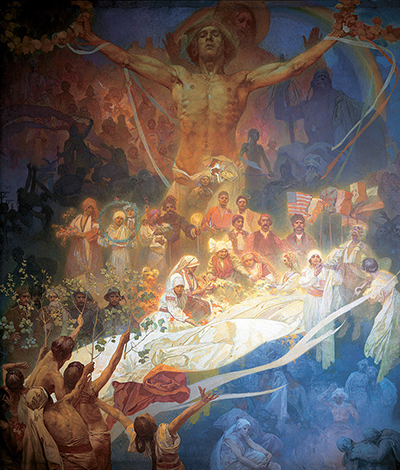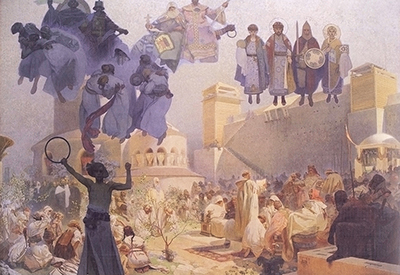
The Introduction of the Slavonic Liturgy (1912), the third canvas in Mucha’s Slav Epic.
Buy Art Prints Nowfrom Amazon
* As an Amazon Associate I earn from qualifying purchases.
 by Tom Gurney
Tom Gurney BSc (Hons) is an art history expert with over 20 years experience
Page Created on / Page Updated on
Email: tomgurney1@gmail.com / Phone: +44 7429 011000
The Introduction of the Slavonic Liturgy by Alphonse Mucha: Worship in a Mother Tongue
A broad gathering fills the lower half of Alphonse Mucha’s Introduction of the Slavonic Liturgy. A ruler listens at the right, a procession moves through the middle, and a dark young figure lifts a circle in the foreground. Above the courtyard, much larger figures hover against pale sky. This is the third canvas in Mucha’s twenty-work Slav Epic, where a ninth-century argument about worship in a Slavic language becomes both a public ceremony and a symbolic vision of cultural unity.[1][2]
The Mucha Foundation dates the finished painting to 1912. Its full title places the depicted subject in the ninth century AD. The central episode is Methodius’s return to Great Moravia after a journey to Rome, where, in Mucha’s telling, he secured approval for worship in Old Church Slavonic. The people and signs above the scene broaden that episode beyond one court and one moment.[1][2]
At a Glance
- ArtistAlphonse Mucha
- CycleThe Slav Epic, No. 3 of 20[1][4]
- Full catalogue titleIntroduction of the Slavonic Liturgy. Praise God in Your Mother Tongue (9th century AD)[1]
- Painting date1912[1]
- Mediumegg tempera on canvas[1]
- Dimensions610 × 810 cm, for the finished canvas[1]
- Related preparationstaged-model photograph for the canvas, 1911–12[3]
The third Epic canvas in Mucha’s career
Contents
- A court receives Methodius
- The language at stake
- The figures above the courtyard
- A young figure with a circle
- Preparing a monumental scene
- The third chapter of the Epic
A court receives Methodius
The scene on the ground is crowded, but its main action is directed toward the right. The Mucha Foundation identifies the enthroned figure there as Prince Svatopluk, listening while a priest reads a letter from the pope.[1] The Prague City Gallery describes the reader more specifically as a deacon and places the event in a Great Moravian courtyard. Its account says the letter confirms Methodius as archbishop and permits religious services in the local Slavic language.[2] Mucha turns a matter of religious authority into a visible public event.
To the left of centre, the Foundation identifies the bearded Methodius, supported by followers on his return from Rome.[1] He does not dominate the picture by size. Rather, the surrounding people, architecture and processional movement give his arrival importance. Mucha asks a viewer to track a message passing through a community: the traveller returns, the document is read, and the gathered listeners receive its consequences.
The Prague City Gallery adds a broader background to the episode. It describes the earlier mission of Constantine, later known as Cyril, and Methodius to Great Moravia, the development of writing and translation for Slavic-language Christian practice, and opposition from Latin-speaking church authorities.[2] These are the historical claims through which the Gallery explains Mucha’s chosen subject. The canvas itself is a later artist’s reconstruction, not a record made at the Moravian court. The distinction lets us read the picture closely without using it as proof of every detail in ninth-century ecclesiastical history.
Architecture helps give the ceremony a place. A rounded building rises in the middle distance, while walls and a gateway contain the gathering. The Prague City Gallery says Mucha based the rotunda on Saint George Church in Thessaloniki.[2] That reference adds a layer of artistic construction: he selected a visual model for a building within a scene set elsewhere. The court’s apparent solidity is the result of choices made in 1912.
The letter behind the ceremony is identifiable. A scholarly papal-document register records John VIII’s Industriae tuae, addressed to Svatopluk in June 880.[5] It reports that Methodius had come to Rome, that the pope confirmed his archbishopric, and that Wiching was consecrated bishop of Nitra. These are institutional decisions as well as a ruling about words of worship. Mucha compresses them into the single visible act of a document being read before the prince. The text is a firmer historical anchor for the painting’s subject than any attempt to identify the individual listeners in the painted crowd.
The Diocese of Nitra publishes a Slovak translation of the surviving letter. It says Methodius came to Rome with Zemežizeň, a man described as loyal to Svatopluk, and that the pope examined the archbishop's teaching before sending him back.[8] John VIII instructed Svatopluk to receive Methodius with honour; he also required Wiching, although chosen for Nitra, to obey the archbishop. The letter anticipated a further bishop who, with Methodius and Wiching, could help establish an enduring church hierarchy.[8] Thus the reader in Mucha's courtyard is conveying more than permission to use a language. The document sets out who could govern clergy and who would recognise that authority.
The scene also needs its earlier chronology. A later Vatican account places the brothers’ arrival in Great Moravia around 863, describes Constantine’s creation of a writing system for Slavonic translations, and says Rome had already approved Slavonic liturgical books under Hadrian II before Cyril died in 869.[6] The 880 letter was therefore a renewed decision in a contested mission, not the first instant anyone prayed or read scripture in Slavonic. That distinction matters to the title: “Introduction” is Mucha’s broad narrative label for a process that unfolded over years.
The language at stake
The subtitle, “Praise God in Your Mother Tongue,” tells readers what Mucha considered central. The story is not simply about an appointment to office. It is about whether Christian worship and religious texts could be heard and understood in a Slavic language. The Foundation credits Cyril and Methodius’s translations with an important role in the later survival of Slavic speech.[1] The Prague City Gallery places the papal letter and Methodius’s work amid resistance from bishops who favoured Latin liturgy.[2]
In the painted court, language has no easy physical shape. Mucha gives it one through the act of reading. A document is held before a ruler and an assembly; the words have a public audience. The gathered people make the issue collective. They are not shown as solitary scholars with books but as a community whose religious life may be affected by what is authorised. This is how the picture turns an abstract question about language into an event viewers can locate within a crowd.
The ninth-century story also had meaning for Mucha’s own project. The Foundation describes the Slav Epic as an effort to connect Slavic peoples through a history of shared trials, learning and hopes for peace.[4] The language of worship fits that plan because speech can mark belonging and carry culture across generations. A reader need not accept a single, uniform history of all Slavic peoples to see why Mucha chose this turning point for his Epic. It gives a public form to the idea that communities should be able to voice important beliefs in words they know.
The papal register makes the permission more exact than a simple exchange of Latin for Slavonic. It allows Slavonic in Mass and other offices, but specifies that the Gospel be read first in Latin and then in Slavonic in the churches of Svatopluk’s land; it also permits Latin Mass for the prince and his judges if they prefer it.[5] Worship in an understood language was authorised within a mixed practice. The ruler whom Mucha paints listening was not merely receiving a command to abandon Latin. This condition puts useful pressure on the subtitle’s ideal of the “mother tongue”: it was a powerful claim made within a negotiated church order.
In the Nitra translation, the pope defends that permission by appealing to scriptural praise in all languages, rather than limiting sacred speech to Hebrew, Greek and Latin.[8] This is a theological argument within the letter itself, not only a modern explanation placed upon it. The same text insists on Latin before the Slavonic Gospel for listeners who do not understand Latin. Read together, those provisions explain both the breadth and the boundary of the approval. Mucha's subtitle lifts out its inclusive principle; the historical document preserves the conditions under which the principle was expressed.[5][8]
Nor was Svatopluk’s court a simple, unanimous partner to Methodius. The Vatican’s historical account says the prince had opposed the Slavonic liturgy and questioned the archbishop’s orthodoxy before the 880 hearing.[6] Yet historian Teodor Kostov argues from the papal correspondence that Svatopluk may have supported Methodius at important moments; his 2026 study notes that Latin clergy complained about that support in 879.[9] The ruler's attitude is therefore a point of historical debate rather than a single settled hostility. A pope addressing a prince, confirming an archbishop and providing room for a Latin service was navigating competing people and practices. Mucha shows public reception and unity; the textual record points to a more conditional settlement. The contrast shows which part of a contentious story the artist selected as his emblem.
The writing system needs a similar distinction. Constantine’s early script was Glagolitic, according to the Cyril and Methodius Route’s scholarly survey; Cyrillic developed later in the Bulgarian sphere.[7] The papal register refers to Slavonic letters devised by Constantine without naming a modern alphabet.[5] The language in question was an early literary and liturgical Slavonic, not a claim that every present-day Slavic language was already the same or that Cyril personally designed the later Cyrillic script. Mucha’s image can speak about shared cultural origins while the textual history remains varied and regional.
The figures above the courtyard
The upper part of the painting does not read like a second row of court spectators. Its figures hover at a larger scale, separated from the action below. The Foundation describes rulers and families associated with the spread of Christianity in Slavic languages, including Boris of Bulgaria and Igor of Russia with their wives.[1] The Prague City Gallery names further figures in this symbolic assembly and interprets them as connections between Great Moravia, Bulgaria and Kievan Rus.[2] Their purpose is to widen the scope of one Moravian scene into a cross-regional story.
At upper left, a darker group contrasts with the pale figures on the right. The Prague City Gallery reads this area as an image of coercive Christianisation by the Franks, with a hooded Cyril below it protecting the Moravians from heaven.[2] That is an attributed iconographic interpretation. In the 400-pixel reproduction, individual identities in the sky are not securely readable by eye alone. What remains unmistakable is the contrast between turbulence and reassurance, and the way the hovering groups ask the viewer to look beyond the immediate ceremony.
Mucha combines court, procession and allegory rather than confining himself to one observed moment. The upper figures are not meant as people who physically occupied the courtyard during the letter’s reading. They visualise earlier pressures and later cultural reach. The composition therefore works across different kinds of time: a particular return, a longer struggle over religious language, and the legacy Mucha imagined for that language.[1][2]
The later reach was not guaranteed by this one approval. Methodius died in 885, and the Vatican’s retrospective account acknowledges that his followers faced persecution and had to leave their Moravian field.[6] A scholarly history of the Cyril and Methodius cultural route follows their work onward into Bulgarian centres of translation and education at Pliska–Preslav and Ohrid.[7] That movement helps explain why Mucha set later Slavic figures above the Moravian court: the legacy extended across regions, though by interruption and migration rather than by an unbroken, peaceful line from the 880 letter.
Even the papal letter survives through a history of copying. The Diocese of Nitra says the original document is lost and its text is known from an eleventh-century Monte Cassino copy now in the Vatican Apostolic Archive.[8] A document that anchors Mucha's scene is thus not a sheet available to us exactly as the Moravian court received it. Its recorded words remain valuable, but the pictured ceremony is a twentieth-century interpretation built upon a transmitted text. The distinction matters particularly here: Mucha makes the act of public reading seem immediate, while historians recover the decision through a later manuscript tradition.
A young figure with a circle
In the foreground, a dark youth raises a circular form while lifting the other arm. The Foundation interprets his clenched fist and circle as symbols of strength and unity among Slavic peoples.[1] The figure is close to the viewer and visually separate from the formal ceremony at right. He gives the subject an emblem that can be recognised even if the reader does not identify every participant in the court.
The circle also offers a shape the eye can follow. It echoes round forms in the upper figures and the curved architecture farther back. Those connections help bind the foreground, main scene and allegorical sky. The youth’s body is darker than the pale courtyard, which makes the gesture more forceful. This is Mucha’s symbolic addition to the historical episode, not a portrait of a named witness to Methodius’s return.
The emblem can be read alongside the document. The letter represents institutional permission; the youth represents the collective value Mucha attaches to it. A reader may question whether a single symbol can capture the varied experiences of different Slavic communities. The painting invites that question because it makes such a strong claim about unity. Close looking makes both the force of Mucha’s hope and its constructed nature visible.
Preparing a monumental scene
The Mucha Foundation catalogues a 1911–12 photograph of models posing as struggling figures for this canvas.[3] Its studio history describes Mucha’s practice of arranging costumed people and synthesising poses into large historical compositions. The photograph helps explain how active groups in the painting could be planned. It does not establish that every courtier or hovering figure was copied one for one from a single plate.
The finished painting is egg tempera on canvas and measures 610 × 810 cm.[1] At that scale, relationships between figures must remain intelligible from a distance as well as close up. Mucha uses broad zones: earthly crowd, formal court and raised symbolic presences. Within them, gestures carry the eye between Methodius, the reader, the ruler and the youth. The model photograph is a related research source, not another view of the painted object; its displayed image is not reproduced here.[1][3]
The third chapter of the Epic
The first canvas begins with a threatened couple, while the second gathers a festival beneath signs of later loss. This third scene shifts attention to language, worship and the public authority of words. All three canvases were finished in 1912, according to the Foundation, though their numbered order describes Mucha’s historical narrative rather than proving a month-by-month order of painting.[4]
The Slav Epic guide follows the remaining subjects, where speech, faith, printing and political action recur in different forms. Return to the young figure at the front of this painting after looking at the papal letter. Mucha has joined a specific decision in a court to a much larger claim about shared identity. The power of the scene lies in that leap; its limitation is that no one ceremony can tell the whole history of all the people it seeks to represent.[1][2][4]
Watch: Alphonse Mucha
Place Mucha’s Czech and Slavic projects beside his better known Paris work.
Prague’s Art Nouveau, Mucha, and the Slav Epic
A short view of Mucha’s Prague legacy and the Slav Epic cycle.
Watch on YouTubeArtworks directory
| Name | Date | Medium |
|---|---|---|
| 'Accept Love and Enthusiasm from Your Son, Mother of the Holy Nation': study for the mural 'By Own Strength III' at the Lord Mayor's Hall, Obecní Dům, Prague | 1910-1911 | Pencil and charcoal on canvas |
| 'By force towards freedom, with love towards unity!': study for the mural 'By Own Strength II' at the Lord Mayor's Hall, Obecní Dům, Prague | 1910-1911 | Pencil and charcoal on canvas |
| 'The Passing Wind Takes Youth Away': design for a fan and the façade of the 'Pavilion of Man' (unrealised) | 1899 | Colour lithograph |
| 'Through humiliated and tortured, you will live again, my country!': study for the mural 'By Own Strength II' at the Lord Mayor's Hall, Obecní Dům, Prague | 1910-1911 | Pencil and charcoal on canvas |
| 1918-1928: Poster for the 10th Anniversary of the Independence of the Republic of Czechoslovakia | 1928 | Colour lithograph |
| 6th Sokol Festival | 1912 | Colour lithograph |
| 8th Sokol Festival | 1925 | Colour lithograph |
| After the Battle of Grunwald | 1924 | egg tempera on canvas |
| After the Battle of Vitkov Hill | 1923 | egg tempera on canvas |
| Age of Love | 1936–1938 | |
| Age of Reason | 1936–1938 | |
| Age of Wisdom | 1936–1938 | |
| Amants | 1895 | Colour lithograph |
| Apotheosis of the Slavs | 1926 | Egg tempera on canvas |
| As Hamlet | 1899 | colour lithograph |
| Au Quartier Latin | 1898 | Magazine cover |
| Banknotes of Czechoslovakia, designed by Mucha: 500 crown; 50 Crown; 10 Crown | 1929 | Banknotes |
| Bieres de la Meuse | 1897 | Colour lithograph |
| Biscuits Champagne Lefevre Utile | 1896 | Colour lithograph |
| Biscuits Lefevre Utile | 1896 design for 1897 calendar; Foundation object/Carnavalet 1897 | Colour lithograph |
| Blessed are the Pure in Heart | 1906 | Printed magazine illustration |
| Bleu Deschamps | 1903 (deposit) | Colour lithograph |
| Bosnia & Herzegovina Pavilion - illustration featured in 'Le Figaro Illustré' (1 March 1900) | 1900 | Reproduction from Le Figaro Illustré after watercolour original |
| Bosnia-Herzegovina Pavilion: cartoon for the mural 'The Roman Period and the Arrival of the Slavs' | 1899-1900 | ink and crayon on paper |
| Bosnia-Herzegovina Pavilion: fragment of the upper frieze featuring Ivo and Anica, characters from Bosnian legends | 1899-1900 | tempera and watercolour on canvas |
| Bosnian Legends: Death of Hasanaga's Bride | 1899 | Charcoal on paper |
| Bosnian Legends: Murcia - The Plague Lady | 1899 | Charcoal on paper |
| Bosnian Pavilion Restaurant at the Paris Exhibition 1900: design for the menu | 1900 | Pencil and watercolour on paper |
| Boutique Fouquet (interior design) | 1901 | Shop interior design |
| Boutique Fouquet: sketches of the shop's signboard and decorative details | c.1900 | Pencil, ink and watercolour on paper |
| Box for Lefèvre-Utile biscuits: Gaufrettes Vanille | c.1900 | Tin box covered with lithographed label |
| Box for Lefèvre-Utile biscuits: Madère | c.1900 | Tin box covered with lithographed label |
| Brightness of the Day | 1899 | Colour lithograph |
| Broach with Pendant | 1900 | Gold, ivory, mother-of-pearl and semi-precious stones |
| Byzantine Head - The Blonde | 1897 | Colour lithograph |
| Byzantine Heads (pair) | 1897 | Colour lithograph |
| Byzantine Heads: Brunette | 1897 | Colour lithograph |
| Bénédictine | 1898 (BnF deposit); Hamburg 1899; MNAC 1896 or 1898 | Colour lithograph |
| Champagne Ruinart | 1896 | Colour lithograph |
| Chocolat Ideal | before or in 1897 (catalogue conflict) | Colour lithograph |
| Chocolat Masson (1897 calendar) | 1896–1897 | Colour lithograph |
| Choirboys at Petrov Church, Brno | 1905 | Watercolour on cardboard |
| Cloches de Noel | 1900 | Illustrated book |
| Comedy: study for a mural for the German Theatre, New York | 1908 | Oil on canvas |
| Cours Mucha: poster advertising Mucha's art classes held at the Académie Colarossi, Paris | 1900 | colour lithograph |
| Creative Force - Jan z Pernštýna: study for a pendentive of the Lord Mayor’s Hall, Obecní Dům, Prague | 1910-1911 | Oil on canvas |
| Crucifixion | c.1868 | Pencil, crayon and watercolour on paper |
| Cycles Perfecta | 1897 or 1902 (catalogue conflict) | Colour lithograph |
| Dance | 1898 | Colour lithograph |
| Dead Couple - Abandoned | c.1899-1900 | Charcoal and pastel on blue paper |
| Defense of Sziget against the Turks by Nicholas Zrinsky | 1914 | egg tempera on canvas |
| Design for a champagne poster | c. 1896 | Charcoal and pastel on paper |
| Design for a display stand at the Paris Exhibition 1900 | c.1899-1900 | Pencil and wash on paper |
| Design for Champagne Ruinart | c. 1896 | Pencil, watercolour and gold leaf on paper |
| Design for the cover of the magazine 'Fantaz' | 1882 | Ink and watercolour on paper |
| Design for the heading of the cover of the magazine 'Krokodil' | 1885 | Pen and ink on cardboard |
| Design for the poster for the Mucha Exhibition at the Brooklyn Museum, New York, January-February 1921 | 1920 | Pen and ink and watercolour on paper |
| Designs for cutlery | c.1900 | Charcoal and white on card |
| Designs for tableware | c.1900 | Charcoal, coloured pencil and white on card |
| Diadem for 'La princesse lointaine' | 1895 | metal and pearls |
| Diploma of Ivančice: Mock diploma honouring a local celebrity, with illustration of the first line of 'May', a poem by Karel Hynek Mácha | 1882 | Pen and ink and watercolour on paper |
| Documents décoratifs: designs for a watch and accessories (unused) | 1901-1902 | Pencil, ink and white on paper |
| Documents décoratifs: final study for Plate 25, featuring studies of lily | 1901-1902 | Pencil on paper |
| Documents décoratifs: final study for Plate 43 | 1901-1902 | Pencil, ink and wash, heightened with white on paper |
| Documents décoratifs: final study for Plate 49 | 1901-1902 | Pencil and white on paper |
| Documents décoratifs: final study for Plate 50 | 1901-1902 | Pencil and white on paper |
| Documents décoratifs: final study for Plate 60 | 1901-1902 | Pencil, ink and wash, heightened with white on paper |
| Documents décoratifs: final study for Plate 63 | 1901-1902 | Pencil and white on paper |
| Documents décoratifs: final study for Plate 67 | 1901-1902 | Pencil and white on paper |
| Documents décoratifs: final study for Plate 71 | 1901-1902 | Pencil and white on paper |
| Documents décoratifs: final study for Plate 72 | 1901-1902 | Pencil and wash, heightened with white on paper |
| Documents décoratifs: line drawing for Plate 33, featuring lily motifs | 1901-1902 | Pencil, pen and ink on paper |
| Documents décoratifs: Plate 54 | 1902 | Lithograph |
| Dreaming of Freedom: study for a Panel of the Small Reception Room at the Lord Mayor’s Hall, Obecní Dům, Prague | 1910-1911 | Pen and ink and watercolour on paper |
| Dusk | 1899 | Colour lithograph |
| Evening | 1899 | Colour lithograph |
| F. Champenois (Rêverie imprint) | 1898 | Colour lithograph |
| F. Guillot-Pelletier calendar (1898) | 1897–1898 | Colour lithograph |
| Feather | 1899 | Colour lithograph |
| Figures décoratives: final study for Plate 2 | 1904-1905 | Pencil and white on paper |
| Figures décoratives: final study for Plate 3 | 1904-1905 | Pencil and white on paper |
| Figures décoratives: final study for Plate14 | 1904-1905 | Pencil with white on paper |
| Figures décoratives: sketch study for Plate14 | 1904-1905 | Blue pencil on paper |
| Flirt Lefevre Utile | 1899 (Foundation design); BnF legal deposit 1900 | Colour lithograph |
| Flower | 1897 | Colour lithograph |
| Flower: final study for decorative panel | 1897 | Pencil, ink and watercolour on paper |
| France Embraces Bohemia | 1918 | oil on canvas |
| Fruit | 1897 | Colour lithograph |
| Georges Fouquet (1858-1929), Paris, after design by Mucha: Ornamental Chain with pendants | 1900 | Gold, enamel, fresh-water pearls, mother of pearl and semi-precious stones |
| Georges Fouquet (1858-1929), Paris, after Mucha design: 'Peacock' Ring (Exhibited at the Paris Exhibition 1900) | 1900 | Opal and gold |
| Girl Weeping | c.1899-1900 | Black chalk and pastel on paper |
| Girl with Loose Hair and Tulips | 1920 | Oil on canvas |
| Gismonda | 1894 | Colour lithograph |
| Head of a Girl, statue for the stand of the Houbigant Perfumery at the Paris Exhibition 1900 | 1900 | Bronze, silver and parcel gilt |
| Head of Sarah Bernhardt: Study for 'Lorenzaccio' | 1896 | Pencil on paper |
| Heather from Coastal Cliffs | 1902 | Colour lithograph |
| Heidsieck & Co | 1901 | Colour lithograph |
| Holy Mount Athos | 1926 | Egg tempera on canvas |
| Ilsée, Princesse de Tripoli | 1897 | Illustrated book |
| In the Desert: Study for an illustration for the Světozor magazine | 1889 | Pencil, watercolour and gouache on paper |
| Incantation (Salammbô) | 1897 | Lithograph |
| Independence - Jiří z Poděbrad: study for a pendentive of the Lord Mayor’s Hall, Obecní Dům, Prague | 1910-1911 | Oil on canvas |
| Interior and furniture designs | c.1900 | Pencil on paper |
| Interior of Boutique Fouquet: design for a wall-mounted display cabinet with statuette and mirror | c.1900 | Pencil on paper |
| Interior of Boutique Fouquet: design for the fireplace with statuettes, mirror, and the ornamental details of the wall | c.1900 | Pencil and watercolour on cardboard |
| Interior of Boutique Fouquet: sketches of the fireplace with statue, mirror, display cabinet, and the ornamental details of the wall | c.1900 | Pencil, pen and ink on paper |
| Ivy | 1901 | Colour lithograph |
| Jan Milic of Kromeriz | 1916 | egg tempera on canvas |
| Jaroslava and Jiří, the Artist’s Children | 1918 | Oil on canvas |
| JOB poster | 1896 | Colour lithograph |
| Judgement of Paris (calendar for Vieillemard printing company) | 1895 | Colour lithograph |
| Justice - Master Jan Hus: study for a pendentive of the Lord Mayor's Hall, Obecní dům, Prague | 1910-1911 | Oil on canvas |
| L'Annee Qui Vient | 1897 | red chalk on paper |
| L'Illustration magazine - cover for Christmas 1896/1897 | 1896 | Magazine cover |
| L'Illustré Soleil du Dimanche | 1897 | Magazine cover |
| La Dame aux Camélias: designs for cover and interior of special programme | 1896 | Pencil and watercolour on paper |
| La Nature | 1899-1900 | Bronze and amethyst |
| La Plume | 1897 | Magazine cover |
| La Samaritaine | 1897 | colour lithograph |
| Lance Parfum Rodo | 1896; Albertina print c. 1900 | Colour lithograph |
| Laurel | 1901 | Colour lithograph |
| Le Monde Illustré | 1900 | Magazine cover |
| Le Pater | 1899 | Illustrated book |
| Le Pater: early study for the 1st allegorical scene 'Our Father who art in Heaven' (1899) (Mucha Foundation object 300) | 1899 | Pencil on paper |
| Le Pater: early study for the 1st allegorical scene 'Our Father who art in Heaven' (1899) (Mucha Foundation object 302) | 1899 | Pastel on paper |
| Le Pater: study for the 6th allegorical scene 'Forgive us our debts, as we forgive our debtors' | 1899 | Charcoal and ink wash on paper |
| Lefevre Utile | 1904 | Advertisement |
| Leslie Carter | 1908 | Colour lithograph |
| Letem Českým Světem | 1898 | Printed book |
| Lorenzaccio | 1896 | Colour lithograph |
| Luchon poster (attributed to Mucha) | 1895 | Colour lithograph |
| Madonna of the Lilies | 1905 | Tempera on canvas |
| Master Jan Hus Preaching at the Bethlehem Chapel | 1916 | egg tempera on canvas |
| Maude Adams | 1908 | Lithograph, hand-coloured in watercolour and gouache |
| Maude Adams as Joan of Arc | 1909 | Oil on canvas |
| Medea | 1898 | Colour lithograph |
| Menu for the Bosnian Pavilion Restaurant at the Paris Exhibition 1900 | 1900 | Colour lithograph |
| Militancy - Jan Žižka: study for a pendentive of the Lord Mayor's Hall, Obecní dům, Prague | 1910-1911 | Oil on canvas |
| Military Camp in Winter, near a City on Fire | c.1899-1900 | Pastel on paper |
| Moet et Chandon | 1899 | Colour lithograph |
| Monaco Monte Carlo | 1897 | Colour lithograph |
| Moon | 1902 | |
| Moravian Teachers' Choir | 1911 | Colour lithograph |
| Morning Alphonse Mucha Painting / AlphonseMucha.org | 1899 | Colour lithograph |
| Morning Star | 1902 | Colour lithograph |
| Moët & Chandon White Star | 1899 | Colour lithograph |
| Mrs Mucha’s Necklace | 1906 | gold, enamel and semi-precious stones |
| Mural for the Bosnia-Herzegovina Pavilion: The Roman Period and the Arrival of the Slavs | 1900 | tempera and watercolour on canvas |
| Murals by Mucha in the Lord Mayor's Hall, Obecní Dům (Municipal House), Prague (1910-1911) | ||
| Music | 1898 | Colour lithograph |
| Nativity | c. 1934 | oil on canvas |
| Nestle's Food for Infants | 1897 | Colour lithograph |
| Night | 1899 | Colour lithograph |
| Nude on a Rock | 1898-1899 | Bronze |
| Official Banquet of the Paris Exhibition 1900: design for the menu featuring a fashionable woman wearing a Mucha-style jewellery | 1900 | Pencil, gouache and wash on grey paper |
| Ornamental motifs designed for 'Combinaisons Ornementales se Multipliant à l'Infini à l'Aide du Miroir' (1901) | c.1900-1901 | Blue and red pencil on paper |
| Packaging for 'Savon Mucha Violette' | 1906 | Colour lithograph |
| Packaging for Lefèvre-Utile biscuits: Boudoir | 1901 | Colour lithograph |
| Page's Costume: study for an illustration for 'Le Costume au Théâtre' | 1890 | Pencil and watercolour on cardboard |
| Painting | 1898 | Colour lithograph |
| Peonies | 1897–1898 | Ink and watercolour |
| Petr Chelcicky at Vodnany | 1918 | egg tempera on canvas |
| Poetry | 1898 | Colour lithograph |
| Portrait of Jaroslava | c.1927-1935 | Oil on canvas |
| Portrait of Josephine Crane Bradley as Slavia | 1908 | Oil and tempera on canvas |
| Portrait of Marie Chytilová (Maruška), Mucha's Future Wife | 1903 | pastel on paper |
| Portrait of Mucha's Sister, Angela | c.1880 | Oil on canvas |
| Portrait of Mucha's Sister, Anna | c.1885 | Oil on canvas |
| Portrait of Mucha's Son, Jiří | 1925 | Oil on canvas |
| Portrait of Mucha's Wife, Maruška | 1908/17 | Oil on canvas |
| Portrait of Woman | c. mid 1910s - 1925 | Blue pastel on grey paper |
| Poster for 'Hommage Respectueux de Nestlé' (the Nestlé Company's tribute to Queen Victoria's 60th Jubilee) | 1897 | Colour lithograph |
| Poster for 'Imprimerie Cassan Fils' | 1896 | Colour lithograph |
| JOB poster (1898) | 1898 | Colour lithograph |
| Poster for 'La Dame aux Camélias' | 1896 | Colour lithograph |
| Poster for 'La Tosca' | 1899 | Colour lithograph |
| Poster for 'Regional Exhibition at Ivančice 1913' | 1912 | Colour lithograph |
| Poster for 'The Slav Epic Exhibition, Brno, 1930' | 1928-1930 | Colour lithograph |
| Poster for 'Waverley Cycles' | 1898 | Colour lithograph |
| Poster for the 'Lottery of the Union of Southwestern Moravia' | 1912 | Colour lithograph |
| Poster for the Austrian Pavilion at the Paris Exhibition 1900 | 1900 | Colour lithograph |
| Prague Subjugated: study for a Panel of the Small Reception Room at the Lord Mayor’s Hall, Obecní Dům, Prague | 1910-1911 | Pen and ink and watercolour on paper |
| Primrose | 1899 | Colour lithograph |
| Primrose and Feather (paired image) | 1899 | Colour lithographs (paired image) |
| Princess Hyacinth (Princezna Hyacinta) | 1911 | Colour lithograph |
| Print proof for the Biscuits Lefèvre-Utile tin | 1899 | Lithograph |
| Reverie | 1898 | Colour lithograph |
| Russia Restituenda [Russia Must Recover] | 1922 | Colour lithograph |
| Salome | 1897 | Colour lithograph |
| Salon des Cent | 1896 | Colour lithograph |
| Salon of the Hundred | 1897 | Colour lithograph |
| Sarah Bernhardt - La Princesse Lointaine - Lefevre Utile | 1903 | Colour lithograph |
| Sarah Bernhardt as La Princesse Lointaine: poster for 'La Plume' magazine | 1897 | Colour lithograph |
| Sarah Bernhardt in the role of the Duc de Reichstadt in L’Aiglon | 1900 | Pencil on paper |
| Sarah Bernhardt: study of her full-standing figure | c.1896 | Pen and ink on paper |
| Savonnerie de Bagnolet calendar | 1898 (calendar) | Printed advertising calendar |
| Self-portrait (1899) | 1899 | Oil on board |
| Self-portrait (1907) | 1907 | Blue and white crayon on blue Ingres paper |
| Self-portrait, sketching in his apartment, Paris | late 1880s | oil on canvas |
| Sketches of flowers for Documents décoratifs | c.1900-1901 | Pen and ink on paper |
| Slavia insurance poster | 1907 | Poster |
| Slavs in their Original Homeland | 1912 | Egg tempera on canvas |
| Snake Bracelet with a Ring | 1899 | Gold, enamel, opal, ruby and diamond |
| Société Populaire des Beaux Arts | 1897 | Colour lithograph |
| Song of Bohemia | 1918 | oil on canvas |
| St. Vitus Cathedral Stained-glass Window, Prague: final design for the central panels, featuring SS Cyril and Methodius | 1931 | Ink and watercolour on paper |
| St. Vitus Cathedral Stained-glass Window, Prague: final design for the central panels, featuring St. Ludmila | 1931 | Ink and watercolour on paper |
| St. Vitus Cathedral Stained-glass Window, Prague: final design for the central panels, featuring St. Wenceslas (Duke of Bohemia) kneeling next to his Grandmother, St. Ludmila | 1931 | Ink and watercolour on paper |
| St.Vitus Cathedral Stained-glass Window, Prague: final design for the bottom left panels | 1931 | Ink and watercolour on paper |
| St.Vitus Cathedral Stained-glass Window, Prague: final design for the bottom right panels | 1931 | Ink and watercolour on paper |
| Stained-glass Window designed by Mucha at St. Vitus Cathedral, Prague | Early 1930s | N/A |
| Study for 'The Age of Reason' | 1936-1938 | Pencil and watercolour on paper |
| Study for 'The Slav Epic cycle' No.19: The Abolition of Serfdom in Russia | 1913-1914 | Watercolour and gouache on paper |
| Study for 'The Slav Epic' cycle No.14: The Sacrifice at Szigetvár by Nikola Zrinski | c.1913-1914 | Photographed drawings stuck together, tinted with watercolour and gouache |
| Study for 'The Slav Epic' cycle No.17: The Holy Mount Athos (1926) | c.1925-26 | Charcoal heightened with white on cardboard |
| Study for 'The Slav Epic' cycle No.18: The Oath of Omladina under the Slavic Linden Tree | c.1925-1926 | Pencil and watercolour on paper |
| Study for 'The Slav Epic' cycle No.1: The Slavs in Their Original Homeland (1912) | c.1910-1912 | Oil on canvas |
| Study for 'The Slav Epic' cycle No.2: The Celebration of Svantovít | c.1910-1912 | Oil on canvas |
| Study for 'The Slav Epic' cycle No.7: Jan Milíč of Kroměříž | c.1915-1916 | Oil on canvas |
| Study for 'The Slav Epic' cycle No.9: Master Jan Hus Preaching at the Bethlehem Chapel. The Magic of the Word: Truth Prevails (1412). | c.1915-1916 | Oil on canvas |
| Study for 'The Three Ages' triptych: Reason, Wisdom and Love [unfinished project] | 1936-1938 | Pencil and watercolour on paper |
| Study for 'Woman in the Wilderness' (c. 1922-1923) (Mucha Foundation object 315) | c. 1922-1923 | oil on canvas |
| Study for 'Woman in the Wilderness' (c. 1922-1923) (Mucha Foundation object 316) | c. 1922-1923 | oil on canvas |
| Study for Savon Notre Dame | c. 1896 | pencil and watercolour on paper |
| Study for the poster 'Russia Restituenda [Russia Must Recover]' | 1922 | Pen and ink and watercolour on paper |
| Study of a Male Nude | 1885-1887 | Oil on canvas |
| The Abolition of Serfdom in Russia | 1914 | Egg tempera on canvas |
| The Arts (series) | 1898 | Colour lithograph |
| The Arts: study for 'Dance' | 1898 | Pencil and watercolour on paper |
| The Arts: study for 'Music' | 1898 | Pencil and watercolour on paper |
| The Arts: study for 'Painting' | 1898 | Pencil and watercolour on paper |
| The Arts: study for 'Poetry' | 1898 | Pencil and watercolour on paper |
| The Bohemian King Premysl Otakar II | 1924 | egg tempera on canvas |
| The Bulgarian Tsar Simeon | 1923 | egg tempera on canvas |
| The Burr McIntosh Monthly, 1907 | 1907 | Magazine cover |
| The Celebration of Svantovit | 1912 | egg tempera on canvas |
| The Coronation of the Serbian Tsar Stefan Dusan as East Roman Emperor | 1923 | egg tempera on canvas |
| The Devil and Mr Twardowsky: study for an illustration for 'The Tale of Pan Twardowsky' (a variation of 'Faust') | c.1887-1888 | Charcoal on paper |
| The Flowers (series) | 1898 | Colour lithographs |
| The Flowers: Carnation | 1898 | Colour lithograph |
| The Flowers: Iris | 1898 | Colour lithograph |
| The Flowers: Lily | 1898 | Colour lithograph |
| The Flowers: Rose | 1898 | Colour lithograph |
| The Hussite King Jiri of Podebrady | 1923 | Egg tempera on canvas |
| The Introduction of the Slavonic Liturgy | 1912 | egg tempera on canvas |
| The Last Days of Jan Amos Komensky (Comenius) in Naarden | 1918 | Egg tempera on canvas |
| The Light of Hope | 1933 | Oil on canvas |
| The Meeting at Krizky | 1916 | egg tempera on canvas |
| The Months (January-June) | 1899 | Colour lithograph |
| The Months (July-December) | 1899 | Colour lithograph |
| The Moon and the Stars (four-panel montage) | 1902 | Colour lithographs (four-panel montage) |
| The Moon and the Stars (series) | 1902 | Colour lithograph |
| The Moon and the Stars: study for 'The Evening Star' | 1902 | Ink and watercolour on paper |
| The Moon and the Stars: study for 'The Pole Star' | 1902 | Ink and watercolour on paper |
| The New York Daily News art supplement | 1904 | Printed art supplement |
| The Oath of Concord of the Slavs (unfinished) | 1939 | oil on canvas |
| The Oath of Omladina under the Slavic Linden Tree | 1926, unfinished | Egg tempera on canvas |
| The Precious Stones (four-panel montage) | 1900 | Colour lithographs (four-panel montage) |
| The Precious Stones (series) | 1900 | Colour lithograph |
| The Precious Stones: Amethyst | 1900 | Colour lithograph |
| The Precious Stones: Emerald | 1900 | Colour lithograph |
| The Precious Stones: Ruby | 1900 | Colour lithograph |
| The Printing of the Bible of Kralice in Ivancice | 1914 | egg tempera on canvas |
| The Seasons (series) | 1896 | Colour lithograph |
| The Seasons (series) (1900) | 1900 | Colour lithograph |
| The Seasons (variation in screen format) | 1896 | Colour lithograph |
| The Seasons: Autumn (1896) | 1896 | Colour lithograph |
| The Seasons: Autumn (1900) | 1900 | Colour lithograph |
| The Seasons: Spring | 1900 | Colour lithograph |
| The Seasons: Spring (1896) | 1896 | Colour lithograph |
| The Seasons: Summer | 1900 | Colour lithograph |
| The Seasons: Summer (1896) | 1896 | Colour lithograph |
| The Seasons: Winter | 1900 | Colour lithograph |
| The Seasons: Winter (1896) | 1896 | Colour lithograph |
| The Slavonic Concord: study for the ceiling painting for the Lord Mayor's Hall, Obecní Dům, Prague | 1910-1911 | Oil on canvas |
| The Threat | 1912 | Colour lithograph |
| The Times of the Day (series) | 1899 | Colour lithograph |
| The West End Review | 1897 (Foundation); 1898 promotional cover | Colour lithograph |
| Thistle from the Sands | 1902 | Colour lithograph |
| Théâtre de la Renaissance: design for poster advertising Sarah Bernhardt's theatre | c.1895 | Pen and ink on paper |
| Tin for Lefèvre-Utile biscuits | 1899 | Circular tin with lid and handle; colour print on metal |
| Topaz | 1900 | Colour lithograph |
| Tragedy - study for a mural for the German theatre New York | 1908 | Oil and tempera on canvas |
| Trappistine Liquors | 1897 | colour lithograph |
| Wiener Chic | 1905 | Magazine cover |
| Woman in the Wilderness | 1923 | Oil on canvas |
| Woman masked in white head-scarf - study for the illustration of the Bosnia & Herzegovina Pavilion featured in 'Le Figaro Illustré' (1 March 1900) | 1899 | Pencil and wash heightened with white on paper |
| Woman with a Daisy - textile designed by Mucha | 1900 | Printed upholstery fabric |
| Zdenka Cerny | 1913 | Colour lithograph |
| Zodiac (La Plume calendar) | 1896–97 | Colour lithograph |
| Zodiac (textless decorative panel) | 1896 | Colour lithograph |
| ‘At the sight of the two storks the owl rose.’ Study for an illustration for Contes de Grand-mères | 1891 | Watercolour and gouache on paper |
Frequently Asked Questions
When was The Introduction of the Slavonic Liturgy painted?
Who is the bearded figure returning to the court?
What does the youth in the foreground symbolise?
Discussion
This third Epic canvas turns a question of worship in a Slavic language into a public court scene.
The hovering figures and foreground youth broaden the event into Mucha’s symbolic history.
Reader Insights
Where does your eye go first: the reader, Methodius, Svatopluk or the foreground youth?
How do the figures above change your reading of the courtyard below?
What does the raised circle add to the question of language in the painting?
Join the Conversation
Share what you notice about the court scene, upper allegory and public use of words.
References
- Mucha Foundation, “The Slav Epic cycle No. 3: Introduction of the Slavonic Liturgy,” object 213, finished-canvas identity, date, medium, dimensions and iconography. View source.
- Prague City Gallery, “Introduction of the Slavonic Liturgy,” collection interpretation presented through Google Arts & Culture. View source.
- Mucha Foundation, “Models posing as struggling figures for The Introduction of the Slavonic Liturgy,” object 186, 1911–12 staged photograph and studio-method context. View source.
- Mucha Foundation, “Slav Epic,” cycle overview, 1912 first-three chronology and stated purpose. View source.
- Papal Documents of the Early and High Middle Ages, register entry for John VIII’s Industriae tuae (June 880), summarising the addressee, Methodius’s confirmation, Wiching’s appointment and the Latin-first Gospel condition. View source.
- John Paul II, Slavorum Apostoli (1985), sections 5–7, Vatican account of the mission’s earlier chronology, Svatopluk’s opposition, the 880 letter and the crisis after Methodius’s death. View source.
- Cyril and Methodius Route, Scholarly Basis (2021), historical survey of Methodius’s later years and the disciples’ movement into Bulgarian literary centres, pp. 14–16. Read source.
- Diocese of Nitra, Slovak translation and account of the transmission of John VIII's Industriae tuae, including the eleventh-century Monte Cassino copy, the church hierarchy and the language provisions. Read source.
- Teodor Kostov, “On Svatopluk’s Attitude Towards St. Methodius and His Disciples in Moravia (870–886),” Tereni 11 (2025), published 2026, abstract and bibliographic record; challenges a uniformly hostile account of Svatopluk's stance. Read source.