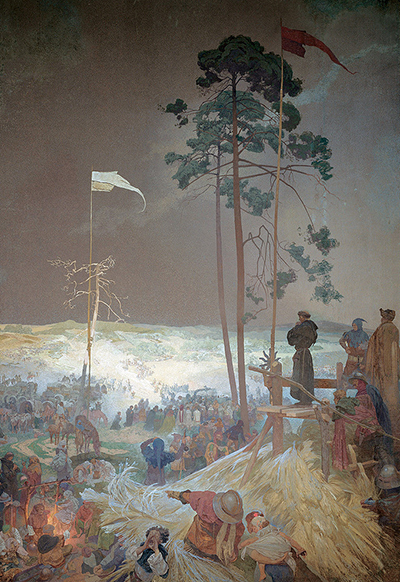
The Meeting at Křížky (1916), No. 10 in the Mucha Foundation’s individual Slav Epic catalogue.
Buy Art Prints Nowfrom Amazon
* As an Amazon Associate I earn from qualifying purchases.
 by Tom Gurney
Tom Gurney BSc (Hons) is an art history expert with over 20 years experience
Page Created on / Page Updated on
Email: tomgurney1@gmail.com / Phone: +44 7429 011000
The Meeting at Křížky by Alphonse Mucha: A Gathering Before War
Under a black-green sky, two tall trees divide a hillside. One is bare and carries a white flag; the other is alive and carries a red one. Far beyond them, a crowd gathers in a strip of light. Closer to us, people rest, work and listen while a preacher stands above a thatched roof. Alphonse Mucha called this scene The Meeting at Křížky, part of his Slav Epic. The Foundation's individual catalogue lists it as No. 10 and dates the finished canvas to 1916. The meeting it imagines took place on 30 September 1419.[1][2]
This is a picture of an assembly becoming a movement. Its people are not yet shown in battle. They share food and faith, arrive from different places and hear a call to defend their beliefs. Mucha places that human activity beneath a threatening sky, allowing devotional gathering and the approach of armed conflict to exist in the same image.[1][2]
At a Glance
- ArtistAlphonse Mucha
- CycleThe Slav Epic, No. 10 of 20 in the Foundation's individual object catalogue[1]
- Foundation titleThe Meeting at Křížky. The Magic of Words: Sub utraque (1419)[1]
- Painting date1916[1]
- Mediumegg tempera on canvas[1]
- Dimensions620 × 405 cm, for the finished canvas[1]
- Depicted eventa gathering at Křížky, south of Prague, on 30 September 1419[1][2]
The tenth Epic canvas in Mucha’s career
Contents
- Why Křížky mattered
- Why worship moved onto hills
- Two trees, two flags
- Communion and ordinary work
- Koranda before the call for swords
- Koranda above the roof
- What the chronicles can establish
- Painted in 1916
- Looking again
Why Křížky mattered
The Foundation places this gathering among the events that followed Jan Hus's execution. His followers met beyond Prague as religious opposition grew, and a radical preacher, Václav Koranda, urged them to defend their faith.[1] The Prague City Gallery gives the date and place more precisely: 30 September 1419 on the height called Na Křížkách, near Jesenice to the south of Prague.[2] A Czech site history places the hill near Sulice and Ládví, on the old route toward Prague; the height is also known as Mandava.[5][7] These names locate Mucha's subject in a real landscape, without claiming that his arranged trees, flags and weather are a topographical record.
The gathering was part of a sequence of “pilgrimages to the hills”, rather than an isolated origin point. The Gallery describes earlier meetings at Hradiště, Beránek and Oreb and a declaration associated with the Bzí gathering about two weeks before Křížky.[2] A Czech local history of the Reformation likewise describes Křížky as a meeting called in advance for 30 September, drawing participants from Prague, Pilsen and elsewhere.[7] Mucha collapses that continuing movement into one hillside assembly.
In the preceding Jan Hus canvas, the reformer speaks inside Bethlehem Chapel in 1412. Here Hus is absent, but words are still central. Koranda stands on a makeshift platform above the camp. The Foundation describes followers arriving toward him; the Gallery identifies pilgrims already gathered below.[1][2] These are different stages of the movement, separated by Hus's death in 1415 and by a change from chapel sermon to hillside assembly. Mucha uses the two scenes to suggest that speech can outlive a speaker.
The picture does not establish that every person on the hill had the same motive. Some may have come for worship, others for fellowship or for a more confrontational cause. Those inner reasons are not visible. What Mucha makes visible is a crowd with shared signs and a preacher addressing it at a moment when religious dissent could become military action.[1][2]
That last phrase matters: could become, not had already become. The Gallery describes armed participants, but historian Petr Čornej describes the 30 September assembly itself as peaceful despite Koranda's militant tone.[2][5] He records that participants collected money to compensate a farmer whose field had been trampled, and that people went on toward Prague with sticks and burning candles, honouring the host carried by a priest.[5] The detail does not make the movement politically harmless. It shows the distance between a call to bring swords next time and the conduct of this particular meeting.
Why worship moved onto hills
The chalice in Mucha's subtitle names a practice with a history before this meeting. In the introduction to his edition of Laurence of Březová's Hussite Chronicle, historian Thomas A. Fudge distinguishes Hus's preaching from the later introduction of communion in both kinds by Jakoubek of Stříbro in late 1414. Hus became a central symbol for the movement, but he did not himself celebrate the lay chalice.[10] That distinction matters here: the hillside worship in 1419 was a development of reform after Hus, not a direct restaging of one of his services.
Fudge explains that the chalice was a recurring concern of the early movement; the Koranda congregation's history says priests denied communion in both kinds in some churches.[10][11] An outdoor gathering could therefore do religious work that participants could not perform in their usual parish setting. People had to travel, find space for a large group, hear preaching and receive the sacrament. Mucha shows the result as a temporary camp with a communion table and household tasks. The painting turns a doctrinal dispute into a visibly organised community rather than leaving sub utraque as an untranslated motto.[2][10]
Fudge also discusses the importance of mountains in biblical accounts of revelation and in some early Hussite expectations of a transformed age.[10] Křížky was one of several hills used for assembly; its significance was therefore more than convenient open ground. This does not prove that every pilgrim read the hill in the same symbolic way, or that Mucha borrowed a particular passage of scripture. It does help explain the artist's decision to put Koranda's words high above a wide gathering, beneath a sky that seems to carry more than ordinary weather.
The same scholarship cautions against treating that community as one party with one settled programme. Fudge notes that early reformers differed in their expectations of religious and social change, and that Laurence's chronicle uses the name “Hussite” less often than modern accounts do.[10] “Pilgrims,” “supporters of Hus” and “defenders of the lay chalice” can each describe part of the scene, but no one label proves what every participant thought. Mucha's broad crowd makes a collective story; the historical movement held different voices within it.
Two trees, two flags
The most striking shapes are not people but trees. On the left, a dead trunk holds a pale flag over the bright distant gathering. On the right, a green pine rises beside a red flag. The Gallery reads the dead tree and white flag as signs of war and death, and the living tree and red flag as signs of life.[2] Mucha uses this contrast to frame the crowd between opposed possibilities.
The reading is suggestive rather than a key that fixes every detail. A viewer can first see how the trees divide the vertical space. Bare branches scratch across the left sky, while the fuller pine carries the eye upward on the right. The flags make those tall forms seem like signals. The field of light between them pulls us toward arriving people, but the dark upper sky denies the comfort of an uncomplicated dawn.
The Gallery describes lightning and ominous weather as signs of recent political upheaval and coming war.[2] The Foundation similarly says the dark sky foretells devastation in the Hussite Wars.[1] Mucha uses weather as an argument about historical direction. The storm is not a measured forecast for the exact hour at Křížky; it is a visual way to make a 1916 viewer feel the danger attached to this 1419 gathering.
The contrast between painted foreboding and recorded conduct is one reason the work is more than a literal scene report. Čornej's account places actual armed mobilisation later. The 1980 Czech edition of the Old Czech Annals says the Křížky pilgrims at first carried sticks, then records the planned 10 November meeting and an armed journey from the Pilsen area.[6] The source is itself a later edited chronicle, not a film of either day, but it preserves a meaningful sequence: worship and warning at Křížky, an armed march after it. Mucha's storm makes the second phase feel present before it arrives.
Communion and ordinary work
The Gallery identifies people taking communion at a long table beneath the pines. It also describes others tending horses, washing clothes and preparing food.[2] These activities give the assembly a temporary-camp character. Participants have brought the needs of daily life with them; a movement is being sustained by more than speeches and flags.
Mucha's subtitle includes “Sub utraque,” a Latin phrase associated with communion in both kinds—bread and wine offered to lay participants. The National Museum describes this practice as central to Utraquist worship.[3] The Gallery points to a chalice at the gathering, later an emblem of religious opposition.[2] In the painting, communal religious practice and the practical work of a travelling crowd occupy the same terrain.
That mixture changes the tone of the image. A viewer may notice the threatening sky first, but the closest people are not all armed figures poised to charge. They crouch, converse, prepare and wait. These ordinary actions do not erase the call to arms identified in the sources; they show how such a call reached a real social gathering rather than an abstract army.[1][2]
The edited annals add another human scale to that gathering. They describe men and women travelling with Koranda from Pilsen, their procession being forced around Rokycany by opponents, and a mounted participant at Křížky urging the crowd to pay for the damaged crop.[6] Those details should not be hunted for as tiny portraits within Mucha's canvas. They explain what a later record remembered about participation, travel and communal discipline—matters the painting expresses more generally through its camp and moving crowds.
Koranda before the call for swords
Koranda's position on the platform had a history before September 1419. A Czech Protestant congregation named for him records that he was already giving communion in both kinds at Pilsen by late 1416. Its account places him among preachers who sought clearer public preaching, simpler worship and reform measured against scripture.[11] This is a denominational remembrance of one of its namesakes, so it is most useful for explaining the movement's stated religious aims, not for reconstructing every word Koranda spoke on Mucha's hill.
The congregation's history also links him to the earlier meeting at Bzí. It describes a manifesto there calling for free and intelligible preaching, communion in both kinds and correction of wrongdoing across social ranks.[11] These were claims about worship and public order, not merely a plan for weaponry. The later Four Articles of Prague developed related demands, but their formulation in 1420 should not be projected back onto the Křížky crowd as if a finished constitution lay on Koranda's makeshift pulpit.[10][11]
In the painting, speech seems to travel from one raised figure across a whole landscape. The written record is narrower. The congregation notes that Koranda left no substantial literary work through which to hear his voice directly.[11] Čornej's account and the edited annals report the sword warning, but they do not supply a complete sermon.[5][6] Mucha's title, “The Magic of Words,” gives the preacher a power that the picture can express more completely than the surviving text can document. Its open-air audience is central to that effect.
Koranda above the roof
The preacher stands at the right on a rough wooden platform above thatch. The Foundation calls it a makeshift pulpit and says Koranda urged Hus's followers to take up arms.[1] The Gallery identifies him by name as Václav Koranda and describes him addressing pilgrims from Pilsen.[2] His position makes him visible without placing him in the centre of the entire canvas. Mucha keeps the trees, the crowd and the camp as strong as the individual speaker.
Compared with Hus's enclosed chapel, the stage here is provisional. A scaffold and roof replace stone vaults and an established pulpit. That difference suits the subject. A movement outside the city must assemble its own place to speak, worship and organise. The painting's vertical format gives Koranda height, but it also lets the viewer look past him toward a much larger body of people.
The Gallery interprets the work as a call to arms.[2] The phrase helps explain the red flag and threatening weather, yet it should not flatten the entire composition into a recruiting poster. Koranda's message, in Čornej's account, was specifically about coming with swords instead of pilgrim staffs in future; the meeting itself remained peaceful.[5] Mucha includes the chalice, camp labour, distant arrivals and two trees with contrasting associations. The picture is about a threshold: people have gathered around a religious cause, and violence is close enough to shape how their meeting is remembered.
What the chronicles can establish
The early events are visible through records written and copied with different purposes. Fudge's introduction identifies Laurence of Březová as a major narrative source but explains that the surviving manuscripts differ and that their transmission cannot be fully reconstructed.[10] The Bavarian Academy's medieval-source catalogue describes another account of 1419–1441 by an anonymous moderate Utraquist who used Laurence's narrative.[12] This means that similar later descriptions need not be independent witnesses. The edited Old Czech Annals used above remain valuable, but their words should be weighed as a transmitted account, not as access to a microphone at Křížky.
That boundary changes how we read Mucha's precise-looking details. The chronicle sequence supports a procession, compensation for damaged crops, a future meeting and later armed movement.[5][6] It does not authenticate the two painted flags, the weather, the design of Koranda's platform or a single uniform reaction from the crowd. Those belong to the artist's historical construction and to the Gallery's interpretation of it. The distinction preserves both the documentary force of the surviving accounts and the freedom Mucha used to turn them into a monumental scene.
Painted in 1916
The canvas's 1916 date matters as much as the date of the meeting. Mucha made this historical scene during the First World War, long after the Hussite conflicts it anticipates.[1] The painting's severe sky and mixed symbols belong to an artist shaping the past for his own century. This is an interpretive connection, not proof that he intended every dark cloud as a direct reference to the war outside his studio.
The Foundation's timeline groups The Meeting at Křížky with the Jan Hus and Jan Milíč paintings as works about the magic of words.[4] They were all finished in 1916, but their subjects belong to different fourteenth- and fifteenth-century moments. Milíč speaks as a refuge is built, Hus speaks inside a chapel, and Koranda addresses an open-air gathering that the sources connect to armed struggle. Across the three, Mucha changes the setting and the consequences of public speech.
The Foundation's English individual catalogue calls this work No. 10, while its Czech individual catalogue and timeline call it No. 9.[1][4][9] This article retains the English object's number for consistency with the linked English catalogue record. The disagreement does not change the painting's title, date, medium or the historical event it represents.
There is also a small but revealing conflict over the meeting's calendar date. Mucha's Foundation record, the Gallery, Čornej and the local Reformation history give 30 September 1419.[1][2][5] The official history of nearby Křížkový Újezdec instead gives 29 September and notes a monument erected on the hill in 1931.[8] The stronger cluster of specialist and object sources supports 30 September for this article, while the local variant shows that commemoration has its own record. The memorial was built after Mucha's 1916 painting; neither can be treated as a contemporary witness to the exact weather or crowd of 1419.
Looking again
Return to the distant crowd between the two trees. Then follow the light down to the camp and across to Koranda's platform. The composition keeps shifting between a collective movement and the people who make it up. Its threatening sky makes the future feel close, while its everyday actions keep the meeting grounded in the present moment of the picture.[1][2]
Mucha's Meeting at Křížky is a portrait of transition. Faith, speech, symbols and practical preparation share one hillside. The image does not let us know every participant's conviction, but it makes clear why a gathering could be remembered as the point where words began to turn toward war.[1][2]
Watch: Alphonse Mucha
Place Mucha’s Czech and Slavic projects beside his better known Paris work.
Prague’s Art Nouveau, Mucha, and the Slav Epic
A short view of Mucha’s Prague legacy and the Slav Epic cycle.
Watch on YouTubeArtworks directory
| Name | Date | Medium |
|---|---|---|
| 'Accept Love and Enthusiasm from Your Son, Mother of the Holy Nation': study for the mural 'By Own Strength III' at the Lord Mayor's Hall, Obecní Dům, Prague | 1910-1911 | Pencil and charcoal on canvas |
| 'By force towards freedom, with love towards unity!': study for the mural 'By Own Strength II' at the Lord Mayor's Hall, Obecní Dům, Prague | 1910-1911 | Pencil and charcoal on canvas |
| 'The Passing Wind Takes Youth Away': design for a fan and the façade of the 'Pavilion of Man' (unrealised) | 1899 | Colour lithograph |
| 'Through humiliated and tortured, you will live again, my country!': study for the mural 'By Own Strength II' at the Lord Mayor's Hall, Obecní Dům, Prague | 1910-1911 | Pencil and charcoal on canvas |
| 1918-1928: Poster for the 10th Anniversary of the Independence of the Republic of Czechoslovakia | 1928 | Colour lithograph |
| 6th Sokol Festival | 1912 | Colour lithograph |
| 8th Sokol Festival | 1925 | Colour lithograph |
| After the Battle of Grunwald | 1924 | egg tempera on canvas |
| After the Battle of Vitkov Hill | 1923 | egg tempera on canvas |
| Age of Love | 1936–1938 | |
| Age of Reason | 1936–1938 | |
| Age of Wisdom | 1936–1938 | |
| Amants | 1895 | Colour lithograph |
| Apotheosis of the Slavs | 1926 | Egg tempera on canvas |
| As Hamlet | 1899 | colour lithograph |
| Au Quartier Latin | 1898 | Magazine cover |
| Banknotes of Czechoslovakia, designed by Mucha: 500 crown; 50 Crown; 10 Crown | 1929 | Banknotes |
| Bieres de la Meuse | 1897 | Colour lithograph |
| Biscuits Champagne Lefevre Utile | 1896 | Colour lithograph |
| Biscuits Lefevre Utile | 1896 design for 1897 calendar; Foundation object/Carnavalet 1897 | Colour lithograph |
| Blessed are the Pure in Heart | 1906 | Printed magazine illustration |
| Bleu Deschamps | 1903 (deposit) | Colour lithograph |
| Bosnia & Herzegovina Pavilion - illustration featured in 'Le Figaro Illustré' (1 March 1900) | 1900 | Reproduction from Le Figaro Illustré after watercolour original |
| Bosnia-Herzegovina Pavilion: cartoon for the mural 'The Roman Period and the Arrival of the Slavs' | 1899-1900 | ink and crayon on paper |
| Bosnia-Herzegovina Pavilion: fragment of the upper frieze featuring Ivo and Anica, characters from Bosnian legends | 1899-1900 | tempera and watercolour on canvas |
| Bosnian Legends: Death of Hasanaga's Bride | 1899 | Charcoal on paper |
| Bosnian Legends: Murcia - The Plague Lady | 1899 | Charcoal on paper |
| Bosnian Pavilion Restaurant at the Paris Exhibition 1900: design for the menu | 1900 | Pencil and watercolour on paper |
| Boutique Fouquet (interior design) | 1901 | Shop interior design |
| Boutique Fouquet: sketches of the shop's signboard and decorative details | c.1900 | Pencil, ink and watercolour on paper |
| Box for Lefèvre-Utile biscuits: Gaufrettes Vanille | c.1900 | Tin box covered with lithographed label |
| Box for Lefèvre-Utile biscuits: Madère | c.1900 | Tin box covered with lithographed label |
| Brightness of the Day | 1899 | Colour lithograph |
| Broach with Pendant | 1900 | Gold, ivory, mother-of-pearl and semi-precious stones |
| Byzantine Head - The Blonde | 1897 | Colour lithograph |
| Byzantine Heads (pair) | 1897 | Colour lithograph |
| Byzantine Heads: Brunette | 1897 | Colour lithograph |
| Bénédictine | 1898 (BnF deposit); Hamburg 1899; MNAC 1896 or 1898 | Colour lithograph |
| Champagne Ruinart | 1896 | Colour lithograph |
| Chocolat Ideal | before or in 1897 (catalogue conflict) | Colour lithograph |
| Chocolat Masson (1897 calendar) | 1896–1897 | Colour lithograph |
| Choirboys at Petrov Church, Brno | 1905 | Watercolour on cardboard |
| Cloches de Noel | 1900 | Illustrated book |
| Comedy: study for a mural for the German Theatre, New York | 1908 | Oil on canvas |
| Cours Mucha: poster advertising Mucha's art classes held at the Académie Colarossi, Paris | 1900 | colour lithograph |
| Creative Force - Jan z Pernštýna: study for a pendentive of the Lord Mayor’s Hall, Obecní Dům, Prague | 1910-1911 | Oil on canvas |
| Crucifixion | c.1868 | Pencil, crayon and watercolour on paper |
| Cycles Perfecta | 1897 or 1902 (catalogue conflict) | Colour lithograph |
| Dance | 1898 | Colour lithograph |
| Dead Couple - Abandoned | c.1899-1900 | Charcoal and pastel on blue paper |
| Defense of Sziget against the Turks by Nicholas Zrinsky | 1914 | egg tempera on canvas |
| Design for a champagne poster | c. 1896 | Charcoal and pastel on paper |
| Design for a display stand at the Paris Exhibition 1900 | c.1899-1900 | Pencil and wash on paper |
| Design for Champagne Ruinart | c. 1896 | Pencil, watercolour and gold leaf on paper |
| Design for the cover of the magazine 'Fantaz' | 1882 | Ink and watercolour on paper |
| Design for the heading of the cover of the magazine 'Krokodil' | 1885 | Pen and ink on cardboard |
| Design for the poster for the Mucha Exhibition at the Brooklyn Museum, New York, January-February 1921 | 1920 | Pen and ink and watercolour on paper |
| Designs for cutlery | c.1900 | Charcoal and white on card |
| Designs for tableware | c.1900 | Charcoal, coloured pencil and white on card |
| Diadem for 'La princesse lointaine' | 1895 | metal and pearls |
| Diploma of Ivančice: Mock diploma honouring a local celebrity, with illustration of the first line of 'May', a poem by Karel Hynek Mácha | 1882 | Pen and ink and watercolour on paper |
| Documents décoratifs: designs for a watch and accessories (unused) | 1901-1902 | Pencil, ink and white on paper |
| Documents décoratifs: final study for Plate 25, featuring studies of lily | 1901-1902 | Pencil on paper |
| Documents décoratifs: final study for Plate 43 | 1901-1902 | Pencil, ink and wash, heightened with white on paper |
| Documents décoratifs: final study for Plate 49 | 1901-1902 | Pencil and white on paper |
| Documents décoratifs: final study for Plate 50 | 1901-1902 | Pencil and white on paper |
| Documents décoratifs: final study for Plate 60 | 1901-1902 | Pencil, ink and wash, heightened with white on paper |
| Documents décoratifs: final study for Plate 63 | 1901-1902 | Pencil and white on paper |
| Documents décoratifs: final study for Plate 67 | 1901-1902 | Pencil and white on paper |
| Documents décoratifs: final study for Plate 71 | 1901-1902 | Pencil and white on paper |
| Documents décoratifs: final study for Plate 72 | 1901-1902 | Pencil and wash, heightened with white on paper |
| Documents décoratifs: line drawing for Plate 33, featuring lily motifs | 1901-1902 | Pencil, pen and ink on paper |
| Documents décoratifs: Plate 54 | 1902 | Lithograph |
| Dreaming of Freedom: study for a Panel of the Small Reception Room at the Lord Mayor’s Hall, Obecní Dům, Prague | 1910-1911 | Pen and ink and watercolour on paper |
| Dusk | 1899 | Colour lithograph |
| Evening | 1899 | Colour lithograph |
| F. Champenois (Rêverie imprint) | 1898 | Colour lithograph |
| F. Guillot-Pelletier calendar (1898) | 1897–1898 | Colour lithograph |
| Feather | 1899 | Colour lithograph |
| Figures décoratives: final study for Plate 2 | 1904-1905 | Pencil and white on paper |
| Figures décoratives: final study for Plate 3 | 1904-1905 | Pencil and white on paper |
| Figures décoratives: final study for Plate14 | 1904-1905 | Pencil with white on paper |
| Figures décoratives: sketch study for Plate14 | 1904-1905 | Blue pencil on paper |
| Flirt Lefevre Utile | 1899 (Foundation design); BnF legal deposit 1900 | Colour lithograph |
| Flower | 1897 | Colour lithograph |
| Flower: final study for decorative panel | 1897 | Pencil, ink and watercolour on paper |
| France Embraces Bohemia | 1918 | oil on canvas |
| Fruit | 1897 | Colour lithograph |
| Georges Fouquet (1858-1929), Paris, after design by Mucha: Ornamental Chain with pendants | 1900 | Gold, enamel, fresh-water pearls, mother of pearl and semi-precious stones |
| Georges Fouquet (1858-1929), Paris, after Mucha design: 'Peacock' Ring (Exhibited at the Paris Exhibition 1900) | 1900 | Opal and gold |
| Girl Weeping | c.1899-1900 | Black chalk and pastel on paper |
| Girl with Loose Hair and Tulips | 1920 | Oil on canvas |
| Gismonda | 1894 | Colour lithograph |
| Head of a Girl, statue for the stand of the Houbigant Perfumery at the Paris Exhibition 1900 | 1900 | Bronze, silver and parcel gilt |
| Head of Sarah Bernhardt: Study for 'Lorenzaccio' | 1896 | Pencil on paper |
| Heather from Coastal Cliffs | 1902 | Colour lithograph |
| Heidsieck & Co | 1901 | Colour lithograph |
| Holy Mount Athos | 1926 | Egg tempera on canvas |
| Ilsée, Princesse de Tripoli | 1897 | Illustrated book |
| In the Desert: Study for an illustration for the Světozor magazine | 1889 | Pencil, watercolour and gouache on paper |
| Incantation (Salammbô) | 1897 | Lithograph |
| Independence - Jiří z Poděbrad: study for a pendentive of the Lord Mayor’s Hall, Obecní Dům, Prague | 1910-1911 | Oil on canvas |
| Interior and furniture designs | c.1900 | Pencil on paper |
| Interior of Boutique Fouquet: design for a wall-mounted display cabinet with statuette and mirror | c.1900 | Pencil on paper |
| Interior of Boutique Fouquet: design for the fireplace with statuettes, mirror, and the ornamental details of the wall | c.1900 | Pencil and watercolour on cardboard |
| Interior of Boutique Fouquet: sketches of the fireplace with statue, mirror, display cabinet, and the ornamental details of the wall | c.1900 | Pencil, pen and ink on paper |
| Ivy | 1901 | Colour lithograph |
| Jan Milic of Kromeriz | 1916 | egg tempera on canvas |
| Jaroslava and Jiří, the Artist’s Children | 1918 | Oil on canvas |
| JOB poster | 1896 | Colour lithograph |
| Judgement of Paris (calendar for Vieillemard printing company) | 1895 | Colour lithograph |
| Justice - Master Jan Hus: study for a pendentive of the Lord Mayor's Hall, Obecní dům, Prague | 1910-1911 | Oil on canvas |
| L'Annee Qui Vient | 1897 | red chalk on paper |
| L'Illustration magazine - cover for Christmas 1896/1897 | 1896 | Magazine cover |
| L'Illustré Soleil du Dimanche | 1897 | Magazine cover |
| La Dame aux Camélias: designs for cover and interior of special programme | 1896 | Pencil and watercolour on paper |
| La Nature | 1899-1900 | Bronze and amethyst |
| La Plume | 1897 | Magazine cover |
| La Samaritaine | 1897 | colour lithograph |
| Lance Parfum Rodo | 1896; Albertina print c. 1900 | Colour lithograph |
| Laurel | 1901 | Colour lithograph |
| Le Monde Illustré | 1900 | Magazine cover |
| Le Pater | 1899 | Illustrated book |
| Le Pater: early study for the 1st allegorical scene 'Our Father who art in Heaven' (1899) (Mucha Foundation object 300) | 1899 | Pencil on paper |
| Le Pater: early study for the 1st allegorical scene 'Our Father who art in Heaven' (1899) (Mucha Foundation object 302) | 1899 | Pastel on paper |
| Le Pater: study for the 6th allegorical scene 'Forgive us our debts, as we forgive our debtors' | 1899 | Charcoal and ink wash on paper |
| Lefevre Utile | 1904 | Advertisement |
| Leslie Carter | 1908 | Colour lithograph |
| Letem Českým Světem | 1898 | Printed book |
| Lorenzaccio | 1896 | Colour lithograph |
| Luchon poster (attributed to Mucha) | 1895 | Colour lithograph |
| Madonna of the Lilies | 1905 | Tempera on canvas |
| Master Jan Hus Preaching at the Bethlehem Chapel | 1916 | egg tempera on canvas |
| Maude Adams | 1908 | Lithograph, hand-coloured in watercolour and gouache |
| Maude Adams as Joan of Arc | 1909 | Oil on canvas |
| Medea | 1898 | Colour lithograph |
| Menu for the Bosnian Pavilion Restaurant at the Paris Exhibition 1900 | 1900 | Colour lithograph |
| Militancy - Jan Žižka: study for a pendentive of the Lord Mayor's Hall, Obecní dům, Prague | 1910-1911 | Oil on canvas |
| Military Camp in Winter, near a City on Fire | c.1899-1900 | Pastel on paper |
| Moet et Chandon | 1899 | Colour lithograph |
| Monaco Monte Carlo | 1897 | Colour lithograph |
| Moon | 1902 | |
| Moravian Teachers' Choir | 1911 | Colour lithograph |
| Morning Alphonse Mucha Painting / AlphonseMucha.org | 1899 | Colour lithograph |
| Morning Star | 1902 | Colour lithograph |
| Moët & Chandon White Star | 1899 | Colour lithograph |
| Mrs Mucha’s Necklace | 1906 | gold, enamel and semi-precious stones |
| Mural for the Bosnia-Herzegovina Pavilion: The Roman Period and the Arrival of the Slavs | 1900 | tempera and watercolour on canvas |
| Murals by Mucha in the Lord Mayor's Hall, Obecní Dům (Municipal House), Prague (1910-1911) | ||
| Music | 1898 | Colour lithograph |
| Nativity | c. 1934 | oil on canvas |
| Nestle's Food for Infants | 1897 | Colour lithograph |
| Night | 1899 | Colour lithograph |
| Nude on a Rock | 1898-1899 | Bronze |
| Official Banquet of the Paris Exhibition 1900: design for the menu featuring a fashionable woman wearing a Mucha-style jewellery | 1900 | Pencil, gouache and wash on grey paper |
| Ornamental motifs designed for 'Combinaisons Ornementales se Multipliant à l'Infini à l'Aide du Miroir' (1901) | c.1900-1901 | Blue and red pencil on paper |
| Packaging for 'Savon Mucha Violette' | 1906 | Colour lithograph |
| Packaging for Lefèvre-Utile biscuits: Boudoir | 1901 | Colour lithograph |
| Page's Costume: study for an illustration for 'Le Costume au Théâtre' | 1890 | Pencil and watercolour on cardboard |
| Painting | 1898 | Colour lithograph |
| Peonies | 1897–1898 | Ink and watercolour |
| Petr Chelcicky at Vodnany | 1918 | egg tempera on canvas |
| Poetry | 1898 | Colour lithograph |
| Portrait of Jaroslava | c.1927-1935 | Oil on canvas |
| Portrait of Josephine Crane Bradley as Slavia | 1908 | Oil and tempera on canvas |
| Portrait of Marie Chytilová (Maruška), Mucha's Future Wife | 1903 | pastel on paper |
| Portrait of Mucha's Sister, Angela | c.1880 | Oil on canvas |
| Portrait of Mucha's Sister, Anna | c.1885 | Oil on canvas |
| Portrait of Mucha's Son, Jiří | 1925 | Oil on canvas |
| Portrait of Mucha's Wife, Maruška | 1908/17 | Oil on canvas |
| Portrait of Woman | c. mid 1910s - 1925 | Blue pastel on grey paper |
| Poster for 'Hommage Respectueux de Nestlé' (the Nestlé Company's tribute to Queen Victoria's 60th Jubilee) | 1897 | Colour lithograph |
| Poster for 'Imprimerie Cassan Fils' | 1896 | Colour lithograph |
| JOB poster (1898) | 1898 | Colour lithograph |
| Poster for 'La Dame aux Camélias' | 1896 | Colour lithograph |
| Poster for 'La Tosca' | 1899 | Colour lithograph |
| Poster for 'Regional Exhibition at Ivančice 1913' | 1912 | Colour lithograph |
| Poster for 'The Slav Epic Exhibition, Brno, 1930' | 1928-1930 | Colour lithograph |
| Poster for 'Waverley Cycles' | 1898 | Colour lithograph |
| Poster for the 'Lottery of the Union of Southwestern Moravia' | 1912 | Colour lithograph |
| Poster for the Austrian Pavilion at the Paris Exhibition 1900 | 1900 | Colour lithograph |
| Prague Subjugated: study for a Panel of the Small Reception Room at the Lord Mayor’s Hall, Obecní Dům, Prague | 1910-1911 | Pen and ink and watercolour on paper |
| Primrose | 1899 | Colour lithograph |
| Primrose and Feather (paired image) | 1899 | Colour lithographs (paired image) |
| Princess Hyacinth (Princezna Hyacinta) | 1911 | Colour lithograph |
| Print proof for the Biscuits Lefèvre-Utile tin | 1899 | Lithograph |
| Reverie | 1898 | Colour lithograph |
| Russia Restituenda [Russia Must Recover] | 1922 | Colour lithograph |
| Salome | 1897 | Colour lithograph |
| Salon des Cent | 1896 | Colour lithograph |
| Salon of the Hundred | 1897 | Colour lithograph |
| Sarah Bernhardt - La Princesse Lointaine - Lefevre Utile | 1903 | Colour lithograph |
| Sarah Bernhardt as La Princesse Lointaine: poster for 'La Plume' magazine | 1897 | Colour lithograph |
| Sarah Bernhardt in the role of the Duc de Reichstadt in L’Aiglon | 1900 | Pencil on paper |
| Sarah Bernhardt: study of her full-standing figure | c.1896 | Pen and ink on paper |
| Savonnerie de Bagnolet calendar | 1898 (calendar) | Printed advertising calendar |
| Self-portrait (1899) | 1899 | Oil on board |
| Self-portrait (1907) | 1907 | Blue and white crayon on blue Ingres paper |
| Self-portrait, sketching in his apartment, Paris | late 1880s | oil on canvas |
| Sketches of flowers for Documents décoratifs | c.1900-1901 | Pen and ink on paper |
| Slavia insurance poster | 1907 | Poster |
| Slavs in their Original Homeland | 1912 | Egg tempera on canvas |
| Snake Bracelet with a Ring | 1899 | Gold, enamel, opal, ruby and diamond |
| Société Populaire des Beaux Arts | 1897 | Colour lithograph |
| Song of Bohemia | 1918 | oil on canvas |
| St. Vitus Cathedral Stained-glass Window, Prague: final design for the central panels, featuring SS Cyril and Methodius | 1931 | Ink and watercolour on paper |
| St. Vitus Cathedral Stained-glass Window, Prague: final design for the central panels, featuring St. Ludmila | 1931 | Ink and watercolour on paper |
| St. Vitus Cathedral Stained-glass Window, Prague: final design for the central panels, featuring St. Wenceslas (Duke of Bohemia) kneeling next to his Grandmother, St. Ludmila | 1931 | Ink and watercolour on paper |
| St.Vitus Cathedral Stained-glass Window, Prague: final design for the bottom left panels | 1931 | Ink and watercolour on paper |
| St.Vitus Cathedral Stained-glass Window, Prague: final design for the bottom right panels | 1931 | Ink and watercolour on paper |
| Stained-glass Window designed by Mucha at St. Vitus Cathedral, Prague | Early 1930s | N/A |
| Study for 'The Age of Reason' | 1936-1938 | Pencil and watercolour on paper |
| Study for 'The Slav Epic cycle' No.19: The Abolition of Serfdom in Russia | 1913-1914 | Watercolour and gouache on paper |
| Study for 'The Slav Epic' cycle No.14: The Sacrifice at Szigetvár by Nikola Zrinski | c.1913-1914 | Photographed drawings stuck together, tinted with watercolour and gouache |
| Study for 'The Slav Epic' cycle No.17: The Holy Mount Athos (1926) | c.1925-26 | Charcoal heightened with white on cardboard |
| Study for 'The Slav Epic' cycle No.18: The Oath of Omladina under the Slavic Linden Tree | c.1925-1926 | Pencil and watercolour on paper |
| Study for 'The Slav Epic' cycle No.1: The Slavs in Their Original Homeland (1912) | c.1910-1912 | Oil on canvas |
| Study for 'The Slav Epic' cycle No.2: The Celebration of Svantovít | c.1910-1912 | Oil on canvas |
| Study for 'The Slav Epic' cycle No.7: Jan Milíč of Kroměříž | c.1915-1916 | Oil on canvas |
| Study for 'The Slav Epic' cycle No.9: Master Jan Hus Preaching at the Bethlehem Chapel. The Magic of the Word: Truth Prevails (1412). | c.1915-1916 | Oil on canvas |
| Study for 'The Three Ages' triptych: Reason, Wisdom and Love [unfinished project] | 1936-1938 | Pencil and watercolour on paper |
| Study for 'Woman in the Wilderness' (c. 1922-1923) (Mucha Foundation object 315) | c. 1922-1923 | oil on canvas |
| Study for 'Woman in the Wilderness' (c. 1922-1923) (Mucha Foundation object 316) | c. 1922-1923 | oil on canvas |
| Study for Savon Notre Dame | c. 1896 | pencil and watercolour on paper |
| Study for the poster 'Russia Restituenda [Russia Must Recover]' | 1922 | Pen and ink and watercolour on paper |
| Study of a Male Nude | 1885-1887 | Oil on canvas |
| The Abolition of Serfdom in Russia | 1914 | Egg tempera on canvas |
| The Arts (series) | 1898 | Colour lithograph |
| The Arts: study for 'Dance' | 1898 | Pencil and watercolour on paper |
| The Arts: study for 'Music' | 1898 | Pencil and watercolour on paper |
| The Arts: study for 'Painting' | 1898 | Pencil and watercolour on paper |
| The Arts: study for 'Poetry' | 1898 | Pencil and watercolour on paper |
| The Bohemian King Premysl Otakar II | 1924 | egg tempera on canvas |
| The Bulgarian Tsar Simeon | 1923 | egg tempera on canvas |
| The Burr McIntosh Monthly, 1907 | 1907 | Magazine cover |
| The Celebration of Svantovit | 1912 | egg tempera on canvas |
| The Coronation of the Serbian Tsar Stefan Dusan as East Roman Emperor | 1923 | egg tempera on canvas |
| The Devil and Mr Twardowsky: study for an illustration for 'The Tale of Pan Twardowsky' (a variation of 'Faust') | c.1887-1888 | Charcoal on paper |
| The Flowers (series) | 1898 | Colour lithographs |
| The Flowers: Carnation | 1898 | Colour lithograph |
| The Flowers: Iris | 1898 | Colour lithograph |
| The Flowers: Lily | 1898 | Colour lithograph |
| The Flowers: Rose | 1898 | Colour lithograph |
| The Hussite King Jiri of Podebrady | 1923 | Egg tempera on canvas |
| The Introduction of the Slavonic Liturgy | 1912 | egg tempera on canvas |
| The Last Days of Jan Amos Komensky (Comenius) in Naarden | 1918 | Egg tempera on canvas |
| The Light of Hope | 1933 | Oil on canvas |
| The Meeting at Krizky | 1916 | egg tempera on canvas |
| The Months (January-June) | 1899 | Colour lithograph |
| The Months (July-December) | 1899 | Colour lithograph |
| The Moon and the Stars (four-panel montage) | 1902 | Colour lithographs (four-panel montage) |
| The Moon and the Stars (series) | 1902 | Colour lithograph |
| The Moon and the Stars: study for 'The Evening Star' | 1902 | Ink and watercolour on paper |
| The Moon and the Stars: study for 'The Pole Star' | 1902 | Ink and watercolour on paper |
| The New York Daily News art supplement | 1904 | Printed art supplement |
| The Oath of Concord of the Slavs (unfinished) | 1939 | oil on canvas |
| The Oath of Omladina under the Slavic Linden Tree | 1926, unfinished | Egg tempera on canvas |
| The Precious Stones (four-panel montage) | 1900 | Colour lithographs (four-panel montage) |
| The Precious Stones (series) | 1900 | Colour lithograph |
| The Precious Stones: Amethyst | 1900 | Colour lithograph |
| The Precious Stones: Emerald | 1900 | Colour lithograph |
| The Precious Stones: Ruby | 1900 | Colour lithograph |
| The Printing of the Bible of Kralice in Ivancice | 1914 | egg tempera on canvas |
| The Seasons (series) | 1896 | Colour lithograph |
| The Seasons (series) (1900) | 1900 | Colour lithograph |
| The Seasons (variation in screen format) | 1896 | Colour lithograph |
| The Seasons: Autumn (1896) | 1896 | Colour lithograph |
| The Seasons: Autumn (1900) | 1900 | Colour lithograph |
| The Seasons: Spring | 1900 | Colour lithograph |
| The Seasons: Spring (1896) | 1896 | Colour lithograph |
| The Seasons: Summer | 1900 | Colour lithograph |
| The Seasons: Summer (1896) | 1896 | Colour lithograph |
| The Seasons: Winter | 1900 | Colour lithograph |
| The Seasons: Winter (1896) | 1896 | Colour lithograph |
| The Slavonic Concord: study for the ceiling painting for the Lord Mayor's Hall, Obecní Dům, Prague | 1910-1911 | Oil on canvas |
| The Threat | 1912 | Colour lithograph |
| The Times of the Day (series) | 1899 | Colour lithograph |
| The West End Review | 1897 (Foundation); 1898 promotional cover | Colour lithograph |
| Thistle from the Sands | 1902 | Colour lithograph |
| Théâtre de la Renaissance: design for poster advertising Sarah Bernhardt's theatre | c.1895 | Pen and ink on paper |
| Tin for Lefèvre-Utile biscuits | 1899 | Circular tin with lid and handle; colour print on metal |
| Topaz | 1900 | Colour lithograph |
| Tragedy - study for a mural for the German theatre New York | 1908 | Oil and tempera on canvas |
| Trappistine Liquors | 1897 | colour lithograph |
| Wiener Chic | 1905 | Magazine cover |
| Woman in the Wilderness | 1923 | Oil on canvas |
| Woman masked in white head-scarf - study for the illustration of the Bosnia & Herzegovina Pavilion featured in 'Le Figaro Illustré' (1 March 1900) | 1899 | Pencil and wash heightened with white on paper |
| Woman with a Daisy - textile designed by Mucha | 1900 | Printed upholstery fabric |
| Zdenka Cerny | 1913 | Colour lithograph |
| Zodiac (La Plume calendar) | 1896–97 | Colour lithograph |
| Zodiac (textless decorative panel) | 1896 | Colour lithograph |
| ‘At the sight of the two storks the owl rose.’ Study for an illustration for Contes de Grand-mères | 1891 | Watercolour and gouache on paper |
Frequently Asked Questions
When did Mucha paint The Meeting at Křížky?
Who is the preacher in the painting?
What does “Sub utraque” mean?
Discussion
Mucha places a gathering beneath two trees, contrasting flags and a threatening sky.
Koranda speaks above the camp while people gather, worship and work below.
Reader Insights
Which part of the gathering catches your eye first?
How do the two trees and their flags shape your sense of what may follow?
What changes when you notice the everyday work around Koranda’s platform?
Join the Conversation
Share what you notice about the trees, the camp and the distant crowd.
References
- Mucha Foundation, “The Slav Epic cycle No. 10: The Meeting at Křížky,” object 221, finished-canvas identity, date, medium, dimensions and gathering interpretation. View source.
- Prague City Gallery, “The Meeting in Křížky,” illustrated story presented through Google Arts & Culture, based on the 2022 Moravský Krumlov exhibition catalogue. View source.
- National Museum, “Oltář ze Slavětína,” note on communion in both kinds in Utraquist practice. View source.
- Mucha Foundation, timeline, 1916 entry grouping the three Magic of the Word canvases. View source.
- Petr Čornej, “Slavnosti husitské Prahy,” Documenta Pragensia XII (1995), pp. 79–81, source-critical account of the peaceful Křížky assembly, compensation and candlelit procession. Read the Prague City Archives volume.
- Jaroslav Porák and Jaroslav Kašpar, editors, Ze Starých letopisů českých (1980), pp. 59–60, edited Czech chronicle account of the Křížky procession and later armed mobilisation. Read the Academy-hosted edition.
- Místa reformace, “Na Křížkách 1419,” Czech site history of the hill, planned date and later 1931 memorial. View source.
- Municipality of Křížkový Újezdec, local history, 29 September date variant and 1931 monument. View source.
- Mucha Foundation, Czech individual catalogue, “9. plátno cyklu Slovanská epopej: Schůzka na Křížkách,” object 574, documenting the competing cycle number. View source.
- Thomas A. Fudge, introduction to Origins of the Hussite Uprising: The Chronicle of Laurence of Březová (1414–1421) (Routledge, 2020), preview pp. 1–14; early lay-chalice history, varied reform perspectives and chronicle transmission. The preview does not contain the complete translated chronicle. Read publisher preview.
- Korandův sbor, Evangelical Church of Czech Brethren, “Václav Koranda starší,” Czech-language congregation history of his Pilsen ministry, Bzí preaching and religious programme. View source.
- Bavarian Academy of Sciences, Geschichtsquellen des deutschen Mittelalters, “Chronicon Pragensis veteris collegiati,” German-language source catalogue on an anonymous Utraquist chronicle, its use of Laurence and manuscript/edition history. View source.