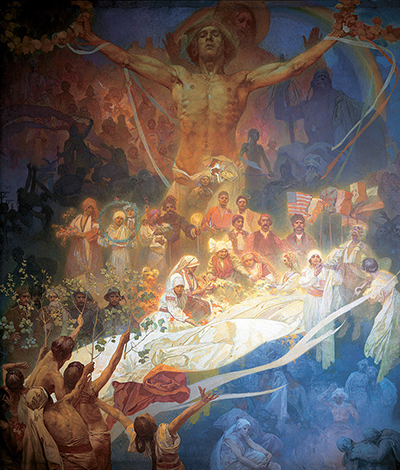
Apotheosis of the Slavs (1926), the final canvas in Mucha’s Slav Epic.
Buy Art Prints Nowfrom Amazon
* As an Amazon Associate I earn from qualifying purchases.
 by Tom Gurney
Tom Gurney BSc (Hons) is an art history expert with over 20 years experience
Page Created on / Page Updated on
Email: tomgurney1@gmail.com / Phone: +44 7429 011000
Apotheosis of the Slavs by Alphonse Mucha: Four Histories in One Painting
A bare-chested figure extends both arms over an assembly of soldiers, civilians, banners and shadowed crowds. Light gathers around him and the people below, while other episodes seem to recede into blue and red distances. This is Apotheosis of the Slavs, the twentieth and final painting in Alphonse Mucha’s Slav Epic. It attempts to bring the earlier nineteen subjects into one image, using different colour areas to move through a history that Mucha wanted to end in freedom and service to humanity.[1][2]
The Mucha Foundation dates the canvas to 1926. Its longer catalogue title includes 1918, the year of the independence celebrated within the scene. The two dates describe different things: a historical turning point and the later painting about it. Reading the work through that distinction helps keep its many figures from collapsing into a single event.[1]
At a Glance
- ArtistAlphonse Mucha
- CycleThe Slav Epic, No. 20 of 20[1][2]
- Full catalogue titleApotheosis: Slavs for Humanity. Four Stages of Slav History in Four Colours (1918)[1]
- Painting date1926[1]
- Mediumegg tempera on canvas in the Foundation's record; the Moravský Krumlov exhibition also lists oil[1][7]
- Dimensions480 × 405 cm, for the catalogued canvas[1]
- Related preparationMucha directing costumed models, photographed in 1926[4]
Apotheosis in Mucha’s career
Contents
- Four times on one surface
- The figures at the centre
- Last in the Epic, but not painted in order
- Poses prepared for a monumental scene
- A conclusion that viewers still question
Four times on one surface
Mucha did not arrange the final painting as a line of separate scenes. He made areas of colour carry different parts of the story. In the lower right, blue evokes an early Slavic world. The Prague City Gallery describes figures linked with pagan worship there, including a priest offering sacrifice. In the small local image these forms are subdued, almost submerged beneath the brighter action nearer the centre.[3]
The upper red area gathers medieval history. The Foundation emphasises blood shed in the Hussite wars; the Prague City Gallery also reads rulers and religious reform in this zone, naming Přemysl Otakar II, Charles IV, Jiří of Poděbrady and Jan Hus.[1][3] Those are institutional interpretations of one densely worked area, not a row of portraits that can all be identified with certainty from a 400-pixel image. The colour makes the period felt before every historical reference becomes legible.
Below, figures fall into shadow. The Foundation sees enemies and repeated attacks on Slavic peoples; the Prague City Gallery describes defeats and periods of oppression.[1][3] In the local view, this darkness does important compositional work. It surrounds the lit assembly without becoming an empty background. The celebration at the centre appears against a remembered history of danger and loss. Mucha’s conclusion depends on that contrast.
The Czech exhibition gives this black zone a more specific historical programme: raids by Franks, Avars and Turks, followed by three centuries of pressure on the Czech language after the 1620 Battle of White Mountain. Those references belong to the Gallery's interpretation of Mucha's chosen history. They should not turn every dark figure into a securely identifiable person or event.[7]
The yellow light pulls the eye back to the present of the painted story. Soldiers return from the First World War, greeted by children and others preparing for celebration. The Foundation describes Czech and Slovak soldiers and green branches held up by boys. The Prague City Gallery identifies returning legionaries, women making garlands and flags that mark the wider war’s end.[1][3] The pale sweep at the front is not a blank area: it channels movement among these people and makes their gathering feel open after the compressed shadows nearby.
The Czech account also places an older man giving thanks beside the flags of the victorious powers and representatives of Slavic peoples at the left.[7] German historian Agnieszka Gąsior reads the soldiers as legionaries associated with several wartime theatres and the flags as an acknowledgment of the Entente's role in Czechoslovak independence.[8] The yellow section therefore combines reunion at home with international diplomacy. Mucha's claim about freedom is located in 1918, but the painting was made eight years later, when that settlement could already be assessed rather than merely anticipated.
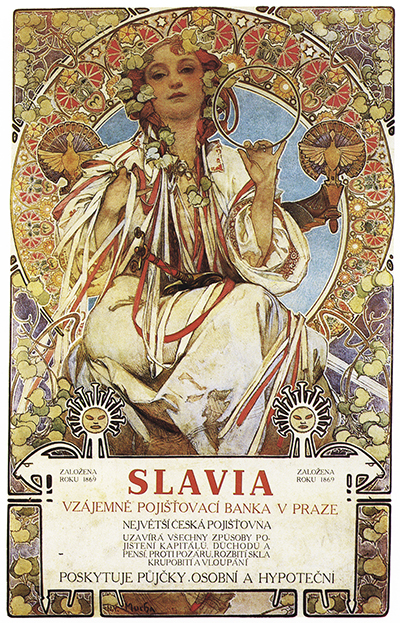
Gąsior also draws attention to the linden branches and flying ribbons, linking them to the symbolic vocabulary Mucha had used in his earlier Slavia insurance poster.[8] That connection does not mean the poster was a study for this canvas. It shows how a public image made for a bank could supply forms for a very different, monumental account of collective identity. In her reading, the white band of cloth running through the liberated crowd conveys purity and spiritual energy. Those meanings are Gąsior's interpretation; the visible cloth also has the practical pictorial role of carrying the eye between groups in the yellow zone.
The zones are therefore not four isolated pictures. Colour moves a viewer from early time and violence toward a luminous claim about the future. A person can read that structure without treating Mucha’s chosen sequence as the only possible history of Slavic peoples. The painting is a historical argument made through composition.[1][2]
The figures at the centre
High above the gathering, the bare-chested figure spreads his arms. The Foundation calls him an embodiment of a strong, independent republic and identifies a Christ figure behind him as guiding and protecting that new state.[1] The Prague City Gallery describes the foreground figure as a Slavic youth holding wreaths of victory and concord, with the Czechoslovak tricolour suspended from them; it also notes a rainbow as a sign of international peace.[3] The image joins national independence to a broader aspiration, the two ideas pressed into one central emblem.
The figure’s outstretched pose makes him visible before the smaller people below. He is an allegory, while the returning soldiers and children give the painting a more recognisable human scene. Mucha asks viewers to move between those levels. The ceremony is about particular lives after war, but it also carries a symbolic claim that the cycle’s painful episodes can lead toward renewal.
The wreaths carry that argument in a precise form. Prague City Gallery calls them wreaths of victory and concord and says the Czechoslovak tricolour hangs from them.[3][7] Gąsior interprets them as unity and achieved freedom under Christ's blessing.[8] These are related readings, but they place slightly different weight on national statehood and a shared Slavic future. The rainbow above, which the Gallery reads as peace among nations, reaches beyond either one state or one ethnic group.[7]
This is a hopeful vision, not a neutral report of 1918. The collapse of Austria-Hungary and the emergence of Czechoslovakia made independence a powerful subject for Mucha, but the painting compresses several nations and centuries into a single end point.[1][2] Its subtitle, “Slavs for Humanity,” makes the intended direction explicit. The Foundation says he hoped common history, peace and learning would allow Slavic peoples to work for humanity.[2] Readers can understand that hope while also asking whose experiences the culminating ceremony includes or leaves less visible.
Mucha explained the cycle's purpose in a Czech statement dated Prague, 1929 and reproduced by the Moravský Krumlov exhibition. He described knowledge of a nation's past as necessary to its continued development, and said that his intention was to build bridges toward understanding among people. That statement helps explain why Apotheosis ends with reunion, wreaths and a rainbow rather than a final battle.[10] It is a retrospective statement about the whole Epic, not a key that resolves every symbol in this particular painting. Gąsior places the image in the early twentieth-century movement for cooperation among Slavic nations and reads its final youth as an ideal for the future, not merely a record of a government formed in 1918.[8]
The colour structure makes that question possible. Those in shadow are part of the composition, yet the eye repeatedly returns to light. Mucha planned a triumphant conclusion; the painting still contains traces of conflict and loss that a viewer cannot simply erase. Close looking holds the two together instead of reducing the canvas to a slogan.
Last in the Epic, but not painted in order
Apotheosis is No. 20 in a twenty-canvas cycle, and it was completed in 1926.[1][2] The number tells us where Mucha wanted the work to stand in his historical sequence. It does not mean that he painted the canvases from one to twenty without interruption. Several earlier-numbered works were made in the 1920s; No. 19, The Abolition of Serfdom in Russia, dates from 1914. The painting years and the historical years in their titles are separate chronologies.[2]
The cycle began with The Slavs in Their Original Homeland, painted in 1912. There a vulnerable couple hide as danger approaches; symbolic figures above hold out a future possibility. In Apotheosis, the future seems to have arrived in a crowded ceremony. Comparing those endpoints shows Mucha’s chosen arc from threat toward independence, though the nineteen works between them contain speech, religion, printing, conflict and uncertain political change rather than one uninterrupted march of progress.[2]
The later Oath of Omladina complicates any tidy statement that all twenty were equally finished. The Foundation identifies that eighteenth canvas as unfinished and notes that it was absent from the nineteen-work 1928 Trade Fair Palace display.[2][5] Apotheosis can be called the cycle’s completed final canvas while acknowledging that the physical state of another painting remained different.
Mucha and his patron Charles Richard Crane presented the Epic to the City of Prague in 1928, the republic’s tenth anniversary. Nineteen canvases appeared at the Trade Fair Palace that year; the unfinished eighteenth was omitted.[2][5] Earlier groups had been seen before then. A reader encountering this page alone sees one image; Mucha’s intended sequence gave its conclusion a much larger visual and political setting.
A Czech chronology records a 29 November 1926 handover of Apotheosis, Holy Mount Athos and Oath of Omladina to Prague representatives at Mucha's U Studánky school studio. It separately dates the formal handover of the Epic as a whole to 21 September 1928, when Mayor Karel Baxa accepted nineteen paintings for the city.[12] These are two stages in the public life of the final canvas, not rival dates for the historical events it depicts. The chronology is a later compilation rather than the municipal protocol itself, so its precise 1926 day remains attributed to that source.
The Czech Academy of Sciences exhibition database dates that display from 21 September to 31 October 1928. It records Mucha's effort to make the new Trade Fair Palace hall suitable for the cycle: he spread sand on the floor, placed plants around the space and covered the glass walls with dark fabric.[9] These choices made the final canvas part of an arranged encounter with nineteen large paintings, rather than an isolated illustration. The database also documents mixed contemporary responses. Some reviewers welcomed the cycle; modernist critics found its historical painting out of step with contemporary art, while others objected to its Pan-Slavic politics or the proposed permanent pavilion. Apotheosis thus closed Mucha's intended story at the same time that public debate over the Epic's meaning was opening.[9]
Gąsior argues that the painting's different times, Christian figure and symbolic youth make it a metaphor of history, rather than a reconstruction of one episode in the manner of a battle panorama.[8] In her account, critics accustomed to historical painting sometimes missed that ambition, while the rise of Cubism, Expressionism and abstraction made Mucha's symbolism look old-fashioned in 1928. Her analysis gives a reason for the divided reception, without requiring a verdict that every critic misunderstood the work. The very features that gather the Epic's subjects into a final statement also keep this canvas open to competing readings of what common Slavic history could mean.
The painting's later exhibition history reminds us that its physical form also shapes interpretation. For the 2018–19 Prague City Gallery display, the Gallery selected eleven of the cycle's smaller canvases for the Municipal House, including Apotheosis, while nine larger canvases remained on display in Brno.[11] The Prague presentation planned exposed supports and access to the backs of the works, under a conservation team led by Tomáš Berger.[11] This was a curatorial proposal for that exhibition, not evidence that the back of this particular canvas bears a note or sketch. It does show a deliberate shift from Mucha's 1928 theatrical setting toward seeing each painted object as a made, maintained canvas.
Poses prepared for a monumental scene
The Mucha Foundation preserves a 1926 photograph of the artist directing a group of costumed models for Apotheosis.[4] It is valuable evidence of a working method. Mucha arranged people and gestures before incorporating them into a painted crowd. The photograph does not show every step of that process, nor does it prove that every painted figure was copied directly from a single negative. It does show that the triumphant gathering was constructed with deliberate attention to bodies in space.
That preparation matters for the painting’s central force. At several metres high, an unclear mass of people could become difficult to read. Mucha uses broad colour zones to hold the history together and smaller poses to give the yellow-lit present its human rhythm. Raised arms answer the larger figure above; people turn toward soldiers and toward one another. Staging helped him test how those relations might work before painting the final canvas.[1][4]
The photograph is linked as a source rather than reproduced here. The Foundation marks its displayed image © Mucha Trust, and that display does not supply permission for a local copy. The existing approved painting image remains the visual basis of this page.
A conclusion that viewers still question
Mucha intended a final vision of concord. Later artists have returned to it from other political positions. In 2015 Jiří David made a black-and-white reinterpretation of Apotheosis, presented at the Venice Biennale; the National Gallery Prague describes that work as a critical response to Mucha’s heroic account.[6] David’s installation is a separate artwork, not a revision of Mucha’s 1926 canvas. Its existence shows that the final scene continues to invite debate about national memory and the promises attached to it.
The Czech and Slovak pavilion's account describes David's intervention as a spatial experience as well as a change of colour: viewers encountered the reworked painting in a narrow passage with a mirror of the same dimensions, drawing themselves into the reflected scene.[13] The account says the work asked visitors to reconsider home, nation and state. That later question sharpens something already present in Mucha's painting: a crowd described through shared freedom can also prompt viewers to ask who speaks for the different peoples assembled under one allegorical youth. David's answer belongs to 2015; Mucha's optimistic proposition belongs to the aftermath of 1918.
Begin with the shadowed blue figures, travel through the red history above and return to the yellow gathering. Then look at the outstretched figure and the rainbow. The painting is at once a summary of Mucha’s twenty-part project and an assertion about what he hoped history might become. The Slav Epic guide lets a reader test that conclusion against every other canvas rather than viewing the final image in isolation.[1][2][3]
Watch: Alphonse Mucha
Place Mucha’s Czech and Slavic projects beside his better known Paris work.
Prague’s Art Nouveau, Mucha, and the Slav Epic
A short view of Mucha’s Prague legacy and the Slav Epic cycle.
Watch on YouTubeArtworks directory
| Name | Date | Medium |
|---|---|---|
| 'Accept Love and Enthusiasm from Your Son, Mother of the Holy Nation': study for the mural 'By Own Strength III' at the Lord Mayor's Hall, Obecní Dům, Prague | 1910-1911 | Pencil and charcoal on canvas |
| 'By force towards freedom, with love towards unity!': study for the mural 'By Own Strength II' at the Lord Mayor's Hall, Obecní Dům, Prague | 1910-1911 | Pencil and charcoal on canvas |
| 'The Passing Wind Takes Youth Away': design for a fan and the façade of the 'Pavilion of Man' (unrealised) | 1899 | Colour lithograph |
| 'Through humiliated and tortured, you will live again, my country!': study for the mural 'By Own Strength II' at the Lord Mayor's Hall, Obecní Dům, Prague | 1910-1911 | Pencil and charcoal on canvas |
| 1918-1928: Poster for the 10th Anniversary of the Independence of the Republic of Czechoslovakia | 1928 | Colour lithograph |
| 6th Sokol Festival | 1912 | Colour lithograph |
| 8th Sokol Festival | 1925 | Colour lithograph |
| After the Battle of Grunwald | 1924 | egg tempera on canvas |
| After the Battle of Vitkov Hill | 1923 | egg tempera on canvas |
| Age of Love | 1936–1938 | |
| Age of Reason | 1936–1938 | |
| Age of Wisdom | 1936–1938 | |
| Amants | 1895 | Colour lithograph |
| Apotheosis of the Slavs | 1926 | Egg tempera on canvas |
| As Hamlet | 1899 | colour lithograph |
| Au Quartier Latin | 1898 | Magazine cover |
| Banknotes of Czechoslovakia, designed by Mucha: 500 crown; 50 Crown; 10 Crown | 1929 | Banknotes |
| Bieres de la Meuse | 1897 | Colour lithograph |
| Biscuits Champagne Lefevre Utile | 1896 | Colour lithograph |
| Biscuits Lefevre Utile | 1896 design for 1897 calendar; Foundation object/Carnavalet 1897 | Colour lithograph |
| Blessed are the Pure in Heart | 1906 | Printed magazine illustration |
| Bleu Deschamps | 1903 (deposit) | Colour lithograph |
| Bosnia & Herzegovina Pavilion - illustration featured in 'Le Figaro Illustré' (1 March 1900) | 1900 | Reproduction from Le Figaro Illustré after watercolour original |
| Bosnia-Herzegovina Pavilion: cartoon for the mural 'The Roman Period and the Arrival of the Slavs' | 1899-1900 | ink and crayon on paper |
| Bosnia-Herzegovina Pavilion: fragment of the upper frieze featuring Ivo and Anica, characters from Bosnian legends | 1899-1900 | tempera and watercolour on canvas |
| Bosnian Legends: Death of Hasanaga's Bride | 1899 | Charcoal on paper |
| Bosnian Legends: Murcia - The Plague Lady | 1899 | Charcoal on paper |
| Bosnian Pavilion Restaurant at the Paris Exhibition 1900: design for the menu | 1900 | Pencil and watercolour on paper |
| Boutique Fouquet (interior design) | 1901 | Shop interior design |
| Boutique Fouquet: sketches of the shop's signboard and decorative details | c.1900 | Pencil, ink and watercolour on paper |
| Box for Lefèvre-Utile biscuits: Gaufrettes Vanille | c.1900 | Tin box covered with lithographed label |
| Box for Lefèvre-Utile biscuits: Madère | c.1900 | Tin box covered with lithographed label |
| Brightness of the Day | 1899 | Colour lithograph |
| Broach with Pendant | 1900 | Gold, ivory, mother-of-pearl and semi-precious stones |
| Byzantine Head - The Blonde | 1897 | Colour lithograph |
| Byzantine Heads (pair) | 1897 | Colour lithograph |
| Byzantine Heads: Brunette | 1897 | Colour lithograph |
| Bénédictine | 1898 (BnF deposit); Hamburg 1899; MNAC 1896 or 1898 | Colour lithograph |
| Champagne Ruinart | 1896 | Colour lithograph |
| Chocolat Ideal | before or in 1897 (catalogue conflict) | Colour lithograph |
| Chocolat Masson (1897 calendar) | 1896–1897 | Colour lithograph |
| Choirboys at Petrov Church, Brno | 1905 | Watercolour on cardboard |
| Cloches de Noel | 1900 | Illustrated book |
| Comedy: study for a mural for the German Theatre, New York | 1908 | Oil on canvas |
| Cours Mucha: poster advertising Mucha's art classes held at the Académie Colarossi, Paris | 1900 | colour lithograph |
| Creative Force - Jan z Pernštýna: study for a pendentive of the Lord Mayor’s Hall, Obecní Dům, Prague | 1910-1911 | Oil on canvas |
| Crucifixion | c.1868 | Pencil, crayon and watercolour on paper |
| Cycles Perfecta | 1897 or 1902 (catalogue conflict) | Colour lithograph |
| Dance | 1898 | Colour lithograph |
| Dead Couple - Abandoned | c.1899-1900 | Charcoal and pastel on blue paper |
| Defense of Sziget against the Turks by Nicholas Zrinsky | 1914 | egg tempera on canvas |
| Design for a champagne poster | c. 1896 | Charcoal and pastel on paper |
| Design for a display stand at the Paris Exhibition 1900 | c.1899-1900 | Pencil and wash on paper |
| Design for Champagne Ruinart | c. 1896 | Pencil, watercolour and gold leaf on paper |
| Design for the cover of the magazine 'Fantaz' | 1882 | Ink and watercolour on paper |
| Design for the heading of the cover of the magazine 'Krokodil' | 1885 | Pen and ink on cardboard |
| Design for the poster for the Mucha Exhibition at the Brooklyn Museum, New York, January-February 1921 | 1920 | Pen and ink and watercolour on paper |
| Designs for cutlery | c.1900 | Charcoal and white on card |
| Designs for tableware | c.1900 | Charcoal, coloured pencil and white on card |
| Diadem for 'La princesse lointaine' | 1895 | metal and pearls |
| Diploma of Ivančice: Mock diploma honouring a local celebrity, with illustration of the first line of 'May', a poem by Karel Hynek Mácha | 1882 | Pen and ink and watercolour on paper |
| Documents décoratifs: designs for a watch and accessories (unused) | 1901-1902 | Pencil, ink and white on paper |
| Documents décoratifs: final study for Plate 25, featuring studies of lily | 1901-1902 | Pencil on paper |
| Documents décoratifs: final study for Plate 43 | 1901-1902 | Pencil, ink and wash, heightened with white on paper |
| Documents décoratifs: final study for Plate 49 | 1901-1902 | Pencil and white on paper |
| Documents décoratifs: final study for Plate 50 | 1901-1902 | Pencil and white on paper |
| Documents décoratifs: final study for Plate 60 | 1901-1902 | Pencil, ink and wash, heightened with white on paper |
| Documents décoratifs: final study for Plate 63 | 1901-1902 | Pencil and white on paper |
| Documents décoratifs: final study for Plate 67 | 1901-1902 | Pencil and white on paper |
| Documents décoratifs: final study for Plate 71 | 1901-1902 | Pencil and white on paper |
| Documents décoratifs: final study for Plate 72 | 1901-1902 | Pencil and wash, heightened with white on paper |
| Documents décoratifs: line drawing for Plate 33, featuring lily motifs | 1901-1902 | Pencil, pen and ink on paper |
| Documents décoratifs: Plate 54 | 1902 | Lithograph |
| Dreaming of Freedom: study for a Panel of the Small Reception Room at the Lord Mayor’s Hall, Obecní Dům, Prague | 1910-1911 | Pen and ink and watercolour on paper |
| Dusk | 1899 | Colour lithograph |
| Evening | 1899 | Colour lithograph |
| F. Champenois (Rêverie imprint) | 1898 | Colour lithograph |
| F. Guillot-Pelletier calendar (1898) | 1897–1898 | Colour lithograph |
| Feather | 1899 | Colour lithograph |
| Figures décoratives: final study for Plate 2 | 1904-1905 | Pencil and white on paper |
| Figures décoratives: final study for Plate 3 | 1904-1905 | Pencil and white on paper |
| Figures décoratives: final study for Plate14 | 1904-1905 | Pencil with white on paper |
| Figures décoratives: sketch study for Plate14 | 1904-1905 | Blue pencil on paper |
| Flirt Lefevre Utile | 1899 (Foundation design); BnF legal deposit 1900 | Colour lithograph |
| Flower | 1897 | Colour lithograph |
| Flower: final study for decorative panel | 1897 | Pencil, ink and watercolour on paper |
| France Embraces Bohemia | 1918 | oil on canvas |
| Fruit | 1897 | Colour lithograph |
| Georges Fouquet (1858-1929), Paris, after design by Mucha: Ornamental Chain with pendants | 1900 | Gold, enamel, fresh-water pearls, mother of pearl and semi-precious stones |
| Georges Fouquet (1858-1929), Paris, after Mucha design: 'Peacock' Ring (Exhibited at the Paris Exhibition 1900) | 1900 | Opal and gold |
| Girl Weeping | c.1899-1900 | Black chalk and pastel on paper |
| Girl with Loose Hair and Tulips | 1920 | Oil on canvas |
| Gismonda | 1894 | Colour lithograph |
| Head of a Girl, statue for the stand of the Houbigant Perfumery at the Paris Exhibition 1900 | 1900 | Bronze, silver and parcel gilt |
| Head of Sarah Bernhardt: Study for 'Lorenzaccio' | 1896 | Pencil on paper |
| Heather from Coastal Cliffs | 1902 | Colour lithograph |
| Heidsieck & Co | 1901 | Colour lithograph |
| Holy Mount Athos | 1926 | Egg tempera on canvas |
| Ilsée, Princesse de Tripoli | 1897 | Illustrated book |
| In the Desert: Study for an illustration for the Světozor magazine | 1889 | Pencil, watercolour and gouache on paper |
| Incantation (Salammbô) | 1897 | Lithograph |
| Independence - Jiří z Poděbrad: study for a pendentive of the Lord Mayor’s Hall, Obecní Dům, Prague | 1910-1911 | Oil on canvas |
| Interior and furniture designs | c.1900 | Pencil on paper |
| Interior of Boutique Fouquet: design for a wall-mounted display cabinet with statuette and mirror | c.1900 | Pencil on paper |
| Interior of Boutique Fouquet: design for the fireplace with statuettes, mirror, and the ornamental details of the wall | c.1900 | Pencil and watercolour on cardboard |
| Interior of Boutique Fouquet: sketches of the fireplace with statue, mirror, display cabinet, and the ornamental details of the wall | c.1900 | Pencil, pen and ink on paper |
| Ivy | 1901 | Colour lithograph |
| Jan Milic of Kromeriz | 1916 | egg tempera on canvas |
| Jaroslava and Jiří, the Artist’s Children | 1918 | Oil on canvas |
| JOB poster | 1896 | Colour lithograph |
| Judgement of Paris (calendar for Vieillemard printing company) | 1895 | Colour lithograph |
| Justice - Master Jan Hus: study for a pendentive of the Lord Mayor's Hall, Obecní dům, Prague | 1910-1911 | Oil on canvas |
| L'Annee Qui Vient | 1897 | red chalk on paper |
| L'Illustration magazine - cover for Christmas 1896/1897 | 1896 | Magazine cover |
| L'Illustré Soleil du Dimanche | 1897 | Magazine cover |
| La Dame aux Camélias: designs for cover and interior of special programme | 1896 | Pencil and watercolour on paper |
| La Nature | 1899-1900 | Bronze and amethyst |
| La Plume | 1897 | Magazine cover |
| La Samaritaine | 1897 | colour lithograph |
| Lance Parfum Rodo | 1896; Albertina print c. 1900 | Colour lithograph |
| Laurel | 1901 | Colour lithograph |
| Le Monde Illustré | 1900 | Magazine cover |
| Le Pater | 1899 | Illustrated book |
| Le Pater: early study for the 1st allegorical scene 'Our Father who art in Heaven' (1899) (Mucha Foundation object 300) | 1899 | Pencil on paper |
| Le Pater: early study for the 1st allegorical scene 'Our Father who art in Heaven' (1899) (Mucha Foundation object 302) | 1899 | Pastel on paper |
| Le Pater: study for the 6th allegorical scene 'Forgive us our debts, as we forgive our debtors' | 1899 | Charcoal and ink wash on paper |
| Lefevre Utile | 1904 | Advertisement |
| Leslie Carter | 1908 | Colour lithograph |
| Letem Českým Světem | 1898 | Printed book |
| Lorenzaccio | 1896 | Colour lithograph |
| Luchon poster (attributed to Mucha) | 1895 | Colour lithograph |
| Madonna of the Lilies | 1905 | Tempera on canvas |
| Master Jan Hus Preaching at the Bethlehem Chapel | 1916 | egg tempera on canvas |
| Maude Adams | 1908 | Lithograph, hand-coloured in watercolour and gouache |
| Maude Adams as Joan of Arc | 1909 | Oil on canvas |
| Medea | 1898 | Colour lithograph |
| Menu for the Bosnian Pavilion Restaurant at the Paris Exhibition 1900 | 1900 | Colour lithograph |
| Militancy - Jan Žižka: study for a pendentive of the Lord Mayor's Hall, Obecní dům, Prague | 1910-1911 | Oil on canvas |
| Military Camp in Winter, near a City on Fire | c.1899-1900 | Pastel on paper |
| Moet et Chandon | 1899 | Colour lithograph |
| Monaco Monte Carlo | 1897 | Colour lithograph |
| Moon | 1902 | |
| Moravian Teachers' Choir | 1911 | Colour lithograph |
| Morning Alphonse Mucha Painting / AlphonseMucha.org | 1899 | Colour lithograph |
| Morning Star | 1902 | Colour lithograph |
| Moët & Chandon White Star | 1899 | Colour lithograph |
| Mrs Mucha’s Necklace | 1906 | gold, enamel and semi-precious stones |
| Mural for the Bosnia-Herzegovina Pavilion: The Roman Period and the Arrival of the Slavs | 1900 | tempera and watercolour on canvas |
| Murals by Mucha in the Lord Mayor's Hall, Obecní Dům (Municipal House), Prague (1910-1911) | ||
| Music | 1898 | Colour lithograph |
| Nativity | c. 1934 | oil on canvas |
| Nestle's Food for Infants | 1897 | Colour lithograph |
| Night | 1899 | Colour lithograph |
| Nude on a Rock | 1898-1899 | Bronze |
| Official Banquet of the Paris Exhibition 1900: design for the menu featuring a fashionable woman wearing a Mucha-style jewellery | 1900 | Pencil, gouache and wash on grey paper |
| Ornamental motifs designed for 'Combinaisons Ornementales se Multipliant à l'Infini à l'Aide du Miroir' (1901) | c.1900-1901 | Blue and red pencil on paper |
| Packaging for 'Savon Mucha Violette' | 1906 | Colour lithograph |
| Packaging for Lefèvre-Utile biscuits: Boudoir | 1901 | Colour lithograph |
| Page's Costume: study for an illustration for 'Le Costume au Théâtre' | 1890 | Pencil and watercolour on cardboard |
| Painting | 1898 | Colour lithograph |
| Peonies | 1897–1898 | Ink and watercolour |
| Petr Chelcicky at Vodnany | 1918 | egg tempera on canvas |
| Poetry | 1898 | Colour lithograph |
| Portrait of Jaroslava | c.1927-1935 | Oil on canvas |
| Portrait of Josephine Crane Bradley as Slavia | 1908 | Oil and tempera on canvas |
| Portrait of Marie Chytilová (Maruška), Mucha's Future Wife | 1903 | pastel on paper |
| Portrait of Mucha's Sister, Angela | c.1880 | Oil on canvas |
| Portrait of Mucha's Sister, Anna | c.1885 | Oil on canvas |
| Portrait of Mucha's Son, Jiří | 1925 | Oil on canvas |
| Portrait of Mucha's Wife, Maruška | 1908/17 | Oil on canvas |
| Portrait of Woman | c. mid 1910s - 1925 | Blue pastel on grey paper |
| Poster for 'Hommage Respectueux de Nestlé' (the Nestlé Company's tribute to Queen Victoria's 60th Jubilee) | 1897 | Colour lithograph |
| Poster for 'Imprimerie Cassan Fils' | 1896 | Colour lithograph |
| JOB poster (1898) | 1898 | Colour lithograph |
| Poster for 'La Dame aux Camélias' | 1896 | Colour lithograph |
| Poster for 'La Tosca' | 1899 | Colour lithograph |
| Poster for 'Regional Exhibition at Ivančice 1913' | 1912 | Colour lithograph |
| Poster for 'The Slav Epic Exhibition, Brno, 1930' | 1928-1930 | Colour lithograph |
| Poster for 'Waverley Cycles' | 1898 | Colour lithograph |
| Poster for the 'Lottery of the Union of Southwestern Moravia' | 1912 | Colour lithograph |
| Poster for the Austrian Pavilion at the Paris Exhibition 1900 | 1900 | Colour lithograph |
| Prague Subjugated: study for a Panel of the Small Reception Room at the Lord Mayor’s Hall, Obecní Dům, Prague | 1910-1911 | Pen and ink and watercolour on paper |
| Primrose | 1899 | Colour lithograph |
| Primrose and Feather (paired image) | 1899 | Colour lithographs (paired image) |
| Princess Hyacinth (Princezna Hyacinta) | 1911 | Colour lithograph |
| Print proof for the Biscuits Lefèvre-Utile tin | 1899 | Lithograph |
| Reverie | 1898 | Colour lithograph |
| Russia Restituenda [Russia Must Recover] | 1922 | Colour lithograph |
| Salome | 1897 | Colour lithograph |
| Salon des Cent | 1896 | Colour lithograph |
| Salon of the Hundred | 1897 | Colour lithograph |
| Sarah Bernhardt - La Princesse Lointaine - Lefevre Utile | 1903 | Colour lithograph |
| Sarah Bernhardt as La Princesse Lointaine: poster for 'La Plume' magazine | 1897 | Colour lithograph |
| Sarah Bernhardt in the role of the Duc de Reichstadt in L’Aiglon | 1900 | Pencil on paper |
| Sarah Bernhardt: study of her full-standing figure | c.1896 | Pen and ink on paper |
| Savonnerie de Bagnolet calendar | 1898 (calendar) | Printed advertising calendar |
| Self-portrait (1899) | 1899 | Oil on board |
| Self-portrait (1907) | 1907 | Blue and white crayon on blue Ingres paper |
| Self-portrait, sketching in his apartment, Paris | late 1880s | oil on canvas |
| Sketches of flowers for Documents décoratifs | c.1900-1901 | Pen and ink on paper |
| Slavia insurance poster | 1907 | Poster |
| Slavs in their Original Homeland | 1912 | Egg tempera on canvas |
| Snake Bracelet with a Ring | 1899 | Gold, enamel, opal, ruby and diamond |
| Société Populaire des Beaux Arts | 1897 | Colour lithograph |
| Song of Bohemia | 1918 | oil on canvas |
| St. Vitus Cathedral Stained-glass Window, Prague: final design for the central panels, featuring SS Cyril and Methodius | 1931 | Ink and watercolour on paper |
| St. Vitus Cathedral Stained-glass Window, Prague: final design for the central panels, featuring St. Ludmila | 1931 | Ink and watercolour on paper |
| St. Vitus Cathedral Stained-glass Window, Prague: final design for the central panels, featuring St. Wenceslas (Duke of Bohemia) kneeling next to his Grandmother, St. Ludmila | 1931 | Ink and watercolour on paper |
| St.Vitus Cathedral Stained-glass Window, Prague: final design for the bottom left panels | 1931 | Ink and watercolour on paper |
| St.Vitus Cathedral Stained-glass Window, Prague: final design for the bottom right panels | 1931 | Ink and watercolour on paper |
| Stained-glass Window designed by Mucha at St. Vitus Cathedral, Prague | Early 1930s | N/A |
| Study for 'The Age of Reason' | 1936-1938 | Pencil and watercolour on paper |
| Study for 'The Slav Epic cycle' No.19: The Abolition of Serfdom in Russia | 1913-1914 | Watercolour and gouache on paper |
| Study for 'The Slav Epic' cycle No.14: The Sacrifice at Szigetvár by Nikola Zrinski | c.1913-1914 | Photographed drawings stuck together, tinted with watercolour and gouache |
| Study for 'The Slav Epic' cycle No.17: The Holy Mount Athos (1926) | c.1925-26 | Charcoal heightened with white on cardboard |
| Study for 'The Slav Epic' cycle No.18: The Oath of Omladina under the Slavic Linden Tree | c.1925-1926 | Pencil and watercolour on paper |
| Study for 'The Slav Epic' cycle No.1: The Slavs in Their Original Homeland (1912) | c.1910-1912 | Oil on canvas |
| Study for 'The Slav Epic' cycle No.2: The Celebration of Svantovít | c.1910-1912 | Oil on canvas |
| Study for 'The Slav Epic' cycle No.7: Jan Milíč of Kroměříž | c.1915-1916 | Oil on canvas |
| Study for 'The Slav Epic' cycle No.9: Master Jan Hus Preaching at the Bethlehem Chapel. The Magic of the Word: Truth Prevails (1412). | c.1915-1916 | Oil on canvas |
| Study for 'The Three Ages' triptych: Reason, Wisdom and Love [unfinished project] | 1936-1938 | Pencil and watercolour on paper |
| Study for 'Woman in the Wilderness' (c. 1922-1923) (Mucha Foundation object 315) | c. 1922-1923 | oil on canvas |
| Study for 'Woman in the Wilderness' (c. 1922-1923) (Mucha Foundation object 316) | c. 1922-1923 | oil on canvas |
| Study for Savon Notre Dame | c. 1896 | pencil and watercolour on paper |
| Study for the poster 'Russia Restituenda [Russia Must Recover]' | 1922 | Pen and ink and watercolour on paper |
| Study of a Male Nude | 1885-1887 | Oil on canvas |
| The Abolition of Serfdom in Russia | 1914 | Egg tempera on canvas |
| The Arts (series) | 1898 | Colour lithograph |
| The Arts: study for 'Dance' | 1898 | Pencil and watercolour on paper |
| The Arts: study for 'Music' | 1898 | Pencil and watercolour on paper |
| The Arts: study for 'Painting' | 1898 | Pencil and watercolour on paper |
| The Arts: study for 'Poetry' | 1898 | Pencil and watercolour on paper |
| The Bohemian King Premysl Otakar II | 1924 | egg tempera on canvas |
| The Bulgarian Tsar Simeon | 1923 | egg tempera on canvas |
| The Burr McIntosh Monthly, 1907 | 1907 | Magazine cover |
| The Celebration of Svantovit | 1912 | egg tempera on canvas |
| The Coronation of the Serbian Tsar Stefan Dusan as East Roman Emperor | 1923 | egg tempera on canvas |
| The Devil and Mr Twardowsky: study for an illustration for 'The Tale of Pan Twardowsky' (a variation of 'Faust') | c.1887-1888 | Charcoal on paper |
| The Flowers (series) | 1898 | Colour lithographs |
| The Flowers: Carnation | 1898 | Colour lithograph |
| The Flowers: Iris | 1898 | Colour lithograph |
| The Flowers: Lily | 1898 | Colour lithograph |
| The Flowers: Rose | 1898 | Colour lithograph |
| The Hussite King Jiri of Podebrady | 1923 | Egg tempera on canvas |
| The Introduction of the Slavonic Liturgy | 1912 | egg tempera on canvas |
| The Last Days of Jan Amos Komensky (Comenius) in Naarden | 1918 | Egg tempera on canvas |
| The Light of Hope | 1933 | Oil on canvas |
| The Meeting at Krizky | 1916 | egg tempera on canvas |
| The Months (January-June) | 1899 | Colour lithograph |
| The Months (July-December) | 1899 | Colour lithograph |
| The Moon and the Stars (four-panel montage) | 1902 | Colour lithographs (four-panel montage) |
| The Moon and the Stars (series) | 1902 | Colour lithograph |
| The Moon and the Stars: study for 'The Evening Star' | 1902 | Ink and watercolour on paper |
| The Moon and the Stars: study for 'The Pole Star' | 1902 | Ink and watercolour on paper |
| The New York Daily News art supplement | 1904 | Printed art supplement |
| The Oath of Concord of the Slavs (unfinished) | 1939 | oil on canvas |
| The Oath of Omladina under the Slavic Linden Tree | 1926, unfinished | Egg tempera on canvas |
| The Precious Stones (four-panel montage) | 1900 | Colour lithographs (four-panel montage) |
| The Precious Stones (series) | 1900 | Colour lithograph |
| The Precious Stones: Amethyst | 1900 | Colour lithograph |
| The Precious Stones: Emerald | 1900 | Colour lithograph |
| The Precious Stones: Ruby | 1900 | Colour lithograph |
| The Printing of the Bible of Kralice in Ivancice | 1914 | egg tempera on canvas |
| The Seasons (series) | 1896 | Colour lithograph |
| The Seasons (series) (1900) | 1900 | Colour lithograph |
| The Seasons (variation in screen format) | 1896 | Colour lithograph |
| The Seasons: Autumn (1896) | 1896 | Colour lithograph |
| The Seasons: Autumn (1900) | 1900 | Colour lithograph |
| The Seasons: Spring | 1900 | Colour lithograph |
| The Seasons: Spring (1896) | 1896 | Colour lithograph |
| The Seasons: Summer | 1900 | Colour lithograph |
| The Seasons: Summer (1896) | 1896 | Colour lithograph |
| The Seasons: Winter | 1900 | Colour lithograph |
| The Seasons: Winter (1896) | 1896 | Colour lithograph |
| The Slavonic Concord: study for the ceiling painting for the Lord Mayor's Hall, Obecní Dům, Prague | 1910-1911 | Oil on canvas |
| The Threat | 1912 | Colour lithograph |
| The Times of the Day (series) | 1899 | Colour lithograph |
| The West End Review | 1897 (Foundation); 1898 promotional cover | Colour lithograph |
| Thistle from the Sands | 1902 | Colour lithograph |
| Théâtre de la Renaissance: design for poster advertising Sarah Bernhardt's theatre | c.1895 | Pen and ink on paper |
| Tin for Lefèvre-Utile biscuits | 1899 | Circular tin with lid and handle; colour print on metal |
| Topaz | 1900 | Colour lithograph |
| Tragedy - study for a mural for the German theatre New York | 1908 | Oil and tempera on canvas |
| Trappistine Liquors | 1897 | colour lithograph |
| Wiener Chic | 1905 | Magazine cover |
| Woman in the Wilderness | 1923 | Oil on canvas |
| Woman masked in white head-scarf - study for the illustration of the Bosnia & Herzegovina Pavilion featured in 'Le Figaro Illustré' (1 March 1900) | 1899 | Pencil and wash heightened with white on paper |
| Woman with a Daisy - textile designed by Mucha | 1900 | Printed upholstery fabric |
| Zdenka Cerny | 1913 | Colour lithograph |
| Zodiac (La Plume calendar) | 1896–97 | Colour lithograph |
| Zodiac (textless decorative panel) | 1896 | Colour lithograph |
| ‘At the sight of the two storks the owl rose.’ Study for an illustration for Contes de Grand-mères | 1891 | Watercolour and gouache on paper |
Frequently Asked Questions
When did Mucha paint Apotheosis of the Slavs?
What are the four colours in Apotheosis of the Slavs?
Was Apotheosis the last painting in the Slav Epic?
Discussion
Mucha brought several periods of Slavic history into one monumental final image.
The four colour areas and the gathering at the centre invite different ways of reading its hopeful ending.
Reader Insights
Which colour area do you notice first, and where does your eye travel next?
How do the shadowed figures change your reading of the central celebration?
Does the figure with outstretched arms feel more like a person or an emblem to you?
Join the Conversation
Share what you notice in the figures, colours and movement across the canvas.
References
- Mucha Foundation, “The Slav Epic cycle No. 20: Apotheosis: Slavs for Humanity,” object 231, date, material, dimensions and iconography. View source.
- Mucha Foundation, “Slav Epic,” twenty-work cycle account, chronology, patronage and 1928 gift. View source.
- Prague City Gallery, “The Apotheosis of the Slavs,” collection interpretation presented through Google Arts & Culture. View source.
- Mucha Foundation, “Mucha directing a group of models posing for Apotheosis,” object 190, 1926. View source.
- Mucha Foundation, “The Slav Epic cycle No. 18: The Oath of Omladina,” unfinished state and exclusion from the nineteen-canvas 1928 display. View source.
- National Gallery Prague, “Jiří David: Apotheosis,” later critical reinterpretation. View source.
- Moravský Krumlov Slav Epic exhibition / Prague City Gallery, Vlasta Čiháková-Noshiro, “Apoteóza z dějin Slovanstva,” Czech description of iconography, date, dimensions and medium. View source.
- Agnieszka Gąsior, “Die Kunst, die Slawen und der Weltfrieden: Alfons Muchas Slawisches Epos,” Mitropa (2010), German scholarly essay on the final canvas, Neoslavism and reception. Read source.
- Institute of Art History, Czech Academy of Sciences, database entry “Alfons Mucha: Slovanská epopeje,” 1928 exhibition dates, installation and contemporary reception. View source.
- Alfons Mucha, statement dated Prague 1929, reproduced at the opening of the Moravský Krumlov exhibition's Czech cycle guide. Read source.
- Prague City Gallery, 2018–19 Slav Epic exhibition press release; lists Apotheosis as 1926–28 and describes conservation and display planning. Read press release.
- “Alfons Mucha a Slovanská epopej v datech,” Czech chronological compilation; 29 November 1926 canvas handover and 21 September 1928 formal cycle presentation. Read chronology.
- Czech and Slovak Pavilion, Venice Biennale 2015, institutional account of Jiří David's mirrored, black-and-white Apotheosis installation and its national-identity questions. Read pavilion account.