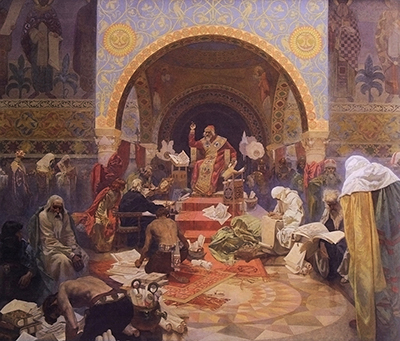
The Bulgarian Tsar Simeon (1923), the fourth canvas in Mucha’s Slav Epic.
Buy Art Prints Nowfrom Amazon
* As an Amazon Associate I earn from qualifying purchases.
 by Tom Gurney
Tom Gurney BSc (Hons) is an art history expert with over 20 years experience
Page Created on / Page Updated on
Email: tomgurney1@gmail.com / Phone: +44 7429 011000
Tsar Simeon of Bulgaria by Alphonse Mucha: A Court of Writers
Alphonse Mucha places a ruler under a deep ornamental arch. Around him, people bend over papers, read, carry books and work at low desks. A patterned floor leads the eye into this crowded room, while richly coloured wall paintings frame it. Tsar Simeon of Bulgaria, No. 4 in Mucha’s Slav Epic, presents the preservation and making of literature as a public achievement. The focus is on writing and learning rather than a coronation or battle.[1][2]
The Mucha Foundation dates the finished canvas to 1923. Its full title places the subject in the tenth century AD. The two dates describe different things: Mucha’s painting and the medieval court he imagined. The canvas follows the Epic’s story about worship in a Slavic language, but it was made more than a decade after the first three numbered paintings, which were finished in 1912.[1][3]
At a Glance
- ArtistAlphonse Mucha
- CycleThe Slav Epic, No. 4 of 20[1][3]
- Full catalogue titleTsar Simeon of Bulgaria. The Dawn of Slav Literature (10th century AD)[1]
- Painting date1923[1]
- Mediumegg tempera on canvas in the Foundation record; Czech and Brazilian exhibition catalogues also list oil[1][9][10]
- Dimensions405 × 480 cm, for the finished canvas[1]
- Historical settingSimeon’s Bulgarian court, interpreted as a centre of Slavic literary work[1][2]
The fourth Epic canvas in Mucha’s career
Contents
- The ruler amid the work
- Colour, architecture and memory
- From Moravia to Bulgaria: the chronology
- Glagolitic, Cyrillic and the labour of transmission
- What survives from Preslav
- A different kind of epic action
- Fourth in the story, painted later
The ruler amid the work
The seated figure at the centre is Tsar Simeon. The Mucha Foundation says he communicates with scholars and scribes in the foreground, while church and court officials occupy the background.[1] That distribution is the painting’s central choice. The ruler is elevated and brightly dressed, but he is not alone. The room’s energy lies in many people reading, dictating, writing and handling sheets around him.
The Prague City Gallery places the scene in Simeon’s palace at Preslav. It describes scribes recording the memories of elders, translating available writings and copying books.[2] Those activities are not all separable with certainty in the small image. At the larger scale, however, the leaning bodies and spread papers make the idea of sustained intellectual labour clear. Mucha gives the written word a physical form: bent backs, extended hands, paper on the floor and desks placed within reach.
Look at the foreground before returning to the throne. A worker closest to us turns toward sheets on the ground. Others sit or kneel at different levels. The people do not line up for a single ceremony. Their poses create a workshop atmosphere within a splendid court. The large arch and ruler provide a centre, while the distributed actions keep the scene from becoming only a royal portrait.
This is still a vision shaped around power. Simeon occupies the strongest axis of the room; scholars work beneath his patronage. Mucha asks viewers to see a ruler’s value in support of literature. We can follow that argument without assuming that every writer in the painting is an identifiable individual or that all the work shown happened at the same time in one room.[1][2]
Colour, architecture and memory
The arch is among the painting’s most conspicuous features. Gold patterns frame a darker inner space behind Simeon, bringing his figure forward. Blues and reds recur across walls, fabrics and carpets. The Prague City Gallery calls the effect Byzantine in colour and splendour.[2] Mucha uses those surfaces to make intellectual work feel consequential: writing belongs in a richly furnished centre of power rather than being tucked out of sight.
The Foundation reads figures in the wall paintings as a tribute to followers of Slavonic worship who had been expelled from Moravia.[1] The Prague City Gallery identifies figures such as Clement of Ohrid, Naum and Angelarius within the painted decoration.[2] Those are institutional readings of details that are difficult to verify independently from the inherited reproduction. The broad visual idea is clear: images of earlier teachers surround the later court, folding memory of them into the room where new texts are produced.
The decorative wall and active foreground work at different speeds. Fresco-like figures seem fixed, while the scribes bend and move. That contrast joins inherited learning to the labour of making it available again. The painting title’s “dawn” is therefore more than an ornamental phrase. Mucha depicts a culture of transmission: remembering people, translating words, copying texts and teaching later readers.[1][2]
No particular sheet in the picture can be identified as a surviving medieval manuscript merely because it is painted near a scribe. The papers help tell Mucha’s story, but they are not catalogue photographs of named objects. That distinction matters when the painting is used as an introduction to actual Slavic manuscript history.
From Moravia to Bulgaria: the chronology
The preceding Epic canvas, Introduction of the Slavonic Liturgy, stages Methodius’s return to Great Moravia and the question of worship in a Slavic language. The Simeon painting imagines what happened to that cultural work after pressures in Moravia pushed Methodius’s followers elsewhere.[1][2] The Foundation’s short object account says Simeon gave refuge to the expelled group. A closer chronology needs one adjustment: Methodius died in 885; the Bulgarian Academy of Sciences dates his disciples' welcome at Pliska to the spring of 886, under Boris I. Simeon became ruler in 893.[4][6] The first welcome therefore preceded his reign.
That correction does not remove Simeon from the later story. The Preslav literary tradition developed during his rule, which ran from 893 to 927.[5] Mucha’s canvas centres him as a patron of writing, translation and scholarship. It compresses the arrival of earlier teachers, the continuation of their work and the cultural ambitions of a later court into one legible room. The painting is persuasive as an image of patronage, but it should not be read as a literal view of the exiles’ first reception in Bulgaria.
The Prague City Gallery describes Simeon’s support for schools and literary work in Preslav and Ohrid.[2] The Bulgarian Academy traces the first literary centres to Boris's reign, initially at Pliska and then at Preslav from 893. Simeon's achievement developed that inherited structure; it was not its first creation.[6] A UNESCO Memory of the World nomination for the Enina Apostolos, a later surviving manuscript fragment, traces a Preslav tradition that inherited the translations of Cyril, Methodius and their disciples.[5] That document offers material context for why copying and transmission matter. It does not identify the painted papers as the Enina Apostolos, nor does it turn Mucha’s room into a precise documentary reconstruction.
The Academy's Institute for Literature places a 893 council at Preslav in this transition and says Old Bulgarian then gained official liturgical and administrative standing.[11] Its exhibition account describes monasteries as places where writers translated Christian teaching and also composed new work. This matters for the painting's crowded arrangement: the varied gestures can stand for more than scribal duplication. It does not follow that all those activities took place in Simeon's immediate presence, or that the picture shows the council. The year 893 marks a political and linguistic shift in the Academy's account; the canvas gathers the resulting literary work into one imagined setting.
Glagolitic, Cyrillic and the labour of transmission
The Academy's Institute for Bulgarian Language distinguishes Glagolitic, the older script associated with Cyril and Methodius's mission, from Cyrillic, which arose in the First Bulgarian Kingdom around the end of the ninth or beginning of the tenth century.[6] It says there is no credible evidence identifying Cyrillic's individual inventor. Its preferred hypothesis credits a group of Preslav scholars working with Simeon's support. The Prague City Gallery's account instead credits Naum and Angelarius with simplifying Glagolitic into Cyrillic.[2] That neat attribution goes further than the Academy's evidence allows. The article therefore treats the alphabet's emergence as a scholarly process, not a single act by two named men.
Preslav's culture also involved original composition, not only translation and copying. The Bulgarian Academy names Clement, Naum, John the Exarch, Constantine of Preslav, Gregory the Presbyter and Chernorizets Hrabar among the writers and translators associated with the wider Old Bulgarian literary world.[6] Those names give historical substance to Mucha's collective scene, but the painting's working figures are not labelled portraits of this list. They stand for kinds of work and for a court-supported network that extended beyond one palace room.
The Academy's exhibition booklet names Constantine of Preslav's Gospel commentary, the Alphabetical Prayer, Hrabar's defence of Slavic letters, hymns, saints' lives and translations of Greek Christian authors among the tradition's different forms.[11] Some examples are known through much later copies: a Russian manuscript dated 1073 contains an encomium for Simeon, and the surviving Codex Suprasliensis belongs to the end of the tenth century or the beginning of the eleventh.[11][12] The list therefore shows the breadth of Preslav's textual legacy, not a shelf inventory for Simeon's own palace. Mucha's scattered sheets make many genres look simultaneous because his subject is the cultural achievement rather than a single writing session.
John the Exarch offers a rarer near-contemporary voice. Scholar Anisava Miltenova discusses the prologue to his Hexameron, in which John addresses Simeon as prince and refers to the prince's court; she uses that wording as one reason to place the composition before Simeon's assumption of a royal title in 913.[13] The work draws on Greek Christian explanations of Creation while containing original passages, rather than being only a copied text. That direct address supports a relationship between a writer and Simeon's rule. It still does not locate John among the people Mucha painted, and the surviving textual witnesses are later than the original composition.[13]
What survives from Preslav
The Bulgarian Academy's archaeological museum catalogues a tenth-century ceramic tile from Veliki Preslav bearing twelve surviving lines of Cyrillic liturgical text. It was excavated with other inscribed fragments near the Round Church, in a pottery workshop that the museum cautiously marks as a possible monastic scriptorium.[7] This small, durable object gives a different kind of evidence from Mucha's vast painted court. It proves that Cyrillic religious writing was present at Preslav, while its exact date within the century and the function of the workshop remain less certain.
Preslav itself also has an earlier history than the painting's tenth-century setting. The Veliki Preslav Archaeological Museum distinguishes a pre-capital phase before 893 from its period as Bulgaria's capital. It reports buildings and material finds beneath the capital-era levels, correcting the older assumption that Simeon founded the settlement from nothing.[14] Mucha's ornate hall conveys the height of a literary court, not the archaeology of the town's beginnings. The museum's excavated inscriptions on stone, plaster and ceramics are physical traces of writing across the site, but they cannot be matched to the loose papers in this painted interior.[14]
The Institute for Literature describes the Codex Suprasliensis as a late-tenth-century Old Bulgarian Cyrillic manuscript written in the Preslav literary norm. Its surviving leaves are now divided among libraries in Ljubljana, Saint Petersburg and Warsaw.[8] That history shows both the reach and fragility of the tradition: a text can be copied, dispersed and later studied in several countries. The codex postdates Simeon's death in 927, so it is evidence of the tradition's continuation, not a book that can be placed in his hands. Together with the Enina Apostolos, it makes the painting's concern with transmission historically intelligible without converting its imaginary manuscripts into known artefacts.[5][8]
The specialist digital edition inventories twenty-four saints' lives associated with March and twenty-three homilies tied to the movable Easter cycle in the surviving codex.[12] This is the kind of mixture that the phrase “Slav literature” can obscure: a reader met biography, preaching, interpretation and calendar order within one manuscript culture. The edition reunites texts now held in three countries through transcription and comparison. That modern work reverses the physical scattering of the book, while also reminding us how many stages of copying and preservation separate Simeon's literary milieu from a manuscript available to read today.
A different kind of epic action
Across the Slav Epic, Mucha often gives physical conflicts enormous dramatic force. Here he makes quieter actions carry the weight. A writer bends over a page; a reader turns to a text; a ruler listens and directs. The crowded floor holds scrolls and sheets instead of weapons. This does not mean cultural change happened without political struggle. The preceding Moravian episode and the later history surrounding the disciples show otherwise. Mucha simply chooses to make writing the action of this particular canvas.[1][2]
The title, “The Dawn of Slav Literature,” is an expansive claim. Literary traditions do not have one single beginning shared by every Slavic people. In this picture, Mucha selects Simeon’s court as a powerful symbol of support for Slavic-language learning. The work can be admired for the way it gives manuscript culture visual energy while its title and historical compression remain open to scrutiny. That is a more useful reading than treating its scene as a complete history in miniature.
The Academy's account also shows why the word dawn needs care: Glagolitic books and teaching preceded Simeon's accession, and Pliska was already a literary centre under Boris.[6] The scene can represent a decisive expansion of writing at Preslav without making Simeon the sole founder of Slavic literature. It honours a later phase of a longer cultural chain.
The room also makes readers notice dependence. Texts survive through many hands, not just through the person at the throne. The ruler may be the named subject, but the artists, translators, scribes and readers around him make the picture function. Their varied postures prevent the richly patterned interior from becoming a static backdrop. Mucha turns an idea about a “golden age” into a network of bodily tasks.[1][2]
Fourth in the story, painted later
The Slav Epic guide follows all twenty canvases. No. 3 and No. 4 sit beside each other in Mucha’s historical sequence: first the defence of Slavic-language liturgy, then the literary work associated with Bulgaria. Their production dates are far apart. The Foundation dates the first three numbered canvases to 1912 and Tsar Simeon to 1923.[1][3] The numbering is a reading path through Mucha’s chosen past, not a chronological studio diary.
The physical catalogue has its own unsettled point. The Foundation lists egg tempera on canvas, while both the Czech exhibition text credited to the Prague City Gallery and a Brazilian exhibition catalogue list egg tempera and oil on canvas. All give 405 × 480 cm.[1][9][10] A conservator's technical report would be needed to decide whether the oil label reflects analysis, a broader cataloguing convention or an error. The discrepancy concerns the material description of Mucha's 1923 work; it has no bearing on the medieval chronology represented in it.
Return to the foreground after looking at the court’s decorated walls. The papers scattered near the workers are small within a painting nearly five metres across, but they explain its title. In Mucha’s view, a culture’s continuity depends on the patient work of people who copy, translate and remember. The ruler provides a focal point; the labour around him gives the painting its deeper subject.[1][2]
Watch: Alphonse Mucha
Place Mucha’s Czech and Slavic projects beside his better known Paris work.
Prague’s Art Nouveau, Mucha, and the Slav Epic
A short view of Mucha’s Prague legacy and the Slav Epic cycle.
Watch on YouTubeArtworks directory
| Name | Date | Medium |
|---|---|---|
| 'Accept Love and Enthusiasm from Your Son, Mother of the Holy Nation': study for the mural 'By Own Strength III' at the Lord Mayor's Hall, Obecní Dům, Prague | 1910-1911 | Pencil and charcoal on canvas |
| 'By force towards freedom, with love towards unity!': study for the mural 'By Own Strength II' at the Lord Mayor's Hall, Obecní Dům, Prague | 1910-1911 | Pencil and charcoal on canvas |
| 'The Passing Wind Takes Youth Away': design for a fan and the façade of the 'Pavilion of Man' (unrealised) | 1899 | Colour lithograph |
| 'Through humiliated and tortured, you will live again, my country!': study for the mural 'By Own Strength II' at the Lord Mayor's Hall, Obecní Dům, Prague | 1910-1911 | Pencil and charcoal on canvas |
| 1918-1928: Poster for the 10th Anniversary of the Independence of the Republic of Czechoslovakia | 1928 | Colour lithograph |
| 6th Sokol Festival | 1912 | Colour lithograph |
| 8th Sokol Festival | 1925 | Colour lithograph |
| After the Battle of Grunwald | 1924 | egg tempera on canvas |
| After the Battle of Vitkov Hill | 1923 | egg tempera on canvas |
| Age of Love | 1936–1938 | |
| Age of Reason | 1936–1938 | |
| Age of Wisdom | 1936–1938 | |
| Amants | 1895 | Colour lithograph |
| Apotheosis of the Slavs | 1926 | Egg tempera on canvas |
| As Hamlet | 1899 | colour lithograph |
| Au Quartier Latin | 1898 | Magazine cover |
| Banknotes of Czechoslovakia, designed by Mucha: 500 crown; 50 Crown; 10 Crown | 1929 | Banknotes |
| Bieres de la Meuse | 1897 | Colour lithograph |
| Biscuits Champagne Lefevre Utile | 1896 | Colour lithograph |
| Biscuits Lefevre Utile | 1896 design for 1897 calendar; Foundation object/Carnavalet 1897 | Colour lithograph |
| Blessed are the Pure in Heart | 1906 | Printed magazine illustration |
| Bleu Deschamps | 1903 (deposit) | Colour lithograph |
| Bosnia & Herzegovina Pavilion - illustration featured in 'Le Figaro Illustré' (1 March 1900) | 1900 | Reproduction from Le Figaro Illustré after watercolour original |
| Bosnia-Herzegovina Pavilion: cartoon for the mural 'The Roman Period and the Arrival of the Slavs' | 1899-1900 | ink and crayon on paper |
| Bosnia-Herzegovina Pavilion: fragment of the upper frieze featuring Ivo and Anica, characters from Bosnian legends | 1899-1900 | tempera and watercolour on canvas |
| Bosnian Legends: Death of Hasanaga's Bride | 1899 | Charcoal on paper |
| Bosnian Legends: Murcia - The Plague Lady | 1899 | Charcoal on paper |
| Bosnian Pavilion Restaurant at the Paris Exhibition 1900: design for the menu | 1900 | Pencil and watercolour on paper |
| Boutique Fouquet (interior design) | 1901 | Shop interior design |
| Boutique Fouquet: sketches of the shop's signboard and decorative details | c.1900 | Pencil, ink and watercolour on paper |
| Box for Lefèvre-Utile biscuits: Gaufrettes Vanille | c.1900 | Tin box covered with lithographed label |
| Box for Lefèvre-Utile biscuits: Madère | c.1900 | Tin box covered with lithographed label |
| Brightness of the Day | 1899 | Colour lithograph |
| Broach with Pendant | 1900 | Gold, ivory, mother-of-pearl and semi-precious stones |
| Byzantine Head - The Blonde | 1897 | Colour lithograph |
| Byzantine Heads (pair) | 1897 | Colour lithograph |
| Byzantine Heads: Brunette | 1897 | Colour lithograph |
| Bénédictine | 1898 (BnF deposit); Hamburg 1899; MNAC 1896 or 1898 | Colour lithograph |
| Champagne Ruinart | 1896 | Colour lithograph |
| Chocolat Ideal | before or in 1897 (catalogue conflict) | Colour lithograph |
| Chocolat Masson (1897 calendar) | 1896–1897 | Colour lithograph |
| Choirboys at Petrov Church, Brno | 1905 | Watercolour on cardboard |
| Cloches de Noel | 1900 | Illustrated book |
| Comedy: study for a mural for the German Theatre, New York | 1908 | Oil on canvas |
| Cours Mucha: poster advertising Mucha's art classes held at the Académie Colarossi, Paris | 1900 | colour lithograph |
| Creative Force - Jan z Pernštýna: study for a pendentive of the Lord Mayor’s Hall, Obecní Dům, Prague | 1910-1911 | Oil on canvas |
| Crucifixion | c.1868 | Pencil, crayon and watercolour on paper |
| Cycles Perfecta | 1897 or 1902 (catalogue conflict) | Colour lithograph |
| Dance | 1898 | Colour lithograph |
| Dead Couple - Abandoned | c.1899-1900 | Charcoal and pastel on blue paper |
| Defense of Sziget against the Turks by Nicholas Zrinsky | 1914 | egg tempera on canvas |
| Design for a champagne poster | c. 1896 | Charcoal and pastel on paper |
| Design for a display stand at the Paris Exhibition 1900 | c.1899-1900 | Pencil and wash on paper |
| Design for Champagne Ruinart | c. 1896 | Pencil, watercolour and gold leaf on paper |
| Design for the cover of the magazine 'Fantaz' | 1882 | Ink and watercolour on paper |
| Design for the heading of the cover of the magazine 'Krokodil' | 1885 | Pen and ink on cardboard |
| Design for the poster for the Mucha Exhibition at the Brooklyn Museum, New York, January-February 1921 | 1920 | Pen and ink and watercolour on paper |
| Designs for cutlery | c.1900 | Charcoal and white on card |
| Designs for tableware | c.1900 | Charcoal, coloured pencil and white on card |
| Diadem for 'La princesse lointaine' | 1895 | metal and pearls |
| Diploma of Ivančice: Mock diploma honouring a local celebrity, with illustration of the first line of 'May', a poem by Karel Hynek Mácha | 1882 | Pen and ink and watercolour on paper |
| Documents décoratifs: designs for a watch and accessories (unused) | 1901-1902 | Pencil, ink and white on paper |
| Documents décoratifs: final study for Plate 25, featuring studies of lily | 1901-1902 | Pencil on paper |
| Documents décoratifs: final study for Plate 43 | 1901-1902 | Pencil, ink and wash, heightened with white on paper |
| Documents décoratifs: final study for Plate 49 | 1901-1902 | Pencil and white on paper |
| Documents décoratifs: final study for Plate 50 | 1901-1902 | Pencil and white on paper |
| Documents décoratifs: final study for Plate 60 | 1901-1902 | Pencil, ink and wash, heightened with white on paper |
| Documents décoratifs: final study for Plate 63 | 1901-1902 | Pencil and white on paper |
| Documents décoratifs: final study for Plate 67 | 1901-1902 | Pencil and white on paper |
| Documents décoratifs: final study for Plate 71 | 1901-1902 | Pencil and white on paper |
| Documents décoratifs: final study for Plate 72 | 1901-1902 | Pencil and wash, heightened with white on paper |
| Documents décoratifs: line drawing for Plate 33, featuring lily motifs | 1901-1902 | Pencil, pen and ink on paper |
| Documents décoratifs: Plate 54 | 1902 | Lithograph |
| Dreaming of Freedom: study for a Panel of the Small Reception Room at the Lord Mayor’s Hall, Obecní Dům, Prague | 1910-1911 | Pen and ink and watercolour on paper |
| Dusk | 1899 | Colour lithograph |
| Evening | 1899 | Colour lithograph |
| F. Champenois (Rêverie imprint) | 1898 | Colour lithograph |
| F. Guillot-Pelletier calendar (1898) | 1897–1898 | Colour lithograph |
| Feather | 1899 | Colour lithograph |
| Figures décoratives: final study for Plate 2 | 1904-1905 | Pencil and white on paper |
| Figures décoratives: final study for Plate 3 | 1904-1905 | Pencil and white on paper |
| Figures décoratives: final study for Plate14 | 1904-1905 | Pencil with white on paper |
| Figures décoratives: sketch study for Plate14 | 1904-1905 | Blue pencil on paper |
| Flirt Lefevre Utile | 1899 (Foundation design); BnF legal deposit 1900 | Colour lithograph |
| Flower | 1897 | Colour lithograph |
| Flower: final study for decorative panel | 1897 | Pencil, ink and watercolour on paper |
| France Embraces Bohemia | 1918 | oil on canvas |
| Fruit | 1897 | Colour lithograph |
| Georges Fouquet (1858-1929), Paris, after design by Mucha: Ornamental Chain with pendants | 1900 | Gold, enamel, fresh-water pearls, mother of pearl and semi-precious stones |
| Georges Fouquet (1858-1929), Paris, after Mucha design: 'Peacock' Ring (Exhibited at the Paris Exhibition 1900) | 1900 | Opal and gold |
| Girl Weeping | c.1899-1900 | Black chalk and pastel on paper |
| Girl with Loose Hair and Tulips | 1920 | Oil on canvas |
| Gismonda | 1894 | Colour lithograph |
| Head of a Girl, statue for the stand of the Houbigant Perfumery at the Paris Exhibition 1900 | 1900 | Bronze, silver and parcel gilt |
| Head of Sarah Bernhardt: Study for 'Lorenzaccio' | 1896 | Pencil on paper |
| Heather from Coastal Cliffs | 1902 | Colour lithograph |
| Heidsieck & Co | 1901 | Colour lithograph |
| Holy Mount Athos | 1926 | Egg tempera on canvas |
| Ilsée, Princesse de Tripoli | 1897 | Illustrated book |
| In the Desert: Study for an illustration for the Světozor magazine | 1889 | Pencil, watercolour and gouache on paper |
| Incantation (Salammbô) | 1897 | Lithograph |
| Independence - Jiří z Poděbrad: study for a pendentive of the Lord Mayor’s Hall, Obecní Dům, Prague | 1910-1911 | Oil on canvas |
| Interior and furniture designs | c.1900 | Pencil on paper |
| Interior of Boutique Fouquet: design for a wall-mounted display cabinet with statuette and mirror | c.1900 | Pencil on paper |
| Interior of Boutique Fouquet: design for the fireplace with statuettes, mirror, and the ornamental details of the wall | c.1900 | Pencil and watercolour on cardboard |
| Interior of Boutique Fouquet: sketches of the fireplace with statue, mirror, display cabinet, and the ornamental details of the wall | c.1900 | Pencil, pen and ink on paper |
| Ivy | 1901 | Colour lithograph |
| Jan Milic of Kromeriz | 1916 | egg tempera on canvas |
| Jaroslava and Jiří, the Artist’s Children | 1918 | Oil on canvas |
| JOB poster | 1896 | Colour lithograph |
| Judgement of Paris (calendar for Vieillemard printing company) | 1895 | Colour lithograph |
| Justice - Master Jan Hus: study for a pendentive of the Lord Mayor's Hall, Obecní dům, Prague | 1910-1911 | Oil on canvas |
| L'Annee Qui Vient | 1897 | red chalk on paper |
| L'Illustration magazine - cover for Christmas 1896/1897 | 1896 | Magazine cover |
| L'Illustré Soleil du Dimanche | 1897 | Magazine cover |
| La Dame aux Camélias: designs for cover and interior of special programme | 1896 | Pencil and watercolour on paper |
| La Nature | 1899-1900 | Bronze and amethyst |
| La Plume | 1897 | Magazine cover |
| La Samaritaine | 1897 | colour lithograph |
| Lance Parfum Rodo | 1896; Albertina print c. 1900 | Colour lithograph |
| Laurel | 1901 | Colour lithograph |
| Le Monde Illustré | 1900 | Magazine cover |
| Le Pater | 1899 | Illustrated book |
| Le Pater: early study for the 1st allegorical scene 'Our Father who art in Heaven' (1899) (Mucha Foundation object 300) | 1899 | Pencil on paper |
| Le Pater: early study for the 1st allegorical scene 'Our Father who art in Heaven' (1899) (Mucha Foundation object 302) | 1899 | Pastel on paper |
| Le Pater: study for the 6th allegorical scene 'Forgive us our debts, as we forgive our debtors' | 1899 | Charcoal and ink wash on paper |
| Lefevre Utile | 1904 | Advertisement |
| Leslie Carter | 1908 | Colour lithograph |
| Letem Českým Světem | 1898 | Printed book |
| Lorenzaccio | 1896 | Colour lithograph |
| Luchon poster (attributed to Mucha) | 1895 | Colour lithograph |
| Madonna of the Lilies | 1905 | Tempera on canvas |
| Master Jan Hus Preaching at the Bethlehem Chapel | 1916 | egg tempera on canvas |
| Maude Adams | 1908 | Lithograph, hand-coloured in watercolour and gouache |
| Maude Adams as Joan of Arc | 1909 | Oil on canvas |
| Medea | 1898 | Colour lithograph |
| Menu for the Bosnian Pavilion Restaurant at the Paris Exhibition 1900 | 1900 | Colour lithograph |
| Militancy - Jan Žižka: study for a pendentive of the Lord Mayor's Hall, Obecní dům, Prague | 1910-1911 | Oil on canvas |
| Military Camp in Winter, near a City on Fire | c.1899-1900 | Pastel on paper |
| Moet et Chandon | 1899 | Colour lithograph |
| Monaco Monte Carlo | 1897 | Colour lithograph |
| Moon | 1902 | |
| Moravian Teachers' Choir | 1911 | Colour lithograph |
| Morning Alphonse Mucha Painting / AlphonseMucha.org | 1899 | Colour lithograph |
| Morning Star | 1902 | Colour lithograph |
| Moët & Chandon White Star | 1899 | Colour lithograph |
| Mrs Mucha’s Necklace | 1906 | gold, enamel and semi-precious stones |
| Mural for the Bosnia-Herzegovina Pavilion: The Roman Period and the Arrival of the Slavs | 1900 | tempera and watercolour on canvas |
| Murals by Mucha in the Lord Mayor's Hall, Obecní Dům (Municipal House), Prague (1910-1911) | ||
| Music | 1898 | Colour lithograph |
| Nativity | c. 1934 | oil on canvas |
| Nestle's Food for Infants | 1897 | Colour lithograph |
| Night | 1899 | Colour lithograph |
| Nude on a Rock | 1898-1899 | Bronze |
| Official Banquet of the Paris Exhibition 1900: design for the menu featuring a fashionable woman wearing a Mucha-style jewellery | 1900 | Pencil, gouache and wash on grey paper |
| Ornamental motifs designed for 'Combinaisons Ornementales se Multipliant à l'Infini à l'Aide du Miroir' (1901) | c.1900-1901 | Blue and red pencil on paper |
| Packaging for 'Savon Mucha Violette' | 1906 | Colour lithograph |
| Packaging for Lefèvre-Utile biscuits: Boudoir | 1901 | Colour lithograph |
| Page's Costume: study for an illustration for 'Le Costume au Théâtre' | 1890 | Pencil and watercolour on cardboard |
| Painting | 1898 | Colour lithograph |
| Peonies | 1897–1898 | Ink and watercolour |
| Petr Chelcicky at Vodnany | 1918 | egg tempera on canvas |
| Poetry | 1898 | Colour lithograph |
| Portrait of Jaroslava | c.1927-1935 | Oil on canvas |
| Portrait of Josephine Crane Bradley as Slavia | 1908 | Oil and tempera on canvas |
| Portrait of Marie Chytilová (Maruška), Mucha's Future Wife | 1903 | pastel on paper |
| Portrait of Mucha's Sister, Angela | c.1880 | Oil on canvas |
| Portrait of Mucha's Sister, Anna | c.1885 | Oil on canvas |
| Portrait of Mucha's Son, Jiří | 1925 | Oil on canvas |
| Portrait of Mucha's Wife, Maruška | 1908/17 | Oil on canvas |
| Portrait of Woman | c. mid 1910s - 1925 | Blue pastel on grey paper |
| Poster for 'Hommage Respectueux de Nestlé' (the Nestlé Company's tribute to Queen Victoria's 60th Jubilee) | 1897 | Colour lithograph |
| Poster for 'Imprimerie Cassan Fils' | 1896 | Colour lithograph |
| JOB poster (1898) | 1898 | Colour lithograph |
| Poster for 'La Dame aux Camélias' | 1896 | Colour lithograph |
| Poster for 'La Tosca' | 1899 | Colour lithograph |
| Poster for 'Regional Exhibition at Ivančice 1913' | 1912 | Colour lithograph |
| Poster for 'The Slav Epic Exhibition, Brno, 1930' | 1928-1930 | Colour lithograph |
| Poster for 'Waverley Cycles' | 1898 | Colour lithograph |
| Poster for the 'Lottery of the Union of Southwestern Moravia' | 1912 | Colour lithograph |
| Poster for the Austrian Pavilion at the Paris Exhibition 1900 | 1900 | Colour lithograph |
| Prague Subjugated: study for a Panel of the Small Reception Room at the Lord Mayor’s Hall, Obecní Dům, Prague | 1910-1911 | Pen and ink and watercolour on paper |
| Primrose | 1899 | Colour lithograph |
| Primrose and Feather (paired image) | 1899 | Colour lithographs (paired image) |
| Princess Hyacinth (Princezna Hyacinta) | 1911 | Colour lithograph |
| Print proof for the Biscuits Lefèvre-Utile tin | 1899 | Lithograph |
| Reverie | 1898 | Colour lithograph |
| Russia Restituenda [Russia Must Recover] | 1922 | Colour lithograph |
| Salome | 1897 | Colour lithograph |
| Salon des Cent | 1896 | Colour lithograph |
| Salon of the Hundred | 1897 | Colour lithograph |
| Sarah Bernhardt - La Princesse Lointaine - Lefevre Utile | 1903 | Colour lithograph |
| Sarah Bernhardt as La Princesse Lointaine: poster for 'La Plume' magazine | 1897 | Colour lithograph |
| Sarah Bernhardt in the role of the Duc de Reichstadt in L’Aiglon | 1900 | Pencil on paper |
| Sarah Bernhardt: study of her full-standing figure | c.1896 | Pen and ink on paper |
| Savonnerie de Bagnolet calendar | 1898 (calendar) | Printed advertising calendar |
| Self-portrait (1899) | 1899 | Oil on board |
| Self-portrait (1907) | 1907 | Blue and white crayon on blue Ingres paper |
| Self-portrait, sketching in his apartment, Paris | late 1880s | oil on canvas |
| Sketches of flowers for Documents décoratifs | c.1900-1901 | Pen and ink on paper |
| Slavia insurance poster | 1907 | Poster |
| Slavs in their Original Homeland | 1912 | Egg tempera on canvas |
| Snake Bracelet with a Ring | 1899 | Gold, enamel, opal, ruby and diamond |
| Société Populaire des Beaux Arts | 1897 | Colour lithograph |
| Song of Bohemia | 1918 | oil on canvas |
| St. Vitus Cathedral Stained-glass Window, Prague: final design for the central panels, featuring SS Cyril and Methodius | 1931 | Ink and watercolour on paper |
| St. Vitus Cathedral Stained-glass Window, Prague: final design for the central panels, featuring St. Ludmila | 1931 | Ink and watercolour on paper |
| St. Vitus Cathedral Stained-glass Window, Prague: final design for the central panels, featuring St. Wenceslas (Duke of Bohemia) kneeling next to his Grandmother, St. Ludmila | 1931 | Ink and watercolour on paper |
| St.Vitus Cathedral Stained-glass Window, Prague: final design for the bottom left panels | 1931 | Ink and watercolour on paper |
| St.Vitus Cathedral Stained-glass Window, Prague: final design for the bottom right panels | 1931 | Ink and watercolour on paper |
| Stained-glass Window designed by Mucha at St. Vitus Cathedral, Prague | Early 1930s | N/A |
| Study for 'The Age of Reason' | 1936-1938 | Pencil and watercolour on paper |
| Study for 'The Slav Epic cycle' No.19: The Abolition of Serfdom in Russia | 1913-1914 | Watercolour and gouache on paper |
| Study for 'The Slav Epic' cycle No.14: The Sacrifice at Szigetvár by Nikola Zrinski | c.1913-1914 | Photographed drawings stuck together, tinted with watercolour and gouache |
| Study for 'The Slav Epic' cycle No.17: The Holy Mount Athos (1926) | c.1925-26 | Charcoal heightened with white on cardboard |
| Study for 'The Slav Epic' cycle No.18: The Oath of Omladina under the Slavic Linden Tree | c.1925-1926 | Pencil and watercolour on paper |
| Study for 'The Slav Epic' cycle No.1: The Slavs in Their Original Homeland (1912) | c.1910-1912 | Oil on canvas |
| Study for 'The Slav Epic' cycle No.2: The Celebration of Svantovít | c.1910-1912 | Oil on canvas |
| Study for 'The Slav Epic' cycle No.7: Jan Milíč of Kroměříž | c.1915-1916 | Oil on canvas |
| Study for 'The Slav Epic' cycle No.9: Master Jan Hus Preaching at the Bethlehem Chapel. The Magic of the Word: Truth Prevails (1412). | c.1915-1916 | Oil on canvas |
| Study for 'The Three Ages' triptych: Reason, Wisdom and Love [unfinished project] | 1936-1938 | Pencil and watercolour on paper |
| Study for 'Woman in the Wilderness' (c. 1922-1923) (Mucha Foundation object 315) | c. 1922-1923 | oil on canvas |
| Study for 'Woman in the Wilderness' (c. 1922-1923) (Mucha Foundation object 316) | c. 1922-1923 | oil on canvas |
| Study for Savon Notre Dame | c. 1896 | pencil and watercolour on paper |
| Study for the poster 'Russia Restituenda [Russia Must Recover]' | 1922 | Pen and ink and watercolour on paper |
| Study of a Male Nude | 1885-1887 | Oil on canvas |
| The Abolition of Serfdom in Russia | 1914 | Egg tempera on canvas |
| The Arts (series) | 1898 | Colour lithograph |
| The Arts: study for 'Dance' | 1898 | Pencil and watercolour on paper |
| The Arts: study for 'Music' | 1898 | Pencil and watercolour on paper |
| The Arts: study for 'Painting' | 1898 | Pencil and watercolour on paper |
| The Arts: study for 'Poetry' | 1898 | Pencil and watercolour on paper |
| The Bohemian King Premysl Otakar II | 1924 | egg tempera on canvas |
| The Bulgarian Tsar Simeon | 1923 | egg tempera on canvas |
| The Burr McIntosh Monthly, 1907 | 1907 | Magazine cover |
| The Celebration of Svantovit | 1912 | egg tempera on canvas |
| The Coronation of the Serbian Tsar Stefan Dusan as East Roman Emperor | 1923 | egg tempera on canvas |
| The Devil and Mr Twardowsky: study for an illustration for 'The Tale of Pan Twardowsky' (a variation of 'Faust') | c.1887-1888 | Charcoal on paper |
| The Flowers (series) | 1898 | Colour lithographs |
| The Flowers: Carnation | 1898 | Colour lithograph |
| The Flowers: Iris | 1898 | Colour lithograph |
| The Flowers: Lily | 1898 | Colour lithograph |
| The Flowers: Rose | 1898 | Colour lithograph |
| The Hussite King Jiri of Podebrady | 1923 | Egg tempera on canvas |
| The Introduction of the Slavonic Liturgy | 1912 | egg tempera on canvas |
| The Last Days of Jan Amos Komensky (Comenius) in Naarden | 1918 | Egg tempera on canvas |
| The Light of Hope | 1933 | Oil on canvas |
| The Meeting at Krizky | 1916 | egg tempera on canvas |
| The Months (January-June) | 1899 | Colour lithograph |
| The Months (July-December) | 1899 | Colour lithograph |
| The Moon and the Stars (four-panel montage) | 1902 | Colour lithographs (four-panel montage) |
| The Moon and the Stars (series) | 1902 | Colour lithograph |
| The Moon and the Stars: study for 'The Evening Star' | 1902 | Ink and watercolour on paper |
| The Moon and the Stars: study for 'The Pole Star' | 1902 | Ink and watercolour on paper |
| The New York Daily News art supplement | 1904 | Printed art supplement |
| The Oath of Concord of the Slavs (unfinished) | 1939 | oil on canvas |
| The Oath of Omladina under the Slavic Linden Tree | 1926, unfinished | Egg tempera on canvas |
| The Precious Stones (four-panel montage) | 1900 | Colour lithographs (four-panel montage) |
| The Precious Stones (series) | 1900 | Colour lithograph |
| The Precious Stones: Amethyst | 1900 | Colour lithograph |
| The Precious Stones: Emerald | 1900 | Colour lithograph |
| The Precious Stones: Ruby | 1900 | Colour lithograph |
| The Printing of the Bible of Kralice in Ivancice | 1914 | egg tempera on canvas |
| The Seasons (series) | 1896 | Colour lithograph |
| The Seasons (series) (1900) | 1900 | Colour lithograph |
| The Seasons (variation in screen format) | 1896 | Colour lithograph |
| The Seasons: Autumn (1896) | 1896 | Colour lithograph |
| The Seasons: Autumn (1900) | 1900 | Colour lithograph |
| The Seasons: Spring | 1900 | Colour lithograph |
| The Seasons: Spring (1896) | 1896 | Colour lithograph |
| The Seasons: Summer | 1900 | Colour lithograph |
| The Seasons: Summer (1896) | 1896 | Colour lithograph |
| The Seasons: Winter | 1900 | Colour lithograph |
| The Seasons: Winter (1896) | 1896 | Colour lithograph |
| The Slavonic Concord: study for the ceiling painting for the Lord Mayor's Hall, Obecní Dům, Prague | 1910-1911 | Oil on canvas |
| The Threat | 1912 | Colour lithograph |
| The Times of the Day (series) | 1899 | Colour lithograph |
| The West End Review | 1897 (Foundation); 1898 promotional cover | Colour lithograph |
| Thistle from the Sands | 1902 | Colour lithograph |
| Théâtre de la Renaissance: design for poster advertising Sarah Bernhardt's theatre | c.1895 | Pen and ink on paper |
| Tin for Lefèvre-Utile biscuits | 1899 | Circular tin with lid and handle; colour print on metal |
| Topaz | 1900 | Colour lithograph |
| Tragedy - study for a mural for the German theatre New York | 1908 | Oil and tempera on canvas |
| Trappistine Liquors | 1897 | colour lithograph |
| Wiener Chic | 1905 | Magazine cover |
| Woman in the Wilderness | 1923 | Oil on canvas |
| Woman masked in white head-scarf - study for the illustration of the Bosnia & Herzegovina Pavilion featured in 'Le Figaro Illustré' (1 March 1900) | 1899 | Pencil and wash heightened with white on paper |
| Woman with a Daisy - textile designed by Mucha | 1900 | Printed upholstery fabric |
| Zdenka Cerny | 1913 | Colour lithograph |
| Zodiac (La Plume calendar) | 1896–97 | Colour lithograph |
| Zodiac (textless decorative panel) | 1896 | Colour lithograph |
| ‘At the sight of the two storks the owl rose.’ Study for an illustration for Contes de Grand-mères | 1891 | Watercolour and gouache on paper |
Frequently Asked Questions
When did Mucha paint Tsar Simeon of Bulgaria?
What are the people around Simeon doing?
Did Simeon receive Methodius’s expelled disciples in 885?
Discussion
Mucha placed Simeon at the centre of a richly patterned room filled with writers and readers.
The small acts of reading, copying and translation carry the picture’s historical claim.
Reader Insights
Which worker or object do you notice before looking at the throne?
How does the arch draw your eye toward Simeon and back to the scribes?
What changes when you read this as a picture about many people’s labour?
Join the Conversation
Share what you notice about the court, its books and the people making them.
References
- Mucha Foundation, “The Slav Epic cycle No. 4: Tsar Simeon of Bulgaria,” object 214, finished-canvas identity, date, medium, dimensions and interpretation. View source.
- Prague City Gallery, “The Bulgarian Tsar Simeon,” illustrated story presented through Google Arts & Culture, based on the 2022 Moravský Krumlov exhibition catalogue. View source.
- Mucha Foundation, “Slav Epic,” cycle overview and painting chronology. View source.
- Florin Curta, Southeastern Europe in the Middle Ages, 500–1250, Cambridge University Press frontmatter chronology, entries for 885 and 893. View source.
- Bulgarian National Library, UNESCO Memory of the World nomination for the Enina Apostolos, Preslav manuscript tradition and Simeon’s reign. View source.
- Bulgarian Academy of Sciences, Institute for Bulgarian Language, “Bulgarian alphabets,” on the 886 reception, Pliska and Preslav centres, script history and uncertain Cyrillic authorship. View source.
- Bulgarian Academy of Sciences, National Archaeological Institute with Museum, catalogue text for a tenth-century Cyrillic-inscribed ceramic tile from Veliki Preslav. View source.
- Bulgarian Academy of Sciences, Institute for Literature, “Rediscovering the Codex Suprasliensis,” late-tenth-century Preslav literary norm and the divided surviving manuscript. View source.
- Prague City Gallery / Moravský Krumlov exhibition, Czech text by Vlasta Čiháková-Noshiro, listing egg tempera and oil and the canvas size. View source.
- Centro Cultural Banco do Brasil, bilingual Portuguese-English catalogue Mucha: O Legado da Art Nouveau, listing egg tempera and oil, 405 × 480 cm, for canvas No. 4. View source.
- Institute for Literature, Bulgarian Academy of Sciences, Preslav Literary School: The Golden Age of Bulgarian Literature, English exhibition booklet hosted by Bulgaria's Ministry of Foreign Affairs; council, genres and authors. Read booklet.
- Codex Suprasliensis Project, scholarly digital edition; late-tenth- or early-eleventh-century dating, contents and divided manuscript custody. Read project description.
- Anisava Miltenova, “John Exarch in Russian Medieval Literature,” SESDIVA scholarly project; Hexameron prologue, prince title, source composition and later manuscript witnesses. Read study.
- Veliki Preslav Archaeological Museum, “Hall” exhibition text; pre-capital phase, excavated building levels and epigraphic collection. Read museum account.