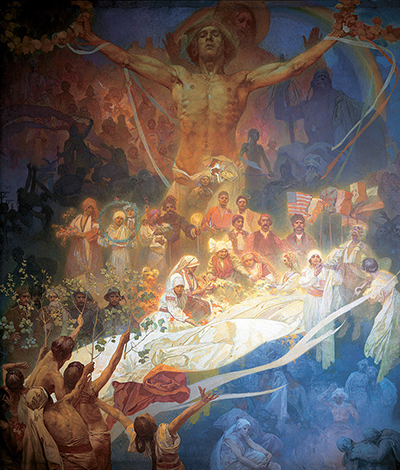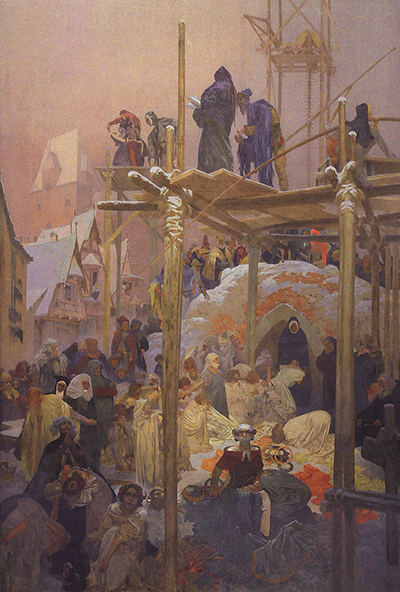
Jan Milíč of Kroměříž (1916), the seventh canvas in Mucha’s Slav Epic.
Buy Art Prints Nowfrom Amazon
* As an Amazon Associate I earn from qualifying purchases.
 by Tom Gurney
Tom Gurney BSc (Hons) is an art history expert with over 20 years experience
Page Created on / Page Updated on
Email: tomgurney1@gmail.com / Phone: +44 7429 011000
Jan Milíč of Kroměříž by Alphonse Mucha: A Building Site for Change
Wooden scaffolding rises through almost the whole height of Alphonse Mucha’s painting. A dark-robed preacher stands above a busy gathering, while women at ground level remove jewellery and put on pale clothes. The building behind them is unfinished. Mucha chose this scene for the seventh canvas of his Slav Epic, naming the fourteenth-century reformer Jan Milíč of Kroměříž and calling the subject “The Magic of the Word: A Brothel Converted into a Convent.” The work asks viewers to see a change in people and in a place at the same time.[1]
The Mucha Foundation dates the finished painting to 1916. The historical episode it represents belongs to 1372, when Milíč’s preaching was linked to a refuge for women in Prague. Neither date should be mistaken for the other. Nor should the scene be read as a record of one photographed day: Mucha assembled construction, public attention and symbolic gestures into a single dramatic image.[1][2]
The Foundation title's word “convent” is a compressed description. Research on Milíč's Jerusalem calls it a community of clerics, other lay followers and women leaving prostitution, with housing and material support; it was not simply a building handed to a settled women's order.[6][7] That difference makes the workers and the changing urban site more than incidental scenery. They point toward the practical resources behind the painted moment of conversion.
At a Glance
- ArtistAlphonse Mucha
- CycleThe Slav Epic, No. 7 of 20[1]
- Foundation titleJan Milíč of Kroměříž. The Magic of the Word: A Brothel Converted into a Convent (14th century)[1]
- Painting date1916[1]
- Mediumegg tempera on canvas[1]
- Dimensions620 × 405 cm, for the finished canvas[1]
- Historical focusMilíč’s preaching and the foundation of a refuge in Prague, associated with 1372[1][2]
The seventh Epic canvas in Mucha’s career
Contents
- What is happening on the scaffolding?
- Milíč before this scene
- What Jerusalem offered
- The women nearest the viewer
- The place changes too
- Painted in 1916
- Why this image holds attention
What is happening on the scaffolding?
The timber frame divides the canvas into several levels. Workers and onlookers occupy the upper platform; ropes, poles and posts carry the eye down to a cluster of people below. The Foundation identifies Milíč as a modest figure in blue with a long grey beard, preaching from the top of the scaffold.[1] He is easy to miss at first. Mucha gives more immediate space to the women and the fabric at the front than to the man named in the title.
This arrangement makes the building itself part of the action. It is neither a completed monastery nor a neutral backdrop. Open beams and rough masonry signal work in progress. A viewer sees the promised refuge being made while the preacher speaks. The Foundation describes construction for women who had left prostitution; the Prague City Gallery places the site in Prague’s Old Town and identifies the buildings to the left with Konviktská Street.[1][2] Those accounts offer a historical setting, while the picture presents Mucha’s interpretation of the change.
Mucha’s tall format reinforces the relationship between the two levels. We look upward to find Milíč, then back down to the nearest figures. The posts do not simply frame a saint on a platform. They connect his words to the activity under him. The title’s phrase “Magic of the Word” points to persuasion, but the painting shows labour, clothing and shelter as the visible results of that speech.[1][4]
Milíč before this scene
The Foundation describes Milíč as a learned theologian who held responsibilities in the church and in the court of Charles IV. Troubled by what he saw as corruption and indulgence among clergy, he left those positions to preach and work among poorer people.[1] The Gallery adds that he had served in the royal chancery and at St Vitus Cathedral. It says he preached in Czech, Latin and German, including in public streets, and faced accusations of heresy.[2]
That background matters because Mucha does not paint a ruler commanding change from above. Milíč appears in an elevated position, yet his authority rests on the spoken word and on the response below. His plain cloak contrasts with ceremonial power in the preceding Dušan canvas. In one painting, an imperial procession puts public authority on display; here, a construction site becomes the stage for moral reform. This comparison describes Mucha’s chosen subjects, not a claim that the two episodes were historically connected.
According to both institutional accounts, the significant turn came in 1372. The Foundation says a number of women who had been prostitutes turned to helping the sick and poor, and that Charles IV and local burghers supported a refuge, chapel and convent dedicated to Mary Magdalene.[1] The Gallery calls the new asylum New Jerusalem and says it was established at and around the site of a former brothel known as Venice.[2] Mucha compresses that story into the moment of visible transition. The old site remains in the background as the new structure rises in front of it.
Historian Peter C. A. Morée dates the laying of the chapel's foundation stone to 19 September 1372 and identifies Mary Magdalene as its dedicatee.[6] The chapel belonged to a wider compound near the street now called Konviktská. The biblical name Jerusalem expressed Milíč's hope for a transformed community in an age he saw through urgent expectations of religious renewal. The building project was therefore inseparable from his preaching, but the project needed land, money and daily support as well as words.
What Jerusalem offered
Morée describes people with different statuses living in the community: preachers, other lay followers and former prostitutes. His reading of the medieval Life of Milíč says some women found shelter and material support as they left sex work.[6] Eleanor Janega's archival study goes further into the urban problem. She argues that closing a brothel without offering alternative housing could leave women homeless or drive them into another establishment; she finds that Milíč's group provided food, shelter and, in some cases, help with debts.[7] Those material measures make Mucha's scaffolding more historically suggestive than a reading focused only on instant moral persuasion.
The building called Venice was an officially permitted brothel in the area. Morée writes that it was transferred to Milíč in 1372; Janega describes Charles IV ending its charter and placing its houses within the Jerusalem project.[6][7] This sequence is more exact than saying the women simply converted one brothel into a convent. It involved a royal decision, property, neighbouring houses, a chapel and an evolving community. The painting brings all those processes into one scene, while documentary research separates their stages.
Jerusalem also served people who had never been sex workers. Milíč trained preachers and developed sermons for a group of clerics and lay members. Morée shows that his Gratiae Dei sermons addressed a practical religious question within this unusual community: how frequently lay people, including the women, could receive communion. Milíč advocated frequent participation for all members.[6] This is an aspect of the reform that Mucha cannot easily show as a public change of clothing. It shifts attention from a single visible act of repentance to the community's continuing life.
That continuing life produced disputes the painting cannot show. In a study of Prague church-court records, Olga Kalashnikova describes a 1373 conflict between Milíč and the priest of nearby St Stephen's over the new chapel's income and parish rights. The court ruled for the parish in August; Milíč eventually withdrew his appeal later that year.[10] The issue was not whether the women had discarded jewellery. It was who held authority and received income after the site changed use. A refuge, chapel and preaching school occupied an existing city with other clergy and legal claims. Mucha's construction site is a fitting image of beginnings, but the documented institution also had to negotiate boundaries with its neighbours.
The women nearest the viewer
In the foreground, white cloth and discarded adornments catch the light. The Foundation reads the women’s removal of jewellery and adoption of white habits as signs of repentance and purity.[1] The Gallery also describes women taking off jewellery under the scaffold.[2] Mucha makes their changed appearance the picture’s most legible evidence of transformation. Even at a reduced size, pale garments stand apart from the darker figures and earth-coloured buildings.
These gestures are part of the artwork’s symbolic language. They do not tell us the inner thoughts or future lives of individual women. The institutional texts preserve a historical claim about a refuge, while Mucha’s painted figures carry his idealised story of conversion. A careful reading can describe the visible exchange of clothing without assuming that every woman accepted it in the same way or that the image proves a complete social resolution.
Nor do the accounts support treating the group as one uniform population. Morée notes that the medieval source speaks of many women changing their lives, but its language does not establish that all residents followed the same path.[6] Janega cautions against assuming every woman at Venice joined the project.[7] The white garments in Mucha's foreground create a coherent pictorial event; actual routes out of prostitution would have depended on circumstances that the canvas cannot record.
The surviving descriptions of the conversions also have a literary form. Kalashnikova notes that the medieval Life of Milíč calls the women's response a miracle, while another near-contemporary account by Matthias of Janov gives a much larger public conversion figure.[10] These texts are evidence that later followers regarded the episode as exceptional; they are not a roll of identifiable women in Mucha's foreground. Their different emphases help explain why a painter could make a single dramatic change of dress stand for a wider story, and why a historian has to ask how many people actually lived in Jerusalem and what happened to them afterward.
A tied-mouth woman in red draws attention at the front. The Foundation says she is gagged to prevent gossip; the Gallery gives the figure a broader symbolic role in repentance and reform.[1][2] The difference is useful. It shows that this detail is interpreted, rather than a straightforward report of a documented punishment. Mucha placed it where a viewer cannot avoid it, interrupting the gentle flow of white fabric with a harsh image of restraint. The scene’s moral promise has a stern edge.
The place changes too
The former brothel and the new refuge are central to the title, yet the picture does not present a simple before-and-after pair. Old buildings, scaffolding, workers and women share one crowded space. The Gallery identifies an onlooking crowd and the remains of the old establishment in the background.[2] Mucha makes a public urban transformation happen in view of neighbours, not behind closed doors.
From the lower left, the eye moves through a dense group toward the light cloth, then along the posts to the upper platform. The composition therefore gives a route through the story: people gather, some alter their dress, building rises, and a speaker addresses them. Each step supports the next in the painting’s visual argument. The structure is persuasive precisely because it lets a viewer discover Milíč after seeing the people and place that his words are said to affect.
At 620 × 405 cm, the finished canvas is much larger than either local image.[1] Its vertical scale would have allowed the foreground figures and upper scaffold to occupy distinct zones in front of a viewer. On a screen, the larger inherited reproduction helps recover some of that separation. It cannot reproduce the physical force of a painting more than six metres tall, but it makes the main pattern—an unfinished building joining speech and response—clear.
The historical site's later use sets a limit to the painting's triumphant present tense. Mlada Holá's study for the Czech Academy of Sciences records that Charles IV subsequently gave the Jerusalem property to the Cistercians for theological study; it became associated with a St Bernard college. Her note cites a 1374 donation.[8] Morée likewise says the Jerusalem community did not survive Milíč's unexpected death that year.[6] Mucha paints a beginning, not the institution's whole lifespan. Remembering the later transfer does not undo the refuge's significance; it prevents the finished scaffold from standing for a permanent social solution.
Painted in 1916
The Foundation records a separate oil-on-canvas study, about 34 × 23 cm, dated c.1915–16.[3] Its dimensions and medium belong to that study only. The finished painting is the 1916 egg-tempera canvas.[1] Keeping the objects apart matters because a preparatory version may preserve a compositional idea without being the monumental work shown here.
The Foundation’s chronology says Mucha presented the Milíč painting with two other 1916 canvases about religious speech and reform, forming a group it calls “Magic of the Word.”[4] This connection locates the page within the Slav Epic without requiring the three subjects to be read as one continuous event. Mucha used the cycle to move between different centuries, places and kinds of public action.
Mucha's focus on speech has a historical basis beyond the title. Morée distinguishes Milíč's early sermon collection Abortivus from the later Gratiae Dei, which developed in relation to Jerusalem's practical needs.[6] The preacher's words were written, taught and adapted for different listeners. The painting turns that sustained work into a dramatic instant on a scaffold. It captures the idea that speech can start change, while the site's history shows the further work required to sustain it.
The limits of what survives are important for a painting titled “The Magic of the Word.” Masaryk University's Czech biographical entry says Milíč preached in Czech and German and composed prayers in those languages, but that the spoken vernacular sermons have not survived, or may never have been written down.[9] Latin sermon collections and later accounts can reveal subjects and methods, yet they cannot reproduce the exact words heard at the scaffold Mucha imagined. The painted audience gives those lost sounds a powerful form. It also reminds us that the scene's particular speech is an artistic reconstruction rather than a recoverable transcript.[9]
The number seven is the finished canvas’s place in the Foundation’s catalogue sequence.[1] It does not mean Mucha painted it immediately after the sixth canvas. The Foundation’s individual record dates the Dušan painting to 1923, seven years later.[5] In Mucha’s historical arrangement, however, the fourteenth-century reformer follows the Serbian ruler. The sequence changes from law and ceremony to speech and refuge.
Why this image holds attention
It is possible to read the painting quickly as a tribute to a preacher. Look longer and the named man becomes only one part of the work. A scaffold, a half-built shelter, discarded jewellery, white clothing and a tied mouth all carry meaning. Some details celebrate care and renewal; another unsettles that promise. The picture is most revealing when those elements remain visible together, rather than being smoothed into a single uncomplicated success story.[1][2]
Mucha’s seventh canvas turns a place under construction into an argument about what words can do. The institutions identify the historical Milíč and the 1372 refuge; the painting asks us to watch a city and its people being remade before our eyes. Its lasting question is how much of that change a grand image can show—and how much remains beyond the painted scene.[1][2]
Watch: Alphonse Mucha
Follow Mucha’s work from Art Nouveau Paris to his later Czech projects.
Alphonse Mucha: Plongez dans l’Art nouveau !
A French museum introduction to Mucha’s Art Nouveau years, poster work and decorative language.
Watch on YouTubeArtworks directory
| Name | Date | Medium |
|---|---|---|
| 'Accept Love and Enthusiasm from Your Son, Mother of the Holy Nation': study for the mural 'By Own Strength III' at the Lord Mayor's Hall, Obecní Dům, Prague | 1910-1911 | Pencil and charcoal on canvas |
| 'By force towards freedom, with love towards unity!': study for the mural 'By Own Strength II' at the Lord Mayor's Hall, Obecní Dům, Prague | 1910-1911 | Pencil and charcoal on canvas |
| 'The Passing Wind Takes Youth Away': design for a fan and the façade of the 'Pavilion of Man' (unrealised) | 1899 | Colour lithograph |
| 'Through humiliated and tortured, you will live again, my country!': study for the mural 'By Own Strength II' at the Lord Mayor's Hall, Obecní Dům, Prague | 1910-1911 | Pencil and charcoal on canvas |
| 1918-1928: Poster for the 10th Anniversary of the Independence of the Republic of Czechoslovakia | 1928 | Colour lithograph |
| 6th Sokol Festival | 1912 | Colour lithograph |
| 8th Sokol Festival | 1925 | Colour lithograph |
| After the Battle of Grunwald | 1924 | egg tempera on canvas |
| After the Battle of Vitkov Hill | 1923 | egg tempera on canvas |
| Age of Love | 1936–1938 | |
| Age of Reason | 1936–1938 | |
| Age of Wisdom | 1936–1938 | |
| Amants | 1895 | Colour lithograph |
| Apotheosis of the Slavs | 1926 | Egg tempera on canvas |
| As Hamlet | 1899 | colour lithograph |
| Au Quartier Latin | 1898 | Magazine cover |
| Banknotes of Czechoslovakia, designed by Mucha: 500 crown; 50 Crown; 10 Crown | 1929 | Banknotes |
| Bieres de la Meuse | 1897 | Colour lithograph |
| Biscuits Champagne Lefevre Utile | 1896 | Colour lithograph |
| Biscuits Lefevre Utile | 1896 design for 1897 calendar; Foundation object/Carnavalet 1897 | Colour lithograph |
| Blessed are the Pure in Heart | 1906 | Printed magazine illustration |
| Bleu Deschamps | 1903 (deposit) | Colour lithograph |
| Bosnia & Herzegovina Pavilion - illustration featured in 'Le Figaro Illustré' (1 March 1900) | 1900 | Reproduction from Le Figaro Illustré after watercolour original |
| Bosnia-Herzegovina Pavilion: cartoon for the mural 'The Roman Period and the Arrival of the Slavs' | 1899-1900 | ink and crayon on paper |
| Bosnia-Herzegovina Pavilion: fragment of the upper frieze featuring Ivo and Anica, characters from Bosnian legends | 1899-1900 | tempera and watercolour on canvas |
| Bosnian Legends: Death of Hasanaga's Bride | 1899 | Charcoal on paper |
| Bosnian Legends: Murcia - The Plague Lady | 1899 | Charcoal on paper |
| Bosnian Pavilion Restaurant at the Paris Exhibition 1900: design for the menu | 1900 | Pencil and watercolour on paper |
| Boutique Fouquet (interior design) | 1901 | Shop interior design |
| Boutique Fouquet: sketches of the shop's signboard and decorative details | c.1900 | Pencil, ink and watercolour on paper |
| Box for Lefèvre-Utile biscuits: Gaufrettes Vanille | c.1900 | Tin box covered with lithographed label |
| Box for Lefèvre-Utile biscuits: Madère | c.1900 | Tin box covered with lithographed label |
| Brightness of the Day | 1899 | Colour lithograph |
| Broach with Pendant | 1900 | Gold, ivory, mother-of-pearl and semi-precious stones |
| Byzantine Head - The Blonde | 1897 | Colour lithograph |
| Byzantine Heads (pair) | 1897 | Colour lithograph |
| Byzantine Heads: Brunette | 1897 | Colour lithograph |
| Bénédictine | 1898 (BnF deposit); Hamburg 1899; MNAC 1896 or 1898 | Colour lithograph |
| Champagne Ruinart | 1896 | Colour lithograph |
| Chocolat Ideal | before or in 1897 (catalogue conflict) | Colour lithograph |
| Chocolat Masson (1897 calendar) | 1896–1897 | Colour lithograph |
| Choirboys at Petrov Church, Brno | 1905 | Watercolour on cardboard |
| Cloches de Noel | 1900 | Illustrated book |
| Comedy: study for a mural for the German Theatre, New York | 1908 | Oil on canvas |
| Cours Mucha: poster advertising Mucha's art classes held at the Académie Colarossi, Paris | 1900 | colour lithograph |
| Creative Force - Jan z Pernštýna: study for a pendentive of the Lord Mayor’s Hall, Obecní Dům, Prague | 1910-1911 | Oil on canvas |
| Crucifixion | c.1868 | Pencil, crayon and watercolour on paper |
| Cycles Perfecta | 1897 or 1902 (catalogue conflict) | Colour lithograph |
| Dance | 1898 | Colour lithograph |
| Dead Couple - Abandoned | c.1899-1900 | Charcoal and pastel on blue paper |
| Defense of Sziget against the Turks by Nicholas Zrinsky | 1914 | egg tempera on canvas |
| Design for a champagne poster | c. 1896 | Charcoal and pastel on paper |
| Design for a display stand at the Paris Exhibition 1900 | c.1899-1900 | Pencil and wash on paper |
| Design for Champagne Ruinart | c. 1896 | Pencil, watercolour and gold leaf on paper |
| Design for the cover of the magazine 'Fantaz' | 1882 | Ink and watercolour on paper |
| Design for the heading of the cover of the magazine 'Krokodil' | 1885 | Pen and ink on cardboard |
| Design for the poster for the Mucha Exhibition at the Brooklyn Museum, New York, January-February 1921 | 1920 | Pen and ink and watercolour on paper |
| Designs for cutlery | c.1900 | Charcoal and white on card |
| Designs for tableware | c.1900 | Charcoal, coloured pencil and white on card |
| Diadem for 'La princesse lointaine' | 1895 | metal and pearls |
| Diploma of Ivančice: Mock diploma honouring a local celebrity, with illustration of the first line of 'May', a poem by Karel Hynek Mácha | 1882 | Pen and ink and watercolour on paper |
| Documents décoratifs: designs for a watch and accessories (unused) | 1901-1902 | Pencil, ink and white on paper |
| Documents décoratifs: final study for Plate 25, featuring studies of lily | 1901-1902 | Pencil on paper |
| Documents décoratifs: final study for Plate 43 | 1901-1902 | Pencil, ink and wash, heightened with white on paper |
| Documents décoratifs: final study for Plate 49 | 1901-1902 | Pencil and white on paper |
| Documents décoratifs: final study for Plate 50 | 1901-1902 | Pencil and white on paper |
| Documents décoratifs: final study for Plate 60 | 1901-1902 | Pencil, ink and wash, heightened with white on paper |
| Documents décoratifs: final study for Plate 63 | 1901-1902 | Pencil and white on paper |
| Documents décoratifs: final study for Plate 67 | 1901-1902 | Pencil and white on paper |
| Documents décoratifs: final study for Plate 71 | 1901-1902 | Pencil and white on paper |
| Documents décoratifs: final study for Plate 72 | 1901-1902 | Pencil and wash, heightened with white on paper |
| Documents décoratifs: line drawing for Plate 33, featuring lily motifs | 1901-1902 | Pencil, pen and ink on paper |
| Documents décoratifs: Plate 54 | 1902 | Lithograph |
| Dreaming of Freedom: study for a Panel of the Small Reception Room at the Lord Mayor’s Hall, Obecní Dům, Prague | 1910-1911 | Pen and ink and watercolour on paper |
| Dusk | 1899 | Colour lithograph |
| Evening | 1899 | Colour lithograph |
| F. Champenois (Rêverie imprint) | 1898 | Colour lithograph |
| F. Guillot-Pelletier calendar (1898) | 1897–1898 | Colour lithograph |
| Feather | 1899 | Colour lithograph |
| Figures décoratives: final study for Plate 2 | 1904-1905 | Pencil and white on paper |
| Figures décoratives: final study for Plate 3 | 1904-1905 | Pencil and white on paper |
| Figures décoratives: final study for Plate14 | 1904-1905 | Pencil with white on paper |
| Figures décoratives: sketch study for Plate14 | 1904-1905 | Blue pencil on paper |
| Flirt Lefevre Utile | 1899 (Foundation design); BnF legal deposit 1900 | Colour lithograph |
| Flower | 1897 | Colour lithograph |
| Flower: final study for decorative panel | 1897 | Pencil, ink and watercolour on paper |
| France Embraces Bohemia | 1918 | oil on canvas |
| Fruit | 1897 | Colour lithograph |
| Georges Fouquet (1858-1929), Paris, after design by Mucha: Ornamental Chain with pendants | 1900 | Gold, enamel, fresh-water pearls, mother of pearl and semi-precious stones |
| Georges Fouquet (1858-1929), Paris, after Mucha design: 'Peacock' Ring (Exhibited at the Paris Exhibition 1900) | 1900 | Opal and gold |
| Girl Weeping | c.1899-1900 | Black chalk and pastel on paper |
| Girl with Loose Hair and Tulips | 1920 | Oil on canvas |
| Gismonda | 1894 | Colour lithograph |
| Head of a Girl, statue for the stand of the Houbigant Perfumery at the Paris Exhibition 1900 | 1900 | Bronze, silver and parcel gilt |
| Head of Sarah Bernhardt: Study for 'Lorenzaccio' | 1896 | Pencil on paper |
| Heather from Coastal Cliffs | 1902 | Colour lithograph |
| Heidsieck & Co | 1901 | Colour lithograph |
| Holy Mount Athos | 1926 | Egg tempera on canvas |
| Ilsée, Princesse de Tripoli | 1897 | Illustrated book |
| In the Desert: Study for an illustration for the Světozor magazine | 1889 | Pencil, watercolour and gouache on paper |
| Incantation (Salammbô) | 1897 | Lithograph |
| Independence - Jiří z Poděbrad: study for a pendentive of the Lord Mayor’s Hall, Obecní Dům, Prague | 1910-1911 | Oil on canvas |
| Interior and furniture designs | c.1900 | Pencil on paper |
| Interior of Boutique Fouquet: design for a wall-mounted display cabinet with statuette and mirror | c.1900 | Pencil on paper |
| Interior of Boutique Fouquet: design for the fireplace with statuettes, mirror, and the ornamental details of the wall | c.1900 | Pencil and watercolour on cardboard |
| Interior of Boutique Fouquet: sketches of the fireplace with statue, mirror, display cabinet, and the ornamental details of the wall | c.1900 | Pencil, pen and ink on paper |
| Ivy | 1901 | Colour lithograph |
| Jan Milic of Kromeriz | 1916 | egg tempera on canvas |
| Jaroslava and Jiří, the Artist’s Children | 1918 | Oil on canvas |
| JOB poster | 1896 | Colour lithograph |
| Judgement of Paris (calendar for Vieillemard printing company) | 1895 | Colour lithograph |
| Justice - Master Jan Hus: study for a pendentive of the Lord Mayor's Hall, Obecní dům, Prague | 1910-1911 | Oil on canvas |
| L'Annee Qui Vient | 1897 | red chalk on paper |
| L'Illustration magazine - cover for Christmas 1896/1897 | 1896 | Magazine cover |
| L'Illustré Soleil du Dimanche | 1897 | Magazine cover |
| La Dame aux Camélias: designs for cover and interior of special programme | 1896 | Pencil and watercolour on paper |
| La Nature | 1899-1900 | Bronze and amethyst |
| La Plume | 1897 | Magazine cover |
| La Samaritaine | 1897 | colour lithograph |
| Lance Parfum Rodo | 1896; Albertina print c. 1900 | Colour lithograph |
| Laurel | 1901 | Colour lithograph |
| Le Monde Illustré | 1900 | Magazine cover |
| Le Pater | 1899 | Illustrated book |
| Le Pater: early study for the 1st allegorical scene 'Our Father who art in Heaven' (1899) (Mucha Foundation object 300) | 1899 | Pencil on paper |
| Le Pater: early study for the 1st allegorical scene 'Our Father who art in Heaven' (1899) (Mucha Foundation object 302) | 1899 | Pastel on paper |
| Le Pater: study for the 6th allegorical scene 'Forgive us our debts, as we forgive our debtors' | 1899 | Charcoal and ink wash on paper |
| Lefevre Utile | 1904 | Advertisement |
| Leslie Carter | 1908 | Colour lithograph |
| Letem Českým Světem | 1898 | Printed book |
| Lorenzaccio | 1896 | Colour lithograph |
| Luchon poster (attributed to Mucha) | 1895 | Colour lithograph |
| Madonna of the Lilies | 1905 | Tempera on canvas |
| Master Jan Hus Preaching at the Bethlehem Chapel | 1916 | egg tempera on canvas |
| Maude Adams | 1908 | Lithograph, hand-coloured in watercolour and gouache |
| Maude Adams as Joan of Arc | 1909 | Oil on canvas |
| Medea | 1898 | Colour lithograph |
| Menu for the Bosnian Pavilion Restaurant at the Paris Exhibition 1900 | 1900 | Colour lithograph |
| Militancy - Jan Žižka: study for a pendentive of the Lord Mayor's Hall, Obecní dům, Prague | 1910-1911 | Oil on canvas |
| Military Camp in Winter, near a City on Fire | c.1899-1900 | Pastel on paper |
| Moet et Chandon | 1899 | Colour lithograph |
| Monaco Monte Carlo | 1897 | Colour lithograph |
| Moon | 1902 | |
| Moravian Teachers' Choir | 1911 | Colour lithograph |
| Morning Alphonse Mucha Painting / AlphonseMucha.org | 1899 | Colour lithograph |
| Morning Star | 1902 | Colour lithograph |
| Moët & Chandon White Star | 1899 | Colour lithograph |
| Mrs Mucha’s Necklace | 1906 | gold, enamel and semi-precious stones |
| Mural for the Bosnia-Herzegovina Pavilion: The Roman Period and the Arrival of the Slavs | 1900 | tempera and watercolour on canvas |
| Murals by Mucha in the Lord Mayor's Hall, Obecní Dům (Municipal House), Prague (1910-1911) | ||
| Music | 1898 | Colour lithograph |
| Nativity | c. 1934 | oil on canvas |
| Nestle's Food for Infants | 1897 | Colour lithograph |
| Night | 1899 | Colour lithograph |
| Nude on a Rock | 1898-1899 | Bronze |
| Official Banquet of the Paris Exhibition 1900: design for the menu featuring a fashionable woman wearing a Mucha-style jewellery | 1900 | Pencil, gouache and wash on grey paper |
| Ornamental motifs designed for 'Combinaisons Ornementales se Multipliant à l'Infini à l'Aide du Miroir' (1901) | c.1900-1901 | Blue and red pencil on paper |
| Packaging for 'Savon Mucha Violette' | 1906 | Colour lithograph |
| Packaging for Lefèvre-Utile biscuits: Boudoir | 1901 | Colour lithograph |
| Page's Costume: study for an illustration for 'Le Costume au Théâtre' | 1890 | Pencil and watercolour on cardboard |
| Painting | 1898 | Colour lithograph |
| Peonies | 1897–1898 | Ink and watercolour |
| Petr Chelcicky at Vodnany | 1918 | egg tempera on canvas |
| Poetry | 1898 | Colour lithograph |
| Portrait of Jaroslava | c.1927-1935 | Oil on canvas |
| Portrait of Josephine Crane Bradley as Slavia | 1908 | Oil and tempera on canvas |
| Portrait of Marie Chytilová (Maruška), Mucha's Future Wife | 1903 | pastel on paper |
| Portrait of Mucha's Sister, Angela | c.1880 | Oil on canvas |
| Portrait of Mucha's Sister, Anna | c.1885 | Oil on canvas |
| Portrait of Mucha's Son, Jiří | 1925 | Oil on canvas |
| Portrait of Mucha's Wife, Maruška | 1908/17 | Oil on canvas |
| Portrait of Woman | c. mid 1910s - 1925 | Blue pastel on grey paper |
| Poster for 'Hommage Respectueux de Nestlé' (the Nestlé Company's tribute to Queen Victoria's 60th Jubilee) | 1897 | Colour lithograph |
| Poster for 'Imprimerie Cassan Fils' | 1896 | Colour lithograph |
| JOB poster (1898) | 1898 | Colour lithograph |
| Poster for 'La Dame aux Camélias' | 1896 | Colour lithograph |
| Poster for 'La Tosca' | 1899 | Colour lithograph |
| Poster for 'Regional Exhibition at Ivančice 1913' | 1912 | Colour lithograph |
| Poster for 'The Slav Epic Exhibition, Brno, 1930' | 1928-1930 | Colour lithograph |
| Poster for 'Waverley Cycles' | 1898 | Colour lithograph |
| Poster for the 'Lottery of the Union of Southwestern Moravia' | 1912 | Colour lithograph |
| Poster for the Austrian Pavilion at the Paris Exhibition 1900 | 1900 | Colour lithograph |
| Prague Subjugated: study for a Panel of the Small Reception Room at the Lord Mayor’s Hall, Obecní Dům, Prague | 1910-1911 | Pen and ink and watercolour on paper |
| Primrose | 1899 | Colour lithograph |
| Primrose and Feather (paired image) | 1899 | Colour lithographs (paired image) |
| Princess Hyacinth (Princezna Hyacinta) | 1911 | Colour lithograph |
| Print proof for the Biscuits Lefèvre-Utile tin | 1899 | Lithograph |
| Reverie | 1898 | Colour lithograph |
| Russia Restituenda [Russia Must Recover] | 1922 | Colour lithograph |
| Salome | 1897 | Colour lithograph |
| Salon des Cent | 1896 | Colour lithograph |
| Salon of the Hundred | 1897 | Colour lithograph |
| Sarah Bernhardt - La Princesse Lointaine - Lefevre Utile | 1903 | Colour lithograph |
| Sarah Bernhardt as La Princesse Lointaine: poster for 'La Plume' magazine | 1897 | Colour lithograph |
| Sarah Bernhardt in the role of the Duc de Reichstadt in L’Aiglon | 1900 | Pencil on paper |
| Sarah Bernhardt: study of her full-standing figure | c.1896 | Pen and ink on paper |
| Savonnerie de Bagnolet calendar | 1898 (calendar) | Printed advertising calendar |
| Self-portrait (1899) | 1899 | Oil on board |
| Self-portrait (1907) | 1907 | Blue and white crayon on blue Ingres paper |
| Self-portrait, sketching in his apartment, Paris | late 1880s | oil on canvas |
| Sketches of flowers for Documents décoratifs | c.1900-1901 | Pen and ink on paper |
| Slavia insurance poster | 1907 | Poster |
| Slavs in their Original Homeland | 1912 | Egg tempera on canvas |
| Snake Bracelet with a Ring | 1899 | Gold, enamel, opal, ruby and diamond |
| Société Populaire des Beaux Arts | 1897 | Colour lithograph |
| Song of Bohemia | 1918 | oil on canvas |
| St. Vitus Cathedral Stained-glass Window, Prague: final design for the central panels, featuring SS Cyril and Methodius | 1931 | Ink and watercolour on paper |
| St. Vitus Cathedral Stained-glass Window, Prague: final design for the central panels, featuring St. Ludmila | 1931 | Ink and watercolour on paper |
| St. Vitus Cathedral Stained-glass Window, Prague: final design for the central panels, featuring St. Wenceslas (Duke of Bohemia) kneeling next to his Grandmother, St. Ludmila | 1931 | Ink and watercolour on paper |
| St.Vitus Cathedral Stained-glass Window, Prague: final design for the bottom left panels | 1931 | Ink and watercolour on paper |
| St.Vitus Cathedral Stained-glass Window, Prague: final design for the bottom right panels | 1931 | Ink and watercolour on paper |
| Stained-glass Window designed by Mucha at St. Vitus Cathedral, Prague | Early 1930s | N/A |
| Study for 'The Age of Reason' | 1936-1938 | Pencil and watercolour on paper |
| Study for 'The Slav Epic cycle' No.19: The Abolition of Serfdom in Russia | 1913-1914 | Watercolour and gouache on paper |
| Study for 'The Slav Epic' cycle No.14: The Sacrifice at Szigetvár by Nikola Zrinski | c.1913-1914 | Photographed drawings stuck together, tinted with watercolour and gouache |
| Study for 'The Slav Epic' cycle No.17: The Holy Mount Athos (1926) | c.1925-26 | Charcoal heightened with white on cardboard |
| Study for 'The Slav Epic' cycle No.18: The Oath of Omladina under the Slavic Linden Tree | c.1925-1926 | Pencil and watercolour on paper |
| Study for 'The Slav Epic' cycle No.1: The Slavs in Their Original Homeland (1912) | c.1910-1912 | Oil on canvas |
| Study for 'The Slav Epic' cycle No.2: The Celebration of Svantovít | c.1910-1912 | Oil on canvas |
| Study for 'The Slav Epic' cycle No.7: Jan Milíč of Kroměříž | c.1915-1916 | Oil on canvas |
| Study for 'The Slav Epic' cycle No.9: Master Jan Hus Preaching at the Bethlehem Chapel. The Magic of the Word: Truth Prevails (1412). | c.1915-1916 | Oil on canvas |
| Study for 'The Three Ages' triptych: Reason, Wisdom and Love [unfinished project] | 1936-1938 | Pencil and watercolour on paper |
| Study for 'Woman in the Wilderness' (c. 1922-1923) (Mucha Foundation object 315) | c. 1922-1923 | oil on canvas |
| Study for 'Woman in the Wilderness' (c. 1922-1923) (Mucha Foundation object 316) | c. 1922-1923 | oil on canvas |
| Study for Savon Notre Dame | c. 1896 | pencil and watercolour on paper |
| Study for the poster 'Russia Restituenda [Russia Must Recover]' | 1922 | Pen and ink and watercolour on paper |
| Study of a Male Nude | 1885-1887 | Oil on canvas |
| The Abolition of Serfdom in Russia | 1914 | Egg tempera on canvas |
| The Arts (series) | 1898 | Colour lithograph |
| The Arts: study for 'Dance' | 1898 | Pencil and watercolour on paper |
| The Arts: study for 'Music' | 1898 | Pencil and watercolour on paper |
| The Arts: study for 'Painting' | 1898 | Pencil and watercolour on paper |
| The Arts: study for 'Poetry' | 1898 | Pencil and watercolour on paper |
| The Bohemian King Premysl Otakar II | 1924 | egg tempera on canvas |
| The Bulgarian Tsar Simeon | 1923 | egg tempera on canvas |
| The Burr McIntosh Monthly, 1907 | 1907 | Magazine cover |
| The Celebration of Svantovit | 1912 | egg tempera on canvas |
| The Coronation of the Serbian Tsar Stefan Dusan as East Roman Emperor | 1923 | egg tempera on canvas |
| The Devil and Mr Twardowsky: study for an illustration for 'The Tale of Pan Twardowsky' (a variation of 'Faust') | c.1887-1888 | Charcoal on paper |
| The Flowers (series) | 1898 | Colour lithographs |
| The Flowers: Carnation | 1898 | Colour lithograph |
| The Flowers: Iris | 1898 | Colour lithograph |
| The Flowers: Lily | 1898 | Colour lithograph |
| The Flowers: Rose | 1898 | Colour lithograph |
| The Hussite King Jiri of Podebrady | 1923 | Egg tempera on canvas |
| The Introduction of the Slavonic Liturgy | 1912 | egg tempera on canvas |
| The Last Days of Jan Amos Komensky (Comenius) in Naarden | 1918 | Egg tempera on canvas |
| The Light of Hope | 1933 | Oil on canvas |
| The Meeting at Krizky | 1916 | egg tempera on canvas |
| The Months (January-June) | 1899 | Colour lithograph |
| The Months (July-December) | 1899 | Colour lithograph |
| The Moon and the Stars (four-panel montage) | 1902 | Colour lithographs (four-panel montage) |
| The Moon and the Stars (series) | 1902 | Colour lithograph |
| The Moon and the Stars: study for 'The Evening Star' | 1902 | Ink and watercolour on paper |
| The Moon and the Stars: study for 'The Pole Star' | 1902 | Ink and watercolour on paper |
| The New York Daily News art supplement | 1904 | Printed art supplement |
| The Oath of Concord of the Slavs (unfinished) | 1939 | oil on canvas |
| The Oath of Omladina under the Slavic Linden Tree | 1926, unfinished | Egg tempera on canvas |
| The Precious Stones (four-panel montage) | 1900 | Colour lithographs (four-panel montage) |
| The Precious Stones (series) | 1900 | Colour lithograph |
| The Precious Stones: Amethyst | 1900 | Colour lithograph |
| The Precious Stones: Emerald | 1900 | Colour lithograph |
| The Precious Stones: Ruby | 1900 | Colour lithograph |
| The Printing of the Bible of Kralice in Ivancice | 1914 | egg tempera on canvas |
| The Seasons (series) | 1896 | Colour lithograph |
| The Seasons (series) (1900) | 1900 | Colour lithograph |
| The Seasons (variation in screen format) | 1896 | Colour lithograph |
| The Seasons: Autumn (1896) | 1896 | Colour lithograph |
| The Seasons: Autumn (1900) | 1900 | Colour lithograph |
| The Seasons: Spring | 1900 | Colour lithograph |
| The Seasons: Spring (1896) | 1896 | Colour lithograph |
| The Seasons: Summer | 1900 | Colour lithograph |
| The Seasons: Summer (1896) | 1896 | Colour lithograph |
| The Seasons: Winter | 1900 | Colour lithograph |
| The Seasons: Winter (1896) | 1896 | Colour lithograph |
| The Slavonic Concord: study for the ceiling painting for the Lord Mayor's Hall, Obecní Dům, Prague | 1910-1911 | Oil on canvas |
| The Threat | 1912 | Colour lithograph |
| The Times of the Day (series) | 1899 | Colour lithograph |
| The West End Review | 1897 (Foundation); 1898 promotional cover | Colour lithograph |
| Thistle from the Sands | 1902 | Colour lithograph |
| Théâtre de la Renaissance: design for poster advertising Sarah Bernhardt's theatre | c.1895 | Pen and ink on paper |
| Tin for Lefèvre-Utile biscuits | 1899 | Circular tin with lid and handle; colour print on metal |
| Topaz | 1900 | Colour lithograph |
| Tragedy - study for a mural for the German theatre New York | 1908 | Oil and tempera on canvas |
| Trappistine Liquors | 1897 | colour lithograph |
| Wiener Chic | 1905 | Magazine cover |
| Woman in the Wilderness | 1923 | Oil on canvas |
| Woman masked in white head-scarf - study for the illustration of the Bosnia & Herzegovina Pavilion featured in 'Le Figaro Illustré' (1 March 1900) | 1899 | Pencil and wash heightened with white on paper |
| Woman with a Daisy - textile designed by Mucha | 1900 | Printed upholstery fabric |
| Zdenka Cerny | 1913 | Colour lithograph |
| Zodiac (La Plume calendar) | 1896–97 | Colour lithograph |
| Zodiac (textless decorative panel) | 1896 | Colour lithograph |
| ‘At the sight of the two storks the owl rose.’ Study for an illustration for Contes de Grand-mères | 1891 | Watercolour and gouache on paper |
Frequently Asked Questions
When did Mucha paint Jan Milíč of Kroměříž?
Where is Milíč in the painting?
Is the small oil study the same object?
Discussion
Mucha places Milíč above a crowded foreground and connects his preaching to a refuge under construction.
The women’s clothing and jewellery carry the painting’s symbolic account of change.
Reader Insights
How does the scaffolding lead your eye between Milíč and the figures below?
Which details make the site feel unfinished?
How do you read the tied-mouth figure beside the pale fabric?
Join the Conversation
Share what you notice about the building, the people and the power of speech in this scene.
References
- Mucha Foundation, “The Slav Epic cycle No. 7: Jan Milíč of Kroměříž,” object 218, finished-canvas identity, date, medium, dimensions and interpretation. View source.
- Prague City Gallery, “Jan Milíč z Kroměříže,” illustrated story presented through Google Arts & Culture, based on the 2022 Moravský Krumlov exhibition catalogue. View source.
- Mucha Foundation, “Study for The Slav Epic cycle No. 7: Jan Milíč of Kroměříž,” object 179, separate oil study. View source.
- Mucha Foundation, timeline, 1916 entry for the three Magic of the Word canvases. View source.
- Mucha Foundation, “The Slav Epic cycle No. 6: Tsar Štěpán Dušan,” object 217, catalogue date for the preceding canvas. View source.
- Peter C. A. Morée, “Similiter predicator: The Relation of the Postils of Milíč of Kroměříž to his Work and the Jerusalem Community,” Bohemian Reformation and Religious Practice 7 (2009), on the compound, sermons and community. View source.
- Eleanor Janega, Jan Milíč of Kroměříž and Emperor Charles IV: Preaching, Power, and the Church of Prague, University College London doctoral thesis, on the urban context, housing, debts and Charles IV's role. View source.
- Mlada Holá, “Studentské koleje pražské univerzity a staroměstský měšťan Kříž,” Mediaevalia Historica Bohemica 18/2 (2015), on Jerusalem's later use as a Cistercian college and the 1374 donation. View source.
- Masaryk University, Czech biographical entry “Milíč z Kroměříže,” on his preaching languages, surviving writings and limits of the vernacular sermon record. View source.
- Olga Kalashnikova, Central European University doctoral thesis (2024), discussion of the medieval Life, Matthias of Janov and Prague church-court proceedings concerning Jerusalem in 1373, pp. 151–153. Read source.