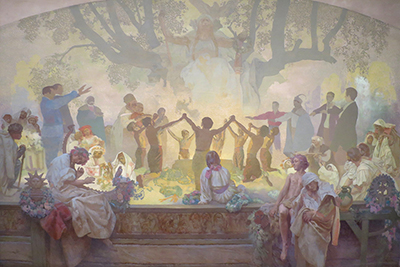
Oath of Omladina (1926, unfinished), the eighteenth canvas in Mucha’s Slav Epic according to the Foundation’s individual catalogue.
Buy Art Prints Nowfrom Amazon
* As an Amazon Associate I earn from qualifying purchases.
 by Tom Gurney
Tom Gurney BSc (Hons) is an art history expert with over 20 years experience
Page Created on / Page Updated on
Email: tomgurney1@gmail.com / Phone: +44 7429 011000
Oath of Omladina: Youth Beneath Mucha’s Linden Tree
Young people join hands in a circle beneath the spreading branches of a linden tree. Above them sits an enormous figure of Slavia; below, musicians and children face the gathering. In Oath of Omladina under the Slav Linden Tree, Alphonse Mucha brought the eighteenth canvas of his Slav Epic toward the Czech national revival of the late nineteenth century. The Mucha Foundation dates the painting to 1926 and identifies it as unfinished.[1]
The picture is a pledge made visible, not a record of a documented oath ceremony. Mucha sets historical youth politics inside an allegorical scene where a national figure and a living tree give the gathering symbolic weight. Its unfinished state matters too. It leaves this canvas distinct from the nineteen Slav Epic paintings shown together in Prague in 1928.[1][6]
At a Glance
- ArtistAlphonse Mucha
- CycleThe Slav Epic, No. 18 of 20[1]
- Foundation titleOath of the “Youth” under the Slav Linden Tree. The Slav Revival (19th century)[1]
- Date and state1926, unfinished[1]
- MediumFoundation: egg tempera on canvas; Prague exhibition: egg tempera and oil; a published conservation examination specifically identifies oil painting in this canvas[1][7][8]
- DimensionsFoundation: 420 × 620 cm; Prague exhibition: 390 × 590 cm; the conflicting measurements are not reconciled here[1][7]
- Historical focusOmladina and the Czech nationalist youth movements of the 1890s[1][2][3]
The eighteenth Epic canvas in Mucha’s career
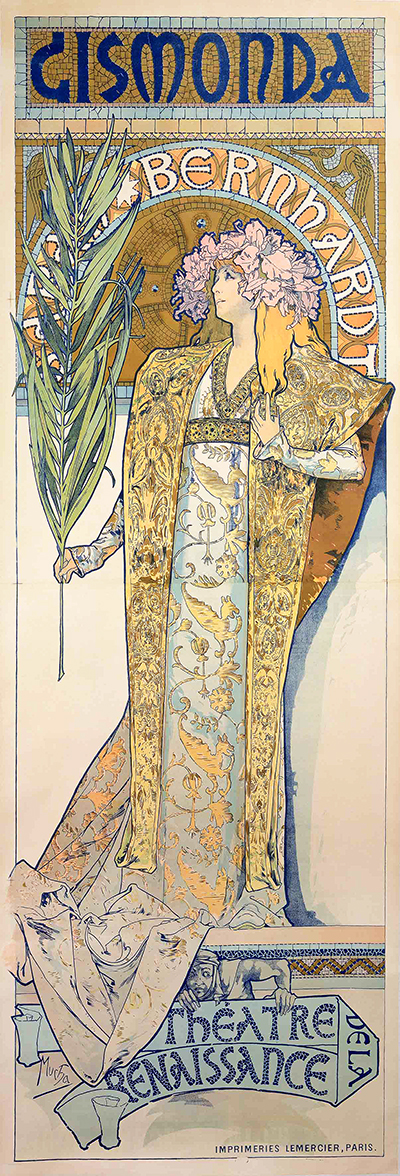
Gismonda
1894 designLe Pater
1899Master Jan Hus
1916Holy Mount Athos
1926Oath of Omladina
1926, unfinishedContents
- Omladina and the 1890s
- From street protest to the 1894 trial
- After the verdict
- Slavia in the tree
- The people around the circle
- Jaroslava, Jiří and the foreground
- An unfinished canvas in a twenty-part cycle
- Looking again
Omladina and the 1890s
Omladina was associated with Czech youth politics under Austria-Hungary at the end of the nineteenth century. The Foundation describes it as nationalist, anti-Austrian and anti-clerical.[1] Prague City Gallery places a major trial of people accused in the Omladina affair in 1894; Czech Radio independently confirms that date.[2][3] The case shows the political stakes behind Mucha's apparently ceremonial painting.
The Foundation's object text says the leaders were prosecuted in 1904.[1] That conflicts with the Gallery, Czech Radio and a 441-page account of the trial printed in 1894, catalogued by the National Library of the Czech Republic.[2][3][9] The historical trial was in 1894; the canvas was made decades later, in 1926.
The word Omladina needs care as well. It can identify a real milieu of radical students and other young Czech activists, but the alleged disciplined secret organisation prosecuted by the authorities is a different proposition. Czech Television's historical account says police constructed the conspiracy case, while the Czech National Bank calls Alois Rašín's conviction a staged prosecution.[10][11] Rašín was sentenced to two years' imprisonment, later entering the political life of the independent state.[11] Mucha's joined circle presents solidarity as an ideal. It should not be read as proof that a formally constituted oath-taking society stood before a court in the way the prosecution claimed.
The name was also used by a periodical around which one group of young activists gathered. Czech Radio's historical account places that circle among several progressive student and worker groups, rather than making it the command centre of a single organisation.[12] Their positions were varied. Some favoured social reform or forms of socialism; others placed greater weight on Czech national rights and cooperation among Slavic peoples. At a progressive youth congress in Prague in 1891, delegates produced a programme addressing both national and social demands within a proposed reorganisation of Austria-Hungary.[12] The painting's calm, unanimous ceremony compresses this politically uneven world into one legible gesture.
The range of people named in Czech Radio's history helps make that variety concrete. It places the young law students Antonín Čížek and Alois Rašín and philosophy student Karel Stanislav Sokol in the progressive current. It also identifies a strand connecting students with working youth, including the typographer Antonín Pravoslav Veselý, writer Stanislav Kostka Neumann and future cooperative theorist František Modráček.[12] This is a map of overlapping circles, not a roster of the painted figures or a claim that all six made the same pledge. The 1891 programme's combination of national and social proposals likewise prevents “anti-Austrian” from describing every political aim on its own. Mucha's youthful bodies stand in for a more diverse generation than the few faces he could place around the tree.
Mucha does not reconstruct the courtroom or identify all the accused. He imagines a collective promise. In the painting, hands link the young figures into a ring, while people from different generations watch around them. This is a vision of political inheritance and solidarity, not a literal picture of how a group took its oath.[1][2]
From street protest to the 1894 trial
The crisis that gave the name Omladina national prominence unfolded in the streets before it reached the courtroom. Historian Jiří Pernes, speaking to Czech Radio, connects the unrest to frustration with Czech political representation in the Habsburg monarchy. Public commemorations of Jan Hus, Jan Amos Komenský and Karel Havlíček Borovský offered occasions for young radicals to demonstrate. On 12 September 1893, protesters recalled Emperor Franz Joseph's unfulfilled promise to be crowned King of Bohemia; police dispersed a meeting on Prague's Žofín island. The account describes subsequent insults to imperial images and a police search for an organisation supposedly directing the disturbances.[13] These events supply a sharper setting for Mucha's later image than the phrase “national revival” alone.
Czech Radio's longer historical account says emergency measures followed the September unrest and that police used information from Rudolf Mrva, an informer whose testimony was partly invented, in arrests of students and young workers.[12] Mrva was murdered in December 1893. The account treats that killing as an isolated act, although it intensified the case against the wider group of defendants.[12] The painting contains no corresponding confrontation, informer or victim. Its shared oath turns a fractured sequence of demonstrations, arrests and accusations into an image of voluntary collective purpose. That is a choice of historical imagination, not a description of the investigation.
Seventy-six people faced the Omladina trial and sixty-eight were convicted, according to Czech Radio's two accounts.[12][13] The archive of the Masaryk Institute and Archives of the Czech Academy of Sciences catalogues the Prague criminal court's Omladina case files under NAD 5020, covering 1893–1895, and identifies the political trial as a 1894 event.[14] The surviving court-file collection is a route into the prosecution's history. Its catalogue entry alone does not establish that an oath like the one Mucha painted ever occurred.
After the verdict
The legal story did not end with the sentences. Czech Radio dates an amnesty for the Omladina defendants and others affected by the emergency period to 18 October 1895.[12] It also observes that police action brought together people who later separated into different political parties. This later divergence is another reason to resist reading the painted ring as a portrait of a stable movement with one programme. Mucha looked back from 1926, after the creation of Czechoslovakia, and gave a disputed 1890s episode a unifying place in a cycle about Slavic history.[1][6][12]
That retrospective setting matters for the children at the foot of the canvas. The young activists of the 1890s had become part of an earlier generation by the time Mucha worked on the picture; his own children modeled the figures positioned nearest to the later viewer.[1][2] The work therefore connects two kinds of youth separated by decades. One belongs to the contested history of the Habsburg monarchy, and the other to Mucha's imagined audience after independence. The canvas does not show what the defendants became one by one. It asks what later generations might inherit from their struggle, while the historical record reminds us that inheritance need not be unanimous.
That distance changes the force of the word “oath.” In the court's version, an alleged secret society helped explain street protests as conspiracy. In Mucha's version, a public circle pledges itself beneath a national allegory. The painting neither clears each defendant nor verifies the prosecution's account; it interprets youth activism through the later language of collective commitment. The published institutional histories and archive catalogue support a real protest and trial, while leaving the supposed ritual at the centre of the picture unverified.[12][13][14]
Slavia in the tree
The linden canopy spans much of the composition. High in its branches, Slavia presides over the circle below.[1][2] She is an allegorical figure, not a historical participant in the Omladina affair. Her scale and position turn a group of kneeling youths into a scene with a larger national meaning.
The young people raise joined hands toward one another. Some are seen from behind, so the viewer reads their connection before reading their faces. Their ring sits between Slavia above and a low carved boundary in the foreground. It binds the centre of the canvas while other people enter from the edges. Mucha gives the pledge a physical shape, making its mutual character visible without writing its words across the image.
The tree provides more than shelter. It allows Slavia, the youths and the onlookers to occupy one continuous space. Its trunk and branches hold a setting broad enough for generations and groups that would not have stood together at a single meeting. The painting's historical claim is about continuity: young people place themselves within an older imagined community.[1][2]
The people around the circle
The Foundation identifies people near the youths as members of patriotic and political organisations and figures in folk dress representing the Czech people.[1] Prague City Gallery describes a Sokol participant at the right and an older Serbian figure at the left as reminders that national movements reached beyond the central Czech group.[2] These are institutional readings of painted identities; the inherited image supports the arrangement and costumes more readily than every specific name.
The onlookers do not form a uniform crowd. Some stand with arms extended, others watch quietly, and a few turn toward a musician. The varied poses make the scene feel like a public gathering with many kinds of involvement. Mucha can suggest a broader Slavic solidarity while making the central oath distinctly about youth and the Czech revival.
The painting also invites a careful distinction between nationalism as Mucha represents it and the history of the political movement. Omladina's trial belongs to a specific late nineteenth-century conflict; Slavia and the linden tree belong to an allegorical vocabulary. The canvas joins those registers. Its imagery tells us what Mucha wanted the pledge to mean, rather than documenting every belief held by the accused people of 1894.[1][2][3]
Jaroslava, Jiří and the foreground
Closer to the viewer, the scene becomes more intimate. The Foundation identifies the girl with the stringed instrument and the boy at the opposite side as figures modeled on Mucha's children Jaroslava and Jiří.[1] Prague City Gallery also links the two foreground faces to them.[2] The children stand for a future that might receive the ideals pledged by the central ring.
The young musician does not take the oath herself. She sits near the carved front edge of the scene, turning the ceremonial act into something watched and heard. The boy's posture is quieter. Placing these figures at the front changes the viewer's relation to the scene: we are not inside the oath circle, but close to the next generation that may inherit its consequences.
The Foundation notes that the girl's lyre-playing image later appeared in a poster for the 1928 Slav Epic exhibition.[1] That connection shows how Mucha carried a motif from an unfinished canvas into the cycle's public presentation. It does not make the unfinished painting itself one of the canvases exhibited that year.
An unfinished canvas in a twenty-part cycle
The Foundation's individual catalogue dates Oath of Omladina to 1926, unfinished. It says that several figures remain in egg tempera without an oil finish.[1] The Prague exhibition account lists egg tempera and oil and measures the work at 390 × 590 cm, compared with the Foundation's 420 × 620 cm.[7] This is an object-record discrepancy, not a choice a small web reproduction can settle. The dimensions above therefore retain both attributed measurements.
A published examination by conservator Tomáš Berger offers more direct evidence about the paint. He describes exposed ground, preliminary drawing, broad first colour areas and progressively worked details in the unfinished canvas. He records dotted transfers from a cartoon and charcoal lines, and states that the work is painted in oil. His X-ray discussion identifies the foreground boy's head as a relatively finished passage and suggests a different shirt collar in an early state.[8] The findings make the incomplete surface useful evidence of Mucha's sequence of work, from planned silhouettes to thin layers of paint. They also put the Foundation's single-medium label in tension with physical study of the object. The article cannot determine from the published text alone why the catalogue labels differ.
The Foundation also holds a separate c.1925–26 pencil-and-watercolour study and a staged photograph of children posing as oath-taking youths.[4][5] Berger's mention of a preparatory photograph in relation to the boy reinforces that photographic posing was part of the working process, while his technical observations concern the canvas itself.[8] Those preparations help explain how Mucha built a large allegorical composition, but they are different objects from the inherited whole-painting images on this page. Their media and dimensions do not belong in the finished-canvas facts.
In 1928, Mucha and his patron Charles Richard Crane formally presented the Slav Epic to the City of Prague. The Foundation timeline says that nineteen canvases were shown at the Trade Fair Palace and that the unfinished Oath of Omladina was excluded.[6] The cycle contains twenty numbered canvases, yet this one did not take part in that display. Both statements can be true only when the unfinished state remains visible in the story of the cycle.
Looking again
Begin with the foreground children, then move inward to the joined hands of the youths. Follow the tree upward to Slavia and out again to the onlookers at either side. The composition moves between an immediate generation, a political pledge and an older imagined national tradition.[1][2]
Oath of Omladina is an image of commitment whose making remained open. Mucha gave the youth circle a strong symbolic form, but he left parts of the canvas unfinished. That tension makes the painting unusually revealing: it shows the ambition to bind past and future together while preserving a visible limit in the object itself.[1][6]
Watch: Alphonse Mucha
Place Mucha’s Czech and Slavic projects beside his better known Paris work.
Prague’s Art Nouveau, Mucha, and the Slav Epic
A short view of Mucha’s Prague legacy and the Slav Epic cycle.
Watch on YouTubeArtworks directory
| Name | Date | Medium |
|---|---|---|
| 'Accept Love and Enthusiasm from Your Son, Mother of the Holy Nation': study for the mural 'By Own Strength III' at the Lord Mayor's Hall, Obecní Dům, Prague | 1910-1911 | Pencil and charcoal on canvas |
| 'By force towards freedom, with love towards unity!': study for the mural 'By Own Strength II' at the Lord Mayor's Hall, Obecní Dům, Prague | 1910-1911 | Pencil and charcoal on canvas |
| 'The Passing Wind Takes Youth Away': design for a fan and the façade of the 'Pavilion of Man' (unrealised) | 1899 | Colour lithograph |
| 'Through humiliated and tortured, you will live again, my country!': study for the mural 'By Own Strength II' at the Lord Mayor's Hall, Obecní Dům, Prague | 1910-1911 | Pencil and charcoal on canvas |
| 1918-1928: Poster for the 10th Anniversary of the Independence of the Republic of Czechoslovakia | 1928 | Colour lithograph |
| 6th Sokol Festival | 1912 | Colour lithograph |
| 8th Sokol Festival | 1925 | Colour lithograph |
| After the Battle of Grunwald | 1924 | egg tempera on canvas |
| After the Battle of Vitkov Hill | 1923 | egg tempera on canvas |
| Age of Love | 1936–1938 | |
| Age of Reason | 1936–1938 | |
| Age of Wisdom | 1936–1938 | |
| Amants | 1895 | Colour lithograph |
| Apotheosis of the Slavs | 1926 | Egg tempera on canvas |
| As Hamlet | 1899 | colour lithograph |
| Au Quartier Latin | 1898 | Magazine cover |
| Banknotes of Czechoslovakia, designed by Mucha: 500 crown; 50 Crown; 10 Crown | 1929 | Banknotes |
| Bieres de la Meuse | 1897 | Colour lithograph |
| Biscuits Champagne Lefevre Utile | 1896 | Colour lithograph |
| Biscuits Lefevre Utile | 1896 design for 1897 calendar; Foundation object/Carnavalet 1897 | Colour lithograph |
| Blessed are the Pure in Heart | 1906 | Printed magazine illustration |
| Bleu Deschamps | 1903 (deposit) | Colour lithograph |
| Bosnia & Herzegovina Pavilion - illustration featured in 'Le Figaro Illustré' (1 March 1900) | 1900 | Reproduction from Le Figaro Illustré after watercolour original |
| Bosnia-Herzegovina Pavilion: cartoon for the mural 'The Roman Period and the Arrival of the Slavs' | 1899-1900 | ink and crayon on paper |
| Bosnia-Herzegovina Pavilion: fragment of the upper frieze featuring Ivo and Anica, characters from Bosnian legends | 1899-1900 | tempera and watercolour on canvas |
| Bosnian Legends: Death of Hasanaga's Bride | 1899 | Charcoal on paper |
| Bosnian Legends: Murcia - The Plague Lady | 1899 | Charcoal on paper |
| Bosnian Pavilion Restaurant at the Paris Exhibition 1900: design for the menu | 1900 | Pencil and watercolour on paper |
| Boutique Fouquet (interior design) | 1901 | Shop interior design |
| Boutique Fouquet: sketches of the shop's signboard and decorative details | c.1900 | Pencil, ink and watercolour on paper |
| Box for Lefèvre-Utile biscuits: Gaufrettes Vanille | c.1900 | Tin box covered with lithographed label |
| Box for Lefèvre-Utile biscuits: Madère | c.1900 | Tin box covered with lithographed label |
| Brightness of the Day | 1899 | Colour lithograph |
| Broach with Pendant | 1900 | Gold, ivory, mother-of-pearl and semi-precious stones |
| Byzantine Head - The Blonde | 1897 | Colour lithograph |
| Byzantine Heads (pair) | 1897 | Colour lithograph |
| Byzantine Heads: Brunette | 1897 | Colour lithograph |
| Bénédictine | 1898 (BnF deposit); Hamburg 1899; MNAC 1896 or 1898 | Colour lithograph |
| Champagne Ruinart | 1896 | Colour lithograph |
| Chocolat Ideal | before or in 1897 (catalogue conflict) | Colour lithograph |
| Chocolat Masson (1897 calendar) | 1896–1897 | Colour lithograph |
| Choirboys at Petrov Church, Brno | 1905 | Watercolour on cardboard |
| Cloches de Noel | 1900 | Illustrated book |
| Comedy: study for a mural for the German Theatre, New York | 1908 | Oil on canvas |
| Cours Mucha: poster advertising Mucha's art classes held at the Académie Colarossi, Paris | 1900 | colour lithograph |
| Creative Force - Jan z Pernštýna: study for a pendentive of the Lord Mayor’s Hall, Obecní Dům, Prague | 1910-1911 | Oil on canvas |
| Crucifixion | c.1868 | Pencil, crayon and watercolour on paper |
| Cycles Perfecta | 1897 or 1902 (catalogue conflict) | Colour lithograph |
| Dance | 1898 | Colour lithograph |
| Dead Couple - Abandoned | c.1899-1900 | Charcoal and pastel on blue paper |
| Defense of Sziget against the Turks by Nicholas Zrinsky | 1914 | egg tempera on canvas |
| Design for a champagne poster | c. 1896 | Charcoal and pastel on paper |
| Design for a display stand at the Paris Exhibition 1900 | c.1899-1900 | Pencil and wash on paper |
| Design for Champagne Ruinart | c. 1896 | Pencil, watercolour and gold leaf on paper |
| Design for the cover of the magazine 'Fantaz' | 1882 | Ink and watercolour on paper |
| Design for the heading of the cover of the magazine 'Krokodil' | 1885 | Pen and ink on cardboard |
| Design for the poster for the Mucha Exhibition at the Brooklyn Museum, New York, January-February 1921 | 1920 | Pen and ink and watercolour on paper |
| Designs for cutlery | c.1900 | Charcoal and white on card |
| Designs for tableware | c.1900 | Charcoal, coloured pencil and white on card |
| Diadem for 'La princesse lointaine' | 1895 | metal and pearls |
| Diploma of Ivančice: Mock diploma honouring a local celebrity, with illustration of the first line of 'May', a poem by Karel Hynek Mácha | 1882 | Pen and ink and watercolour on paper |
| Documents décoratifs: designs for a watch and accessories (unused) | 1901-1902 | Pencil, ink and white on paper |
| Documents décoratifs: final study for Plate 25, featuring studies of lily | 1901-1902 | Pencil on paper |
| Documents décoratifs: final study for Plate 43 | 1901-1902 | Pencil, ink and wash, heightened with white on paper |
| Documents décoratifs: final study for Plate 49 | 1901-1902 | Pencil and white on paper |
| Documents décoratifs: final study for Plate 50 | 1901-1902 | Pencil and white on paper |
| Documents décoratifs: final study for Plate 60 | 1901-1902 | Pencil, ink and wash, heightened with white on paper |
| Documents décoratifs: final study for Plate 63 | 1901-1902 | Pencil and white on paper |
| Documents décoratifs: final study for Plate 67 | 1901-1902 | Pencil and white on paper |
| Documents décoratifs: final study for Plate 71 | 1901-1902 | Pencil and white on paper |
| Documents décoratifs: final study for Plate 72 | 1901-1902 | Pencil and wash, heightened with white on paper |
| Documents décoratifs: line drawing for Plate 33, featuring lily motifs | 1901-1902 | Pencil, pen and ink on paper |
| Documents décoratifs: Plate 54 | 1902 | Lithograph |
| Dreaming of Freedom: study for a Panel of the Small Reception Room at the Lord Mayor’s Hall, Obecní Dům, Prague | 1910-1911 | Pen and ink and watercolour on paper |
| Dusk | 1899 | Colour lithograph |
| Evening | 1899 | Colour lithograph |
| F. Champenois (Rêverie imprint) | 1898 | Colour lithograph |
| F. Guillot-Pelletier calendar (1898) | 1897–1898 | Colour lithograph |
| Feather | 1899 | Colour lithograph |
| Figures décoratives: final study for Plate 2 | 1904-1905 | Pencil and white on paper |
| Figures décoratives: final study for Plate 3 | 1904-1905 | Pencil and white on paper |
| Figures décoratives: final study for Plate14 | 1904-1905 | Pencil with white on paper |
| Figures décoratives: sketch study for Plate14 | 1904-1905 | Blue pencil on paper |
| Flirt Lefevre Utile | 1899 (Foundation design); BnF legal deposit 1900 | Colour lithograph |
| Flower | 1897 | Colour lithograph |
| Flower: final study for decorative panel | 1897 | Pencil, ink and watercolour on paper |
| France Embraces Bohemia | 1918 | oil on canvas |
| Fruit | 1897 | Colour lithograph |
| Georges Fouquet (1858-1929), Paris, after design by Mucha: Ornamental Chain with pendants | 1900 | Gold, enamel, fresh-water pearls, mother of pearl and semi-precious stones |
| Georges Fouquet (1858-1929), Paris, after Mucha design: 'Peacock' Ring (Exhibited at the Paris Exhibition 1900) | 1900 | Opal and gold |
| Girl Weeping | c.1899-1900 | Black chalk and pastel on paper |
| Girl with Loose Hair and Tulips | 1920 | Oil on canvas |
| Gismonda | 1894 | Colour lithograph |
| Head of a Girl, statue for the stand of the Houbigant Perfumery at the Paris Exhibition 1900 | 1900 | Bronze, silver and parcel gilt |
| Head of Sarah Bernhardt: Study for 'Lorenzaccio' | 1896 | Pencil on paper |
| Heather from Coastal Cliffs | 1902 | Colour lithograph |
| Heidsieck & Co | 1901 | Colour lithograph |
| Holy Mount Athos | 1926 | Egg tempera on canvas |
| Ilsée, Princesse de Tripoli | 1897 | Illustrated book |
| In the Desert: Study for an illustration for the Světozor magazine | 1889 | Pencil, watercolour and gouache on paper |
| Incantation (Salammbô) | 1897 | Lithograph |
| Independence - Jiří z Poděbrad: study for a pendentive of the Lord Mayor’s Hall, Obecní Dům, Prague | 1910-1911 | Oil on canvas |
| Interior and furniture designs | c.1900 | Pencil on paper |
| Interior of Boutique Fouquet: design for a wall-mounted display cabinet with statuette and mirror | c.1900 | Pencil on paper |
| Interior of Boutique Fouquet: design for the fireplace with statuettes, mirror, and the ornamental details of the wall | c.1900 | Pencil and watercolour on cardboard |
| Interior of Boutique Fouquet: sketches of the fireplace with statue, mirror, display cabinet, and the ornamental details of the wall | c.1900 | Pencil, pen and ink on paper |
| Ivy | 1901 | Colour lithograph |
| Jan Milic of Kromeriz | 1916 | egg tempera on canvas |
| Jaroslava and Jiří, the Artist’s Children | 1918 | Oil on canvas |
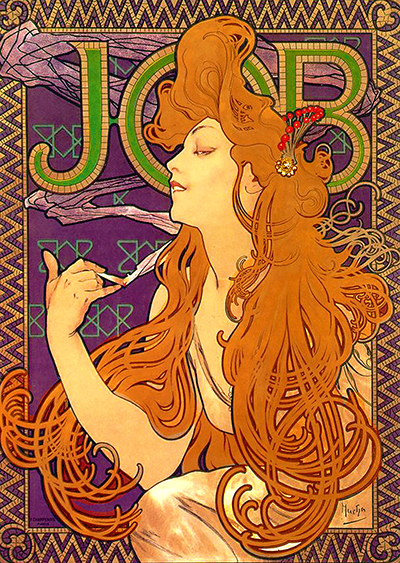
| JOB poster | 1896 | Colour lithograph |
| Judgement of Paris (calendar for Vieillemard printing company) | 1895 | Colour lithograph |
| Justice - Master Jan Hus: study for a pendentive of the Lord Mayor's Hall, Obecní dům, Prague | 1910-1911 | Oil on canvas |
| L'Annee Qui Vient | 1897 | red chalk on paper |
| L'Illustration magazine - cover for Christmas 1896/1897 | 1896 | Magazine cover |
| L'Illustré Soleil du Dimanche | 1897 | Magazine cover |
| La Dame aux Camélias: designs for cover and interior of special programme | 1896 | Pencil and watercolour on paper |
| La Nature | 1899-1900 | Bronze and amethyst |
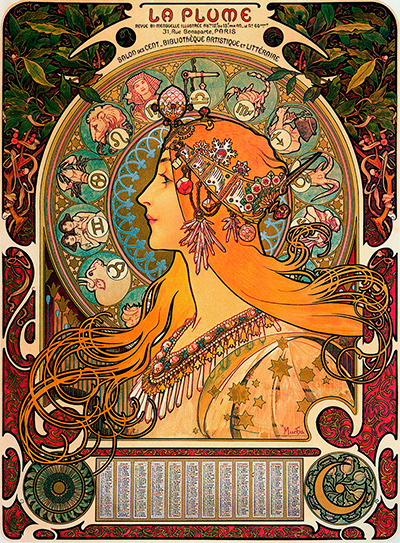
| La Plume | 1897 | Magazine cover |
| La Samaritaine | 1897 | colour lithograph |
| Lance Parfum Rodo | 1896; Albertina print c. 1900 | Colour lithograph |
| Laurel | 1901 | Colour lithograph |
| Le Monde Illustré | 1900 | Magazine cover |
| Le Pater | 1899 | Illustrated book |
| Le Pater: early study for the 1st allegorical scene 'Our Father who art in Heaven' (1899) (Mucha Foundation object 300) | 1899 | Pencil on paper |
| Le Pater: early study for the 1st allegorical scene 'Our Father who art in Heaven' (1899) (Mucha Foundation object 302) | 1899 | Pastel on paper |
| Le Pater: study for the 6th allegorical scene 'Forgive us our debts, as we forgive our debtors' | 1899 | Charcoal and ink wash on paper |
| Lefevre Utile | 1904 | Advertisement |
| Leslie Carter | 1908 | Colour lithograph |
| Letem Českým Světem | 1898 | Printed book |
| Lorenzaccio | 1896 | Colour lithograph |
| Luchon poster (attributed to Mucha) | 1895 | Colour lithograph |
| Madonna of the Lilies | 1905 | Tempera on canvas |
| Master Jan Hus Preaching at the Bethlehem Chapel | 1916 | egg tempera on canvas |
| Maude Adams | 1908 | Lithograph, hand-coloured in watercolour and gouache |
| Maude Adams as Joan of Arc | 1909 | Oil on canvas |
| Medea | 1898 | Colour lithograph |
| Menu for the Bosnian Pavilion Restaurant at the Paris Exhibition 1900 | 1900 | Colour lithograph |
| Militancy - Jan Žižka: study for a pendentive of the Lord Mayor's Hall, Obecní dům, Prague | 1910-1911 | Oil on canvas |
| Military Camp in Winter, near a City on Fire | c.1899-1900 | Pastel on paper |
| Moet et Chandon | 1899 | Colour lithograph |
| Monaco Monte Carlo | 1897 | Colour lithograph |
| Moon | 1902 | |
| Moravian Teachers' Choir | 1911 | Colour lithograph |
| Morning Alphonse Mucha Painting / AlphonseMucha.org | 1899 | Colour lithograph |
| Morning Star | 1902 | Colour lithograph |
| Moët & Chandon White Star | 1899 | Colour lithograph |
| Mrs Mucha’s Necklace | 1906 | gold, enamel and semi-precious stones |
| Mural for the Bosnia-Herzegovina Pavilion: The Roman Period and the Arrival of the Slavs | 1900 | tempera and watercolour on canvas |
| Murals by Mucha in the Lord Mayor's Hall, Obecní Dům (Municipal House), Prague (1910-1911) | ||
| Music | 1898 | Colour lithograph |
| Nativity | c. 1934 | oil on canvas |
| Nestle's Food for Infants | 1897 | Colour lithograph |
| Night | 1899 | Colour lithograph |
| Nude on a Rock | 1898-1899 | Bronze |
| Official Banquet of the Paris Exhibition 1900: design for the menu featuring a fashionable woman wearing a Mucha-style jewellery | 1900 | Pencil, gouache and wash on grey paper |
| Ornamental motifs designed for 'Combinaisons Ornementales se Multipliant à l'Infini à l'Aide du Miroir' (1901) | c.1900-1901 | Blue and red pencil on paper |
| Packaging for 'Savon Mucha Violette' | 1906 | Colour lithograph |
| Packaging for Lefèvre-Utile biscuits: Boudoir | 1901 | Colour lithograph |
| Page's Costume: study for an illustration for 'Le Costume au Théâtre' | 1890 | Pencil and watercolour on cardboard |
| Painting | 1898 | Colour lithograph |
| Peonies | 1897–1898 | Ink and watercolour |
| Petr Chelcicky at Vodnany | 1918 | egg tempera on canvas |
| Poetry | 1898 | Colour lithograph |
| Portrait of Jaroslava | c.1927-1935 | Oil on canvas |
| Portrait of Josephine Crane Bradley as Slavia | 1908 | Oil and tempera on canvas |
| Portrait of Marie Chytilová (Maruška), Mucha's Future Wife | 1903 | pastel on paper |
| Portrait of Mucha's Sister, Angela | c.1880 | Oil on canvas |
| Portrait of Mucha's Sister, Anna | c.1885 | Oil on canvas |
| Portrait of Mucha's Son, Jiří | 1925 | Oil on canvas |
| Portrait of Mucha's Wife, Maruška | 1908/17 | Oil on canvas |
| Portrait of Woman | c. mid 1910s - 1925 | Blue pastel on grey paper |
| Poster for 'Hommage Respectueux de Nestlé' (the Nestlé Company's tribute to Queen Victoria's 60th Jubilee) | 1897 | Colour lithograph |
| Poster for 'Imprimerie Cassan Fils' | 1896 | Colour lithograph |
| JOB poster (1898) | 1898 | Colour lithograph |
| Poster for 'La Dame aux Camélias' | 1896 | Colour lithograph |
| Poster for 'La Tosca' | 1899 | Colour lithograph |
| Poster for 'Regional Exhibition at Ivančice 1913' | 1912 | Colour lithograph |
| Poster for 'The Slav Epic Exhibition, Brno, 1930' | 1928-1930 | Colour lithograph |
| Poster for 'Waverley Cycles' | 1898 | Colour lithograph |
| Poster for the 'Lottery of the Union of Southwestern Moravia' | 1912 | Colour lithograph |
| Poster for the Austrian Pavilion at the Paris Exhibition 1900 | 1900 | Colour lithograph |
| Prague Subjugated: study for a Panel of the Small Reception Room at the Lord Mayor’s Hall, Obecní Dům, Prague | 1910-1911 | Pen and ink and watercolour on paper |
| Primrose | 1899 | Colour lithograph |
| Primrose and Feather (paired image) | 1899 | Colour lithographs (paired image) |
| Princess Hyacinth (Princezna Hyacinta) | 1911 | Colour lithograph |
| Print proof for the Biscuits Lefèvre-Utile tin | 1899 | Lithograph |
| Reverie | 1898 | Colour lithograph |
| Russia Restituenda [Russia Must Recover] | 1922 | Colour lithograph |
| Salome | 1897 | Colour lithograph |
| Salon des Cent | 1896 | Colour lithograph |
| Salon of the Hundred | 1897 | Colour lithograph |
| Sarah Bernhardt - La Princesse Lointaine - Lefevre Utile | 1903 | Colour lithograph |
| Sarah Bernhardt as La Princesse Lointaine: poster for 'La Plume' magazine | 1897 | Colour lithograph |
| Sarah Bernhardt in the role of the Duc de Reichstadt in L’Aiglon | 1900 | Pencil on paper |
| Sarah Bernhardt: study of her full-standing figure | c.1896 | Pen and ink on paper |
| Savonnerie de Bagnolet calendar | 1898 (calendar) | Printed advertising calendar |
| Self-portrait (1899) | 1899 | Oil on board |
| Self-portrait (1907) | 1907 | Blue and white crayon on blue Ingres paper |
| Self-portrait, sketching in his apartment, Paris | late 1880s | oil on canvas |
| Sketches of flowers for Documents décoratifs | c.1900-1901 | Pen and ink on paper |
| Slavia insurance poster | 1907 | Poster |
| Slavs in their Original Homeland | 1912 | Egg tempera on canvas |
| Snake Bracelet with a Ring | 1899 | Gold, enamel, opal, ruby and diamond |
| Société Populaire des Beaux Arts | 1897 | Colour lithograph |
| Song of Bohemia | 1918 | oil on canvas |
| St. Vitus Cathedral Stained-glass Window, Prague: final design for the central panels, featuring SS Cyril and Methodius | 1931 | Ink and watercolour on paper |
| St. Vitus Cathedral Stained-glass Window, Prague: final design for the central panels, featuring St. Ludmila | 1931 | Ink and watercolour on paper |
| St. Vitus Cathedral Stained-glass Window, Prague: final design for the central panels, featuring St. Wenceslas (Duke of Bohemia) kneeling next to his Grandmother, St. Ludmila | 1931 | Ink and watercolour on paper |
| St.Vitus Cathedral Stained-glass Window, Prague: final design for the bottom left panels | 1931 | Ink and watercolour on paper |
| St.Vitus Cathedral Stained-glass Window, Prague: final design for the bottom right panels | 1931 | Ink and watercolour on paper |
| Stained-glass Window designed by Mucha at St. Vitus Cathedral, Prague | Early 1930s | N/A |
| Study for 'The Age of Reason' | 1936-1938 | Pencil and watercolour on paper |
| Study for 'The Slav Epic cycle' No.19: The Abolition of Serfdom in Russia | 1913-1914 | Watercolour and gouache on paper |
| Study for 'The Slav Epic' cycle No.14: The Sacrifice at Szigetvár by Nikola Zrinski | c.1913-1914 | Photographed drawings stuck together, tinted with watercolour and gouache |
| Study for 'The Slav Epic' cycle No.17: The Holy Mount Athos (1926) | c.1925-26 | Charcoal heightened with white on cardboard |
| Study for 'The Slav Epic' cycle No.18: The Oath of Omladina under the Slavic Linden Tree | c.1925-1926 | Pencil and watercolour on paper |
| Study for 'The Slav Epic' cycle No.1: The Slavs in Their Original Homeland (1912) | c.1910-1912 | Oil on canvas |
| Study for 'The Slav Epic' cycle No.2: The Celebration of Svantovít | c.1910-1912 | Oil on canvas |
| Study for 'The Slav Epic' cycle No.7: Jan Milíč of Kroměříž | c.1915-1916 | Oil on canvas |
| Study for 'The Slav Epic' cycle No.9: Master Jan Hus Preaching at the Bethlehem Chapel. The Magic of the Word: Truth Prevails (1412). | c.1915-1916 | Oil on canvas |
| Study for 'The Three Ages' triptych: Reason, Wisdom and Love [unfinished project] | 1936-1938 | Pencil and watercolour on paper |
| Study for 'Woman in the Wilderness' (c. 1922-1923) (Mucha Foundation object 315) | c. 1922-1923 | oil on canvas |
| Study for 'Woman in the Wilderness' (c. 1922-1923) (Mucha Foundation object 316) | c. 1922-1923 | oil on canvas |
| Study for Savon Notre Dame | c. 1896 | pencil and watercolour on paper |
| Study for the poster 'Russia Restituenda [Russia Must Recover]' | 1922 | Pen and ink and watercolour on paper |
| Study of a Male Nude | 1885-1887 | Oil on canvas |
| The Abolition of Serfdom in Russia | 1914 | Egg tempera on canvas |
| The Arts (series) | 1898 | Colour lithograph |
| The Arts: study for 'Dance' | 1898 | Pencil and watercolour on paper |
| The Arts: study for 'Music' | 1898 | Pencil and watercolour on paper |
| The Arts: study for 'Painting' | 1898 | Pencil and watercolour on paper |
| The Arts: study for 'Poetry' | 1898 | Pencil and watercolour on paper |
| The Bohemian King Premysl Otakar II | 1924 | egg tempera on canvas |
| The Bulgarian Tsar Simeon | 1923 | egg tempera on canvas |
| The Burr McIntosh Monthly, 1907 | 1907 | Magazine cover |
| The Celebration of Svantovit | 1912 | egg tempera on canvas |
| The Coronation of the Serbian Tsar Stefan Dusan as East Roman Emperor | 1923 | egg tempera on canvas |
| The Devil and Mr Twardowsky: study for an illustration for 'The Tale of Pan Twardowsky' (a variation of 'Faust') | c.1887-1888 | Charcoal on paper |
| The Flowers (series) | 1898 | Colour lithographs |
| The Flowers: Carnation | 1898 | Colour lithograph |
| The Flowers: Iris | 1898 | Colour lithograph |
| The Flowers: Lily | 1898 | Colour lithograph |
| The Flowers: Rose | 1898 | Colour lithograph |
| The Hussite King Jiri of Podebrady | 1923 | Egg tempera on canvas |
| The Introduction of the Slavonic Liturgy | 1912 | egg tempera on canvas |
| The Last Days of Jan Amos Komensky (Comenius) in Naarden | 1918 | Egg tempera on canvas |
| The Light of Hope | 1933 | Oil on canvas |
| The Meeting at Krizky | 1916 | egg tempera on canvas |
| The Months (January-June) | 1899 | Colour lithograph |
| The Months (July-December) | 1899 | Colour lithograph |
| The Moon and the Stars (four-panel montage) | 1902 | Colour lithographs (four-panel montage) |
| The Moon and the Stars (series) | 1902 | Colour lithograph |
| The Moon and the Stars: study for 'The Evening Star' | 1902 | Ink and watercolour on paper |
| The Moon and the Stars: study for 'The Pole Star' | 1902 | Ink and watercolour on paper |
| The New York Daily News art supplement | 1904 | Printed art supplement |
| The Oath of Concord of the Slavs (unfinished) | 1939 | oil on canvas |
| The Oath of Omladina under the Slavic Linden Tree | 1926, unfinished | Egg tempera on canvas |
| The Precious Stones (four-panel montage) | 1900 | Colour lithographs (four-panel montage) |
| The Precious Stones (series) | 1900 | Colour lithograph |
| The Precious Stones: Amethyst | 1900 | Colour lithograph |
| The Precious Stones: Emerald | 1900 | Colour lithograph |
| The Precious Stones: Ruby | 1900 | Colour lithograph |
| The Printing of the Bible of Kralice in Ivancice | 1914 | egg tempera on canvas |
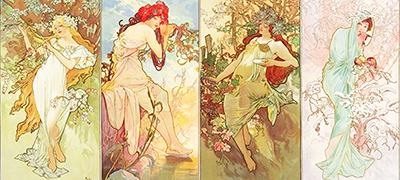
| The Seasons (series) | 1896 | Colour lithograph |
| The Seasons (series) (1900) | 1900 | Colour lithograph |
| The Seasons (variation in screen format) | 1896 | Colour lithograph |
| The Seasons: Autumn (1896) | 1896 | Colour lithograph |
| The Seasons: Autumn (1900) | 1900 | Colour lithograph |
| The Seasons: Spring | 1900 | Colour lithograph |
| The Seasons: Spring (1896) | 1896 | Colour lithograph |
| The Seasons: Summer | 1900 | Colour lithograph |
| The Seasons: Summer (1896) | 1896 | Colour lithograph |
| The Seasons: Winter | 1900 | Colour lithograph |
| The Seasons: Winter (1896) | 1896 | Colour lithograph |
| The Slavonic Concord: study for the ceiling painting for the Lord Mayor's Hall, Obecní Dům, Prague | 1910-1911 | Oil on canvas |
| The Threat | 1912 | Colour lithograph |
| The Times of the Day (series) | 1899 | Colour lithograph |
| The West End Review | 1897 (Foundation); 1898 promotional cover | Colour lithograph |
| Thistle from the Sands | 1902 | Colour lithograph |
| Théâtre de la Renaissance: design for poster advertising Sarah Bernhardt's theatre | c.1895 | Pen and ink on paper |
| Tin for Lefèvre-Utile biscuits | 1899 | Circular tin with lid and handle; colour print on metal |
| Topaz | 1900 | Colour lithograph |
| Tragedy - study for a mural for the German theatre New York | 1908 | Oil and tempera on canvas |
| Trappistine Liquors | 1897 | colour lithograph |
| Wiener Chic | 1905 | Magazine cover |
| Woman in the Wilderness | 1923 | Oil on canvas |
| Woman masked in white head-scarf - study for the illustration of the Bosnia & Herzegovina Pavilion featured in 'Le Figaro Illustré' (1 March 1900) | 1899 | Pencil and wash heightened with white on paper |
| Woman with a Daisy - textile designed by Mucha | 1900 | Printed upholstery fabric |
| Zdenka Cerny | 1913 | Colour lithograph |
| Zodiac (La Plume calendar) | 1896–97 | Colour lithograph |
| Zodiac (textless decorative panel) | 1896 | Colour lithograph |
| ‘At the sight of the two storks the owl rose.’ Study for an illustration for Contes de Grand-mères | 1891 | Watercolour and gouache on paper |
Frequently Asked Questions
When was Oath of Omladina painted?
When was the Omladina trial?
Was the unfinished canvas shown in Prague in 1928?
Discussion
Mucha sets a circle of linked youths beneath Slavia in a broad linden tree.
Foreground figures modeled on his children connect the pledge to a future generation.
Reader Insights
Do you see the joined youths, Slavia or the foreground children first?
What does the linden tree add to the oath circle?
How does the unfinished state affect your reading of the scene?
Join the Conversation
Share what you notice about the oath circle, tree and foreground figures.
References
- Mucha Foundation, “The Slav Epic cycle No. 18: Oath of the ‘Youth’ under the Slav Linden Tree,” object 229, painting identity, object facts, unfinished state and interpretation. View source.
- Prague City Gallery, “The Oath of Omladina,” collection object text presented through Google Arts & Culture, composition and 1894 trial account. View source.
- Czech Radio Plus, “V roce 1894 proběhl první politický proces s Omladinou,” independent 1894 trial chronology. View source.
- Mucha Foundation, “Study for The Slav Epic cycle No. 18,” object 183, separate c.1925–26 pencil-and-watercolour study. View source.
- Mucha Foundation, “Children posing as the Czech youths vowing Slavic ideals,” object 189, separate staged photograph. View source.
- Mucha Foundation, timeline, 1928 bequest and nineteen-canvas Trade Fair Palace exhibition excluding the unfinished Oath of Omladina. View source.
- Prague City Gallery / Moravský Krumlov exhibition, Czech Slovanská epopej entry for Přísaha Omladiny, listing 1926, unfinished, egg tempera and oil, 390 × 590 cm, and the 1894 case. View source.
- Tomáš Berger, “Alfons Mucha: Slovanská epopej. Technologický a restaurátorský průzkum,” Staletá Praha 35, no. 1 (2019), conservation examination of the unfinished canvas, its drawing and oil layers. View source.
- National Library of the Czech Republic, catalogue record for Antonín Čížek and Alois Hajn, Proces s tak zvanou Omladinou (1894), 441 pages. The catalogue confirms contemporary publication, not every claim in the volume. View source.
- Czech Television, historical biographical account of Alois Rašín, describing the police construction of the supposed secret Omladina conspiracy. View source.
- Czech National Bank, historical biography of Alois Rašín, describing the staged 1894 Omladina conviction and two-year sentence. View source.
- Czech Radio Brno, “Ecce Homo – Omladina” (2004), on the progressive youth milieu, September 1893 unrest, Mrva, the trial, convictions and 1895 amnesty. View source.
- iROZHLAS / Czech Radio, Ivana Chmel Denčevová, “Historik: Omladina byli jen neorganizovaní mladí vlastenci” (2024), reporting historian Jiří Pernes on the 1893 demonstrations, police theory and trial. View source.
- Masaryk Institute and Archives of the Czech Academy of Sciences, Archive of the T. G. Masaryk Institute, “Omladina,” fond NAD 5020, Prague criminal court case files dated 1893–1895. View source.