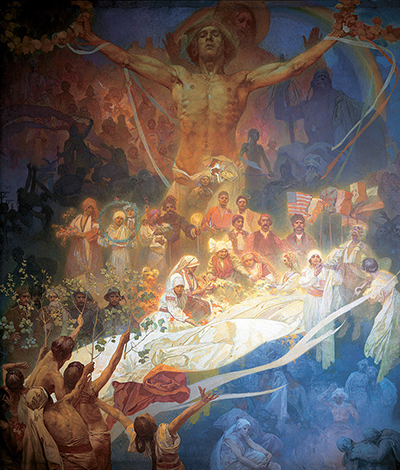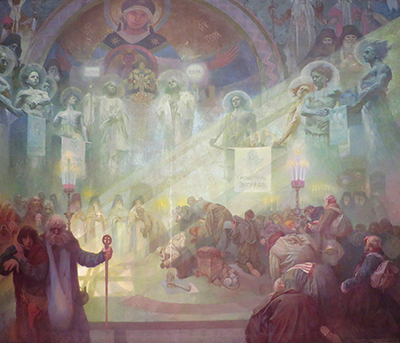
Holy Mount Athos (1926), the seventeenth canvas in Mucha’s Slav Epic according to the Foundation’s individual catalogue.
Buy Art Prints Nowfrom Amazon
* As an Amazon Associate I earn from qualifying purchases.
 by Tom Gurney
Tom Gurney BSc (Hons) is an art history expert with over 20 years experience
Page Created on / Page Updated on
Email: tomgurney1@gmail.com / Phone: +44 7429 011000
Holy Mount Athos: Mucha’s Sanctuary of Memory
A broad beam of light cuts through a sanctuary crowded with pilgrims. Above them, haloed figures hold small models of monasteries beneath an immense image of the Virgin. Holy Mount Athos, the seventeenth canvas of Alphonse Mucha's Slav Epic, turns from named rulers and battles toward a living religious setting. The Mucha Foundation dates the finished painting to 1926, two years after Mucha visited the monastic peninsula in Greece.[1]
The Foundation's subtitle calls Athos a shelter for old Slav literary monuments and gives an “18th century” setting.[1] That label does not identify one particular ceremony. Mucha combines pilgrims, clergy, sacred images and miniature monasteries to express a long history of Orthodox worship and preservation. The painting asks viewers to look at continuity across centuries rather than reconstruct a single dated moment.
The subtitle's “Vatican of Orthodox Christianity” is a metaphor for spiritual and cultural importance, not an institutional equivalence. Athos is a self-governing monastic peninsula with many houses and traditions, as UNESCO's account makes clear.[3] Its libraries and archives make the literary claim concrete, while the painting condenses those dispersed collections into one invented sanctuary.
At a Glance
- ArtistAlphonse Mucha
- CycleThe Slav Epic, No. 17 of 20[1]
- Foundation titleHoly Mount Athos. Vatican of Orthodox Christianity, Sheltering the Oldest Slav Literary Monuments (18th century)[1]
- Painting date1926, for the finished canvas[1]
- MediumMucha Foundation: egg tempera on canvas; Prague City Gallery: egg tempera and oil on canvas; a 2019 conservation survey describes the 1926 painting as oil[1][11][12]
- Dimensions405 × 480 cm, for the finished canvas[1]
- Preparatory workseparate c.1925–26 charcoal study and staged model photograph[4][5]
The seventeenth Epic canvas in Mucha’s career
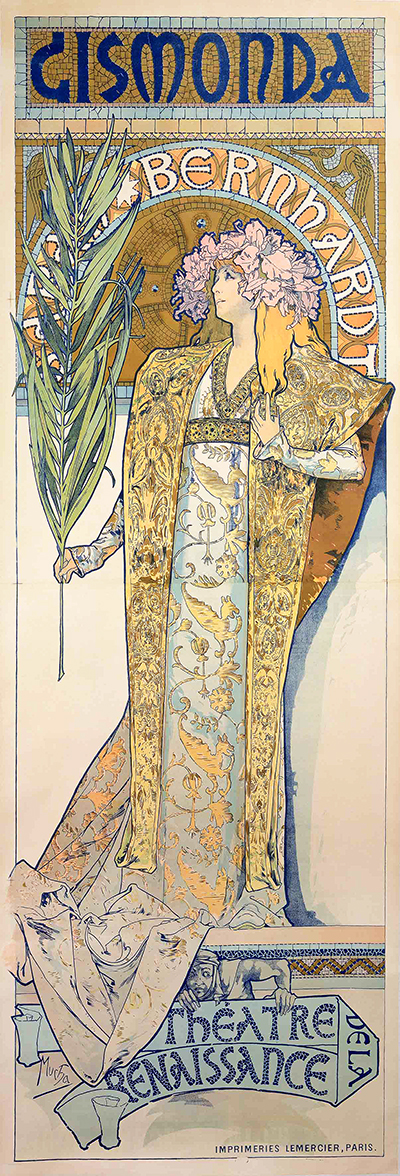
Gismonda
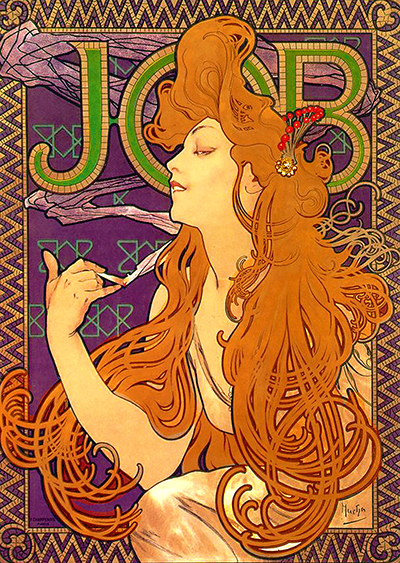
1894 designLe Pater
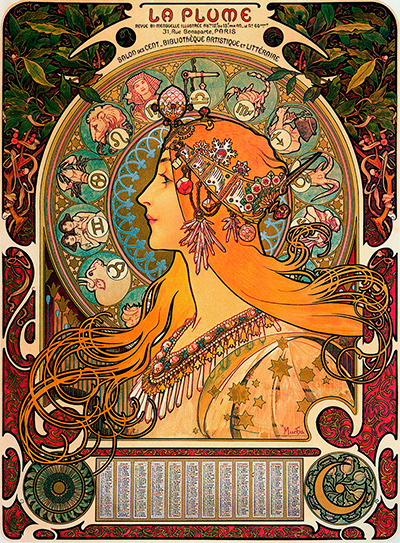
1899Master Jan Hus
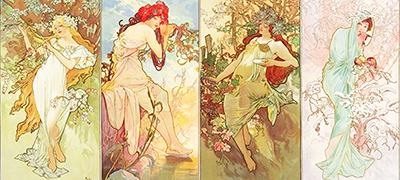
1916Holy Mount Athos
1926Contents
- Athos and its collections
- What preserving writing has meant
- The procession below
- Virgin, angels and light
- The youth and the older man
- From visit to finished canvas
- Looking again
Athos and its collections
Mount Athos is a monastic peninsula in northern Greece and a major centre of Orthodox Christianity. UNESCO describes its monasteries as custodians of wall paintings, icons, metalwork, embroidery and illuminated manuscripts.[3] These collections give substance to the Foundation's subtitle about literary monuments. In Mucha's canvas, art, books and religious practice belong together within a shared place.
The Foundation says Athos had particular significance for southern Slavs from the tenth to the fifteenth century and that Mucha visited in 1924.[1] His journey gave him direct contact with the setting, but this canvas is not a measured interior view of one documented service. It creates an imagined gathering. The monks, pilgrims and hovering figures connect the physical sanctuary with a larger history of Orthodox communities.
UNESCO's account also helps keep the painting's scope clear. Athos is in Greece, and its traditions are not exclusively Slav. Mucha chose aspects that served his Slav Epic: monasteries with Slavic connections, pilgrims, and the care of texts and images. The work presents his interpretation of that wider Orthodox world rather than claiming the site belongs to a single nation.[1][3]
Two monastic collections illustrate the point more precisely. Hilandar's Serbian digital treasury describes medieval charters, manuscript books, icons and later printed books preserved in the monastery.[7] Bulgaria's National Library has exhibited manuscripts that came from Zograf, the Bulgarian monastery on Athos, and identifies them as part of its Slavic manuscript collection.[8] The examples show both the importance of Athos as a centre of writing and a limit to the subtitle: preservation has involved movement into other libraries as well as care within the monasteries. None of these documents is individually identified in Mucha's scene.
One particularly old example, the Glagolitic Codex Zographensis, was discovered at Zograf, according to Sofia University's manuscript catalogue. It was given to the Russian emperor in 1860 and is now held in Saint Petersburg.[9] Its journey is a reminder that “sheltering” describes a history, not a guarantee that every famous Slav manuscript remained physically on the peninsula in 1926. Mucha's symbolic interior celebrates the transmission of writing without inventorying its exact modern locations.
The eighteenth-century phrase in the Foundation's title can also be read against an actual Athonite text from that era. Sofia University's historical-language corpus catalogues a 1762 manuscript of Paisius of Hilandar's Slavo-Bulgarian History, now identified as Zograf 43 in the Zograf monastery repository, and provides its transcribed text.[14] This is a concrete example of Slavic historical writing associated with Athos in the century named by the title. It does not mean that Mucha painted Paisius, included this particular manuscript in the sanctuary, or intended the painting as an illustration of its contents. The document helps a reader understand the kind of literary work a monastery could hold, while the painting remains a generalised tribute to preservation and faith. The university record also gives a precise repository and shelfmark, a reminder that these manuscripts are catalogued objects rather than an undifferentiated treasure in an imagined room.
What preserving writing has meant
Athos's books were not confined to liturgy or national history. Hilandar Monastery describes its Medical Codex, a fifteenth- to sixteenth-century collection of medical and pharmacological writing preserved in the monastery treasury under archive number 517. Its account says the manuscript was brought to scholarly attention in 1952 and remains at Hilandar, while a facsimile edition is held in Belgrade's National Library of Serbia.[15] The text covers remedies, preparations and doses as well as plant terminology. That variety matters for a canvas subtitled “sheltering” literary monuments: monasteries could preserve practical knowledge as well as prayers, chronicles and illuminated gospels. The codex is an example of the broader collection, not an item identified in Mucha's painted sanctuary.
Hilandar's digital treasury gives a sense of the collection's different kinds of record today: it lists 1,041 manuscript books, 507 manuscript charters from medieval rulers, and 80 early printed books from the fifteenth through seventeenth centuries.[7] Those are the treasury's present catalogue figures, not an inventory from Mucha's visit. A charter might preserve a grant or right, while a book could carry theology, history or medicine. Mucha's upper register cannot display that diversity volume by volume; its miniature monasteries stand for institutions that kept such material across generations.
Preservation also changed after Mucha's 1926 canvas. Ohio State University's Hilandar Research Library says that, at the monks' invitation, a project began in 1969 to photograph Hilandar's written heritage. Subsequent expeditions in 1970, 1971 and 1975 made microfilm copies; the library later opened them to researchers far from Athos.[16] The originals and the copies have different homes and different histories. This development could not have informed a painting completed decades earlier. It does show why “sheltering” should not be read as sealing books away: a monastic treasury can guard the originals while catalogues and copies let scholarship travel beyond the peninsula.
The same library lists microfilmed texts from Zograf, the Bulgarian monastery, including fragments as early as the eleventh century and later gospel books. It states that the Zograf material was photographed in 1975 and that colour scans are available for consultation at Sofia University.[17] The record is specific about uneven access: only part of the microfilmed group is described in Ohio State's online catalogue. A reader should therefore resist turning a digital list into a complete inventory of all Athonite writing. Mucha compressed a wide, partly hidden world of manuscripts into a visible procession and a few monastery models; present-day finding aids reveal some of its range without proving that any listed text appeared before him.
Research into Athos was already underway during Mucha's lifetime, however. A Serbian historical survey of Hilandar scholarship names the Byzantine art historian Nikodim Kondakov among earlier investigators who worked with the monastery's art, alongside the French scholar Gabriel Millet.[18] This provides context for Ko's report of “Prof. Kondakoff” on Mucha's compositional sketch.[6] It does not prove that Kondakov accompanied Mucha in 1924, saw a particular drawing, or selected the models in the final canvas. The supported link is narrower: Mucha recorded a scholar's name in his planning, and that scholar had an established interest in Athonite art. The distinction lets the work's researched character stand without replacing an open archival question with a convenient story.
The procession below
The lower part of the canvas is densely occupied. Some pilgrims stand, others bow, and figures move toward clergy in the deeper sanctuary. The Foundation describes a semicircular procession of Russian pilgrims approaching four priests who present relics for veneration.[1] That is the Foundation's identification of the depicted group. At the scale of the inherited image, individual origins cannot be read from the figures alone.
Mucha places the worshippers under a high, luminous space. Their dark clothing and bent postures make the bright diagonal bands more visible. A viewer can follow the line of the procession inward, but the scene does not settle on a single protagonist. People participate at different distances from the clergy. The crowd gives the canvas its feeling of repeated practice: one person approaches while others wait, observe or pray.
The Gallery likewise reads priests before the iconostasis and pilgrims venerating relics.[2] Its account names several monastery models carried by the figures above. The important visual point is their role in the composition: Mucha gathers separate monastic houses into a single ceremonial space. The small models are signs of a network that extends beyond the room we see.
There is a useful source conflict here. A study by museum curator Ko Seong-Jun reports a Mucha compositional note connected to Byzantine art historian Nikodim Kondakov. Ko says an iconostasis appeared in the compositional scheme but was omitted from the finished painting, whereas the Gallery's account describes priests standing before one.[2][6] The two authors may be using the architectural word differently, but the evidence does not justify treating every feature of the Gallery's prose as a secure description of the final work. The central point remains the act of veneration within Mucha's constructed sacred setting.
Virgin, angels and light
An enormous image of the Virgin fills the upper apse. Below and beside it are pale, haloed figures who appear to hover above the people on the floor. The Foundation reads four of these angels as carrying models of Slavic monasteries associated with Athos.[1] Mucha lets their symbolic scale exceed that of the pilgrims. The upper register is not another group standing inside the room; it makes the sanctuary's spiritual and historical meanings visible.
The diagonal light runs across the middle of the canvas and joins the two registers. It touches the crowd while drawing the eye toward the Virgin and the hovering figures. The Foundation and Gallery differ on the exact direction from which the light enters.[1][2] The inherited reproduction supports its presence and effect more clearly than the location of an architectural opening. In the painting, illumination links material objects below with images and memory above.
Ko's research adds a rare trace of how this sacred setting was devised. He reports that the Mucha Foundation found the name “Prof. Kondakoff” in Mucha's handwriting on a compositional sketch. The scholar's comparison links the sketch to the Virgin in the Orans pose, with raised arms, and to a proposed iconostasis.[6] This is stronger evidence of consultation and compositional planning than a general statement that Mucha absorbed Orthodox atmosphere during travel. Ko's further suggestion that a figure with an icon might portray Kondakov is explicitly a hypothesis, so the article does not assign that identity to a painted person.
The Gallery interprets the figures as cherubs carrying monastery models and identifies portraits of monastic superiors behind them.[2] Those small identities remain institutional readings. The painting's broad structure is clearer: a sacred image overhead, a devotional gathering below, and light passing between. Mucha makes the interior both a place people occupy and a diagram of the traditions they inherit.
The youth and the older man
In the left foreground, a dark-haired youth supports an older bearded man. The Foundation describes the older man as blind.[1] Prague City Gallery suggests the youth resembles Mucha himself and calls him a self-portrait.[2] That reading may add a personal layer to the scene, but it is best kept as an interpretation. The local painting image does not independently establish that Mucha intended a literal portrait.
This pair provides a point of entry into the vast composition. The older man cannot rely on the full spectacle of the icon and the luminous figures, yet someone guides him through the space. Their contact gives a human scale to a painting otherwise dominated by architecture and collective worship. The gesture also suggests how a tradition survives: through people helping other people take part.
Mucha had used a young reader beside an older man in his earlier Brethren School in Ivančice. Here, the support is physical rather than a reading aloud. Both scenes give attention to people who need another person's help to reach a place or a text. The parallel is visible across the cycle, though the sources used here do not tell us whether Mucha meant it as a formal pairing.
From visit to finished canvas
The Foundation records Mucha's 1924 visit to Athos and a separate c.1925–26 charcoal study for this subject.[1][4] It also catalogues a staged photograph of Mucha and his assistant Knap posing for the canvas during those preparatory years.[5] Those records show that the finished scene was constructed through observation and studio work. Neither the study nor the photograph should be mistaken for the inherited reproductions of the completed painting on this page.
An exhibition checklist identifies a 1924 Chilandari Monastery record from Mucha's research trip and a separate c.1925 archpriest model study for this canvas.[10] Together with Ko's report of Kondakov's advice, these records show three strands of preparation: travel documentation, posed models and scholarly consultation.[6][10] They explain why the finished work feels grounded in a real Orthodox setting yet remains a synthesis rather than a transcription of a witnessed service.
The Foundation's Czech timeline places Holy Mount Athos among the last Epic canvases Mucha painted in a school hall in Prague, alongside The Oath of Omladina and Apotheosis of the Slavs.[13] That production setting matters: the scene is an image of a Greek sanctuary assembled after travel, study and posing, while the monumental painting itself was made back in Prague. The trip supplied a location and research material; the studio let Mucha reorganise those materials into the spiritual interior he wanted.
What was the finished canvas painted with?
The published medium labels conflict. The Mucha Foundation's individual object record says egg tempera on canvas.[1] Prague City Gallery's Czech exhibition listing says egg tempera and oil on canvas for the same 405 × 480 cm work.[11] Conservator Tomáš Berger's technical survey goes further: its caption to a study of a boy's face in Mont Athos describes the 1926 painting as made entirely in oil, with softer colour transitions than in the early Epic canvases.[12] These are descriptions of the finished canvas, not of the separate charcoal study or the 1924 photographs. The article preserves the disagreement because a catalogue term and a conservation interpretation cannot be made identical by silently choosing one.
Berger's laboratory report is especially specific about one passage. Sample 4, taken from yellow drapery in the background, yielded zinc white, lead white, synthetic ultramarine, and red and yellow ochres in varying proportions. Its white ground was identified as lead white. The paper contrasts that ground with the chalk-and-zinc-white mixture found in earlier Epic material and places lead white within Mucha's later working practice.[12] The sample does not provide a chemical inventory of the whole painting. It does, however, give object-specific material evidence beyond a general medium label and helps explain why the 1926 canvas belongs to a different technical phase from the early tempera works.
The finished canvas was made in 1926.[1] Its subtitle reaches back to an 18th-century frame, while the work draws on an older monastic history and Mucha's modern visit. These are different kinds of time: the site and its collections, an artist researching it, and the moment he completed his large image. The painting folds them together without making each detail a claim about one particular year.
Looking again
Begin with the youth and older man at the lower left. Follow the other pilgrims toward the clergy, then let the light carry your eye up to the monastery models and Virgin image. The route moves from an individual act of help to a collective ceremony and finally to a vision of the cultural memory held by Athos.[1][2][3]
Holy Mount Athos is one of Mucha's most layered Slav Epic interiors. Its lower figures make devotion a human activity, while the upper figures give visible form to traditions and places beyond the room. The finished canvas is not a record of a single service; it is Mucha's image of a sanctuary where art, faith and preserved writing meet.[1][3]
Watch: Alphonse Mucha
Place Mucha’s Czech and Slavic projects beside his better known Paris work.
Prague’s Art Nouveau, Mucha, and the Slav Epic
A short view of Mucha’s Prague legacy and the Slav Epic cycle.
Watch on YouTubeArtworks directory
| Name | Date | Medium |
|---|---|---|
| 'Accept Love and Enthusiasm from Your Son, Mother of the Holy Nation': study for the mural 'By Own Strength III' at the Lord Mayor's Hall, Obecní Dům, Prague | 1910-1911 | Pencil and charcoal on canvas |
| 'By force towards freedom, with love towards unity!': study for the mural 'By Own Strength II' at the Lord Mayor's Hall, Obecní Dům, Prague | 1910-1911 | Pencil and charcoal on canvas |
| 'The Passing Wind Takes Youth Away': design for a fan and the façade of the 'Pavilion of Man' (unrealised) | 1899 | Colour lithograph |
| 'Through humiliated and tortured, you will live again, my country!': study for the mural 'By Own Strength II' at the Lord Mayor's Hall, Obecní Dům, Prague | 1910-1911 | Pencil and charcoal on canvas |
| 1918-1928: Poster for the 10th Anniversary of the Independence of the Republic of Czechoslovakia | 1928 | Colour lithograph |
| 6th Sokol Festival | 1912 | Colour lithograph |
| 8th Sokol Festival | 1925 | Colour lithograph |
| After the Battle of Grunwald | 1924 | egg tempera on canvas |
| After the Battle of Vitkov Hill | 1923 | egg tempera on canvas |
| Age of Love | 1936–1938 | |
| Age of Reason | 1936–1938 | |
| Age of Wisdom | 1936–1938 | |
| Amants | 1895 | Colour lithograph |
| Apotheosis of the Slavs | 1926 | Egg tempera on canvas |
| As Hamlet | 1899 | colour lithograph |
| Au Quartier Latin | 1898 | Magazine cover |
| Banknotes of Czechoslovakia, designed by Mucha: 500 crown; 50 Crown; 10 Crown | 1929 | Banknotes |
| Bieres de la Meuse | 1897 | Colour lithograph |
| Biscuits Champagne Lefevre Utile | 1896 | Colour lithograph |
| Biscuits Lefevre Utile | 1896 design for 1897 calendar; Foundation object/Carnavalet 1897 | Colour lithograph |
| Blessed are the Pure in Heart | 1906 | Printed magazine illustration |
| Bleu Deschamps | 1903 (deposit) | Colour lithograph |
| Bosnia & Herzegovina Pavilion - illustration featured in 'Le Figaro Illustré' (1 March 1900) | 1900 | Reproduction from Le Figaro Illustré after watercolour original |
| Bosnia-Herzegovina Pavilion: cartoon for the mural 'The Roman Period and the Arrival of the Slavs' | 1899-1900 | ink and crayon on paper |
| Bosnia-Herzegovina Pavilion: fragment of the upper frieze featuring Ivo and Anica, characters from Bosnian legends | 1899-1900 | tempera and watercolour on canvas |
| Bosnian Legends: Death of Hasanaga's Bride | 1899 | Charcoal on paper |
| Bosnian Legends: Murcia - The Plague Lady | 1899 | Charcoal on paper |
| Bosnian Pavilion Restaurant at the Paris Exhibition 1900: design for the menu | 1900 | Pencil and watercolour on paper |
| Boutique Fouquet (interior design) | 1901 | Shop interior design |
| Boutique Fouquet: sketches of the shop's signboard and decorative details | c.1900 | Pencil, ink and watercolour on paper |
| Box for Lefèvre-Utile biscuits: Gaufrettes Vanille | c.1900 | Tin box covered with lithographed label |
| Box for Lefèvre-Utile biscuits: Madère | c.1900 | Tin box covered with lithographed label |
| Brightness of the Day | 1899 | Colour lithograph |
| Broach with Pendant | 1900 | Gold, ivory, mother-of-pearl and semi-precious stones |
| Byzantine Head - The Blonde | 1897 | Colour lithograph |
| Byzantine Heads (pair) | 1897 | Colour lithograph |
| Byzantine Heads: Brunette | 1897 | Colour lithograph |
| Bénédictine | 1898 (BnF deposit); Hamburg 1899; MNAC 1896 or 1898 | Colour lithograph |
| Champagne Ruinart | 1896 | Colour lithograph |
| Chocolat Ideal | before or in 1897 (catalogue conflict) | Colour lithograph |
| Chocolat Masson (1897 calendar) | 1896–1897 | Colour lithograph |
| Choirboys at Petrov Church, Brno | 1905 | Watercolour on cardboard |
| Cloches de Noel | 1900 | Illustrated book |
| Comedy: study for a mural for the German Theatre, New York | 1908 | Oil on canvas |
| Cours Mucha: poster advertising Mucha's art classes held at the Académie Colarossi, Paris | 1900 | colour lithograph |
| Creative Force - Jan z Pernštýna: study for a pendentive of the Lord Mayor’s Hall, Obecní Dům, Prague | 1910-1911 | Oil on canvas |
| Crucifixion | c.1868 | Pencil, crayon and watercolour on paper |
| Cycles Perfecta | 1897 or 1902 (catalogue conflict) | Colour lithograph |
| Dance | 1898 | Colour lithograph |
| Dead Couple - Abandoned | c.1899-1900 | Charcoal and pastel on blue paper |
| Defense of Sziget against the Turks by Nicholas Zrinsky | 1914 | egg tempera on canvas |
| Design for a champagne poster | c. 1896 | Charcoal and pastel on paper |
| Design for a display stand at the Paris Exhibition 1900 | c.1899-1900 | Pencil and wash on paper |
| Design for Champagne Ruinart | c. 1896 | Pencil, watercolour and gold leaf on paper |
| Design for the cover of the magazine 'Fantaz' | 1882 | Ink and watercolour on paper |
| Design for the heading of the cover of the magazine 'Krokodil' | 1885 | Pen and ink on cardboard |
| Design for the poster for the Mucha Exhibition at the Brooklyn Museum, New York, January-February 1921 | 1920 | Pen and ink and watercolour on paper |
| Designs for cutlery | c.1900 | Charcoal and white on card |
| Designs for tableware | c.1900 | Charcoal, coloured pencil and white on card |
| Diadem for 'La princesse lointaine' | 1895 | metal and pearls |
| Diploma of Ivančice: Mock diploma honouring a local celebrity, with illustration of the first line of 'May', a poem by Karel Hynek Mácha | 1882 | Pen and ink and watercolour on paper |
| Documents décoratifs: designs for a watch and accessories (unused) | 1901-1902 | Pencil, ink and white on paper |
| Documents décoratifs: final study for Plate 25, featuring studies of lily | 1901-1902 | Pencil on paper |
| Documents décoratifs: final study for Plate 43 | 1901-1902 | Pencil, ink and wash, heightened with white on paper |
| Documents décoratifs: final study for Plate 49 | 1901-1902 | Pencil and white on paper |
| Documents décoratifs: final study for Plate 50 | 1901-1902 | Pencil and white on paper |
| Documents décoratifs: final study for Plate 60 | 1901-1902 | Pencil, ink and wash, heightened with white on paper |
| Documents décoratifs: final study for Plate 63 | 1901-1902 | Pencil and white on paper |
| Documents décoratifs: final study for Plate 67 | 1901-1902 | Pencil and white on paper |
| Documents décoratifs: final study for Plate 71 | 1901-1902 | Pencil and white on paper |
| Documents décoratifs: final study for Plate 72 | 1901-1902 | Pencil and wash, heightened with white on paper |
| Documents décoratifs: line drawing for Plate 33, featuring lily motifs | 1901-1902 | Pencil, pen and ink on paper |
| Documents décoratifs: Plate 54 | 1902 | Lithograph |
| Dreaming of Freedom: study for a Panel of the Small Reception Room at the Lord Mayor’s Hall, Obecní Dům, Prague | 1910-1911 | Pen and ink and watercolour on paper |
| Dusk | 1899 | Colour lithograph |
| Evening | 1899 | Colour lithograph |
| F. Champenois (Rêverie imprint) | 1898 | Colour lithograph |
| F. Guillot-Pelletier calendar (1898) | 1897–1898 | Colour lithograph |
| Feather | 1899 | Colour lithograph |
| Figures décoratives: final study for Plate 2 | 1904-1905 | Pencil and white on paper |
| Figures décoratives: final study for Plate 3 | 1904-1905 | Pencil and white on paper |
| Figures décoratives: final study for Plate14 | 1904-1905 | Pencil with white on paper |
| Figures décoratives: sketch study for Plate14 | 1904-1905 | Blue pencil on paper |
| Flirt Lefevre Utile | 1899 (Foundation design); BnF legal deposit 1900 | Colour lithograph |
| Flower | 1897 | Colour lithograph |
| Flower: final study for decorative panel | 1897 | Pencil, ink and watercolour on paper |
| France Embraces Bohemia | 1918 | oil on canvas |
| Fruit | 1897 | Colour lithograph |
| Georges Fouquet (1858-1929), Paris, after design by Mucha: Ornamental Chain with pendants | 1900 | Gold, enamel, fresh-water pearls, mother of pearl and semi-precious stones |
| Georges Fouquet (1858-1929), Paris, after Mucha design: 'Peacock' Ring (Exhibited at the Paris Exhibition 1900) | 1900 | Opal and gold |
| Girl Weeping | c.1899-1900 | Black chalk and pastel on paper |
| Girl with Loose Hair and Tulips | 1920 | Oil on canvas |
| Gismonda | 1894 | Colour lithograph |
| Head of a Girl, statue for the stand of the Houbigant Perfumery at the Paris Exhibition 1900 | 1900 | Bronze, silver and parcel gilt |
| Head of Sarah Bernhardt: Study for 'Lorenzaccio' | 1896 | Pencil on paper |
| Heather from Coastal Cliffs | 1902 | Colour lithograph |
| Heidsieck & Co | 1901 | Colour lithograph |
| Holy Mount Athos | 1926 | Egg tempera on canvas |
| Ilsée, Princesse de Tripoli | 1897 | Illustrated book |
| In the Desert: Study for an illustration for the Světozor magazine | 1889 | Pencil, watercolour and gouache on paper |
| Incantation (Salammbô) | 1897 | Lithograph |
| Independence - Jiří z Poděbrad: study for a pendentive of the Lord Mayor’s Hall, Obecní Dům, Prague | 1910-1911 | Oil on canvas |
| Interior and furniture designs | c.1900 | Pencil on paper |
| Interior of Boutique Fouquet: design for a wall-mounted display cabinet with statuette and mirror | c.1900 | Pencil on paper |
| Interior of Boutique Fouquet: design for the fireplace with statuettes, mirror, and the ornamental details of the wall | c.1900 | Pencil and watercolour on cardboard |
| Interior of Boutique Fouquet: sketches of the fireplace with statue, mirror, display cabinet, and the ornamental details of the wall | c.1900 | Pencil, pen and ink on paper |
| Ivy | 1901 | Colour lithograph |
| Jan Milic of Kromeriz | 1916 | egg tempera on canvas |
| Jaroslava and Jiří, the Artist’s Children | 1918 | Oil on canvas |
| JOB poster | 1896 | Colour lithograph |
| Judgement of Paris (calendar for Vieillemard printing company) | 1895 | Colour lithograph |
| Justice - Master Jan Hus: study for a pendentive of the Lord Mayor's Hall, Obecní dům, Prague | 1910-1911 | Oil on canvas |
| L'Annee Qui Vient | 1897 | red chalk on paper |
| L'Illustration magazine - cover for Christmas 1896/1897 | 1896 | Magazine cover |
| L'Illustré Soleil du Dimanche | 1897 | Magazine cover |
| La Dame aux Camélias: designs for cover and interior of special programme | 1896 | Pencil and watercolour on paper |
| La Nature | 1899-1900 | Bronze and amethyst |
| La Plume | 1897 | Magazine cover |
| La Samaritaine | 1897 | colour lithograph |
| Lance Parfum Rodo | 1896; Albertina print c. 1900 | Colour lithograph |
| Laurel | 1901 | Colour lithograph |
| Le Monde Illustré | 1900 | Magazine cover |
| Le Pater | 1899 | Illustrated book |
| Le Pater: early study for the 1st allegorical scene 'Our Father who art in Heaven' (1899) (Mucha Foundation object 300) | 1899 | Pencil on paper |
| Le Pater: early study for the 1st allegorical scene 'Our Father who art in Heaven' (1899) (Mucha Foundation object 302) | 1899 | Pastel on paper |
| Le Pater: study for the 6th allegorical scene 'Forgive us our debts, as we forgive our debtors' | 1899 | Charcoal and ink wash on paper |
| Lefevre Utile | 1904 | Advertisement |
| Leslie Carter | 1908 | Colour lithograph |
| Letem Českým Světem | 1898 | Printed book |
| Lorenzaccio | 1896 | Colour lithograph |
| Luchon poster (attributed to Mucha) | 1895 | Colour lithograph |
| Madonna of the Lilies | 1905 | Tempera on canvas |
| Master Jan Hus Preaching at the Bethlehem Chapel | 1916 | egg tempera on canvas |
| Maude Adams | 1908 | Lithograph, hand-coloured in watercolour and gouache |
| Maude Adams as Joan of Arc | 1909 | Oil on canvas |
| Medea | 1898 | Colour lithograph |
| Menu for the Bosnian Pavilion Restaurant at the Paris Exhibition 1900 | 1900 | Colour lithograph |
| Militancy - Jan Žižka: study for a pendentive of the Lord Mayor's Hall, Obecní dům, Prague | 1910-1911 | Oil on canvas |
| Military Camp in Winter, near a City on Fire | c.1899-1900 | Pastel on paper |
| Moet et Chandon | 1899 | Colour lithograph |
| Monaco Monte Carlo | 1897 | Colour lithograph |
| Moon | 1902 | |
| Moravian Teachers' Choir | 1911 | Colour lithograph |
| Morning Alphonse Mucha Painting / AlphonseMucha.org | 1899 | Colour lithograph |
| Morning Star | 1902 | Colour lithograph |
| Moët & Chandon White Star | 1899 | Colour lithograph |
| Mrs Mucha’s Necklace | 1906 | gold, enamel and semi-precious stones |
| Mural for the Bosnia-Herzegovina Pavilion: The Roman Period and the Arrival of the Slavs | 1900 | tempera and watercolour on canvas |
| Murals by Mucha in the Lord Mayor's Hall, Obecní Dům (Municipal House), Prague (1910-1911) | ||
| Music | 1898 | Colour lithograph |
| Nativity | c. 1934 | oil on canvas |
| Nestle's Food for Infants | 1897 | Colour lithograph |
| Night | 1899 | Colour lithograph |
| Nude on a Rock | 1898-1899 | Bronze |
| Official Banquet of the Paris Exhibition 1900: design for the menu featuring a fashionable woman wearing a Mucha-style jewellery | 1900 | Pencil, gouache and wash on grey paper |
| Ornamental motifs designed for 'Combinaisons Ornementales se Multipliant à l'Infini à l'Aide du Miroir' (1901) | c.1900-1901 | Blue and red pencil on paper |
| Packaging for 'Savon Mucha Violette' | 1906 | Colour lithograph |
| Packaging for Lefèvre-Utile biscuits: Boudoir | 1901 | Colour lithograph |
| Page's Costume: study for an illustration for 'Le Costume au Théâtre' | 1890 | Pencil and watercolour on cardboard |
| Painting | 1898 | Colour lithograph |
| Peonies | 1897–1898 | Ink and watercolour |
| Petr Chelcicky at Vodnany | 1918 | egg tempera on canvas |
| Poetry | 1898 | Colour lithograph |
| Portrait of Jaroslava | c.1927-1935 | Oil on canvas |
| Portrait of Josephine Crane Bradley as Slavia | 1908 | Oil and tempera on canvas |
| Portrait of Marie Chytilová (Maruška), Mucha's Future Wife | 1903 | pastel on paper |
| Portrait of Mucha's Sister, Angela | c.1880 | Oil on canvas |
| Portrait of Mucha's Sister, Anna | c.1885 | Oil on canvas |
| Portrait of Mucha's Son, Jiří | 1925 | Oil on canvas |
| Portrait of Mucha's Wife, Maruška | 1908/17 | Oil on canvas |
| Portrait of Woman | c. mid 1910s - 1925 | Blue pastel on grey paper |
| Poster for 'Hommage Respectueux de Nestlé' (the Nestlé Company's tribute to Queen Victoria's 60th Jubilee) | 1897 | Colour lithograph |
| Poster for 'Imprimerie Cassan Fils' | 1896 | Colour lithograph |
| JOB poster (1898) | 1898 | Colour lithograph |
| Poster for 'La Dame aux Camélias' | 1896 | Colour lithograph |
| Poster for 'La Tosca' | 1899 | Colour lithograph |
| Poster for 'Regional Exhibition at Ivančice 1913' | 1912 | Colour lithograph |
| Poster for 'The Slav Epic Exhibition, Brno, 1930' | 1928-1930 | Colour lithograph |
| Poster for 'Waverley Cycles' | 1898 | Colour lithograph |
| Poster for the 'Lottery of the Union of Southwestern Moravia' | 1912 | Colour lithograph |
| Poster for the Austrian Pavilion at the Paris Exhibition 1900 | 1900 | Colour lithograph |
| Prague Subjugated: study for a Panel of the Small Reception Room at the Lord Mayor’s Hall, Obecní Dům, Prague | 1910-1911 | Pen and ink and watercolour on paper |
| Primrose | 1899 | Colour lithograph |
| Primrose and Feather (paired image) | 1899 | Colour lithographs (paired image) |
| Princess Hyacinth (Princezna Hyacinta) | 1911 | Colour lithograph |
| Print proof for the Biscuits Lefèvre-Utile tin | 1899 | Lithograph |
| Reverie | 1898 | Colour lithograph |
| Russia Restituenda [Russia Must Recover] | 1922 | Colour lithograph |
| Salome | 1897 | Colour lithograph |
| Salon des Cent | 1896 | Colour lithograph |
| Salon of the Hundred | 1897 | Colour lithograph |
| Sarah Bernhardt - La Princesse Lointaine - Lefevre Utile | 1903 | Colour lithograph |
| Sarah Bernhardt as La Princesse Lointaine: poster for 'La Plume' magazine | 1897 | Colour lithograph |
| Sarah Bernhardt in the role of the Duc de Reichstadt in L’Aiglon | 1900 | Pencil on paper |
| Sarah Bernhardt: study of her full-standing figure | c.1896 | Pen and ink on paper |
| Savonnerie de Bagnolet calendar | 1898 (calendar) | Printed advertising calendar |
| Self-portrait (1899) | 1899 | Oil on board |
| Self-portrait (1907) | 1907 | Blue and white crayon on blue Ingres paper |
| Self-portrait, sketching in his apartment, Paris | late 1880s | oil on canvas |
| Sketches of flowers for Documents décoratifs | c.1900-1901 | Pen and ink on paper |
| Slavia insurance poster | 1907 | Poster |
| Slavs in their Original Homeland | 1912 | Egg tempera on canvas |
| Snake Bracelet with a Ring | 1899 | Gold, enamel, opal, ruby and diamond |
| Société Populaire des Beaux Arts | 1897 | Colour lithograph |
| Song of Bohemia | 1918 | oil on canvas |
| St. Vitus Cathedral Stained-glass Window, Prague: final design for the central panels, featuring SS Cyril and Methodius | 1931 | Ink and watercolour on paper |
| St. Vitus Cathedral Stained-glass Window, Prague: final design for the central panels, featuring St. Ludmila | 1931 | Ink and watercolour on paper |
| St. Vitus Cathedral Stained-glass Window, Prague: final design for the central panels, featuring St. Wenceslas (Duke of Bohemia) kneeling next to his Grandmother, St. Ludmila | 1931 | Ink and watercolour on paper |
| St.Vitus Cathedral Stained-glass Window, Prague: final design for the bottom left panels | 1931 | Ink and watercolour on paper |
| St.Vitus Cathedral Stained-glass Window, Prague: final design for the bottom right panels | 1931 | Ink and watercolour on paper |
| Stained-glass Window designed by Mucha at St. Vitus Cathedral, Prague | Early 1930s | N/A |
| Study for 'The Age of Reason' | 1936-1938 | Pencil and watercolour on paper |
| Study for 'The Slav Epic cycle' No.19: The Abolition of Serfdom in Russia | 1913-1914 | Watercolour and gouache on paper |
| Study for 'The Slav Epic' cycle No.14: The Sacrifice at Szigetvár by Nikola Zrinski | c.1913-1914 | Photographed drawings stuck together, tinted with watercolour and gouache |
| Study for 'The Slav Epic' cycle No.17: The Holy Mount Athos (1926) | c.1925-26 | Charcoal heightened with white on cardboard |
| Study for 'The Slav Epic' cycle No.18: The Oath of Omladina under the Slavic Linden Tree | c.1925-1926 | Pencil and watercolour on paper |
| Study for 'The Slav Epic' cycle No.1: The Slavs in Their Original Homeland (1912) | c.1910-1912 | Oil on canvas |
| Study for 'The Slav Epic' cycle No.2: The Celebration of Svantovít | c.1910-1912 | Oil on canvas |
| Study for 'The Slav Epic' cycle No.7: Jan Milíč of Kroměříž | c.1915-1916 | Oil on canvas |
| Study for 'The Slav Epic' cycle No.9: Master Jan Hus Preaching at the Bethlehem Chapel. The Magic of the Word: Truth Prevails (1412). | c.1915-1916 | Oil on canvas |
| Study for 'The Three Ages' triptych: Reason, Wisdom and Love [unfinished project] | 1936-1938 | Pencil and watercolour on paper |
| Study for 'Woman in the Wilderness' (c. 1922-1923) (Mucha Foundation object 315) | c. 1922-1923 | oil on canvas |
| Study for 'Woman in the Wilderness' (c. 1922-1923) (Mucha Foundation object 316) | c. 1922-1923 | oil on canvas |
| Study for Savon Notre Dame | c. 1896 | pencil and watercolour on paper |
| Study for the poster 'Russia Restituenda [Russia Must Recover]' | 1922 | Pen and ink and watercolour on paper |
| Study of a Male Nude | 1885-1887 | Oil on canvas |
| The Abolition of Serfdom in Russia | 1914 | Egg tempera on canvas |
| The Arts (series) | 1898 | Colour lithograph |
| The Arts: study for 'Dance' | 1898 | Pencil and watercolour on paper |
| The Arts: study for 'Music' | 1898 | Pencil and watercolour on paper |
| The Arts: study for 'Painting' | 1898 | Pencil and watercolour on paper |
| The Arts: study for 'Poetry' | 1898 | Pencil and watercolour on paper |
| The Bohemian King Premysl Otakar II | 1924 | egg tempera on canvas |
| The Bulgarian Tsar Simeon | 1923 | egg tempera on canvas |
| The Burr McIntosh Monthly, 1907 | 1907 | Magazine cover |
| The Celebration of Svantovit | 1912 | egg tempera on canvas |
| The Coronation of the Serbian Tsar Stefan Dusan as East Roman Emperor | 1923 | egg tempera on canvas |
| The Devil and Mr Twardowsky: study for an illustration for 'The Tale of Pan Twardowsky' (a variation of 'Faust') | c.1887-1888 | Charcoal on paper |
| The Flowers (series) | 1898 | Colour lithographs |
| The Flowers: Carnation | 1898 | Colour lithograph |
| The Flowers: Iris | 1898 | Colour lithograph |
| The Flowers: Lily | 1898 | Colour lithograph |
| The Flowers: Rose | 1898 | Colour lithograph |
| The Hussite King Jiri of Podebrady | 1923 | Egg tempera on canvas |
| The Introduction of the Slavonic Liturgy | 1912 | egg tempera on canvas |
| The Last Days of Jan Amos Komensky (Comenius) in Naarden | 1918 | Egg tempera on canvas |
| The Light of Hope | 1933 | Oil on canvas |
| The Meeting at Krizky | 1916 | egg tempera on canvas |
| The Months (January-June) | 1899 | Colour lithograph |
| The Months (July-December) | 1899 | Colour lithograph |
| The Moon and the Stars (four-panel montage) | 1902 | Colour lithographs (four-panel montage) |
| The Moon and the Stars (series) | 1902 | Colour lithograph |
| The Moon and the Stars: study for 'The Evening Star' | 1902 | Ink and watercolour on paper |
| The Moon and the Stars: study for 'The Pole Star' | 1902 | Ink and watercolour on paper |
| The New York Daily News art supplement | 1904 | Printed art supplement |
| The Oath of Concord of the Slavs (unfinished) | 1939 | oil on canvas |
| The Oath of Omladina under the Slavic Linden Tree | 1926, unfinished | Egg tempera on canvas |
| The Precious Stones (four-panel montage) | 1900 | Colour lithographs (four-panel montage) |
| The Precious Stones (series) | 1900 | Colour lithograph |
| The Precious Stones: Amethyst | 1900 | Colour lithograph |
| The Precious Stones: Emerald | 1900 | Colour lithograph |
| The Precious Stones: Ruby | 1900 | Colour lithograph |
| The Printing of the Bible of Kralice in Ivancice | 1914 | egg tempera on canvas |
| The Seasons (series) | 1896 | Colour lithograph |
| The Seasons (series) (1900) | 1900 | Colour lithograph |
| The Seasons (variation in screen format) | 1896 | Colour lithograph |
| The Seasons: Autumn (1896) | 1896 | Colour lithograph |
| The Seasons: Autumn (1900) | 1900 | Colour lithograph |
| The Seasons: Spring | 1900 | Colour lithograph |
| The Seasons: Spring (1896) | 1896 | Colour lithograph |
| The Seasons: Summer | 1900 | Colour lithograph |
| The Seasons: Summer (1896) | 1896 | Colour lithograph |
| The Seasons: Winter | 1900 | Colour lithograph |
| The Seasons: Winter (1896) | 1896 | Colour lithograph |
| The Slavonic Concord: study for the ceiling painting for the Lord Mayor's Hall, Obecní Dům, Prague | 1910-1911 | Oil on canvas |
| The Threat | 1912 | Colour lithograph |
| The Times of the Day (series) | 1899 | Colour lithograph |
| The West End Review | 1897 (Foundation); 1898 promotional cover | Colour lithograph |
| Thistle from the Sands | 1902 | Colour lithograph |
| Théâtre de la Renaissance: design for poster advertising Sarah Bernhardt's theatre | c.1895 | Pen and ink on paper |
| Tin for Lefèvre-Utile biscuits | 1899 | Circular tin with lid and handle; colour print on metal |
| Topaz | 1900 | Colour lithograph |
| Tragedy - study for a mural for the German theatre New York | 1908 | Oil and tempera on canvas |
| Trappistine Liquors | 1897 | colour lithograph |
| Wiener Chic | 1905 | Magazine cover |
| Woman in the Wilderness | 1923 | Oil on canvas |
| Woman masked in white head-scarf - study for the illustration of the Bosnia & Herzegovina Pavilion featured in 'Le Figaro Illustré' (1 March 1900) | 1899 | Pencil and wash heightened with white on paper |
| Woman with a Daisy - textile designed by Mucha | 1900 | Printed upholstery fabric |
| Zdenka Cerny | 1913 | Colour lithograph |
| Zodiac (La Plume calendar) | 1896–97 | Colour lithograph |
| Zodiac (textless decorative panel) | 1896 | Colour lithograph |
| ‘At the sight of the two storks the owl rose.’ Study for an illustration for Contes de Grand-mères | 1891 | Watercolour and gouache on paper |
Frequently Asked Questions
When did Mucha paint Holy Mount Athos?
Does the painting show one documented ceremony?
Is the youth at the left Mucha himself?
Discussion
Mucha fills an Athos sanctuary with pilgrims, clergy and sacred images.
A youth supporting an older man gives the monumental interior a human point of entry.
Reader Insights
Where does your eye first settle in the crowded sanctuary?
How does the foreground pair change the scale of the scene?
What do the monastery models and upper figures add to the gathering below?
Join the Conversation
Share what you notice about the pilgrims, the light and the upper figures.
References
- Mucha Foundation, “The Slav Epic cycle No. 17: Holy Mount Athos,” object 230, finished-canvas identity, medium, dimensions, visit and interpretation. View source.
- Prague City Gallery, “Holy Mount Athos,” illustrated story presented through Google Arts & Culture, based on the 2022 Moravský Krumlov exhibition catalogue. View source.
- UNESCO World Heritage Centre, “Mount Athos,” World Heritage account of the monastic site and its artistic and manuscript collections. View source.
- Mucha Foundation, “Study for The Slav Epic cycle No. 17: The Holy Mount Athos,” object 182, separate preparatory drawing. View source.
- Mucha Foundation, “Mucha and his assistant Knap posing for The Holy Mount Athos,” object 188, separate staged photograph. View source.
- Ko Seong-Jun, “Nikodim Kondakov and Alphonse Mucha,” Niigata Prefectural Museum of Modern Art/Bandaijima Art Museum paper, on a Mucha sketch annotated with Kondakov's name and the composition's development. View source.
- Hilandar Monastery, “Nasleđe,” Serbian-language digital treasury description of manuscript books, charters and other holdings. View source.
- Bulgarian National Library, “For two manuscripts from Zograf Monastery,” Bulgarian-language exhibition note on transferred Slavic manuscripts. View source.
- Sofia University, “Codex Zographensis,” Bulgarian-language manuscript catalogue entry on discovery and present location. View source.
-
Alphonse Mucha: Spirit of Art Nouveau, exhibition large-print checklist, entries for the 1924 Chilandari research record and c.1925 archpriest model. View source.
-
Prague City Gallery / Moravský Krumlov exhibition, Czech Slovanská epopej entry for Svatá hora Mont Athos, 1926, 405 × 480 cm, listed as egg tempera and oil on canvas. View source.
- Tomáš Berger, “Alfons Mucha: Slovanská epopej. Technologický a restaurátorský průzkum,” Staletá Praha 35, no. 1 (2019), pp. 98–137; work-specific figure 12, sample 4 / figure 22, and discussion of later technique. View source.
- Mucha Foundation, Czech timeline, 1926 entry on the final Epic canvases painted in a Prague school hall. View source.
- Sofia University, Historical Dictionary text corpus, manuscript record and transcription for Paisius of Hilandar's 1762 Slavo-Bulgarian History, Zograf Monastery MS 43. View source.
- Hilandar Monastery, Serbian-language account of the Hilandar Medical Codex, its fifteenth- to sixteenth-century contents, archive number 517, 1952 scholarly discovery and continuing custody. View source.
- Ohio State University Libraries, history of the Hilandar Research Library and the 1969–84 manuscript microfilming project. View source.
- Ohio State University Libraries, Zograf Monastery manuscripts list, dates of selected texts, 1975 microfilming and Sofia University scan access. View source.
- Hilandar research history, Serbian-language survey of researchers of Hilandar's manuscripts and art, including Nikodim Kondakov and Gabriel Millet. View source.