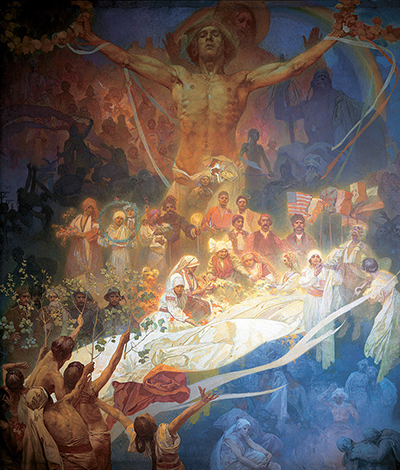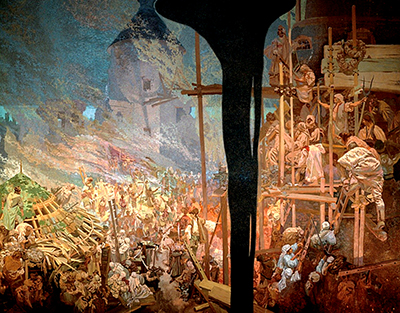
The Defence of Szigetvár by Nikola Zrinski (1914), the fourteenth canvas in Mucha’s Slav Epic according to the Foundation’s individual catalogue.
Buy Art Prints Nowfrom Amazon
* As an Amazon Associate I earn from qualifying purchases.
 by Tom Gurney
Tom Gurney BSc (Hons) is an art history expert with over 20 years experience
Page Created on / Page Updated on
Email: tomgurney1@gmail.com / Phone: +44 7429 011000
The Defence of Szigetvár by Nikola Zrinski: Mucha’s Divided Fortress
A column of black smoke divides a burning fortress. To its left, armed men gather for a final sortie; to its right, women crowd a wooden scaffold beside a powder store. Alphonse Mucha's Defence of Szigetvár by Nikola Zrinski is one of the darkest scenes in his Slav Epic. The Mucha Foundation lists the finished painting as No. 14, dated 1914, and gives it the subtitle “The Shield of Christendom (1566).”[1] The historical subject is the siege of Szigetvár in 1566, when a small garrison resisted a much larger Ottoman army.[3][4]
The painting does not promise rescue. Its defenders are preparing to leave a lost position, and the people at the right face danger inside it. Mucha uses the smoke to hold those two situations together: a collective military decision and a civilian catastrophe. The image honours resistance, but its scale of sacrifice should remain visible.[1][3]
At a Glance
- ArtistAlphonse Mucha
- CycleThe Slav Epic, No. 14 of 20[1]
- Foundation titleThe Sacrifice at Szigetvár by Nikola Zrinski. The Shield of Christendom (1566)[1]
- Painting date1914, for the finished canvas[1]
- Mediumegg tempera on canvas[1]
- Dimensions610 × 810 cm, for the finished canvas[1]
- Depicted eventthe final stage of the 1566 siege of Szigetvár[1][3][4]
The fourteenth Epic canvas in Mucha’s career
Contents
- The siege in 1566
- A fortress of water, bridges and retreating lines
- Zrinski and the final sortie
- How Črnko's account reached later readers
- The smoke between two groups
- The women at the powder store
- Painted in 1914
- Looking again
The siege in 1566
Nikola Zrinski was a Croatian nobleman commanding Szigetvár, a fortress in Hungary. Prague City Gallery describes the Ottoman siege as beginning in August 1566 and the defenders fighting through the loss of the city and castle's outer positions.[3] The city of Szigetvár dates the Ottoman camp's establishment to 5 August and Zrinski's final sortie with the remaining garrison to 7 September.[4] Those dates locate the historical crisis that Mucha later turned into a painting.
The Foundation describes Zrinski refusing to surrender after the fortifications gave way.[1] The city's history likewise presents the final sortie as a choice to fight rather than capitulate.[4] Mucha sets his scene around that decision. It is not a diagram of the siege's successive walls or exact troop movements. Its crowded left side suggests men preparing to move outward from a collapsing defence.
Other accounts reveal how carefully even a short siege chronology needs to be handled. The Hungarian National Archives dates the final sortie to 8 September, while Croatian historian Petra Babić, discussing the surviving account of Zrinski's chamberlain Franjo Črnko, gives 7 September.[5][6] The disagreement does not change Mucha's subject, but it prevents a single day from being presented as universally settled. Ottoman historian Géza Dávid describes the fortress as a castle with old and new towns linked by bridges and records the successive loss of those outer positions during August.[7] The final withdrawal and sortie arose from collapsing defences, not from a free choice between equal military options.
The Foundation's subtitle calls Szigetvár a “shield of Christendom.”[1] This language belongs to the way the episode has been remembered and to Mucha's own selected history. The fortress stood at the meeting of several political and religious worlds: a Croatian commander defending a Hungarian stronghold against an Ottoman army. The painting's ethical charge comes partly from that wide frame, but the figures within it remain individuals facing death.
Art historian Júlia Papp traces the related “shield and bastion of Christianity” trope through sixteenth-century European accounts of wars against the Ottomans. Such writing circulated images of defence and suffering, in part to seek military and financial support.[8] Mucha's subtitle joins that long tradition of treating a border fortress as the defence of a larger civilisation. The tradition explains the heroic register; it does not tell us what every inhabitant believed or hoped to protect.
A fortress of water, bridges and retreating lines
Szigetvár was harder to approach than a single walled enclosure. Archaeologist and historian Erika Hancz brings written accounts together with excavations to describe four connected parts: New Town, Old Town, the outer castle and the inner castle. Water from the Almás stream filled the ditches around the towns and was held back to create a lake and marsh around the castle. Bridges connected positions that could otherwise be isolated. The arrangement made water an active part of the defence, although Hancz notes that its effectiveness varied with weather and season.[9]
Ottoman writers did not describe this structure in identical terms. Ágehi wrote of two strong castles joined by bridges; Ahmed Feridun, who accompanied the campaign, called Szigetvár a fortress of four castles. Gelibolulu Mustafa Âlî distinguished New Town, Old Town, outer castle and inner castle, and said the defenders flooded the approaches. These accounts use different categories for the same complex site. Read together with Hancz's archaeological discussion, they explain why a painting of one blazing interior should not be mistaken for a plan of the whole siege.[9]
Hancz traces a sequence of retreat that gives Mucha's final gathering its setting. The attackers first assaulted New Town; the defenders withdrew to Old Town, then into the castle complex as the outer positions failed. A wooden bridge linked Old Town to the outer castle, while a separate narrow ditch divided the two castle sections. This was a defence conducted across connected spaces over weeks, not one continuous fight around the scaffold Mucha depicts. His compression gives the last decision emotional clarity while leaving the earlier engineering and losses outside the frame.[9]
The physical evidence also has limits. Hancz reports that a 2010 excavation found positions of thick medieval oak posts near the gate between the two towns, beside a different line of thinner posts from a later Ottoman palisade. Those finds support a changing fortified landscape, but they do not locate Mucha's scaffold or establish the shape of every building in his scene. Hancz cautions that later Western prints of the siege are schematic and that older reconstructions have needed revision after new excavations.[9]
The accounts also make the siege a campaign with several commanders and political audiences. Hancz places Grand Vizier Sokollu Mehmed Pasha at the head of the main Ottoman army and notes that Sultan Süleyman died before the fortress was taken. She identifies a substantial Ottoman literature about the campaign, including contemporary Szigetvár-nâme narratives. Their authors had reasons to celebrate victory just as Christian accounts had reasons to make Zrinski a model of steadfast defence. Hancz therefore compares chronicles with diplomatic records and material evidence rather than taking either side's rhetoric as a transparent report.[9] The picture belongs to the later history of that event, not to either army's operational record.
Zrinski and the final sortie
The Prague City Gallery places Zrinski among the men at the left, speaking to the exhausted garrison before their last attack. It says some fighters remove heavy armour so they can move more easily.[3] Those are institutional identifications; in the inherited image, the overall movement and crowd are much clearer than any one face. Mucha makes the group, rather than a portrait of the commander, carry the scene.
The left side is full of diagonals: ladders, fallen timber, weapons and bodies angled toward a bright opening. The arrangement gives the sense of a pressure that can no longer be contained. Behind them, fire reaches the architecture. The defenders are shown at a threshold, not at the moment of a successful counterattack.
The city history says Zrinski led a sortie from the inner fortress on 7 September 1566.[4] That record helps distinguish the historical action from Mucha's composition. The painting imagines preparation and collective resolve in one visual moment. It cannot verify the precise gestures each defender made before leaving the gate.
Črnko survived the siege and later wrote about its final preparations. As Babić summarises his Croatian account, Zrinski requested formal light clothing, a black velvet hat, his father's sabre and a small shield rather than armour. The men then went out after a cannon shot intended to open a path.[6] The eyewitness account is valuable for the event, but its details cannot simply be assigned to every figure Mucha painted. The artist selected a moment of collective readiness rather than a literal inventory of Črnko's narrative.
How Črnko's account reached later readers
Črnko's position makes him an unusually important witness, but the text itself has a history. The Croatian Encyclopaedia identifies him as Zrinski's secretary and chamberlain. He was captured when Szigetvár fell and was subsequently ransomed by Zrinski's son Juraj. The encyclopaedia suggests that notes made during the siege may have helped him write his chronicle after his release; that remains a probability, not a surviving notebook.[10]
Črnko's original manuscript has been lost. Samuel Budina published a Latin translation in 1568; two German and two Italian translations based on that Latin text appeared the same year. A Croatian Glagolitic copy was discovered in Austria in 1912, probably descended through a Latin-script copy of the original. Thus a claim repeated in several languages may still depend on one mediated witness narrative rather than on independent eyewitnesses.[10] The route through Latin and later copies matters especially for vivid details of the final hours, which are easily made more certain by repetition.
The siege also entered poetry, drama and historical writing beyond Črnko's chronicle. The Croatian Encyclopaedia names Croatian epic adaptations that used it, while a Turkish-language study by Hüseyin Şevket Çağatay Çapraz examines how Hungarian and Croatian accounts made the siege and Zrinski's death part of a heroic Christian-border narrative.[10][11] Neither source demonstrates which book Mucha personally consulted. They do, however, show that his 1914 painting inherits a subject already retold for centuries. The torch-bearing woman is best read within that layered tradition, alongside the independent historical question of who was actually present.
The smoke between two groups
The central plume is the painting's most forceful shape. Almost black against the brighter flames, it rises from the lower edge and separates the fighters from the scaffold. The Gallery interprets it as both the explosion at the fortress and a sign of the scale of human sacrifice.[3] The Foundation also makes the smoke a focal point of its reading.[1]
The plume obscures any easy path from one half of the canvas to the other. A viewer must look around it, comparing the two groups rather than merging them into a single heroic crowd. At left, the men prepare to go out; at right, the women climb and gather near the powder store. The dark division forces the question of whose lives are included when a painting speaks of a fortress's sacrifice.
Smoke also blocks a clear view of what follows. Mucha does not paint a neat final outcome in the distance. The image feels suspended just before a catastrophic act. Its bright fire and black vertical cut make the fortress seem to consume itself as its defenders are overcome.
The women at the powder store
On the right, a woman holds a torch above other women who climb toward her. The Foundation identifies her as Eva, Zrinski's wife, and says she chose to set a destructive fire rather than let the fortress fall intact.[1] The Gallery calls her a female leader beside the powder tower and describes the group as facing captivity if taken.[3] These are readings of Mucha's dramatic scene; the cited sources do not independently prove every woman's identity or choice in the historical siege.
Babić's Croatian study states that Eva Rosenberg was in Čakovec with her young son during the siege, rather than at Szigetvár.[6] The Foundation's identification cannot therefore be treated as a literal portrait of Eva at the fortress. It identifies a character in Mucha's composition. The difference between the painted role and the historical person is especially important when the scene appears to assign her responsibility for the powder-store fire.
Babić reports that Črnko described women and children being taken captive after the Ottoman entry and a subsequent explosion amid the fighting.[6] Dávid's Turkish-language account gives a different sequence for the explosion, placing a powder-store blast after a mine attack before the final sortie.[7] Neither account establishes the Foundation's story of Eva deliberately lighting the store. The smoke and torch can carry Mucha's theme of sacrifice while the historical mechanism and timing remain open.
The torch is a small object with enormous implied consequence. It draws the eye up the scaffold and toward the darkness at the top of the painting. The women are not a decorative echo of the fighters. Their half of the scene makes the price of refusing surrender visible beyond the garrison.
The Gallery says the tower holds gunpowder that the defenders do not want to hand over to the attacking army.[3] Mucha compresses fear, agency and destruction into a few figures on a wooden structure. Describing their action as “heroic” alone would miss the extremity of what the image asks viewers to witness. The painting can commemorate resistance while leaving its human cost disturbing.
Papp's study shows that the “valiant woman of Szigetvár” changed shape as stories crossed languages and centuries. A Hungarian song from 1566 described a woman who argued for the right to fight rather than be killed by her husband before the last battle. Later Latin, German and French works reshaped the motif, and nineteenth-century pictures gave women more prominent roles.[8] This does not prove that Mucha borrowed any one of them. It does show that a female act of courage or self-sacrifice at Szigetvár was a long-standing literary and artistic theme. Mucha's scaffold scene belongs to that history of remembrance as well as to his own Slav Epic.
Painted in 1914
The Foundation dates the finished canvas to 1914 and records a separate c.1913–14 preparatory design made from photographed drawings tinted with watercolour and gouache.[1][2] The inherited images on this page show the finished canvas. Their medium and scale should not be borrowed from the study, and the study should not be mistaken for a second reproduction of this work.
The Gallery story's image caption gives 1912 for the painting, while the Foundation's individual finished-object record gives 1914.[1][3] This page follows the latter for its object facts and keeps the discrepancy in the source packet. The 1566 date belongs to the siege, not the making of either image.
Mucha worked on the Slav Epic during years of political upheaval in Europe. The canvas's production date overlaps the outbreak of the First World War, but that coincidence alone cannot tell us exactly how he intended a 1566 siege to comment on 1914. The picture's present force rests in what it shows: people facing a choice under siege and a composition that refuses to hide the cost.[1][3]
Looking again
Move from the crowd preparing at left, through the smoke, to the women above the powder store. The eye crosses a divide between two forms of last action. Neither path leads to an uncomplicated victory; both are bounded by fire and the knowledge that the fortress is falling.[1][3]
In The Defence of Szigetvár, Mucha offers a scene of resistance and sacrifice on an immense scale. Its title and subtitle place the siege within a wider story of defence, while its figures keep the viewer close to fear, exhaustion and loss. The central smoke makes those meanings inseparable: the memory of courage rises from a picture of lives consumed by war.[1][3]
Watch: Alphonse Mucha
Place Mucha’s Czech and Slavic projects beside his better known Paris work.
Prague’s Art Nouveau, Mucha, and the Slav Epic
A short view of Mucha’s Prague legacy and the Slav Epic cycle.
Watch on YouTubeArtworks directory
| Name | Date | Medium |
|---|---|---|
| 'Accept Love and Enthusiasm from Your Son, Mother of the Holy Nation': study for the mural 'By Own Strength III' at the Lord Mayor's Hall, Obecní Dům, Prague | 1910-1911 | Pencil and charcoal on canvas |
| 'By force towards freedom, with love towards unity!': study for the mural 'By Own Strength II' at the Lord Mayor's Hall, Obecní Dům, Prague | 1910-1911 | Pencil and charcoal on canvas |
| 'The Passing Wind Takes Youth Away': design for a fan and the façade of the 'Pavilion of Man' (unrealised) | 1899 | Colour lithograph |
| 'Through humiliated and tortured, you will live again, my country!': study for the mural 'By Own Strength II' at the Lord Mayor's Hall, Obecní Dům, Prague | 1910-1911 | Pencil and charcoal on canvas |
| 1918-1928: Poster for the 10th Anniversary of the Independence of the Republic of Czechoslovakia | 1928 | Colour lithograph |
| 6th Sokol Festival | 1912 | Colour lithograph |
| 8th Sokol Festival | 1925 | Colour lithograph |
| After the Battle of Grunwald | 1924 | egg tempera on canvas |
| After the Battle of Vitkov Hill | 1923 | egg tempera on canvas |
| Age of Love | 1936–1938 | |
| Age of Reason | 1936–1938 | |
| Age of Wisdom | 1936–1938 | |
| Amants | 1895 | Colour lithograph |
| Apotheosis of the Slavs | 1926 | Egg tempera on canvas |
| As Hamlet | 1899 | colour lithograph |
| Au Quartier Latin | 1898 | Magazine cover |
| Banknotes of Czechoslovakia, designed by Mucha: 500 crown; 50 Crown; 10 Crown | 1929 | Banknotes |
| Bieres de la Meuse | 1897 | Colour lithograph |
| Biscuits Champagne Lefevre Utile | 1896 | Colour lithograph |
| Biscuits Lefevre Utile | 1896 design for 1897 calendar; Foundation object/Carnavalet 1897 | Colour lithograph |
| Blessed are the Pure in Heart | 1906 | Printed magazine illustration |
| Bleu Deschamps | 1903 (deposit) | Colour lithograph |
| Bosnia & Herzegovina Pavilion - illustration featured in 'Le Figaro Illustré' (1 March 1900) | 1900 | Reproduction from Le Figaro Illustré after watercolour original |
| Bosnia-Herzegovina Pavilion: cartoon for the mural 'The Roman Period and the Arrival of the Slavs' | 1899-1900 | ink and crayon on paper |
| Bosnia-Herzegovina Pavilion: fragment of the upper frieze featuring Ivo and Anica, characters from Bosnian legends | 1899-1900 | tempera and watercolour on canvas |
| Bosnian Legends: Death of Hasanaga's Bride | 1899 | Charcoal on paper |
| Bosnian Legends: Murcia - The Plague Lady | 1899 | Charcoal on paper |
| Bosnian Pavilion Restaurant at the Paris Exhibition 1900: design for the menu | 1900 | Pencil and watercolour on paper |
| Boutique Fouquet (interior design) | 1901 | Shop interior design |
| Boutique Fouquet: sketches of the shop's signboard and decorative details | c.1900 | Pencil, ink and watercolour on paper |
| Box for Lefèvre-Utile biscuits: Gaufrettes Vanille | c.1900 | Tin box covered with lithographed label |
| Box for Lefèvre-Utile biscuits: Madère | c.1900 | Tin box covered with lithographed label |
| Brightness of the Day | 1899 | Colour lithograph |
| Broach with Pendant | 1900 | Gold, ivory, mother-of-pearl and semi-precious stones |
| Byzantine Head - The Blonde | 1897 | Colour lithograph |
| Byzantine Heads (pair) | 1897 | Colour lithograph |
| Byzantine Heads: Brunette | 1897 | Colour lithograph |
| Bénédictine | 1898 (BnF deposit); Hamburg 1899; MNAC 1896 or 1898 | Colour lithograph |
| Champagne Ruinart | 1896 | Colour lithograph |
| Chocolat Ideal | before or in 1897 (catalogue conflict) | Colour lithograph |
| Chocolat Masson (1897 calendar) | 1896–1897 | Colour lithograph |
| Choirboys at Petrov Church, Brno | 1905 | Watercolour on cardboard |
| Cloches de Noel | 1900 | Illustrated book |
| Comedy: study for a mural for the German Theatre, New York | 1908 | Oil on canvas |
| Cours Mucha: poster advertising Mucha's art classes held at the Académie Colarossi, Paris | 1900 | colour lithograph |
| Creative Force - Jan z Pernštýna: study for a pendentive of the Lord Mayor’s Hall, Obecní Dům, Prague | 1910-1911 | Oil on canvas |
| Crucifixion | c.1868 | Pencil, crayon and watercolour on paper |
| Cycles Perfecta | 1897 or 1902 (catalogue conflict) | Colour lithograph |
| Dance | 1898 | Colour lithograph |
| Dead Couple - Abandoned | c.1899-1900 | Charcoal and pastel on blue paper |
| Defense of Sziget against the Turks by Nicholas Zrinsky | 1914 | egg tempera on canvas |
| Design for a champagne poster | c. 1896 | Charcoal and pastel on paper |
| Design for a display stand at the Paris Exhibition 1900 | c.1899-1900 | Pencil and wash on paper |
| Design for Champagne Ruinart | c. 1896 | Pencil, watercolour and gold leaf on paper |
| Design for the cover of the magazine 'Fantaz' | 1882 | Ink and watercolour on paper |
| Design for the heading of the cover of the magazine 'Krokodil' | 1885 | Pen and ink on cardboard |
| Design for the poster for the Mucha Exhibition at the Brooklyn Museum, New York, January-February 1921 | 1920 | Pen and ink and watercolour on paper |
| Designs for cutlery | c.1900 | Charcoal and white on card |
| Designs for tableware | c.1900 | Charcoal, coloured pencil and white on card |
| Diadem for 'La princesse lointaine' | 1895 | metal and pearls |
| Diploma of Ivančice: Mock diploma honouring a local celebrity, with illustration of the first line of 'May', a poem by Karel Hynek Mácha | 1882 | Pen and ink and watercolour on paper |
| Documents décoratifs: designs for a watch and accessories (unused) | 1901-1902 | Pencil, ink and white on paper |
| Documents décoratifs: final study for Plate 25, featuring studies of lily | 1901-1902 | Pencil on paper |
| Documents décoratifs: final study for Plate 43 | 1901-1902 | Pencil, ink and wash, heightened with white on paper |
| Documents décoratifs: final study for Plate 49 | 1901-1902 | Pencil and white on paper |
| Documents décoratifs: final study for Plate 50 | 1901-1902 | Pencil and white on paper |
| Documents décoratifs: final study for Plate 60 | 1901-1902 | Pencil, ink and wash, heightened with white on paper |
| Documents décoratifs: final study for Plate 63 | 1901-1902 | Pencil and white on paper |
| Documents décoratifs: final study for Plate 67 | 1901-1902 | Pencil and white on paper |
| Documents décoratifs: final study for Plate 71 | 1901-1902 | Pencil and white on paper |
| Documents décoratifs: final study for Plate 72 | 1901-1902 | Pencil and wash, heightened with white on paper |
| Documents décoratifs: line drawing for Plate 33, featuring lily motifs | 1901-1902 | Pencil, pen and ink on paper |
| Documents décoratifs: Plate 54 | 1902 | Lithograph |
| Dreaming of Freedom: study for a Panel of the Small Reception Room at the Lord Mayor’s Hall, Obecní Dům, Prague | 1910-1911 | Pen and ink and watercolour on paper |
| Dusk | 1899 | Colour lithograph |
| Evening | 1899 | Colour lithograph |
| F. Champenois (Rêverie imprint) | 1898 | Colour lithograph |
| F. Guillot-Pelletier calendar (1898) | 1897–1898 | Colour lithograph |
| Feather | 1899 | Colour lithograph |
| Figures décoratives: final study for Plate 2 | 1904-1905 | Pencil and white on paper |
| Figures décoratives: final study for Plate 3 | 1904-1905 | Pencil and white on paper |
| Figures décoratives: final study for Plate14 | 1904-1905 | Pencil with white on paper |
| Figures décoratives: sketch study for Plate14 | 1904-1905 | Blue pencil on paper |
| Flirt Lefevre Utile | 1899 (Foundation design); BnF legal deposit 1900 | Colour lithograph |
| Flower | 1897 | Colour lithograph |
| Flower: final study for decorative panel | 1897 | Pencil, ink and watercolour on paper |
| France Embraces Bohemia | 1918 | oil on canvas |
| Fruit | 1897 | Colour lithograph |
| Georges Fouquet (1858-1929), Paris, after design by Mucha: Ornamental Chain with pendants | 1900 | Gold, enamel, fresh-water pearls, mother of pearl and semi-precious stones |
| Georges Fouquet (1858-1929), Paris, after Mucha design: 'Peacock' Ring (Exhibited at the Paris Exhibition 1900) | 1900 | Opal and gold |
| Girl Weeping | c.1899-1900 | Black chalk and pastel on paper |
| Girl with Loose Hair and Tulips | 1920 | Oil on canvas |
| Gismonda | 1894 | Colour lithograph |
| Head of a Girl, statue for the stand of the Houbigant Perfumery at the Paris Exhibition 1900 | 1900 | Bronze, silver and parcel gilt |
| Head of Sarah Bernhardt: Study for 'Lorenzaccio' | 1896 | Pencil on paper |
| Heather from Coastal Cliffs | 1902 | Colour lithograph |
| Heidsieck & Co | 1901 | Colour lithograph |
| Holy Mount Athos | 1926 | Egg tempera on canvas |
| Ilsée, Princesse de Tripoli | 1897 | Illustrated book |
| In the Desert: Study for an illustration for the Světozor magazine | 1889 | Pencil, watercolour and gouache on paper |
| Incantation (Salammbô) | 1897 | Lithograph |
| Independence - Jiří z Poděbrad: study for a pendentive of the Lord Mayor’s Hall, Obecní Dům, Prague | 1910-1911 | Oil on canvas |
| Interior and furniture designs | c.1900 | Pencil on paper |
| Interior of Boutique Fouquet: design for a wall-mounted display cabinet with statuette and mirror | c.1900 | Pencil on paper |
| Interior of Boutique Fouquet: design for the fireplace with statuettes, mirror, and the ornamental details of the wall | c.1900 | Pencil and watercolour on cardboard |
| Interior of Boutique Fouquet: sketches of the fireplace with statue, mirror, display cabinet, and the ornamental details of the wall | c.1900 | Pencil, pen and ink on paper |
| Ivy | 1901 | Colour lithograph |
| Jan Milic of Kromeriz | 1916 | egg tempera on canvas |
| Jaroslava and Jiří, the Artist’s Children | 1918 | Oil on canvas |
| JOB poster | 1896 | Colour lithograph |
| Judgement of Paris (calendar for Vieillemard printing company) | 1895 | Colour lithograph |
| Justice - Master Jan Hus: study for a pendentive of the Lord Mayor's Hall, Obecní dům, Prague | 1910-1911 | Oil on canvas |
| L'Annee Qui Vient | 1897 | red chalk on paper |
| L'Illustration magazine - cover for Christmas 1896/1897 | 1896 | Magazine cover |
| L'Illustré Soleil du Dimanche | 1897 | Magazine cover |
| La Dame aux Camélias: designs for cover and interior of special programme | 1896 | Pencil and watercolour on paper |
| La Nature | 1899-1900 | Bronze and amethyst |
| La Plume | 1897 | Magazine cover |
| La Samaritaine | 1897 | colour lithograph |
| Lance Parfum Rodo | 1896; Albertina print c. 1900 | Colour lithograph |
| Laurel | 1901 | Colour lithograph |
| Le Monde Illustré | 1900 | Magazine cover |
| Le Pater | 1899 | Illustrated book |
| Le Pater: early study for the 1st allegorical scene 'Our Father who art in Heaven' (1899) (Mucha Foundation object 300) | 1899 | Pencil on paper |
| Le Pater: early study for the 1st allegorical scene 'Our Father who art in Heaven' (1899) (Mucha Foundation object 302) | 1899 | Pastel on paper |
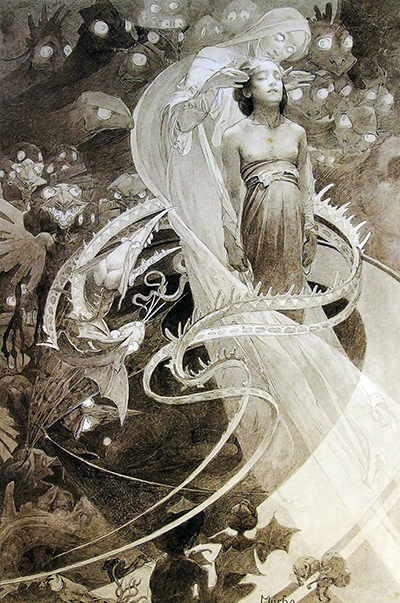
| Le Pater: study for the 6th allegorical scene 'Forgive us our debts, as we forgive our debtors' | 1899 | Charcoal and ink wash on paper |
| Lefevre Utile | 1904 | Advertisement |
| Leslie Carter | 1908 | Colour lithograph |
| Letem Českým Světem | 1898 | Printed book |
| Lorenzaccio | 1896 | Colour lithograph |
| Luchon poster (attributed to Mucha) | 1895 | Colour lithograph |
| Madonna of the Lilies | 1905 | Tempera on canvas |
| Master Jan Hus Preaching at the Bethlehem Chapel | 1916 | egg tempera on canvas |
| Maude Adams | 1908 | Lithograph, hand-coloured in watercolour and gouache |
| Maude Adams as Joan of Arc | 1909 | Oil on canvas |
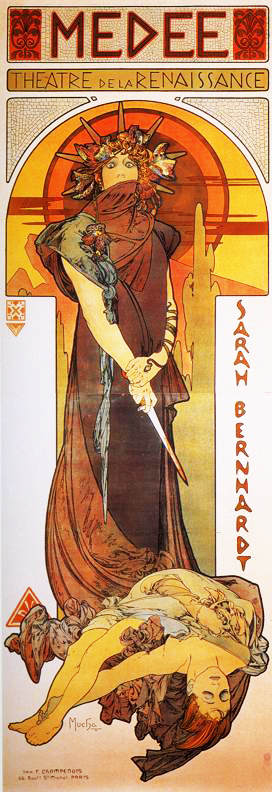
| Medea | 1898 | Colour lithograph |
| Menu for the Bosnian Pavilion Restaurant at the Paris Exhibition 1900 | 1900 | Colour lithograph |
| Militancy - Jan Žižka: study for a pendentive of the Lord Mayor's Hall, Obecní dům, Prague | 1910-1911 | Oil on canvas |
| Military Camp in Winter, near a City on Fire | c.1899-1900 | Pastel on paper |
| Moet et Chandon | 1899 | Colour lithograph |
| Monaco Monte Carlo | 1897 | Colour lithograph |
| Moon | 1902 | |
| Moravian Teachers' Choir | 1911 | Colour lithograph |
| Morning Alphonse Mucha Painting / AlphonseMucha.org | 1899 | Colour lithograph |
| Morning Star | 1902 | Colour lithograph |
| Moët & Chandon White Star | 1899 | Colour lithograph |
| Mrs Mucha’s Necklace | 1906 | gold, enamel and semi-precious stones |
| Mural for the Bosnia-Herzegovina Pavilion: The Roman Period and the Arrival of the Slavs | 1900 | tempera and watercolour on canvas |
| Murals by Mucha in the Lord Mayor's Hall, Obecní Dům (Municipal House), Prague (1910-1911) | ||
| Music | 1898 | Colour lithograph |
| Nativity | c. 1934 | oil on canvas |
| Nestle's Food for Infants | 1897 | Colour lithograph |
| Night | 1899 | Colour lithograph |
| Nude on a Rock | 1898-1899 | Bronze |
| Official Banquet of the Paris Exhibition 1900: design for the menu featuring a fashionable woman wearing a Mucha-style jewellery | 1900 | Pencil, gouache and wash on grey paper |
| Ornamental motifs designed for 'Combinaisons Ornementales se Multipliant à l'Infini à l'Aide du Miroir' (1901) | c.1900-1901 | Blue and red pencil on paper |
| Packaging for 'Savon Mucha Violette' | 1906 | Colour lithograph |
| Packaging for Lefèvre-Utile biscuits: Boudoir | 1901 | Colour lithograph |
| Page's Costume: study for an illustration for 'Le Costume au Théâtre' | 1890 | Pencil and watercolour on cardboard |
| Painting | 1898 | Colour lithograph |
| Peonies | 1897–1898 | Ink and watercolour |
| Petr Chelcicky at Vodnany | 1918 | egg tempera on canvas |
| Poetry | 1898 | Colour lithograph |
| Portrait of Jaroslava | c.1927-1935 | Oil on canvas |
| Portrait of Josephine Crane Bradley as Slavia | 1908 | Oil and tempera on canvas |
| Portrait of Marie Chytilová (Maruška), Mucha's Future Wife | 1903 | pastel on paper |
| Portrait of Mucha's Sister, Angela | c.1880 | Oil on canvas |
| Portrait of Mucha's Sister, Anna | c.1885 | Oil on canvas |
| Portrait of Mucha's Son, Jiří | 1925 | Oil on canvas |
| Portrait of Mucha's Wife, Maruška | 1908/17 | Oil on canvas |
| Portrait of Woman | c. mid 1910s - 1925 | Blue pastel on grey paper |
| Poster for 'Hommage Respectueux de Nestlé' (the Nestlé Company's tribute to Queen Victoria's 60th Jubilee) | 1897 | Colour lithograph |
| Poster for 'Imprimerie Cassan Fils' | 1896 | Colour lithograph |
| JOB poster (1898) | 1898 | Colour lithograph |
| Poster for 'La Dame aux Camélias' | 1896 | Colour lithograph |
| Poster for 'La Tosca' | 1899 | Colour lithograph |
| Poster for 'Regional Exhibition at Ivančice 1913' | 1912 | Colour lithograph |
| Poster for 'The Slav Epic Exhibition, Brno, 1930' | 1928-1930 | Colour lithograph |
| Poster for 'Waverley Cycles' | 1898 | Colour lithograph |
| Poster for the 'Lottery of the Union of Southwestern Moravia' | 1912 | Colour lithograph |
| Poster for the Austrian Pavilion at the Paris Exhibition 1900 | 1900 | Colour lithograph |
| Prague Subjugated: study for a Panel of the Small Reception Room at the Lord Mayor’s Hall, Obecní Dům, Prague | 1910-1911 | Pen and ink and watercolour on paper |
| Primrose | 1899 | Colour lithograph |
| Primrose and Feather (paired image) | 1899 | Colour lithographs (paired image) |
| Princess Hyacinth (Princezna Hyacinta) | 1911 | Colour lithograph |
| Print proof for the Biscuits Lefèvre-Utile tin | 1899 | Lithograph |
| Reverie | 1898 | Colour lithograph |
| Russia Restituenda [Russia Must Recover] | 1922 | Colour lithograph |
| Salome | 1897 | Colour lithograph |
| Salon des Cent | 1896 | Colour lithograph |
| Salon of the Hundred | 1897 | Colour lithograph |
| Sarah Bernhardt - La Princesse Lointaine - Lefevre Utile | 1903 | Colour lithograph |
| Sarah Bernhardt as La Princesse Lointaine: poster for 'La Plume' magazine | 1897 | Colour lithograph |
| Sarah Bernhardt in the role of the Duc de Reichstadt in L’Aiglon | 1900 | Pencil on paper |
| Sarah Bernhardt: study of her full-standing figure | c.1896 | Pen and ink on paper |
| Savonnerie de Bagnolet calendar | 1898 (calendar) | Printed advertising calendar |
| Self-portrait (1899) | 1899 | Oil on board |
| Self-portrait (1907) | 1907 | Blue and white crayon on blue Ingres paper |
| Self-portrait, sketching in his apartment, Paris | late 1880s | oil on canvas |
| Sketches of flowers for Documents décoratifs | c.1900-1901 | Pen and ink on paper |
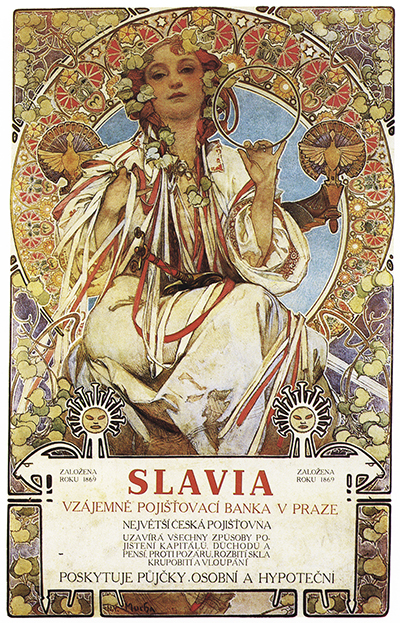
| Slavia insurance poster | 1907 | Poster |
| Slavs in their Original Homeland | 1912 | Egg tempera on canvas |
| Snake Bracelet with a Ring | 1899 | Gold, enamel, opal, ruby and diamond |
| Société Populaire des Beaux Arts | 1897 | Colour lithograph |
| Song of Bohemia | 1918 | oil on canvas |
| St. Vitus Cathedral Stained-glass Window, Prague: final design for the central panels, featuring SS Cyril and Methodius | 1931 | Ink and watercolour on paper |
| St. Vitus Cathedral Stained-glass Window, Prague: final design for the central panels, featuring St. Ludmila | 1931 | Ink and watercolour on paper |
| St. Vitus Cathedral Stained-glass Window, Prague: final design for the central panels, featuring St. Wenceslas (Duke of Bohemia) kneeling next to his Grandmother, St. Ludmila | 1931 | Ink and watercolour on paper |
| St.Vitus Cathedral Stained-glass Window, Prague: final design for the bottom left panels | 1931 | Ink and watercolour on paper |
| St.Vitus Cathedral Stained-glass Window, Prague: final design for the bottom right panels | 1931 | Ink and watercolour on paper |
| Stained-glass Window designed by Mucha at St. Vitus Cathedral, Prague | Early 1930s | N/A |
| Study for 'The Age of Reason' | 1936-1938 | Pencil and watercolour on paper |
| Study for 'The Slav Epic cycle' No.19: The Abolition of Serfdom in Russia | 1913-1914 | Watercolour and gouache on paper |
| Study for 'The Slav Epic' cycle No.14: The Sacrifice at Szigetvár by Nikola Zrinski | c.1913-1914 | Photographed drawings stuck together, tinted with watercolour and gouache |
| Study for 'The Slav Epic' cycle No.17: The Holy Mount Athos (1926) | c.1925-26 | Charcoal heightened with white on cardboard |
| Study for 'The Slav Epic' cycle No.18: The Oath of Omladina under the Slavic Linden Tree | c.1925-1926 | Pencil and watercolour on paper |
| Study for 'The Slav Epic' cycle No.1: The Slavs in Their Original Homeland (1912) | c.1910-1912 | Oil on canvas |
| Study for 'The Slav Epic' cycle No.2: The Celebration of Svantovít | c.1910-1912 | Oil on canvas |
| Study for 'The Slav Epic' cycle No.7: Jan Milíč of Kroměříž | c.1915-1916 | Oil on canvas |
| Study for 'The Slav Epic' cycle No.9: Master Jan Hus Preaching at the Bethlehem Chapel. The Magic of the Word: Truth Prevails (1412). | c.1915-1916 | Oil on canvas |
| Study for 'The Three Ages' triptych: Reason, Wisdom and Love [unfinished project] | 1936-1938 | Pencil and watercolour on paper |
| Study for 'Woman in the Wilderness' (c. 1922-1923) (Mucha Foundation object 315) | c. 1922-1923 | oil on canvas |
| Study for 'Woman in the Wilderness' (c. 1922-1923) (Mucha Foundation object 316) | c. 1922-1923 | oil on canvas |
| Study for Savon Notre Dame | c. 1896 | pencil and watercolour on paper |
| Study for the poster 'Russia Restituenda [Russia Must Recover]' | 1922 | Pen and ink and watercolour on paper |
| Study of a Male Nude | 1885-1887 | Oil on canvas |
| The Abolition of Serfdom in Russia | 1914 | Egg tempera on canvas |
| The Arts (series) | 1898 | Colour lithograph |
| The Arts: study for 'Dance' | 1898 | Pencil and watercolour on paper |
| The Arts: study for 'Music' | 1898 | Pencil and watercolour on paper |
| The Arts: study for 'Painting' | 1898 | Pencil and watercolour on paper |
| The Arts: study for 'Poetry' | 1898 | Pencil and watercolour on paper |
| The Bohemian King Premysl Otakar II | 1924 | egg tempera on canvas |
| The Bulgarian Tsar Simeon | 1923 | egg tempera on canvas |
| The Burr McIntosh Monthly, 1907 | 1907 | Magazine cover |
| The Celebration of Svantovit | 1912 | egg tempera on canvas |
| The Coronation of the Serbian Tsar Stefan Dusan as East Roman Emperor | 1923 | egg tempera on canvas |
| The Devil and Mr Twardowsky: study for an illustration for 'The Tale of Pan Twardowsky' (a variation of 'Faust') | c.1887-1888 | Charcoal on paper |
| The Flowers (series) | 1898 | Colour lithographs |
| The Flowers: Carnation | 1898 | Colour lithograph |
| The Flowers: Iris | 1898 | Colour lithograph |
| The Flowers: Lily | 1898 | Colour lithograph |
| The Flowers: Rose | 1898 | Colour lithograph |
| The Hussite King Jiri of Podebrady | 1923 | Egg tempera on canvas |
| The Introduction of the Slavonic Liturgy | 1912 | egg tempera on canvas |
| The Last Days of Jan Amos Komensky (Comenius) in Naarden | 1918 | Egg tempera on canvas |
| The Light of Hope | 1933 | Oil on canvas |
| The Meeting at Krizky | 1916 | egg tempera on canvas |
| The Months (January-June) | 1899 | Colour lithograph |
| The Months (July-December) | 1899 | Colour lithograph |
| The Moon and the Stars (four-panel montage) | 1902 | Colour lithographs (four-panel montage) |
| The Moon and the Stars (series) | 1902 | Colour lithograph |
| The Moon and the Stars: study for 'The Evening Star' | 1902 | Ink and watercolour on paper |
| The Moon and the Stars: study for 'The Pole Star' | 1902 | Ink and watercolour on paper |
| The New York Daily News art supplement | 1904 | Printed art supplement |
| The Oath of Concord of the Slavs (unfinished) | 1939 | oil on canvas |
| The Oath of Omladina under the Slavic Linden Tree | 1926, unfinished | Egg tempera on canvas |
| The Precious Stones (four-panel montage) | 1900 | Colour lithographs (four-panel montage) |
| The Precious Stones (series) | 1900 | Colour lithograph |
| The Precious Stones: Amethyst | 1900 | Colour lithograph |
| The Precious Stones: Emerald | 1900 | Colour lithograph |
| The Precious Stones: Ruby | 1900 | Colour lithograph |
| The Printing of the Bible of Kralice in Ivancice | 1914 | egg tempera on canvas |
| The Seasons (series) | 1896 | Colour lithograph |
| The Seasons (series) (1900) | 1900 | Colour lithograph |
| The Seasons (variation in screen format) | 1896 | Colour lithograph |
| The Seasons: Autumn (1896) | 1896 | Colour lithograph |
| The Seasons: Autumn (1900) | 1900 | Colour lithograph |
| The Seasons: Spring | 1900 | Colour lithograph |
| The Seasons: Spring (1896) | 1896 | Colour lithograph |
| The Seasons: Summer | 1900 | Colour lithograph |
| The Seasons: Summer (1896) | 1896 | Colour lithograph |
| The Seasons: Winter | 1900 | Colour lithograph |
| The Seasons: Winter (1896) | 1896 | Colour lithograph |
| The Slavonic Concord: study for the ceiling painting for the Lord Mayor's Hall, Obecní Dům, Prague | 1910-1911 | Oil on canvas |
| The Threat | 1912 | Colour lithograph |
| The Times of the Day (series) | 1899 | Colour lithograph |
| The West End Review | 1897 (Foundation); 1898 promotional cover | Colour lithograph |
| Thistle from the Sands | 1902 | Colour lithograph |
| Théâtre de la Renaissance: design for poster advertising Sarah Bernhardt's theatre | c.1895 | Pen and ink on paper |
| Tin for Lefèvre-Utile biscuits | 1899 | Circular tin with lid and handle; colour print on metal |
| Topaz | 1900 | Colour lithograph |
| Tragedy - study for a mural for the German theatre New York | 1908 | Oil and tempera on canvas |
| Trappistine Liquors | 1897 | colour lithograph |
| Wiener Chic | 1905 | Magazine cover |
| Woman in the Wilderness | 1923 | Oil on canvas |
| Woman masked in white head-scarf - study for the illustration of the Bosnia & Herzegovina Pavilion featured in 'Le Figaro Illustré' (1 March 1900) | 1899 | Pencil and wash heightened with white on paper |
| Woman with a Daisy - textile designed by Mucha | 1900 | Printed upholstery fabric |
| Zdenka Cerny | 1913 | Colour lithograph |
| Zodiac (La Plume calendar) | 1896–97 | Colour lithograph |
| Zodiac (textless decorative panel) | 1896 | Colour lithograph |
| ‘At the sight of the two storks the owl rose.’ Study for an illustration for Contes de Grand-mères | 1891 | Watercolour and gouache on paper |
Frequently Asked Questions
When did Mucha paint The Defence of Szigetvár?
Who was Nikola Zrinski?
What divides the two groups in the painting?
Discussion
Mucha sets defenders and women on opposite sides of a central plume of smoke.
The division connects a final sortie with the cost borne by those left inside the fortress.
Reader Insights
Which group catches your eye first, and why?
How does the central smoke affect the way you read the two halves?
What does the torch suggest about the women’s part in the scene?
Join the Conversation
Share what you notice about the defenders, the women and the smoke between them.
References
- Mucha Foundation, “The Slav Epic cycle No. 14: The Sacrifice at Szigetvár by Nikola Zrinski,” object 225, finished-canvas identity, medium, dimensions and interpretation. View source.
- Mucha Foundation, “Study for The Slav Epic cycle No. 14,” object 181, preparatory-design identity and medium. View source.
- Prague City Gallery, “Defense of Sziget against the Turks by Nikola Zrinsky,” illustrated story presented through Google Arts & Culture, based on the 2022 Moravský Krumlov exhibition catalogue. View source.
- City of Szigetvár, “Zrínyi Vár,” local castle history and siege chronology. View source.
- Hungarian National Archives, “Szigetvár: 1566,” Hungarian-language discussion of archival evidence, campaign context and the final sortie. View source.
- Petra Babić, “Znanstvena historiografija i licentia poetica,” Arti musices 53/1 (2022), 83–112; Croatian-language comparison of Črnko's account and later dramatic tradition. View source.
- Géza Dávid, “Sigetvar,” TDV İslâm Ansiklopedisi (2009), Turkish-language account of the Ottoman siege and town. View source.
- Júlia Papp, “Female body—male body: The valiant Hungarian women of Eger and Szigetvár,” Cogent Arts & Humanities 3 (2016), on sixteenth-century narratives and their later reception. View source.
- Erika Hancz, “Szigetvár az 1566. évi török hadjárat idején: A vár és a város történeti és régészeti kutatásai,” in Fiatal Középkoros Régészek IV. Konferenciájának Tanulmánykötete (2013), 149–158; Hungarian-language study of Ottoman accounts, fortress structures and archaeology. View source.
- Croatian Encyclopaedia, “Črnko, Ferenc,” Croatian-language account of the witness, captivity, lost original, translations and later copy. View source.
- Hüseyin Şevket Çağatay Çapraz, “Vakadan Destana 1566 Szigetvár Kuşatması,” Türk Dünyası Araştırmaları 116/228 (2017), 99–118; Turkish-language study of the siege's epic treatment in Hungarian and Croatian writing. View source.