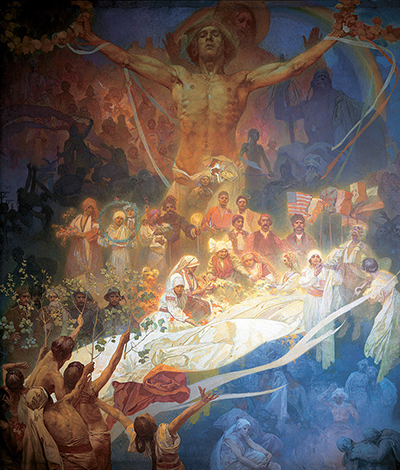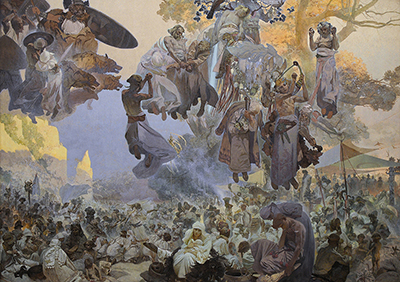
The Celebration of Svantovít (1912), the second canvas in Mucha’s Slav Epic.
Buy Art Prints Nowfrom Amazon
* As an Amazon Associate I earn from qualifying purchases.
 by Tom Gurney
Tom Gurney BSc (Hons) is an art history expert with over 20 years experience
Page Created on / Page Updated on
Email: tomgurney1@gmail.com / Phone: +44 7429 011000
The Celebration of Svantovít by Alphonse Mucha: Festival and Forewarning
A dense crowd gathers in sunlight across the lower part of Alphonse Mucha’s Celebration of Svantovít. Above it, a larger, airborne struggle fills the sky. Near the lower centre, a mother holds a child and looks outward, separated in mood from the festival around her. This is the second painting in Mucha’s twenty-canvas Slav Epic. It makes a moment of communal celebration share one surface with a vision of danger.[1][2]
The Mucha Foundation dates the finished canvas to 1912. Its long catalogue title places the imagined celebration between the eighth and tenth centuries AD. The Foundation also describes the later destruction of Svantovít’s temple in 1168 as part of the painting’s meaning. Historians differ between 1168 and 1169 for that conquest.[8][9][10] These are three different times: the era Mucha chose for the scene, the future loss it foreshadows, and the twentieth-century date when he painted it.[1]
At a Glance
- ArtistAlphonse Mucha
- CycleThe Slav Epic, No. 2 of 20[1][5]
- Full catalogue titleThe Celebration of Svantovít. When Gods Are at War, Salvation Is in the Arts (between the 8th and 10th centuries AD)[1]
- Painting date1912[1]
- Mediumegg tempera on canvas in the Foundation record; a Czech exhibition account also lists oil[1][11]
- Dimensions610 × 810 cm, for the finished canvas[1]
- Related preparationsmall oil study, c.1910–12; staged-model photograph, 1911–12[3][4]
The second Epic canvas in Mucha’s career
Contents
- A festival beneath an ominous sky
- What the medieval account says about the festival
- Gods, wolves and a different kind of conflict
- The fall of Arkona and its disputed year
- Why the arts appear in the title
- Planned with a study and posed figures
- The second chapter of the Slav Epic
A festival beneath an ominous sky
Mucha divides the composition by mood. Below, a festival crowds the ground. Pale clothing catches the light, and bodies bend, turn, dance and converse. The Foundation describes white-clad pilgrims in the bottom third of the canvas, gathered for an autumn celebration of Svantovít on the island of Rujana, now Rügen in Germany.[1] The Prague City Gallery gives the scene a more specific reading: a procession led by a high priest emerges from the temple at right, with a bull intended for sacrifice, while people rejoice at the harvest.[2]
The lower crowd has no single central leader. A viewer has to move among its clusters. This makes the celebration feel collective rather than staged for one ruler. At the right, the procession and tented structures help set an occasion; at the left, the mass of people extends beyond any one small incident. The painting asks the eye to work across its broad width, discovering relationships that a thumbnail compresses into texture.
At lower centre, the mother and child interrupt that rhythm. The mother’s pale clothes make her visible, but it is her stillness that matters. The Foundation says she looks toward the viewer in distress, as though aware of what will happen to the city.[1] The Prague City Gallery likewise singles her out as the one person who seems troubled amid singing and dancing.[2] We do not need to read her as a portrait of a named historical woman. She is a figure within Mucha’s constructed scene, inviting the viewer to notice a future the other celebrants cannot see.
The tension lies partly in what the people below cannot know. In the Foundation’s account, the temple at Arkona was destroyed by Danish attackers in 1168, long after the centuries named in the painting’s subtitle.[1] Mucha brings that later loss into a festival set earlier. The canvas is therefore not a snapshot of a single day. It is a historical drama compressed into one image, with celebration in the present of the scene and disaster looming above it.
What the medieval account says about the festival
The most detailed written account of Svantovít's cult comes from Saxo Grammaticus, whose Gesta Danorum was written after the Danish conquest. A modern source-critical study by Juan Antonio Álvarez-Pedrosa and Enrique Santos Marinas describes Saxo's report of a public post-harvest ceremony on Rügen. The priest inspected liquid left in the deity's horn to forecast the following year's abundance, then made offerings and renewed the vessel.[6] A Danish scholarly reference also records cattle sacrifice and a sacred white horse used for divination about war.[7] The rites connect harvest and conflict, the two concerns that Mucha separates across his ground and sky.
These details do not make the painted crowd a literal illustration of Saxo's text. The Prague City Gallery identifies a bull and a leading priest in Mucha's procession, but no one can date that particular imagined scene from the painted animal.[2] Nor does Saxo supply a contemporary eyewitness description of an eighth-century festival: he wrote from the Danish Christian side after the shrine had fallen. Historians of Slavic religion stress that the surviving written evidence is indirect and shaped by the beliefs of its authors.[6] Mucha's later reconstruction draws on this kind of record and on his own symbolic programme.
Saxo's sequence is more specific than a general claim that people danced at harvest. In the source-critical reconstruction by Álvarez-Pedrosa and Santos Marinas, the priest first assessed the horn's remaining drink as an omen for next year's crop. A low level prompted restraint with the current harvest; a promising level allowed more generous use. After renewing the offering, the priest addressed the community. A large round cake then became part of a question-and-answer rite: he wished that next year's cake would be so large that he could no longer be seen behind it. The scholars stress that the cake's exact shape is unknown, even though the wish for abundance is clear in Saxo's narrative.[6] This is a festival concerned with practical survival as well as sacred celebration.
The account ends with a shared banquet after cattle were sacrificed and with an appeal for military success by land and sea.[6] Harvest divination and war are therefore linked inside the medieval text, before Mucha separates a cheerful ground from a threatening sky. Yet this parallel does not mean he copied Saxo's order of actions into the canvas. The horn and cake explain the cult's concerns; the mother, the giant figures overhead and the future destruction belong to Mucha's own dramatic arrangement. The painting's subtitle about salvation in the arts is his response to that later loss, not a line supplied by the medieval chronicler.
Gods, wolves and a different kind of conflict
The airborne figures are too large and unsettled to belong to the ordinary festival. The Foundation identifies gods struggling with an approaching enemy led by wolves.[1] The Prague City Gallery offers a more detailed interpretation: Wödan, a Germanic war god, appears at the upper left with wolves; Svantovít struggles near the centre, while bound people symbolise subjugation.[2] Those identifications help explain Mucha’s intended symbolic conflict. In the small local reproduction, however, the most immediate fact is the difference in scale and energy between the turbulent sky and the busy ground.
Mucha’s light complicates the scene. The people below are sunlit, and the upper figures also have bright passages of pale cloth and flesh. Brightness does not simply mean safety. The upper area contains movement, struggle and threat; the quieter mother sits within the warmer earthly light. The viewer must read mood through gesture and grouping as well as colour. Mucha used the full height of the canvas to make a festival feel temporary, shadowed by a story its participants have yet to experience.
The upper struggle is an allegory of what came later, not a claim that divine beings were visibly fighting in the sky at an eighth- or tenth-century harvest. The temple’s destruction belongs to the historical account around the painting. Mucha turned that account into symbolic theatre. Keeping those levels apart makes it possible to see both his narrative ambition and the limits of the image as a source for early medieval history.[1][2]
Even the deity's name has its own history of interpretation. Svantovít, the form in Mucha's title, appears as Sventovit or Svantevit in other modern-language accounts.[7][12] Roman Zaroff's study of the name explains that scholars disagree over its second element and over a proposed connection to the Christian Saint Vitus. Zaroff argues against deriving the god directly from the saint, while discussing rival linguistic readings rather than claiming that a modern spelling recovers exactly what every medieval worshipper said.[12] For this page, the variant spellings refer to the same Rügen cult. They should not be treated as evidence for separate gods, nor does the similarity to a saint's name make the festival a disguised Christian ceremony.
The fall of Arkona and its disputed year
Arkona was a fortified sanctuary on Rügen's northern cape. A Danish national reference places the fort's construction in the ninth century and says its temple was the chief shrine of Svantevit; much of the former site has since been lost to coastal erosion.[8] This material geography gives Mucha's festival a real setting, though it does not authenticate the architecture or individual people he painted. The picture looks back at a place whose surviving physical evidence is fragmentary.
The conquest involved Valdemar I and Bishop Absalon, followed by the destruction of the temple and image and the Christianisation of Rügen.[8][9] There is a genuine chronological dispute. One Danish reference gives 15 June 1168; a Danish history chapter gives 15 June 1169; a recent Czech Academy historical study prudently writes 1168 or 1169.[8][9][10] The article therefore keeps the Foundation's 1168 label attributed but does not present it as a settled date.
Saxo's account became central to Danish memory of the campaign, with Absalon cast as its driving figure.[9] Mucha's painting reverses the viewing position: it asks for sympathy with the Rani community whose religious centre was lost. Neither perspective is neutral evidence for every detail of the assault. The conquest also changed authority and worship beyond the burning of one statue: the Danes imposed Christian rites and tribute, while local rulers retained a subordinate role.[9][10] That aftermath helps explain why the bound figures in Mucha's sky stand for a political fate as well as a religious one.
The shrine had a role beyond the island in some modern historical reconstructions. Zaroff argues that the Rani polity drew in mainland Slavs and that a cult centred on Arkona could help bind a wider community together.[12] This is an interpretation of the cult's political function, not a census of people attending Mucha's imaginary festival. It does, however, sharpen the stakes of the lost sanctuary. The destruction could be remembered as more than the removal of one carved figure: a focal point for collective authority and identity had also been broken. Mucha transforms that possibility into the immense shared crowd below and the captive forms above.
Why the arts appear in the title
The full title asks an unusual question: when gods are at war, how can art offer salvation? The Prague City Gallery reads the figures of bards as a reminder that stories of the Baltic Slavs survive through chronicles and legends. It also identifies a young woodcarver at lower right making a new idol to replace the destroyed image of Svantovít.[2] Those smaller motifs are easy to lose when the painting is reduced to a screen image, but they give the subtitle a practical meaning. Song, story and making preserve memory after a place or object is lost.
Mucha does not show art preventing the attack. The mother’s worry and the bound figures in the upper scene keep the cost of defeat visible. The arts offer another form of continuity: they can carry names, images and accounts into a later time. The woodcarver’s proposed replacement, as the Gallery interprets it, is especially ambivalent. Its reference to a destroyed statue belongs to the painting's prophetic layer, not to the earlier festival's literal moment. A new object can be made, but it cannot reverse the destruction of the old one. That ambiguity keeps the painting from becoming a simple assurance that everything endangered will survive.[2]
This theme also belongs to the Slav Epic as a project. Mucha made twenty monumental pictures to present a history that he hoped would connect Slavic peoples through shared memory and ideals of peace and learning.[5] In this second canvas, cultural survival is visible within a festival already haunted by future loss. His own artwork becomes one more act of remembrance, though viewers are free to question the historical story he chose to tell.
Planned with a study and posed figures
The Mucha Foundation records an oil-on-canvas study, about 38 × 45 cm, dated around 1910–12.[3] The finished canvas is egg tempera on canvas and measures 610 × 810 cm.[1] The materials and sizes mark them as separate works. The study shows that a large composition could be planned at a far smaller scale, where the balance between crowd, sky and allegorical group was easier to revise.
The Foundation also catalogues a 1911–12 photograph of models posing as struggling figures for this canvas.[4] It supports a specific point about Mucha’s process: he arranged bodies and gestures while developing the dramatic upper scene. It does not establish that every painted figure was copied from that photograph or that the entire festival below was photographed in one session. The preparatory record is evidence of deliberate staging, not a complete recipe for the final painting.
The medium of the finished work is recorded differently by two institutional sources. The Foundation gives egg tempera on canvas, while the Czech exhibition text credited to Prague City Gallery lists egg tempera and oil on canvas; both give 610 × 810 cm.[1][11] The small preparatory study, separately catalogued as oil on canvas, cannot settle that difference for the much larger painting.[3]
Conservator Tomáš Berger's published account of a technical survey supplies evidence from the finished canvas itself. He describes Celebration of Svantovít as predominantly painted in tempera, with very thin layers over the strong, double-threaded Belgian canvas used for some of the Epic's largest works.[13] He discusses the modelling of a mother and child through fine glazes and reports a laboratory sample from a light on a ship in which several pigments were identified. Those are observations of specific passages and a sampled spot, not a declaration that every stroke across eight metres has the same binder. They support the Foundation's principal tempera description while leaving room for the exhibition catalogue's broader wording.[1][11][13]
The survey also distinguishes original painting from subsequent work. Berger identifies coarse corrective strokes in one area as Mucha's own late-1930s repairs, made with the painter Zahel after damage during school storage; finer retouching belongs to repairs in the 1990s.[13] Oil can therefore enter the material history of an early tempera canvas through later intervention as well as original execution. The published observations do not identify each oil-containing area across the whole painting, so they cannot fully reconcile the two catalogue labels. They do make it clear why a one-word medium tag is an incomplete account of this canvas's long life.
Neither the study nor the model photograph is inserted on this page. The Foundation marks their displayed images © Mucha Trust. The local images already associated with this route show the completed canvas. The larger one below lets the reader return to details that the small splash cannot hold, especially the distance between the mother and child, the crowd and the conflict overhead.
The second chapter of the Slav Epic
Compare this painting with The Slavs in Their Original Homeland, No. 1 in the sequence. Both were completed in 1912.[5] The first places a frightened couple in hiding after an attack. The second opens onto a large, active community, then lets foreboding enter its festival. Mucha moves from an immediate threat to a more layered one: people celebrating below cannot see the later loss that the allegory above announces.
The numbered sequence is Mucha’s chosen historical order, not a rule that each next canvas was painted in a later year. From here the Slav Epic guide follows language, religion, conflict and political change through the other eighteen paintings.[5] This canvas supplies an early premise for those chapters. A community’s customs and images may outlast a temple, but the act of remembering cannot make its destruction harmless. Look once more at the mother amid the festival: Mucha lets a single uneasy face hold that difficult knowledge within a crowd still rejoicing.[1][2]
Watch: Alphonse Mucha
Place Mucha’s Czech and Slavic projects beside his better known Paris work.
Prague’s Art Nouveau, Mucha, and the Slav Epic
A short view of Mucha’s Prague legacy and the Slav Epic cycle.
Watch on YouTubeArtworks directory
| Name | Date | Medium |
|---|---|---|
| 'Accept Love and Enthusiasm from Your Son, Mother of the Holy Nation': study for the mural 'By Own Strength III' at the Lord Mayor's Hall, Obecní Dům, Prague | 1910-1911 | Pencil and charcoal on canvas |
| 'By force towards freedom, with love towards unity!': study for the mural 'By Own Strength II' at the Lord Mayor's Hall, Obecní Dům, Prague | 1910-1911 | Pencil and charcoal on canvas |
| 'The Passing Wind Takes Youth Away': design for a fan and the façade of the 'Pavilion of Man' (unrealised) | 1899 | Colour lithograph |
| 'Through humiliated and tortured, you will live again, my country!': study for the mural 'By Own Strength II' at the Lord Mayor's Hall, Obecní Dům, Prague | 1910-1911 | Pencil and charcoal on canvas |
| 1918-1928: Poster for the 10th Anniversary of the Independence of the Republic of Czechoslovakia | 1928 | Colour lithograph |
| 6th Sokol Festival | 1912 | Colour lithograph |
| 8th Sokol Festival | 1925 | Colour lithograph |
| After the Battle of Grunwald | 1924 | egg tempera on canvas |
| After the Battle of Vitkov Hill | 1923 | egg tempera on canvas |
| Age of Love | 1936–1938 | |
| Age of Reason | 1936–1938 | |
| Age of Wisdom | 1936–1938 | |
| Amants | 1895 | Colour lithograph |
| Apotheosis of the Slavs | 1926 | Egg tempera on canvas |
| As Hamlet | 1899 | colour lithograph |
| Au Quartier Latin | 1898 | Magazine cover |
| Banknotes of Czechoslovakia, designed by Mucha: 500 crown; 50 Crown; 10 Crown | 1929 | Banknotes |
| Bieres de la Meuse | 1897 | Colour lithograph |
| Biscuits Champagne Lefevre Utile | 1896 | Colour lithograph |
| Biscuits Lefevre Utile | 1896 design for 1897 calendar; Foundation object/Carnavalet 1897 | Colour lithograph |
| Blessed are the Pure in Heart | 1906 | Printed magazine illustration |
| Bleu Deschamps | 1903 (deposit) | Colour lithograph |
| Bosnia & Herzegovina Pavilion - illustration featured in 'Le Figaro Illustré' (1 March 1900) | 1900 | Reproduction from Le Figaro Illustré after watercolour original |
| Bosnia-Herzegovina Pavilion: cartoon for the mural 'The Roman Period and the Arrival of the Slavs' | 1899-1900 | ink and crayon on paper |
| Bosnia-Herzegovina Pavilion: fragment of the upper frieze featuring Ivo and Anica, characters from Bosnian legends | 1899-1900 | tempera and watercolour on canvas |
| Bosnian Legends: Death of Hasanaga's Bride | 1899 | Charcoal on paper |
| Bosnian Legends: Murcia - The Plague Lady | 1899 | Charcoal on paper |
| Bosnian Pavilion Restaurant at the Paris Exhibition 1900: design for the menu | 1900 | Pencil and watercolour on paper |
| Boutique Fouquet (interior design) | 1901 | Shop interior design |
| Boutique Fouquet: sketches of the shop's signboard and decorative details | c.1900 | Pencil, ink and watercolour on paper |
| Box for Lefèvre-Utile biscuits: Gaufrettes Vanille | c.1900 | Tin box covered with lithographed label |
| Box for Lefèvre-Utile biscuits: Madère | c.1900 | Tin box covered with lithographed label |
| Brightness of the Day | 1899 | Colour lithograph |
| Broach with Pendant | 1900 | Gold, ivory, mother-of-pearl and semi-precious stones |
| Byzantine Head - The Blonde | 1897 | Colour lithograph |
| Byzantine Heads (pair) | 1897 | Colour lithograph |
| Byzantine Heads: Brunette | 1897 | Colour lithograph |
| Bénédictine | 1898 (BnF deposit); Hamburg 1899; MNAC 1896 or 1898 | Colour lithograph |
| Champagne Ruinart | 1896 | Colour lithograph |
| Chocolat Ideal | before or in 1897 (catalogue conflict) | Colour lithograph |
| Chocolat Masson (1897 calendar) | 1896–1897 | Colour lithograph |
| Choirboys at Petrov Church, Brno | 1905 | Watercolour on cardboard |
| Cloches de Noel | 1900 | Illustrated book |
| Comedy: study for a mural for the German Theatre, New York | 1908 | Oil on canvas |
| Cours Mucha: poster advertising Mucha's art classes held at the Académie Colarossi, Paris | 1900 | colour lithograph |
| Creative Force - Jan z Pernštýna: study for a pendentive of the Lord Mayor’s Hall, Obecní Dům, Prague | 1910-1911 | Oil on canvas |
| Crucifixion | c.1868 | Pencil, crayon and watercolour on paper |
| Cycles Perfecta | 1897 or 1902 (catalogue conflict) | Colour lithograph |
| Dance | 1898 | Colour lithograph |
| Dead Couple - Abandoned | c.1899-1900 | Charcoal and pastel on blue paper |
| Defense of Sziget against the Turks by Nicholas Zrinsky | 1914 | egg tempera on canvas |
| Design for a champagne poster | c. 1896 | Charcoal and pastel on paper |
| Design for a display stand at the Paris Exhibition 1900 | c.1899-1900 | Pencil and wash on paper |
| Design for Champagne Ruinart | c. 1896 | Pencil, watercolour and gold leaf on paper |
| Design for the cover of the magazine 'Fantaz' | 1882 | Ink and watercolour on paper |
| Design for the heading of the cover of the magazine 'Krokodil' | 1885 | Pen and ink on cardboard |
| Design for the poster for the Mucha Exhibition at the Brooklyn Museum, New York, January-February 1921 | 1920 | Pen and ink and watercolour on paper |
| Designs for cutlery | c.1900 | Charcoal and white on card |
| Designs for tableware | c.1900 | Charcoal, coloured pencil and white on card |
| Diadem for 'La princesse lointaine' | 1895 | metal and pearls |
| Diploma of Ivančice: Mock diploma honouring a local celebrity, with illustration of the first line of 'May', a poem by Karel Hynek Mácha | 1882 | Pen and ink and watercolour on paper |
| Documents décoratifs: designs for a watch and accessories (unused) | 1901-1902 | Pencil, ink and white on paper |
| Documents décoratifs: final study for Plate 25, featuring studies of lily | 1901-1902 | Pencil on paper |
| Documents décoratifs: final study for Plate 43 | 1901-1902 | Pencil, ink and wash, heightened with white on paper |
| Documents décoratifs: final study for Plate 49 | 1901-1902 | Pencil and white on paper |
| Documents décoratifs: final study for Plate 50 | 1901-1902 | Pencil and white on paper |
| Documents décoratifs: final study for Plate 60 | 1901-1902 | Pencil, ink and wash, heightened with white on paper |
| Documents décoratifs: final study for Plate 63 | 1901-1902 | Pencil and white on paper |
| Documents décoratifs: final study for Plate 67 | 1901-1902 | Pencil and white on paper |
| Documents décoratifs: final study for Plate 71 | 1901-1902 | Pencil and white on paper |
| Documents décoratifs: final study for Plate 72 | 1901-1902 | Pencil and wash, heightened with white on paper |
| Documents décoratifs: line drawing for Plate 33, featuring lily motifs | 1901-1902 | Pencil, pen and ink on paper |
| Documents décoratifs: Plate 54 | 1902 | Lithograph |
| Dreaming of Freedom: study for a Panel of the Small Reception Room at the Lord Mayor’s Hall, Obecní Dům, Prague | 1910-1911 | Pen and ink and watercolour on paper |
| Dusk | 1899 | Colour lithograph |
| Evening | 1899 | Colour lithograph |
| F. Champenois (Rêverie imprint) | 1898 | Colour lithograph |
| F. Guillot-Pelletier calendar (1898) | 1897–1898 | Colour lithograph |
| Feather | 1899 | Colour lithograph |
| Figures décoratives: final study for Plate 2 | 1904-1905 | Pencil and white on paper |
| Figures décoratives: final study for Plate 3 | 1904-1905 | Pencil and white on paper |
| Figures décoratives: final study for Plate14 | 1904-1905 | Pencil with white on paper |
| Figures décoratives: sketch study for Plate14 | 1904-1905 | Blue pencil on paper |
| Flirt Lefevre Utile | 1899 (Foundation design); BnF legal deposit 1900 | Colour lithograph |
| Flower | 1897 | Colour lithograph |
| Flower: final study for decorative panel | 1897 | Pencil, ink and watercolour on paper |
| France Embraces Bohemia | 1918 | oil on canvas |
| Fruit | 1897 | Colour lithograph |
| Georges Fouquet (1858-1929), Paris, after design by Mucha: Ornamental Chain with pendants | 1900 | Gold, enamel, fresh-water pearls, mother of pearl and semi-precious stones |
| Georges Fouquet (1858-1929), Paris, after Mucha design: 'Peacock' Ring (Exhibited at the Paris Exhibition 1900) | 1900 | Opal and gold |
| Girl Weeping | c.1899-1900 | Black chalk and pastel on paper |
| Girl with Loose Hair and Tulips | 1920 | Oil on canvas |
| Gismonda | 1894 | Colour lithograph |
| Head of a Girl, statue for the stand of the Houbigant Perfumery at the Paris Exhibition 1900 | 1900 | Bronze, silver and parcel gilt |
| Head of Sarah Bernhardt: Study for 'Lorenzaccio' | 1896 | Pencil on paper |
| Heather from Coastal Cliffs | 1902 | Colour lithograph |
| Heidsieck & Co | 1901 | Colour lithograph |
| Holy Mount Athos | 1926 | Egg tempera on canvas |
| Ilsée, Princesse de Tripoli | 1897 | Illustrated book |
| In the Desert: Study for an illustration for the Světozor magazine | 1889 | Pencil, watercolour and gouache on paper |
| Incantation (Salammbô) | 1897 | Lithograph |
| Independence - Jiří z Poděbrad: study for a pendentive of the Lord Mayor’s Hall, Obecní Dům, Prague | 1910-1911 | Oil on canvas |
| Interior and furniture designs | c.1900 | Pencil on paper |
| Interior of Boutique Fouquet: design for a wall-mounted display cabinet with statuette and mirror | c.1900 | Pencil on paper |
| Interior of Boutique Fouquet: design for the fireplace with statuettes, mirror, and the ornamental details of the wall | c.1900 | Pencil and watercolour on cardboard |
| Interior of Boutique Fouquet: sketches of the fireplace with statue, mirror, display cabinet, and the ornamental details of the wall | c.1900 | Pencil, pen and ink on paper |
| Ivy | 1901 | Colour lithograph |
| Jan Milic of Kromeriz | 1916 | egg tempera on canvas |
| Jaroslava and Jiří, the Artist’s Children | 1918 | Oil on canvas |
| JOB poster | 1896 | Colour lithograph |
| Judgement of Paris (calendar for Vieillemard printing company) | 1895 | Colour lithograph |
| Justice - Master Jan Hus: study for a pendentive of the Lord Mayor's Hall, Obecní dům, Prague | 1910-1911 | Oil on canvas |
| L'Annee Qui Vient | 1897 | red chalk on paper |
| L'Illustration magazine - cover for Christmas 1896/1897 | 1896 | Magazine cover |
| L'Illustré Soleil du Dimanche | 1897 | Magazine cover |
| La Dame aux Camélias: designs for cover and interior of special programme | 1896 | Pencil and watercolour on paper |
| La Nature | 1899-1900 | Bronze and amethyst |
| La Plume | 1897 | Magazine cover |
| La Samaritaine | 1897 | colour lithograph |
| Lance Parfum Rodo | 1896; Albertina print c. 1900 | Colour lithograph |
| Laurel | 1901 | Colour lithograph |
| Le Monde Illustré | 1900 | Magazine cover |
| Le Pater | 1899 | Illustrated book |
| Le Pater: early study for the 1st allegorical scene 'Our Father who art in Heaven' (1899) (Mucha Foundation object 300) | 1899 | Pencil on paper |
| Le Pater: early study for the 1st allegorical scene 'Our Father who art in Heaven' (1899) (Mucha Foundation object 302) | 1899 | Pastel on paper |
| Le Pater: study for the 6th allegorical scene 'Forgive us our debts, as we forgive our debtors' | 1899 | Charcoal and ink wash on paper |
| Lefevre Utile | 1904 | Advertisement |
| Leslie Carter | 1908 | Colour lithograph |
| Letem Českým Světem | 1898 | Printed book |
| Lorenzaccio | 1896 | Colour lithograph |
| Luchon poster (attributed to Mucha) | 1895 | Colour lithograph |
| Madonna of the Lilies | 1905 | Tempera on canvas |
| Master Jan Hus Preaching at the Bethlehem Chapel | 1916 | egg tempera on canvas |
| Maude Adams | 1908 | Lithograph, hand-coloured in watercolour and gouache |
| Maude Adams as Joan of Arc | 1909 | Oil on canvas |
| Medea | 1898 | Colour lithograph |
| Menu for the Bosnian Pavilion Restaurant at the Paris Exhibition 1900 | 1900 | Colour lithograph |
| Militancy - Jan Žižka: study for a pendentive of the Lord Mayor's Hall, Obecní dům, Prague | 1910-1911 | Oil on canvas |
| Military Camp in Winter, near a City on Fire | c.1899-1900 | Pastel on paper |
| Moet et Chandon | 1899 | Colour lithograph |
| Monaco Monte Carlo | 1897 | Colour lithograph |
| Moon | 1902 | |
| Moravian Teachers' Choir | 1911 | Colour lithograph |
| Morning Alphonse Mucha Painting / AlphonseMucha.org | 1899 | Colour lithograph |
| Morning Star | 1902 | Colour lithograph |
| Moët & Chandon White Star | 1899 | Colour lithograph |
| Mrs Mucha’s Necklace | 1906 | gold, enamel and semi-precious stones |
| Mural for the Bosnia-Herzegovina Pavilion: The Roman Period and the Arrival of the Slavs | 1900 | tempera and watercolour on canvas |
| Murals by Mucha in the Lord Mayor's Hall, Obecní Dům (Municipal House), Prague (1910-1911) | ||
| Music | 1898 | Colour lithograph |
| Nativity | c. 1934 | oil on canvas |
| Nestle's Food for Infants | 1897 | Colour lithograph |
| Night | 1899 | Colour lithograph |
| Nude on a Rock | 1898-1899 | Bronze |
| Official Banquet of the Paris Exhibition 1900: design for the menu featuring a fashionable woman wearing a Mucha-style jewellery | 1900 | Pencil, gouache and wash on grey paper |
| Ornamental motifs designed for 'Combinaisons Ornementales se Multipliant à l'Infini à l'Aide du Miroir' (1901) | c.1900-1901 | Blue and red pencil on paper |
| Packaging for 'Savon Mucha Violette' | 1906 | Colour lithograph |
| Packaging for Lefèvre-Utile biscuits: Boudoir | 1901 | Colour lithograph |
| Page's Costume: study for an illustration for 'Le Costume au Théâtre' | 1890 | Pencil and watercolour on cardboard |
| Painting | 1898 | Colour lithograph |
| Peonies | 1897–1898 | Ink and watercolour |
| Petr Chelcicky at Vodnany | 1918 | egg tempera on canvas |
| Poetry | 1898 | Colour lithograph |
| Portrait of Jaroslava | c.1927-1935 | Oil on canvas |
| Portrait of Josephine Crane Bradley as Slavia | 1908 | Oil and tempera on canvas |
| Portrait of Marie Chytilová (Maruška), Mucha's Future Wife | 1903 | pastel on paper |
| Portrait of Mucha's Sister, Angela | c.1880 | Oil on canvas |
| Portrait of Mucha's Sister, Anna | c.1885 | Oil on canvas |
| Portrait of Mucha's Son, Jiří | 1925 | Oil on canvas |
| Portrait of Mucha's Wife, Maruška | 1908/17 | Oil on canvas |
| Portrait of Woman | c. mid 1910s - 1925 | Blue pastel on grey paper |
| Poster for 'Hommage Respectueux de Nestlé' (the Nestlé Company's tribute to Queen Victoria's 60th Jubilee) | 1897 | Colour lithograph |
| Poster for 'Imprimerie Cassan Fils' | 1896 | Colour lithograph |
| JOB poster (1898) | 1898 | Colour lithograph |
| Poster for 'La Dame aux Camélias' | 1896 | Colour lithograph |
| Poster for 'La Tosca' | 1899 | Colour lithograph |
| Poster for 'Regional Exhibition at Ivančice 1913' | 1912 | Colour lithograph |
| Poster for 'The Slav Epic Exhibition, Brno, 1930' | 1928-1930 | Colour lithograph |
| Poster for 'Waverley Cycles' | 1898 | Colour lithograph |
| Poster for the 'Lottery of the Union of Southwestern Moravia' | 1912 | Colour lithograph |
| Poster for the Austrian Pavilion at the Paris Exhibition 1900 | 1900 | Colour lithograph |
| Prague Subjugated: study for a Panel of the Small Reception Room at the Lord Mayor’s Hall, Obecní Dům, Prague | 1910-1911 | Pen and ink and watercolour on paper |
| Primrose | 1899 | Colour lithograph |
| Primrose and Feather (paired image) | 1899 | Colour lithographs (paired image) |
| Princess Hyacinth (Princezna Hyacinta) | 1911 | Colour lithograph |
| Print proof for the Biscuits Lefèvre-Utile tin | 1899 | Lithograph |
| Reverie | 1898 | Colour lithograph |
| Russia Restituenda [Russia Must Recover] | 1922 | Colour lithograph |
| Salome | 1897 | Colour lithograph |
| Salon des Cent | 1896 | Colour lithograph |
| Salon of the Hundred | 1897 | Colour lithograph |
| Sarah Bernhardt - La Princesse Lointaine - Lefevre Utile | 1903 | Colour lithograph |
| Sarah Bernhardt as La Princesse Lointaine: poster for 'La Plume' magazine | 1897 | Colour lithograph |
| Sarah Bernhardt in the role of the Duc de Reichstadt in L’Aiglon | 1900 | Pencil on paper |
| Sarah Bernhardt: study of her full-standing figure | c.1896 | Pen and ink on paper |
| Savonnerie de Bagnolet calendar | 1898 (calendar) | Printed advertising calendar |
| Self-portrait (1899) | 1899 | Oil on board |
| Self-portrait (1907) | 1907 | Blue and white crayon on blue Ingres paper |
| Self-portrait, sketching in his apartment, Paris | late 1880s | oil on canvas |
| Sketches of flowers for Documents décoratifs | c.1900-1901 | Pen and ink on paper |
| Slavia insurance poster | 1907 | Poster |
| Slavs in their Original Homeland | 1912 | Egg tempera on canvas |
| Snake Bracelet with a Ring | 1899 | Gold, enamel, opal, ruby and diamond |
| Société Populaire des Beaux Arts | 1897 | Colour lithograph |
| Song of Bohemia | 1918 | oil on canvas |
| St. Vitus Cathedral Stained-glass Window, Prague: final design for the central panels, featuring SS Cyril and Methodius | 1931 | Ink and watercolour on paper |
| St. Vitus Cathedral Stained-glass Window, Prague: final design for the central panels, featuring St. Ludmila | 1931 | Ink and watercolour on paper |
| St. Vitus Cathedral Stained-glass Window, Prague: final design for the central panels, featuring St. Wenceslas (Duke of Bohemia) kneeling next to his Grandmother, St. Ludmila | 1931 | Ink and watercolour on paper |
| St.Vitus Cathedral Stained-glass Window, Prague: final design for the bottom left panels | 1931 | Ink and watercolour on paper |
| St.Vitus Cathedral Stained-glass Window, Prague: final design for the bottom right panels | 1931 | Ink and watercolour on paper |
| Stained-glass Window designed by Mucha at St. Vitus Cathedral, Prague | Early 1930s | N/A |
| Study for 'The Age of Reason' | 1936-1938 | Pencil and watercolour on paper |
| Study for 'The Slav Epic cycle' No.19: The Abolition of Serfdom in Russia | 1913-1914 | Watercolour and gouache on paper |
| Study for 'The Slav Epic' cycle No.14: The Sacrifice at Szigetvár by Nikola Zrinski | c.1913-1914 | Photographed drawings stuck together, tinted with watercolour and gouache |
| Study for 'The Slav Epic' cycle No.17: The Holy Mount Athos (1926) | c.1925-26 | Charcoal heightened with white on cardboard |
| Study for 'The Slav Epic' cycle No.18: The Oath of Omladina under the Slavic Linden Tree | c.1925-1926 | Pencil and watercolour on paper |
| Study for 'The Slav Epic' cycle No.1: The Slavs in Their Original Homeland (1912) | c.1910-1912 | Oil on canvas |
| Study for 'The Slav Epic' cycle No.2: The Celebration of Svantovít | c.1910-1912 | Oil on canvas |
| Study for 'The Slav Epic' cycle No.7: Jan Milíč of Kroměříž | c.1915-1916 | Oil on canvas |
| Study for 'The Slav Epic' cycle No.9: Master Jan Hus Preaching at the Bethlehem Chapel. The Magic of the Word: Truth Prevails (1412). | c.1915-1916 | Oil on canvas |
| Study for 'The Three Ages' triptych: Reason, Wisdom and Love [unfinished project] | 1936-1938 | Pencil and watercolour on paper |
| Study for 'Woman in the Wilderness' (c. 1922-1923) (Mucha Foundation object 315) | c. 1922-1923 | oil on canvas |
| Study for 'Woman in the Wilderness' (c. 1922-1923) (Mucha Foundation object 316) | c. 1922-1923 | oil on canvas |
| Study for Savon Notre Dame | c. 1896 | pencil and watercolour on paper |
| Study for the poster 'Russia Restituenda [Russia Must Recover]' | 1922 | Pen and ink and watercolour on paper |
| Study of a Male Nude | 1885-1887 | Oil on canvas |
| The Abolition of Serfdom in Russia | 1914 | Egg tempera on canvas |
| The Arts (series) | 1898 | Colour lithograph |
| The Arts: study for 'Dance' | 1898 | Pencil and watercolour on paper |
| The Arts: study for 'Music' | 1898 | Pencil and watercolour on paper |
| The Arts: study for 'Painting' | 1898 | Pencil and watercolour on paper |
| The Arts: study for 'Poetry' | 1898 | Pencil and watercolour on paper |
| The Bohemian King Premysl Otakar II | 1924 | egg tempera on canvas |
| The Bulgarian Tsar Simeon | 1923 | egg tempera on canvas |
| The Burr McIntosh Monthly, 1907 | 1907 | Magazine cover |
| The Celebration of Svantovit | 1912 | egg tempera on canvas |
| The Coronation of the Serbian Tsar Stefan Dusan as East Roman Emperor | 1923 | egg tempera on canvas |
| The Devil and Mr Twardowsky: study for an illustration for 'The Tale of Pan Twardowsky' (a variation of 'Faust') | c.1887-1888 | Charcoal on paper |
| The Flowers (series) | 1898 | Colour lithographs |
| The Flowers: Carnation | 1898 | Colour lithograph |
| The Flowers: Iris | 1898 | Colour lithograph |
| The Flowers: Lily | 1898 | Colour lithograph |
| The Flowers: Rose | 1898 | Colour lithograph |
| The Hussite King Jiri of Podebrady | 1923 | Egg tempera on canvas |
| The Introduction of the Slavonic Liturgy | 1912 | egg tempera on canvas |
| The Last Days of Jan Amos Komensky (Comenius) in Naarden | 1918 | Egg tempera on canvas |
| The Light of Hope | 1933 | Oil on canvas |
| The Meeting at Krizky | 1916 | egg tempera on canvas |
| The Months (January-June) | 1899 | Colour lithograph |
| The Months (July-December) | 1899 | Colour lithograph |
| The Moon and the Stars (four-panel montage) | 1902 | Colour lithographs (four-panel montage) |
| The Moon and the Stars (series) | 1902 | Colour lithograph |
| The Moon and the Stars: study for 'The Evening Star' | 1902 | Ink and watercolour on paper |
| The Moon and the Stars: study for 'The Pole Star' | 1902 | Ink and watercolour on paper |
| The New York Daily News art supplement | 1904 | Printed art supplement |
| The Oath of Concord of the Slavs (unfinished) | 1939 | oil on canvas |
| The Oath of Omladina under the Slavic Linden Tree | 1926, unfinished | Egg tempera on canvas |
| The Precious Stones (four-panel montage) | 1900 | Colour lithographs (four-panel montage) |
| The Precious Stones (series) | 1900 | Colour lithograph |
| The Precious Stones: Amethyst | 1900 | Colour lithograph |
| The Precious Stones: Emerald | 1900 | Colour lithograph |
| The Precious Stones: Ruby | 1900 | Colour lithograph |
| The Printing of the Bible of Kralice in Ivancice | 1914 | egg tempera on canvas |
| The Seasons (series) | 1896 | Colour lithograph |
| The Seasons (series) (1900) | 1900 | Colour lithograph |
| The Seasons (variation in screen format) | 1896 | Colour lithograph |
| The Seasons: Autumn (1896) | 1896 | Colour lithograph |
| The Seasons: Autumn (1900) | 1900 | Colour lithograph |
| The Seasons: Spring | 1900 | Colour lithograph |
| The Seasons: Spring (1896) | 1896 | Colour lithograph |
| The Seasons: Summer | 1900 | Colour lithograph |
| The Seasons: Summer (1896) | 1896 | Colour lithograph |
| The Seasons: Winter | 1900 | Colour lithograph |
| The Seasons: Winter (1896) | 1896 | Colour lithograph |
| The Slavonic Concord: study for the ceiling painting for the Lord Mayor's Hall, Obecní Dům, Prague | 1910-1911 | Oil on canvas |
| The Threat | 1912 | Colour lithograph |
| The Times of the Day (series) | 1899 | Colour lithograph |
| The West End Review | 1897 (Foundation); 1898 promotional cover | Colour lithograph |
| Thistle from the Sands | 1902 | Colour lithograph |
| Théâtre de la Renaissance: design for poster advertising Sarah Bernhardt's theatre | c.1895 | Pen and ink on paper |
| Tin for Lefèvre-Utile biscuits | 1899 | Circular tin with lid and handle; colour print on metal |
| Topaz | 1900 | Colour lithograph |
| Tragedy - study for a mural for the German theatre New York | 1908 | Oil and tempera on canvas |
| Trappistine Liquors | 1897 | colour lithograph |
| Wiener Chic | 1905 | Magazine cover |
| Woman in the Wilderness | 1923 | Oil on canvas |
| Woman masked in white head-scarf - study for the illustration of the Bosnia & Herzegovina Pavilion featured in 'Le Figaro Illustré' (1 March 1900) | 1899 | Pencil and wash heightened with white on paper |
| Woman with a Daisy - textile designed by Mucha | 1900 | Printed upholstery fabric |
| Zdenka Cerny | 1913 | Colour lithograph |
| Zodiac (La Plume calendar) | 1896–97 | Colour lithograph |
| Zodiac (textless decorative panel) | 1896 | Colour lithograph |
| ‘At the sight of the two storks the owl rose.’ Study for an illustration for Contes de Grand-mères | 1891 | Watercolour and gouache on paper |
Frequently Asked Questions
When was The Celebration of Svantovít painted?
What is happening above the festival?
Are the study and model photograph the finished painting?
Discussion
This second Epic canvas sets a sunlit festival beneath a turbulent allegorical sky.
A mother and child near the lower centre interrupt the crowd’s festive mood.
Reader Insights
Where does your eye go first: the crowd, the mother and child, or the figures above?
How do the upper figures change your reading of the festival below?
What might the bards and woodcarver add to the painting’s idea of memory?
Join the Conversation
Share what you notice about celebration, forewarning and the two parts of the image.
References
- Mucha Foundation, “The Slav Epic cycle No. 2: The Celebration of Svantovít,” object 215, finished-canvas identity, date, medium, dimensions and iconography. View source.
- Prague City Gallery, “Celebration of Svantovit on the Island of Rujana,” illustrated story presented through Google Arts & Culture, based on the 2022 Moravský Krumlov exhibition catalogue. View source.
- Mucha Foundation, “Study for The Slav Epic cycle No. 2,” object 178, c.1910–12 oil study. View source.
- Mucha Foundation, “Models posing as struggling figures for The Slav Epic cycle No. 2,” object 185, 1911–12 staged-model photograph. View source.
- Mucha Foundation, “Slav Epic,” twenty-canvas cycle, production and stated purpose. View source.
- Juan Antonio Álvarez-Pedrosa and Enrique Santos Marinas, Rituals in Slavic Pre-Christian Religion (2023), chapter 2, source-critical discussion of Saxo's account of the Arkona harvest ceremony. View source.
- Lex, Denmark's national encyclopedia, Annika Hvithamar, “Svantevit,” on the harvest festival, cattle offering, white horse and horn. View source.
- Lex, Gert Jensen and Michael Andersen of the National Museum of Denmark, “Arkona,” fortified site, erosion and 1168 chronology. View source.
- Gyldendal and Politiken's Danish History via Lex, “The Taking of Arkona,” Danish campaign, post-conquest conditions and 1169 chronology. View source.
- Mihai Dragnea, “Mobility, settlement and colonization on Rügen in the second half of the twelfth century,” Slovanský přehled 108/2 (2022), pp. 227–250, noting the conquest as 1168 or 1169 and its political aftermath. View source.
- Prague City Gallery / Moravský Krumlov exhibition, Czech text by Vlasta Čiháková-Noshiro, listing egg tempera and oil for the finished canvas. View source.
- Roman Zaroff, “Rugian Slavic God Sventovit — One More Time,” Studia Mythologica Slavica 22 (2019), pp. 37–54, on the deity's name, variant linguistic interpretations and the debated Saint Vitus connection. Journal article.
- Tomáš Berger, “Alfons Mucha: Slovanská epopej. Technologický a restaurátorský průzkum,” Staletá Praha 35, no. 1 (2019), pp. 98–137, especially pp. 103, 117 and 135–137; 2016 technical survey of the completed Svantovít canvas, supports, sampled paint and later repairs. Journal article PDF.