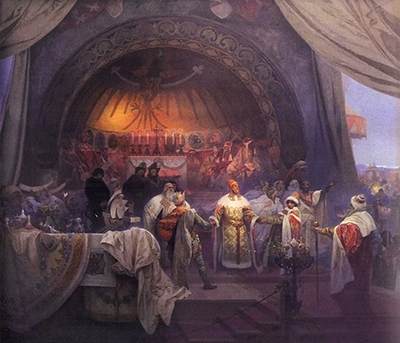
The Bohemian King Přemysl Otakar II (1924), the fifth canvas in Mucha’s Slav Epic.
Buy Art Prints Nowfrom Amazon
* As an Amazon Associate I earn from qualifying purchases.
 by Tom Gurney
Tom Gurney BSc (Hons) is an art history expert with over 20 years experience
Page Created on / Page Updated on
Email: tomgurney1@gmail.com / Phone: +44 7429 011000
The Bohemian King Přemysl Otakar II by Alphonse Mucha: A Wedding as Alliance
A king stands inside a richly dressed tent and takes the hands of guests arriving before him. A chapel glows behind the meeting; at the edges, attendants and other visitors fill the space. Alphonse Mucha chose this greeting, rather than a battle, for The Bohemian King Přemysl Otakar II, the fifth painting in his Slav Epic. The scene turns a family wedding into an image of political alliance.[1][2]
The Mucha Foundation dates the finished canvas to 1924. Its title places the subject in the thirteenth century. Mucha was looking back at a ruler who reigned over Bohemia from 1253 to 1278. The difference between historical subject and painting date is especially useful here: the painted gathering is a twentieth-century interpretation of medieval diplomacy, not a picture made by someone present at the wedding.[1]
At a Glance
- ArtistAlphonse Mucha
- CycleThe Slav Epic, No. 5 of 20[1][3]
- Full catalogue titleThe Bohemian King Přemysl Otakar II. The Union of Slav Dynasties (13th century)[1]
- Painting date1924[1]
- Mediumegg tempera on canvas[1]
- Dimensions405 × 480 cm, for the finished canvas[1]
- Depicted occasiona wedding gathering used by Mucha to express dynastic alliance[1][2]
- Historical weddingKunhuta of Brandenburg and the younger Béla, son of Béla IV, in 1264[1][4]
The fifth Epic canvas in Mucha’s career
Contents
- Greeting instead of conquest
- A wedding with political reach
- What the records say about the wedding
- A disputed roll of guests
- The tent, chapel and surface of power
- An alliance imagined from a later time
- Fifth in the Epic’s order
Greeting instead of conquest
The Foundation identifies the central figure as Přemysl Otakar II, holding hands with two guests in a gesture of friendship.[1] His pale, richly patterned clothing draws attention, but the joined hands give the scene its meaning. They create a small, readable action within a room full of people. A viewer can understand a welcome before knowing every participant’s name.
Mucha places this action near the front of an opulent tent. The Foundation describes a chapel built into it for the wedding.[1] Behind the king, warm light catches a ceremonial interior. Curtains and heavy fabric enclose the scene at the top and sides; the open area at right suggests arrivals beyond the central group. The structure makes a temporary gathering feel like a stage for a consequential political decision.
That decision is not shown as a written treaty. Mucha makes it a social encounter: people face one another, reach toward one another and meet in a shared space. The Prague City Gallery tells the longer story of conflict between Přemysl and Hungary’s King Béla IV, followed by marriages meant to secure peace.[2] The canvas concentrates that history into the king’s welcome. It suggests that a handclasp can stand for relations among dynasties, even though those relations were made and tested over many years.
The title calls the scene a “union of Slav dynasties.” It is Mucha’s reading of the meeting, not a guarantee that the alliance lasted. In the Gallery’s historical account, later conflict returned and Přemysl was eventually defeated and killed in 1278.[2] Knowing that later ending changes how the hopeful wedding scene may feel. The painting holds a moment when peace could be imagined, while history beyond its frame remains unsettled.
A wedding with political reach
The Foundation says the occasion was the marriage of Přemysl’s niece Kunhuta of Brandenburg to a son of Béla IV of Hungary. Mucha understood it as an opportunity for the Bohemian ruler to invite other Slavic leaders and build lasting ties.[1] Kunhuta was the daughter of Brandenburg's Otto III and of Božena, Přemysl's sister; the groom was the younger Béla, not the king Béla IV himself.[4] That distinction matters because there were two men named Béla in the same diplomatic story. The Prague City Gallery describes a large assembly of dignitaries and identifies rulers from several regions in its reading of the canvas.[2] Those names describe the Gallery's interpretation of Mucha's gathering; they do not establish that every named ruler attended the historical wedding.
Weddings among ruling families joined domestic and diplomatic interests. The ceremony could signal a settlement after conflict and form relationships across courts. Mucha emphasises the hospitable face of that process. He omits any visible battlefield from the picture, though the Gallery’s account makes clear that rivalry lay behind the proposed peace.[2] The contrast helps explain why the king can be remembered as both an “Iron King,” associated with military force, and a figure Mucha uses to express union.[1]
What the records say about the wedding
Historian Jakub Palko places the marriage in late October or early November 1264, after a 1261 settlement between Přemysl and Béla IV over the Babenberg lands.[4] The two linked families had been rivals in war; the marriage was one part of a broader attempt to maintain peace. Palko discusses medieval annals and a Styrian rhymed chronicle rather than treating Mucha's twentieth-century painting as an eyewitness document. One annal explains the match in terms of preventing the return of discord between the rulers. This brings the political purpose closer to its recorded thirteenth-century language while keeping the painted handclasp in its own century.
The wedding's precise day and site are not settled by the sources used here. The Epic's Czech exhibition text gives 25 October 1264 on Žitný ostrov near Bratislava.[5] Palko locates the celebrations from several chronicles in a field called Vizze near Pottenburg, in the border region between Bratislava and Vienna, and gives the broader late-October/early-November window.[4] Hungarian medievalist András Vizkelety gives 5 October 1264 in a study of the courtly festivities.[7] The article therefore uses the secure year and border-region context rather than presenting one contested day or location as beyond doubt. Mucha's painted tent speaks to the ceremonial setting; it cannot decide a dispute over the medieval site.
A fourth date appears in Serbian historian Ivana Komatina's comparison of written accounts. She reports that the Annales Otakariani, a Czech annal, places a ceremony on 28 September, the feast of St Wenceslas, near Pozsony, now Bratislava.[8] Komatina describes the wedding celebration as held in Vienna; the annal's location and her broader place-name should not be silently fused into a single pinpointed site. These sources may also be dating different parts of an extended gathering, but the texts examined here do not establish that explanation. The disagreement is useful for reading the painting: Mucha offers one coherent ceremonial space where historians have to work with brief annal entries, a later narrative chronicle and varying modern reconstructions.
The tent itself has documentary resonance. Palko cites a Czech annal describing a new tent arranged like a church, used during the celebrations and knighting ceremonies.[4] This is a stronger historical parallel for the chapel-like space in Mucha's painting than a claim that the artist reproduced a surviving architectural plan. The same study describes tournaments, costly textiles and a large courtly retinue from the chronicle accounts, though it cautions that the chronicler's enormous expenditure figure is probably exaggerated. Mucha's richly staged greeting fits that remembered splendour, but no surviving source proves that the particular handclasp occurred just as he painted it.
The character of the evidence matters as much as its vividness. The Styrian rhymed chronicle gives a sustained story of the festivities, while the annal is much briefer.[7][8] Vizkelety reads the chronicle's account of entertainers and the Hungarian delegation as a meeting of different courtly habits: the travelling performers and elements of the chivalric entertainment did not necessarily mean the same thing to every guest.[7] This is his interpretation of a narrative written after the event, not a transcript of anyone's thoughts in 1264. It helps explain what Mucha leaves outside his selected instant. A diplomatic wedding could involve spectacle, negotiation and awkward encounters over several days. His calm handclasp condenses that social complexity into a legible sign of welcome.
A disputed roll of guests
The Prague City Gallery's account names Daniel of Galicia among the rulers at the wedding.[2][5] Palko finds that identification historically untenable: Daniel had died by the time of the celebrations, and a later editor's identification of a chronicle's unnamed “king of Râzen” with Daniel has propagated into retellings.[4] Palko argues that the term is better read as referring to Raška, a Serbian region, and sees no securely attested East Slavic representative at the event. His analysis also treats several other customary guest identifications as uncertain. A list of figures in Mucha's conceived “union” should therefore be read as an account of the artist's historical imagination, not as a verified attendance register.
There is scholarly disagreement even after Daniel is removed from the list. Đura Hardi has argued that the chronicle's disputed “king of Râzen” was Leo Danylovych, Daniel's son.[6] Palko rejects that reading on linguistic and contextual grounds.[4] This disagreement is a useful limit on certainty: the painting can make an alliance among Slavic dynasties feel coherent, while the surviving texts leave the identity of at least one reported guest unsettled. The main action remains a king receiving visitors, not a trustworthy portrait key for each person around him.
Komatina's transcription of the rhymed chronicle introduces a further caution. In its list of guests, the “king of Râzen” and the “king of Sirvîe” appear as separate entries.[8] She reads Sirvîe as Serbia and accordingly accepts Serbian king Stefan Uroš I among those present. The shorter Czech annal, she notes, mentions dignitaries from different countries without naming Uroš; a Brandenburg chronicle records the marriage but does not name him either.[8] Thus a named Serbian ruler in one later account does not, by itself, settle who the other, disputed Râzen figure was. Nor does a silence in the shorter accounts prove Uroš absent. Palko and Hardi are asking how a particular title should be identified, while Komatina highlights a second title in the same list. Keeping the two entries distinct is safer than turning the entire roll into a confident set of modern names.
The attendants matter too. The central handclasp draws the eye, but it depends on the surrounding assembly for weight. Figures at different depths create an audience for the gesture. Others stand near tables, fabrics and chapel furnishings. The event appears public within a courtly world: a welcome observed and therefore given political force. Mucha does not depict an intimate family portrait alone. He makes a diplomatic theatre in which many viewers witness the king’s action.
At the same time, the picture is selective. It presents rulers and guests inside a sumptuous enclosure, not ordinary people whose lives might be affected by war and peace. That choice follows the subject of dynastic alliance. It also gives a modern reader a question to carry into the rest of the Epic: whose experience is most visible when a history of nations is told through kings, marriages and ceremonial rooms?
The tent, chapel and surface of power
The drapery around the image frames a smaller opening, drawing attention inward. Within it, the chapel’s warm light and ornamental arch create depth. The king’s pale garment stands out against darker guests. A table and hanging cloth fill the foreground, slowing the view before the handshake. These features are more than decoration. They make rank, wealth and ceremonial purpose visible without requiring a caption for each person.
Mucha’s patterning also connects this canvas with other Epic pictures of courts and worship. In Tsar Simeon of Bulgaria, made in 1923, an ornate arch focuses attention on a ruler amid scribes. Here a ceremonial enclosure focuses attention on a ruler among guests. The first celebrates literary patronage; the second places diplomacy in a wedding. Both use architecture to organise a crowd, but the human action at their centres differs.[1][3]
The painting’s medium is egg tempera on canvas, according to the Foundation.[1] That material fact belongs to the finished object, not to the local JPEG. The screen version conveys broad colour and staging, yet it compresses transitions in fabric and faces. The larger inherited view below can help a reader locate the handclasp, chapel and receding visitors without pretending to replace the experience of a canvas more than four metres high.
An alliance imagined from a later time
Mucha completed this work in 1924, long after the thirteenth-century events it evokes.[1] The distance allowed him to arrange the scene around an idea: Slavic rulers might strengthen one another through cooperation. The Foundation says the king sought links that could secure future peace for Bohemians.[1] Mucha makes that aspiration visible in a welcoming gesture. He does not present a neutral inventory of every political interest involved.
The Gallery’s account of later war prevents the page from ending with a simple claim that the wedding created permanent harmony.[2] A painted ideal can still matter when the outcome was fragile. Indeed, the gap between wish and result is part of what makes this subject interesting. Mucha chose a moment of possible agreement within a history that did not stop being violent.
Palko makes the aftermath more precise. He finds the marriages helped maintain comparatively good relations between Přemysl and Béla IV until Béla's death in 1270, while Přemysl's relations with Béla's older son Stephen remained strained.[4] The future violence should therefore not erase the diplomacy's immediate effect. Mucha's larger, enduring “union of Slav dynasties” is still an artistic and political ideal, rather than a treaty that all the wedding guests signed.
The possible Serbian presence also shows why a gathering and a durable alliance cannot be treated as the same thing. Komatina places Uroš at the feast through the rhymed chronicle, then discusses later Hungarian charters recording armed conflict with him over Mačva.[8] The dates of some charters have themselves been debated, so they do not provide a simple calendar for the change in relations. They do show that courtly attendance, if accepted, did not prevent a later rupture. This is a different test of Mucha's title from the Bohemian–Hungarian conflict: the ideal of unity stretches across rulers whose interests continued to diverge.
A reader can therefore hold two responses at once. The image offers an appealing alternative to conquest as the central action of an epic painting. It also asks us to recognise how a ceremony can be used to project a political story. The king’s handclasp is concrete; the “union” in the full title is the larger interpretation Mucha builds from it.
Fifth in the Epic’s order
The Slav Epic guide puts this canvas after the early pictures of survival, ritual, language and Bulgarian literature. It then leads into later dynastic and religious conflicts. The fifth position is part of Mucha’s historical sequence. It is not a strict record of production: the Foundation dates the preceding Tsar Simeon to 1923 and this painting to 1924, while No. 6 was also painted in 1923.[3]
Return to the hands at the centre after taking in the tent and its many occupants. The gesture is deliberately easy to read, but the history it stands for is not simple. Mucha gives alliance a human form at one chosen moment. The people, architecture and light around it turn that moment into the larger claim of his title. Reading the canvas closely means seeing both the greeting and the uncertain future that lies beyond it.[1][2]
Watch: Alphonse Mucha
Place Mucha’s Czech and Slavic projects beside his better known Paris work.
Prague’s Art Nouveau, Mucha, and the Slav Epic
A short view of Mucha’s Prague legacy and the Slav Epic cycle.
Watch on YouTubeArtworks directory
| Name | Date | Medium |
|---|---|---|
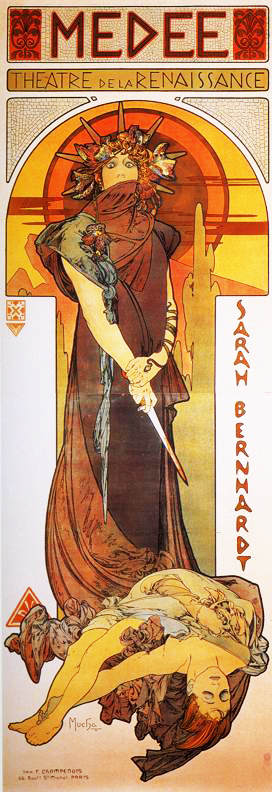
| 'Accept Love and Enthusiasm from Your Son, Mother of the Holy Nation': study for the mural 'By Own Strength III' at the Lord Mayor's Hall, Obecní Dům, Prague | 1910-1911 | Pencil and charcoal on canvas |
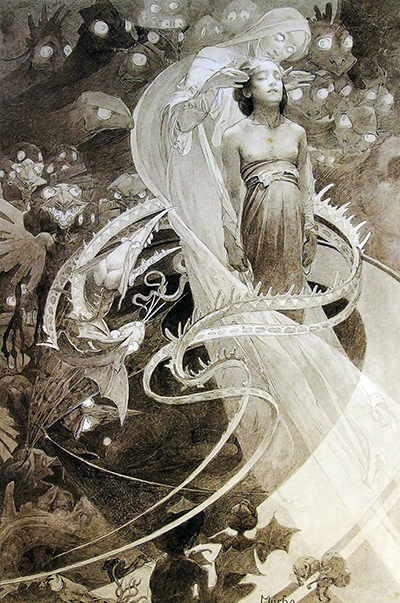
| 'By force towards freedom, with love towards unity!': study for the mural 'By Own Strength II' at the Lord Mayor's Hall, Obecní Dům, Prague | 1910-1911 | Pencil and charcoal on canvas |
| 'The Passing Wind Takes Youth Away': design for a fan and the façade of the 'Pavilion of Man' (unrealised) | 1899 | Colour lithograph |
| 'Through humiliated and tortured, you will live again, my country!': study for the mural 'By Own Strength II' at the Lord Mayor's Hall, Obecní Dům, Prague | 1910-1911 | Pencil and charcoal on canvas |
| 1918-1928: Poster for the 10th Anniversary of the Independence of the Republic of Czechoslovakia | 1928 | Colour lithograph |
| 6th Sokol Festival | 1912 | Colour lithograph |
| 8th Sokol Festival | 1925 | Colour lithograph |
| After the Battle of Grunwald | 1924 | egg tempera on canvas |
| After the Battle of Vitkov Hill | 1923 | egg tempera on canvas |
| Age of Love | 1936–1938 | |
| Age of Reason | 1936–1938 | |
| Age of Wisdom | 1936–1938 | |
| Amants | 1895 | Colour lithograph |
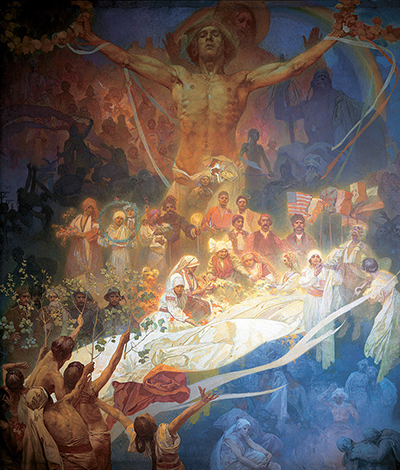
| Apotheosis of the Slavs | 1926 | Egg tempera on canvas |
| As Hamlet | 1899 | colour lithograph |
| Au Quartier Latin | 1898 | Magazine cover |
| Banknotes of Czechoslovakia, designed by Mucha: 500 crown; 50 Crown; 10 Crown | 1929 | Banknotes |
| Bieres de la Meuse | 1897 | Colour lithograph |
| Biscuits Champagne Lefevre Utile | 1896 | Colour lithograph |
| Biscuits Lefevre Utile | 1896 design for 1897 calendar; Foundation object/Carnavalet 1897 | Colour lithograph |
| Blessed are the Pure in Heart | 1906 | Printed magazine illustration |
| Bleu Deschamps | 1903 (deposit) | Colour lithograph |
| Bosnia & Herzegovina Pavilion - illustration featured in 'Le Figaro Illustré' (1 March 1900) | 1900 | Reproduction from Le Figaro Illustré after watercolour original |
| Bosnia-Herzegovina Pavilion: cartoon for the mural 'The Roman Period and the Arrival of the Slavs' | 1899-1900 | ink and crayon on paper |
| Bosnia-Herzegovina Pavilion: fragment of the upper frieze featuring Ivo and Anica, characters from Bosnian legends | 1899-1900 | tempera and watercolour on canvas |
| Bosnian Legends: Death of Hasanaga's Bride | 1899 | Charcoal on paper |
| Bosnian Legends: Murcia - The Plague Lady | 1899 | Charcoal on paper |
| Bosnian Pavilion Restaurant at the Paris Exhibition 1900: design for the menu | 1900 | Pencil and watercolour on paper |
| Boutique Fouquet (interior design) | 1901 | Shop interior design |
| Boutique Fouquet: sketches of the shop's signboard and decorative details | c.1900 | Pencil, ink and watercolour on paper |
| Box for Lefèvre-Utile biscuits: Gaufrettes Vanille | c.1900 | Tin box covered with lithographed label |
| Box for Lefèvre-Utile biscuits: Madère | c.1900 | Tin box covered with lithographed label |
| Brightness of the Day | 1899 | Colour lithograph |
| Broach with Pendant | 1900 | Gold, ivory, mother-of-pearl and semi-precious stones |
| Byzantine Head - The Blonde | 1897 | Colour lithograph |
| Byzantine Heads (pair) | 1897 | Colour lithograph |
| Byzantine Heads: Brunette | 1897 | Colour lithograph |
| Bénédictine | 1898 (BnF deposit); Hamburg 1899; MNAC 1896 or 1898 | Colour lithograph |
| Champagne Ruinart | 1896 | Colour lithograph |
| Chocolat Ideal | before or in 1897 (catalogue conflict) | Colour lithograph |
| Chocolat Masson (1897 calendar) | 1896–1897 | Colour lithograph |
| Choirboys at Petrov Church, Brno | 1905 | Watercolour on cardboard |
| Cloches de Noel | 1900 | Illustrated book |
| Comedy: study for a mural for the German Theatre, New York | 1908 | Oil on canvas |
| Cours Mucha: poster advertising Mucha's art classes held at the Académie Colarossi, Paris | 1900 | colour lithograph |
| Creative Force - Jan z Pernštýna: study for a pendentive of the Lord Mayor’s Hall, Obecní Dům, Prague | 1910-1911 | Oil on canvas |
| Crucifixion | c.1868 | Pencil, crayon and watercolour on paper |
| Cycles Perfecta | 1897 or 1902 (catalogue conflict) | Colour lithograph |
| Dance | 1898 | Colour lithograph |
| Dead Couple - Abandoned | c.1899-1900 | Charcoal and pastel on blue paper |
| Defense of Sziget against the Turks by Nicholas Zrinsky | 1914 | egg tempera on canvas |
| Design for a champagne poster | c. 1896 | Charcoal and pastel on paper |
| Design for a display stand at the Paris Exhibition 1900 | c.1899-1900 | Pencil and wash on paper |
| Design for Champagne Ruinart | c. 1896 | Pencil, watercolour and gold leaf on paper |
| Design for the cover of the magazine 'Fantaz' | 1882 | Ink and watercolour on paper |
| Design for the heading of the cover of the magazine 'Krokodil' | 1885 | Pen and ink on cardboard |
| Design for the poster for the Mucha Exhibition at the Brooklyn Museum, New York, January-February 1921 | 1920 | Pen and ink and watercolour on paper |
| Designs for cutlery | c.1900 | Charcoal and white on card |
| Designs for tableware | c.1900 | Charcoal, coloured pencil and white on card |
| Diadem for 'La princesse lointaine' | 1895 | metal and pearls |
| Diploma of Ivančice: Mock diploma honouring a local celebrity, with illustration of the first line of 'May', a poem by Karel Hynek Mácha | 1882 | Pen and ink and watercolour on paper |
| Documents décoratifs: designs for a watch and accessories (unused) | 1901-1902 | Pencil, ink and white on paper |
| Documents décoratifs: final study for Plate 25, featuring studies of lily | 1901-1902 | Pencil on paper |
| Documents décoratifs: final study for Plate 43 | 1901-1902 | Pencil, ink and wash, heightened with white on paper |
| Documents décoratifs: final study for Plate 49 | 1901-1902 | Pencil and white on paper |
| Documents décoratifs: final study for Plate 50 | 1901-1902 | Pencil and white on paper |
| Documents décoratifs: final study for Plate 60 | 1901-1902 | Pencil, ink and wash, heightened with white on paper |
| Documents décoratifs: final study for Plate 63 | 1901-1902 | Pencil and white on paper |
| Documents décoratifs: final study for Plate 67 | 1901-1902 | Pencil and white on paper |
| Documents décoratifs: final study for Plate 71 | 1901-1902 | Pencil and white on paper |
| Documents décoratifs: final study for Plate 72 | 1901-1902 | Pencil and wash, heightened with white on paper |
| Documents décoratifs: line drawing for Plate 33, featuring lily motifs | 1901-1902 | Pencil, pen and ink on paper |
| Documents décoratifs: Plate 54 | 1902 | Lithograph |
| Dreaming of Freedom: study for a Panel of the Small Reception Room at the Lord Mayor’s Hall, Obecní Dům, Prague | 1910-1911 | Pen and ink and watercolour on paper |
| Dusk | 1899 | Colour lithograph |
| Evening | 1899 | Colour lithograph |
| F. Champenois (Rêverie imprint) | 1898 | Colour lithograph |
| F. Guillot-Pelletier calendar (1898) | 1897–1898 | Colour lithograph |
| Feather | 1899 | Colour lithograph |
| Figures décoratives: final study for Plate 2 | 1904-1905 | Pencil and white on paper |
| Figures décoratives: final study for Plate 3 | 1904-1905 | Pencil and white on paper |
| Figures décoratives: final study for Plate14 | 1904-1905 | Pencil with white on paper |
| Figures décoratives: sketch study for Plate14 | 1904-1905 | Blue pencil on paper |
| Flirt Lefevre Utile | 1899 (Foundation design); BnF legal deposit 1900 | Colour lithograph |
| Flower | 1897 | Colour lithograph |
| Flower: final study for decorative panel | 1897 | Pencil, ink and watercolour on paper |
| France Embraces Bohemia | 1918 | oil on canvas |
| Fruit | 1897 | Colour lithograph |
| Georges Fouquet (1858-1929), Paris, after design by Mucha: Ornamental Chain with pendants | 1900 | Gold, enamel, fresh-water pearls, mother of pearl and semi-precious stones |
| Georges Fouquet (1858-1929), Paris, after Mucha design: 'Peacock' Ring (Exhibited at the Paris Exhibition 1900) | 1900 | Opal and gold |
| Girl Weeping | c.1899-1900 | Black chalk and pastel on paper |
| Girl with Loose Hair and Tulips | 1920 | Oil on canvas |
| Gismonda | 1894 | Colour lithograph |
| Head of a Girl, statue for the stand of the Houbigant Perfumery at the Paris Exhibition 1900 | 1900 | Bronze, silver and parcel gilt |
| Head of Sarah Bernhardt: Study for 'Lorenzaccio' | 1896 | Pencil on paper |
| Heather from Coastal Cliffs | 1902 | Colour lithograph |
| Heidsieck & Co | 1901 | Colour lithograph |
| Holy Mount Athos | 1926 | Egg tempera on canvas |
| Ilsée, Princesse de Tripoli | 1897 | Illustrated book |
| In the Desert: Study for an illustration for the Světozor magazine | 1889 | Pencil, watercolour and gouache on paper |
| Incantation (Salammbô) | 1897 | Lithograph |
| Independence - Jiří z Poděbrad: study for a pendentive of the Lord Mayor’s Hall, Obecní Dům, Prague | 1910-1911 | Oil on canvas |
| Interior and furniture designs | c.1900 | Pencil on paper |
| Interior of Boutique Fouquet: design for a wall-mounted display cabinet with statuette and mirror | c.1900 | Pencil on paper |
| Interior of Boutique Fouquet: design for the fireplace with statuettes, mirror, and the ornamental details of the wall | c.1900 | Pencil and watercolour on cardboard |
| Interior of Boutique Fouquet: sketches of the fireplace with statue, mirror, display cabinet, and the ornamental details of the wall | c.1900 | Pencil, pen and ink on paper |
| Ivy | 1901 | Colour lithograph |
| Jan Milic of Kromeriz | 1916 | egg tempera on canvas |
| Jaroslava and Jiří, the Artist’s Children | 1918 | Oil on canvas |
| JOB poster | 1896 | Colour lithograph |
| Judgement of Paris (calendar for Vieillemard printing company) | 1895 | Colour lithograph |
| Justice - Master Jan Hus: study for a pendentive of the Lord Mayor's Hall, Obecní dům, Prague | 1910-1911 | Oil on canvas |
| L'Annee Qui Vient | 1897 | red chalk on paper |
| L'Illustration magazine - cover for Christmas 1896/1897 | 1896 | Magazine cover |
| L'Illustré Soleil du Dimanche | 1897 | Magazine cover |
| La Dame aux Camélias: designs for cover and interior of special programme | 1896 | Pencil and watercolour on paper |
| La Nature | 1899-1900 | Bronze and amethyst |
| La Plume | 1897 | Magazine cover |
| La Samaritaine | 1897 | colour lithograph |
| Lance Parfum Rodo | 1896; Albertina print c. 1900 | Colour lithograph |
| Laurel | 1901 | Colour lithograph |
| Le Monde Illustré | 1900 | Magazine cover |
| Le Pater | 1899 | Illustrated book |
| Le Pater: early study for the 1st allegorical scene 'Our Father who art in Heaven' (1899) (Mucha Foundation object 300) | 1899 | Pencil on paper |
| Le Pater: early study for the 1st allegorical scene 'Our Father who art in Heaven' (1899) (Mucha Foundation object 302) | 1899 | Pastel on paper |
| Le Pater: study for the 6th allegorical scene 'Forgive us our debts, as we forgive our debtors' | 1899 | Charcoal and ink wash on paper |
| Lefevre Utile | 1904 | Advertisement |
| Leslie Carter | 1908 | Colour lithograph |
| Letem Českým Světem | 1898 | Printed book |
| Lorenzaccio | 1896 | Colour lithograph |
| Luchon poster (attributed to Mucha) | 1895 | Colour lithograph |
| Madonna of the Lilies | 1905 | Tempera on canvas |
| Master Jan Hus Preaching at the Bethlehem Chapel | 1916 | egg tempera on canvas |
| Maude Adams | 1908 | Lithograph, hand-coloured in watercolour and gouache |
| Maude Adams as Joan of Arc | 1909 | Oil on canvas |
| Medea | 1898 | Colour lithograph |
| Menu for the Bosnian Pavilion Restaurant at the Paris Exhibition 1900 | 1900 | Colour lithograph |
| Militancy - Jan Žižka: study for a pendentive of the Lord Mayor's Hall, Obecní dům, Prague | 1910-1911 | Oil on canvas |
| Military Camp in Winter, near a City on Fire | c.1899-1900 | Pastel on paper |
| Moet et Chandon | 1899 | Colour lithograph |
| Monaco Monte Carlo | 1897 | Colour lithograph |
| Moon | 1902 | |
| Moravian Teachers' Choir | 1911 | Colour lithograph |
| Morning Alphonse Mucha Painting / AlphonseMucha.org | 1899 | Colour lithograph |
| Morning Star | 1902 | Colour lithograph |
| Moët & Chandon White Star | 1899 | Colour lithograph |
| Mrs Mucha’s Necklace | 1906 | gold, enamel and semi-precious stones |
| Mural for the Bosnia-Herzegovina Pavilion: The Roman Period and the Arrival of the Slavs | 1900 | tempera and watercolour on canvas |
| Murals by Mucha in the Lord Mayor's Hall, Obecní Dům (Municipal House), Prague (1910-1911) | ||
| Music | 1898 | Colour lithograph |
| Nativity | c. 1934 | oil on canvas |
| Nestle's Food for Infants | 1897 | Colour lithograph |
| Night | 1899 | Colour lithograph |
| Nude on a Rock | 1898-1899 | Bronze |
| Official Banquet of the Paris Exhibition 1900: design for the menu featuring a fashionable woman wearing a Mucha-style jewellery | 1900 | Pencil, gouache and wash on grey paper |
| Ornamental motifs designed for 'Combinaisons Ornementales se Multipliant à l'Infini à l'Aide du Miroir' (1901) | c.1900-1901 | Blue and red pencil on paper |
| Packaging for 'Savon Mucha Violette' | 1906 | Colour lithograph |
| Packaging for Lefèvre-Utile biscuits: Boudoir | 1901 | Colour lithograph |
| Page's Costume: study for an illustration for 'Le Costume au Théâtre' | 1890 | Pencil and watercolour on cardboard |
| Painting | 1898 | Colour lithograph |
| Peonies | 1897–1898 | Ink and watercolour |
| Petr Chelcicky at Vodnany | 1918 | egg tempera on canvas |
| Poetry | 1898 | Colour lithograph |
| Portrait of Jaroslava | c.1927-1935 | Oil on canvas |
| Portrait of Josephine Crane Bradley as Slavia | 1908 | Oil and tempera on canvas |
| Portrait of Marie Chytilová (Maruška), Mucha's Future Wife | 1903 | pastel on paper |
| Portrait of Mucha's Sister, Angela | c.1880 | Oil on canvas |
| Portrait of Mucha's Sister, Anna | c.1885 | Oil on canvas |
| Portrait of Mucha's Son, Jiří | 1925 | Oil on canvas |
| Portrait of Mucha's Wife, Maruška | 1908/17 | Oil on canvas |
| Portrait of Woman | c. mid 1910s - 1925 | Blue pastel on grey paper |
| Poster for 'Hommage Respectueux de Nestlé' (the Nestlé Company's tribute to Queen Victoria's 60th Jubilee) | 1897 | Colour lithograph |
| Poster for 'Imprimerie Cassan Fils' | 1896 | Colour lithograph |
| JOB poster (1898) | 1898 | Colour lithograph |
| Poster for 'La Dame aux Camélias' | 1896 | Colour lithograph |
| Poster for 'La Tosca' | 1899 | Colour lithograph |
| Poster for 'Regional Exhibition at Ivančice 1913' | 1912 | Colour lithograph |
| Poster for 'The Slav Epic Exhibition, Brno, 1930' | 1928-1930 | Colour lithograph |
| Poster for 'Waverley Cycles' | 1898 | Colour lithograph |
| Poster for the 'Lottery of the Union of Southwestern Moravia' | 1912 | Colour lithograph |
| Poster for the Austrian Pavilion at the Paris Exhibition 1900 | 1900 | Colour lithograph |
| Prague Subjugated: study for a Panel of the Small Reception Room at the Lord Mayor’s Hall, Obecní Dům, Prague | 1910-1911 | Pen and ink and watercolour on paper |
| Primrose | 1899 | Colour lithograph |
| Primrose and Feather (paired image) | 1899 | Colour lithographs (paired image) |
| Princess Hyacinth (Princezna Hyacinta) | 1911 | Colour lithograph |
| Print proof for the Biscuits Lefèvre-Utile tin | 1899 | Lithograph |
| Reverie | 1898 | Colour lithograph |
| Russia Restituenda [Russia Must Recover] | 1922 | Colour lithograph |
| Salome | 1897 | Colour lithograph |
| Salon des Cent | 1896 | Colour lithograph |
| Salon of the Hundred | 1897 | Colour lithograph |
| Sarah Bernhardt - La Princesse Lointaine - Lefevre Utile | 1903 | Colour lithograph |
| Sarah Bernhardt as La Princesse Lointaine: poster for 'La Plume' magazine | 1897 | Colour lithograph |
| Sarah Bernhardt in the role of the Duc de Reichstadt in L’Aiglon | 1900 | Pencil on paper |
| Sarah Bernhardt: study of her full-standing figure | c.1896 | Pen and ink on paper |
| Savonnerie de Bagnolet calendar | 1898 (calendar) | Printed advertising calendar |
| Self-portrait (1899) | 1899 | Oil on board |
| Self-portrait (1907) | 1907 | Blue and white crayon on blue Ingres paper |
| Self-portrait, sketching in his apartment, Paris | late 1880s | oil on canvas |
| Sketches of flowers for Documents décoratifs | c.1900-1901 | Pen and ink on paper |
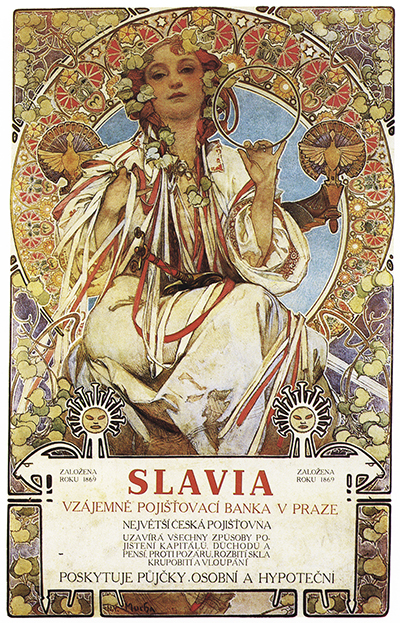
| Slavia insurance poster | 1907 | Poster |
| Slavs in their Original Homeland | 1912 | Egg tempera on canvas |
| Snake Bracelet with a Ring | 1899 | Gold, enamel, opal, ruby and diamond |
| Société Populaire des Beaux Arts | 1897 | Colour lithograph |
| Song of Bohemia | 1918 | oil on canvas |
| St. Vitus Cathedral Stained-glass Window, Prague: final design for the central panels, featuring SS Cyril and Methodius | 1931 | Ink and watercolour on paper |
| St. Vitus Cathedral Stained-glass Window, Prague: final design for the central panels, featuring St. Ludmila | 1931 | Ink and watercolour on paper |
| St. Vitus Cathedral Stained-glass Window, Prague: final design for the central panels, featuring St. Wenceslas (Duke of Bohemia) kneeling next to his Grandmother, St. Ludmila | 1931 | Ink and watercolour on paper |
| St.Vitus Cathedral Stained-glass Window, Prague: final design for the bottom left panels | 1931 | Ink and watercolour on paper |
| St.Vitus Cathedral Stained-glass Window, Prague: final design for the bottom right panels | 1931 | Ink and watercolour on paper |
| Stained-glass Window designed by Mucha at St. Vitus Cathedral, Prague | Early 1930s | N/A |
| Study for 'The Age of Reason' | 1936-1938 | Pencil and watercolour on paper |
| Study for 'The Slav Epic cycle' No.19: The Abolition of Serfdom in Russia | 1913-1914 | Watercolour and gouache on paper |
| Study for 'The Slav Epic' cycle No.14: The Sacrifice at Szigetvár by Nikola Zrinski | c.1913-1914 | Photographed drawings stuck together, tinted with watercolour and gouache |
| Study for 'The Slav Epic' cycle No.17: The Holy Mount Athos (1926) | c.1925-26 | Charcoal heightened with white on cardboard |
| Study for 'The Slav Epic' cycle No.18: The Oath of Omladina under the Slavic Linden Tree | c.1925-1926 | Pencil and watercolour on paper |
| Study for 'The Slav Epic' cycle No.1: The Slavs in Their Original Homeland (1912) | c.1910-1912 | Oil on canvas |
| Study for 'The Slav Epic' cycle No.2: The Celebration of Svantovít | c.1910-1912 | Oil on canvas |
| Study for 'The Slav Epic' cycle No.7: Jan Milíč of Kroměříž | c.1915-1916 | Oil on canvas |
| Study for 'The Slav Epic' cycle No.9: Master Jan Hus Preaching at the Bethlehem Chapel. The Magic of the Word: Truth Prevails (1412). | c.1915-1916 | Oil on canvas |
| Study for 'The Three Ages' triptych: Reason, Wisdom and Love [unfinished project] | 1936-1938 | Pencil and watercolour on paper |
| Study for 'Woman in the Wilderness' (c. 1922-1923) (Mucha Foundation object 315) | c. 1922-1923 | oil on canvas |
| Study for 'Woman in the Wilderness' (c. 1922-1923) (Mucha Foundation object 316) | c. 1922-1923 | oil on canvas |
| Study for Savon Notre Dame | c. 1896 | pencil and watercolour on paper |
| Study for the poster 'Russia Restituenda [Russia Must Recover]' | 1922 | Pen and ink and watercolour on paper |
| Study of a Male Nude | 1885-1887 | Oil on canvas |
| The Abolition of Serfdom in Russia | 1914 | Egg tempera on canvas |
| The Arts (series) | 1898 | Colour lithograph |
| The Arts: study for 'Dance' | 1898 | Pencil and watercolour on paper |
| The Arts: study for 'Music' | 1898 | Pencil and watercolour on paper |
| The Arts: study for 'Painting' | 1898 | Pencil and watercolour on paper |
| The Arts: study for 'Poetry' | 1898 | Pencil and watercolour on paper |
| The Bohemian King Premysl Otakar II | 1924 | egg tempera on canvas |
| The Bulgarian Tsar Simeon | 1923 | egg tempera on canvas |
| The Burr McIntosh Monthly, 1907 | 1907 | Magazine cover |
| The Celebration of Svantovit | 1912 | egg tempera on canvas |
| The Coronation of the Serbian Tsar Stefan Dusan as East Roman Emperor | 1923 | egg tempera on canvas |
| The Devil and Mr Twardowsky: study for an illustration for 'The Tale of Pan Twardowsky' (a variation of 'Faust') | c.1887-1888 | Charcoal on paper |
| The Flowers (series) | 1898 | Colour lithographs |
| The Flowers: Carnation | 1898 | Colour lithograph |
| The Flowers: Iris | 1898 | Colour lithograph |
| The Flowers: Lily | 1898 | Colour lithograph |
| The Flowers: Rose | 1898 | Colour lithograph |
| The Hussite King Jiri of Podebrady | 1923 | Egg tempera on canvas |
| The Introduction of the Slavonic Liturgy | 1912 | egg tempera on canvas |
| The Last Days of Jan Amos Komensky (Comenius) in Naarden | 1918 | Egg tempera on canvas |
| The Light of Hope | 1933 | Oil on canvas |
| The Meeting at Krizky | 1916 | egg tempera on canvas |
| The Months (January-June) | 1899 | Colour lithograph |
| The Months (July-December) | 1899 | Colour lithograph |
| The Moon and the Stars (four-panel montage) | 1902 | Colour lithographs (four-panel montage) |
| The Moon and the Stars (series) | 1902 | Colour lithograph |
| The Moon and the Stars: study for 'The Evening Star' | 1902 | Ink and watercolour on paper |
| The Moon and the Stars: study for 'The Pole Star' | 1902 | Ink and watercolour on paper |
| The New York Daily News art supplement | 1904 | Printed art supplement |
| The Oath of Concord of the Slavs (unfinished) | 1939 | oil on canvas |
| The Oath of Omladina under the Slavic Linden Tree | 1926, unfinished | Egg tempera on canvas |
| The Precious Stones (four-panel montage) | 1900 | Colour lithographs (four-panel montage) |
| The Precious Stones (series) | 1900 | Colour lithograph |
| The Precious Stones: Amethyst | 1900 | Colour lithograph |
| The Precious Stones: Emerald | 1900 | Colour lithograph |
| The Precious Stones: Ruby | 1900 | Colour lithograph |
| The Printing of the Bible of Kralice in Ivancice | 1914 | egg tempera on canvas |
| The Seasons (series) | 1896 | Colour lithograph |
| The Seasons (series) (1900) | 1900 | Colour lithograph |
| The Seasons (variation in screen format) | 1896 | Colour lithograph |
| The Seasons: Autumn (1896) | 1896 | Colour lithograph |
| The Seasons: Autumn (1900) | 1900 | Colour lithograph |
| The Seasons: Spring | 1900 | Colour lithograph |
| The Seasons: Spring (1896) | 1896 | Colour lithograph |
| The Seasons: Summer | 1900 | Colour lithograph |
| The Seasons: Summer (1896) | 1896 | Colour lithograph |
| The Seasons: Winter | 1900 | Colour lithograph |
| The Seasons: Winter (1896) | 1896 | Colour lithograph |
| The Slavonic Concord: study for the ceiling painting for the Lord Mayor's Hall, Obecní Dům, Prague | 1910-1911 | Oil on canvas |
| The Threat | 1912 | Colour lithograph |
| The Times of the Day (series) | 1899 | Colour lithograph |
| The West End Review | 1897 (Foundation); 1898 promotional cover | Colour lithograph |
| Thistle from the Sands | 1902 | Colour lithograph |
| Théâtre de la Renaissance: design for poster advertising Sarah Bernhardt's theatre | c.1895 | Pen and ink on paper |
| Tin for Lefèvre-Utile biscuits | 1899 | Circular tin with lid and handle; colour print on metal |
| Topaz | 1900 | Colour lithograph |
| Tragedy - study for a mural for the German theatre New York | 1908 | Oil and tempera on canvas |
| Trappistine Liquors | 1897 | colour lithograph |
| Wiener Chic | 1905 | Magazine cover |
| Woman in the Wilderness | 1923 | Oil on canvas |
| Woman masked in white head-scarf - study for the illustration of the Bosnia & Herzegovina Pavilion featured in 'Le Figaro Illustré' (1 March 1900) | 1899 | Pencil and wash heightened with white on paper |
| Woman with a Daisy - textile designed by Mucha | 1900 | Printed upholstery fabric |
| Zdenka Cerny | 1913 | Colour lithograph |
| Zodiac (La Plume calendar) | 1896–97 | Colour lithograph |
| Zodiac (textless decorative panel) | 1896 | Colour lithograph |
| ‘At the sight of the two storks the owl rose.’ Study for an illustration for Contes de Grand-mères | 1891 | Watercolour and gouache on paper |
Frequently Asked Questions
When did Mucha paint The Bohemian King Přemysl Otakar II?
What is the king doing at the centre?
Did the wedding establish permanent peace?
Was Daniel of Galicia at the wedding?
Discussion
Mucha placed a royal greeting inside a wedding tent with a chapel behind it.
The central handclasp turns a ceremony into a claim about political alliance.
Reader Insights
What draws your eye first: the joined hands, the king’s clothing or the chapel?
How do the curtains and crowd shape your sense of a public event?
Does the image suggest a lasting peace, a hoped-for peace or something else?
Join the Conversation
Share what you notice about the greeting and the wider room around it.
References
- Mucha Foundation, “The Slav Epic cycle No. 5: The Bohemian King Přemysl Otakar II,” object 216, finished-canvas identity, date, medium, dimensions and narrative. View source.
- Prague City Gallery, “The Bohemian King Přemysl Otakar II,” illustrated story presented through Google Arts & Culture, based on the 2022 Moravský Krumlov exhibition catalogue. View source.
- Mucha Foundation, “Slav Epic,” twenty-canvas overview and painting chronology. View source.
- Jakub Palko, Kráľovič Belo (1249–1269): Dux tocius Sclavoniæ, Dalmaciæ et Croaciæ (2022), pp. 68–82, based on medieval annals, the Styrian rhymed chronicle and diplomatic records; guest identities and wedding setting are debated. Open monograph.
- Slav Epic exhibition at Moravský Krumlov / Prague City Gallery, “Král český Přemysl Otakar II.,” Czech curatorial account by Vlasta Čiháková-Noshiro, with exhibition date and guest list. Exhibition text.
- Đura Hardi, “Ким був ‘der kunic von râzen’, присутній на весіллі герцога Бели ...,” Княжа доба: історія і культура 5 (2011), pp. 199–208. Hardi argues for Leo Danylovych from dynastic ties and a reading of the chronicle title; this remains a disputed identification. Full article at the publishing institute.
- András Vizkelety, “Béla hercegnek, IV. Béla király fiának menyegzője,” Irodalomtörténeti Közlemények 97, nos. 5–6 (1993), pp. 571–584; states 5 October 1264. Journal PDF.
- Ivana Komatina, “A Hypothesis about the Origin of Záviš’s Cross (or about a Lost Serbian Reliquary),” Balcanica 53 (2022), pp. 21–44, especially p. 34 and note 52 for the wedding accounts and the distinct Râzen and Sirvîe labels; later charters are discussed on pp. 34–36. Journal PDF.