



 by Tom Gurney
Tom Gurney BSc (Hons) is an art history expert with over 20 years experience
Email: tomgurney1@gmail.com / Phone: +44 7429 011000
Zebra by George Stubbs: Introduction
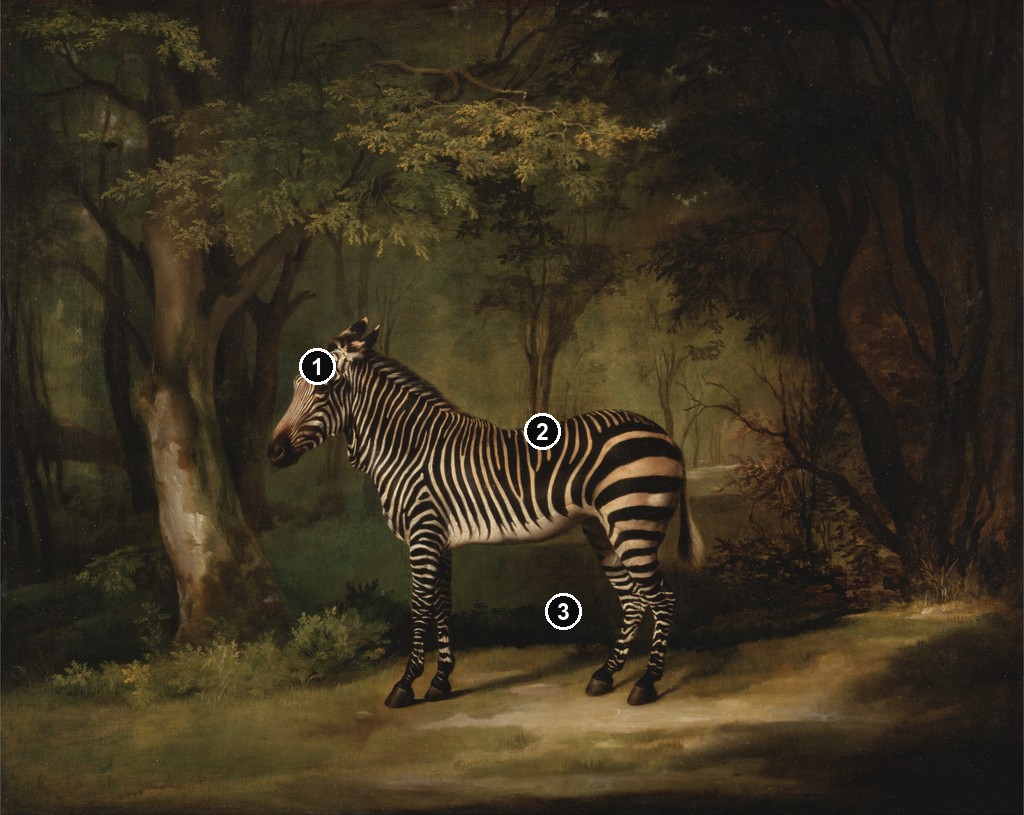
George Stubbs’s Zebra presents an unfamiliar animal with the measured attention usually reserved for a distinguished horse. The Yale Center for British Art holds this 1763 oil painting in its Paul Mellon Collection, numbered B1981.25.617. The canvas measures 102.9 by 127.6 centimetres. [1] Its quiet woodland scene conceals a complicated history of maritime transport, royal display and public curiosity.
At a Glance
This work across George Stubbs’s career
Whistlejacket
about 1762 [6]Contents
- From southern Africa to London
- Annotated details
- Painting an individual animal
- Stripes and the picturesque
- A celebrity in pictures and print
- The animal’s later fate
- The canvas after Stubbs
- Videos on George Stubbs
From southern Africa to London
The sitter was a female zebra brought from southern Africa in 1762 as a gift for Queen Charlotte. She was the only survivor of the pair dispatched. Sir Thomas Adams, commanding HMS Terpsichore, transported the animals from the Cape of Good Hope. The Huntington identifies the survivor as a Cape mountain zebra. [14] [15] These details locate the painting within a particular movement of animals through naval and royal networks.
She was not the first zebra to reach Britain. Christopher Plumb’s research distinguishes earlier animals at Kew from Charlotte’s much more conspicuous arrival. His account also separates this female from later royal zebras and animals associated with Robert Clive. Those distinctions matter: stories about different arrivals, owners and collections can otherwise accumulate around one apparently recognisable creature. Plumb describes the contradiction between nominally free access to the royal animal and guards’ attempts to extract payments from visitors. Public generosity and private opportunity could operate at the same paddock gate. [14]
A July 1762 account in The London Magazine, reproduced by King’s College London’s Mozart & Material Culture project, describes crowds viewing the animal in a paddock near the queen’s house. Its comparison of her elegance to that of a racehorse helps explain why a horse painter might find the subject compelling. The same project presents Nannerl Mozart’s London diary for 1765: she remembered an elephant and a donkey with striking white and coffee-brown stripes. Her remembered colours convey the impact of seeing the unfamiliar coat at first hand. [16]
Annotated Details from Zebra
Select a number on the painting to jump to a closer view.
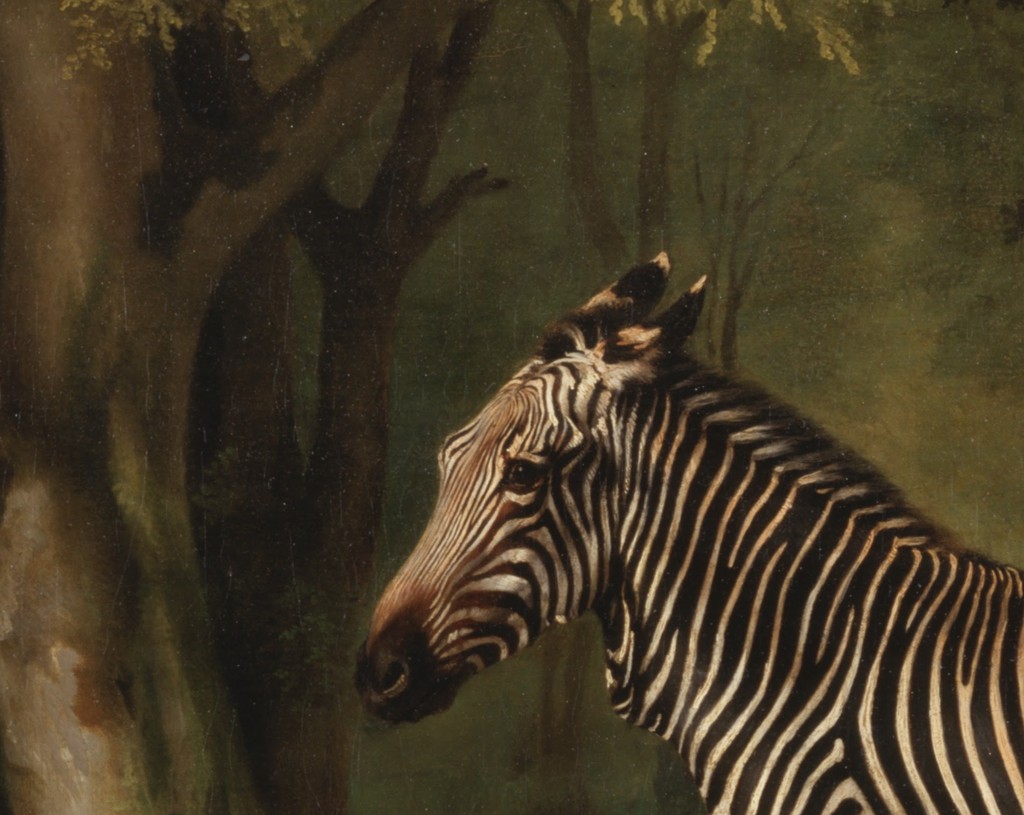
Details from ZEBRA
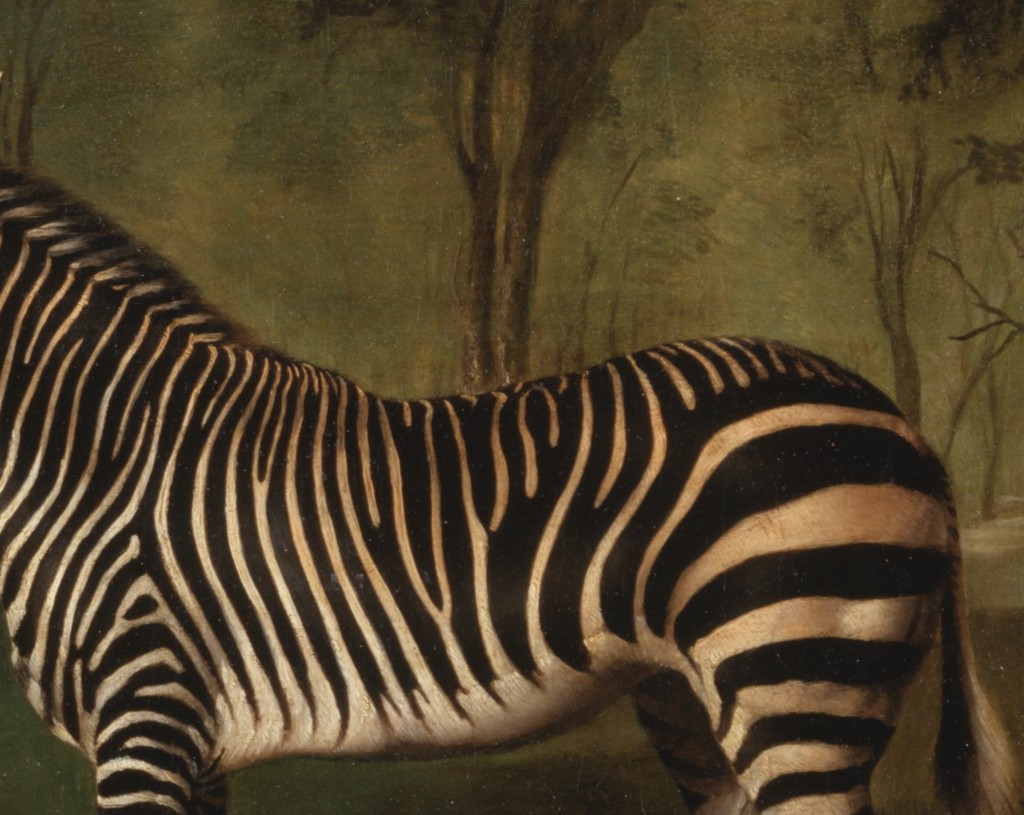
Each crop comes from the same reproduction shown above.
Head and ears
The head interrupts the pattern of the woodland. The upright ears and narrow stripes make its outline legible against the trees.
Stripes across the flank
The stripes follow the curve of the ribs, turning beneath the belly. The alternating bands help describe the volume of the body.
Hooves on the track
Light falls across the strip of ground beneath the zebra. The dark hooves stand out against it and anchor the animal in the woodland.
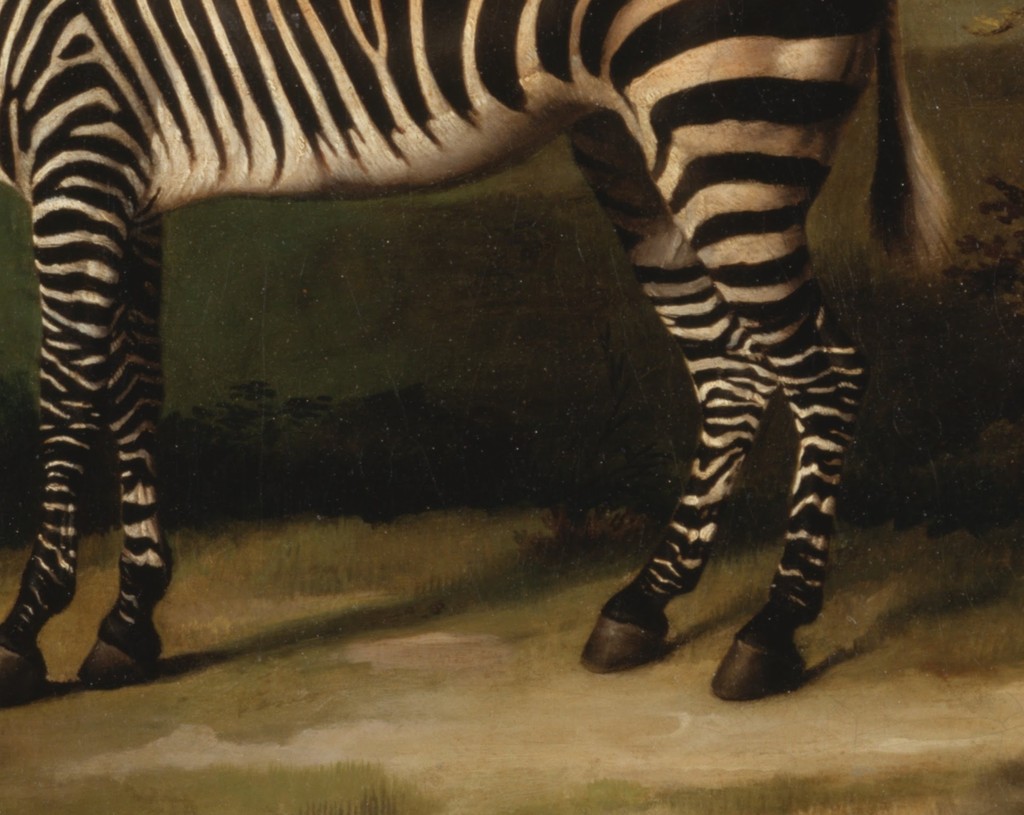
Image source: Yale Center for British Art
Painting an individual animal
Queen Charlotte’s ownership of the zebra should not become a claim that she commissioned this canvas. Melinda McCurdy notes that the painting remained in Stubbs’s studio when he died. She suggests that William Hunter, an anatomist and one of the queen’s doctors, probably arranged access. McCurdy also describes the accuracy of the animal’s anatomy and markings, through which specialists have identified the Cape mountain zebra. [17]
Walter Gilbey’s 1898 transcription of Stubbs’s exhibition record lists The Zebra as number 121 at the Society of Artists exhibition of 4 May 1763. It appeared beside two lion-and-horse subjects and a portrait of the horse Bandy. This retrospective evidence places the unfamiliar animal within a varied public presentation of Stubbs’s work, rather than isolating it as an incidental royal curiosity. [18]
Malcolm Warner suggests that an apparently uncommissioned painting of this kind could serve Stubbs as an advertisement for his own abilities. Retaining the canvas would allow a remarkable subject and an exacting piece of animal painting to remain available as a demonstration. This is a proposed explanation for the work’s purpose, rather than a recorded statement by Stubbs. [1]
The zebra occupies the lower half of the canvas, facing left. Her pale body is easy to distinguish from the deeper tones behind it, but the pose is less rigid than a diagram. The head turns sufficiently towards us to disclose the near eye and the shape of the muzzle. The ears point in different directions, while the dark upright mane makes a firm, irregular edge along the neck. Four slender legs descend into the light foreground. Their arrangement leaves narrow openings through which the ground remains visible.
Across the body, the stripes change direction and width. Narrow bands articulate the face and neck; broader curves wrap around the barrel and hindquarters. Their pattern helps the eye travel over the rounded surface rather than simply reading a flat alternation of black and white. At the shoulder and flank, dark bands interrupt the illuminated coat without destroying the sense of volume beneath it. The animal’s outline remains clear even where an internal stripe pulls attention away from the outer edge.
The foreground is relatively open, giving each hoof a visible place on the pale ground. Behind it, tree trunks rise through a dense mass of foliage. A particularly large trunk anchors the right side, while branches and leaves gather overhead. On the left, a lighter opening draws the gaze beyond the zebra’s head. The woodland therefore surrounds the animal without closing the picture completely. Its recesses establish depth, but the broad, brightly legible body keeps drawing attention back towards the front.
The contrast in scale is equally striking. The zebra is substantial enough to dominate the foreground, yet the trees extend far above her. Their vertical growth differs from the long, almost horizontal disposition of her body. Small patches of light among the leaves punctuate the darkness without competing with the white coat. Stubbs makes an intricate subject readable through large divisions of light and shade, then rewards closer inspection with the changing rhythm of the stripes.
Yale’s current gallery interpretation identifies this woodland as a fictional setting, unlike either the animal’s natural grassland habitat or the paddocks in which she lived in royal captivity. [1] The woodland belongs to the painting’s imaginative construction of an encounter with the animal.
Stripes and the picturesque
Stripes themselves could trouble eighteenth-century ideas about beautiful animal painting. In the notes to his appended poem On Landscape Painting, published with Three Essays in 1792, William Gilpin favoured colours that passed gradually into one another. Abrupt patches of black and white worked against that preference. He regarded the zebra as an intriguing creature whose stripes interfered with pleasing colour and the clear delineation of form. His judgement concerns the animal’s appearance, rather than a documented review of this canvas. [19]
Richard Payne Knight offered a different comparison in the third edition of An Analytical Inquiry into the Principles of Taste in 1806. He considered the zebra beautiful, yet found other painterly possibilities in a water spaniel: curling hair offered varied light and shadow, while irregular brown and white areas contrasted with regular stripes. These parallel period judgements show that conspicuous markings could prompt questions about what made an animal attractive as a subject for art. [20]
A celebrity in pictures and print
The living zebra also acquired a public identity through language that could be affectionate, bawdy or political. The Library of Congress records Henry Howard’s The Queen’s Ass, a humorous allegorical song issued in August 1762 or later. Its title exploited the animal’s royal association and the possibilities of the word “ass”. The record identifies an engraved broadside with ten verses, placing the animal within a topical culture of song and satire. [21]
Colonial Williamsburg holds a 1762 engraving titled The Asses of Great Britain, described as an answer to Howard. Its catalogue connects the zebra with a satirical attack on the writer. That response demonstrates how quickly one royal acquisition could generate further printed argument. Such works belong to the animal’s public afterlife, but their polemical purposes differ from the sustained scrutiny offered by the painted portrait. [22]
A separate print, The Sebra, or Wild Ass, carries a more direct connection with Stubbs. Europeana’s institutional index, drawing on the Herzog Anton Ulrich Museum, identifies George Townley Stubbs as engraver alongside George Stubbs and Carington Bowles. A museum exhibition announcement preserved by CODART identifies the work with the date 1771. [23] [24] The spelling “Sebra” belongs to its historical title. This printed image needs to be distinguished from both the 1763 oil painting and the topical satires surrounding the living animal. It also belongs within the wider history of prints after Stubbs.
The animal’s later fate
A letter from William Mason to Horace Walpole, dated 28 June 1773, provides unusually specific evidence about the animal’s death. Mason reported an advertisement in that day’s York Courant: the zebra had died on 3 April and had lately belonged to “Mr Pinchy”. The edition’s note identifies him as Christopher Pinchbeck the younger. Mason’s account is a report of an advertisement, rather than an eyewitness description of the death. His suggestion that the animal might have changed hands through a friendly gift remains speculation. [25]
The same letter describes the preserved skin being displayed at the Blue Boar in York. Advertising now promised a close inspection that had supposedly been impossible while the animal lived. Mason responded to this reversal with pity and satire: royal possession had ended in a commercial spectacle that criticised the creature’s former behaviour. The surviving account therefore tells us about both an animal’s reported fate and the language used to sell access to her remains. [25]
The canvas after Stubbs
The painting followed a separate course. In the 1807 sale of Stubbs’s studio, Peter Coxe’s catalogue offered a portrait of the celebrated zebra as lot 88. Its description emphasised that the artist had worked from life and set the animal in a landscape; it also praised the result as art, rather than merely a record of an unusual creature. That combination of faithful likeness and artistic achievement was central to the sale’s appeal. [26]
Yale records William Worsley and Walter Gilbey among later owners, with gaps between known transfers. Paul Mellon acquired the picture in 1960; his gift brought it to Yale in 1981. [1]
Modern interpretation often turns towards the relationship between exact observation and displacement. Choosing the painting for Country Life in 2016, Amy Meyers emphasised its emotional power and the animal’s exposure within a setting removed from her African surroundings. Her reading connects the image with imperial movement while remaining attentive to the particular body Stubbs painted. [27]
Marisa Bass, discussing the work in a Yale article in 2025, likewise draws attention to its capacity to encourage empathy for an isolated animal. The transport and display of unfamiliar creatures give that response a historical context. [28] Stubbs’s painting remains compelling because its clear, patiently differentiated forms allow the zebra to be encountered as a particular presence. The history around her complicates that encounter without exhausting what can be seen in the canvas.
Videos on George Stubbs
Explore Stubbs’s equestrian painting in its wider context, including two readings of Whistlejacket.
A Horse Lover’s Guide to the YCBA
A museum tour that places Stubbs alongside other artists who painted horses. It includes a look at Pumpkin with a Stable-lad.
Watch on YouTubeGeorge Stubbs artworks directory
Search works and related prints documented in this guide. Separate versions and printing matrices have separate entries; printmakers are named where known. Unidentified historical titles and untraced studio-sale material are discussed in the essays. A dash means that a date is not established here.
| Name | Date | Medium |
|---|---|---|
| A Bay Horse with a Groom | 1791 | Painting |
| A Bay Hunter with Two Playful Spaniels | 1777 | Painting |
| A Bay Hunter, a Springer Spaniel and a Sussex Spaniel in a wooded river Landscape | 1782 | Painting |
| A Cheetah and a Stag with Two Indian Attendants | about 1764 | Painting |
| A Couple of Fox Hounds (coloured print after Stubbs) | — | Print after Stubbs |
| A Couple of Foxhounds | 1792 | Painting |
| A Foxhound on the Scent | 1788 | Drawing |
| A Gentleman driving a Lady in a Phaeton | 1787 | Painting |
| A Grey Horse | 1793 | Painting |
| A Grey Horse (cantering companion) | 1793 | Painting |
| A Grey Stallion in a Landscape | — | Painting |
| A Horse Affrighted at a Lion | 1 May 1788 | |
| A Horse Belonging to the Rt. Honourable Lord Grosvenor called Bandy from his Crooked Leg | about 1763 | Painting |
| A Horse Frightened by a Lion | 1777 | |
| A Lion (A Lion Resting on a Rock) | 1 May 1788 | |
| A Lion Attacking a Horse | 1770 | Painting |
| A Lion Attacking a Horse (monumental Yale canvas) | 1762 | Painting |
| A lion attacking a horse (NGV) | about 1765 | Painting |
| A Lion Devouring a Horse (1788 print) | 1788 | |
| A lion devouring a horse (attribution disputed) | Proposed mid-1770s | Painting |
| A mare and foal with a bay horse | 1771 | Painting |
| A Monkey | 1799 | Painting |
| A Prancing Horse, Facing Right | c. 1790 | Drawing |
| A Rough Dog | 1790 | Painting |
| A Saddled Bay Hunter | 1786 | Painting |
| A Sleeping Leopard | 1 January 1791 | |
| A Tiger and a Sleeping Leopard | 1 May 1788 | |
| A Tigress (John Dixon after Stubbs) | 1772 | Print after Stubbs |
| A Tyger (A Recumbent Leopard by a Tree) | 1 May 1788 | |
| A Tyger (Sleeping Leopard) | 1 May 1788 | |
| An animal found on the coast of New Holland called kanguroo (after Stubbs) | 1773 | Print after Stubbs |
| An animal of a new species found on the coast of New South Wales (after Stubbs) | July 1773 | Print after Stubbs |
| Antinous and Jockey | — | Painting |
| Antinoüs, a chestnut racehorse, in a landscape | Undated | Painting |
| Bandy belonging to Lord Grosvenor (print after Stubbs) | — | Print after Stubbs |
| Baronet (George Townley Stubbs after Stubbs) | 20 February 1794 | Print after Stubbs |
| Baronet with Sam Chifney Up | 1791 | Painting |
| Baronet with Samuel Chifney up (Royal Collection) | 1791 | Painting |
| Bay Hunter by a Lake | 1787 | Painting |
| Brood Mares (Benjamin Green after Stubbs) | Issue 14 November 1776 | Print after Stubbs |
| Brood Mares and Foals | usually dated 1767 | Painting |
| Brown and White Norfolk or Water Spaniel | 1778 | Painting |
| Bulls Fighting | 1786 | Painting |
| Captain Samuel Sharpe Pocklington with His Wife, Pleasance, and possibly His Sister, Frances | 1769 | Painting |
| Death of the Doe (attribution disputed) | 1804 | |
| Der Englische Hühnerhund (Johann Wölfle after Stubbs) | about 1860 | Print after Stubbs |
| Dog (A Foxhound Viewed from Behind) | 1 May 1788 | |
| Dog [A Foxhound on the Scent] | 1788 | |
| Drill and albino baboon | before 1789 | Painting |
| Eclipse (Charles Hunt after Stubbs) | 12 November 1839 | Print after Stubbs |
| Eclipse (George Townley Stubbs after Stubbs) | 1796 | Print after Stubbs |
| Eclipse (oil study) | — | Painting |
| Eclipse (Thomas Burke after Stubbs) | First published 1772 | Print after Stubbs |
| Eclipse and John Wildman (Benjamin Green after Stubbs) | 1772 | Print after Stubbs |
| Eclipse at Newmarket (Jockey Club version) | Proposed early 1790s; often dated 1770 | Painting |
| Eclipse at Newmarket with a groom and jockey | 1770 | Painting |
| Eclipse with Mr Wildman and His Sons | 1769–71 | Painting |
| Eclipse, the Property of Capt.n O Kelly (anonymous print after Stubbs) | Imprint 4 June 1804; impression undated | Print after Stubbs |
| Euston | 1774 | Painting |
| Finished Study for the Seventh Anatomical Table of the Muscles of the Horse | 1756–58 | Drawing |
| Five Brood Mares at the Duke of Cumberland's Stud Farm in Windsor Great Park | 1765 | Painting |
| Fowl Body, Lateral View (Highly Finished Study for an Unpublished Table; Shows the Last Stage in Dissection) | — | Drawing |
| Fowl Body, Lateral View (Probably Prepared for Transfer to the Plate for Engraving of Table XV) | — | Drawing |
| Fowl Skeleton, Lateral View (Finished Study for Table V) | — | Drawing |
| Freeman, the Earl of Clarendon's Gamekeeper, with a Dying Doe and Hound (Yale) | 1800 | Painting |
| George Stubbs (enamel self-portrait) | 1781 | Enamel |
| Gimcrack (George Townley Stubbs after Stubbs) | 1775 | Print after Stubbs |
| Gimcrack on Newmarket Heath, with a trainer, a jockey and a stable lad | about 1765 | Painting |
| Gimcrack, with John Pratt up, on Newmarket Heath | about 1765 | Painting |
| Hambletonian, Rubbing Down | 1800 | Painting |
| Hay-Makers | 1791 | |
| Haycarting | 1795 | Enamel |
| Haymakers | 1785 | Painting |
| Haymakers (Lady Lever Art Gallery) | 1794 | Enamel |
| Hollyhock (with later additions by Vernet and Boucher) | about 1765–70 | Painting |
| Horse Attacked by a Lion (Episode C) | 1768–69 | Painting |
| Horse Attacked by a Lion (Tate enamel) | 1769 | Enamel |
| Horse Devoured by a Lion | Possibly exhibited 1763 | Painting |
| Horse Frightened by a Lion | 1770 | Painting |
| Horse Frightened by a Lion (Episode A; Wedgwood and Bentley after Stubbs) | — | Sculpture |
| Horse Frightened by a Lion (Tate) | Possibly exhibited 1763 | Painting |
| Horse Frightened by a Lion (Yale) | 1762–68 | Painting |
| Horse in the Shade of a Wood | 1780 | Painting |
| Hound Coursing a Stag | about 1762 | Painting |
| Human Figure, Anterior View (Intended for a Plate That was Never Published) | — | Drawing |
| Human Skeleton, Lateral View | 1795–1806 | Drawing |
| Hunt servants setting out (Southill commission) | 1767 | Painting |
| Hühnerhund (The Spanish Pointer) | about 1766 | Painting |
| John and Sophia Musters Riding at Colwick Hall | 1777 | Painting |
| John Musters on his hunter Pilgrim | 1777–78 | Painting |
| Labourers | 1789 | |
| Labourers (Richard Earlom after Stubbs and Amos Greene) | 25 March 1790 | Print after Stubbs |
| Laetitia, Lady Lade (d.1825) | 1793 | Painting |
| Lemon and White Water Spaniel | — | Painting |
| Lion Attacking a Stag | — | Painting |
| Lord Grosvenor's Arabian Stallion with a Groom | about 1765 | Painting |
| Lord Grosvenor's Arabian Stallion with a Groom (Peter Mazell after Stubbs) | 1771 | Print after Stubbs |
| Mambrino (Eaton Hall painting) | — | Painting |
| Mambrino (George Townley Stubbs after Stubbs) | 1794 | Print after Stubbs |
| Mares and Foals belonging to the 2nd Viscount Bolingbroke | about 1761–62 | Painting |
| Mares and foals beneath large oak trees | — | Painting |
| Mares and Foals by a stream | Exhibited 1764 | Painting |
| Mares and Foals in a River Landscape | about 1763–68 | Painting |
| Mares and Foals in an Extensive Landscape | about 1769 | Painting |
| Mares and Foals without a Background | 1762 | Painting |
| Moose Deer (after Stubbs) (Arctic Zoology plate VIII) | 1784–85 publication | Print after Stubbs |
| Newmarket Heath with a Rubbing-Down House | — | Painting |
| Otho (1796 print after Stubbs) | 1 December 1796 | Print after Stubbs |
| Otho, with John Larkin up | 1768 | Painting |
| Pangloss | about 1762 | Painting |
| Patch (Grafton commission) | 1759 | Painting |
| Phaeton and the Chariot of the Sun (enamel) | 1775 | Enamel |
| Phaeton with a Pair of Cream Ponies and a Stable-Lad | 1780–84 | Painting |
| Phillis | 1772 | Painting |
| Portrait of a Large Dog (Dingo) | 1772 | Painting |
| Pumpkin with a Stable-lad | 1774 | Painting |
| Racehorses Exercising at Goodwood | 1759–60 | Painting |
| Reapers (1791 print) | 1791 | |
| Reapers (Tate) | 1785 | Painting |
| Reapers (Yale) | 1795 | Enamel |
| Red Deer: A Stag and a Hind | 1792 | Painting |
| Richard Wedgwood | — | Enamel |
| Ringwood, a Brocklesby Foxhound | 1792 | Painting |
| Scrub, a bay horse belonging to the Marquess of Rockingham | about 1762 | Painting |
| Self Portrait on a White Hunter | 1782 | Enamel |
| Self-Portrait | about 1759 | Painting |
| Shooting (1770 Woollett plate after Stubbs) | 1770 | Print after Stubbs |
| Shooting (1771 Woollett plate after Stubbs) | 1771 | Print after Stubbs |
| Shooting at Goodwood | 1759–60 | Painting |
| Sir John Nelthorpe as a boy | 1756 | Painting |
| Sir John Nelthorpe partridge shooting with one pointer | — | Painting |
| Sir John Nelthorpe, 6th Baronet, out Shooting with His Dogs in Barton Field, Lincolnshire | 1776 | Painting |
| Sleeping Leopard | 1777 | Enamel |
| Soldiers of the 10th Light Dragoons | 1793 | Painting |
| Stallion and Mare (George Townley Stubbs after Stubbs) | 1776; reissued 1789 | Print after Stubbs |
| Steward and gamekeeper with dogs (Southill commission) | 1767 | Painting |
| Studies of a Lemur (Lemur murinus) in six different attitudes | 1773 | Drawing |
| Study for the Self-portrait in Enamel | c. 1781 | Drawing |
| Study of a Lemur | 1773 | Drawing |
| Study of a Racehorse in Action: Galloping to Left, a Semi-Anatomical Study, with Skin Flayed to Show Action of Muscles | — | Drawing |
| Study of the Legs of a Draught-Horse Pulling a Harrow (attributed to Stubbs) | Proposed about 1786 | Drawing |
| Sweet William (Grosvenor panel) | — | Painting |
| Sweet William (Turf Gallery canvas) | — | Painting |
| The Black Stallion Sampson, Portrayed from Three Angles (with landscape additions) | about 1764 | Painting |
| The Charlton Hunt | 1759–60 | Painting |
| The Fall of Phaeton | — | Sculpture |
| The Frightened Horse | 1780 | Sculpture |
| The Grosvenor Hunt | — | Painting |
| The Haymakers (Upton House) | 1783 | Painting |
| The Horse and Lion (George Townley Stubbs after George Stubbs) | 1770 | Print after Stubbs |
| The Kongouro from New Holland | 1772 | Painting |
| The Labourers | 1779 | Painting |
| The Labourers (Southill original) | 1767 | Painting |
| The lion and horse (Benjamin Green after Stubbs) | 1769; reissued 1777 | Print after Stubbs |
| The Milbanke and Melbourne Families | about 1769 | Painting |
| The Moose | 1770 | Painting |
| The Prince of Wales's Phaeton | 1793 | Painting |
| The Reapers (Upton House) | 1783 | Painting |
| The Sebra, or Wild Ass (George Townley Stubbs after Stubbs) | 1771 | Print after Stubbs |
| The Spanish Pointer (Bradford version) | about 1766–68 | Painting |
| The Spanish Pointer (William Woollett after Stubbs) | January 1768 | Print after Stubbs |
| The Third Duke of Dorset's Hunter with a Groom and a Dog | 1768 | Painting |
| Thomas Freeman, Lord Clarendon's gamekeeper, with a dog and a shot doe (with George Townly Stubbs) | 1803 | Painting |
| Turf, with Jockey up, at Newmarket | — | Painting |
| Turk and Crab | — | Painting |
| Two Bay Hunters Communing On The Bank Of A Lake | — | Painting |
| Tygers at Play | 1780 | |
| Viscount Gormanston's White Dog | 1781 | Painting |
| Viscount Gormanston's White Dog (canvas version) | — | Painting |
| Water Spaniel | 1769 | Painting |
| Wedgwood Family Portrait | 1780 | Painting |
| Whistlejacket | about 1762 | Painting |
| Whistlejacket with two other stallions and a groom | Recorded 1762 | Painting |
| White Poodle in a Punt | about 1780 | Painting |
| William Anderson with two Saddle-Horses | 1793 | Painting |
| Working Drawing for the Seventh Anatomical Table of the Muscles of the Horse | 1756–58 | Drawing |
| Zebra | 1763 | Painting |
Discussion
Look again at the images and ideas explored in Zebra by George Stubbs. These editorial prompts invite your observations.
Reader Insights
How does the woodland setting direct attention to the zebra’s striped body?
How does the animal’s documented history affect your reading of the portrait?
What changes when you see the zebra as an individual animal in a particular setting rather than as an unfamiliar species?
Join the Conversation
Share a detail, comparison or question about Zebra by George Stubbs below.
References
- Yale Center for British Art, Zebra, B1981.25.617, current object metadata, gallery labels, Malcolm Warner’s 1998 catalogue entry and provenance supplied through the museum’s public collection record. View source.
- Goodwood, The Collection, Painting Collection modal, Racehorses Exercising at Goodwood; An exciting acquisition: a study by George Stubbs, 30 June 2023; History of the Estate Hounds, 4 October 2023; About Goodwood Racecourse. Accessed 4 November 2026. View source.
- Goodwood, The Collection, Painting Collection modal, Racehorses Exercising at Goodwood; An exciting acquisition: a study by George Stubbs, 30 June 2023; History of the Estate Hounds, 4 October 2023; About Goodwood Racecourse. Accessed 4 November 2026. View source.
- Goodwood, The Collection, Painting Collection modal, Racehorses Exercising at Goodwood; An exciting acquisition: a study by George Stubbs, 30 June 2023; History of the Estate Hounds, 4 October 2023; About Goodwood Racecourse. Accessed 4 November 2026. View source.
- Goodwood, The Collection, Painting Collection modal, Racehorses Exercising at Goodwood; An exciting acquisition: a study by George Stubbs, 30 June 2023; History of the Estate Hounds, 4 October 2023; About Goodwood Racecourse. Accessed 4 November 2026. View source.
- National Gallery, Whistlejacket, NG6569, current collection record, provenance, in-depth discussion and frame entry. View source.
- Yale Center for British Art, Zebra, B1981.25.617, current object metadata, gallery labels, Malcolm Warner’s 1998 catalogue entry and provenance supplied through the museum’s public collection record. View source.
- Christie’s, Gimcrack on Newmarket Heath, with a trainer, a jockey and a stable lad, London, 5 July 2011, lot 12; object details, essay, provenance, exhibitions and whole image. View source.
- Christie’s, Gimcrack on Newmarket Heath, with a trainer, a jockey and a stable lad, London, 5 July 2011, lot 12; object details, essay, provenance, exhibitions and whole image. View source.
- Yale University Art Gallery, A Lion Attacking a Horse, 1770, 1955.27.1, collection record. Accessed 4 November 2026. View source.
- Royal Museums Greenwich, ‘The Kongouro from New Holland’ (Kangaroo), ZBA5754. Accessed 4 November 2026. View source.
- Tate, George Stubbs, Haymakers, 1785, T02256; details, Terry Riggs’s collection text (January 1998), and online caption. Collection record. View source.
- Frances Bailey, ‘Hambletonian, Rubbing Down: A masterpiece by George Stubbs’, National Trust Cultural Heritage Magazine, Autumn/Winter 2024, pp. 22–33. Article. View source.
- Christopher Plumb, Exotic Animals in Eighteenth-Century Britain, PhD thesis, University of Manchester, 2010, chapter 3, pp. 168–186. View source.
- The Huntington, Stubbs’ Zebra, exhibition information, 3 February–30 April 2018. View source.
- King’s College London, Mozart & Material Culture, “1764 or 1765, London: Zebra”, presenting Nannerl Mozart’s diary and an extract from The London Magazine, July 1762, p. 317. View source.
- Melinda McCurdy, “An 18th-Century Star in Stripes”, The Huntington, 31 January 2018. View source.
- Walter Gilbey, The Life of George Stubbs, R.A., 1898, pp. 167, 177. View source.
- William Gilpin, Three Essays, 1792, notes to the appended poem On Landscape Painting, second pagination, pp. 36–37, note 447. View source.
- Richard Payne Knight, An Analytical Inquiry into the Principles of Taste, third edition, 1806, pp. 81–86, especially section 26. View source.
- Library of Congress, The Queen’s Ass, record 2006682183. View source.
- Colonial Williamsburg, The Asses of Great Britain, 1762, accession 1960-145,A. View source.
- Europeana, George Stubbs collection index, entry for The Sebra, or Wild Ass, supplied by the Herzog Anton Ulrich Museum. View source.
- CODART, Curious Beasts: Animal Prints from Dürer to Goya, museum exhibition announcement, 2014. View source.
- William Mason to Horace Walpole, 28 June 1773, The Yale Edition of Horace Walpole’s Correspondence, vol. 28, pp. 89–92, especially pp. 90–91 and notes 6–7. View source.
- Peter Coxe, catalogue of the sale of George Stubbs’s works, 27 May 1807, p. 15, lot 88. View source.
- Amy Meyers and John McEwen, “My Favourite Painting: Amy Meyers”, Country Life, 13 May 2016. View source.
- Oscar Sweeting, “The first zebra publicly exhibited in Britain”, Yale News, 8 January 2025, including Marisa Bass’s interpretation. View source.
- Basic title, date and material metadata for Tate’s Reapers (T02257) and Otho (T02375) is adapted from the Tate collection dataset, October 2014, released under CC0. TheHistoryOfArt.org has reconciled labels and versions. This credit does not apply to Tate’s authored catalogue commentary or images.
- Data Source: Yale Center for British Art. Basic object fields are adapted and reconciled for this directory. Reuse is subject to the Center’s Open Data and Data Services Terms of Use. No museum endorsement is implied. This metadata credit does not relabel scholarly essays or images as open data.
- Basic object metadata for A Horse Frightened by a Lion, 1985.38, The Cleveland Museum of Art, John L. Severance Fund, is available under CC0. Titles and design-level grouping have been reconciled for this directory.


