 by Tom Gurney
Tom Gurney BSc (Hons) is an art history expert with over 20 years experience
Email: tomgurney1@gmail.com / Phone: +44 7429 011000
The Parker painting
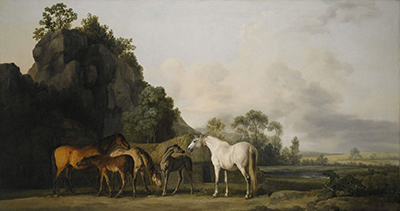
Three mares and two foals occupy a strip of ground beneath an immense rocky height. At the opposite end of the group, a pale mare turns towards the other horses. Beyond her, the landscape opens into water, fields and sky. This is George Stubbs's Brood Mares and Foals associated with Colonel George Lane Parker, a particular composition within his repeatedly explored subject of breeding mares and their young.
The canvas measures 99.7 × 188.6 centimetres. Its lower-right signature reads “Geo: Stubbs pinxit”; it is painted in oils on canvas. The signature gives no year, and the usual date of 1767 remains an attribution rather than a dated inscription. [1] [2]
The painting's exhibition and print history begins in 1768; Sotheby's catalogue inconsistently gives both 1767 and 1768 for its execution. [1]
The five-animal arrangement identifies a particular work among Stubbs's paintings. It should be distinguished from the Bolingbroke, Rockingham and other breeding groups rather than used to illustrate all of them indiscriminately.
At a Glance
This work across George Stubbs’s career
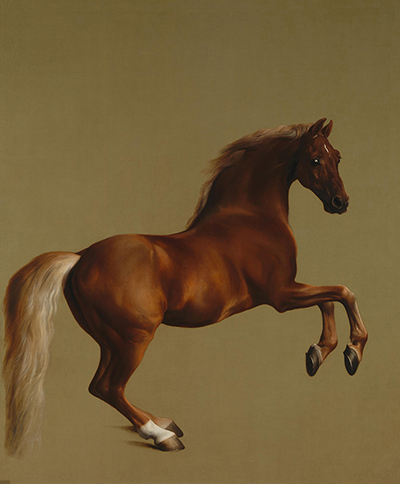
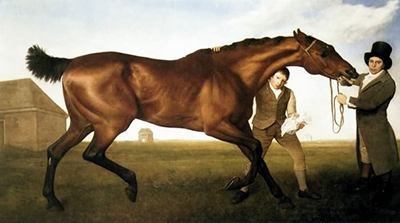
Whistlejacket
about 1762 [7]Brood Mares and Foals (current article)
usually dated 1767 [11] [12] [13]Contents
- The Parker painting
- A breeder's picture, and an owner's name
- Following the five animals
- Legs, intervals and the low horizon
- Rock, shelter and cultivated distance
- A subject with predecessors
- Keeping the neighbouring canvases separate
- Repeating the group on a larger scale
- A smaller adaptation sent to Geneva
- Green's reversed image
- Videos on George Stubbs
A breeder's picture, and an owner's name
Parker was the younger brother of Thomas Parker, 3rd Earl of Macclesfield. The Government Art Collection describes the canvas as probably commissioned by him. That qualification is appropriate: Benjamin Green's reproductive print names Parker as the original picture's owner, whereas the commission itself is less securely documented. [18] A possession inscription and a surviving order would answer different questions.
Judy Egerton's National Gallery catalogue explains the breeder's perspective on Stubbs's mares and foals. Choosing a stallion required expenditure and judgement; the offspring might become successful racers or valuable breeding animals. Recognition of particular horses mattered to patrons, alongside the appeal of a country scene. Egerton connects that concern to the precise description of newborn animals in a groom's correspondence. [19] These pictures offered an opportunity to examine the animals whose future occupied an owner's attention.
There is no race in Parker's picture, no jockey declaring a result and no stallion shown covering a mare. The different ages and sizes make breeding visible through the group itself. Adult bodies provide a measure against which the young appear smaller, lighter and differently proportioned. This is one reason the subject differs from an isolated racehorse portrait: the painting offers several bodies for comparison within a single continuous space.
Historical breed labels differ: Gilbey in 1898 calls the grey a Barb; Sotheby's in 2010 calls her Arabian. These are descriptions, not verified pedigrees; the individual animals remain unnamed. [20] [1]
Following the five animals
The easiest way into the design is to follow the heads, beginning at the left. The outer adult stands broadly across the picture, her long back leading towards the centre and her muzzle pointing right. Her dark mane interrupts the warm colour of her neck. Behind the silhouette of the head, foliage and the darker rock make the forward edge legible without a large area of sky around it.
The smaller animal immediately in front moves across that adult's legs. Its muzzle extends towards the left, almost reversing the direction established above. Its neck is stretched low and nearly horizontal. The young horse's back, belly and legs occupy a narrower band than the adult's body behind it, so size is understood through overlap as well as through height. Two animals share much of the same space on the canvas without merging into one silhouette.
Next comes the mare whose head descends to the ground. Her back and rounded body remain visible behind the nearer foal, while her neck makes a steep downward turn towards the centre. This posture brings a head below the others and places a long curve among the more upright legs. It also prevents the upper edge of the group from becoming an even sequence of five raised heads. Grazing gives the eye somewhere to descend, away from the broad backs and into the intricate lower half.
Beside her stands the darker foal. Its forequarters are towards the left, but its neck turns back and its muzzle points right, towards the grey mare. The bend is important: a body that might otherwise continue the leftward movement instead redirects attention to the opposite end of the group. There is a small interval between the two facing heads. They approach one another across that gap without the picture showing their muzzles touching.
At the right, the grey adult faces left. Her shoulder, barrel and hindquarters occupy a larger uninterrupted light area than any neighbouring form. The turned head is darker than the brightest part of her flank; shadows below the neck and body keep her from reading as a flat white patch. Her tail falls behind the hindquarters in a loose, irregular outline. She supplies a firm end to the sequence while her head draws the eye back inside it.
The animals are thus connected through opposing directions rather than a common forward movement. The left adult points inwards, the nearer foal stretches outwards, the grazing mare lowers the sequence, and the central youngster twists towards the right-hand adult. Each change is visible without requiring a story about affection, protection or leadership. The picture establishes relationships of position and attention; it does not identify a mother for every foal.
Legs, intervals and the low horizon
The group is unusually dense at ground level. Legs cross other bodies, some are partly hidden and others stand against a clear strip of earth. Stubbs repeatedly alternates a readable outline with a more complicated junction. The viewer can recognise each horse first, then return to work out how the different legs occupy the shared space below. The ground beneath the hooves keeps that complication attached to a common surface.
There is also a distinction between the horses' lower edges and their upper ones. Above, broad backs and necks make a relatively continuous band; below, the gaps between legs admit slivers of the setting. Those openings keep the group permeable. They matter especially where warm brown bodies overlap, because the eye needs more than differences of coat colour to separate one animal from another.
The five horses occupy considerably less than the whole width. To the right of the grey, open ground continues towards the corner, where large leaves and angular stones interrupt it. This unoccupied foreground allows the group to feel placed within a wider setting. If the last mare ended directly at the picture's edge, the animals would read more as a closed strip; here the ground extends beyond their gathering.
The sky takes up a substantial area above the heads. Its pale expanse prevents the extraordinary height of the rock from enclosing the entire scene. In the far distance, the fields form narrow horizontal bands. Those small, compressed divisions contrast with the large bodies nearest us, producing depth without a human figure to provide scale. The horses dominate because the landscape becomes progressively finer and lower behind them.
Rock, shelter and cultivated distance
The rock at the left is not a single smooth shape. Lighter faces turn towards the sky while deeper recesses break its front into irregular vertical masses. Trees rise from its crown and grow around its base. The uppermost leaves reach into a different part of the painting from the horses, joining the distant sky to the shaded ground without putting a human structure on the skyline.
A diagonal descent from this height leads towards the group. First the rock falls away; then the trees and lower ground bring the eye down towards the central animals. The mare on the left is backed by some of the darkest painting, but her warm flank is still clearly differentiated. The contrast gives that side weight without making the horses disappear into the shadow.
Behind the animals, a thatched structure is largely concealed. Its roof is more readily traced than its lower wall, and a dark doorway appears between the horses. Architecture occupies an intermediate distance: close enough to belong to their immediate surroundings, yet screened so that it never becomes a competing subject. We see enough to register a building without being shown the activity inside it.
To the right, water stretches horizontally behind the grey mare and the low bank. Farther away, lines of planting and patches of cultivated land divide the distance. The visual movement is from the broken, steep forms on the left towards a flatter and more open terrain. Near vegetation at the bottom edge, middle-distance water and far fields give three distinct measures of space.
The auction catalogue describes a constructed landscape rather than an identifiable place. [1]
Its interest lies in the arrangement we can see. The broad rock occupies the space above the dark mare, while the pale animal stands beside a more open distance. These unequal surroundings help distinguish the outer figures. They make the group readable from one end to the other without arranging it symmetrically.
There are no visible grooms or riders, and no saddles or bridles frame the heads. Yet the nearby building and divided land mean that the horses are not isolated from human provision. Their bodies occupy the foreground, while the signs of organised land use retreat behind them. Stubbs gives the animals visual priority without needing to depict an untouched wilderness. This relationship between figure and setting is one of the distinguishing pleasures of his animal painting.
A subject with predecessors
A useful predecessor survives in Colonial Williamsburg's collection: Brood Mares with their Foles, published in January 1758, engraved by William Elliott after Thomas Smith of Derby. It was the second of six prints concerned with horse breeding, training and racing. [21] Mares with their young already belonged to the imagery of sporting husbandry before Parker's canvas. This is evidence for an existing subject, without proving that Stubbs borrowed from this particular print.
Stubbs's own series supplied further precedents. The Kimbell's Bolingbroke painting dates from about 1761–62 and measures 99 × 187 centimetres. It contains three adults and three foals, and entered the museum's collection in 2024. The Kimbell places these commissions within the sophisticated domestic display of sporting pictures alongside portraits and older paintings. [22] A similar horizontal format could serve several owners while carrying a different arrangement in each case.
Rockingham's Mares and Foals without a background is another crucial distinction. Egerton reproduces the August 1762 receipt specifying five mares and two foals, part of an aggregate payment for several pictures. Its seven animals occupy a canvas of 99 × 190.5 centimetres. [19] The receipt documents Rockingham's commission; it cannot supply the missing payment history of Parker's work. The two paintings share a subject and approximate format while treating the surrounding space very differently.
Keeping the neighbouring canvases separate
The five adult mares at Windsor belong to the Duke of Cumberland's stud. The National Trust records a dated 1765 signature, a 99.1 × 188 centimetre canvas, a large oak and a pool; the picture is at Ascott. It was Stubbs's first royal commission. [23] There are no foals in that five-horse group.
The separate river composition is Tate's T00295, dated about 1763–68 and measuring 101.6 × 162 centimetres. [24] Egerton explains that Stubbs adapted horses from the Rockingham group for it. [25] Water in Parker's setting therefore offers a point of comparison, rather than an alternative title for the same picture.
The six-horse group at the Kimbell Art Museum, accession AP 2024.01, dates from about 1761–62. It is catalogued as Mares and Foals belonging to the 2nd Viscount Bolingbroke. [26] Its current title identifies the original patron. National Museums Liverpool's 2009–10 report also lists Mares and foals beneath large oak trees as a distinct Grosvenor Estate loan. [27] A recurring subject does not carry a single provenance through all its appearances.
Repeating the group on a larger scale
The most striking comparison is the much larger extensive landscape, sometimes described as mountainous. Christie's dates it to about 1769 and gives its dimensions as 184.5 × 274 centimetres. A Grafton commission is probable, although John Smyth appears as an alternative in its provenance. The group repeats Parker's three mares and two foals. [28]
The relationship is immediately visible. The stretched neck of the left foal, the lowered head of the grazing mare and the central youngster's backward turn recur. Their neighbours are recognisable too, but the grey commands much more of the design. Above the horses, an enormous oak trunk and spreading branches occupy the area where Parker's canvas raises its rock. Darker weather and distant crags also change the setting around the familiar bodies.
These changes affect how the group fills its world. In Parker's narrower view, much of the upper-right area belongs to pale sky and low distance. In the larger picture, the tree's branches reach over the animals and into that upper space. The horses seem gathered beneath a canopy. Repeating their poses has not produced the same relation between foreground and background.
Christie's records that the picture was called a stallion, mares and foals in 1976, reflecting debate over its enlarged grey horse. It also discusses Egerton's reservations about the attribution, subsequent restoration and later specialist support for Stubbs. [28] Those questions concern that canvas. They should not change the sex, attribution or condition history of Parker's painting by association. The distinction also shows why an animal group may be recognisable even when the identity of a later commission remains qualified.
A smaller adaptation sent to Geneva
In A mare and foal with a bay horse, signed and dated 1771, the grey and the adjacent neck-turned youngster reappear in a canvas measuring 58.5 × 71.2 centimetres. Egerton's account identifies Palmerston's commission as a gift for the Swiss artist Jean Huber. Stubbs added a foreshortened bay horse and reduced the rocky setting. [25]
Looking at the two paintings together makes the selection clear. The grey still faces left, while the young horse turns its head towards her. The additional bay approaches from the left at an angle to the viewer, its forelegs breaking the broadside pattern. The other two adult mares and the stretched-neck foal are absent. A familiar pair now occupies a more compact encounter rather than one end of a long gathering.
The background changes the balance again. Rock and trees rise behind the grey on the right, while the left edge opens into sky. Compared with Parker's canvas, the great rocky mass has moved to the opposite side of the selected pair. The grey's light body is held against dark forms immediately behind it. Stubbs retained a recognisable relationship between two horses while reorganising the space around them.
Egerton reports that William Pars made Palmerston a copy for £20, retained at Broadlands, before the original went to Huber. Delayed at Calais, the painting reached Geneva in spring 1773. Huber admired the mare but disliked the mane hiding the junction between head and neck. [25] His response concerns a specific visible feature. It gives an unusually concrete example of a recipient looking critically at a form adapted from Parker's picture.
Green's reversed image
Benjamin Green's mezzotint, titled Brood Mares, reverses the composition. The Government Art Collection holds an impression published on 14 November 1776 by Sayer and Bennett. Its account explains that Green had sold them the plate in 1775 or 1776, and that the reissue belonged to a set of six prints after Stubbs. [18] The later date belongs to a publication state, not to a newly painted version of the group.
The first publication was on 10 May 1768. [1]
Beneath the image, the inscription identifies the original as Parker's possession. Owner, painter and engraver therefore occupy different places in the print's account of itself. The private canvas supplies the design, Green makes the reproductive object, and Parker's name remains attached to the original.
In the impression, the grey stands at the left and the tall rock rises at the right. The reversal is comprehensive: water, low building and foreground leaves change sides along with the horses. The central youngster now turns its muzzle left. Comparing the direction of one head alone would be misleading; following the surrounding features makes the relationship clear.
Black ink also changes the means of distinction. The pale mare remains conspicuous, but the differences between the warmer brown animals have to be conveyed through tone and modelling rather than differences of hue. The shadows beneath bodies and between legs become particularly useful. The print preserves the arrangement while asking the viewer to read it through another range of contrasts.
The Government Art Collection records that Green exhibited the print at the Society of Artists in 1768, alongside the painting's appearance there. Green, also a drawing master, made nine large mezzotints after Stubbs. [18]
The image outlived its first publisher. This connection makes Stubbs's prints part of the painting's history.
The canvas as a surviving object
Conservator Max Deliss's 1 October 2010 report records his 2004 removal of dirt and yellowed varnish, an earlier lining possibly from the 1930s, slight dark-paint thinning and limited retouching. He used dry pigment with MS2A and an MS2A varnish. This describes historical treatment, not present condition. [1]
Gilbey's 1898 entry places the signed and engraved picture at Shirburn Castle in the Earl of Macclesfield's collection. His descriptive title enumerates the three mares and two foals, and notes a rocky background with trees. [20] The catalogue preserves an earlier way of naming the work, alongside evidence of its location. Its approximate measurements need not displace the precise modern sale measurements.
Family descent ran from Parker through his elder brother Thomas, 3rd Earl, to the 2010 consignor. The canvas appeared in Stubbs and the Horse in 2004–05. [1]
At Sotheby's on 8 December 2010, an undisclosed buyer paid £10,121,250 including premium. [2] Its present owner and location remain undisclosed.
Across that history, the five bodies remained recognisable enough to be engraved, selected, enlarged and recombined. Parker's canvas brings them together in its own distinctive setting: a high rock, a low shelter and an opening towards cultivated distance. Those relations make it a specific work within George Stubbs's art, even where the animals' names and the circumstances of the original commission have not survived.
Videos on George Stubbs
Explore Stubbs’s equestrian painting in its wider context, including two readings of Whistlejacket.
A Horse Lover’s Guide to the YCBA
A museum tour that places Stubbs alongside other artists who painted horses. It includes a look at Pumpkin with a Stable-lad.
Watch on YouTubeGeorge Stubbs artworks directory
Search works and related prints documented in this guide. Separate versions and printing matrices have separate entries; printmakers are named where known. Unidentified historical titles and untraced studio-sale material are discussed in the essays. A dash means that a date is not established here.
| Name | Date | Medium |
|---|---|---|
| A Bay Horse with a Groom | 1791 | Painting |
| A Bay Hunter with Two Playful Spaniels | 1777 | Painting |
| A Bay Hunter, a Springer Spaniel and a Sussex Spaniel in a wooded river Landscape | 1782 | Painting |
| A Cheetah and a Stag with Two Indian Attendants | about 1764 | Painting |
| A Couple of Fox Hounds (coloured print after Stubbs) | — | Print after Stubbs |
| A Couple of Foxhounds | 1792 | Painting |
| A Foxhound on the Scent | 1788 | Drawing |
| A Gentleman driving a Lady in a Phaeton | 1787 | Painting |
| A Grey Horse | 1793 | Painting |
| A Grey Horse (cantering companion) | 1793 | Painting |
| A Grey Stallion in a Landscape | — | Painting |
| A Horse Affrighted at a Lion | 1 May 1788 | |
| A Horse Belonging to the Rt. Honourable Lord Grosvenor called Bandy from his Crooked Leg | about 1763 | Painting |
| A Horse Frightened by a Lion | 1777 | |
| A Lion (A Lion Resting on a Rock) | 1 May 1788 | |
| A Lion Attacking a Horse | 1770 | Painting |
| A Lion Attacking a Horse (monumental Yale canvas) | 1762 | Painting |
| A lion attacking a horse (NGV) | about 1765 | Painting |
| A Lion Devouring a Horse (1788 print) | 1788 | |
| A lion devouring a horse (attribution disputed) | Proposed mid-1770s | Painting |
| A mare and foal with a bay horse | 1771 | Painting |
| A Monkey | 1799 | Painting |
| A Prancing Horse, Facing Right | c. 1790 | Drawing |
| A Rough Dog | 1790 | Painting |
| A Saddled Bay Hunter | 1786 | Painting |
| A Sleeping Leopard | 1 January 1791 | |
| A Tiger and a Sleeping Leopard | 1 May 1788 | |
| A Tigress (John Dixon after Stubbs) | 1772 | Print after Stubbs |
| A Tyger (A Recumbent Leopard by a Tree) | 1 May 1788 | |
| A Tyger (Sleeping Leopard) | 1 May 1788 | |
| An animal found on the coast of New Holland called kanguroo (after Stubbs) | 1773 | Print after Stubbs |
| An animal of a new species found on the coast of New South Wales (after Stubbs) | July 1773 | Print after Stubbs |
| Antinous and Jockey | — | Painting |
| Antinoüs, a chestnut racehorse, in a landscape | Undated | Painting |
| Bandy belonging to Lord Grosvenor (print after Stubbs) | — | Print after Stubbs |
| Baronet (George Townley Stubbs after Stubbs) | 20 February 1794 | Print after Stubbs |
| Baronet with Sam Chifney Up | 1791 | Painting |
| Baronet with Samuel Chifney up (Royal Collection) | 1791 | Painting |
| Bay Hunter by a Lake | 1787 | Painting |
| Brood Mares (Benjamin Green after Stubbs) | Issue 14 November 1776 | Print after Stubbs |
| Brood Mares and Foals | usually dated 1767 | Painting |
| Brown and White Norfolk or Water Spaniel | 1778 | Painting |
| Bulls Fighting | 1786 | Painting |
| Captain Samuel Sharpe Pocklington with His Wife, Pleasance, and possibly His Sister, Frances | 1769 | Painting |
| Death of the Doe (attribution disputed) | 1804 | |
| Der Englische Hühnerhund (Johann Wölfle after Stubbs) | about 1860 | Print after Stubbs |
| Dog (A Foxhound Viewed from Behind) | 1 May 1788 | |
| Dog [A Foxhound on the Scent] | 1788 | |
| Drill and albino baboon | before 1789 | Painting |
| Eclipse (Charles Hunt after Stubbs) | 12 November 1839 | Print after Stubbs |
| Eclipse (George Townley Stubbs after Stubbs) | 1796 | Print after Stubbs |
| Eclipse (oil study) | — | Painting |
| Eclipse (Thomas Burke after Stubbs) | First published 1772 | Print after Stubbs |
| Eclipse and John Wildman (Benjamin Green after Stubbs) | 1772 | Print after Stubbs |
| Eclipse at Newmarket (Jockey Club version) | Proposed early 1790s; often dated 1770 | Painting |
| Eclipse at Newmarket with a groom and jockey | 1770 | Painting |
| Eclipse with Mr Wildman and His Sons | 1769–71 | Painting |
| Eclipse, the Property of Capt.n O Kelly (anonymous print after Stubbs) | Imprint 4 June 1804; impression undated | Print after Stubbs |
| Euston | 1774 | Painting |
| Finished Study for the Seventh Anatomical Table of the Muscles of the Horse | 1756–58 | Drawing |
| Five Brood Mares at the Duke of Cumberland's Stud Farm in Windsor Great Park | 1765 | Painting |
| Fowl Body, Lateral View (Highly Finished Study for an Unpublished Table; Shows the Last Stage in Dissection) | — | Drawing |
| Fowl Body, Lateral View (Probably Prepared for Transfer to the Plate for Engraving of Table XV) | — | Drawing |
| Fowl Skeleton, Lateral View (Finished Study for Table V) | — | Drawing |
| Freeman, the Earl of Clarendon's Gamekeeper, with a Dying Doe and Hound (Yale) | 1800 | Painting |
| George Stubbs (enamel self-portrait) | 1781 | Enamel |
| Gimcrack (George Townley Stubbs after Stubbs) | 1775 | Print after Stubbs |
| Gimcrack on Newmarket Heath, with a trainer, a jockey and a stable lad | about 1765 | Painting |
| Gimcrack, with John Pratt up, on Newmarket Heath | about 1765 | Painting |
| Hambletonian, Rubbing Down | 1800 | Painting |
| Hay-Makers | 1791 | |
| Haycarting | 1795 | Enamel |
| Haymakers | 1785 | Painting |
| Haymakers (Lady Lever Art Gallery) | 1794 | Enamel |
| Hollyhock (with later additions by Vernet and Boucher) | about 1765–70 | Painting |
| Horse Attacked by a Lion (Episode C) | 1768–69 | Painting |
| Horse Attacked by a Lion (Tate enamel) | 1769 | Enamel |
| Horse Devoured by a Lion | Possibly exhibited 1763 | Painting |
| Horse Frightened by a Lion | 1770 | Painting |
| Horse Frightened by a Lion (Episode A; Wedgwood and Bentley after Stubbs) | — | Sculpture |
| Horse Frightened by a Lion (Tate) | Possibly exhibited 1763 | Painting |
| Horse Frightened by a Lion (Yale) | 1762–68 | Painting |
| Horse in the Shade of a Wood | 1780 | Painting |
| Hound Coursing a Stag | about 1762 | Painting |
| Human Figure, Anterior View (Intended for a Plate That was Never Published) | — | Drawing |
| Human Skeleton, Lateral View | 1795–1806 | Drawing |
| Hunt servants setting out (Southill commission) | 1767 | Painting |
| Hühnerhund (The Spanish Pointer) | about 1766 | Painting |
| John and Sophia Musters Riding at Colwick Hall | 1777 | Painting |
| John Musters on his hunter Pilgrim | 1777–78 | Painting |
| Labourers | 1789 | |
| Labourers (Richard Earlom after Stubbs and Amos Greene) | 25 March 1790 | Print after Stubbs |
| Laetitia, Lady Lade (d.1825) | 1793 | Painting |
| Lemon and White Water Spaniel | — | Painting |
| Lion Attacking a Stag | — | Painting |
| Lord Grosvenor's Arabian Stallion with a Groom | about 1765 | Painting |
| Lord Grosvenor's Arabian Stallion with a Groom (Peter Mazell after Stubbs) | 1771 | Print after Stubbs |
| Mambrino (Eaton Hall painting) | — | Painting |
| Mambrino (George Townley Stubbs after Stubbs) | 1794 | Print after Stubbs |
| Mares and Foals belonging to the 2nd Viscount Bolingbroke | about 1761–62 | Painting |
| Mares and foals beneath large oak trees | — | Painting |
| Mares and Foals by a stream | Exhibited 1764 | Painting |
| Mares and Foals in a River Landscape | about 1763–68 | Painting |
| Mares and Foals in an Extensive Landscape | about 1769 | Painting |
| Mares and Foals without a Background | 1762 | Painting |
| Moose Deer (after Stubbs) (Arctic Zoology plate VIII) | 1784–85 publication | Print after Stubbs |
| Newmarket Heath with a Rubbing-Down House | — | Painting |
| Otho (1796 print after Stubbs) | 1 December 1796 | Print after Stubbs |
| Otho, with John Larkin up | 1768 | Painting |
| Pangloss | about 1762 | Painting |
| Patch (Grafton commission) | 1759 | Painting |
| Phaeton and the Chariot of the Sun (enamel) | 1775 | Enamel |
| Phaeton with a Pair of Cream Ponies and a Stable-Lad | 1780–84 | Painting |
| Phillis | 1772 | Painting |
| Portrait of a Large Dog (Dingo) | 1772 | Painting |
| Pumpkin with a Stable-lad | 1774 | Painting |
| Racehorses Exercising at Goodwood | 1759–60 | Painting |
| Reapers (1791 print) | 1791 | |
| Reapers (Tate) | 1785 | Painting |
| Reapers (Yale) | 1795 | Enamel |
| Red Deer: A Stag and a Hind | 1792 | Painting |
| Richard Wedgwood | — | Enamel |
| Ringwood, a Brocklesby Foxhound | 1792 | Painting |
| Scrub, a bay horse belonging to the Marquess of Rockingham | about 1762 | Painting |
| Self Portrait on a White Hunter | 1782 | Enamel |
| Self-Portrait | about 1759 | Painting |
| Shooting (1770 Woollett plate after Stubbs) | 1770 | Print after Stubbs |
| Shooting (1771 Woollett plate after Stubbs) | 1771 | Print after Stubbs |
| Shooting at Goodwood | 1759–60 | Painting |
| Sir John Nelthorpe as a boy | 1756 | Painting |
| Sir John Nelthorpe partridge shooting with one pointer | — | Painting |
| Sir John Nelthorpe, 6th Baronet, out Shooting with His Dogs in Barton Field, Lincolnshire | 1776 | Painting |
| Sleeping Leopard | 1777 | Enamel |
| Soldiers of the 10th Light Dragoons | 1793 | Painting |
| Stallion and Mare (George Townley Stubbs after Stubbs) | 1776; reissued 1789 | Print after Stubbs |
| Steward and gamekeeper with dogs (Southill commission) | 1767 | Painting |
| Studies of a Lemur (Lemur murinus) in six different attitudes | 1773 | Drawing |
| Study for the Self-portrait in Enamel | c. 1781 | Drawing |
| Study of a Lemur | 1773 | Drawing |
| Study of a Racehorse in Action: Galloping to Left, a Semi-Anatomical Study, with Skin Flayed to Show Action of Muscles | — | Drawing |
| Study of the Legs of a Draught-Horse Pulling a Harrow (attributed to Stubbs) | Proposed about 1786 | Drawing |
| Sweet William (Grosvenor panel) | — | Painting |
| Sweet William (Turf Gallery canvas) | — | Painting |
| The Black Stallion Sampson, Portrayed from Three Angles (with landscape additions) | about 1764 | Painting |
| The Charlton Hunt | 1759–60 | Painting |
| The Fall of Phaeton | — | Sculpture |
| The Frightened Horse | 1780 | Sculpture |
| The Grosvenor Hunt | — | Painting |
| The Haymakers (Upton House) | 1783 | Painting |
| The Horse and Lion (George Townley Stubbs after George Stubbs) | 1770 | Print after Stubbs |
| The Kongouro from New Holland | 1772 | Painting |
| The Labourers | 1779 | Painting |
| The Labourers (Southill original) | 1767 | Painting |
| The lion and horse (Benjamin Green after Stubbs) | 1769; reissued 1777 | Print after Stubbs |
| The Milbanke and Melbourne Families | about 1769 | Painting |
| The Moose | 1770 | Painting |
| The Prince of Wales's Phaeton | 1793 | Painting |
| The Reapers (Upton House) | 1783 | Painting |
| The Sebra, or Wild Ass (George Townley Stubbs after Stubbs) | 1771 | Print after Stubbs |
| The Spanish Pointer (Bradford version) | about 1766–68 | Painting |
| The Spanish Pointer (William Woollett after Stubbs) | January 1768 | Print after Stubbs |
| The Third Duke of Dorset's Hunter with a Groom and a Dog | 1768 | Painting |
| Thomas Freeman, Lord Clarendon's gamekeeper, with a dog and a shot doe (with George Townly Stubbs) | 1803 | Painting |
| Turf, with Jockey up, at Newmarket | — | Painting |
| Turk and Crab | — | Painting |
| Two Bay Hunters Communing On The Bank Of A Lake | — | Painting |
| Tygers at Play | 1780 | |
| Viscount Gormanston's White Dog | 1781 | Painting |
| Viscount Gormanston's White Dog (canvas version) | — | Painting |
| Water Spaniel | 1769 | Painting |
| Wedgwood Family Portrait | 1780 | Painting |
| Whistlejacket | about 1762 | Painting |
| Whistlejacket with two other stallions and a groom | Recorded 1762 | Painting |
| White Poodle in a Punt | about 1780 | Painting |
| William Anderson with two Saddle-Horses | 1793 | Painting |
| Working Drawing for the Seventh Anatomical Table of the Muscles of the Horse | 1756–58 | Drawing |
| Zebra | 1763 | Painting |
Discussion
Look again at the images and ideas explored in Brood Mares and Foals. These editorial prompts invite your observations.
Reader Insights
How do the positions of the mares and foals connect the group?
Which difference between the painting and its printed adaptation is most revealing?
Which relationship between the animals gives the group its strongest sense of coherence?
Join the Conversation
Share a detail, comparison or question about Brood Mares and Foals below.
References
- Sotheby's, Brood Mares and Foals, lot 45, London, 8 December 2010; includes Max Deliss's condition report dated 1 October 2010. Catalogue and sale announcement read together, accessed 31 October 2026. ; ; View source 1. View source 2. View source 3.
- Evening Standard, “Painting by Stubbs fetches £10m”, accessed 31 October 2026. View source.
- Goodwood, The Collection, Painting Collection modal, Racehorses Exercising at Goodwood; An exciting acquisition: a study by George Stubbs, 30 June 2023; History of the Estate Hounds, 4 October 2023; About Goodwood Racecourse. Accessed 4 November 2026. View source.
- Goodwood, The Collection, Painting Collection modal, Racehorses Exercising at Goodwood; An exciting acquisition: a study by George Stubbs, 30 June 2023; History of the Estate Hounds, 4 October 2023; About Goodwood Racecourse. Accessed 4 November 2026. View source.
- Goodwood, The Collection, Painting Collection modal, Racehorses Exercising at Goodwood; An exciting acquisition: a study by George Stubbs, 30 June 2023; History of the Estate Hounds, 4 October 2023; About Goodwood Racecourse. Accessed 4 November 2026. View source.
- Goodwood, The Collection, Painting Collection modal, Racehorses Exercising at Goodwood; An exciting acquisition: a study by George Stubbs, 30 June 2023; History of the Estate Hounds, 4 October 2023; About Goodwood Racecourse. Accessed 4 November 2026. View source.
- National Gallery, Whistlejacket, NG6569, current collection record, provenance, in-depth discussion and frame entry. View source.
- Yale Center for British Art, Zebra, B1981.25.617, current object metadata, gallery labels, Malcolm Warner’s 1998 catalogue entry and provenance supplied through the museum’s public collection record. View source.
- Christie’s, Gimcrack on Newmarket Heath, with a trainer, a jockey and a stable lad, London, 5 July 2011, lot 12; object details, essay, provenance, exhibitions and whole image. View source.
- Christie’s, Gimcrack on Newmarket Heath, with a trainer, a jockey and a stable lad, London, 5 July 2011, lot 12; object details, essay, provenance, exhibitions and whole image. View source.
- Sotheby's, Brood Mares and Foals, lot 45, London, 8 December 2010; includes Max Deliss's condition report dated 1 October 2010. Catalogue and sale announcement read together, accessed 31 October 2026. View source.
- Sotheby's, Brood Mares and Foals, lot 45, London, 8 December 2010; includes Max Deliss's condition report dated 1 October 2010. Catalogue and sale announcement read together, accessed 31 October 2026. View source.
- Sotheby's, Brood Mares and Foals, lot 45, London, 8 December 2010; includes Max Deliss's condition report dated 1 October 2010. Catalogue and sale announcement read together, accessed 31 October 2026. View source.
- Yale University Art Gallery, A Lion Attacking a Horse, 1770, 1955.27.1, collection record. Accessed 4 November 2026. View source.
- Royal Museums Greenwich, ‘The Kongouro from New Holland’ (Kangaroo), ZBA5754. Accessed 4 November 2026. View source.
- Tate, George Stubbs, Haymakers, 1785, T02256; details, Terry Riggs’s collection text (January 1998), and online caption. Collection record. View source.
- Frances Bailey, ‘Hambletonian, Rubbing Down: A masterpiece by George Stubbs’, National Trust Cultural Heritage Magazine, Autumn/Winter 2024, pp. 22–33. Article. View source.
- Government Art Collection, Brood Mares, Benjamin Green after George Stubbs, 2319, accessed 31 October 2026. View source.
- Judy Egerton / National Gallery, Whistlejacket, in The British Paintings, 2000, discussion and receipt, accessed 31 October 2026. View source.
- Walter Gilbey, Life of George Stubbs, R.A., London, 1898, Appendix B, p. 169, accessed 31 October 2026. View source.
- Colonial Williamsburg, Brood Mares with their Foles, William Elliott after Thomas Smith, 1758, object 1961-78, accessed 31 October 2026. View source.
- Kimbell Art Museum, “Kimbell Acquires Masterpiece by George Stubbs”, June 2024, accessed 31 October 2026. View source.
- National Trust Collections, Five Brood Mares at the Duke of Cumberland's Stud Farm in Windsor Great Park, 1535163, accessed 31 October 2026. View source.
- Tate, Mares and Foals in a River Landscape, T00295, object metadata accessed 30 August 2026. View source.
- Judy Egerton / Christie's, A mare and foal with a bay horse, object 3830368, specialist essay, accessed 31 October 2026. View source.
- Kimbell Art Museum, Mares and Foals belonging to the 2nd Viscount Bolingbroke, AP 2024.01, c.1761–62, accessed 4 November 2026. View source.
- National Museums Liverpool, Annual Report for the year ended 31 March 2010, p. 9, accessed 31 October 2026. View source.
- Christie's, Mares and Foals in an extensive landscape, object 6490846, accessed 31 October 2026. View source.
- Basic title, date and material metadata for Tate’s Reapers (T02257) and Otho (T02375) is adapted from the Tate collection dataset, October 2014, released under CC0. TheHistoryOfArt.org has reconciled labels and versions. This credit does not apply to Tate’s authored catalogue commentary or images.
- Data Source: Yale Center for British Art. Basic object fields are adapted and reconciled for this directory. Reuse is subject to the Center’s Open Data and Data Services Terms of Use. No museum endorsement is implied. This metadata credit does not relabel scholarly essays or images as open data.
- Basic object metadata for A Horse Frightened by a Lion, 1985.38, The Cleveland Museum of Art, John L. Severance Fund, is available under CC0. Titles and design-level grouping have been reconciled for this directory.