 by Tom Gurney
Tom Gurney BSc (Hons) is an art history expert with over 20 years experience
Email: tomgurney1@gmail.com / Phone: +44 7429 011000
The Moose by George Stubbs: Introduction
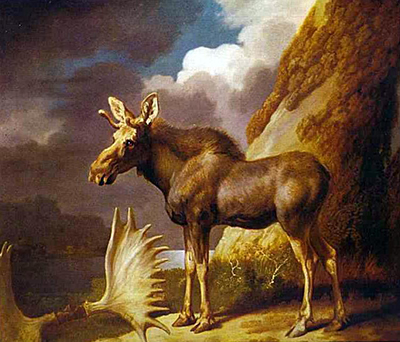
George Stubbs painted The Moose in 1770. The Hunterian, University of Glasgow, identifies it as a signed and dated oil painting on canvas, accession GLAHA 43823. [1] Published specialist captions give its dimensions as 61 by 70.5 centimetres. [2] The animal occupies a landscape with an unexpectedly dramatic sky, while an enormous pair of antlers spreads across the foreground. Understanding that combination is essential to understanding the picture.
William Hunter arranged the painting after Richard Brocklesby introduced him to General Guy Carleton, who brought the Canadian calf to Britain in September 1770 for the Duke of Richmond. Hunter cautiously called it the first male seen here, adding “I believe”. He recorded capture with the aid of Indigenous hunters’ dogs, followed by hand-rearing. [3]
At a Glance
This work across George Stubbs’s career
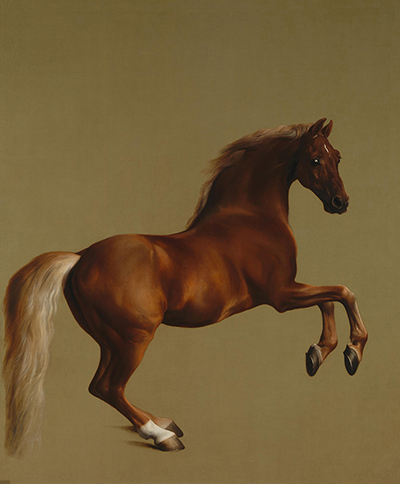
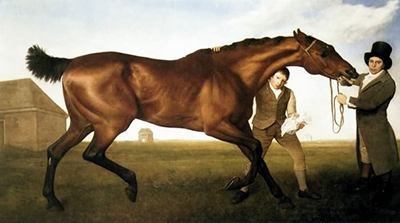
Whistlejacket
about 1762 [8]Contents
- Looking at the painting
- The animal and the antlers
- A picture used to ask questions
- From canvas to printed natural history
- Later readings
- Videos on George Stubbs
Looking at the painting
The moose stands sideways, its head turned sufficiently towards us to show the projecting muzzle and one dark eye. Its ears rise above the small antlers, opening in different directions. The long forelegs support a heavy shoulder and deep chest; the back slopes towards the rounded hindquarters. Stubbs gives these uneven proportions an arresting clarity. Against the darker body, light catches the face, the ridge above the shoulder and the outer surface of the rear leg. The animal is substantial without being symmetrically arranged. Its pose leaves enough space beneath the belly for the far side of the landscape to remain visible.
The foreground antlers complicate that reading of scale. Their pale, spreading surfaces rise almost to the animal’s chest, and their branching points produce a jagged pattern against the shadowed distance. The largest palm cuts diagonally across the bottom left of the picture. Its brightness draws the eye down from the face, then back towards the slender legs. The antlers seem almost too large for the space available to them: part of their spread reaches the edge, making the foreground feel close to the viewer. Their broad, flat forms also contrast with the curved, weighty volume of the body above.
Behind the moose, a steep rock face climbs out of the picture on the right. A thin stretch of pale water appears on the left, beyond a dark mass of land. Overhead, dense cloud opens around a much lighter area near the top centre. The sky makes the dark outline of the animal especially legible, while the cliff provides a warm, rough background to the hindquarters. These large divisions give a stationary subject considerable visual force. There is no need to invent an episode of alarm or loneliness to explain that force: the contrasts of light, silhouette, height and distance already sustain it.
The animal and the antlers
The sitter was a yearling; the mature antlers belonged to another animal. Hunter wanted both represented accurately. In 1773 he took this painting to compare it with a different, older bull, accompanied by Daniel Solander and friends. Stubbs’s drawing of that second animal supplied a later engraved head. [3]
Earlier moose had already reached Goodwood. In Letter XXVIII of The Natural History of Selborne, dated March 1770, Gilbert White recalled visiting a female there on Michaelmas Day in 1768. She had died the previous morning. He found the body suspended in an old greenhouse and measured it, but decomposition prevented the close examination of teeth, tongue and feet that he wanted. A second female had died earlier. These were distinct animals from Stubbs’s young bull. [17]
White also recorded a hope of breeding the female with a red deer and Richmond’s intention to preserve her skeleton. His account moves between an estate experiment, a living creature and a specimen for study. The garden’s animals could be valued in several ways at once; their scientific usefulness might continue after death. Mark Laird places the episode within Goodwood’s menagerie history and the period’s attempts to establish unfamiliar animals and plants in English surroundings. [17] [18]
A picture used to ask questions
Hunter compared the living moose with accounts of the European elk and with giant antlers recovered in Ireland. He thought the Irish animal probably extinct, retaining uncertainty about survival. His notes also explain why a convincing animal image could clarify knowledge yet give errors an undeserved authority. [3]
Helen McCormack argues that an apparently motionless subject can belong among Stubbs’s ambitious animal paintings: anatomical exactness may contribute to an experience of the sublime, as well as conveying information. Her interpretation directs attention to the expressive possibilities of the still body and its setting. It allows accuracy and visual intensity to work together, without turning the image into evidence for a dramatic event witnessed by the painter. [19]
Lisa Vargo draws a sharper distinction between accurate depiction of the animal and convincing depiction of its environment. For her, the imagined setting is a form of displacement: the organism has travelled into a landscape shaped by British expectation. That reading raises a question about the limits of visual knowledge. A painter may make a body recognisable while leaving its ways of living and surroundings only partially understood. The picture’s apparent completeness can coexist with those gaps. [20]
Hunter’s moose research remained unpublished. Rolfe’s 1983 edition assembles unfinished manuscript material from 1770–73, requiring distinctions between the original notes and editorial reconstruction. [3]
From canvas to printed natural history
Plate VIII in Thomas Pennant’s Arctic Zoology, captioned Moose Deer, retains the animal, foreground antlers, cliff and cloudy sky. The plate list credits a Stubbs painting supplied by the late Dr Hunter. A separate antlered head appears on the title-page. These illustrations join a description of the creature’s appearance, distribution and uses. [21]
The title-page says 1784; Pennant’s advertisement is dated 1 February 1785. He explains that Britain’s loss of its American colonies had reshaped a project originally devoted to North American animals. He expanded its territory to include northern Europe and Asia. The printed image entered that reorganised geographical and political framework. [21]
Later readings
Lisa Vargo follows the painting into twentieth-century poetry. In Robert Duncan’s 1960 Poetry, a Natural Thing, the moose becomes part of a meditation on poetic creation. Vargo points out that Duncan read the antlers on the ground as the animal’s own previous growth. His response shows how persuasive an arrangement can become even when its original evidential relationship is misunderstood. The painting supplied a memorable image whose meaning could change with a reader’s purpose. Vargo’s discussion also attends to the distance between the imported animal and the imagined world in which Stubbs placed it. [20]
The work’s appeal can produce very different descriptive language. Reviewing the 2016 exhibition Stubbs and the Wild, Caroline Cannon-Brookes called the moose ugly and its forms lumpy, while describing the image as semi-scientific. [22] Those are a critic’s judgements. Looking at the canvas allows a wider response: its awkward proportions, brilliant foreground shapes and commanding setting can be examined without deciding that unusual appearance is a defect. The painting rewards both knowledge of its circumstances and sustained attention to the forms Stubbs chose to make visible.
Videos on George Stubbs
Explore Stubbs’s equestrian painting in its wider context, including two readings of Whistlejacket.
A Horse Lover’s Guide to the YCBA
A museum tour that places Stubbs alongside other artists who painted horses. It includes a look at Pumpkin with a Stable-lad.
Watch on YouTubeGeorge Stubbs artworks directory
Search works and related prints documented in this guide. Separate versions and printing matrices have separate entries; printmakers are named where known. Unidentified historical titles and untraced studio-sale material are discussed in the essays. A dash means that a date is not established here.
| Name | Date | Medium |
|---|---|---|
| A Bay Horse with a Groom | 1791 | Painting |
| A Bay Hunter with Two Playful Spaniels | 1777 | Painting |
| A Bay Hunter, a Springer Spaniel and a Sussex Spaniel in a wooded river Landscape | 1782 | Painting |
| A Cheetah and a Stag with Two Indian Attendants | about 1764 | Painting |
| A Couple of Fox Hounds (coloured print after Stubbs) | — | Print after Stubbs |
| A Couple of Foxhounds | 1792 | Painting |
| A Foxhound on the Scent | 1788 | Drawing |
| A Gentleman driving a Lady in a Phaeton | 1787 | Painting |
| A Grey Horse | 1793 | Painting |
| A Grey Horse (cantering companion) | 1793 | Painting |
| A Grey Stallion in a Landscape | — | Painting |
| A Horse Affrighted at a Lion | 1 May 1788 | |
| A Horse Belonging to the Rt. Honourable Lord Grosvenor called Bandy from his Crooked Leg | about 1763 | Painting |
| A Horse Frightened by a Lion | 1777 | |
| A Lion (A Lion Resting on a Rock) | 1 May 1788 | |
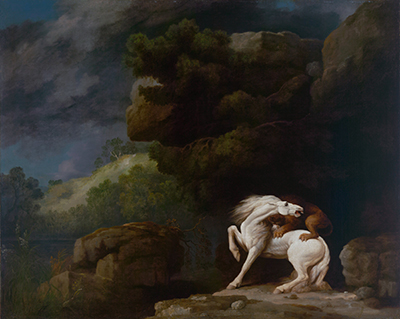
| A Lion Attacking a Horse | 1770 | Painting |
| A Lion Attacking a Horse (monumental Yale canvas) | 1762 | Painting |
| A lion attacking a horse (NGV) | about 1765 | Painting |
| A Lion Devouring a Horse (1788 print) | 1788 | |
| A lion devouring a horse (attribution disputed) | Proposed mid-1770s | Painting |
| A mare and foal with a bay horse | 1771 | Painting |
| A Monkey | 1799 | Painting |
| A Prancing Horse, Facing Right | c. 1790 | Drawing |
| A Rough Dog | 1790 | Painting |
| A Saddled Bay Hunter | 1786 | Painting |
| A Sleeping Leopard | 1 January 1791 | |
| A Tiger and a Sleeping Leopard | 1 May 1788 | |
| A Tigress (John Dixon after Stubbs) | 1772 | Print after Stubbs |
| A Tyger (A Recumbent Leopard by a Tree) | 1 May 1788 | |
| A Tyger (Sleeping Leopard) | 1 May 1788 | |
| An animal found on the coast of New Holland called kanguroo (after Stubbs) | 1773 | Print after Stubbs |
| An animal of a new species found on the coast of New South Wales (after Stubbs) | July 1773 | Print after Stubbs |
| Antinous and Jockey | — | Painting |
| Antinoüs, a chestnut racehorse, in a landscape | Undated | Painting |
| Bandy belonging to Lord Grosvenor (print after Stubbs) | — | Print after Stubbs |
| Baronet (George Townley Stubbs after Stubbs) | 20 February 1794 | Print after Stubbs |
| Baronet with Sam Chifney Up | 1791 | Painting |
| Baronet with Samuel Chifney up (Royal Collection) | 1791 | Painting |
| Bay Hunter by a Lake | 1787 | Painting |
| Brood Mares (Benjamin Green after Stubbs) | Issue 14 November 1776 | Print after Stubbs |
| Brood Mares and Foals | usually dated 1767 | Painting |
| Brown and White Norfolk or Water Spaniel | 1778 | Painting |
| Bulls Fighting | 1786 | Painting |
| Captain Samuel Sharpe Pocklington with His Wife, Pleasance, and possibly His Sister, Frances | 1769 | Painting |
| Death of the Doe (attribution disputed) | 1804 | |
| Der Englische Hühnerhund (Johann Wölfle after Stubbs) | about 1860 | Print after Stubbs |
| Dog (A Foxhound Viewed from Behind) | 1 May 1788 | |
| Dog [A Foxhound on the Scent] | 1788 | |
| Drill and albino baboon | before 1789 | Painting |
| Eclipse (Charles Hunt after Stubbs) | 12 November 1839 | Print after Stubbs |
| Eclipse (George Townley Stubbs after Stubbs) | 1796 | Print after Stubbs |
| Eclipse (oil study) | — | Painting |
| Eclipse (Thomas Burke after Stubbs) | First published 1772 | Print after Stubbs |
| Eclipse and John Wildman (Benjamin Green after Stubbs) | 1772 | Print after Stubbs |
| Eclipse at Newmarket (Jockey Club version) | Proposed early 1790s; often dated 1770 | Painting |
| Eclipse at Newmarket with a groom and jockey | 1770 | Painting |
| Eclipse with Mr Wildman and His Sons | 1769–71 | Painting |
| Eclipse, the Property of Capt.n O Kelly (anonymous print after Stubbs) | Imprint 4 June 1804; impression undated | Print after Stubbs |
| Euston | 1774 | Painting |
| Finished Study for the Seventh Anatomical Table of the Muscles of the Horse | 1756–58 | Drawing |
| Five Brood Mares at the Duke of Cumberland's Stud Farm in Windsor Great Park | 1765 | Painting |
| Fowl Body, Lateral View (Highly Finished Study for an Unpublished Table; Shows the Last Stage in Dissection) | — | Drawing |
| Fowl Body, Lateral View (Probably Prepared for Transfer to the Plate for Engraving of Table XV) | — | Drawing |
| Fowl Skeleton, Lateral View (Finished Study for Table V) | — | Drawing |
| Freeman, the Earl of Clarendon's Gamekeeper, with a Dying Doe and Hound (Yale) | 1800 | Painting |
| George Stubbs (enamel self-portrait) | 1781 | Enamel |
| Gimcrack (George Townley Stubbs after Stubbs) | 1775 | Print after Stubbs |
| Gimcrack on Newmarket Heath, with a trainer, a jockey and a stable lad | about 1765 | Painting |
| Gimcrack, with John Pratt up, on Newmarket Heath | about 1765 | Painting |
| Hambletonian, Rubbing Down | 1800 | Painting |
| Hay-Makers | 1791 | |
| Haycarting | 1795 | Enamel |
| Haymakers | 1785 | Painting |
| Haymakers (Lady Lever Art Gallery) | 1794 | Enamel |
| Hollyhock (with later additions by Vernet and Boucher) | about 1765–70 | Painting |
| Horse Attacked by a Lion (Episode C) | 1768–69 | Painting |
| Horse Attacked by a Lion (Tate enamel) | 1769 | Enamel |
| Horse Devoured by a Lion | Possibly exhibited 1763 | Painting |
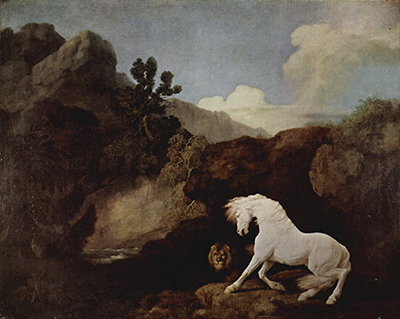
| Horse Frightened by a Lion | 1770 | Painting |
| Horse Frightened by a Lion (Episode A; Wedgwood and Bentley after Stubbs) | — | Sculpture |
| Horse Frightened by a Lion (Tate) | Possibly exhibited 1763 | Painting |
| Horse Frightened by a Lion (Yale) | 1762–68 | Painting |
| Horse in the Shade of a Wood | 1780 | Painting |
| Hound Coursing a Stag | about 1762 | Painting |
| Human Figure, Anterior View (Intended for a Plate That was Never Published) | — | Drawing |
| Human Skeleton, Lateral View | 1795–1806 | Drawing |
| Hunt servants setting out (Southill commission) | 1767 | Painting |
| Hühnerhund (The Spanish Pointer) | about 1766 | Painting |
| John and Sophia Musters Riding at Colwick Hall | 1777 | Painting |
| John Musters on his hunter Pilgrim | 1777–78 | Painting |
| Labourers | 1789 | |
| Labourers (Richard Earlom after Stubbs and Amos Greene) | 25 March 1790 | Print after Stubbs |
| Laetitia, Lady Lade (d.1825) | 1793 | Painting |
| Lemon and White Water Spaniel | — | Painting |
| Lion Attacking a Stag | — | Painting |
| Lord Grosvenor's Arabian Stallion with a Groom | about 1765 | Painting |
| Lord Grosvenor's Arabian Stallion with a Groom (Peter Mazell after Stubbs) | 1771 | Print after Stubbs |
| Mambrino (Eaton Hall painting) | — | Painting |
| Mambrino (George Townley Stubbs after Stubbs) | 1794 | Print after Stubbs |
| Mares and Foals belonging to the 2nd Viscount Bolingbroke | about 1761–62 | Painting |
| Mares and foals beneath large oak trees | — | Painting |
| Mares and Foals by a stream | Exhibited 1764 | Painting |
| Mares and Foals in a River Landscape | about 1763–68 | Painting |
| Mares and Foals in an Extensive Landscape | about 1769 | Painting |
| Mares and Foals without a Background | 1762 | Painting |
| Moose Deer (after Stubbs) (Arctic Zoology plate VIII) | 1784–85 publication | Print after Stubbs |
| Newmarket Heath with a Rubbing-Down House | — | Painting |
| Otho (1796 print after Stubbs) | 1 December 1796 | Print after Stubbs |
| Otho, with John Larkin up | 1768 | Painting |
| Pangloss | about 1762 | Painting |
| Patch (Grafton commission) | 1759 | Painting |
| Phaeton and the Chariot of the Sun (enamel) | 1775 | Enamel |
| Phaeton with a Pair of Cream Ponies and a Stable-Lad | 1780–84 | Painting |
| Phillis | 1772 | Painting |
| Portrait of a Large Dog (Dingo) | 1772 | Painting |
| Pumpkin with a Stable-lad | 1774 | Painting |
| Racehorses Exercising at Goodwood | 1759–60 | Painting |
| Reapers (1791 print) | 1791 | |
| Reapers (Tate) | 1785 | Painting |
| Reapers (Yale) | 1795 | Enamel |
| Red Deer: A Stag and a Hind | 1792 | Painting |
| Richard Wedgwood | — | Enamel |
| Ringwood, a Brocklesby Foxhound | 1792 | Painting |
| Scrub, a bay horse belonging to the Marquess of Rockingham | about 1762 | Painting |
| Self Portrait on a White Hunter | 1782 | Enamel |
| Self-Portrait | about 1759 | Painting |
| Shooting (1770 Woollett plate after Stubbs) | 1770 | Print after Stubbs |
| Shooting (1771 Woollett plate after Stubbs) | 1771 | Print after Stubbs |
| Shooting at Goodwood | 1759–60 | Painting |
| Sir John Nelthorpe as a boy | 1756 | Painting |
| Sir John Nelthorpe partridge shooting with one pointer | — | Painting |
| Sir John Nelthorpe, 6th Baronet, out Shooting with His Dogs in Barton Field, Lincolnshire | 1776 | Painting |
| Sleeping Leopard | 1777 | Enamel |
| Soldiers of the 10th Light Dragoons | 1793 | Painting |
| Stallion and Mare (George Townley Stubbs after Stubbs) | 1776; reissued 1789 | Print after Stubbs |
| Steward and gamekeeper with dogs (Southill commission) | 1767 | Painting |
| Studies of a Lemur (Lemur murinus) in six different attitudes | 1773 | Drawing |
| Study for the Self-portrait in Enamel | c. 1781 | Drawing |
| Study of a Lemur | 1773 | Drawing |
| Study of a Racehorse in Action: Galloping to Left, a Semi-Anatomical Study, with Skin Flayed to Show Action of Muscles | — | Drawing |
| Study of the Legs of a Draught-Horse Pulling a Harrow (attributed to Stubbs) | Proposed about 1786 | Drawing |
| Sweet William (Grosvenor panel) | — | Painting |
| Sweet William (Turf Gallery canvas) | — | Painting |
| The Black Stallion Sampson, Portrayed from Three Angles (with landscape additions) | about 1764 | Painting |
| The Charlton Hunt | 1759–60 | Painting |
| The Fall of Phaeton | — | Sculpture |
| The Frightened Horse | 1780 | Sculpture |
| The Grosvenor Hunt | — | Painting |
| The Haymakers (Upton House) | 1783 | Painting |
| The Horse and Lion (George Townley Stubbs after George Stubbs) | 1770 | Print after Stubbs |
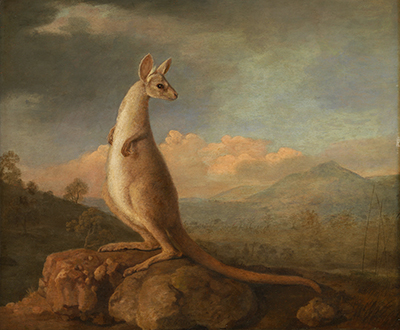
| The Kongouro from New Holland | 1772 | Painting |
| The Labourers | 1779 | Painting |
| The Labourers (Southill original) | 1767 | Painting |
| The lion and horse (Benjamin Green after Stubbs) | 1769; reissued 1777 | Print after Stubbs |
| The Milbanke and Melbourne Families | about 1769 | Painting |
| The Moose | 1770 | Painting |
| The Prince of Wales's Phaeton | 1793 | Painting |
| The Reapers (Upton House) | 1783 | Painting |
| The Sebra, or Wild Ass (George Townley Stubbs after Stubbs) | 1771 | Print after Stubbs |
| The Spanish Pointer (Bradford version) | about 1766–68 | Painting |
| The Spanish Pointer (William Woollett after Stubbs) | January 1768 | Print after Stubbs |
| The Third Duke of Dorset's Hunter with a Groom and a Dog | 1768 | Painting |
| Thomas Freeman, Lord Clarendon's gamekeeper, with a dog and a shot doe (with George Townly Stubbs) | 1803 | Painting |
| Turf, with Jockey up, at Newmarket | — | Painting |
| Turk and Crab | — | Painting |
| Two Bay Hunters Communing On The Bank Of A Lake | — | Painting |
| Tygers at Play | 1780 | |
| Viscount Gormanston's White Dog | 1781 | Painting |
| Viscount Gormanston's White Dog (canvas version) | — | Painting |
| Water Spaniel | 1769 | Painting |
| Wedgwood Family Portrait | 1780 | Painting |
| Whistlejacket | about 1762 | Painting |
| Whistlejacket with two other stallions and a groom | Recorded 1762 | Painting |
| White Poodle in a Punt | about 1780 | Painting |
| William Anderson with two Saddle-Horses | 1793 | Painting |
| Working Drawing for the Seventh Anatomical Table of the Muscles of the Horse | 1756–58 | Drawing |
| Zebra | 1763 | Painting |
Discussion
Look again at the images and ideas explored in The Moose by George Stubbs. These editorial prompts invite your observations.
Reader Insights
How do the loose antlers affect your reading of the living animal?
What changes when the painting is used as evidence in a discussion of natural history?
How does the encounter between a particular animal and its documented history alter your first impression?
Join the Conversation
Share a detail, comparison or question about The Moose by George Stubbs below.
References
- University of Glasgow Collections, ‘The Moose’, narrative 352 and linked image caption, GLAHA 43823. Current museum record. View source.
- A&AePortal, ‘The Moose’, image 110332, including Mark Laird’s caption to figure 208. Object and scholarly captions. View source.
- W. D. Ian Rolfe, ‘William Hunter (1718–1783) on Irish “elk” and Stubbs’s Moose’, Archives of Natural History 11, no. 2 (1983), pp. 263–290, including edited Hunter manuscripts and notes. Author-uploaded article. View source.
- Goodwood, The Collection, Painting Collection modal, Racehorses Exercising at Goodwood; An exciting acquisition: a study by George Stubbs, 30 June 2023; History of the Estate Hounds, 4 October 2023; About Goodwood Racecourse. Accessed 4 November 2026. View source.
- Goodwood, The Collection, Painting Collection modal, Racehorses Exercising at Goodwood; An exciting acquisition: a study by George Stubbs, 30 June 2023; History of the Estate Hounds, 4 October 2023; About Goodwood Racecourse. Accessed 4 November 2026. View source.
- Goodwood, The Collection, Painting Collection modal, Racehorses Exercising at Goodwood; An exciting acquisition: a study by George Stubbs, 30 June 2023; History of the Estate Hounds, 4 October 2023; About Goodwood Racecourse. Accessed 4 November 2026. View source.
- Goodwood, The Collection, Painting Collection modal, Racehorses Exercising at Goodwood; An exciting acquisition: a study by George Stubbs, 30 June 2023; History of the Estate Hounds, 4 October 2023; About Goodwood Racecourse. Accessed 4 November 2026. View source.
- National Gallery, Whistlejacket, NG6569, current collection record, provenance, in-depth discussion and frame entry. View source.
- Yale Center for British Art, Zebra, B1981.25.617, current object metadata, gallery labels, Malcolm Warner’s 1998 catalogue entry and provenance supplied through the museum’s public collection record. View source.
- Christie’s, Gimcrack on Newmarket Heath, with a trainer, a jockey and a stable lad, London, 5 July 2011, lot 12; object details, essay, provenance, exhibitions and whole image. View source.
- Christie’s, Gimcrack on Newmarket Heath, with a trainer, a jockey and a stable lad, London, 5 July 2011, lot 12; object details, essay, provenance, exhibitions and whole image. View source.
- Yale University Art Gallery, A Lion Attacking a Horse, 1770, 1955.27.1, collection record. Accessed 4 November 2026. View source.
- University of Glasgow Collections, ‘The Moose’, narrative 352 and linked image caption, GLAHA 43823. Current museum record. View source.
- Royal Museums Greenwich, ‘The Kongouro from New Holland’ (Kangaroo), ZBA5754. Accessed 4 November 2026. View source.
- Tate, George Stubbs, Haymakers, 1785, T02256; details, Terry Riggs’s collection text (January 1998), and online caption. Collection record. View source.
- Frances Bailey, ‘Hambletonian, Rubbing Down: A masterpiece by George Stubbs’, National Trust Cultural Heritage Magazine, Autumn/Winter 2024, pp. 22–33. Article. View source.
- Gilbert White, The Natural History of Selborne, vol. 1, edited by Henry Morley (Cassell, 1887), Letter XXVIII, March 1770, pp. 101–103. Public transcription. View source.
- Mark Laird, A Natural History of English Gardening 1650–1800 (2015), chapter 5, especially ‘Preamble: Goodwood, Selborne and Kew in 1768’, figure 208 and notes 21–22. Chapter text. View source.
- Helen McCormack, ‘Animalia, Autopsia, Natura: George Stubbs’s The Moose (1770)’, conference paper delivered at George Stubbs: All Done from Nature, MK Gallery, 17 January 2020; unpublished paper deposited in RADAR. Paper. View source.
- Lisa Vargo, ‘The Romantic Prospects of the Duke of Richmond’s Moose’, European Romantic Review 24, no. 3 (2013), pp. 297–305, DOI: 10.1080/10509585.2013.790187. Author-uploaded article. View source.
- Thomas Pennant, Arctic Zoology, vol. 1 (title-page 1784; advertisement dated 1 February 1785), advertisement, list of plates, plate VIII and pp. 17–21. Digitised volume. View source.
- Caroline Cannon-Brookes, ‘Stubbs and the Wild’, British Society for Eighteenth-Century Studies, 12 August 2016. Exhibition review. View source.
- Basic title, date and material metadata for Tate’s Reapers (T02257) and Otho (T02375) is adapted from the Tate collection dataset, October 2014, released under CC0. TheHistoryOfArt.org has reconciled labels and versions. This credit does not apply to Tate’s authored catalogue commentary or images.
- Data Source: Yale Center for British Art. Basic object fields are adapted and reconciled for this directory. Reuse is subject to the Center’s Open Data and Data Services Terms of Use. No museum endorsement is implied. This metadata credit does not relabel scholarly essays or images as open data.
- Basic object metadata for A Horse Frightened by a Lion, 1985.38, The Cleveland Museum of Art, John L. Severance Fund, is available under CC0. Titles and design-level grouping have been reconciled for this directory.