 by Tom Gurney
Tom Gurney BSc (Hons) is an art history expert with over 20 years experience
Email: tomgurney1@gmail.com / Phone: +44 7429 011000
A Saddled Bay Hunter: Introduction
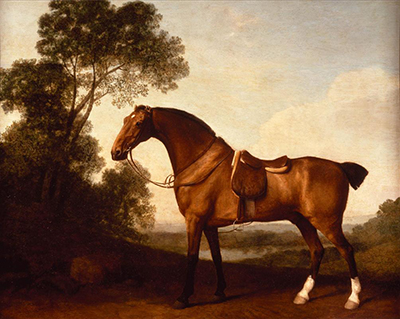
George Stubbs painted A Saddled Bay Hunter in 1786. Now in the Denver Art Museum, this oil painting on panel measures 55.2 × 70.5 cm and entered the collection as a gift from the Berger Collection Educational Trust in 2019. [1]
The horse stands facing left, with its body turned sufficiently towards us to show the breadth of its chest. A brown saddle rests on its back; reins hang in a loose curve below its head. There is no rider, groom or companion animal. The empty saddle gives human activity a place in the picture while making the horse itself the focus of our attention. [2] Against a pale sky, its dark head and neck make a firm, uninterrupted shape. [3]
At a Glance
This work across George Stubbs’s career
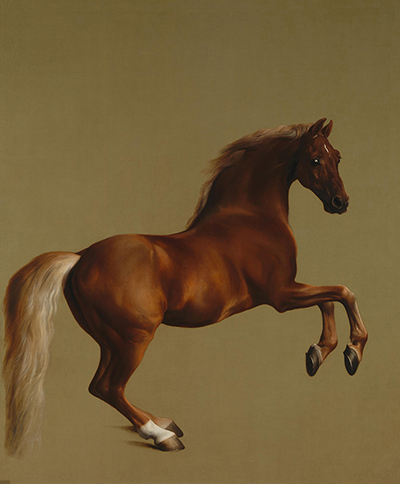
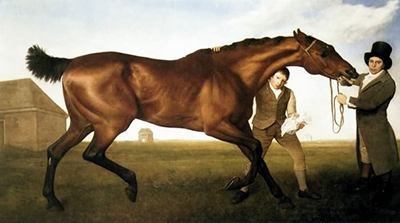
Whistlejacket
about 1762 [8]Contents
- A hunter shown at rest
- The saddle and the absent rider
- Trees, water and an open sky
- Anatomy beneath the painted surface
- Painting on panel
- Another bay hunter, another history
- From private collections to Denver
- Videos on George Stubbs
A hunter shown at rest
Stubbs gives the standing animal considerable weight. The rounded shoulder presses forward beneath the neck, while the barrel of the body extends almost horizontally towards the hindquarters. Light crosses these large forms in broad passages, gathering along the upper shoulder and across the flank. Below them, the lower legs look slender. The change from substantial body to narrow supporting limbs is especially clear where the darker legs descend against the lighter distant landscape. [3]
Denver's commentary relates the horse's thick neck, substantial body and relatively short legs to the demands of crossing rough ground. It presents the animal as a hunter suited to that work. [1]
A hunter was defined by what it could do. In his Sporting Dictionary of 1803, William Taplin describes a horse or mare kept for the chase and possessing the necessary qualities. He also stresses that the demands varied with the hounds being followed. An animal adequate with harriers might struggle in a faster field. His account places performance and suitability at the centre of the term, rather than supplying a single pedigree that every hunter shared. Written seventeen years after Stubbs's painting, it offers a period explanation of the title's practical meaning. [17]
The stance lets us examine differences between the four legs. The forelegs form a close, dark pair beneath the chest, with their hooves resting on the brown foreground. Behind, the legs separate more widely. Two white markings above the hind hooves brighten the lower right of the horse's silhouette. They are small areas beside the expanse of brown coat, yet they prevent the lower body from becoming an undifferentiated dark mass. They also make the positions of the rear feet particularly easy to follow. [3]
The saddle and the absent rider
The saddle is a substantial part of the portrait. Its curved seat has a light edge that catches the eye above the darker flap against the horse's side. A narrow strap descends towards a metal stirrup, whose open centre allows the landscape to show through. Other bands cross the body and pass beneath the belly. Their straight or gently curving edges divide the broad painted surfaces without hiding the animal's overall shape. The horse remains legible beneath its equipment. [3]
Taplin's separate entries on bridles and girths describe how equipment connected horse and rider. A bridle enabled a rider to direct movement; girths held the saddle in position. He pays particular attention to rubbing and pressure during a long chase, recommending suitable webbing and careful placement of the buckles. Such concerns remind us that riding equipment had to work against a moving body. [17]
The reins have a different visual character from the saddle's heavier forms. Thin lines descend from the mouth, swing outward, then return towards the chest and neck. They enclose irregular patches of pale background, introducing a delicacy beside the large brown head. Small bright touches around the mouth distinguish the metal fittings. The eye and the white mark high on the forehead provide further points of definition, giving the face features that can be recognised within its long outline. [3]
At the other end of the animal, the tail finishes in a short, dark tuft. [3] The textile conservator Kate Herron used this very painting to illustrate an account of horsehair upholstery for The Henry Ford. She explains that working horses' tails were commonly shortened for practical and hygienic reasons, and that the removed hair could be used in furnishing fabrics. This brings the apparently minor tail into a wider history of how people managed and used horses. [18]
The rider's absence leaves no gesture directing us towards a hunt or journey. Instead, the saddle occupies the place where a person could sit, while the stirrup hangs unused. These objects make the animal's relationship with riding visible through equipment alone. [2] Across the picture, there is a balance between attachment and openness: straps touch the body, but air and landscape surround the legs, the head and the spaces beneath the reins. [3]
Trees, water and an open sky
A tall tree fills much of the left side. Its trunks rise beside the horse's face and divide into a branching crown above the head. The foliage is densely grouped near the outer edge, then becomes more broken where small leaves and twigs meet the sky. This shift matters to the space around the horse. The animal is close to the tree's shadowed mass, yet a narrow passage of light keeps the face from disappearing into it. [3]
To the right, the landscape opens beyond the hindquarters. A pale band of water and low, distant ground stretches beneath the sky. Nearer vegetation forms darker layers, with a sloping bank entering from the right edge. The horse stands across these changes of distance, its body cutting through the broad horizon. The low placement of the distant view allows its back, neck and head to rise against the much simpler field of clouds. [3]
Colour connects the animal to its surroundings. Warm brown recurs in the ground, the saddle and the coat, while dark foliage answers the black mane and tail. The sky provides the largest light area, but it is not uniformly blank. Thin cloud passages and a warmer glow near the horizon soften the transition towards the distance. This gives the horse a setting that is spacious without competing with the precise contours of the equipment and limbs. [3]
The left and right sides offer different kinds of shelter and exposure. Dense vegetation brings the nearest space up towards the viewer; the distant water carries the eye away. Between them, the horse occupies a strip of earth whose slight unevenness remains visible around the hooves. Stubbs can therefore present the animal clearly without placing it on an abstract platform. Its feet belong to the same ground that leads into the landscape. [3]
Anatomy beneath the painted surface
By 1786, Stubbs had long experience of studying how horses were built. The National Gallery dates his sustained Lincolnshire work on equine dissection and drawing to 1756–58. These studies preceded the publication of The Anatomy of the Horse in 1766. Stubbs's book grew from his own direct investigation of the animal's structure. The broader account of his anatomical work explains how this undertaking developed. [19]
The book's scope was more extensive than the muscles visible beneath an animal's coat. Its title names bones, cartilages, muscles, fascias, ligaments, nerves, arteries, veins and glands. The Metropolitan Museum of Art identifies its 1766 copy as a volume written and illustrated by Stubbs, with etched illustrations. That combination of text and images made the horse's internal structures a subject that could be studied on paper. It helps explain the kind of sustained inquiry behind his reputation. [20]
Here, the body is covered, rounded and lit. At the shoulder, a curved highlight turns into shadow beneath the chest; towards the rear, the flank catches a broader glow before the hindquarters darken. The painted transitions describe changes in volume without drawing a separate boundary around every muscle. Even the saddle's overlap contributes: its lower edge passes across a body that continues below it, so that equipment and flesh remain distinct kinds of form. [3]
Painting on panel
Stubbs's choice of support belongs to an experimental part of his practice. John Mills and Raymond White's technical study examined ten paintings made between 1772 and 1800. Their analyses distinguished an early group using wax and resin, or other oil or fat with resin, from later examples that also contained drying oil. Prepared grounds and mixtures varied. Their table does not include Denver's hunter, so these findings provide context rather than a chemical recipe for this particular panel. [21]
The study also warns that conservation materials can complicate the interpretation of paint samples. Its account of renewed eighteenth-century interest in ancient wax painting offers a possible setting for Stubbs's experiments, rather than a single documented formula used throughout his career. To identify his materials precisely requires examination of individual paintings. The wider discussion of technique, enamel and printmaking follows those experiments across different supports and processes. [21]
A useful comparison is A Bay Hunter with Two Playful Spaniels, signed and dated 1777. Christie's records it as oil on mahogany panel, commissioned by Charles Vere Dashwood. Its catalogue essay connects Stubbs's increasing preference for panel during the 1770s with the smooth surfaces of his enamel work, suggesting that he sought a comparable surface on a larger scale. That is a useful interpretation of his practice. The commission supplies a documented example of a horse portrait made for a country-house owner. [22]
Another bay hunter, another history
The Tate painting Bay Hunter by a Lake is a distinct work dated 1787. Tate records oil paint on oak and a support measuring 90.5 × 137.2 cm. Its historical catalogue cautiously associates it with Arthur Annesley, 9th Viscount Valentia, and its collection commentary identifies cropped ears, plants beneath trees on the right, and a lake on the left. That particular description belongs to the Tate picture. Similar subjects gave Stubbs repeated opportunities to vary a horse's presentation without making every bay hunter the same animal or commission. [23]
From private collections to Denver
The original commissioner and the horse's name remain unverified. Denver's ownership history begins with Lieutenant Colonel Ririd Myddelton at Chirk Castle, followed by Sotheby's on 15 July 1964, Thomas Agnew & Sons, and Jack R. and Lynda T. Dick in 1965. After another Sotheby's sale on 26 June 1974 came Lord Alistair McAlpine, Kurt E. Schon, and William Oliver and Evalyn Poole by 1979. A private American collection, Patrick Ellis and Simon Gillespie Studio preceded the Bergers' purchase in 1997. The Trust subsequently gave it to Denver. Exhibitions included the Poole collection's 1980–83 tour, beginning at the International Museum of the Horse in Lexington, and Berger collection displays from 2014 onwards. [1]
The painting was also shown at the Taft Museum of Art in 2017. Reviewing that exhibition for ÆQAI, Jonathan Kamholtz placed it at the centre of the Berger collection's interest in horses. He considered its profile statuesque and understood Stubbs's horses as individual portrait subjects. His response also held together two aspects of the image: the saddle brings the animal within human use, while the portrait retains a sense of distance from that human world. [2]
Videos on George Stubbs
Explore Stubbs’s equestrian painting in its wider context, including two readings of Whistlejacket.
A Horse Lover’s Guide to the YCBA
A museum tour that places Stubbs alongside other artists who painted horses. It includes a look at Pumpkin with a Stable-lad.
Watch on YouTubeGeorge Stubbs artworks directory
Search works and related prints documented in this guide. Separate versions and printing matrices have separate entries; printmakers are named where known. Unidentified historical titles and untraced studio-sale material are discussed in the essays. A dash means that a date is not established here.
| Name | Date | Medium |
|---|---|---|
| A Bay Horse with a Groom | 1791 | Painting |
| A Bay Hunter with Two Playful Spaniels | 1777 | Painting |
| A Bay Hunter, a Springer Spaniel and a Sussex Spaniel in a wooded river Landscape | 1782 | Painting |
| A Cheetah and a Stag with Two Indian Attendants | about 1764 | Painting |
| A Couple of Fox Hounds (coloured print after Stubbs) | — | Print after Stubbs |
| A Couple of Foxhounds | 1792 | Painting |
| A Foxhound on the Scent | 1788 | Drawing |
| A Gentleman driving a Lady in a Phaeton | 1787 | Painting |
| A Grey Horse | 1793 | Painting |
| A Grey Horse (cantering companion) | 1793 | Painting |
| A Grey Stallion in a Landscape | — | Painting |
| A Horse Affrighted at a Lion | 1 May 1788 | |
| A Horse Belonging to the Rt. Honourable Lord Grosvenor called Bandy from his Crooked Leg | about 1763 | Painting |
| A Horse Frightened by a Lion | 1777 | |
| A Lion (A Lion Resting on a Rock) | 1 May 1788 | |
| A Lion Attacking a Horse | 1770 | Painting |
| A Lion Attacking a Horse (monumental Yale canvas) | 1762 | Painting |
| A lion attacking a horse (NGV) | about 1765 | Painting |
| A Lion Devouring a Horse (1788 print) | 1788 | |
| A lion devouring a horse (attribution disputed) | Proposed mid-1770s | Painting |
| A mare and foal with a bay horse | 1771 | Painting |
| A Monkey | 1799 | Painting |
| A Prancing Horse, Facing Right | c. 1790 | Drawing |
| A Rough Dog | 1790 | Painting |
| A Saddled Bay Hunter | 1786 | Painting |
| A Sleeping Leopard | 1 January 1791 | |
| A Tiger and a Sleeping Leopard | 1 May 1788 | |
| A Tigress (John Dixon after Stubbs) | 1772 | Print after Stubbs |
| A Tyger (A Recumbent Leopard by a Tree) | 1 May 1788 | |
| A Tyger (Sleeping Leopard) | 1 May 1788 | |
| An animal found on the coast of New Holland called kanguroo (after Stubbs) | 1773 | Print after Stubbs |
| An animal of a new species found on the coast of New South Wales (after Stubbs) | July 1773 | Print after Stubbs |
| Antinous and Jockey | — | Painting |
| Antinoüs, a chestnut racehorse, in a landscape | Undated | Painting |
| Bandy belonging to Lord Grosvenor (print after Stubbs) | — | Print after Stubbs |
| Baronet (George Townley Stubbs after Stubbs) | 20 February 1794 | Print after Stubbs |
| Baronet with Sam Chifney Up | 1791 | Painting |
| Baronet with Samuel Chifney up (Royal Collection) | 1791 | Painting |
| Bay Hunter by a Lake | 1787 | Painting |
| Brood Mares (Benjamin Green after Stubbs) | Issue 14 November 1776 | Print after Stubbs |
| Brood Mares and Foals | usually dated 1767 | Painting |
| Brown and White Norfolk or Water Spaniel | 1778 | Painting |
| Bulls Fighting | 1786 | Painting |
| Captain Samuel Sharpe Pocklington with His Wife, Pleasance, and possibly His Sister, Frances | 1769 | Painting |
| Death of the Doe (attribution disputed) | 1804 | |
| Der Englische Hühnerhund (Johann Wölfle after Stubbs) | about 1860 | Print after Stubbs |
| Dog (A Foxhound Viewed from Behind) | 1 May 1788 | |
| Dog [A Foxhound on the Scent] | 1788 | |
| Drill and albino baboon | before 1789 | Painting |
| Eclipse (Charles Hunt after Stubbs) | 12 November 1839 | Print after Stubbs |
| Eclipse (George Townley Stubbs after Stubbs) | 1796 | Print after Stubbs |
| Eclipse (oil study) | — | Painting |
| Eclipse (Thomas Burke after Stubbs) | First published 1772 | Print after Stubbs |
| Eclipse and John Wildman (Benjamin Green after Stubbs) | 1772 | Print after Stubbs |
| Eclipse at Newmarket (Jockey Club version) | Proposed early 1790s; often dated 1770 | Painting |
| Eclipse at Newmarket with a groom and jockey | 1770 | Painting |
| Eclipse with Mr Wildman and His Sons | 1769–71 | Painting |
| Eclipse, the Property of Capt.n O Kelly (anonymous print after Stubbs) | Imprint 4 June 1804; impression undated | Print after Stubbs |
| Euston | 1774 | Painting |
| Finished Study for the Seventh Anatomical Table of the Muscles of the Horse | 1756–58 | Drawing |
| Five Brood Mares at the Duke of Cumberland's Stud Farm in Windsor Great Park | 1765 | Painting |
| Fowl Body, Lateral View (Highly Finished Study for an Unpublished Table; Shows the Last Stage in Dissection) | — | Drawing |
| Fowl Body, Lateral View (Probably Prepared for Transfer to the Plate for Engraving of Table XV) | — | Drawing |
| Fowl Skeleton, Lateral View (Finished Study for Table V) | — | Drawing |
| Freeman, the Earl of Clarendon's Gamekeeper, with a Dying Doe and Hound (Yale) | 1800 | Painting |
| George Stubbs (enamel self-portrait) | 1781 | Enamel |
| Gimcrack (George Townley Stubbs after Stubbs) | 1775 | Print after Stubbs |
| Gimcrack on Newmarket Heath, with a trainer, a jockey and a stable lad | about 1765 | Painting |
| Gimcrack, with John Pratt up, on Newmarket Heath | about 1765 | Painting |
| Hambletonian, Rubbing Down | 1800 | Painting |
| Hay-Makers | 1791 | |
| Haycarting | 1795 | Enamel |
| Haymakers | 1785 | Painting |
| Haymakers (Lady Lever Art Gallery) | 1794 | Enamel |
| Hollyhock (with later additions by Vernet and Boucher) | about 1765–70 | Painting |
| Horse Attacked by a Lion (Episode C) | 1768–69 | Painting |
| Horse Attacked by a Lion (Tate enamel) | 1769 | Enamel |
| Horse Devoured by a Lion | Possibly exhibited 1763 | Painting |
| Horse Frightened by a Lion | 1770 | Painting |
| Horse Frightened by a Lion (Episode A; Wedgwood and Bentley after Stubbs) | — | Sculpture |
| Horse Frightened by a Lion (Tate) | Possibly exhibited 1763 | Painting |
| Horse Frightened by a Lion (Yale) | 1762–68 | Painting |
| Horse in the Shade of a Wood | 1780 | Painting |
| Hound Coursing a Stag | about 1762 | Painting |
| Human Figure, Anterior View (Intended for a Plate That was Never Published) | — | Drawing |
| Human Skeleton, Lateral View | 1795–1806 | Drawing |
| Hunt servants setting out (Southill commission) | 1767 | Painting |
| Hühnerhund (The Spanish Pointer) | about 1766 | Painting |
| John and Sophia Musters Riding at Colwick Hall | 1777 | Painting |
| John Musters on his hunter Pilgrim | 1777–78 | Painting |
| Labourers | 1789 | |
| Labourers (Richard Earlom after Stubbs and Amos Greene) | 25 March 1790 | Print after Stubbs |
| Laetitia, Lady Lade (d.1825) | 1793 | Painting |
| Lemon and White Water Spaniel | — | Painting |
| Lion Attacking a Stag | — | Painting |
| Lord Grosvenor's Arabian Stallion with a Groom | about 1765 | Painting |
| Lord Grosvenor's Arabian Stallion with a Groom (Peter Mazell after Stubbs) | 1771 | Print after Stubbs |
| Mambrino (Eaton Hall painting) | — | Painting |
| Mambrino (George Townley Stubbs after Stubbs) | 1794 | Print after Stubbs |
| Mares and Foals belonging to the 2nd Viscount Bolingbroke | about 1761–62 | Painting |
| Mares and foals beneath large oak trees | — | Painting |
| Mares and Foals by a stream | Exhibited 1764 | Painting |
| Mares and Foals in a River Landscape | about 1763–68 | Painting |
| Mares and Foals in an Extensive Landscape | about 1769 | Painting |
| Mares and Foals without a Background | 1762 | Painting |
| Moose Deer (after Stubbs) (Arctic Zoology plate VIII) | 1784–85 publication | Print after Stubbs |
| Newmarket Heath with a Rubbing-Down House | — | Painting |
| Otho (1796 print after Stubbs) | 1 December 1796 | Print after Stubbs |
| Otho, with John Larkin up | 1768 | Painting |
| Pangloss | about 1762 | Painting |
| Patch (Grafton commission) | 1759 | Painting |
| Phaeton and the Chariot of the Sun (enamel) | 1775 | Enamel |
| Phaeton with a Pair of Cream Ponies and a Stable-Lad | 1780–84 | Painting |
| Phillis | 1772 | Painting |
| Portrait of a Large Dog (Dingo) | 1772 | Painting |
| Pumpkin with a Stable-lad | 1774 | Painting |
| Racehorses Exercising at Goodwood | 1759–60 | Painting |
| Reapers (1791 print) | 1791 | |
| Reapers (Tate) | 1785 | Painting |
| Reapers (Yale) | 1795 | Enamel |
| Red Deer: A Stag and a Hind | 1792 | Painting |
| Richard Wedgwood | — | Enamel |
| Ringwood, a Brocklesby Foxhound | 1792 | Painting |
| Scrub, a bay horse belonging to the Marquess of Rockingham | about 1762 | Painting |
| Self Portrait on a White Hunter | 1782 | Enamel |
| Self-Portrait | about 1759 | Painting |
| Shooting (1770 Woollett plate after Stubbs) | 1770 | Print after Stubbs |
| Shooting (1771 Woollett plate after Stubbs) | 1771 | Print after Stubbs |
| Shooting at Goodwood | 1759–60 | Painting |
| Sir John Nelthorpe as a boy | 1756 | Painting |
| Sir John Nelthorpe partridge shooting with one pointer | — | Painting |
| Sir John Nelthorpe, 6th Baronet, out Shooting with His Dogs in Barton Field, Lincolnshire | 1776 | Painting |
| Sleeping Leopard | 1777 | Enamel |
| Soldiers of the 10th Light Dragoons | 1793 | Painting |
| Stallion and Mare (George Townley Stubbs after Stubbs) | 1776; reissued 1789 | Print after Stubbs |
| Steward and gamekeeper with dogs (Southill commission) | 1767 | Painting |
| Studies of a Lemur (Lemur murinus) in six different attitudes | 1773 | Drawing |
| Study for the Self-portrait in Enamel | c. 1781 | Drawing |
| Study of a Lemur | 1773 | Drawing |
| Study of a Racehorse in Action: Galloping to Left, a Semi-Anatomical Study, with Skin Flayed to Show Action of Muscles | — | Drawing |
| Study of the Legs of a Draught-Horse Pulling a Harrow (attributed to Stubbs) | Proposed about 1786 | Drawing |
| Sweet William (Grosvenor panel) | — | Painting |
| Sweet William (Turf Gallery canvas) | — | Painting |
| The Black Stallion Sampson, Portrayed from Three Angles (with landscape additions) | about 1764 | Painting |
| The Charlton Hunt | 1759–60 | Painting |
| The Fall of Phaeton | — | Sculpture |
| The Frightened Horse | 1780 | Sculpture |
| The Grosvenor Hunt | — | Painting |
| The Haymakers (Upton House) | 1783 | Painting |
| The Horse and Lion (George Townley Stubbs after George Stubbs) | 1770 | Print after Stubbs |
| The Kongouro from New Holland | 1772 | Painting |
| The Labourers | 1779 | Painting |
| The Labourers (Southill original) | 1767 | Painting |
| The lion and horse (Benjamin Green after Stubbs) | 1769; reissued 1777 | Print after Stubbs |
| The Milbanke and Melbourne Families | about 1769 | Painting |
| The Moose | 1770 | Painting |
| The Prince of Wales's Phaeton | 1793 | Painting |
| The Reapers (Upton House) | 1783 | Painting |
| The Sebra, or Wild Ass (George Townley Stubbs after Stubbs) | 1771 | Print after Stubbs |
| The Spanish Pointer (Bradford version) | about 1766–68 | Painting |
| The Spanish Pointer (William Woollett after Stubbs) | January 1768 | Print after Stubbs |
| The Third Duke of Dorset's Hunter with a Groom and a Dog | 1768 | Painting |
| Thomas Freeman, Lord Clarendon's gamekeeper, with a dog and a shot doe (with George Townly Stubbs) | 1803 | Painting |
| Turf, with Jockey up, at Newmarket | — | Painting |
| Turk and Crab | — | Painting |
| Two Bay Hunters Communing On The Bank Of A Lake | — | Painting |
| Tygers at Play | 1780 | |
| Viscount Gormanston's White Dog | 1781 | Painting |
| Viscount Gormanston's White Dog (canvas version) | — | Painting |
| Water Spaniel | 1769 | Painting |
| Wedgwood Family Portrait | 1780 | Painting |
| Whistlejacket | about 1762 | Painting |
| Whistlejacket with two other stallions and a groom | Recorded 1762 | Painting |
| White Poodle in a Punt | about 1780 | Painting |
| William Anderson with two Saddle-Horses | 1793 | Painting |
| Working Drawing for the Seventh Anatomical Table of the Muscles of the Horse | 1756–58 | Drawing |
| Zebra | 1763 | Painting |
Discussion
Look again at the images and ideas explored in A Saddled Bay Hunter. These editorial prompts invite your observations.
Reader Insights
How do saddle and setting change your understanding of the waiting horse?
Which comparison with the other bay hunter best reveals the individuality of this design?
How does the equipment help you read a horse that is shown without a rider?
Join the Conversation
Share a detail, comparison or question about A Saddled Bay Hunter below.
References
- Denver Art Museum. A Saddled Bay Hunter, 1786, accession 2019.10. Current collection record, provenance and exhibitions. Accessed 4 November 2026. View source.
- Jonathan Kamholtz. “Kingdoms and Horses: ‘Treasures of British Painting 1400–2000: The Berger Collection,’ Taft Museum of Art June 10–October 1, 2017”, ÆQAI, 2017. Exhibition review. Accessed 4 November 2026. View source.
- Denver Art Museum / Google Arts & Culture. A Saddled Bay Hunter, whole institutional image, asset 5gFsuk373TxFug. Artwork image; full-resolution institutional image preserved on Wikimedia Commons. Accessed and visually inspected 4 November 2026. View source 1. View source 2.
- Goodwood, The Collection, Painting Collection modal, Racehorses Exercising at Goodwood; An exciting acquisition: a study by George Stubbs, 30 June 2023; History of the Estate Hounds, 4 October 2023; About Goodwood Racecourse. Accessed 4 November 2026. View source.
- Goodwood, The Collection, Painting Collection modal, Racehorses Exercising at Goodwood; An exciting acquisition: a study by George Stubbs, 30 June 2023; History of the Estate Hounds, 4 October 2023; About Goodwood Racecourse. Accessed 4 November 2026. View source.
- Goodwood, The Collection, Painting Collection modal, Racehorses Exercising at Goodwood; An exciting acquisition: a study by George Stubbs, 30 June 2023; History of the Estate Hounds, 4 October 2023; About Goodwood Racecourse. Accessed 4 November 2026. View source.
- Goodwood, The Collection, Painting Collection modal, Racehorses Exercising at Goodwood; An exciting acquisition: a study by George Stubbs, 30 June 2023; History of the Estate Hounds, 4 October 2023; About Goodwood Racecourse. Accessed 4 November 2026. View source.
- National Gallery, Whistlejacket, NG6569, current collection record, provenance, in-depth discussion and frame entry. View source.
- Yale Center for British Art, Zebra, B1981.25.617, current object metadata, gallery labels, Malcolm Warner’s 1998 catalogue entry and provenance supplied through the museum’s public collection record. View source.
- Christie’s, Gimcrack on Newmarket Heath, with a trainer, a jockey and a stable lad, London, 5 July 2011, lot 12; object details, essay, provenance, exhibitions and whole image. View source.
- Christie’s, Gimcrack on Newmarket Heath, with a trainer, a jockey and a stable lad, London, 5 July 2011, lot 12; object details, essay, provenance, exhibitions and whole image. View source.
- Yale University Art Gallery, A Lion Attacking a Horse, 1770, 1955.27.1, collection record. Accessed 4 November 2026. View source.
- Royal Museums Greenwich, ‘The Kongouro from New Holland’ (Kangaroo), ZBA5754. Accessed 4 November 2026. View source.
- Tate, George Stubbs, Haymakers, 1785, T02256; details, Terry Riggs’s collection text (January 1998), and online caption. Collection record. View source.
- Denver Art Museum. A Saddled Bay Hunter, 1786, accession 2019.10. Current collection record, provenance and exhibitions. Accessed 4 November 2026. View source.
- Frances Bailey, ‘Hambletonian, Rubbing Down: A masterpiece by George Stubbs’, National Trust Cultural Heritage Magazine, Autumn/Winter 2024, pp. 22–33. Article. View source.
- William Taplin. The Sporting Dictionary, and Rural Repository, 1803, vol. I, entries “Bridle”, “Girths” and “Hunter”; vol. II, “Saddle”. Volume I; Volume II. Accessed 4 November 2026. View source 1. View source 2.
- Kate Herron. “A Tale of Tails: Conserving a Horsehair Footstool”, The Henry Ford, 15 June 2023. Conservator's article. Accessed 4 November 2026. View source.
- National Gallery. “Stubbs: Portrait of a Horse”, 2026, artist biography. Institutional account. Accessed 4 November 2026. View source.
- Metropolitan Museum of Art. George Stubbs, The Anatomy of the Horse, 1766, 53.599.1bis. Book record. Accessed 4 November 2026. View source.
- John Mills and Raymond White. “The Mediums used by George Stubbs: Some Further Studies”, National Gallery Technical Bulletin, vol. 9, 1985, pp. 60–64, especially table 1. Technical study. Accessed 4 November 2026. View source.
- Christie's. George Stubbs, A Bay Hunter with Two Playful Spaniels, lot 6182773, 2018, details, provenance and catalogue essay. Comparison painting. Accessed 4 November 2026. View source.
- Tate. George Stubbs, Bay Hunter by a Lake, 1787, T02374, current details, Terry Riggs's collection text, December 1997, and The Tate Gallery 1978–80: Illustrated Catalogue of Acquisitions, 1981. Distinct painting and catalogue. Accessed through the public artwork interface 4 November 2026. View source.
- Basic title, date and material metadata for Tate’s Reapers (T02257) and Otho (T02375) is adapted from the Tate collection dataset, October 2014, released under CC0. TheHistoryOfArt.org has reconciled labels and versions. This credit does not apply to Tate’s authored catalogue commentary or images.
- Data Source: Yale Center for British Art. Basic object fields are adapted and reconciled for this directory. Reuse is subject to the Center’s Open Data and Data Services Terms of Use. No museum endorsement is implied. This metadata credit does not relabel scholarly essays or images as open data.
- Basic object metadata for A Horse Frightened by a Lion, 1985.38, The Cleveland Museum of Art, John L. Severance Fund, is available under CC0. Titles and design-level grouping have been reconciled for this directory.