 by Tom Gurney
Tom Gurney BSc (Hons) is an art history expert with over 20 years experience
Email: tomgurney1@gmail.com / Phone: +44 7429 011000
Laetitia, Lady Lade: Introduction
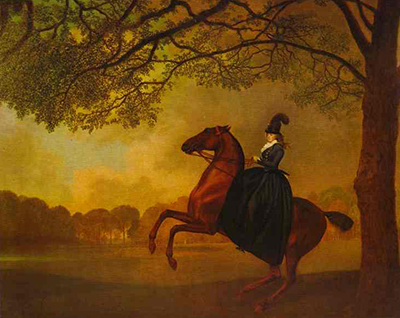
George Stubbs's Laetitia, Lady Lade is signed and dated 1793. Painted in oil on canvas, it measures 102.5 × 128.2 cm and belongs to the Royal Collection, RCIN 400997. [1]
A woman sits upright on a rearing horse, holding the reins before her. The animal faces left, its forelegs lifted and folded, its long neck rising in front of the rider. Her blue skirt falls over its side in a broad sweep. Above them, a great tree sends branches across the sky. Horse and rider make a compact, animated group within a landscape that opens towards still water. [2]
The picture brings equestrian skill into the foreground of portraiture. Lady Lade is represented through her relation to a moving animal: the position of her hands, the steadiness of her upper body and the enveloping shape of her riding dress. Her face occupies relatively little space. Recognition depends upon the complete mounted figure, whose appearance joins activity with a carefully composed public presence. [2]
At a Glance
This work across George Stubbs’s career
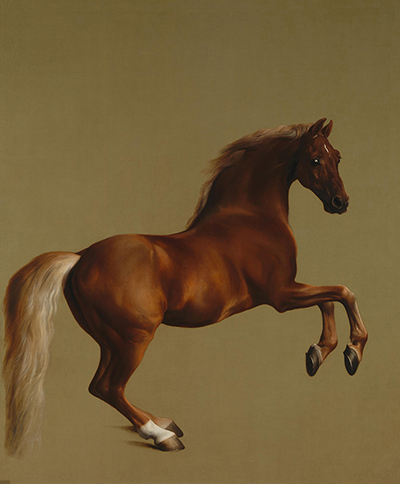
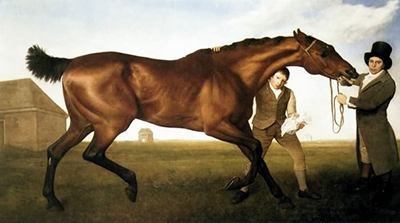
Whistlejacket
about 1762 [7]Contents
- Rider and horse in a suspended movement
- A parkland setting with room to breathe
- What the riding habit reveals
- Laetitia, her names and her reputation
- The Prince of Wales and the royal group
- An uncertain name and a long afterlife
- Videos on George Stubbs
Rider and horse in a suspended movement
The two front legs establish the most conspicuous interruption in the horse's forward movement. One hoof hangs higher than the other; the bent limbs turn back towards the chest. Below the hindquarters, the rear legs reach towards the ground at different angles. These changes of direction prevent the animal from becoming a simple diagonal. Stubbs builds its movement out of articulated parts, each contributing to a convincing sense of weight. [2]
The horse's head extends beyond the rising line of the neck. Its muzzle points left, while the reins draw a set of fine lines back towards Lady Lade's hands. The dark mane emphasises the curve along the upper neck; light catches the shoulder and chest below. Against the relatively pale sky, the animal's outline is exceptionally easy to follow. Its energy is concentrated without a crowd, a hunt or a visible obstacle to explain the action. [2]
Lady Lade's torso answers this movement with a much firmer vertical. Her tall hat and feather carry that line upwards, while her elbows remain close to her body. The hands are busy, but the figure does not lean far backwards or fling an arm outwards. Her seat appears composed within the lifted group. The difference between the animal's bent limbs and her contained posture makes competence visible as a relationship between bodies. [2]
The skirt changes the terms of that relationship. Its deep folds conceal much of the saddle and the rider's legs, creating a large blue shape between the horse's chest and hindquarters. It is an obstacle to reading the practical arrangement beneath, yet essential to the painting's design. A narrow waist opens into an ample descending curve, which answers the rounded body of the horse and brings the human figure into the same rhythmic structure. [2]
Small bright accents keep the upper body legible. White cloth at the throat separates the face from the dark jacket, and the rows of buttons punctuate the blue. The plume bends over the tall crown of the hat. These details vary the larger masses without dissolving them into ornament. The eye can move from the broad fall of the skirt to the concentrated area of face and hands, then back along the reins to the horse. [2]
A parkland setting with room to breathe
The tree trunk stands close to the right edge. From it, branches extend above the rider's space, framing a broad opening in the sky. Their irregular network provides a different kind of movement from the horse's tightly organised curves. Small leaves gather densely towards the left, then become more scattered around the open branches. The canopy gives the composition an upper boundary without turning the scene into an enclosed interior. [2]
The distant trees form a low, continuous belt, leaving the horse's head and Lady Lade's upper body against open sky. A strip of water stretches horizontally beyond the foreground. Its quiet line steadies the lifted bodies and establishes distance without requiring a sharply described building. The contrast is between the immediate event and a landscape that appears to continue undisturbed behind it. [2]
The colour also binds the pair to their setting. Brown in the horse's body returns in the tree trunk; blue in the riding habit finds a softer counterpart in the water and sky. Those correspondences make the figures belong outdoors, while their sharper edges and stronger contrasts keep them prominent. The landscape supports the portrait's distinction without needing to become an identifiable estate view. [2]
What the riding habit reveals
The riding habit was a practical form of dress with a distinctive relationship to masculine tailoring. The Victoria and Albert Museum explains, through a surviving British example of about 1770–75, how the jacket and waistcoat adapted men's clothing while the petticoat retained a separate, recognisably feminine form. Comparable buttons and trimming belonged to that adaptation. The ensemble could serve riding, travelling and walking, bringing outdoor usefulness into a fashionable wardrobe. [17]
That surviving garment offers a useful way of understanding the blue shape in Stubbs's picture. A riding habit combined pieces whose cuts performed different tasks: the close jacket defined the upper body, while the petticoat supplied the long expanse below. The contrast between fitted and flowing forms is therefore part of the clothing's construction as well as an opportunity for the painter. It helps explain why Lady Lade's jacket and skirt can look so different while remaining one coherent outfit. [17] [2]
The Royal Collection's dress research notes that male tailors usually made riding habits, whereas female mantua-makers made dresses. Lady Lade's particular tailor is unidentified. [1]
Such clothing could attract approval as well as criticism. The Metropolitan Museum of Art places its British riding coat of about 1775 within a debate over women adopting masculine attire. It quotes an anonymous contributor to the Weekly Register of 10 July 1731 who praised the elegance of a riding habit with a black velvet cap and white feather. This earlier response makes a useful counterweight to the assumption that all observers found women in riding dress improper. [18]
Ulrike Elisabeth Weiss's history of sidesaddle riding explains the changing equipment beneath such clothes. Eighteenth-century saddles could use two upper pommels to support the rider's position. The downward-pointing third pommel, or leaping horn, was introduced in the early 1830s, considerably later than this portrait. The long habit prevents us from determining the exact construction of Lady Lade's saddle. Her painted balance should not be explained by equipment that became available decades afterwards. [19]
Weiss also emphasises a tension in the reception of horsewomen: an accomplished rider could be admired for her appearance and spirit, yet criticised for seeming too commanding or insufficiently feminine. Riding habits themselves passed into fashionable daywear, even among women who did not ride. The costume alone therefore did not prove sporting achievement. Stubbs gives it a particular function by presenting its wearer actually engaged with the horse, her hands and posture forming the centre of the action. [19] [2]
Laetitia, her names and her reputation
The National Portrait Gallery identifies the sitter as Lady Laetitia Lade, née Smith, wife of Sir John Lade, and records her death in 1825. Its portrait is a mezzotint made by Frederick Bromley after an earlier image by Joshua Reynolds and published in 1861. That print belongs to a separate history of her likeness. It is neither an original Reynolds painting nor a reproduction of Stubbs's equestrian portrait. [20]
Sophie Coulombeau's research into naming and reputation follows the woman known as Letitia Darby, Mrs Smith and later Lady Lade. Her study examines an episode recorded in the correspondence of Frances Burney and Hester Thrale Piozzi in 1782, when an invitation and a visit exposed the limits of polite acceptance. The nickname Mrs Nominative made uncertainty about a woman's social and marital position into a grammatical joke. Naming became a means of granting recognition or withholding it. [21]
This context changes how the colourful stories attached to Lady Lade should be read. They circulated through texts with purposes of their own. Charles Pigott's The Female Jockey Club, published in 1794, offers a particularly sharp contemporary example. Its entry presents her rise from an obscure background through a sequence of sarcastic compliments about refinement, chastity and aristocratic virtue. The mock praise makes class prejudice and sexual insinuation inseparable. It records an attack on her reputation, rather than supplying an unfiltered account of her private life. [22]
Within that hostile portrait, Pigott nevertheless makes riding and driving central to her public identity. He describes her hunting with the Windsor hounds and praises her command of a four-in-hand, placing her skill beside Sir John's. His insinuations extend into the language of mastery and the whip. The passage is revealing because accomplishment itself becomes material for satire: a woman capable of managing horses could also be represented as excessively forceful in social or sexual life. [22]
Coulombeau follows the same pressures into later caricature, including Isaac Cruikshank's Hints towards a Change of Ministry of 1797 and A Brighton Breakfast, or Morning Comforts of 1802. These images turn Lady Lade into a figure of unsettled gender roles. Read beside that hostile tradition, Stubbs's picture offers another public representation: the mounted body receives ample space and sustained attention. Its visual composure can be recognised without treating the portrait as a documented declaration of political or social principles. [21] [2]
The Prince of Wales and the royal group
The Royal Collection considers the portrait presumably painted for George IV when Prince of Wales. Lady Lade and Sir John were his friends; the collection record supplies no individual payment for this canvas. [1]
The canvas is one of thirteen similarly sized Stubbs paintings dated 1790–93 in matching frames. In 1793 the carver and gilder Thomas Allwood billed the Prince £110 16s for eight Stubbs picture frames. The Royal Collection cannot identify those eight paintings or their pairings. Its interpretation proposes a loosely conceived set. [1]
The portrait remained in store at Carlton House when recorded in 1816 and 1819. Its transfer in 1822 took it to Windsor Great Park's King's Lodge, subsequently Royal Lodge; by 1844 it was at Cumberland Lodge. Another royal sporting picture from this circle is The Prince of Wales's Phaeton. [1]
An uncertain name and a long afterlife
The sitter's identification was less settled at the end of the nineteenth century. Sir Walter Gilbey's Life of George Stubbs of 1898 lists the canvas as a portrait of Mrs Hills or Lady Ladd. He describes the blue riding habit and records the 1793 signature, but explicitly leaves the choice between the two names undecided. The historical uncertainty concerns the sitter, rather than evidence for a second, interchangeable Stubbs painting. [23]
Gilbey places the portrait within the collection at Prince Christian's residence, Cumberland Lodge. He describes the pictures hanging around its dining room, where a large window overlooking the park gave good light for examining them. The portrait belonged to a lived domestic display as well as a royal collection. [23]
Gilbey also records a small coloured print owned by Prince Christian in which the same lady rides the horse. He does not supply enough information to establish its maker, date or present whereabouts. That notice is still useful when considering Stubbs's paintings and prints: the portrait's image circulated beyond the canvas, although the surviving reference does not allow its reproductive history to be reconstructed in full. [23]
Modern exhibition responses have repeatedly returned to the riding habit's pictorial effect. Reviewing Stubbs and the Horse in 2005, Waldemar Januszczak singled out the poetic quality of Lady Lade's blue dress, describing its apparent capacity to lift rider and mount. When the work appeared in the British Museum's horse exhibition in 2012, he again chose it as a favourite. These are responses to the painting's combination of figures, colour and landscape, rather than fresh documentation of the sitter's life. [24]
The picture continues to hold those elements together with unusual economy. The horse's rising neck and folded forelegs announce activity; the blue dress gives that activity a broad, memorable shape; the upright rider supplies a contained centre. Around them, the horizontal water and open park create a slower rhythm. Among Stubbs's paintings, the portrait rewards attention to the way human presence and animal movement become a single organised event. [2]
Videos on George Stubbs
Explore Stubbs’s equestrian painting in its wider context, including two readings of Whistlejacket.
A Horse Lover’s Guide to the YCBA
A museum tour that places Stubbs alongside other artists who painted horses. It includes a look at Pumpkin with a Stable-lad.
Watch on YouTubeGeorge Stubbs artworks directory
Search works and related prints documented in this guide. Separate versions and printing matrices have separate entries; printmakers are named where known. Unidentified historical titles and untraced studio-sale material are discussed in the essays. A dash means that a date is not established here.
| Name | Date | Medium |
|---|---|---|
| A Bay Horse with a Groom | 1791 | Painting |
| A Bay Hunter with Two Playful Spaniels | 1777 | Painting |
| A Bay Hunter, a Springer Spaniel and a Sussex Spaniel in a wooded river Landscape | 1782 | Painting |
| A Cheetah and a Stag with Two Indian Attendants | about 1764 | Painting |
| A Couple of Fox Hounds (coloured print after Stubbs) | — | Print after Stubbs |
| A Couple of Foxhounds | 1792 | Painting |
| A Foxhound on the Scent | 1788 | Drawing |
| A Gentleman driving a Lady in a Phaeton | 1787 | Painting |
| A Grey Horse | 1793 | Painting |
| A Grey Horse (cantering companion) | 1793 | Painting |
| A Grey Stallion in a Landscape | — | Painting |
| A Horse Affrighted at a Lion | 1 May 1788 | |
| A Horse Belonging to the Rt. Honourable Lord Grosvenor called Bandy from his Crooked Leg | about 1763 | Painting |
| A Horse Frightened by a Lion | 1777 | |
| A Lion (A Lion Resting on a Rock) | 1 May 1788 | |
| A Lion Attacking a Horse | 1770 | Painting |
| A Lion Attacking a Horse (monumental Yale canvas) | 1762 | Painting |
| A lion attacking a horse (NGV) | about 1765 | Painting |
| A Lion Devouring a Horse (1788 print) | 1788 | |
| A lion devouring a horse (attribution disputed) | Proposed mid-1770s | Painting |
| A mare and foal with a bay horse | 1771 | Painting |
| A Monkey | 1799 | Painting |
| A Prancing Horse, Facing Right | c. 1790 | Drawing |
| A Rough Dog | 1790 | Painting |
| A Saddled Bay Hunter | 1786 | Painting |
| A Sleeping Leopard | 1 January 1791 | |
| A Tiger and a Sleeping Leopard | 1 May 1788 | |
| A Tigress (John Dixon after Stubbs) | 1772 | Print after Stubbs |
| A Tyger (A Recumbent Leopard by a Tree) | 1 May 1788 | |
| A Tyger (Sleeping Leopard) | 1 May 1788 | |
| An animal found on the coast of New Holland called kanguroo (after Stubbs) | 1773 | Print after Stubbs |
| An animal of a new species found on the coast of New South Wales (after Stubbs) | July 1773 | Print after Stubbs |
| Antinous and Jockey | — | Painting |
| Antinoüs, a chestnut racehorse, in a landscape | Undated | Painting |
| Bandy belonging to Lord Grosvenor (print after Stubbs) | — | Print after Stubbs |
| Baronet (George Townley Stubbs after Stubbs) | 20 February 1794 | Print after Stubbs |
| Baronet with Sam Chifney Up | 1791 | Painting |
| Baronet with Samuel Chifney up (Royal Collection) | 1791 | Painting |
| Bay Hunter by a Lake | 1787 | Painting |
| Brood Mares (Benjamin Green after Stubbs) | Issue 14 November 1776 | Print after Stubbs |
| Brood Mares and Foals | usually dated 1767 | Painting |
| Brown and White Norfolk or Water Spaniel | 1778 | Painting |
| Bulls Fighting | 1786 | Painting |
| Captain Samuel Sharpe Pocklington with His Wife, Pleasance, and possibly His Sister, Frances | 1769 | Painting |
| Death of the Doe (attribution disputed) | 1804 | |
| Der Englische Hühnerhund (Johann Wölfle after Stubbs) | about 1860 | Print after Stubbs |
| Dog (A Foxhound Viewed from Behind) | 1 May 1788 | |
| Dog [A Foxhound on the Scent] | 1788 | |
| Drill and albino baboon | before 1789 | Painting |
| Eclipse (Charles Hunt after Stubbs) | 12 November 1839 | Print after Stubbs |
| Eclipse (George Townley Stubbs after Stubbs) | 1796 | Print after Stubbs |
| Eclipse (oil study) | — | Painting |
| Eclipse (Thomas Burke after Stubbs) | First published 1772 | Print after Stubbs |
| Eclipse and John Wildman (Benjamin Green after Stubbs) | 1772 | Print after Stubbs |
| Eclipse at Newmarket (Jockey Club version) | Proposed early 1790s; often dated 1770 | Painting |
| Eclipse at Newmarket with a groom and jockey | 1770 | Painting |
| Eclipse with Mr Wildman and His Sons | 1769–71 | Painting |
| Eclipse, the Property of Capt.n O Kelly (anonymous print after Stubbs) | Imprint 4 June 1804; impression undated | Print after Stubbs |
| Euston | 1774 | Painting |
| Finished Study for the Seventh Anatomical Table of the Muscles of the Horse | 1756–58 | Drawing |
| Five Brood Mares at the Duke of Cumberland's Stud Farm in Windsor Great Park | 1765 | Painting |
| Fowl Body, Lateral View (Highly Finished Study for an Unpublished Table; Shows the Last Stage in Dissection) | — | Drawing |
| Fowl Body, Lateral View (Probably Prepared for Transfer to the Plate for Engraving of Table XV) | — | Drawing |
| Fowl Skeleton, Lateral View (Finished Study for Table V) | — | Drawing |
| Freeman, the Earl of Clarendon's Gamekeeper, with a Dying Doe and Hound (Yale) | 1800 | Painting |
| George Stubbs (enamel self-portrait) | 1781 | Enamel |
| Gimcrack (George Townley Stubbs after Stubbs) | 1775 | Print after Stubbs |
| Gimcrack on Newmarket Heath, with a trainer, a jockey and a stable lad | about 1765 | Painting |
| Gimcrack, with John Pratt up, on Newmarket Heath | about 1765 | Painting |
| Hambletonian, Rubbing Down | 1800 | Painting |
| Hay-Makers | 1791 | |
| Haycarting | 1795 | Enamel |
| Haymakers | 1785 | Painting |
| Haymakers (Lady Lever Art Gallery) | 1794 | Enamel |
| Hollyhock (with later additions by Vernet and Boucher) | about 1765–70 | Painting |
| Horse Attacked by a Lion (Episode C) | 1768–69 | Painting |
| Horse Attacked by a Lion (Tate enamel) | 1769 | Enamel |
| Horse Devoured by a Lion | Possibly exhibited 1763 | Painting |
| Horse Frightened by a Lion | 1770 | Painting |
| Horse Frightened by a Lion (Episode A; Wedgwood and Bentley after Stubbs) | — | Sculpture |
| Horse Frightened by a Lion (Tate) | Possibly exhibited 1763 | Painting |
| Horse Frightened by a Lion (Yale) | 1762–68 | Painting |
| Horse in the Shade of a Wood | 1780 | Painting |
| Hound Coursing a Stag | about 1762 | Painting |
| Human Figure, Anterior View (Intended for a Plate That was Never Published) | — | Drawing |
| Human Skeleton, Lateral View | 1795–1806 | Drawing |
| Hunt servants setting out (Southill commission) | 1767 | Painting |
| Hühnerhund (The Spanish Pointer) | about 1766 | Painting |
| John and Sophia Musters Riding at Colwick Hall | 1777 | Painting |
| John Musters on his hunter Pilgrim | 1777–78 | Painting |
| Labourers | 1789 | |
| Labourers (Richard Earlom after Stubbs and Amos Greene) | 25 March 1790 | Print after Stubbs |
| Laetitia, Lady Lade (d.1825) | 1793 | Painting |
| Lemon and White Water Spaniel | — | Painting |
| Lion Attacking a Stag | — | Painting |
| Lord Grosvenor's Arabian Stallion with a Groom | about 1765 | Painting |
| Lord Grosvenor's Arabian Stallion with a Groom (Peter Mazell after Stubbs) | 1771 | Print after Stubbs |
| Mambrino (Eaton Hall painting) | — | Painting |
| Mambrino (George Townley Stubbs after Stubbs) | 1794 | Print after Stubbs |
| Mares and Foals belonging to the 2nd Viscount Bolingbroke | about 1761–62 | Painting |
| Mares and foals beneath large oak trees | — | Painting |
| Mares and Foals by a stream | Exhibited 1764 | Painting |
| Mares and Foals in a River Landscape | about 1763–68 | Painting |
| Mares and Foals in an Extensive Landscape | about 1769 | Painting |
| Mares and Foals without a Background | 1762 | Painting |
| Moose Deer (after Stubbs) (Arctic Zoology plate VIII) | 1784–85 publication | Print after Stubbs |
| Newmarket Heath with a Rubbing-Down House | — | Painting |
| Otho (1796 print after Stubbs) | 1 December 1796 | Print after Stubbs |
| Otho, with John Larkin up | 1768 | Painting |
| Pangloss | about 1762 | Painting |
| Patch (Grafton commission) | 1759 | Painting |
| Phaeton and the Chariot of the Sun (enamel) | 1775 | Enamel |
| Phaeton with a Pair of Cream Ponies and a Stable-Lad | 1780–84 | Painting |
| Phillis | 1772 | Painting |
| Portrait of a Large Dog (Dingo) | 1772 | Painting |
| Pumpkin with a Stable-lad | 1774 | Painting |
| Racehorses Exercising at Goodwood | 1759–60 | Painting |
| Reapers (1791 print) | 1791 | |
| Reapers (Tate) | 1785 | Painting |
| Reapers (Yale) | 1795 | Enamel |
| Red Deer: A Stag and a Hind | 1792 | Painting |
| Richard Wedgwood | — | Enamel |
| Ringwood, a Brocklesby Foxhound | 1792 | Painting |
| Scrub, a bay horse belonging to the Marquess of Rockingham | about 1762 | Painting |
| Self Portrait on a White Hunter | 1782 | Enamel |
| Self-Portrait | about 1759 | Painting |
| Shooting (1770 Woollett plate after Stubbs) | 1770 | Print after Stubbs |
| Shooting (1771 Woollett plate after Stubbs) | 1771 | Print after Stubbs |
| Shooting at Goodwood | 1759–60 | Painting |
| Sir John Nelthorpe as a boy | 1756 | Painting |
| Sir John Nelthorpe partridge shooting with one pointer | — | Painting |
| Sir John Nelthorpe, 6th Baronet, out Shooting with His Dogs in Barton Field, Lincolnshire | 1776 | Painting |
| Sleeping Leopard | 1777 | Enamel |
| Soldiers of the 10th Light Dragoons | 1793 | Painting |
| Stallion and Mare (George Townley Stubbs after Stubbs) | 1776; reissued 1789 | Print after Stubbs |
| Steward and gamekeeper with dogs (Southill commission) | 1767 | Painting |
| Studies of a Lemur (Lemur murinus) in six different attitudes | 1773 | Drawing |
| Study for the Self-portrait in Enamel | c. 1781 | Drawing |
| Study of a Lemur | 1773 | Drawing |
| Study of a Racehorse in Action: Galloping to Left, a Semi-Anatomical Study, with Skin Flayed to Show Action of Muscles | — | Drawing |
| Study of the Legs of a Draught-Horse Pulling a Harrow (attributed to Stubbs) | Proposed about 1786 | Drawing |
| Sweet William (Grosvenor panel) | — | Painting |
| Sweet William (Turf Gallery canvas) | — | Painting |
| The Black Stallion Sampson, Portrayed from Three Angles (with landscape additions) | about 1764 | Painting |
| The Charlton Hunt | 1759–60 | Painting |
| The Fall of Phaeton | — | Sculpture |
| The Frightened Horse | 1780 | Sculpture |
| The Grosvenor Hunt | — | Painting |
| The Haymakers (Upton House) | 1783 | Painting |
| The Horse and Lion (George Townley Stubbs after George Stubbs) | 1770 | Print after Stubbs |
| The Kongouro from New Holland | 1772 | Painting |
| The Labourers | 1779 | Painting |
| The Labourers (Southill original) | 1767 | Painting |
| The lion and horse (Benjamin Green after Stubbs) | 1769; reissued 1777 | Print after Stubbs |
| The Milbanke and Melbourne Families | about 1769 | Painting |
| The Moose | 1770 | Painting |
| The Prince of Wales's Phaeton | 1793 | Painting |
| The Reapers (Upton House) | 1783 | Painting |
| The Sebra, or Wild Ass (George Townley Stubbs after Stubbs) | 1771 | Print after Stubbs |
| The Spanish Pointer (Bradford version) | about 1766–68 | Painting |
| The Spanish Pointer (William Woollett after Stubbs) | January 1768 | Print after Stubbs |
| The Third Duke of Dorset's Hunter with a Groom and a Dog | 1768 | Painting |
| Thomas Freeman, Lord Clarendon's gamekeeper, with a dog and a shot doe (with George Townly Stubbs) | 1803 | Painting |
| Turf, with Jockey up, at Newmarket | — | Painting |
| Turk and Crab | — | Painting |
| Two Bay Hunters Communing On The Bank Of A Lake | — | Painting |
| Tygers at Play | 1780 | |
| Viscount Gormanston's White Dog | 1781 | Painting |
| Viscount Gormanston's White Dog (canvas version) | — | Painting |
| Water Spaniel | 1769 | Painting |
| Wedgwood Family Portrait | 1780 | Painting |
| Whistlejacket | about 1762 | Painting |
| Whistlejacket with two other stallions and a groom | Recorded 1762 | Painting |
| White Poodle in a Punt | about 1780 | Painting |
| William Anderson with two Saddle-Horses | 1793 | Painting |
| Working Drawing for the Seventh Anatomical Table of the Muscles of the Horse | 1756–58 | Drawing |
| Zebra | 1763 | Painting |
Discussion
Look again at the images and ideas explored in Laetitia, Lady Lade. These editorial prompts invite your observations.
Reader Insights
Follow the line from Lady Lade's hands along the reins to the horse's head.
Then compare her upright body with the animal's raised forelegs.
Which relationship most strongly conveys her command of the situation? Does the broad blue skirt strengthen that impression, or make the practical act of riding harder to understand?
Join the Conversation
Share a detail, comparison or question about Laetitia, Lady Lade below.
References
- Royal Collection Trust, George Stubbs, Laetitia, Lady Lade (d. 1825), signed and dated 1793, RCIN 400997, including current description, provenance and physical properties; and Style & Society: Dressing the Georgians, Plain English transcript, 2023, p. 21. Collection record; Exhibition transcript. Accessed 4 November 2026. View source 1. View source 2.
- Royal Collection Trust, whole-image reproduction of Laetitia, Lady Lade, 2,000 × 1,619 pixels, preserved on Wikimedia Commons. View image. Accessed 4 November 2026. View source.
- Goodwood, The Collection, Painting Collection modal, Racehorses Exercising at Goodwood; An exciting acquisition: a study by George Stubbs, 30 June 2023; History of the Estate Hounds, 4 October 2023; About Goodwood Racecourse. Accessed 4 November 2026. View source.
- Goodwood, The Collection, Painting Collection modal, Racehorses Exercising at Goodwood; An exciting acquisition: a study by George Stubbs, 30 June 2023; History of the Estate Hounds, 4 October 2023; About Goodwood Racecourse. Accessed 4 November 2026. View source.
- Goodwood, The Collection, Painting Collection modal, Racehorses Exercising at Goodwood; An exciting acquisition: a study by George Stubbs, 30 June 2023; History of the Estate Hounds, 4 October 2023; About Goodwood Racecourse. Accessed 4 November 2026. View source.
- Goodwood, The Collection, Painting Collection modal, Racehorses Exercising at Goodwood; An exciting acquisition: a study by George Stubbs, 30 June 2023; History of the Estate Hounds, 4 October 2023; About Goodwood Racecourse. Accessed 4 November 2026. View source.
- National Gallery, Whistlejacket, NG6569, current collection record, provenance, in-depth discussion and frame entry. View source.
- Yale Center for British Art, Zebra, B1981.25.617, current object metadata, gallery labels, Malcolm Warner’s 1998 catalogue entry and provenance supplied through the museum’s public collection record. View source.
- Christie’s, Gimcrack on Newmarket Heath, with a trainer, a jockey and a stable lad, London, 5 July 2011, lot 12; object details, essay, provenance, exhibitions and whole image. View source.
- Christie’s, Gimcrack on Newmarket Heath, with a trainer, a jockey and a stable lad, London, 5 July 2011, lot 12; object details, essay, provenance, exhibitions and whole image. View source.
- Yale University Art Gallery, A Lion Attacking a Horse, 1770, 1955.27.1, collection record. Accessed 4 November 2026. View source.
- Royal Museums Greenwich, ‘The Kongouro from New Holland’ (Kangaroo), ZBA5754. Accessed 4 November 2026. View source.
- Tate, George Stubbs, Haymakers, 1785, T02256; details, Terry Riggs’s collection text (January 1998), and online caption. Collection record. View source.
- Royal Collection Trust, George Stubbs, Laetitia, Lady Lade (d. 1825), signed and dated 1793, RCIN 400997, including current description, provenance and physical properties; and Style & Society: Dressing the Georgians, Plain English transcript, 2023, p. 21. Collection record; Exhibition transcript. Accessed 4 November 2026. View source.
- Royal Collection Trust, George Stubbs, Laetitia, Lady Lade (d. 1825), signed and dated 1793, RCIN 400997, including current description, provenance and physical properties; and Style & Society: Dressing the Georgians, Plain English transcript, 2023, p. 21. Collection record; Exhibition transcript. Accessed 4 November 2026. View source.
- Frances Bailey, ‘Hambletonian, Rubbing Down: A masterpiece by George Stubbs’, National Trust Cultural Heritage Magazine, Autumn/Winter 2024, pp. 22–33. Article. View source.
- Victoria and Albert Museum, Riding habit, about 1770–75, collection interpretation supplied to Google Arts & Culture. Accessed 4 November 2026. View source.
- The Metropolitan Museum of Art, Riding coat, British, about 1775, 1976.147.2, including a passage from the Weekly Register, 10 July 1731. Accessed 4 November 2026. View source.
- Ulrike Elisabeth Weiss, “Backwards in High Heels”, in Sidesaddle 1690–1935 (National Sporting Library & Museum, 2018), pp. 10–17; and “Die Königin hat (die) Hosen an: Caroline Mathilde von Dänemark zu Pferd”, Niedersächsisches Jahrbuch für Landesgeschichte, 85 (2013), pp. 59–112, especially pp. 79–87. 2018 essay; 2013 article. Accessed 4 November 2026. View source 1. View source 2.
- National Portrait Gallery, Lady Laetitia Lade (née Smith), Frederick Bromley after Sir Joshua Reynolds, mezzotint published 1861, NPG D14548. Accessed 4 November 2026. View source.
- Sophie Coulombeau, “The Knot, that ties them fast together”: Personal Proper Name Change and Identity Formation in English Literature, 1779–1800, PhD thesis, University of York, 2014, pp. 138–143, including quoted correspondence by Frances Burney and Hester Thrale Piozzi. Accessed 4 November 2026. View source.
- Charles Pigott, The Female Jockey Club, or a Sketch of the Manners of the Age, third edition (London: D. I. Eaton, 1794), “L—dy L—de”, pp. 43–49. Accessed 4 November 2026. View source.
- Sir Walter Gilbey, Life of George Stubbs, R.A. (London, 1898), Appendix B, pp. 117–118 and p. 125, no. 10. Accessed 4 November 2026. View source.
- Waldemar Januszczak, “Art: Stubbs”, 3 July 2005; and “The Triumph of Horse Power”, 2012. 2005 review; 2012 review. Accessed 4 November 2026. View source 1. View source 2.
- Basic title, date and material metadata for Tate’s Reapers (T02257) and Otho (T02375) is adapted from the Tate collection dataset, October 2014, released under CC0. TheHistoryOfArt.org has reconciled labels and versions. This credit does not apply to Tate’s authored catalogue commentary or images.
- Data Source: Yale Center for British Art. Basic object fields are adapted and reconciled for this directory. Reuse is subject to the Center’s Open Data and Data Services Terms of Use. No museum endorsement is implied. This metadata credit does not relabel scholarly essays or images as open data.
- Basic object metadata for A Horse Frightened by a Lion, 1985.38, The Cleveland Museum of Art, John L. Severance Fund, is available under CC0. Titles and design-level grouping have been reconciled for this directory.