 by Tom Gurney
Tom Gurney BSc (Hons) is an art history expert with over 20 years experience
Email: tomgurney1@gmail.com / Phone: +44 7429 011000
A small panel with three distinct presences
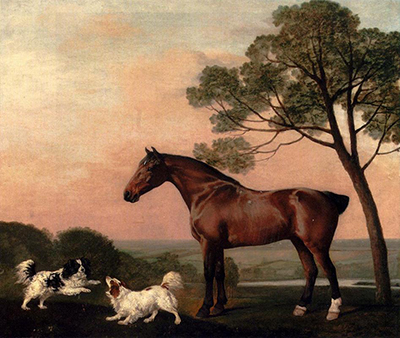
A bay horse stands beneath a tree while two spaniels spring and crouch in front of it. George Stubbs makes the difference between their actions the centre of this painting: the horse holds a broad, steady profile, while the dogs turn a small patch of ground into a meeting place. Their activity occupies relatively little of the picture, yet changes how we see the larger animal above them.
A Bay Hunter with Two Playful Spaniels (1777) is an oil painting on mahogany panel, 59.7 × 71.1 centimetres, signed near the lower centre “Geo: Stubbs pinxit / 1777”. Its commissioner was Charles Vere Dashwood of Stanford Hall, Nottinghamshire. [1] The latest verified public sale ended with an anonymous buyer in 2018; a present owner and location are not disclosed. [2]
The group has the visual clarity of a portrait without supplying the animals' names. The hunter has no rider or attendant; the spaniels have no human partner in their exchange. Looking at the panel involves moving between the horse's much larger body and the dogs' smaller, more rapidly changing shapes. Within Stubbs's paintings, this is a particularly compact demonstration of how unequal scales can produce a coherent animal group.
At a Glance
This work across George Stubbs’s career
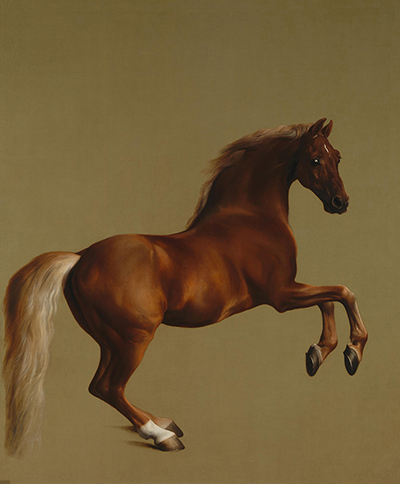
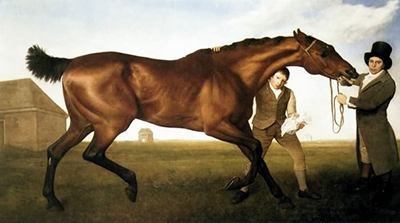
Whistlejacket
about 1762 [7]Contents
- A small panel with three distinct presences
- The standing horse and the dogs in motion
- Tree, sky and the space around the group
- Dashwood's country house
- A horse and dogs in the library
- Descent, sale and anonymity
- What the mahogany support establishes
- Exhibition titles and other hunters
- Videos on George Stubbs
The standing horse and the dogs in motion
The horse faces left, its body filling the lower middle and right of the panel. Its head projects beyond the breast into an almost uninterrupted area of pale sky. The neck descends towards the muzzle, while the upper line runs back through the withers to the rounded hindquarter. That long contour is immediately legible. The eye can follow it without being caught in harness, a rider's clothing or the paraphernalia of a stable.
The title calls the horse a hunter, a working category rather than an individual name. Bay identifies its coat, not a separate breed. Neither term identifies its sex or ancestry. That distinction keeps attention on the particular animal Stubbs presents: its proportions, markings and stance can be closely observed even where its life history cannot be reconstructed. [1]
Light defines the body through broad changes in the brown coat. A brighter line along the shoulder separates it from the deeper tone of the chest; a rounded highlight follows the upper hindquarter. Across the barrel, light spreads more softly, producing a continuous volume between those stronger accents. The modelling makes the trunk seem substantial while leaving the legs comparatively narrow. This contrast of mass and slender support is central to the animal's standing presence.
The short, dark mane belongs closely to the neck's upper edge. At the opposite end, the dark tail forms a compact shape against the tree and sky. Two pale markings above the hind hooves interrupt the darker legs. These small light areas help keep the feet distinct from the surrounding earth. They matter pictorially even though they cannot supply the horse with a pedigree or proper name.
Both forelegs descend beneath the chest, close together but separately visible. The hind legs open out more clearly, carrying the rounded body above them. The stance gives Stubbs a sequence of narrow gaps through which the landscape continues. The horse does not simply cover the view: its legs divide it into smaller passages. The eye can travel down the body to the ground and then through those intervals towards the distance.
At the left, the black-and-white spaniel rises towards its companion. Its hind feet touch the ground, while its forelegs extend in the air. The white chest and outstretched limbs form a bright, broken horizontal shape below the horse's head. Dark ears and patches interrupt the fur. Behind, the lifted tail turns upwards, making the body's movement readable even before the viewer notices the feet.
The brown-and-white dog answers from a lower position. Its front legs reach forwards and its chest approaches the earth, while its hindquarters and tail remain higher. Its head turns towards the springing dog. This difference is essential: the pair does not repeat one gesture twice. One dog rises into the interval between them; the other spreads towards it along the ground. Their lifted tails provide a loose correspondence above those different bodies.
Fur gives the dogs an additional contrast with the hunter. Along their chests and tails, small pale strands and uneven edges break up the outline. The horse's flank instead reads as a larger, relatively continuous surface. Stubbs can therefore distinguish the animals through the kinds of edges they present, as well as their size and position. The spaniels remain visibly shaggy even at a scale where their limbs occupy only a narrow part of the panel.
The patch of open space between the two heads holds the action together. Stubbs leaves enough separation for each outline to remain clear, yet brings the dogs close enough for the gestures to read as reciprocal. Their white coats carry the strongest small accents in the foreground. Those accents draw attention away from the horse temporarily, then return it through the dogs' proximity to its forelegs.
“Playful” belongs to the painting's catalogue title. [1] The springing and crouching shapes make that description intelligible without assigning the dogs spoken thoughts or specific emotions. Nor does the horse visibly direct their encounter. Its head remains above them, facing into the open left side. The three animals share a setting while retaining separate directions of attention. That independence gives the scene more variety than a group in which every figure answered the same signal.
Tree, sky and the space around the group
The large tree at the right is almost another figure. Its trunk rises beside the horse's hindquarters, bends slightly, then branches across the upper half of the panel. Some limbs stretch left over the back and neck. Others support the heavier crown near the right edge. The tree's branching structure supplies an irregular counterpart to the horse's long, continuous upper contour.
This relationship also prevents the horse from appearing detached from its setting. The dark trunk lies close to the rump, but the branches extend far beyond that point of contact. They reach over the animal and occupy space that its low head leaves empty. The horse and tree consequently hold the right side together at different heights. Below, the legs anchor the animal; above, the leaves gather the sky into a series of openings.
The left half is much less enclosed. Pale blue and pinkish cloud colour spread above the dogs and in front of the hunter. The horse faces towards this spacious area, while the tree stands behind it. Direction therefore becomes a compositional fact: the animal's profile opens towards the lighter side rather than pressing into the largest dark mass. Its muzzle is particularly clear because there is so little competing detail around it.
A dark, rounded bank of vegetation rises behind the spaniels. Against it, their white fur can remain sharply visible even where the small bodies overlap the ground. Farther back, the land drops towards a broad valley, divided into patches of muted green and brown. A pale blue strip winds through the lower distance. It resembles water, but neither that resemblance nor the documented commission establishes a particular river or lake.
The low horizon leaves a substantial area of sky above the hunter. This means the picture is not filled simply by enlarging its animal subjects. Empty space becomes part of their presentation. The dogs' compressed action at the bottom is set against an unusually generous expanse overhead. The standing horse mediates between those extremes: taller than the dogs, lower than the tree, and large enough to interrupt the sky without exhausting it.
Close to the viewer, small plants and uneven touches of colour enliven the earth. They break the foreground into local incidents while leaving the dogs' gestures readable. Beneath the horse, the small written signature introduces another kind of mark. It belongs to the painted ground but asks to be read as writing. Moving from the animal's broad body to this fine inscription changes the scale of attention within a single small panel.
The pink sky need not be translated into a sunrise or sunset. Likewise, the absence of tack, people and quarry leaves the scene without a demonstrable stage in a hunt. The painting offers enough visible relationships to sustain looking without such a story. Space, colour and different bodily positions already account for its sense of simultaneous stillness and activity.
Dashwood's country house
Stanford Hall gives the commission a specific social and architectural setting. Historic England records Charles Vere Dashwood's rebuilding of the house between 1771 and 1774. Its landscape included pasture, trees and water. [16] By the date on Stubbs's panel, the new house had recently been completed. A commission for an animal painting thus belonged to a household actively reshaping its surroundings, although no surviving instruction establishes where Dashwood originally intended to hang it.
Describing his own view of Stanford in 1790, John Throsby admitted replacing cultivated ground and fencing with more pleasing vegetation. That statement concerns Throsby's illustration, not Stubbs's working practice. [17] It nevertheless cautions against expecting a country-house landscape image to function as a map. The presence of real trees and water at Stanford cannot, by itself, identify the tree and distant blue strip in this panel.
Christie's suggests a likely Nottinghamshire visit linking the Dashwood commission with Stubbs's work for the neighbouring Musters family. [1] The separate John and Sophia Musters Riding at Colwick Hall presents estate life through named human sitters. Here the patron's name survives outside the scene. Commissioning alone does not establish ownership of the animals.
A horse and dogs in the library
Early descriptions give this painting a richer domestic context than the label “sporting picture” alone suggests. In his 1790 additions to Thoroton's History of Nottinghamshire, Throsby describes Stanford's library as a room containing several kinds of art. Alongside a Stubbs horse he records a landscape with two horses by Boultbee, a Romney portrait of Mrs Dashwood, a fox-dog picture and watercolours by the Reverend Mr Carr. [17]
Throsby admired Boultbee's work, yet thought proximity to Stubbs put it at a disadvantage. His preference concerns pictures viewed together within a domestic collection, rather than supplying a universal order of merit among the painters. [17]
His brief mention does not provide a date, support, dimensions or two spaniels. It cannot independently certify the exact 1777 panel. The same limitation applies to the 1813 Beauties of England and Wales, which records “a horse by Stubbs” at Stanford Hall. Christie's bibliography makes the connection. [18] [1] The location is valuable; the abbreviated wording requires care.
A later description is more explicit. In the inspected 1823 volume of J. P. Neale's Views of the Seats of Noblemen and Gentlemen, the library contains “a horse and dogs by the late G. Stubbs”. The notice distinguishes this room from the dining room, where family portraits, Morlands and a Vandervelde are recorded. It also describes the prospect from the drawing-room windows across the Soar towards Leicestershire. [19]
Neale's horse-and-dogs wording is a closer match to the present subject than the earlier horse notices. Even so, it supplies neither the signed date nor a complete object description. Read alongside the documented Dashwood provenance, these accounts support a qualified history of the panel's association with the library. They do not establish an exact wall position, frame, hanging height or uninterrupted arrangement of neighbouring pictures. [19]
That distinction changes how the outdoor group can be understood. The painted field entered an interior where viewers also encountered family likenesses and other artists' work. The small scale permits attention to a dog's feet, a horse's marking and an inscription, rather than requiring only a distant view of the whole. This remains a setting for looking, rather than proof of Dashwood's motives.
Descent, sale and anonymity
Dashwood-family descent led to General Dashwood; Bernard bought the panel at Christie's in 1949. A private collection followed in 1951, Drysdale in 1970, and private acquisition around 1995 before the 2018 consignment. [1]
The official December 2018 results identify lot 37A, an estimate of £500,000–£800,000, and a realised price of £608,750 including premium. The buyer is anonymous. [2] That result matters for more than its monetary figure. The pre-sale reference to a “current owner” belongs to the consignor's position in 2018; it cannot name the holder after the auction. Present ownership and location remain undisclosed.
These public appearances show changes in the painting's circulation, from family possession to private sales and auction catalogues. They provide a sequence of recorded transactions rather than a continuous account of how it was displayed or cared for. Neither an auction price nor an anonymous collection label supplies the missing domestic history between those appearances. The earlier library descriptions and the later sales answer different questions about the same surviving object.
What the mahogany support establishes
The wooden support also matters when discussing technique. Observations about one support or one tested picture cannot automatically describe another. The visible smoothness of an animal's coat is also different from evidence about the substance binding its paint.
John Mills and Raymond White's The Mediums used by George Stubbs: Some Further Studies reports analysis of ten paintings dated between 1772 and 1800. The table includes early panels dated 1772, 1775 and 1780, but not this 1777 horse-and-spaniels group. Their findings distinguish drying oils, non-drying oils or fats, beeswax and pine resin, with qualifications about identifying components and interpreting mixtures. [20]
This is valuable context for Stubbs's technique, enamel and printmaking, but it supplies no recipe for Dashwood's panel. Without an examination of this object, its ground, successive layers and precise binding medium remain unspecified. A reproduction likewise cannot establish a restoration history or diagnose its condition. The clear modelling discussed above can be described as a pictorial effect while its material construction remains less fully known.
Exhibition titles and other hunters
The proposed early exhibition history is less secure than the date on the painting. Christie's proposes Royal Academy 1778, number 300, under a horse-and-two-dogs title. [1] The printed catalogue instead gives number 300 as “Portrait of two dogs”. Nearby, number 298 is “Portrait of a horse”, followed by a dog portrait at 299. [21]
The discrepancy cannot responsibly be removed simply by choosing the horse entry. Its short title could apply to another equine portrait, and neither entry identifies Dashwood, the mahogany panel or a signed date. A 1778 appearance remains possible, but the proposed catalogue identification is unresolved. Exhibition lists often compress subjects; that brevity does not authorise reconstructing the missing match. [21]
Other titles create different risks. The separately signed 1782 A Bay Hunter, a Springer Spaniel and a Sussex Spaniel in a wooded river Landscape measures 57.8 × 73.7 centimetres and has a believed Lopes provenance. [22] Its specific dog labels belong to that object. They cannot identify the unnamed spaniels here. Christie's connects their poses to Turk and Crab, a separate dog portrait. [1]
The Denver Art Museum's 1786 A Saddled Bay Hunter is another distinct painting. [23] Such comparisons help show the variety within Stubbs's equine subjects without converting similarities into a series of versions. For the broader relationship between horse portraits and dogs, animal painting provides the wider context.
This panel's particular achievement remains the distribution of attention among three animals. The horse supplies scale and continuity, the spaniels introduce opposed movement, and the tree and sky give both room. The account of George Stubbs extends beyond this commission, but the small signed group rewards an unusually close return to the visible differences that hold it together.
Videos on George Stubbs
Explore Stubbs’s equestrian painting in its wider context, including two readings of Whistlejacket.
A Horse Lover’s Guide to the YCBA
A museum tour that places Stubbs alongside other artists who painted horses. It includes a look at Pumpkin with a Stable-lad.
Watch on YouTubeGeorge Stubbs artworks directory
Search works and related prints documented in this guide. Separate versions and printing matrices have separate entries; printmakers are named where known. Unidentified historical titles and untraced studio-sale material are discussed in the essays. A dash means that a date is not established here.
| Name | Date | Medium |
|---|---|---|
| A Bay Horse with a Groom | 1791 | Painting |
| A Bay Hunter with Two Playful Spaniels | 1777 | Painting |
| A Bay Hunter, a Springer Spaniel and a Sussex Spaniel in a wooded river Landscape | 1782 | Painting |
| A Cheetah and a Stag with Two Indian Attendants | about 1764 | Painting |
| A Couple of Fox Hounds (coloured print after Stubbs) | — | Print after Stubbs |
| A Couple of Foxhounds | 1792 | Painting |
| A Foxhound on the Scent | 1788 | Drawing |
| A Gentleman driving a Lady in a Phaeton | 1787 | Painting |
| A Grey Horse | 1793 | Painting |
| A Grey Horse (cantering companion) | 1793 | Painting |
| A Grey Stallion in a Landscape | — | Painting |
| A Horse Affrighted at a Lion | 1 May 1788 | |
| A Horse Belonging to the Rt. Honourable Lord Grosvenor called Bandy from his Crooked Leg | about 1763 | Painting |
| A Horse Frightened by a Lion | 1777 | |
| A Lion (A Lion Resting on a Rock) | 1 May 1788 | |
| A Lion Attacking a Horse | 1770 | Painting |
| A Lion Attacking a Horse (monumental Yale canvas) | 1762 | Painting |
| A lion attacking a horse (NGV) | about 1765 | Painting |
| A Lion Devouring a Horse (1788 print) | 1788 | |
| A lion devouring a horse (attribution disputed) | Proposed mid-1770s | Painting |
| A mare and foal with a bay horse | 1771 | Painting |
| A Monkey | 1799 | Painting |
| A Prancing Horse, Facing Right | c. 1790 | Drawing |
| A Rough Dog | 1790 | Painting |
| A Saddled Bay Hunter | 1786 | Painting |
| A Sleeping Leopard | 1 January 1791 | |
| A Tiger and a Sleeping Leopard | 1 May 1788 | |
| A Tigress (John Dixon after Stubbs) | 1772 | Print after Stubbs |
| A Tyger (A Recumbent Leopard by a Tree) | 1 May 1788 | |
| A Tyger (Sleeping Leopard) | 1 May 1788 | |
| An animal found on the coast of New Holland called kanguroo (after Stubbs) | 1773 | Print after Stubbs |
| An animal of a new species found on the coast of New South Wales (after Stubbs) | July 1773 | Print after Stubbs |
| Antinous and Jockey | — | Painting |
| Antinoüs, a chestnut racehorse, in a landscape | Undated | Painting |
| Bandy belonging to Lord Grosvenor (print after Stubbs) | — | Print after Stubbs |
| Baronet (George Townley Stubbs after Stubbs) | 20 February 1794 | Print after Stubbs |
| Baronet with Sam Chifney Up | 1791 | Painting |
| Baronet with Samuel Chifney up (Royal Collection) | 1791 | Painting |
| Bay Hunter by a Lake | 1787 | Painting |
| Brood Mares (Benjamin Green after Stubbs) | Issue 14 November 1776 | Print after Stubbs |
| Brood Mares and Foals | usually dated 1767 | Painting |
| Brown and White Norfolk or Water Spaniel | 1778 | Painting |
| Bulls Fighting | 1786 | Painting |
| Captain Samuel Sharpe Pocklington with His Wife, Pleasance, and possibly His Sister, Frances | 1769 | Painting |
| Death of the Doe (attribution disputed) | 1804 | |
| Der Englische Hühnerhund (Johann Wölfle after Stubbs) | about 1860 | Print after Stubbs |
| Dog (A Foxhound Viewed from Behind) | 1 May 1788 | |
| Dog [A Foxhound on the Scent] | 1788 | |
| Drill and albino baboon | before 1789 | Painting |
| Eclipse (Charles Hunt after Stubbs) | 12 November 1839 | Print after Stubbs |
| Eclipse (George Townley Stubbs after Stubbs) | 1796 | Print after Stubbs |
| Eclipse (oil study) | — | Painting |
| Eclipse (Thomas Burke after Stubbs) | First published 1772 | Print after Stubbs |
| Eclipse and John Wildman (Benjamin Green after Stubbs) | 1772 | Print after Stubbs |
| Eclipse at Newmarket (Jockey Club version) | Proposed early 1790s; often dated 1770 | Painting |
| Eclipse at Newmarket with a groom and jockey | 1770 | Painting |
| Eclipse with Mr Wildman and His Sons | 1769–71 | Painting |
| Eclipse, the Property of Capt.n O Kelly (anonymous print after Stubbs) | Imprint 4 June 1804; impression undated | Print after Stubbs |
| Euston | 1774 | Painting |
| Finished Study for the Seventh Anatomical Table of the Muscles of the Horse | 1756–58 | Drawing |
| Five Brood Mares at the Duke of Cumberland's Stud Farm in Windsor Great Park | 1765 | Painting |
| Fowl Body, Lateral View (Highly Finished Study for an Unpublished Table; Shows the Last Stage in Dissection) | — | Drawing |
| Fowl Body, Lateral View (Probably Prepared for Transfer to the Plate for Engraving of Table XV) | — | Drawing |
| Fowl Skeleton, Lateral View (Finished Study for Table V) | — | Drawing |
| Freeman, the Earl of Clarendon's Gamekeeper, with a Dying Doe and Hound (Yale) | 1800 | Painting |
| George Stubbs (enamel self-portrait) | 1781 | Enamel |
| Gimcrack (George Townley Stubbs after Stubbs) | 1775 | Print after Stubbs |
| Gimcrack on Newmarket Heath, with a trainer, a jockey and a stable lad | about 1765 | Painting |
| Gimcrack, with John Pratt up, on Newmarket Heath | about 1765 | Painting |
| Hambletonian, Rubbing Down | 1800 | Painting |
| Hay-Makers | 1791 | |
| Haycarting | 1795 | Enamel |
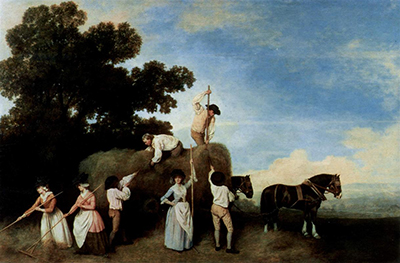
| Haymakers | 1785 | Painting |
| Haymakers (Lady Lever Art Gallery) | 1794 | Enamel |
| Hollyhock (with later additions by Vernet and Boucher) | about 1765–70 | Painting |
| Horse Attacked by a Lion (Episode C) | 1768–69 | Painting |
| Horse Attacked by a Lion (Tate enamel) | 1769 | Enamel |
| Horse Devoured by a Lion | Possibly exhibited 1763 | Painting |
| Horse Frightened by a Lion | 1770 | Painting |
| Horse Frightened by a Lion (Episode A; Wedgwood and Bentley after Stubbs) | — | Sculpture |
| Horse Frightened by a Lion (Tate) | Possibly exhibited 1763 | Painting |
| Horse Frightened by a Lion (Yale) | 1762–68 | Painting |
| Horse in the Shade of a Wood | 1780 | Painting |
| Hound Coursing a Stag | about 1762 | Painting |
| Human Figure, Anterior View (Intended for a Plate That was Never Published) | — | Drawing |
| Human Skeleton, Lateral View | 1795–1806 | Drawing |
| Hunt servants setting out (Southill commission) | 1767 | Painting |
| Hühnerhund (The Spanish Pointer) | about 1766 | Painting |
| John and Sophia Musters Riding at Colwick Hall | 1777 | Painting |
| John Musters on his hunter Pilgrim | 1777–78 | Painting |
| Labourers | 1789 | |
| Labourers (Richard Earlom after Stubbs and Amos Greene) | 25 March 1790 | Print after Stubbs |
| Laetitia, Lady Lade (d.1825) | 1793 | Painting |
| Lemon and White Water Spaniel | — | Painting |
| Lion Attacking a Stag | — | Painting |
| Lord Grosvenor's Arabian Stallion with a Groom | about 1765 | Painting |
| Lord Grosvenor's Arabian Stallion with a Groom (Peter Mazell after Stubbs) | 1771 | Print after Stubbs |
| Mambrino (Eaton Hall painting) | — | Painting |
| Mambrino (George Townley Stubbs after Stubbs) | 1794 | Print after Stubbs |
| Mares and Foals belonging to the 2nd Viscount Bolingbroke | about 1761–62 | Painting |
| Mares and foals beneath large oak trees | — | Painting |
| Mares and Foals by a stream | Exhibited 1764 | Painting |
| Mares and Foals in a River Landscape | about 1763–68 | Painting |
| Mares and Foals in an Extensive Landscape | about 1769 | Painting |
| Mares and Foals without a Background | 1762 | Painting |
| Moose Deer (after Stubbs) (Arctic Zoology plate VIII) | 1784–85 publication | Print after Stubbs |
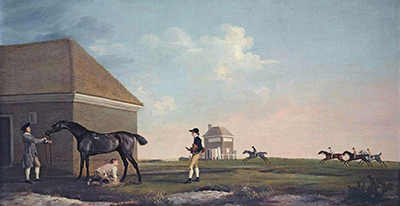
| Newmarket Heath with a Rubbing-Down House | — | Painting |
| Otho (1796 print after Stubbs) | 1 December 1796 | Print after Stubbs |
| Otho, with John Larkin up | 1768 | Painting |
| Pangloss | about 1762 | Painting |
| Patch (Grafton commission) | 1759 | Painting |
| Phaeton and the Chariot of the Sun (enamel) | 1775 | Enamel |
| Phaeton with a Pair of Cream Ponies and a Stable-Lad | 1780–84 | Painting |
| Phillis | 1772 | Painting |
| Portrait of a Large Dog (Dingo) | 1772 | Painting |
| Pumpkin with a Stable-lad | 1774 | Painting |
| Racehorses Exercising at Goodwood | 1759–60 | Painting |
| Reapers (1791 print) | 1791 | |
| Reapers (Tate) | 1785 | Painting |
| Reapers (Yale) | 1795 | Enamel |
| Red Deer: A Stag and a Hind | 1792 | Painting |
| Richard Wedgwood | — | Enamel |
| Ringwood, a Brocklesby Foxhound | 1792 | Painting |
| Scrub, a bay horse belonging to the Marquess of Rockingham | about 1762 | Painting |
| Self Portrait on a White Hunter | 1782 | Enamel |
| Self-Portrait | about 1759 | Painting |
| Shooting (1770 Woollett plate after Stubbs) | 1770 | Print after Stubbs |
| Shooting (1771 Woollett plate after Stubbs) | 1771 | Print after Stubbs |
| Shooting at Goodwood | 1759–60 | Painting |
| Sir John Nelthorpe as a boy | 1756 | Painting |
| Sir John Nelthorpe partridge shooting with one pointer | — | Painting |
| Sir John Nelthorpe, 6th Baronet, out Shooting with His Dogs in Barton Field, Lincolnshire | 1776 | Painting |
| Sleeping Leopard | 1777 | Enamel |
| Soldiers of the 10th Light Dragoons | 1793 | Painting |
| Stallion and Mare (George Townley Stubbs after Stubbs) | 1776; reissued 1789 | Print after Stubbs |
| Steward and gamekeeper with dogs (Southill commission) | 1767 | Painting |
| Studies of a Lemur (Lemur murinus) in six different attitudes | 1773 | Drawing |
| Study for the Self-portrait in Enamel | c. 1781 | Drawing |
| Study of a Lemur | 1773 | Drawing |
| Study of a Racehorse in Action: Galloping to Left, a Semi-Anatomical Study, with Skin Flayed to Show Action of Muscles | — | Drawing |
| Study of the Legs of a Draught-Horse Pulling a Harrow (attributed to Stubbs) | Proposed about 1786 | Drawing |
| Sweet William (Grosvenor panel) | — | Painting |
| Sweet William (Turf Gallery canvas) | — | Painting |
| The Black Stallion Sampson, Portrayed from Three Angles (with landscape additions) | about 1764 | Painting |
| The Charlton Hunt | 1759–60 | Painting |
| The Fall of Phaeton | — | Sculpture |
| The Frightened Horse | 1780 | Sculpture |
| The Grosvenor Hunt | — | Painting |
| The Haymakers (Upton House) | 1783 | Painting |
| The Horse and Lion (George Townley Stubbs after George Stubbs) | 1770 | Print after Stubbs |
| The Kongouro from New Holland | 1772 | Painting |
| The Labourers | 1779 | Painting |
| The Labourers (Southill original) | 1767 | Painting |
| The lion and horse (Benjamin Green after Stubbs) | 1769; reissued 1777 | Print after Stubbs |
| The Milbanke and Melbourne Families | about 1769 | Painting |
| The Moose | 1770 | Painting |
| The Prince of Wales's Phaeton | 1793 | Painting |
| The Reapers (Upton House) | 1783 | Painting |
| The Sebra, or Wild Ass (George Townley Stubbs after Stubbs) | 1771 | Print after Stubbs |
| The Spanish Pointer (Bradford version) | about 1766–68 | Painting |
| The Spanish Pointer (William Woollett after Stubbs) | January 1768 | Print after Stubbs |
| The Third Duke of Dorset's Hunter with a Groom and a Dog | 1768 | Painting |
| Thomas Freeman, Lord Clarendon's gamekeeper, with a dog and a shot doe (with George Townly Stubbs) | 1803 | Painting |
| Turf, with Jockey up, at Newmarket | — | Painting |
| Turk and Crab | — | Painting |
| Two Bay Hunters Communing On The Bank Of A Lake | — | Painting |
| Tygers at Play | 1780 | |
| Viscount Gormanston's White Dog | 1781 | Painting |
| Viscount Gormanston's White Dog (canvas version) | — | Painting |
| Water Spaniel | 1769 | Painting |
| Wedgwood Family Portrait | 1780 | Painting |
| Whistlejacket | about 1762 | Painting |
| Whistlejacket with two other stallions and a groom | Recorded 1762 | Painting |
| White Poodle in a Punt | about 1780 | Painting |
| William Anderson with two Saddle-Horses | 1793 | Painting |
| Working Drawing for the Seventh Anatomical Table of the Muscles of the Horse | 1756–58 | Drawing |
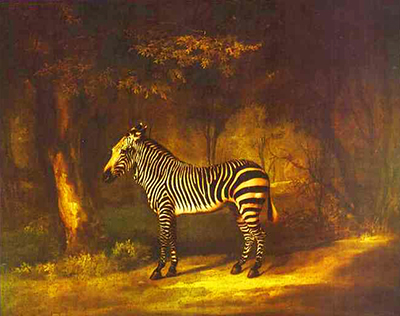
| Zebra | 1763 | Painting |
Discussion
Look again at the images and ideas explored in A Bay Hunter with Two Playful Spaniels. These editorial prompts invite your observations.
Reader Insights
How do the spaniels change the stillness of the hunter’s pose?
Which part of the landscape most affects your sense of space around the animals?
How do the dogs change the rhythm of looking between the horse and its surroundings?
Join the Conversation
Share a detail, comparison or question about A Bay Hunter with Two Playful Spaniels below.
References
- Christie's, George Stubbs, A bay hunter with two playful spaniels, Old Masters Evening Sale, London, 6 December 2018, lot 37A; cites Judy Egerton, George Stubbs, Painter: Catalogue Raisonné (2007), p. 396, no. 193. (accessed 31 October 2026). View source.
- Christie's, London, Thursday 06 December 2018, Sale 16352 & Sale 15496, combined results, lot 37A. (accessed 31 October 2026). View source.
- Goodwood, The Collection, Painting Collection modal, Racehorses Exercising at Goodwood; An exciting acquisition: a study by George Stubbs, 30 June 2023; History of the Estate Hounds, 4 October 2023; About Goodwood Racecourse. Accessed 4 November 2026. View source.
- Goodwood, The Collection, Painting Collection modal, Racehorses Exercising at Goodwood; An exciting acquisition: a study by George Stubbs, 30 June 2023; History of the Estate Hounds, 4 October 2023; About Goodwood Racecourse. Accessed 4 November 2026. View source.
- Goodwood, The Collection, Painting Collection modal, Racehorses Exercising at Goodwood; An exciting acquisition: a study by George Stubbs, 30 June 2023; History of the Estate Hounds, 4 October 2023; About Goodwood Racecourse. Accessed 4 November 2026. View source.
- Goodwood, The Collection, Painting Collection modal, Racehorses Exercising at Goodwood; An exciting acquisition: a study by George Stubbs, 30 June 2023; History of the Estate Hounds, 4 October 2023; About Goodwood Racecourse. Accessed 4 November 2026. View source.
- National Gallery, Whistlejacket, NG6569, current collection record, provenance, in-depth discussion and frame entry. View source.
- Yale Center for British Art, Zebra, B1981.25.617, current object metadata, gallery labels, Malcolm Warner’s 1998 catalogue entry and provenance supplied through the museum’s public collection record. View source.
- Christie’s, Gimcrack on Newmarket Heath, with a trainer, a jockey and a stable lad, London, 5 July 2011, lot 12; object details, essay, provenance, exhibitions and whole image. View source.
- Christie’s, Gimcrack on Newmarket Heath, with a trainer, a jockey and a stable lad, London, 5 July 2011, lot 12; object details, essay, provenance, exhibitions and whole image. View source.
- Yale University Art Gallery, A Lion Attacking a Horse, 1770, 1955.27.1, collection record. Accessed 4 November 2026. View source.
- Royal Museums Greenwich, ‘The Kongouro from New Holland’ (Kangaroo), ZBA5754. Accessed 4 November 2026. View source.
- Christie's, George Stubbs, A bay hunter with two playful spaniels, Old Masters Evening Sale, London, 6 December 2018, lot 37A; cites Judy Egerton, George Stubbs, Painter: Catalogue Raisonné (2007), p. 396, no. 193. View source.
- Tate, George Stubbs, Haymakers, 1785, T02256; details, Terry Riggs’s collection text (January 1998), and online caption. Collection record. View source.
- Frances Bailey, ‘Hambletonian, Rubbing Down: A masterpiece by George Stubbs’, National Trust Cultural Heritage Magazine, Autumn/Winter 2024, pp. 22–33. Article. View source.
- Historic England, “Stanford Hall”, National Heritage List for England, entry 1001640. (accessed 31 October 2026). View source.
- John Throsby's additions to Robert Thoroton, Thoroton's History of Nottinghamshire, vol. I (Nottingham, 1790), “Nottinghamshire: Rushcliffe hundred”, pp. 1–10, especially Stanford Hall, pp. 9–10; British History Online transcription. (accessed 31 October 2026). View source.
- Rev. J. Hodgson and F. C. Laird, The Beauties of England and Wales, vol. XII, part I, Nottinghamshire (London, 1813), p. 197. (direct page inspection 30 August 2026; bibliographical wording reconfirmed through reference 1 on 31 October 2026). View source.
- J. P. Neale, Views of the Seats of Noblemen and Gentlemen, in England, Wales, Scotland, and Ireland, vol. II (London, 1823), unnumbered “Stanford Hall, Nottinghamshire” notice; scan p. 191, title p. 11. (accessed 31 October 2026). View source.
- John Mills and Raymond White, “The Mediums used by George Stubbs: Some Further Studies”, National Gallery Technical Bulletin 9 (1985), pp. 60–64, especially table 1, p. 61. (accessed 31 October 2026). View source.
- Royal Academy of Arts, The Exhibition of the Royal Academy, MDCCLXXVIII (London, 1778), p. 22. (accessed 31 October 2026). View source.
- Christie's, George Stubbs, A Bay Hunter, a Springer Spaniel and a Sussex Spaniel in a wooded river Landscape, signed 1782, lot 47, object 2984189. (accessed 31 October 2026). View source.
- Denver Art Museum, Treasures of British Art: The Berger Collection, collection release. (accessed 31 October 2026). View source.
- Basic title, date and material metadata for Tate’s Reapers (T02257) and Otho (T02375) is adapted from the Tate collection dataset, October 2014, released under CC0. TheHistoryOfArt.org has reconciled labels and versions. This credit does not apply to Tate’s authored catalogue commentary or images.
- Data Source: Yale Center for British Art. Basic object fields are adapted and reconciled for this directory. Reuse is subject to the Center’s Open Data and Data Services Terms of Use. No museum endorsement is implied. This metadata credit does not relabel scholarly essays or images as open data.
- Basic object metadata for A Horse Frightened by a Lion, 1985.38, The Cleveland Museum of Art, John L. Severance Fund, is available under CC0. Titles and design-level grouping have been reconciled for this directory.