 by Tom Gurney
Tom Gurney BSc (Hons) is an art history expert with over 20 years experience
Email: tomgurney1@gmail.com / Phone: +44 7429 011000
George Stubbs: Introduction
George Stubbs (1724–1806) changed the possibilities of animal painting in Britain. Horses are central to that achievement, but “horse painter” is a beginning, not a conclusion. He was also a portraitist, draughtsman, anatomist, etcher, publisher and maker of enamel pictures. He represented dogs, deer, monkeys, lions and animals newly carried into British collections; he painted riders, attendants, family groups and agricultural workers; and he tested how an image might move from drawing to copper plate, printed book, painted panel or ceramic plaque. [1] [2] [3]
The range matters because Stubbs did not divide knowledge from art. His sustained dissections of horses produced drawings and a publication, but their purpose was connected to painting. A named racehorse could be both an animal whose structure he understood and an individual whose breeding, performance and ownership were documented. An imported zebra might be studied alive in a royal menagerie. [4] A composition could reappear in oil, enamel and print without those objects becoming equivalent. [1] [5]
This combination of exact looking and deliberate design is the thread through Stubbs's career. It helps explain why the enormous Whistlejacket is more than a feat of description, why a rider's balance can be as revealing as a horse's gait, and why the circumstances in which an animal reached the artist are part of the picture's history. It also explains the unusually broad modern record of his work. Judy Egerton's 2007 catalogue raisonné was the first to encompass Stubbs's paintings and drawings across the whole career; the Paul Mellon Centre now points researchers to Egerton's archive, more than 500 digitised reference photographs and a long sequence of exhibition catalogues and specialist studies. [6] [7]
Several questions sharpen any encounter with Stubbs. What kind of object is being viewed: a painting, anatomical drawing, printed impression or enamel? Is the animal named, and are its owner, rider, handler or breeder securely known? Did Stubbs observe the living subject, or did information arrive through another person or object? Finally, what does the body visibly do? Those questions keep later reproductions from being mistaken for original designs and prevent posture from being turned too quickly into emotion or symbolism. They also lead back to the central strength of his art: knowledge is never simply displayed; it is organised into an encounter.
That achievement also altered the scale on which an animal could count as a portrait subject. Stubbs did not merely improve the accuracy of a familiar sporting genre. He gave individual animals the concentration, size and formal distinction associated with images of powerful people, while continuing to record the human systems around them. Owners and breeders valued recognisable conformation; riders and handlers contributed specialised knowledge; viewers encountered the results in country houses, exhibitions, books and prints. The work can therefore be exact and socially implicated at the same time. A horse may dominate the canvas, but its name, training, ownership and display history remain part of what made that dominance possible. [3] [8]
At a Glance
- Born25 August 1724, Liverpool [1]
- Died10 July 1806 [1]
- PracticePainting, drawing, anatomy, print and enamel [1]
George Stubbs in context
Neoclassicism
Eighteenth-century development, c.1750–1800 [12]Romanticism
c.1800–1850 [13]Whistlejacket
about 1762 [22]The people and practices around Stubbs
Explore the commissions, research and collaborative work that shaped his career.
- Mary Spencer and anatomical research: Spencer assisted the Horkstow project. The surviving accounts establish her contribution without supplying a reliable daily list of tasks. [30]
- Medical illustration and the horse: The 1751 Burton plates precede The Anatomy of the Horse of 1766, linking drawing, etched publication and specialised readers. [31] [32]
- Rockingham and Whistlejacket: Rockingham’s commissions gave Stubbs sustained access to named horses and the means to undertake ambitious animal portraits. [22]
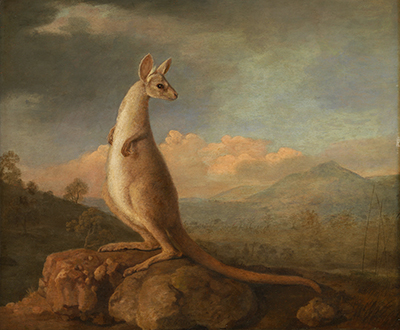
- Banks and the Kongouro: The 1772 painting arose from Banks’s commission and material brought back from the Endeavour voyage; it was not painted from a living kangaroo in Stubbs’s studio. [27]
- Wedgwood and enamel: The 1781 self-portrait on a Wedgwood plaque makes the relationship between painting and manufactured supports tangible. [33]
- George Townly and printmaking: The British Museum’s 1771 Sebra distinguishes George Townly’s work as mezzotint maker from George Stubbs’s role as the painter whose design was reproduced. [34]
Contents
- Learning to see a living structure
- Anatomy for the painter
- A horse becomes the whole subject
- Racing pictures are networks of knowledge
- Animals acting, not merely symbolising
- Animals carried across distance
- People, estates and work
- An experimental maker across media
- A journey through the career
- Reputation, collecting and renewed attention
- Videos on George Stubbs
Learning to see a living structure
Stubbs was born in Liverpool on 25 August 1724, the son of a currier. He was largely self-taught, although he briefly worked with the painter Hamlet Winstanley. In York he developed two practices that would remain connected: portraiture and anatomy. The Royal Academy records his study at York County Hospital between 1745 and 1751 and his anonymous etching of illustrations for John Burton's treatise on midwifery. This was experience not only of bodies but of translation—turning observed structure into an image that could be printed and read. [1] [2]
He travelled to Italy in 1754, then returned to England rather than building his reputation through a long continental career. During 1756–58 he spent about eighteen months in a farmhouse near Barton-upon-Humber, at Horkstow in Lincolnshire, dissecting horses and recording successive anatomical layers. By around 1759 he had moved to London. There he etched the plates for The Anatomy of the Horse while commissions from racing and landowning patrons began to establish him as an animal painter. [1] [3]
The surviving record also complicates the myth of a solitary investigator. The Royal Academy's current biography identifies Mary Spencer as Stubbs's long-term partner and assistant from at least the mid-1740s. It notes that a contemporary described her as the daughter of “Captain Spencer of the Guinea trade”, while Stubbs received several Liverpool houses from his father's estate. The city was a port deeply implicated in colonial commerce. Those facts do not prove a simple explanation for every work, but they place the working household and the artist's early circumstances within histories larger than individual genius. [1] The fuller biography considers that documented life without turning later recollections into certainty.
By 1761 Stubbs was exhibiting with the Society of Artists. He continued there until 1774 and served as its president in 1772, then exhibited at the Royal Academy from 1775 to 1803. His institutional position was neither that of an unrecognised outsider nor a straightforward full Academician. He was elected an Associate in 1780 and elected to full membership the following year, but the election was annulled when he did not provide the required Diploma Work. [1] That qualified status is revealing: his career flourished within public exhibitions and elite patronage even while animal and sporting subjects occupied an uneasy place in academic hierarchies.
“Largely self-taught” must therefore be used with care. It describes the absence of a conventional, sustained apprenticeship, not a life without teachers, collaborators, institutions or visual traditions. Winstanley, York medical circles, Burton's publication, Italian art, Mary Spencer, London engravers, exhibition societies and patrons all formed parts of the working environment. [1] [2] Stubbs's independence lay less in isolation than in his ability to combine kinds of knowledge that the established hierarchy often separated.
Four stages of George Stubbs’s career
These four periods group overlapping developments in Stubbs’s work; they are a guide to changing opportunities and interests, rather than fixed boundaries.
Portrait work and anatomical investigation
Northern portrait work and medical illustration preceded Stubbs’s London reputation. Burton’s midwifery book appeared in 1751; the horse dissections and drawings at Horkstow followed about 1756–58. Mary Spencer assisted the later project, although her daily tasks are not documented. [30] [31]
Country-house commissions and a published anatomy
Commissions at Goodwood and for Rockingham brought access to horses, handlers and estate settings. The Anatomy of the Horse appeared in 1766 while the painting practice was already established: publication and patronage developed together. [30] [32]
Painting, prints and enamel
Stubbs continued painting animals and people while developing prints, rural subjects and enamel. His 1781 self-portrait on a Wedgwood plaque is a firm surviving example of that material ambition. These experiments overlapped with continuing commissions. [30] [33]
Royal work and unfinished projects
Royal commissions brought substantial work in the early 1790s, alongside the unsuccessful Turf enterprise. Stubbs later compared human, tiger and fowl anatomy in plates published in 1804–06. The comparative project was unfinished when he died in 1806. [35] [30] [36]
Anatomy for the painter
The Anatomy of the Horse, published in London in 1766, is a large, technically complex book rather than a loose portfolio of pictures. The Royal Academy's copy is described as an oblong broadsheet with forty-seven numbered pages of text and twenty-four plates arranged through numbered and supplementary sequences. Forty-four preparatory drawings survive, all but two in the Academy's collection. Their materials range from pencil and black chalk to red chalk and coloured inks, and the sequence includes measured studies, working drawings, finished studies and key diagrams. [5]
Stubbs defined the project's purpose with unusual clarity. He identified himself as “Painter” on the title page and wrote that the work might serve both members of his own profession and people responsible for treating horses. He insisted that its figures were drawn from nature after the dissection of many animals. In a 1771 letter to the Dutch anatomist Petrus Camper, however, he set a limit: he had done what he considered necessary for the study of painting and had looked very little into the horse's internal organs. The work therefore joined artistic and practical anatomical knowledge without pretending to be an exhaustive account of every bodily system. [5] [8]
The plates make that aim visible. Skeleton and musculature are presented in related views, with outline diagrams keyed to the written explanation. In a high-resolution image of the Metropolitan Museum of Art's copy, an open spread shows a horse in lateral profile with extensive areas flayed to reveal ribs, muscle groups and tendons. Other plates rotate the body towards front or rear so that a form hidden in one view can be followed in another. [37] [38] [39] A study drawing, an etched copper plate, a printed sheet and a bound volume are linked stages in this process, not interchangeable labels.
The surviving drawings show how much information was negotiated before the plate. Some measure the skeleton in pen and ink; others build vessels or muscles with pencil, black and red chalk, and brown or red-brown washes; finished studies suppress much of that working apparatus. Etching then reverses the design and translates differences of line and tone into marks that must remain intelligible beside the text. The twenty-four printed plates represent the published solution, not a transparent facsimile of forty-four surviving sheets. [5] [37] This is why the book belongs as much to the history of image-making as to equine anatomy.
This method helps explain Stubbs's command of weight without reducing painting to a diagram. Knowledge of where a shoulder attaches, how a tendon crosses a joint or how mass shifts through the hindquarters gave him a relational understanding of the body. It did not supply a ready-made pose, colour scheme or composition. The structure had to be reimagined each time an animal stood, galloped, recoiled or reared. The guide to The Anatomy of the Horse follows the dissections, drawings and publication in depth, while the drawings and prints sections keep the stages of production distinct.
The word “scientific” is useful here only if it remains specific. Stubbs pursued repeatable observation, compared views and made structures available for checking by other people. Yet the publication was organised around what a painter needed to know, and its images required selection at every stage. Even an outline key chooses which boundary to isolate; a finished plate decides how much shading will clarify rather than obscure. Empirical discipline and aesthetic judgement were partners, not opposites. [5] [39]
The book's afterlife also shows that its value extended beyond a private studio resource. The Royal Academy resolved to buy a copy for its library in December 1791 and paid Stubbs five guineas in March 1792. Its detailed plates contributed to his international reputation as an anatomist, yet the title-page designation and Camper letter keep their original artistic purpose in view. [5] Anatomy was not a credential appended to the paintings. It was one means by which drawing, print and observation could be made answerable to one another.
A horse becomes the whole subject
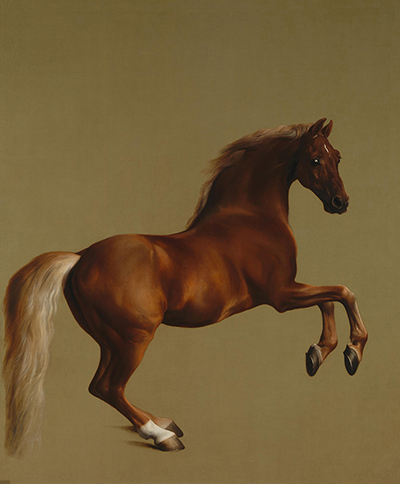
The National Gallery's Whistlejacket, painted about 1762, is nearly three metres high. A chestnut stallion rises against a pale buff field. His body is chiefly in profile, but his head turns towards the viewer; both forelegs flex above the ground while the hind legs bear his mass. There is no rider, bridle, saddle, architecture or landscape. Small shadows beneath the rear hooves are almost the only indication of contact with the surface. [40]
The omissions are active. Without narrative accessories, the curve from neck to back, the spread of the hindquarters, the differently angled joints and the fall of mane and tail must establish both movement and stability. The picture does not need to be described as an expression of pride or freedom for its force to register. Its scale gives an individual animal the pictorial authority usually reserved for grand human portraiture, while the unbroken ground makes each structural transition unusually exposed.
Whistlejacket was a documented racehorse, not a generic emblem. Foaled in 1749 and bred at Sir William Middleton's Belsay stud, he was later acquired by Charles Watson-Wentworth, 2nd Marquess of Rockingham. His racing career included wins in northern meetings and a mixed record at Newmarket. His most celebrated performance came at York in August 1759, when, ridden by John Singleton, he defeated Brutus by a length in a 2,000-guinea match. He did not race again and was retired to Rockingham's stud. [8]
Rockingham's patronage joined racing, breeding, collecting and display. The National Gallery catalogue identifies a large circle of Stubbs's early clients—including the Dukes of Richmond, Ancaster, Grafton and Portland, Viscounts Torrington and Bolingbroke, and Lord Grosvenor—and records that they commissioned racehorses, jockeys, stallions, grooms and dogs. Rockingham alone commissioned twelve works. His papers include close descriptions from the head groom Joshua Cobb of newly foaled horses' colour and markings, evidence of the precision valued in a breeding establishment. His collection of classical sculpture and small bronzes also shaped the setting in which large animal pictures were seen. [8]
The surviving accounts are detailed but incomplete. A receipt of August 1762 itemises brood mares and foals, three stallions with a figure, a mounted figure, five dogs and a single horse with a dog. Another payment in December mentions a lion picture and a horse “Large as Life”, but Egerton argues that these may be the paired Lion Attacking a Horse and Lion Attacking a Stag, not Whistlejacket. [8] A rich archive can narrow possibilities without supplying a missing contract. Confidence should follow the document, not the fame of the work.
The origin of Whistlejacket's plain field remains disputed. Judy Egerton's National Gallery catalogue traces the story that George III was originally to ride the horse to Horace Walpole's 1772 visit and Ozias Humphry's later memoir, but notes that no surviving correspondence confirms the plan. It argues that the story may have arisen because a horse as the sole hero of such a vast canvas was difficult for contemporaries to imagine. The Gallery's 2026 exhibition, Stubbs: Portrait of a Horse, advances a more definite reconstruction: Whistlejacket was intended as the basis of an equestrian portrait of George III, the decision was made to leave it without rider or landscape, and a second horse, Scrub, was begun for the royal scheme. [8] [41] These are interpretations of incomplete evidence, not facts to collapse into one settled account.
The newly displayed Scrub, a bay horse belonging to the Marquess of Rockingham, about 1762, makes the comparison productive. This oil on canvas, National Gallery loan L1384, measures 268 by 244.5 centimetres. Scrub, another retired Rockingham racehorse, rears in profile without a rider, but he is placed in a landscape of trees, water, ground and open sky. The institutional record suggests that the setting may have been added later. Rockingham declined to buy the picture; apart from an unsuccessful attempt to sell it in India in the 1780s, it remained with Stubbs until his death. [41] [42]
Seen together, the two paintings expose choice rather than formula. Similar scale and action do not produce the same encounter. Scrub's landscape locates movement in depth and terrain; Whistlejacket's empty field makes the stallion's contour and turning head almost confrontationally present. The recent proposed connection to George III is valuable because it directs attention to equestrian-portrait conventions, but the earlier catalogue's evidential caution remains essential. The dedicated account of Whistlejacket follows the horse, commission and debate; the broader guide to paintings shows how different settings and formats altered equine portraiture.
Both canvases also unsettle the division between likeness and invention. A patron could demand a recognisable horse, and Stubbs could record colour, conformation and characteristic posture, but the result was never a neutral specimen sheet. Scale, crop, illumination, ground and the chosen instant of movement determine how the animal is encountered. Whistlejacket is convincing because exact relationships within the body support an audacious design, not because the picture suppresses design in favour of information. [40] [8] [42]
Racing pictures are networks of knowledge
Stubbs's racing art is often discussed as if it joined only a painter and a horse. The pictures themselves preserve a more crowded system: owners chose commissions; breeders tracked pedigrees; jockeys developed techniques; grooms and stable-lads cared for animals; race meetings produced results and reputations; and prints could carry a winning horse's image beyond an estate. A careful reading keeps those roles separate rather than making every human figure an unnamed accessory.
The documentary culture of racing was becoming more systematic during Stubbs's career. James Weatherby became Secretary to the Jockey Club and Keeper of its Match Book in 1770. He published the first Racing Calendar in 1773 and the first General Stud Book in 1791, creating durable frameworks for results and pedigrees. [43] These records did not replace memory or ownership, but they help explain why a horse's name, lineage and performance mattered so strongly. Stubbs's portraits occupied the visual side of the same culture of differentiation.
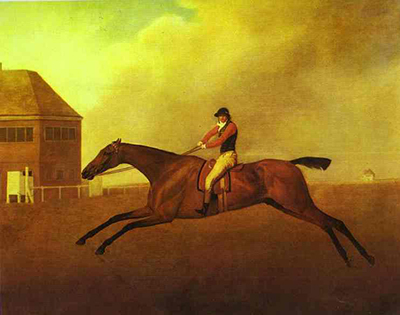
In Baronet with Sam Chifney Up, dated 1791, neither horse nor rider is incidental. Baronet belonged to the Prince of Wales and won the inaugural Oatlands Stakes that year, beating eighteen opponents at odds of twenty to one. The Huntington emphasises Chifney's distinctive riding method: he sits far back, keeps a relaxed rein and does not drive the horse with an active whip. [44] The image therefore records technique as well as appearance. Balance passes between two living bodies, and the precise relation of seat, rein and stride carries the historical meaning.
Naming also prevents the individual horse from dissolving into an ideal of breed. Whistlejacket's profile can be compared with eighteenth-century descriptions of Arabian conformation, but his moderate racing record and particular York victory remain his own. Baronet's 1791 success and Chifney's seat produce a different identity. Hambletonian's fame is attached to a hard match and the care that followed. [8] [44] [45] Anatomy provided general knowledge; portraiture depended on the specific body and history placed before the painter.
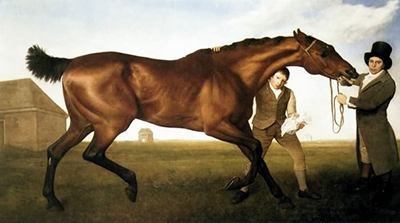
Hambletonian, Rubbing Down, completed in 1800, turns from racing action to its aftermath. Sir Henry Vane Tempest commissioned the vast canvas following Hambletonian's match victory at Newmarket on 25 March 1799. The horse fills the horizontal field while two attendants undertake post-race care. [45] Their work is central to the subject even though the chosen institutional account does not securely supply their names or exact occupations. It would be false precision to convert them automatically into a named trainer and groom.
Breeding pictures add a further layer. The National Gallery catalogue identifies at least ten arrangements of mares and foals, mostly from the 1760s. They may appear pastoral to a modern visitor, yet commissioners wanted recognisable animals and understood the breeding decisions represented by mares, sires and young stock. Changes of grouping, ownership and background mean that these works should not be treated as copies of one standard design. [8] The guide to racehorses and racing reconnects portraits of Whistlejacket, Baronet, Hambletonian, Gimcrack and Eclipse to their particular histories.
Late in the career, Stubbs attempted to turn that history into a larger sequence. Around 1790 an anonymous patron proposed portraits chronicling fifty years of British racing, including famous horses such as Eclipse and Gimcrack. Some images were to revisit earlier works and others to be newly made. Funding failed, but sixteen paintings were completed and shown at the Turf Gallery in Conduit Street in 1794; Stubbs's son made engravings in two sizes for A Review of the Turf. [41] The project demonstrates that repetition could be historical and reproductive at once. A later painting after an earlier design, an engraving by George Townly Stubbs and an original George Stubbs canvas need separate identities.
Patronage made this work possible but did not distribute power evenly. Owners' names, estates and payments often survive more readily than the labour of stable-lads, jockeys and handlers. At the same time, the images can retain forms of expertise that written accounts marginalise: Chifney's balance, Morgan's presence beside the cheetah, or the two attendants working over Hambletonian's heated body. Reading the commission and the pictured action together keeps property, skill and care in the same history without pretending that they carried equal status. [44] [45] [46]
Animals acting, not merely symbolising
Stubbs's anatomical knowledge was not restricted to ideal stillness. Across horses, dogs and wild animals he attended to the consequences of action: a leg bears weight, a rider shifts balance, a dog turns towards a person, a predator's grip reorganises another body. Such observations can support interpretation without requiring every animal to stand for a human virtue or vice.
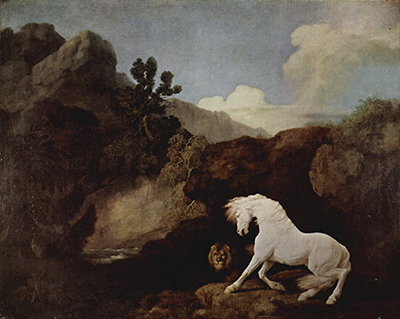
The long lion-and-horse series is the clearest test. The National Heritage Memorial Fund records seventeen known works made over roughly three decades in oil, enamel, print and Wedgwood relief, organised into four broad episodes. One horse is startled; another is attacked; in later stages the horse is overcome. These are related inventions, not loose titles for one object. [47] Earlier European art and Stubbs's rocky landscape studies at Creswell Crags contributed to the pictorial language, but neither source establishes a universal allegory. [48]
In the high-resolution image of Yale's A Lion Attacking a Horse (1762), the lion lies lengthwise across the horse's shoulders and back. Its forepaws grip neck and barrel while the horse turns its head towards the attacker, mouth open and one white eye visible. One foreleg lifts and bends; the other braces; the hind legs separate beneath the twisting body. Predator and prey form a locked diagonal against shallow rocks, trees and distant sky. [49] The visible facts convey force, instability and resistance. Calling the scene a fixed moral contest between civilisation and savagery would narrow what the bodies actually show.
The return to the subject across media allowed Stubbs to alter time as well as surface. A frightened horse and an attacked horse are different moments. An enamel's fired colour, an oil painting's scale, a print's reversal and circulation, and a relief's physical projection change the experience even where the underlying encounter is related. [47] The individual account of Horse Frightened by a Lion preserves one object's place within that larger sequence.
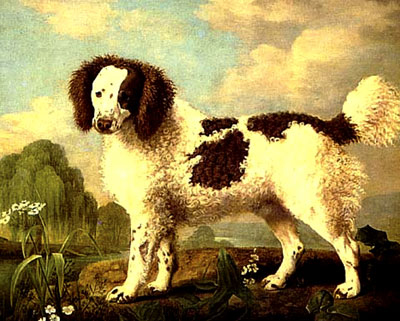
Dogs ask for the same discipline. Stubbs painted hounds as estate groups, individual dogs as portraits and animals accompanying human sitters. A turned head or attentive stance may establish a relation within the composition, but affection, loyalty or anxiety should not be asserted as documented mental states merely because they suit a familiar story about dogs. His strength lies in making behaviour legible without converting observation into sentimentality.
This approach permits difference within “animal painting”. A racehorse carrying a jockey, a mare beside a foal, a restrained cheetah, a zebra standing alone and two animals locked in attack pose distinct problems of access, motion and relationship. Stubbs did not solve them with a single anatomical template. He changed viewpoint, scale, setting and medium to meet the action before him. [3] [47]
Animals carried across distance
Access depended on people and institutions. The royal menagerie made a living zebra available for study; the cheetah picture brings an animal handler into the composition itself. [46] [4] Those encounters involved different relationships between observation, care and control. The presence of a living subject did not remove the human circumstances in which it became available to a painter.
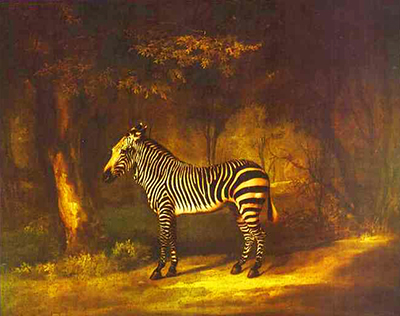
Yale's Zebra of 1763 provides a case of living access within forced displacement. Its current record identifies a female Cape mountain zebra brought from Africa to London by a British warship in 1762 and presented to Queen Charlotte. The animal lived in royal menageries. Stubbs appears to have painted it from direct observation and kept the canvas himself until his death rather than making it for a patron. [4]
In the inspected Yale image, the zebra stands in strict lateral profile on a pale clearing, its head turned slightly and ears angled apart. The dark and light bands follow the torso, gather tightly down the legs and curve concentrically over the hindquarters. Dense woodland replaces both the animal's southern African habitat and the paddocks in which it lived in Britain. The setting therefore looks natural without documenting an actual environment. Exact stripes and musculature coexist with an invented landscape. [4] The page on the Zebra traces the animal's transport, display and the painting's later history.
Manchester Art Gallery holds the canvas now titled A Cheetah and a Stag with Two Indian Attendants, painted about 1764. It requires attention to human expertise as well as animal novelty. Current Manchester research identifies one attendant as John Morgan, an animal handler from Bengal described in contemporary records as a “lascar”. Morgan and the cheetah, called Miss Jenny, were associated with George Pigot's return from Madras. [46] The other man remains unidentified in the selected evidence. Clothing cannot supply a name, profession or biography that the record does not preserve.
Restoring Morgan's name changes the picture's history. The cheetah did not arrive as an isolated specimen, and its management was not self-explanatory. A knowledgeable handler travelled within the same colonial network as the animal and was represented beside it. The work's modern title and interpretation have shifted as that evidence has been recovered. The detailed essay on the cheetah, stag and two Indian attendants follows the object, historic language and current identification without treating the second figure as interchangeable.
Banks's 1772 panels followed Cook's 1768–71 voyage: The Kongouro from New Holland and its companion, Portrait of a Large Dog (Dingo). [50] [51]
Neither animal provided a living model for the commission. [50] Royal Museums Greenwich describes Banks's accounts, Parkinson's sketches and a lost stuffed or inflated kangaroo skin as Stubbs's resources. [50] Angus Trumble questioned the skin story, identifying a skull and Parkinson drawings as the documented evidence instead. [52] The precise materials Stubbs used remain disputed. [50] [52]
Both paintings appeared at the Society of Artists in 1773; Hawkesworth's voyage account reproduced the kangaroo that year. [50] Banks later displayed the pair at 32 Soho Square alongside specimens and Dance's Cook portrait, bringing painting into a scientific meeting place. [50] Exhibition, print and private display gave the same design different audiences and helped turn an image into shared knowledge. [50]
Greenwich catalogues ZBA5754 and ZBA5755 as beeswax on mahogany; that label alone does not establish an oil-free recipe. [50] [51] [53] Their wider histories are explored in animals, science and empire.
The contrast between the zebra and cheetah concerns more than the availability of unusual species. The zebra's captive life and Morgan's journey with the cheetah are specific histories. [46] [4] Reading them together brings the animal, the person and the institution into view, rather than treating every imported creature as interchangeable evidence of a single experience.
The wider practice confirms that no single transport story will suffice. The Royal Academy notes Stubbs's work on an Indian nilgai and a Canadian moose, both species brought into view through colonial trade channels. [1] The moose therefore needs its own specimen and commission history. “Exotic” describes a British category of unfamiliarity; it is not a natural quality possessed by the animals themselves.
People, estates and work
Human figures do not disappear when Stubbs moves beyond conventional portraiture. They enter the same systems of animals, land, vehicles and labour. A family portrait may use horses and a dog to organise kinship; a carriage picture can give mechanical construction unusual prominence; a harvest scene can coordinate many bodies across a field.
The National Gallery's The Milbanke and Melbourne Families, about 1769, was probably commissioned to mark the marriage alliance of Elizabeth Milbanke and Peniston Lamb. Elizabeth sits in a carriage beside her father, Sir Ralph Milbanke; Peniston is mounted on a bay horse; the central man is most likely Elizabeth's elder brother, John. Stubbs exhibited it at the Society of Artists in 1770 under the title A Conversation. The figures, horses and dog occupy a shallow horizontal band beneath a spreading oak, an arrangement the Gallery compares to a classical frieze. [54]
The picture shows how animal and human portraiture can perform different work within one design. Elizabeth's grey pony and Peniston's larger bay distinguish positions within the family group; the dog helps connect gazes; branches extend above the sitters like a structural canopy. Yet the present title and identifications depend on research, not appearance alone. The Milbanke and Melbourne family portrait is best understood through the specific marriage, commission and corrected order of names.
In A Gentleman driving a Lady in a Phaeton (1787), the sitters remain unknown and it is not certain that they were married. The high-built, lightly sprung carriage was designed for owner-driving and speed. Stubbs places the vehicle against dark foliage and gives close attention to its crane-neck undercarriage, wheels and harness. [55] That precision extends the logic of anatomy to made structure: a carriage also depends on articulated parts, transmitted force and the relation between movement and control. The picture's dedicated account corrects the old unsupported social identities while retaining the safer title A Gentleman Driving a Lady in a Phaeton.
The companion subjects Haymakers and Reapers bring organised rural labour to the foreground. The principal painted versions were oils on panel made in 1785 and exhibited at the Royal Academy the next year. [48] Stubbs later translated related designs into print. The National Gallery of Art's Reapers, published in 1791, is a stipple-and-roulette print painted, engraved and issued by Stubbs, not the 1785 panel. [56] Repetition altered both surface and audience: tonal passages became systems of printed marks, and multiple impressions could circulate beyond the single painted object.
These works should not be recruited automatically as either celebrations of country harmony or condemnations of rural inequality. What can be securely examined is the ordering of tasks, tools, bodies, animals and space, along with the patrons, exhibitions and reproductive processes that carried the images. Across conversation piece, carriage picture and harvest scene, Stubbs's attention moves from biological articulation to social and mechanical coordination.
The presence of labour also corrects the idea that expertise belonged only to the artist or patron. Jockeys controlled pace and balance; attendants cooled and handled horses; John Morgan managed an unfamiliar predator; carriage builders made complex mechanisms; field workers coordinated harvest tasks. The surviving record names some participants and leaves others anonymous. Stubbs's pictures cannot recover every life, but they repeatedly make skilled action visible within commissions shaped by wealth and ownership. [44] [45] [46] [55]
An experimental maker across media
Stubbs's practice changed not only through subject but through material. He made relatively few original prints, yet the Royal Academy describes him as one of the most original British printmakers. He etched his own anatomy plates, used mixed print processes for later designs and explored enamel on copper and ceramic supports. [1] Each choice altered scale, texture, durability and circulation.
Technical analysis is especially useful because it corrects the idea of one secret “wax technique”. A National Gallery study of ten paintings dated from 1772 to 1800 found changing combinations of drying oil, non-drying oil or fat, beeswax and pine resin. Works after 1783 differed from earlier examples in the sample. [53] “Wax-containing medium” is consequently more responsible than applying “encaustic” indiscriminately. Oil-and-wax experiments and fired enamels are materially related only in limited ways. [53] [57]
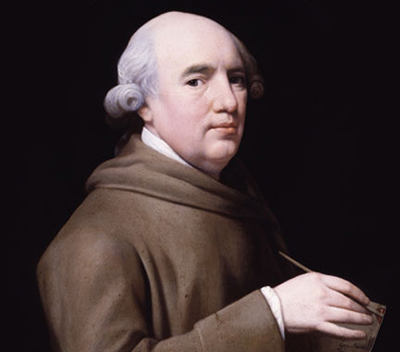
The self-images make those distinctions tangible. National Portrait Gallery NPG 4575 is Stubbs's 1781 self-portrait in enamel on a Wedgwood plaque, exhibited at the Royal Academy in 1782. A contemporary critic described the complexion as pallid, but the work's identity does not depend on agreeing with that response. [57] Yale's smaller Self-Portrait of about 1759 is oil on copper, while the National Portrait Gallery's iconography also distinguishes the mounted self-image of 1782 and portraits made by Ozias Humphry, George Dance and others. [58] [59] They are separate objects, not stages of one numbered portrait. The guide to Stubbs's self-portraits compares their purposes and supports.
Enamel posed demanding technical problems. Colour had to survive firing, and the size of available supports constrained the image. Wedgwood's manufacture offered ceramic plaques on which Stubbs could pursue a durable, smooth surface quite unlike canvas or mahogany. Printmaking posed the opposite possibility: a plate could generate many impressions, although changes of state, lettering, publisher or reproductive engraver complicated authorship. The account of technique, enamel and printmaking follows those processes without calling every object “mixed media”.
The late project usually shortened to A Comparative Anatomical Exposition brought several strands together. Stubbs had conceived it by 1765 but began serious work only in 1795, when he was seventy-one. The Royal Academy subscribed in 1802. The publication was planned in six parts of ten plates, but only the first three parts and thirty plates were completed before his death. Their paired images compare skeleton and musculature across human, tiger and common fowl. [60]
For these plates Stubbs used stipple rather than relying only on line, allowing printed dots to reproduce the shaded modelling of the finished drawings. Text and images had a complicated publication history: the three parts appeared between about 1803 and 1806, while a later 1817 reissue was produced after the original explanatory text could not be obtained. [60] [61] The unfinished publication was therefore both a return and an expansion. Equine anatomy had served the painter; comparative study now tested correspondences among human, tiger and bird near the end of a long career.
Authorship in Stubbs's printed work is consequently a matter of roles, not merely a name attached to an image. He could be designer, draughtsman, etcher, engraver and publisher; another printmaker might translate one of his paintings; his son might engrave a design for the Turf project. Lettering, state and publication date help identify the resulting impression. [1] [41] [56] Print multiplied access, but it also introduced new hands and new decisions between painted design and paper object.
A journey through the career
1724–54: Liverpool, York and Italy. Stubbs was born into a Liverpool family connected with leather working. His short experience with Hamlet Winstanley did not become prolonged formal training. Portrait practice in northern England, hospital anatomy in York and printed medical illustration established an early traffic between likeness, bodily knowledge and reproducible design. The journey to Italy in 1754 added direct experience of European art without supplying a single conversion story. [1] [2]
1756–66: dissection, London and publication. The Horkstow project occupied about eighteen months within 1756–58. Stubbs moved to London around 1759 with a portfolio of anatomical drawings and began receiving commissions from patrons engaged in breeding, racing and country sports. He exhibited with the Society of Artists from 1761. Rockingham's Whistlejacket, Scrub, mares, stallions, hounds and other pictures belong to this first remarkable surge. The Anatomy of the Horse appeared in 1766. [1] [5] [8]
1760s–70s: species, patrons and public exhibition. The Manchester cheetah picture, Yale Zebra, lion-and-horse compositions, family groups and sporting scenes show how rapidly the subjects widened. [46] [4] [49] Banks's 1772 commission added the kangaroo and dingo. [50] Stubbs became president of the Society of Artists in 1772, moved to Royal Academy exhibitions in 1775 and increasingly explored dogs, rural life, print and enamel. [1]
1780s: institutional ambiguity and material experiment. Election as ARA in 1780 was followed by an annulled election to full membership. The enamel self-portrait, paintings on prepared panels, carriage pictures and the 1785 Haymakers and Reapers show that the decade cannot be reduced to a decline from the early horse portraits. [48] [55] [53] [57] Stubbs was testing how smooth supports, altered binders and reproducible designs could carry the exactness associated with his earlier work.
1790s: racing history and mature action. The planned Turf series attempted to organise half a century of notable racehorses. Baronet with Sam Chifney Up made riding technique inseparable from equine movement; Hambletonian, Rubbing Down made recovery and attendants' work the subject after a famous race. [41] [44] [45] Around 1795 Stubbs also returned seriously to comparative anatomy, so late sporting commissions and scientific image-making developed together rather than succeeding one another neatly.
1800–06: comparison unfinished. Stubbs continued to exhibit at the Royal Academy through 1803 and worked on the comparative publication until his death on 10 July 1806. Only half of the planned sixty plates was completed. [1] [60] The incomplete state is not evidence of a fading concern. It shows the scale of the problem he had set himself: to compare bone and musculature across human, feline and avian bodies through drawing, text and print.
The sequence reveals continuities more important than a list of dates. Portraiture taught attention to individual difference; anatomy made relationships within bodies intelligible; print converted observation into repeatable knowledge; patrons supplied access and demanded likeness; material experiments changed what an image could physically be. The career was cumulative, but never mechanically progressive.
Reputation, collecting and renewed attention
Stubbs was successful with elite patrons and exhibited for more than forty years, yet later reputation has repeatedly been reshaped by collections, publications and exhibitions. Edwin Landseer owned Stubbs's group of horse-anatomy drawings and imitated his anatomical study of animals. The National Gallery's 2018–19 Landseer exhibition placed one of Stubbs's working drawings beside Landseer's study of a dog's leg, making a concrete nineteenth-century line of transmission visible. [62]
In the twentieth century Paul Mellon collected Stubbs with unusual breadth. His first painting purchase was Pumpkin with a Stable-Lad, and he went on to acquire paintings, drawings, prints, enamels and The Anatomy of the Horse. Those holdings became a defining strength of the Yale Center for British Art. [63] Mellon's cross-media approach mattered because it resisted the reduction of Stubbs to one celebrated horse or one kind of object.
Scholarship provided another form of recovery. Judy Egerton curated major exhibitions in 1976 and 1984–85 before publishing the full catalogue raisonné in 2007. Her archive contains correspondence, research notes, annotated publications and images connected with decades of work; the Paul Mellon Centre's photo archive contains more than 500 Stubbs images, while its library holds more than twenty exhibition catalogues. [6] That accumulation makes version, provenance and attribution questions more visible rather than pretending they have all disappeared.
Public display has also changed the frame. The National Gallery purchased Whistlejacket in 1997 after a loan beginning in 1996, supported by the Heritage Lottery Fund and private donations. [8] In 2019–20 the Mauritshuis brought together thirteen paintings, ten anatomical drawings and the skeleton of Eclipse, marking Whistlejacket's first journey to mainland Europe; its partner exhibition at MK Gallery surveyed the wider practice under the phrase “all done from Nature”. [64] The National Gallery's 2026 pairing of Whistlejacket and Scrub now reopens the question of how Stubbs and Rockingham arrived at two monumental riderless horses. [41]
Changing titles and attributions are part of this renewed attention. Manchester's recovery of John Morgan alters a figure once treated generically; the unknown sitters in the phaeton picture replace confident but unsupported social names; the Milbanke and Melbourne group requires exact family relationships; Whistlejacket's commission continues to support competing reconstructions. [8] [46] [54] [55] Revision is not an embarrassment added after the art. It is how provenance, archives and object study bring the historical record closer to what can actually be supported.
This exhibition history does not form a simple march towards correct appreciation. Each setting emphasises something different: anatomy, national school, sporting portraiture, cross-media experiment, collecting or commission history. The best modern view keeps these frames in dialogue. Stubbs's importance lies not in escaping his patrons or period, but in using their commissions, technologies and knowledge systems to give animals unprecedented pictorial agency.
Connections that open the work
One path begins with anatomy. Move from the 1766 publication to the surviving anatomical drawings, then to a painted horse and finally to the late comparative exposition. The sequence shows knowledge changing form: measured marks become etched plates, a painted body redistributes weight, and stippled comparisons cross species. [5] [60]
A second path follows a racing identity. Begin with Whistlejacket's York match, compare Chifney's seat on Baronet, then look at Hambletonian after exertion. Horse, rider, owner, attendants and record-keeping enter at different points. The connection is not “sport” in the abstract but the changing visibility of performance and care. [8] [44] [45]
A third path follows transport and evidence. John Morgan and Miss Jenny reached Britain through Madras; Queen Charlotte's zebra arrived by warship and lived in royal menageries. [46] [4] These journeys show why animal painting must include histories of people, captivity and collecting.
A fourth path follows repetition. The lion-and-horse subject changes action and medium over decades; mares and foals vary by patron and animal; Reapers moves from a painted panel to a printed design; the Turf project revisits earlier horse portraits for a historical series. [8] [41] [47] [56] Repetition becomes a means of testing bodies, audiences and memory, not evidence that every version is interchangeable.
A fifth path follows material. The anatomy book depends on drawing, etching, paper and binding; the 1781 self-portrait is fired enamel on Wedgwood; late comparative plates use stipple to carry shaded modelling. [5] [57] [60] The Banks panels introduce beeswax on mahogany. [50] [51] These processes reveal an artist who treated medium as part of thought.
Finally, a path through people changes the familiar image of the solitary “horse painter”. Mary Spencer assisted Stubbs; John Singleton and Sam Chifney rode named horses; John Morgan handled the cheetah; unnamed attendants care for Hambletonian; family sitters and rural workers organise other pictures. [1] [44] [45] [46] [54] Some identities are documented, others uncertain and still others lost. Respecting those differences is part of looking accurately.
Stubbs's achievement is not photographic correctness and not a vague sympathy with animals. It is the disciplined movement between structure and presence. He could use anatomy without making a diagram, describe a named horse without reducing it to property, and make the shaping of an image part of its meaning. Across painting, drawing, print and enamel, the body remains both something known and something newly made visible.
That is why his work rewards movement between objects rather than reverence for one masterpiece. Whistlejacket gains depth beside Scrub, the anatomy plates, racing records and later prints; the zebra changes when set beside Morgan's cheetah; the self-portraits become clearer when their supports are not confused. Stubbs made difference visible—between species, individuals, actions, materials and kinds of evidence—and built a career from the exactness of those distinctions.
Essential George Stubbs works
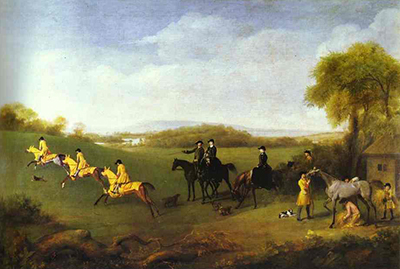
Racehorses Exercising at Goodwood
1759–60 · Horses, riders and handlers within an early estate commission. [18] [19] [20] [21]
Whistlejacket
about 1762 · A named racehorse presented at an exceptional scale. [22]
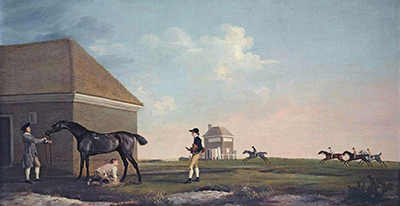
Gimcrack on Newmarket Heath, with a trainer, a jockey and a stable lad
about 1765 · Racing, training and the labour around a celebrated horse. [24] [25]
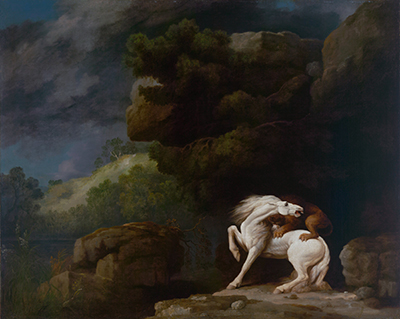
A Lion Attacking a Horse
1770 · The 1770 Yale canvas within a long series of related inventions. [26]
The Kongouro from New Holland
1772 · Banks’s commission and the limits of working from a preserved animal. [27]
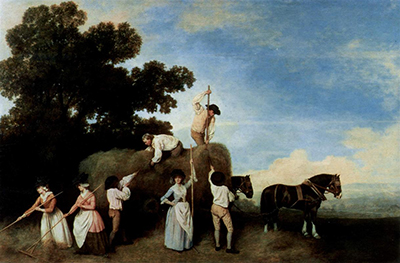
Hambletonian, Rubbing Down
1800 · A late portrait that includes the work of rubbing down a racehorse. [29]
Videos on George Stubbs
Explore Stubbs’s equestrian painting in its wider context, including two readings of Whistlejacket.
A Horse Lover’s Guide to the YCBA
A museum tour that places Stubbs alongside other artists who painted horses. It includes a look at Pumpkin with a Stable-lad.
Watch on YouTubeGeorge Stubbs artworks directory
Search works and related prints documented in this guide. Separate versions and printing matrices have separate entries; printmakers are named where known. Unidentified historical titles and untraced studio-sale material are discussed in the essays. A dash means that a date is not established here.
| Name | Date | Medium |
|---|---|---|
| A Bay Horse with a Groom | 1791 | Painting |
| A Bay Hunter with Two Playful Spaniels | 1777 | Painting |
| A Bay Hunter, a Springer Spaniel and a Sussex Spaniel in a wooded river Landscape | 1782 | Painting |
| A Cheetah and a Stag with Two Indian Attendants | about 1764 | Painting |
| A Couple of Fox Hounds (coloured print after Stubbs) | — | Print after Stubbs |
| A Couple of Foxhounds | 1792 | Painting |
| A Foxhound on the Scent | 1788 | Drawing |
| A Gentleman driving a Lady in a Phaeton | 1787 | Painting |
| A Grey Horse | 1793 | Painting |
| A Grey Horse (cantering companion) | 1793 | Painting |
| A Grey Stallion in a Landscape | — | Painting |
| A Horse Affrighted at a Lion | 1 May 1788 | |
| A Horse Belonging to the Rt. Honourable Lord Grosvenor called Bandy from his Crooked Leg | about 1763 | Painting |
| A Horse Frightened by a Lion | 1777 | |
| A Lion (A Lion Resting on a Rock) | 1 May 1788 | |
| A Lion Attacking a Horse | 1770 | Painting |
| A Lion Attacking a Horse (monumental Yale canvas) | 1762 | Painting |
| A lion attacking a horse (NGV) | about 1765 | Painting |
| A Lion Devouring a Horse (1788 print) | 1788 | |
| A lion devouring a horse (attribution disputed) | Proposed mid-1770s | Painting |
| A mare and foal with a bay horse | 1771 | Painting |
| A Monkey | 1799 | Painting |
| A Prancing Horse, Facing Right | c. 1790 | Drawing |
| A Rough Dog | 1790 | Painting |
| A Saddled Bay Hunter | 1786 | Painting |
| A Sleeping Leopard | 1 January 1791 | |
| A Tiger and a Sleeping Leopard | 1 May 1788 | |
| A Tigress (John Dixon after Stubbs) | 1772 | Print after Stubbs |
| A Tyger (A Recumbent Leopard by a Tree) | 1 May 1788 | |
| A Tyger (Sleeping Leopard) | 1 May 1788 | |
| An animal found on the coast of New Holland called kanguroo (after Stubbs) | 1773 | Print after Stubbs |
| An animal of a new species found on the coast of New South Wales (after Stubbs) | July 1773 | Print after Stubbs |
| Antinous and Jockey | — | Painting |
| Antinoüs, a chestnut racehorse, in a landscape | Undated | Painting |
| Bandy belonging to Lord Grosvenor (print after Stubbs) | — | Print after Stubbs |
| Baronet (George Townley Stubbs after Stubbs) | 20 February 1794 | Print after Stubbs |
| Baronet with Sam Chifney Up | 1791 | Painting |
| Baronet with Samuel Chifney up (Royal Collection) | 1791 | Painting |
| Bay Hunter by a Lake | 1787 | Painting |
| Brood Mares (Benjamin Green after Stubbs) | Issue 14 November 1776 | Print after Stubbs |
| Brood Mares and Foals | usually dated 1767 | Painting |
| Brown and White Norfolk or Water Spaniel | 1778 | Painting |
| Bulls Fighting | 1786 | Painting |
| Captain Samuel Sharpe Pocklington with His Wife, Pleasance, and possibly His Sister, Frances | 1769 | Painting |
| Death of the Doe (attribution disputed) | 1804 | |
| Der Englische Hühnerhund (Johann Wölfle after Stubbs) | about 1860 | Print after Stubbs |
| Dog (A Foxhound Viewed from Behind) | 1 May 1788 | |
| Dog [A Foxhound on the Scent] | 1788 | |
| Drill and albino baboon | before 1789 | Painting |
| Eclipse (Charles Hunt after Stubbs) | 12 November 1839 | Print after Stubbs |
| Eclipse (George Townley Stubbs after Stubbs) | 1796 | Print after Stubbs |
| Eclipse (oil study) | — | Painting |
| Eclipse (Thomas Burke after Stubbs) | First published 1772 | Print after Stubbs |
| Eclipse and John Wildman (Benjamin Green after Stubbs) | 1772 | Print after Stubbs |
| Eclipse at Newmarket (Jockey Club version) | Proposed early 1790s; often dated 1770 | Painting |
| Eclipse at Newmarket with a groom and jockey | 1770 | Painting |
| Eclipse with Mr Wildman and His Sons | 1769–71 | Painting |
| Eclipse, the Property of Capt.n O Kelly (anonymous print after Stubbs) | Imprint 4 June 1804; impression undated | Print after Stubbs |
| Euston | 1774 | Painting |
| Finished Study for the Seventh Anatomical Table of the Muscles of the Horse | 1756–58 | Drawing |
| Five Brood Mares at the Duke of Cumberland's Stud Farm in Windsor Great Park | 1765 | Painting |
| Fowl Body, Lateral View (Highly Finished Study for an Unpublished Table; Shows the Last Stage in Dissection) | — | Drawing |
| Fowl Body, Lateral View (Probably Prepared for Transfer to the Plate for Engraving of Table XV) | — | Drawing |
| Fowl Skeleton, Lateral View (Finished Study for Table V) | — | Drawing |
| Freeman, the Earl of Clarendon's Gamekeeper, with a Dying Doe and Hound (Yale) | 1800 | Painting |
| George Stubbs (enamel self-portrait) | 1781 | Enamel |
| Gimcrack (George Townley Stubbs after Stubbs) | 1775 | Print after Stubbs |
| Gimcrack on Newmarket Heath, with a trainer, a jockey and a stable lad | about 1765 | Painting |
| Gimcrack, with John Pratt up, on Newmarket Heath | about 1765 | Painting |
| Hambletonian, Rubbing Down | 1800 | Painting |
| Hay-Makers | 1791 | |
| Haycarting | 1795 | Enamel |
| Haymakers | 1785 | Painting |
| Haymakers (Lady Lever Art Gallery) | 1794 | Enamel |
| Hollyhock (with later additions by Vernet and Boucher) | about 1765–70 | Painting |
| Horse Attacked by a Lion (Episode C) | 1768–69 | Painting |
| Horse Attacked by a Lion (Tate enamel) | 1769 | Enamel |
| Horse Devoured by a Lion | Possibly exhibited 1763 | Painting |
| Horse Frightened by a Lion | 1770 | Painting |
| Horse Frightened by a Lion (Episode A; Wedgwood and Bentley after Stubbs) | — | Sculpture |
| Horse Frightened by a Lion (Tate) | Possibly exhibited 1763 | Painting |
| Horse Frightened by a Lion (Yale) | 1762–68 | Painting |
| Horse in the Shade of a Wood | 1780 | Painting |
| Hound Coursing a Stag | about 1762 | Painting |
| Human Figure, Anterior View (Intended for a Plate That was Never Published) | — | Drawing |
| Human Skeleton, Lateral View | 1795–1806 | Drawing |
| Hunt servants setting out (Southill commission) | 1767 | Painting |
| Hühnerhund (The Spanish Pointer) | about 1766 | Painting |
| John and Sophia Musters Riding at Colwick Hall | 1777 | Painting |
| John Musters on his hunter Pilgrim | 1777–78 | Painting |
| Labourers | 1789 | |
| Labourers (Richard Earlom after Stubbs and Amos Greene) | 25 March 1790 | Print after Stubbs |
| Laetitia, Lady Lade (d.1825) | 1793 | Painting |
| Lemon and White Water Spaniel | — | Painting |
| Lion Attacking a Stag | — | Painting |
| Lord Grosvenor's Arabian Stallion with a Groom | about 1765 | Painting |
| Lord Grosvenor's Arabian Stallion with a Groom (Peter Mazell after Stubbs) | 1771 | Print after Stubbs |
| Mambrino (Eaton Hall painting) | — | Painting |
| Mambrino (George Townley Stubbs after Stubbs) | 1794 | Print after Stubbs |
| Mares and Foals belonging to the 2nd Viscount Bolingbroke | about 1761–62 | Painting |
| Mares and foals beneath large oak trees | — | Painting |
| Mares and Foals by a stream | Exhibited 1764 | Painting |
| Mares and Foals in a River Landscape | about 1763–68 | Painting |
| Mares and Foals in an Extensive Landscape | about 1769 | Painting |
| Mares and Foals without a Background | 1762 | Painting |
| Moose Deer (after Stubbs) (Arctic Zoology plate VIII) | 1784–85 publication | Print after Stubbs |
| Newmarket Heath with a Rubbing-Down House | — | Painting |
| Otho (1796 print after Stubbs) | 1 December 1796 | Print after Stubbs |
| Otho, with John Larkin up | 1768 | Painting |
| Pangloss | about 1762 | Painting |
| Patch (Grafton commission) | 1759 | Painting |
| Phaeton and the Chariot of the Sun (enamel) | 1775 | Enamel |
| Phaeton with a Pair of Cream Ponies and a Stable-Lad | 1780–84 | Painting |
| Phillis | 1772 | Painting |
| Portrait of a Large Dog (Dingo) | 1772 | Painting |
| Pumpkin with a Stable-lad | 1774 | Painting |
| Racehorses Exercising at Goodwood | 1759–60 | Painting |
| Reapers (1791 print) | 1791 | |
| Reapers (Tate) | 1785 | Painting |
| Reapers (Yale) | 1795 | Enamel |
| Red Deer: A Stag and a Hind | 1792 | Painting |
| Richard Wedgwood | — | Enamel |
| Ringwood, a Brocklesby Foxhound | 1792 | Painting |
| Scrub, a bay horse belonging to the Marquess of Rockingham | about 1762 | Painting |
| Self Portrait on a White Hunter | 1782 | Enamel |
| Self-Portrait | about 1759 | Painting |
| Shooting (1770 Woollett plate after Stubbs) | 1770 | Print after Stubbs |
| Shooting (1771 Woollett plate after Stubbs) | 1771 | Print after Stubbs |
| Shooting at Goodwood | 1759–60 | Painting |
| Sir John Nelthorpe as a boy | 1756 | Painting |
| Sir John Nelthorpe partridge shooting with one pointer | — | Painting |
| Sir John Nelthorpe, 6th Baronet, out Shooting with His Dogs in Barton Field, Lincolnshire | 1776 | Painting |
| Sleeping Leopard | 1777 | Enamel |
| Soldiers of the 10th Light Dragoons | 1793 | Painting |
| Stallion and Mare (George Townley Stubbs after Stubbs) | 1776; reissued 1789 | Print after Stubbs |
| Steward and gamekeeper with dogs (Southill commission) | 1767 | Painting |
| Studies of a Lemur (Lemur murinus) in six different attitudes | 1773 | Drawing |
| Study for the Self-portrait in Enamel | c. 1781 | Drawing |
| Study of a Lemur | 1773 | Drawing |
| Study of a Racehorse in Action: Galloping to Left, a Semi-Anatomical Study, with Skin Flayed to Show Action of Muscles | — | Drawing |
| Study of the Legs of a Draught-Horse Pulling a Harrow (attributed to Stubbs) | Proposed about 1786 | Drawing |
| Sweet William (Grosvenor panel) | — | Painting |
| Sweet William (Turf Gallery canvas) | — | Painting |
| The Black Stallion Sampson, Portrayed from Three Angles (with landscape additions) | about 1764 | Painting |
| The Charlton Hunt | 1759–60 | Painting |
| The Fall of Phaeton | — | Sculpture |
| The Frightened Horse | 1780 | Sculpture |
| The Grosvenor Hunt | — | Painting |
| The Haymakers (Upton House) | 1783 | Painting |
| The Horse and Lion (George Townley Stubbs after George Stubbs) | 1770 | Print after Stubbs |
| The Kongouro from New Holland | 1772 | Painting |
| The Labourers | 1779 | Painting |
| The Labourers (Southill original) | 1767 | Painting |
| The lion and horse (Benjamin Green after Stubbs) | 1769; reissued 1777 | Print after Stubbs |
| The Milbanke and Melbourne Families | about 1769 | Painting |
| The Moose | 1770 | Painting |
| The Prince of Wales's Phaeton | 1793 | Painting |
| The Reapers (Upton House) | 1783 | Painting |
| The Sebra, or Wild Ass (George Townley Stubbs after Stubbs) | 1771 | Print after Stubbs |
| The Spanish Pointer (Bradford version) | about 1766–68 | Painting |
| The Spanish Pointer (William Woollett after Stubbs) | January 1768 | Print after Stubbs |
| The Third Duke of Dorset's Hunter with a Groom and a Dog | 1768 | Painting |
| Thomas Freeman, Lord Clarendon's gamekeeper, with a dog and a shot doe (with George Townly Stubbs) | 1803 | Painting |
| Turf, with Jockey up, at Newmarket | — | Painting |
| Turk and Crab | — | Painting |
| Two Bay Hunters Communing On The Bank Of A Lake | — | Painting |
| Tygers at Play | 1780 | |
| Viscount Gormanston's White Dog | 1781 | Painting |
| Viscount Gormanston's White Dog (canvas version) | — | Painting |
| Water Spaniel | 1769 | Painting |
| Wedgwood Family Portrait | 1780 | Painting |
| Whistlejacket | about 1762 | Painting |
| Whistlejacket with two other stallions and a groom | Recorded 1762 | Painting |
| White Poodle in a Punt | about 1780 | Painting |
| William Anderson with two Saddle-Horses | 1793 | Painting |
| Working Drawing for the Seventh Anatomical Table of the Muscles of the Horse | 1756–58 | Drawing |
| Zebra | 1763 | Painting |
Discussion
Look again at the images and ideas explored in George Stubbs. These editorial prompts invite your observations.
Reader Insights
Which work most changes your view of Stubbs as a horse painter?
Where does attention to anatomy help explain what an animal’s body is doing?
Which subject would you explore next: portraiture, animal behaviour, anatomy or experimental materials?
Join the Conversation
Share a detail, comparison or question about George Stubbs below.
References
- Royal Academy of Arts, “George Stubbs ARA (1724–1806)”. Accessed 2026-08-30. View source.
- National Portrait Gallery, “George Stubbs: Biography”. Accessed 2026-08-30. View source.
- National Gallery, “George Stubbs”. Accessed 2026-08-30. View source.
- Yale Center for British Art, “Zebra”, B1981.25.617. Accessed 2026-08-30. View source.
- Royal Academy of Arts, “The Anatomy of the Horse”. Accessed 2026-08-30. View source.
- Paul Mellon Centre, “Research George Stubbs at the Paul Mellon Centre”. Accessed 2026-08-30. View source.
- Paul Mellon Centre, “George Stubbs, Painter: Catalogue Raisonné”. Accessed 2026-08-30. View source.
- National Gallery, Judy Egerton catalogue entry, “Whistlejacket”. Accessed 2026-08-30. View source.
- Alison E. Wright, Animal and Sporting Painting in Britain, 1760–c.1850, University of East Anglia PhD thesis, 2018, especially pp. 13–28 and 43–55. View source.
- John Ingamells, George Stubbs, National Portrait Gallery Mid-Georgian Portraits extended catalogue entry, 2004. View source.
- Victoria and Albert Museum, Europe 1600–1815 audio guide, City & Commerce introduction. View source.
- Cybele Gontar, Neoclassicism, Metropolitan Museum of Art, October 2003. View source.
- Kathryn Calley Galitz, Romanticism, Metropolitan Museum of Art, October 2004. View source.
- Royal Collection Trust, John Wootton, The Death of the Stag, 1737, RCIN 407815. View source.
- National Gallery of Art, James Seymour, artist record. View source.
- National Portrait Gallery, Sawrey Gilpin, artist record. View source.
- National Gallery of Art, James Ward, artist record. View source.
- Goodwood, The Collection, Painting Collection modal, Racehorses Exercising at Goodwood; An exciting acquisition: a study by George Stubbs, 30 June 2023; History of the Estate Hounds, 4 October 2023; About Goodwood Racecourse. Accessed 4 November 2026. View source.
- Goodwood, The Collection, Painting Collection modal, Racehorses Exercising at Goodwood; An exciting acquisition: a study by George Stubbs, 30 June 2023; History of the Estate Hounds, 4 October 2023; About Goodwood Racecourse. Accessed 4 November 2026. View source.
- Goodwood, The Collection, Painting Collection modal, Racehorses Exercising at Goodwood; An exciting acquisition: a study by George Stubbs, 30 June 2023; History of the Estate Hounds, 4 October 2023; About Goodwood Racecourse. Accessed 4 November 2026. View source.
- Goodwood, The Collection, Painting Collection modal, Racehorses Exercising at Goodwood; An exciting acquisition: a study by George Stubbs, 30 June 2023; History of the Estate Hounds, 4 October 2023; About Goodwood Racecourse. Accessed 4 November 2026. View source.
- National Gallery, Whistlejacket, NG6569, current collection record, provenance, in-depth discussion and frame entry. View source.
- Yale Center for British Art, Zebra, B1981.25.617, current object metadata, gallery labels, Malcolm Warner’s 1998 catalogue entry and provenance supplied through the museum’s public collection record. View source.
- Christie’s, Gimcrack on Newmarket Heath, with a trainer, a jockey and a stable lad, London, 5 July 2011, lot 12; object details, essay, provenance, exhibitions and whole image. View source.
- Christie’s, Gimcrack on Newmarket Heath, with a trainer, a jockey and a stable lad, London, 5 July 2011, lot 12; object details, essay, provenance, exhibitions and whole image. View source.
- Yale University Art Gallery, A Lion Attacking a Horse, 1770, 1955.27.1, collection record. Accessed 4 November 2026. View source.
- Royal Museums Greenwich, ‘The Kongouro from New Holland’ (Kangaroo), ZBA5754. Accessed 4 November 2026. View source.
- Tate, George Stubbs, Haymakers, 1785, T02256; details, Terry Riggs’s collection text (January 1998), and online caption. Collection record. View source.
- Frances Bailey, ‘Hambletonian, Rubbing Down: A masterpiece by George Stubbs’, National Trust Cultural Heritage Magazine, Autumn/Winter 2024, pp. 22–33. Article. View source.
- National Gallery of Art, George Stubbs, systematic catalogue biography. View source.
- Morgan Library & Museum, John Burton, An Essay towards a Complete New System of Midwifery, 1751, PML 128265. View source.
- Metropolitan Museum of Art, George Stubbs, The Anatomy of the Horse, 1766, 53.599.1bis. View source.
- National Portrait Gallery, George Stubbs, enamel self-portrait, 1781, NPG 4575. View source.
- British Museum, George Townly Stubbs after George Stubbs, The Sebra, or Wild Ass, 1771, 1862,1011.557. View source.
- Martin Postle, 1791: George Stubbs and the Empty Picture Frame, Royal Academy Summer Exhibition Chronicle, 2018. View source.
- British Museum, George Stubbs, Comparative Anatomy, 1804–06, 1947,0618.1.1–30. View source.
- British Museum, “The Anatomy of the Horse”. Accessed 2026-08-30. View source.
- Metropolitan Museum of Art, “The Anatomy of the Horse”. Accessed 2026-08-30. View source.
- Metropolitan Museum of Art, “Anatomy of the Horse”. Accessed 2026-08-30. View source.
- National Gallery, “Whistlejacket”. Accessed 2026-08-30. View source.
- National Gallery, “Stubbs: Portrait of a Horse”. Accessed 2026-08-30. View source.
- National Gallery, “Scrub”. Accessed 2026-08-30. View source.
- Weatherbys, “Our History”. Accessed 2026-08-30. View source.
- The Huntington, “Baronet with Sam Chifney Up”. Accessed 2026-08-30. View source.
- National Trust, “Great masterpieces: Hambletonian, Rubbing Down”. Accessed 2026-08-30. View source.
- Manchester Art Gallery, “Gallery 3: Introducing George Stubbs”. Accessed 2026-08-30. View source.
- National Heritage Memorial Fund, “Horse Frightened by a Lion by George Stubbs”. Accessed 2026-08-30. View source.
- The Frick Collection, “George Stubbs (1724–1806): A Celebration — Image Notes”. Accessed 2026-08-30. View source.
- Yale Center for British Art, “A Lion Attacking a Horse”, B1977.14.71. Accessed 2026-08-30. View source.
- Royal Museums Greenwich, “The Kongouro from New Holland (Kangaroo)”. Accessed 2026-08-30; rechecked 2026-11-04. View source.
- Royal Museums Greenwich, “Portrait of a Large Dog (Dingo)”. Accessed 2026-08-30; rechecked 2026-11-04. View source.
- Angus Trumble, “Stubbs and the horse”, National Portrait Gallery Australia, earlier exhibition review republished with display date 30 October 2018. Accessed 2026-11-04. View source.
- National Gallery, John S. Mills and Raymond White, “The Mediums Used by George Stubbs: Some Further Studies”. Accessed 2026-08-30. View source.
- National Gallery, “The Milbanke and Melbourne Families”. Accessed 2026-08-30. View source.
- National Gallery, “A Gentleman driving a Lady in a Phaeton”. Accessed 2026-08-30. View source.
- National Gallery of Art, Washington, “Reapers”. Accessed 2026-08-30. View source.
- National Portrait Gallery, “George Stubbs”, NPG 4575. Accessed 2026-08-30. View source.
- National Portrait Gallery, “George Stubbs: Iconography”. Accessed 2026-08-30. View source.
- Yale Center for British Art, exhibition booklet listing George Stubbs, Self-Portrait, B2006.16. Accessed 2026-08-30. View source.
- Royal Academy of Arts, “A Comparative Anatomical Exposition of the Structure of the Human Body, with that of a Tiger and Common Fowl”. Accessed 2026-08-30. View source.
- British Museum, “Thirty plates from A Comparative Anatomical Exposition”. Accessed 2026-08-30. View source.
- National Gallery, “Landseer's Monarch of the Glen”. Accessed 2026-08-30. View source.
- Yale Center for British Art, “George Stubbs in the Collection of Paul Mellon: A Memorial Exhibition”. Accessed 2026-08-30. View source.
- Mauritshuis, “George Stubbs: The Man, The Horse, The Obsession”. Accessed 2026-08-30. View source.
- Basic title, date and material metadata for Tate’s Reapers (T02257) and Otho (T02375) is adapted from the Tate collection dataset, October 2014, released under CC0. TheHistoryOfArt.org has reconciled labels and versions. This credit does not apply to Tate’s authored catalogue commentary or images.
- Data Source: Yale Center for British Art. Basic object fields are adapted and reconciled for this directory. Reuse is subject to the Center’s Open Data and Data Services Terms of Use. No museum endorsement is implied. This metadata credit does not relabel scholarly essays or images as open data.
- Basic object metadata for A Horse Frightened by a Lion, 1985.38, The Cleveland Museum of Art, John L. Severance Fund, is available under CC0. Titles and design-level grouping have been reconciled for this directory.