 by Tom Gurney
Tom Gurney BSc (Hons) is an art history expert with over 20 years experience
Email: tomgurney1@gmail.com / Phone: +44 7429 011000
John and Sophia Musters Riding at Colwick Hall: Introduction
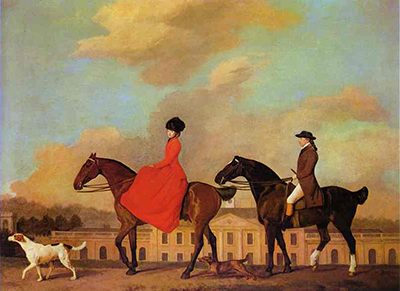
George Stubbs painted John and Sophia Musters Riding at Colwick Hall in 1777. An oil painting on panel, it is catalogued in a private collection. Its named sitters and recognisable estate make it a portrait of a particular household and place. [1]
Sophia rides ahead in red, while John follows on a darker horse. Behind them, the long façade of their house stretches almost across the picture. Two dogs occupy the narrow strip of ground beneath the horses. The scene brings people, animals and a substantial building into a single view: a portrait of a couple whose surroundings are unusually prominent. Looking at the house as well as the riders helps explain what their joint appearance makes visible. [2]
At a Glance
This work across George Stubbs’s career
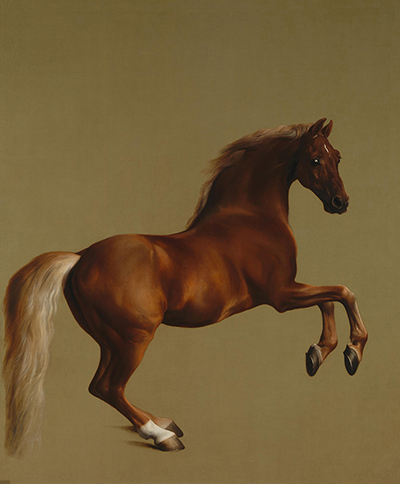
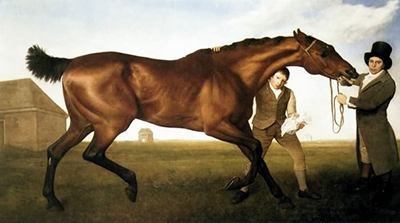
Whistlejacket
about 1762 [7]Contents
- A procession before the house
- John, Sophia and Colwick
- Riding dress and paired likenesses
- The riders who disappeared
- Wealth and the limits of a marriage story
- Private ownership and later looking
- Videos on George Stubbs
A procession before the house
Both horses face left, but their bodies are separated sufficiently for each silhouette to remain legible. Sophia's horse is a warm brown; John's is much darker, with white markings towards its feet. Their heads are carried at different heights, and the reins form several fine lines between the muzzles and the riders' hands. The animals stand close enough to establish a pair without merging into one dark mass. Their large bodies give the riders a substantial platform above the low line of the building. [2]
Sophia's skirt spreads across the side of her horse, making a conspicuous red shape between its neck and hindquarters. The cloth conceals part of the saddle and flank, so that her figure reads through dress as much as through the outline of her body. John's seat is more exposed: a pale breeched leg descends against the dark horse, ending in a black boot. Her red reaches down towards the foreground; his brown coat draws a quieter vertical shape above the second animal. These unequal areas of colour make the two figures easy to distinguish even in a small reproduction. [2]
The sky takes up a much greater area than the house. Clouds of warm pink and ochre cross a blue-grey field, leaving broad, relatively open space around the riders' heads. Neither person is crowded against a wall or a tree. Sophia's dark hat and John's brim interrupt the pale sky clearly, while the lower outlines of horses and dogs overlap the architecture. The figures thus connect two different zones: the spacious atmosphere above and the more closely articulated windows, doors and columns below. [2]
At the left, the predominantly white dog has moved beyond the leading horse's head. Its pale body stands out against the darker vegetation and the shaded end of the building. The brown dog appears low between the horses, its body extended along the ground. Their differing positions keep attention moving through the foreground rather than fastening it exclusively on the mounted couple. Neither animal needs a symbolic meaning for its placement to matter: each fills a different interval within the arrangement. [2]
The view of the hall is interrupted rather than presented as a complete architectural elevation. Horse bodies conceal sections of its roofline, while legs divide the windows and openings into glimpses. The central entrance remains visible between the animals. That partial view is effective: the house is extensive enough to register as an important presence, but the riders still command the foreground. It is seen through their passage, giving the building a close pictorial relationship with the people in front of it. [2]
John, Sophia and Colwick
John Musters lived from 1753 to 1827. His wife, Sophia Catherine, née Heywood, lived from 1758 to 1819. She was the daughter of James Modyford Heywood of Maristow in Devon and Catherine, née Hartopp. A modern Newfields catalogue places their marriage on 29 or 30 July 1776: the year is firmer than the precise day. Stubbs's portrait therefore followed their marriage by about a year. [16]
The same catalogue records both spouses in Joshua Reynolds's accounts, with Sophia appearing from 1777 onwards. Their commissioning of paintings by Stubbs sits within a wider interest in having their likenesses made, rather than defining the entirety of Sophia's portrait history. Calling this a picture of a newly married couple is justified; describing it as a documented wedding commission would require more specific evidence. Its paired presentation is visible, but the occasion on which it was ordered should not be confused with the occasion it might bring to mind. [16]
Colwick Hall stands near Nottingham. Historic England attributes its 1776 remodelling to the architect John Carr and the builder Samuel Stretton, working for John Musters. The official listing describes an early eighteenth-century house remodelled at that date, a more precise account than treating every part as an entirely new building. Its south front has a central Ionic portico beneath a pediment, with a two-storey main block and lower wings. [17]
That description helps identify the setting's character without assuming that all features visible at Colwick today existed when Stubbs painted it. The listing, for example, dates the north-front screen and colonnade later in the eighteenth century and records subsequent changes to openings. The painting looks towards the south front. Its orderly spread of central block and wings makes the house a clear setting for the couple's appearance soon after the remodelling, while the present building preserves a longer history than this one moment. [17]
The Arts Council's 2013 Acceptance in Lieu report places the separate equestrian portrait of John on his hunter Pilgrim within seven works commissioned from Stubbs in 1777–78. The group included this double portrait, the stable-block scene, horses and spaniels. Pilgrim is the name attached to that separate portrait; it does not securely identify either horse here. [18]
Riding dress and paired likenesses
The Metropolitan Museum of Art's Man and the Horse identifies Sophia's outfit as a red riding habit with a fitted coat and ample skirts, worn with a black fur hat. John wears a brown frock coat, a white stock and breeches, a round black hat and black boots with wide tops. Its account places the picture within the history of fashionable pleasure riding, where dress had a different emphasis from the specialised requirements of particular equestrian sports. [2]
Reynolds's separate portrait of John, now in the National Gallery of Art, dates from 1777 to about 1780. There, John stands in a landscape, wearing a brown coat and holding a hat, rather than appearing mounted before Colwick. The change of format alters what surrounds the sitter: the single standing figure can dominate a tall canvas, whereas Stubbs gives two horse-and-rider groups room across a broad setting. [19]
Sophia's likeness also circulated independently of this estate view. The National Portrait Gallery records mezzotints by John Raphael Smith after Reynolds published in 1779, and a later print by Samuel William Reynolds after Joshua Reynolds, published in 1835. These are reproductions of Reynolds's portraits, not engravings of Stubbs's mounted couple. Their existence nevertheless helps explain why identifying a picture simply as Mrs Musters is insufficient: her name belongs to several images, with different artists, formats and histories of circulation. A print of Sophia alone cannot establish the earlier appearance or alteration of this two-figure composition. [20]
The riders who disappeared
The painting's apparently settled arrangement conceals an unsettled history. The Metropolitan Museum's 1984 account states that both John and Sophia were eliminated from the picture and replaced by grooms leading the horses, before the original composition was restored in the twentieth century. It connects the change, cautiously, with presumed infidelity. This describes an alteration of the picture, rather than a visible narrative that Stubbs painted into its original scene. [2]
Kate Retford discusses the recovery of both riders through cleaning and an inferred sequence in which Sophia disappeared first. Her account draws attention to the removal of a wife from a family representation. That interpretation depends on the painting's subsequent history; it cannot turn the original figures' expressions into a forecast of the marriage. [21]
A crucial distinction concerns the companion stable-block picture. There Sophia was replaced by the Reverend Philip Story. Judy Egerton's 2007 catalogue explicitly identifies Stubbs as the maker of that replacement, distinguishing it from this portrait's alteration. The two histories cannot be collapsed into a claim that Stubbs removed and later repainted Sophia here to celebrate a reconciliation. [22]
Drawing on Marcia Pointon's work, Retford places altered portraits within a larger argument about possession and representation. A portrait was a material object that could be kept, given away or changed, as well as a likeness of a person. In this account, removing a spouse from an image could sever the representation of a relationship while preserving the object that had once expressed it. [21]
Wealth and the limits of a marriage story
Sophia's family connections extend beyond the English country house. In his study of opera subscribers and slavery-derived wealth, David Hunter traces her father James Modyford Heywood's ownership of Jamaican plantations. He records £8,000 bequests to each of the four surviving daughters, derived partly from a plantation sale in 1796. That later transaction establishes a family connection to wealth produced through enslavement; it does not identify the money used to pay for this 1777 painting. [23]
Hunter also documents Sophia's opera subscriptions. This evidence of her participation in London musical life adds a specific social setting beyond the country-house world presented in the riding portrait. [23]
Hunter distinguishes a genuine Burney comment on Sophia's beauty and fashionable prominence from the familiar formula describing her as beautiful but unhappy. He traces the latter to Edward Hamilton's later publication, rather than Burney. He likewise finds no official confirmation of Sophia's supposed bedchamber appointment to Queen Charlotte. These corrections limit the confident stories often attached to her image: neither the repeated phrase nor the court title provides evidence of her private thoughts. [23]
A later representation gives her accomplishments a more concrete place. After Sophia died on 19 September 1819, aged sixty-one, her husband erected a memorial by Richard Westmacott. Now at All Saints, Annesley, it was brought from Old Colwick Church. The Southwell and Nottingham Church History Project identifies painting, music and dancing on the three panels of its pedestal. The inscription presents the monument as a husband's affectionate commemoration. [24]
The memorial is another deliberate representation, created for a different purpose from a riding portrait. Its record of artistic accomplishments prevents Sophia from being considered only as the subject of marital gossip. Its affectionate language, however, cannot retrospectively prove that the couple lived happily throughout their marriage, or that any repainting marked a particular reconciliation. A commemorative inscription tells us how the deceased was publicly remembered. It is valuable evidence without being a complete account of the relationship. [24]
Private ownership and later looking
The older designation Major Musters Collection belongs to the Metropolitan Museum publication of 1984; it should be understood as a dated collection statement within the painting's documented collection history. The reproductions have made an otherwise privately held picture accessible to a much wider audience. [2]
In his 2020 review of the Stubbs exhibition at MK Gallery, Tom Stammers singled out the Colwick painting's relationship between the ordered passage of the horses and the dogs' quicker activity. His response shows how strongly the picture can register through arrangement and movement, even when little seems to happen. The review places this privately owned painting within a public exhibition context. [25]
That emphasis offers a useful way back to the painting after its more complicated history. A viewer can attend to the relationship between moving animals and the stable architectural setting without treating the scene as a transparent statement of the couple's feelings. Stammers's reading directs attention to pictorial construction. The biographical and material histories add further questions; they do not replace the activity of looking. [25]
Videos on George Stubbs
Explore Stubbs’s equestrian painting in its wider context, including two readings of Whistlejacket.
A Horse Lover’s Guide to the YCBA
A museum tour that places Stubbs alongside other artists who painted horses. It includes a look at Pumpkin with a Stable-lad.
Watch on YouTubeGeorge Stubbs artworks directory
Search works and related prints documented in this guide. Separate versions and printing matrices have separate entries; printmakers are named where known. Unidentified historical titles and untraced studio-sale material are discussed in the essays. A dash means that a date is not established here.
| Name | Date | Medium |
|---|---|---|
| A Bay Horse with a Groom | 1791 | Painting |
| A Bay Hunter with Two Playful Spaniels | 1777 | Painting |
| A Bay Hunter, a Springer Spaniel and a Sussex Spaniel in a wooded river Landscape | 1782 | Painting |
| A Cheetah and a Stag with Two Indian Attendants | about 1764 | Painting |
| A Couple of Fox Hounds (coloured print after Stubbs) | — | Print after Stubbs |
| A Couple of Foxhounds | 1792 | Painting |
| A Foxhound on the Scent | 1788 | Drawing |
| A Gentleman driving a Lady in a Phaeton | 1787 | Painting |
| A Grey Horse | 1793 | Painting |
| A Grey Horse (cantering companion) | 1793 | Painting |
| A Grey Stallion in a Landscape | — | Painting |
| A Horse Affrighted at a Lion | 1 May 1788 | |
| A Horse Belonging to the Rt. Honourable Lord Grosvenor called Bandy from his Crooked Leg | about 1763 | Painting |
| A Horse Frightened by a Lion | 1777 | |
| A Lion (A Lion Resting on a Rock) | 1 May 1788 | |
| A Lion Attacking a Horse | 1770 | Painting |
| A Lion Attacking a Horse (monumental Yale canvas) | 1762 | Painting |
| A lion attacking a horse (NGV) | about 1765 | Painting |
| A Lion Devouring a Horse (1788 print) | 1788 | |
| A lion devouring a horse (attribution disputed) | Proposed mid-1770s | Painting |
| A mare and foal with a bay horse | 1771 | Painting |
| A Monkey | 1799 | Painting |
| A Prancing Horse, Facing Right | c. 1790 | Drawing |
| A Rough Dog | 1790 | Painting |
| A Saddled Bay Hunter | 1786 | Painting |
| A Sleeping Leopard | 1 January 1791 | |
| A Tiger and a Sleeping Leopard | 1 May 1788 | |
| A Tigress (John Dixon after Stubbs) | 1772 | Print after Stubbs |
| A Tyger (A Recumbent Leopard by a Tree) | 1 May 1788 | |
| A Tyger (Sleeping Leopard) | 1 May 1788 | |
| An animal found on the coast of New Holland called kanguroo (after Stubbs) | 1773 | Print after Stubbs |
| An animal of a new species found on the coast of New South Wales (after Stubbs) | July 1773 | Print after Stubbs |
| Antinous and Jockey | — | Painting |
| Antinoüs, a chestnut racehorse, in a landscape | Undated | Painting |
| Bandy belonging to Lord Grosvenor (print after Stubbs) | — | Print after Stubbs |
| Baronet (George Townley Stubbs after Stubbs) | 20 February 1794 | Print after Stubbs |
| Baronet with Sam Chifney Up | 1791 | Painting |
| Baronet with Samuel Chifney up (Royal Collection) | 1791 | Painting |
| Bay Hunter by a Lake | 1787 | Painting |
| Brood Mares (Benjamin Green after Stubbs) | Issue 14 November 1776 | Print after Stubbs |
| Brood Mares and Foals | usually dated 1767 | Painting |
| Brown and White Norfolk or Water Spaniel | 1778 | Painting |
| Bulls Fighting | 1786 | Painting |
| Captain Samuel Sharpe Pocklington with His Wife, Pleasance, and possibly His Sister, Frances | 1769 | Painting |
| Death of the Doe (attribution disputed) | 1804 | |
| Der Englische Hühnerhund (Johann Wölfle after Stubbs) | about 1860 | Print after Stubbs |
| Dog (A Foxhound Viewed from Behind) | 1 May 1788 | |
| Dog [A Foxhound on the Scent] | 1788 | |
| Drill and albino baboon | before 1789 | Painting |
| Eclipse (Charles Hunt after Stubbs) | 12 November 1839 | Print after Stubbs |
| Eclipse (George Townley Stubbs after Stubbs) | 1796 | Print after Stubbs |
| Eclipse (oil study) | — | Painting |
| Eclipse (Thomas Burke after Stubbs) | First published 1772 | Print after Stubbs |
| Eclipse and John Wildman (Benjamin Green after Stubbs) | 1772 | Print after Stubbs |
| Eclipse at Newmarket (Jockey Club version) | Proposed early 1790s; often dated 1770 | Painting |
| Eclipse at Newmarket with a groom and jockey | 1770 | Painting |
| Eclipse with Mr Wildman and His Sons | 1769–71 | Painting |
| Eclipse, the Property of Capt.n O Kelly (anonymous print after Stubbs) | Imprint 4 June 1804; impression undated | Print after Stubbs |
| Euston | 1774 | Painting |
| Finished Study for the Seventh Anatomical Table of the Muscles of the Horse | 1756–58 | Drawing |
| Five Brood Mares at the Duke of Cumberland's Stud Farm in Windsor Great Park | 1765 | Painting |
| Fowl Body, Lateral View (Highly Finished Study for an Unpublished Table; Shows the Last Stage in Dissection) | — | Drawing |
| Fowl Body, Lateral View (Probably Prepared for Transfer to the Plate for Engraving of Table XV) | — | Drawing |
| Fowl Skeleton, Lateral View (Finished Study for Table V) | — | Drawing |
| Freeman, the Earl of Clarendon's Gamekeeper, with a Dying Doe and Hound (Yale) | 1800 | Painting |
| George Stubbs (enamel self-portrait) | 1781 | Enamel |
| Gimcrack (George Townley Stubbs after Stubbs) | 1775 | Print after Stubbs |
| Gimcrack on Newmarket Heath, with a trainer, a jockey and a stable lad | about 1765 | Painting |
| Gimcrack, with John Pratt up, on Newmarket Heath | about 1765 | Painting |
| Hambletonian, Rubbing Down | 1800 | Painting |
| Hay-Makers | 1791 | |
| Haycarting | 1795 | Enamel |
| Haymakers | 1785 | Painting |
| Haymakers (Lady Lever Art Gallery) | 1794 | Enamel |
| Hollyhock (with later additions by Vernet and Boucher) | about 1765–70 | Painting |
| Horse Attacked by a Lion (Episode C) | 1768–69 | Painting |
| Horse Attacked by a Lion (Tate enamel) | 1769 | Enamel |
| Horse Devoured by a Lion | Possibly exhibited 1763 | Painting |
| Horse Frightened by a Lion | 1770 | Painting |
| Horse Frightened by a Lion (Episode A; Wedgwood and Bentley after Stubbs) | — | Sculpture |
| Horse Frightened by a Lion (Tate) | Possibly exhibited 1763 | Painting |
| Horse Frightened by a Lion (Yale) | 1762–68 | Painting |
| Horse in the Shade of a Wood | 1780 | Painting |
| Hound Coursing a Stag | about 1762 | Painting |
| Human Figure, Anterior View (Intended for a Plate That was Never Published) | — | Drawing |
| Human Skeleton, Lateral View | 1795–1806 | Drawing |
| Hunt servants setting out (Southill commission) | 1767 | Painting |
| Hühnerhund (The Spanish Pointer) | about 1766 | Painting |
| John and Sophia Musters Riding at Colwick Hall | 1777 | Painting |
| John Musters on his hunter Pilgrim | 1777–78 | Painting |
| Labourers | 1789 | |
| Labourers (Richard Earlom after Stubbs and Amos Greene) | 25 March 1790 | Print after Stubbs |
| Laetitia, Lady Lade (d.1825) | 1793 | Painting |
| Lemon and White Water Spaniel | — | Painting |
| Lion Attacking a Stag | — | Painting |
| Lord Grosvenor's Arabian Stallion with a Groom | about 1765 | Painting |
| Lord Grosvenor's Arabian Stallion with a Groom (Peter Mazell after Stubbs) | 1771 | Print after Stubbs |
| Mambrino (Eaton Hall painting) | — | Painting |
| Mambrino (George Townley Stubbs after Stubbs) | 1794 | Print after Stubbs |
| Mares and Foals belonging to the 2nd Viscount Bolingbroke | about 1761–62 | Painting |
| Mares and foals beneath large oak trees | — | Painting |
| Mares and Foals by a stream | Exhibited 1764 | Painting |
| Mares and Foals in a River Landscape | about 1763–68 | Painting |
| Mares and Foals in an Extensive Landscape | about 1769 | Painting |
| Mares and Foals without a Background | 1762 | Painting |
| Moose Deer (after Stubbs) (Arctic Zoology plate VIII) | 1784–85 publication | Print after Stubbs |
| Newmarket Heath with a Rubbing-Down House | — | Painting |
| Otho (1796 print after Stubbs) | 1 December 1796 | Print after Stubbs |
| Otho, with John Larkin up | 1768 | Painting |
| Pangloss | about 1762 | Painting |
| Patch (Grafton commission) | 1759 | Painting |
| Phaeton and the Chariot of the Sun (enamel) | 1775 | Enamel |
| Phaeton with a Pair of Cream Ponies and a Stable-Lad | 1780–84 | Painting |
| Phillis | 1772 | Painting |
| Portrait of a Large Dog (Dingo) | 1772 | Painting |
| Pumpkin with a Stable-lad | 1774 | Painting |
| Racehorses Exercising at Goodwood | 1759–60 | Painting |
| Reapers (1791 print) | 1791 | |
| Reapers (Tate) | 1785 | Painting |
| Reapers (Yale) | 1795 | Enamel |
| Red Deer: A Stag and a Hind | 1792 | Painting |
| Richard Wedgwood | — | Enamel |
| Ringwood, a Brocklesby Foxhound | 1792 | Painting |
| Scrub, a bay horse belonging to the Marquess of Rockingham | about 1762 | Painting |
| Self Portrait on a White Hunter | 1782 | Enamel |
| Self-Portrait | about 1759 | Painting |
| Shooting (1770 Woollett plate after Stubbs) | 1770 | Print after Stubbs |
| Shooting (1771 Woollett plate after Stubbs) | 1771 | Print after Stubbs |
| Shooting at Goodwood | 1759–60 | Painting |
| Sir John Nelthorpe as a boy | 1756 | Painting |
| Sir John Nelthorpe partridge shooting with one pointer | — | Painting |
| Sir John Nelthorpe, 6th Baronet, out Shooting with His Dogs in Barton Field, Lincolnshire | 1776 | Painting |
| Sleeping Leopard | 1777 | Enamel |
| Soldiers of the 10th Light Dragoons | 1793 | Painting |
| Stallion and Mare (George Townley Stubbs after Stubbs) | 1776; reissued 1789 | Print after Stubbs |
| Steward and gamekeeper with dogs (Southill commission) | 1767 | Painting |
| Studies of a Lemur (Lemur murinus) in six different attitudes | 1773 | Drawing |
| Study for the Self-portrait in Enamel | c. 1781 | Drawing |
| Study of a Lemur | 1773 | Drawing |
| Study of a Racehorse in Action: Galloping to Left, a Semi-Anatomical Study, with Skin Flayed to Show Action of Muscles | — | Drawing |
| Study of the Legs of a Draught-Horse Pulling a Harrow (attributed to Stubbs) | Proposed about 1786 | Drawing |
| Sweet William (Grosvenor panel) | — | Painting |
| Sweet William (Turf Gallery canvas) | — | Painting |
| The Black Stallion Sampson, Portrayed from Three Angles (with landscape additions) | about 1764 | Painting |
| The Charlton Hunt | 1759–60 | Painting |
| The Fall of Phaeton | — | Sculpture |
| The Frightened Horse | 1780 | Sculpture |
| The Grosvenor Hunt | — | Painting |
| The Haymakers (Upton House) | 1783 | Painting |
| The Horse and Lion (George Townley Stubbs after George Stubbs) | 1770 | Print after Stubbs |
| The Kongouro from New Holland | 1772 | Painting |
| The Labourers | 1779 | Painting |
| The Labourers (Southill original) | 1767 | Painting |
| The lion and horse (Benjamin Green after Stubbs) | 1769; reissued 1777 | Print after Stubbs |
| The Milbanke and Melbourne Families | about 1769 | Painting |
| The Moose | 1770 | Painting |
| The Prince of Wales's Phaeton | 1793 | Painting |
| The Reapers (Upton House) | 1783 | Painting |
| The Sebra, or Wild Ass (George Townley Stubbs after Stubbs) | 1771 | Print after Stubbs |
| The Spanish Pointer (Bradford version) | about 1766–68 | Painting |
| The Spanish Pointer (William Woollett after Stubbs) | January 1768 | Print after Stubbs |
| The Third Duke of Dorset's Hunter with a Groom and a Dog | 1768 | Painting |
| Thomas Freeman, Lord Clarendon's gamekeeper, with a dog and a shot doe (with George Townly Stubbs) | 1803 | Painting |
| Turf, with Jockey up, at Newmarket | — | Painting |
| Turk and Crab | — | Painting |
| Two Bay Hunters Communing On The Bank Of A Lake | — | Painting |
| Tygers at Play | 1780 | |
| Viscount Gormanston's White Dog | 1781 | Painting |
| Viscount Gormanston's White Dog (canvas version) | — | Painting |
| Water Spaniel | 1769 | Painting |
| Wedgwood Family Portrait | 1780 | Painting |
| Whistlejacket | about 1762 | Painting |
| Whistlejacket with two other stallions and a groom | Recorded 1762 | Painting |
| White Poodle in a Punt | about 1780 | Painting |
| William Anderson with two Saddle-Horses | 1793 | Painting |
| Working Drawing for the Seventh Anatomical Table of the Muscles of the Horse | 1756–58 | Drawing |
| Zebra | 1763 | Painting |
Discussion
Look again at the images and ideas explored in John and Sophia Musters Riding at Colwick Hall. These editorial prompts invite your observations.
Reader Insights
Which part of the view first catches your attention: Sophia's red dress, the dark horses, or the long façade?
Follow the different outlines against the sky and the building.
Where does one shape interrupt another, and which details become clearer when you look again?
Join the Conversation
Share a detail, comparison or question about John and Sophia Musters Riding at Colwick Hall below.
References
- Bridgeman Images. John and Sophia Musters riding at Colwick Hall, 1777, BAL1923. Collection record. Accessed 4 November 2026. View source.
- Alexander Mackay-Smith, Jean R. Druesedow and Thomas Ryder. Man and the Horse: An Illustrated History of Equestrian Apparel. New York: Metropolitan Museum of Art and Simon and Schuster, 1984, p. 48. Book. Accessed 4 November 2026. View source.
- Goodwood, The Collection, Painting Collection modal, Racehorses Exercising at Goodwood; An exciting acquisition: a study by George Stubbs, 30 June 2023; History of the Estate Hounds, 4 October 2023; About Goodwood Racecourse. Accessed 4 November 2026. View source.
- Goodwood, The Collection, Painting Collection modal, Racehorses Exercising at Goodwood; An exciting acquisition: a study by George Stubbs, 30 June 2023; History of the Estate Hounds, 4 October 2023; About Goodwood Racecourse. Accessed 4 November 2026. View source.
- Goodwood, The Collection, Painting Collection modal, Racehorses Exercising at Goodwood; An exciting acquisition: a study by George Stubbs, 30 June 2023; History of the Estate Hounds, 4 October 2023; About Goodwood Racecourse. Accessed 4 November 2026. View source.
- Goodwood, The Collection, Painting Collection modal, Racehorses Exercising at Goodwood; An exciting acquisition: a study by George Stubbs, 30 June 2023; History of the Estate Hounds, 4 October 2023; About Goodwood Racecourse. Accessed 4 November 2026. View source.
- National Gallery, Whistlejacket, NG6569, current collection record, provenance, in-depth discussion and frame entry. View source.
- Yale Center for British Art, Zebra, B1981.25.617, current object metadata, gallery labels, Malcolm Warner’s 1998 catalogue entry and provenance supplied through the museum’s public collection record. View source.
- Christie’s, Gimcrack on Newmarket Heath, with a trainer, a jockey and a stable lad, London, 5 July 2011, lot 12; object details, essay, provenance, exhibitions and whole image. View source.
- Christie’s, Gimcrack on Newmarket Heath, with a trainer, a jockey and a stable lad, London, 5 July 2011, lot 12; object details, essay, provenance, exhibitions and whole image. View source.
- Yale University Art Gallery, A Lion Attacking a Horse, 1770, 1955.27.1, collection record. Accessed 4 November 2026. View source.
- Royal Museums Greenwich, ‘The Kongouro from New Holland’ (Kangaroo), ZBA5754. Accessed 4 November 2026. View source.
- Bridgeman Images. John and Sophia Musters riding at Colwick Hall, 1777, BAL1923. Collection record. Accessed 4 November 2026. View source.
- Tate, George Stubbs, Haymakers, 1785, T02256; details, Terry Riggs’s collection text (January 1998), and online caption. Collection record. View source.
- Frances Bailey, ‘Hambletonian, Rubbing Down: A masterpiece by George Stubbs’, National Trust Cultural Heritage Magazine, Autumn/Winter 2024, pp. 22–33. Article. View source.
- Molly Dorkin Taylor. “Portrait of a Woman, possibly Mrs. Charles James Fox.” Masterpieces from the Clowes Collection, Newfields, 2022, paragraph 7. Catalogue entry. Accessed 4 November 2026. View source.
- Historic England. Colwick Hall, National Heritage List for England, entry 1254981. Official listing. Accessed 4 November 2026. View source.
- Arts Council England. Acceptance in Lieu Report 2013, pp. 26–27, case 8, “Equestrian Portrait of John Musters”. Report. Accessed 4 November 2026. View source.
- National Gallery of Art. Joshua Reynolds, John Musters, 1777–c.1780, 1961.2.2. Collection record. Accessed 4 November 2026. View source.
- National Portrait Gallery. Sophia Musters (née Heywood), person mp64409; prints D39138, D39139 and D14619. Sitter record. Accessed 4 November 2026. View source.
- Kate Retford. Family and Familiarity: The Domestic Sphere in Eighteenth-Century English Visual Culture. PhD thesis, University of Warwick, 2000, vol.1, pp. 278–279 and note 72. Thesis. Accessed 4 November 2026. View source.
- Judy Egerton. George Stubbs, Painter: Catalogue Raisonné. New Haven and London: Yale University Press for the Paul Mellon Centre for Studies in British Art, 2007, p. 392, no. 188. Catalogue. Accessed 4 November 2026. View source.
- David Hunter. “The Profiteers of Slavery Go to the Opera: London, 1782–1808.” Cambridge Opera Journal 37, no. 1 (2025): 1–26, case study 3 and notes 77–95. Article. Accessed 4 November 2026. View source.
- Southwell and Nottingham Church History Project. “Annesley All Saints: Monuments and Memorials”, no. 5, Sophia Musters. Memorial record. Accessed 4 November 2026. View source.
- Tom Stammers. “Animal instinct – George Stubbs at MK Gallery, reviewed.” Apollo, 3 January 2020. Review. Accessed 4 November 2026. View source.
- Basic title, date and material metadata for Tate’s Reapers (T02257) and Otho (T02375) is adapted from the Tate collection dataset, October 2014, released under CC0. TheHistoryOfArt.org has reconciled labels and versions. This credit does not apply to Tate’s authored catalogue commentary or images.
- Data Source: Yale Center for British Art. Basic object fields are adapted and reconciled for this directory. Reuse is subject to the Center’s Open Data and Data Services Terms of Use. No museum endorsement is implied. This metadata credit does not relabel scholarly essays or images as open data.
- Basic object metadata for A Horse Frightened by a Lion, 1985.38, The Cleveland Museum of Art, John L. Severance Fund, is available under CC0. Titles and design-level grouping have been reconciled for this directory.