 by Tom Gurney
Tom Gurney BSc (Hons) is an art history expert with over 20 years experience
Email: tomgurney1@gmail.com / Phone: +44 7429 011000
Captain Samuel Sharpe Pocklington with His Wife, Pleasance, and possibly His Sister, Frances: Introduction
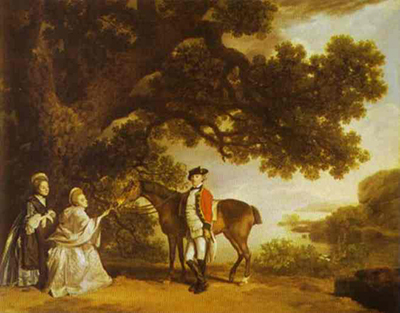
A woman in white holds flowers beneath a horse's nose. Beside the animal, a red-coated man stands with his ankles crossed; another woman watches from behind a chair. Above them, an immense tree spreads across the sky. Stubbs makes this small encounter the focus of a landscape whose upper branches and distant water occupy far more space than the people themselves. [1]
The painting is a marriage portrait with an unusually consequential change of title. [2] Its present name identifies Captain Samuel Sharpe Pocklington and his wife, Pleasance, while leaving the standing woman's identity tentative. The National Gallery of Art in Washington holds the 1769 oil on canvas as accession 1952.9.4. Its overall dimensions are 100.2 × 126.6 centimetres; the lower-right inscription reads “Geo: Stubbs / pinxit 1769”. [3]
The contrast between a formal uniform and an apparently casual meeting is central to its appeal. No one rides, marches or makes a grand public gesture. The horse's head and the woman's extended hand provide a smaller point of contact, around which the group coheres. Among Stubbs's paintings, this is an especially concentrated example of people and animal sharing the same pictorial space. [1]
At a Glance
This work across George Stubbs’s career
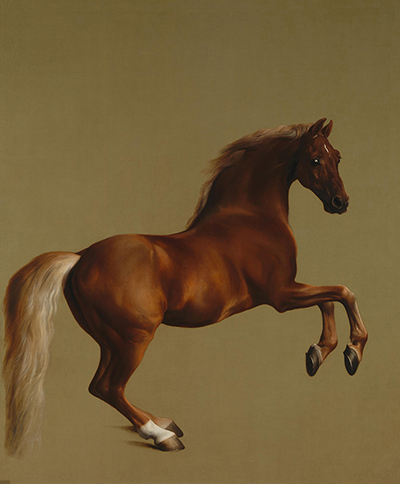
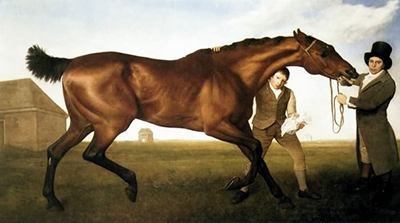
Whistlejacket
about 1762 [8]Contents
- A marriage and a new name
- The captain at rest
- The horse and the offered flowers
- Under the spreading canopy
- A conversation piece, carefully arranged
- Canvas, paint and the history of treatment
- From a family possession to Washington
- Exhibitions and a corrected identity
- Videos on George Stubbs
A marriage and a new name
The Chelsworth village chronology records the marriage of Pleasance Pykarell and Samuel Sharpe in 1769, the year on the canvas, associating the couple with the Pocklington name and arms. [17]
All Saints Church's guide connects this change with Robert Pocklington, Pleasance's cousin and the owner of Chelsworth Manor. It describes his requirement that successors take his surname, including an heiress's husband, and spend five months of each year at Chelsworth. This is a local account of the estate's succession conditions, rather than a statement of what Stubbs was instructed to paint. [18]
The same church preserves a different kind of family image: Pleasance's funerary hatchment, identified by the guide above the north door. The guide records her death in 1774. This local commemoration gives her a history beyond the young woman in white, although the painting contains no reference to that later death. [18]
The seated woman's dress expands into a broad, luminous shape. Its folds gather around the chair and spread towards the ground, making her visible even against the darkest part of the tree. Her arm reaches upwards from the enveloping fabric; a narrow hand and a few flowers bridge the interval to the muzzle. Her face tilts along the same rising direction. [1]
Hayes distinguishes Pleasance's earlier Pocklington surname from Samuel's adoption on marriage. He identifies a wedding gown and marriage portrait. Egerton corrected the Colonel-and-sisters identification, recorded at the 1911 Blagrave sale. The standing woman is unestablished, possibly Samuel's unmarried sister Frances. [2]
The two women are sharply differentiated by dress and posture. Behind the white figure, the other woman's blue skirt runs down in straighter folds. Dark fabric crosses her upper body and descends over the front of the dress; pale sleeve edges catch the light near the chair. Her forearms lie across its back. This upright, comparatively compact silhouette makes the seated woman's flowing outline easier to read. [1]
The captain at rest
Hayes dates Samuel's Third Foot Guards service from 1760 and tentatively places his resignation shortly after marriage. [2]
The National Army Museum explains the regiment's changing names: it became the Scots Fusilier Guards in 1831 and the Scots Guards in 1877. Calling Samuel an officer of the Third Foot Guards therefore keeps the uniform within its eighteenth-century setting. The regiment's campaigns are a separate history; membership alone does not show which actions this particular officer experienced. [19]
His coat supplies the strongest red in the picture. Blue facing and narrow gold-coloured edges frame the pale waistcoat, while the open front lets the light clothing continue down towards his knees. Below it, polished black boots compress the light-dark pattern into a much narrower area. The cocked hat makes a dark horizontal accent above his face. His figure remains immediately legible despite the dark mass of the horse directly behind him. [1]
The sword is present, but it does not interrupt the relaxed arrangement. Its scabbard drops beside the pale breeches, close to the gloved hand. One boot crosses before the other. At shoulder level, Samuel's arm reaches back along the horse, joining his upright torso to its long horizontal body. These diagonals keep the standing figure from looking like an isolated military effigy. [1]
There is a difference between the direction of his body and the direction of the group's activity. His legs belong to the foreground; his upper body overlaps the horse; his face turns more outward than either woman's. The flowers attract the other faces towards the animal, while Samuel remains available to the spectator. The resulting arrangement permits several directions of attention without needing a depicted conversation. [1]
The horse and the offered flowers
The horse is almost broadside, with its head turned towards the seated figure. Its barrel continues behind Samuel and emerges on his other side as a rounded hindquarter. The mane is dark against the neck, and the short tail projects into the lighter distance. A pale marking near a hind hoof supplies a small bright note beneath the brown body. Head, back, belly and legs are distinct shapes, even where human and animal overlap. [1]
Look especially at the space between Pleasance and the horse's chest. The reins make several long, shallow curves through the gap. They gather towards the bridle and muzzle, close to the hand holding the flowers, while their other ends pass towards Samuel. The lines make the interval visible: the figures do not need to be pressed together to form a connected group. [1]
Its bent hind leg contributes to the picture's suspension of activity. The angle differs from the more upright legs that bear its body, while Samuel's crossed boots produce another set of converging diagonals in front. Neither body is presented in the forceful extension of movement. The small forward reach of the head becomes more noticeable because the rest of the group is so composed. [1]
The posy remains tiny in relation to the horse. Stubbs has not filled the space with a basket, trough or large bunch of vegetation. A few spots of colour, the pale fingertips and the approaching muzzle are enough. That scale matters: the exchange is discovered within the larger composition rather than announced by a large prop. Calling the gesture an offering describes what can be seen without supplying an account of the animal's appetite. [1]
This horse has no securely established individual history in the accounts of the painting. [3] Its bridle and its proximity to Samuel do not identify a racer, hunter or favourite mount. Its pictorial role is clearer: it stretches between the human figures and gives their separate poses a common focus. The social setting distinguishes this example of animal painting from the concentrated isolation of Whistlejacket. [1]
Under the spreading canopy
The upper part of the canvas is anything but empty background. From a thick trunk at the left, branches rise and turn across almost the entire width. Some disappear into dense leaves; others emerge as dark, bent lengths against the sky. The largest branch passes above Samuel and the horse. The group occupies a low strip underneath this enormous overhead structure. [1]
That disparity of scale prevents the figures from filling the painting like a row of full-length portraits against a curtain. The tree has its own weight, extent and irregularity. Its dark trunk anchors the left boundary, where the women stand and sit; the branch's outward movement carries the eye above the horse towards the right. It frames the meeting without becoming a symmetrical arch. [1]
The ground supplies a different kind of continuity. A warm, largely bare strip passes beneath the chair, dress, boots and hooves. Small shadows articulate the points where bodies meet it. At the lower right, a darker bank breaks the strip's smooth passage towards the edge. The individual feet and chair need this common surface: without it, the carefully separated silhouettes would seem to float. [1]
Beyond the animal, pale water curves between low land and a rocky outcrop. The far hills have much less definition than the tree trunk or costume. Blue-grey cloud and warmer light near the horizon introduce another gradual transition. The eye can travel from the highly articulated foreground into this softer distance, then return to the figures through the dark outline of the horse. [1]
White clothing, red coat and blue dress divide the human group into unequal areas of colour. Pleasance's pale fabric is the broadest; Samuel's red is narrower but more intense; the standing woman's blue is partly enclosed by dark cloth. These differences prevent the three people from becoming equivalent upright units. Their common setting holds together figures who retain strongly individual outlines. [1]
A conversation piece, carefully arranged
A conversation piece is a kind of group portrait, rather than an assurance that the figures are speaking. The Metropolitan Museum classifies Hogarth's 1729 Wedding of Stephen Beckingham and Mary Cox as an early example. Its setting is based on a church other than the actual wedding venue. A marriage picture can therefore commemorate an event while constructing its own setting; literal reportage is not the defining requirement. [20]
A closer comparison is Stubbs's Milbanke and Melbourne family group, about 1769. The National Gallery associates it with the families' marriage alliance and records its exhibition as A Conversation in 1770. The Gallery also notes how the spreading tree and the shallow band occupied by the figures unite the composition. [21]
In that separate picture, the carriage, several horses and the dog extend the gathering across the foreground. Pocklington's group is more tightly concentrated around one animal and a single offered posy. The resemblance lies in the organisation of a social portrait beneath a tree; the particular encounters differ. Neither the other family's relationships nor the identities of its horses explain the Pocklington animal. [21]
Hayes reports Basil Taylor's comparison with Reynolds's Henry Fane group, including the tentative possibility of Stubbs seeking larger portrait commissions. [2]
The Metropolitan Museum dates Reynolds's Henry Fane with Inigo Jones and Charles Blair to 1761–66. At 254.6 × 360.7 centimetres, it is substantially larger than the Pocklington canvas. The Museum describes a fictional landscape and figures arranged from individual studio sittings. That account belongs to Reynolds's procedure; it is not documentation of how Stubbs assembled this group. [22]
The visible comparison is illuminating nonetheless. Reynolds places a standing, red-coated man on the right of a seated pair, with a table and a greyhound linking their leisure. Stubbs's man and women are joined by an entirely different animal encounter. The crossed stance and uneven distribution of seated and standing figures help explain the formal affinity without making either painting a copy of the other. [22]
Canvas, paint and the history of treatment
Hayes records medium-weight, plain-woven canvas, an old lining, intact tacking margins and a non-original stretcher. Remounting was slightly off-centre: original paint extended over the top edge, with overpainted ground along the bottom. A greyish-white ground supported smooth, fluid, fairly thick paint with low impasto. An old retouched tear lay near the right-hand rocks. Treatment in 1984 included inpainting craquelure and glazing abrasions near the horse's rump and foliage, without relining. These are dated observations, rather than a current condition report. [2]
See also Stubbs's technique for the artist's broader material practice.
From a family possession to Washington
The NGA provenance begins with Samuel as the person for whom the picture was painted. It passed through his elder son, Colonel Sir Robert Pocklington, who married Catherine Blagrave, to John Blagrave of Calcot Park. Francis Howard bought it for Knoedler at Foster's London sale on 28 June 1911, lot 102. Charles Stewart Carstairs acquired it by 1913; after his death it passed to his widow. The NGA records her bequest in 1952, commemorating her husband. [3]
The transition to Washington began before that accession year. The Gallery's report for the financial year ending in June 1948 lists the Stubbs among works received on loan from Mrs Charles Carstairs. It appears there under the old Colonel-and-sisters title. The lender's address is given as Paris; the entry records the loan, rather than a Paris exhibition or a new French owner. [23]
The 1950 report then records the trustees' acceptance on 18 October 1949. Again the painting carries the older identification. The earlier loan, this formal acceptance and the 1952 bequest recorded today describe different stages in the same acquisition history. Reducing all three to a single arrival date would obscure the years in which the work's relationship with the museum was developing. [24]
Exhibitions and a corrected identity
Its public history includes Vienna in 1927, English Conversation Pieces in 1930, British Art in 1934 and a Tate loan from 1936 to 1947. The NGA also records its inclusion in Stubbs & The Horse in 2004–05. [3]
Between those earlier displays and the horse exhibition came the Tate and Yale retrospective of 1984–85. The NGA's annual report gives the London dates as 18 October 1984 to 6 January 1985, followed by New Haven from 13 February to 7 April 1985. Its loan list already calls the sitters Captain Samuel, his wife Pleasance and a possible sister Frances. The corrected relationship was therefore circulating before the 1992 systematic catalogue. [25]
The two earlier annual reports and the later exhibition list preserve a visible change in the picture's reception: a supposed group of siblings became a marriage portrait with a tentative third identity. They record changing knowledge about one canvas, rather than successive versions of the composition. [23] [24] [25]
Returning to the image, the distinctions between the sitters become easier to appreciate. The seated woman performs the small central gesture; the standing woman observes from behind; the man connects the horse with the spectator. The scene's intimacy is made through these exact placements and intervals. In George Stubbs's art, the study of an animal could sustain a human portrait as fully as it could occupy a canvas of its own. [1]
Videos on George Stubbs
Explore Stubbs’s equestrian painting in its wider context, including two readings of Whistlejacket.
A Horse Lover’s Guide to the YCBA
A museum tour that places Stubbs alongside other artists who painted horses. It includes a look at Pumpkin with a Stable-lad.
Watch on YouTubeGeorge Stubbs artworks directory
Search works and related prints documented in this guide. Separate versions and printing matrices have separate entries; printmakers are named where known. Unidentified historical titles and untraced studio-sale material are discussed in the essays. A dash means that a date is not established here.
| Name | Date | Medium |
|---|---|---|
| A Bay Horse with a Groom | 1791 | Painting |
| A Bay Hunter with Two Playful Spaniels | 1777 | Painting |
| A Bay Hunter, a Springer Spaniel and a Sussex Spaniel in a wooded river Landscape | 1782 | Painting |
| A Cheetah and a Stag with Two Indian Attendants | about 1764 | Painting |
| A Couple of Fox Hounds (coloured print after Stubbs) | — | Print after Stubbs |
| A Couple of Foxhounds | 1792 | Painting |
| A Foxhound on the Scent | 1788 | Drawing |
| A Gentleman driving a Lady in a Phaeton | 1787 | Painting |
| A Grey Horse | 1793 | Painting |
| A Grey Horse (cantering companion) | 1793 | Painting |
| A Grey Stallion in a Landscape | — | Painting |
| A Horse Affrighted at a Lion | 1 May 1788 | |
| A Horse Belonging to the Rt. Honourable Lord Grosvenor called Bandy from his Crooked Leg | about 1763 | Painting |
| A Horse Frightened by a Lion | 1777 | |
| A Lion (A Lion Resting on a Rock) | 1 May 1788 | |
| A Lion Attacking a Horse | 1770 | Painting |
| A Lion Attacking a Horse (monumental Yale canvas) | 1762 | Painting |
| A lion attacking a horse (NGV) | about 1765 | Painting |
| A Lion Devouring a Horse (1788 print) | 1788 | |
| A lion devouring a horse (attribution disputed) | Proposed mid-1770s | Painting |
| A mare and foal with a bay horse | 1771 | Painting |
| A Monkey | 1799 | Painting |
| A Prancing Horse, Facing Right | c. 1790 | Drawing |
| A Rough Dog | 1790 | Painting |
| A Saddled Bay Hunter | 1786 | Painting |
| A Sleeping Leopard | 1 January 1791 | |
| A Tiger and a Sleeping Leopard | 1 May 1788 | |
| A Tigress (John Dixon after Stubbs) | 1772 | Print after Stubbs |
| A Tyger (A Recumbent Leopard by a Tree) | 1 May 1788 | |
| A Tyger (Sleeping Leopard) | 1 May 1788 | |
| An animal found on the coast of New Holland called kanguroo (after Stubbs) | 1773 | Print after Stubbs |
| An animal of a new species found on the coast of New South Wales (after Stubbs) | July 1773 | Print after Stubbs |
| Antinous and Jockey | — | Painting |
| Antinoüs, a chestnut racehorse, in a landscape | Undated | Painting |
| Bandy belonging to Lord Grosvenor (print after Stubbs) | — | Print after Stubbs |
| Baronet (George Townley Stubbs after Stubbs) | 20 February 1794 | Print after Stubbs |
| Baronet with Sam Chifney Up | 1791 | Painting |
| Baronet with Samuel Chifney up (Royal Collection) | 1791 | Painting |
| Bay Hunter by a Lake | 1787 | Painting |
| Brood Mares (Benjamin Green after Stubbs) | Issue 14 November 1776 | Print after Stubbs |
| Brood Mares and Foals | usually dated 1767 | Painting |
| Brown and White Norfolk or Water Spaniel | 1778 | Painting |
| Bulls Fighting | 1786 | Painting |
| Captain Samuel Sharpe Pocklington with His Wife, Pleasance, and possibly His Sister, Frances | 1769 | Painting |
| Death of the Doe (attribution disputed) | 1804 | |
| Der Englische Hühnerhund (Johann Wölfle after Stubbs) | about 1860 | Print after Stubbs |
| Dog (A Foxhound Viewed from Behind) | 1 May 1788 | |
| Dog [A Foxhound on the Scent] | 1788 | |
| Drill and albino baboon | before 1789 | Painting |
| Eclipse (Charles Hunt after Stubbs) | 12 November 1839 | Print after Stubbs |
| Eclipse (George Townley Stubbs after Stubbs) | 1796 | Print after Stubbs |
| Eclipse (oil study) | — | Painting |
| Eclipse (Thomas Burke after Stubbs) | First published 1772 | Print after Stubbs |
| Eclipse and John Wildman (Benjamin Green after Stubbs) | 1772 | Print after Stubbs |
| Eclipse at Newmarket (Jockey Club version) | Proposed early 1790s; often dated 1770 | Painting |
| Eclipse at Newmarket with a groom and jockey | 1770 | Painting |
| Eclipse with Mr Wildman and His Sons | 1769–71 | Painting |
| Eclipse, the Property of Capt.n O Kelly (anonymous print after Stubbs) | Imprint 4 June 1804; impression undated | Print after Stubbs |
| Euston | 1774 | Painting |
| Finished Study for the Seventh Anatomical Table of the Muscles of the Horse | 1756–58 | Drawing |
| Five Brood Mares at the Duke of Cumberland's Stud Farm in Windsor Great Park | 1765 | Painting |
| Fowl Body, Lateral View (Highly Finished Study for an Unpublished Table; Shows the Last Stage in Dissection) | — | Drawing |
| Fowl Body, Lateral View (Probably Prepared for Transfer to the Plate for Engraving of Table XV) | — | Drawing |
| Fowl Skeleton, Lateral View (Finished Study for Table V) | — | Drawing |
| Freeman, the Earl of Clarendon's Gamekeeper, with a Dying Doe and Hound (Yale) | 1800 | Painting |
| George Stubbs (enamel self-portrait) | 1781 | Enamel |
| Gimcrack (George Townley Stubbs after Stubbs) | 1775 | Print after Stubbs |
| Gimcrack on Newmarket Heath, with a trainer, a jockey and a stable lad | about 1765 | Painting |
| Gimcrack, with John Pratt up, on Newmarket Heath | about 1765 | Painting |
| Hambletonian, Rubbing Down | 1800 | Painting |
| Hay-Makers | 1791 | |
| Haycarting | 1795 | Enamel |
| Haymakers | 1785 | Painting |
| Haymakers (Lady Lever Art Gallery) | 1794 | Enamel |
| Hollyhock (with later additions by Vernet and Boucher) | about 1765–70 | Painting |
| Horse Attacked by a Lion (Episode C) | 1768–69 | Painting |
| Horse Attacked by a Lion (Tate enamel) | 1769 | Enamel |
| Horse Devoured by a Lion | Possibly exhibited 1763 | Painting |
| Horse Frightened by a Lion | 1770 | Painting |
| Horse Frightened by a Lion (Episode A; Wedgwood and Bentley after Stubbs) | — | Sculpture |
| Horse Frightened by a Lion (Tate) | Possibly exhibited 1763 | Painting |
| Horse Frightened by a Lion (Yale) | 1762–68 | Painting |
| Horse in the Shade of a Wood | 1780 | Painting |
| Hound Coursing a Stag | about 1762 | Painting |
| Human Figure, Anterior View (Intended for a Plate That was Never Published) | — | Drawing |
| Human Skeleton, Lateral View | 1795–1806 | Drawing |
| Hunt servants setting out (Southill commission) | 1767 | Painting |
| Hühnerhund (The Spanish Pointer) | about 1766 | Painting |
| John and Sophia Musters Riding at Colwick Hall | 1777 | Painting |
| John Musters on his hunter Pilgrim | 1777–78 | Painting |
| Labourers | 1789 | |
| Labourers (Richard Earlom after Stubbs and Amos Greene) | 25 March 1790 | Print after Stubbs |
| Laetitia, Lady Lade (d.1825) | 1793 | Painting |
| Lemon and White Water Spaniel | — | Painting |
| Lion Attacking a Stag | — | Painting |
| Lord Grosvenor's Arabian Stallion with a Groom | about 1765 | Painting |
| Lord Grosvenor's Arabian Stallion with a Groom (Peter Mazell after Stubbs) | 1771 | Print after Stubbs |
| Mambrino (Eaton Hall painting) | — | Painting |
| Mambrino (George Townley Stubbs after Stubbs) | 1794 | Print after Stubbs |
| Mares and Foals belonging to the 2nd Viscount Bolingbroke | about 1761–62 | Painting |
| Mares and foals beneath large oak trees | — | Painting |
| Mares and Foals by a stream | Exhibited 1764 | Painting |
| Mares and Foals in a River Landscape | about 1763–68 | Painting |
| Mares and Foals in an Extensive Landscape | about 1769 | Painting |
| Mares and Foals without a Background | 1762 | Painting |
| Moose Deer (after Stubbs) (Arctic Zoology plate VIII) | 1784–85 publication | Print after Stubbs |
| Newmarket Heath with a Rubbing-Down House | — | Painting |
| Otho (1796 print after Stubbs) | 1 December 1796 | Print after Stubbs |
| Otho, with John Larkin up | 1768 | Painting |
| Pangloss | about 1762 | Painting |
| Patch (Grafton commission) | 1759 | Painting |
| Phaeton and the Chariot of the Sun (enamel) | 1775 | Enamel |
| Phaeton with a Pair of Cream Ponies and a Stable-Lad | 1780–84 | Painting |
| Phillis | 1772 | Painting |
| Portrait of a Large Dog (Dingo) | 1772 | Painting |
| Pumpkin with a Stable-lad | 1774 | Painting |
| Racehorses Exercising at Goodwood | 1759–60 | Painting |
| Reapers (1791 print) | 1791 | |
| Reapers (Tate) | 1785 | Painting |
| Reapers (Yale) | 1795 | Enamel |
| Red Deer: A Stag and a Hind | 1792 | Painting |
| Richard Wedgwood | — | Enamel |
| Ringwood, a Brocklesby Foxhound | 1792 | Painting |
| Scrub, a bay horse belonging to the Marquess of Rockingham | about 1762 | Painting |
| Self Portrait on a White Hunter | 1782 | Enamel |
| Self-Portrait | about 1759 | Painting |
| Shooting (1770 Woollett plate after Stubbs) | 1770 | Print after Stubbs |
| Shooting (1771 Woollett plate after Stubbs) | 1771 | Print after Stubbs |
| Shooting at Goodwood | 1759–60 | Painting |
| Sir John Nelthorpe as a boy | 1756 | Painting |
| Sir John Nelthorpe partridge shooting with one pointer | — | Painting |
| Sir John Nelthorpe, 6th Baronet, out Shooting with His Dogs in Barton Field, Lincolnshire | 1776 | Painting |
| Sleeping Leopard | 1777 | Enamel |
| Soldiers of the 10th Light Dragoons | 1793 | Painting |
| Stallion and Mare (George Townley Stubbs after Stubbs) | 1776; reissued 1789 | Print after Stubbs |
| Steward and gamekeeper with dogs (Southill commission) | 1767 | Painting |
| Studies of a Lemur (Lemur murinus) in six different attitudes | 1773 | Drawing |
| Study for the Self-portrait in Enamel | c. 1781 | Drawing |
| Study of a Lemur | 1773 | Drawing |
| Study of a Racehorse in Action: Galloping to Left, a Semi-Anatomical Study, with Skin Flayed to Show Action of Muscles | — | Drawing |
| Study of the Legs of a Draught-Horse Pulling a Harrow (attributed to Stubbs) | Proposed about 1786 | Drawing |
| Sweet William (Grosvenor panel) | — | Painting |
| Sweet William (Turf Gallery canvas) | — | Painting |
| The Black Stallion Sampson, Portrayed from Three Angles (with landscape additions) | about 1764 | Painting |
| The Charlton Hunt | 1759–60 | Painting |
| The Fall of Phaeton | — | Sculpture |
| The Frightened Horse | 1780 | Sculpture |
| The Grosvenor Hunt | — | Painting |
| The Haymakers (Upton House) | 1783 | Painting |
| The Horse and Lion (George Townley Stubbs after George Stubbs) | 1770 | Print after Stubbs |
| The Kongouro from New Holland | 1772 | Painting |
| The Labourers | 1779 | Painting |
| The Labourers (Southill original) | 1767 | Painting |
| The lion and horse (Benjamin Green after Stubbs) | 1769; reissued 1777 | Print after Stubbs |
| The Milbanke and Melbourne Families | about 1769 | Painting |
| The Moose | 1770 | Painting |
| The Prince of Wales's Phaeton | 1793 | Painting |
| The Reapers (Upton House) | 1783 | Painting |
| The Sebra, or Wild Ass (George Townley Stubbs after Stubbs) | 1771 | Print after Stubbs |
| The Spanish Pointer (Bradford version) | about 1766–68 | Painting |
| The Spanish Pointer (William Woollett after Stubbs) | January 1768 | Print after Stubbs |
| The Third Duke of Dorset's Hunter with a Groom and a Dog | 1768 | Painting |
| Thomas Freeman, Lord Clarendon's gamekeeper, with a dog and a shot doe (with George Townly Stubbs) | 1803 | Painting |
| Turf, with Jockey up, at Newmarket | — | Painting |
| Turk and Crab | — | Painting |
| Two Bay Hunters Communing On The Bank Of A Lake | — | Painting |
| Tygers at Play | 1780 | |
| Viscount Gormanston's White Dog | 1781 | Painting |
| Viscount Gormanston's White Dog (canvas version) | — | Painting |
| Water Spaniel | 1769 | Painting |
| Wedgwood Family Portrait | 1780 | Painting |
| Whistlejacket | about 1762 | Painting |
| Whistlejacket with two other stallions and a groom | Recorded 1762 | Painting |
| White Poodle in a Punt | about 1780 | Painting |
| William Anderson with two Saddle-Horses | 1793 | Painting |
| Working Drawing for the Seventh Anatomical Table of the Muscles of the Horse | 1756–58 | Drawing |
| Zebra | 1763 | Painting |
Discussion
Look again at the images and ideas explored in Captain Samuel Sharpe Pocklington with His Wife, Pleasance, and possibly His Sister, Frances. These editorial prompts invite your observations.
Reader Insights
How do the sitters’ gestures connect them with the horse?
How does the corrected identification of the family change your reading of the group?
How does uncertainty about a sitter’s identity affect, or leave intact, your reading of the group?
Join the Conversation
Share a detail, comparison or question about Captain Samuel Sharpe Pocklington with His Wife, Pleasance, and possibly His Sister, Frances below.
References
- National Gallery of Art, whole-painting reproduction of accession 1952.9.4. (accessed 2026-10-31). View source.
- John Hayes, British Paintings of the Sixteenth through Nineteenth Centuries, National Gallery of Art, 1992, pp. 259–261. (accessed 2026-10-31). View source.
- National Gallery of Art, George Stubbs, Captain Samuel Sharpe Pocklington with His Wife, Pleasance, and possibly His Sister, Frances, 1952.9.4. (accessed 2026-10-31). View source.
- Goodwood, The Collection, Painting Collection modal, Racehorses Exercising at Goodwood; An exciting acquisition: a study by George Stubbs, 30 June 2023; History of the Estate Hounds, 4 October 2023; About Goodwood Racecourse. Accessed 4 November 2026. View source.
- Goodwood, The Collection, Painting Collection modal, Racehorses Exercising at Goodwood; An exciting acquisition: a study by George Stubbs, 30 June 2023; History of the Estate Hounds, 4 October 2023; About Goodwood Racecourse. Accessed 4 November 2026. View source.
- Goodwood, The Collection, Painting Collection modal, Racehorses Exercising at Goodwood; An exciting acquisition: a study by George Stubbs, 30 June 2023; History of the Estate Hounds, 4 October 2023; About Goodwood Racecourse. Accessed 4 November 2026. View source.
- Goodwood, The Collection, Painting Collection modal, Racehorses Exercising at Goodwood; An exciting acquisition: a study by George Stubbs, 30 June 2023; History of the Estate Hounds, 4 October 2023; About Goodwood Racecourse. Accessed 4 November 2026. View source.
- National Gallery, Whistlejacket, NG6569, current collection record, provenance, in-depth discussion and frame entry. View source.
- Yale Center for British Art, Zebra, B1981.25.617, current object metadata, gallery labels, Malcolm Warner’s 1998 catalogue entry and provenance supplied through the museum’s public collection record. View source.
- Christie’s, Gimcrack on Newmarket Heath, with a trainer, a jockey and a stable lad, London, 5 July 2011, lot 12; object details, essay, provenance, exhibitions and whole image. View source.
- Christie’s, Gimcrack on Newmarket Heath, with a trainer, a jockey and a stable lad, London, 5 July 2011, lot 12; object details, essay, provenance, exhibitions and whole image. View source.
- National Gallery of Art, George Stubbs, Captain Samuel Sharpe Pocklington with His Wife, Pleasance, and possibly His Sister, Frances, 1952.9.4. View source.
- Yale University Art Gallery, A Lion Attacking a Horse, 1770, 1955.27.1, collection record. Accessed 4 November 2026. View source.
- Royal Museums Greenwich, ‘The Kongouro from New Holland’ (Kangaroo), ZBA5754. Accessed 4 November 2026. View source.
- Tate, George Stubbs, Haymakers, 1785, T02256; details, Terry Riggs’s collection text (January 1998), and online caption. Collection record. View source.
- Frances Bailey, ‘Hambletonian, Rubbing Down: A masterpiece by George Stubbs’, National Trust Cultural Heritage Magazine, Autumn/Winter 2024, pp. 22–33. Article. View source.
- Chelsworth Village, “Lords of the Manor”. (accessed 2026-10-31). View source.
- All Saints Church, Chelsworth, Your Church Guide, p. 10, hosted by Suffolk Historic Churches Trust. (accessed 2026-10-31). View source.
- National Army Museum, “The Scots Guards”. (accessed 2026-10-31). View source.
- Metropolitan Museum of Art, William Hogarth, The Wedding of Stephen Beckingham and Mary Cox, 1729, 36.111. (accessed 2026-10-31). View source.
- National Gallery, London, George Stubbs, The Milbanke and Melbourne Families, about 1769, NG6429. (accessed 2026-10-31). View source.
- Metropolitan Museum of Art, Joshua Reynolds, The Honorable Henry Fane (1739–1802) with Inigo Jones and Charles Blair, 1761–66, 87.16. (accessed 2026-10-31). View source.
- National Gallery of Art, Report for the Year Ended June 30, 1948, p. 27. (accessed 2026-10-31). View source.
- National Gallery of Art, Report for the Year Ended June 30, 1950, p. 25. (accessed 2026-10-31). View source.
- National Gallery of Art, Annual Report 1985, p. 67. (accessed 2026-10-31). View source.
- Basic title, date and material metadata for Tate’s Reapers (T02257) and Otho (T02375) is adapted from the Tate collection dataset, October 2014, released under CC0. TheHistoryOfArt.org has reconciled labels and versions. This credit does not apply to Tate’s authored catalogue commentary or images.
- Data Source: Yale Center for British Art. Basic object fields are adapted and reconciled for this directory. Reuse is subject to the Center’s Open Data and Data Services Terms of Use. No museum endorsement is implied. This metadata credit does not relabel scholarly essays or images as open data.
- Basic object metadata for A Horse Frightened by a Lion, 1985.38, The Cleveland Museum of Art, John L. Severance Fund, is available under CC0. Titles and design-level grouping have been reconciled for this directory.