 by Tom Gurney
Tom Gurney BSc (Hons) is an art history expert with over 20 years experience
Email: tomgurney1@gmail.com / Phone: +44 7429 011000
George Stubbs Prints: Introduction
“A George Stubbs print” can describe several very different things. It may be an image that Stubbs designed, etched and published himself. It may instead be a mezzotint or engraving made by another specialist from one of his paintings. It might be a plate in an anatomical book, a proof taken before a title was added, a later issue of an altered plate, or a nineteenth-century republication. Even a museum record that prominently displays Stubbs's name may be crediting the source design rather than the person who made the printed image.
The useful first question is therefore not simply “is this by Stubbs?” but “what did each named person do?” That question opens onto the material history of the object: the matrix that carried the design, the impression pulled from it, the state in which the matrix then existed, and the publisher responsible for an issue. It also prevents an old print, a source painting and a modern digital reproduction from being treated as interchangeable images.
Stubbs's importance as a printmaker lies partly in the range of those relationships. He etched medical and equine anatomy, employed print to circulate observations that a single drawing could not widely transmit, allowed or encouraged other engravers to translate paintings, and later worked and published independent plates of animals and rural labour. The resulting history is not a supplement to his paintings. It is a connected but materially separate field in which scale, direction, tone, lettering, state and ownership could all change.
At a Glance
- Anatomical publicationThe Anatomy of the Horse, 1766 [1]
- Illustrations24 etched plates [1]
- Roles to distinguishDesigner, printmaker and publisher [2] [3]
Contents
- Matrix, impression and state: what the catalogue is describing
- Etching before the famous animal plates
- Prints after Stubbs and the eighteenth-century publishing network
- Stubbs's original animal prints before and during 1788
- Labourers, harvest sheets and self-publication
- Lettering, provenance and the modern catalogue
- A disputed late mezzotint
- How to identify and explore a Stubbs print
- Videos on George Stubbs
Explore plates and reproductive prints
Matrix, impression and state: what the catalogue is describing
A print is made by transferring an image from a prepared surface. That surface is the matrix; in the intaglio works central to Stubbs's career it is usually a metal plate. The sheet produced by passing ink from the plate to paper is an impression. A plate can yield many impressions, and those sheets can differ through inking, paper, wear, trimming or later damage even when the matrix has not been deliberately altered. [2]
A state begins when the matrix itself changes. More work may be added to the image; scratched names may be replaced by fully engraved lettering; a title may appear; worn passages may be strengthened. “Third state of three” consequently means that scholars recognise three conditions of the plate and that the sheet belongs to the last one. It does not mean the third impression printed, and it says nothing by itself about the size of an edition.
An edition and a state can overlap without meaning the same thing. An edition is a planned or issued body of impressions, whereas a state is defined by the plate's physical condition. A publisher can print an edition from one state, alter the plate, and later issue impressions from another; a new owner can also print from a plate without changing its design. Unless a source documents quantities, dates or a coherent issue, the survival of several impressions cannot be converted into an edition-size claim. This is why a publisher's address and date are evidence, but not a complete print run.
Proof terminology records another kind of evidence. A proof before letters was taken before the regular title or publication line was engraved. A proof before colour precedes a coloured issue. “Finished proof” can describe an image judged complete before its ordinary lettering appeared. None of these phrases is a universal certificate of quality, and none settles who designed or worked the plate. The words become useful only when read beside maker roles, state and physical description.
Dimensions demand the same care. An intaglio plate often presses a rectangular mark into damp paper, but a later owner can trim the sheet to that mark or even cut inside it. A catalogue may measure the image, the plate and the surviving sheet separately. Title matter might also come from a second plate. Two impressions of one matrix can therefore have different sheet sizes without being different designs, while two sheets of similar size may have no material connection at all.
Direction is another material consequence. An image worked directly onto a plate normally prints in reverse, while an engraver translating a painting may compensate for reversal or accept it. A reversed composition is not automatically an error or a new subject. It records how a design passed through the matrix, and it becomes useful only when a holder has securely identified both source and print. The plate is therefore an active stage in the image's history, not a transparent carrier.
Process terms should be treated as recorded evidence rather than guessed from a screen. Etching uses acid to bite exposed passages; engraving cuts into the plate; mezzotint manipulates a roughened ground to create tone. Stipple, roulette and soft-ground can produce related fields of dots, grain or broken marks, but a digital photograph cannot reliably reconstruct how every passage was made. [2] The extended account belongs with Stubbs's technique, enamel and printmaking. Here the formal medium supplied by the holding institution controls each object label, and any disagreement in a curator's commentary remains a qualified interpretation.
The word “after” is the clearest key to the authorship problem. “William Woollett after George Stubbs” means that Woollett made the print from a design associated with Stubbs; it does not make Stubbs the engraver. “Published by” identifies a further role. A publisher might finance, advertise, sell, acquire or reissue a plate. When Stubbs combined the roles of painter, engraver and publisher, his printed inscriptions could announce that fact. When the roles were divided, every name matters.
Etching before the famous animal plates
Printmaking entered Stubbs's career well before the independent animal sheets for which he is now best known. The Royal Academy records that his study of human anatomy enabled him anonymously to etch illustrations for John Burton's 1751 book on midwifery. After moving to London around 1759, he etched the plates for The Anatomy of the Horse himself while also taking painting commissions. The Academy describes his original print output as small, but calls him one of the most original British printmakers. [3] That combination is more accurate than presenting print as a late or occasional sideline.
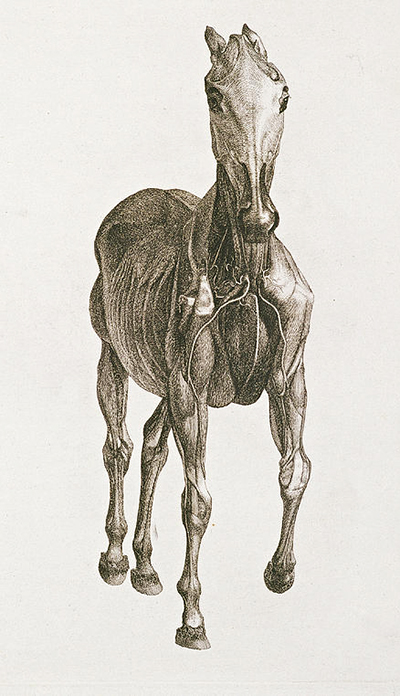
The Anatomy of the Horse makes the successive objects unusually clear. A drawing could establish the forms and explanatory system; the design was then worked into a copperplate; an inked plate yielded an impression; impressions were gathered with letterpress into a book. The British Museum's 1766 copy contains 47 pages and 24 etched plates and records the imprint “J. Purser, for the author”. Stubbs is identified as the printmaker. [1] A bound copy is thus neither the copperplates nor the drawings, even though it preserves their visual information.
The numbers in the book reveal why catalogue units matter. Its sequence consists of three skeletal and fifteen muscular tables, yet the physical copy has 24 plates. Some table subjects required separate modelled views and outline keys, so eighteen numbered subjects occupy more than eighteen printed sheets. [1] Forty-four associated drawings are known, with 42 now at the Royal Academy, but those sheets have their own materials, accessions and histories. [4] The full research and publication sequence belongs in George Stubbs and The Anatomy of the Horse; for print history, the decisive point is that Stubbs controlled the transition from observation to etched and publishable form.
He returned to an even more ambitious anatomical print project near the end of his life. The British Museum holds thirty plates comparing the human body with a tiger and a common fowl, worked in etching, stipple and roulette. The records date their first issue to 1804–06 and identify Edward Orme's 1817 appearance as a republication; two volumes of letterpress were issued with the plates. [5] The Royal Academy identifies Stubbs as author, draughtsman, engraver and publisher, and shows that the three published numbers—fifteen tables with related supplementary plates—were only half of a projected sixty-plate scheme. [6] The project was incomplete, not unprinted. Its larger intellectual and publication history is examined under A Comparative Anatomical Exposition.
These anatomical books prevent a narrow definition of Stubbs's prints. They are not reproductions of paintings. They convert research drawings into repeatable explanatory images, place those impressions in designed sequences, and bind them to text. At the same time, their survival as particular copies means that paper, order, completeness, binding and later ownership remain part of the evidence.
Repeatability changed the use of the anatomical image. One drawing could be studied by its owner or a visitor; impressions from a plate could accompany the same explanatory text in multiple copies. Yet repeatability did not make every copy materially identical. A volume might lack a plate, bind it in a different position, preserve a cleaner margin or carry evidence of a former reader. The shared design and the individual copy must both be kept in view. This dual identity—repeatable image, singular surviving object—also governs Stubbs's separate animal sheets.
Prints after Stubbs and the eighteenth-century publishing network
The reproductive market gave Stubbs's compositions lives outside the paintings, but those lives depended on other artists and businesses. Engravers selected processes, translated colour into monochrome, decided how surface and atmosphere would read, and sometimes reversed the composition through the mechanics of printing. Publishers organised issues and could continue selling a plate after it changed hands. The phrase “after Stubbs” acknowledges the origin of a design while leaving these interventions visible.
Translation could involve more than converting hue into black ink. A printmaker had to decide which contours would carry structure, how a coat or cloud would be differentiated from a dark ground, where detail would survive at the new scale, and how much lower margin to reserve for names and title. Those decisions are not proof of equal collaboration on every plate; they are reasons to credit the documented printmaker rather than describing the sheet as if it emerged mechanically from Stubbs's canvas.
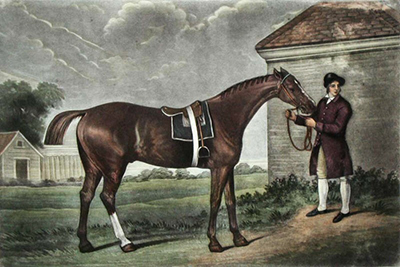
William Woollett's The Spanish Pointer is a particularly instructive case. The Rijksmuseum identifies Woollett as printmaker, Stubbs as the painter after whom he worked, Thomas Bradford as publisher and January 1768 as the date; its plate measures 444 by 558 millimetres and the record notes several known states. [7] Sotheby's research on the source painting specifies line engraving with etching and publication by Bradford on 1 January 1768. It also traces later ownership of the painting and an interest in the copperplate, evidence that the painted object and the printing matrix could travel through related but separate histories. [8] A Christie's impression is catalogued as the third state of six, on laid paper. [9]
Those converging records establish that Woollett, not Stubbs, worked the 1768 plate. A surviving impression cannot be identified safely from the dog and landscape alone: its lettering, state, paper, dimensions and publisher must also be checked. The relationship between painting, plate and later issues receives its full treatment with The Spanish Pointer.
Woollett also made a four-sheet Shooting set after Stubbs. One British Museum impression, dated 1770, combines etching and engraving and shows two men and hounds resting near a stream and mill. The museum records it as one of four sporting prints whose source paintings are now at the Yale Center for British Art. Its sheet is 414 by 529 millimetres, but its physical history is unusually complicated: the proof was laid onto a larger support, and the visible plate mark on that support may have been produced during the mounting process rather than by the original printing. [10] Object examination can therefore overturn an apparently simple reading of a photographed border.
Another Shooting plate, dated 1771, is catalogued as an etching by Woollett after Stubbs and published by Bradford. The checked sheet has been trimmed to 378 by 532 millimetres. [11] One such impression can establish maker, publisher, process and condition for itself; it cannot stand in for the other three matrices. A set is a relationship among distinct plates, not a single design divided into catalogue aliases.
Bradford's presence on The Spanish Pointer and the checked Shooting sheet also shows how one publisher could connect otherwise separate subjects. That commercial link does not turn the dog and sporting scenes into one series, nor does it prove that every Woollett print after Stubbs was issued under identical terms. Publisher identity is one axis of comparison alongside matrix, subject and date, never a substitute for them.
Benjamin Green developed a different tonal translation of Stubbs's work. The Government Art Collection's Brood Mares is a mezzotint made by Green after a 1768 painting. The printed composition is reversed, and the impression is dated 14 November 1776 after the plate had been sold to Sayer and Bennett. The collection states that Green produced nine large mezzotints after Stubbs. [12] This was a sustained reproductive partnership, not an isolated facsimile. Direction, tonal organisation, publisher and issue belong to the print's own identity, while the painted and printed Brood Mares remain related rather than duplicate objects.
John Dixon's A Tigress shows how a clear maker record can coexist with misleading marks on a particular sheet. The National Gallery of Art identifies Dixon as printmaker after Stubbs, dates the mezzotint to 1772 and catalogues its plate as 48.1 by 58.4 centimetres, its larger sheet as 53.5 by 60.3 centimetres, and its condition as state i/iv. [13] Graphite inscriptions reading “Stubbs Pinxit” and “J. Dixon Fecit” might seem to confirm authorship, but the museum records them as additions by a later hand. They are evidence about this impression's later history, not original lettering from the matrix.
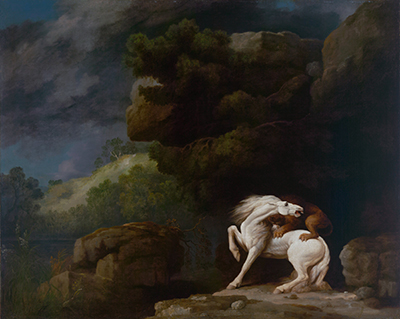
The National Portrait Gallery identifies George Townley Stubbs (1756–1815) as an engraver and as George Stubbs's son. Its records also show him making and publishing stipple engravings, so he should not be reduced to an unnamed workshop intermediary. [14] In The Horse and Lion of 1770, the British Museum assigns the printmaking to George Townley, the source design to George, and publication to John Wesson. The large plate combines mezzotint and etching. The museum's impression has scratched names before the title, while a later state acquired engraved lettering and a title. [15] This is a separate matrix from the elder artist's later sheets, even though all belong to the broader lion-and-horse series.
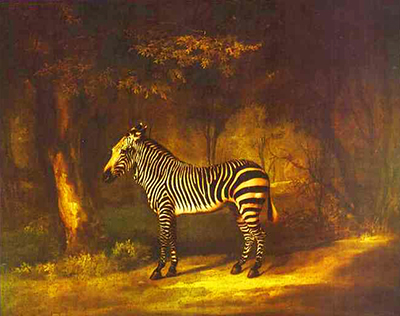
George Townley's The Sebra, or Wild Ass of 1771 is likewise a mezzotint after his father's design, published by Carington Bowles. [16] Its 251-by-344-millimetre format and named roles belong to the impression, not to the source painting. The sheet connects to the exact zebra object history and to the acquisition, display and naming networks discussed under Stubbs's exotic animals and empire. The print hub can establish who made and circulated the image without collapsing the living animal, painting and mezzotint into a single “zebra picture”.
Stallion and Mare demonstrates how publication could continue after an initial issue. The British Museum records a 1776 mezzotint with etching by George Townley after George Stubbs, published by John Harris, and a republication in 1789. It also distinguishes a 253-by-354-millimetre image from a greater height when a separate inscription plate is present; an examined impression was printed without that additional title unit. [17] Here “the print” can refer too loosely to an image matrix, a title matrix and sheets that do or do not combine them.
Racehorse plates extend this network into publication projects and named equine reputations. The British Museum identifies George Townley as the printmaker of a 1794 Mambrino, made in stipple with etching after George Stubbs and intended for A Review of the Turf. [18] It also assigns him a 1775 Gimcrack after his father, with John Harris as publisher, [19] and an Eclipse published in 1796. [20] Those records establish the maker relationships; the horses' breeding, owners, trainers, racing records and painted versions belong to Stubbs's racehorses and Georgian racing and the individual pages for Baronet, Gimcrack on Newmarket Heath and Eclipse.
Taken together, Woollett, Green, Dixon and George Townley Stubbs dismantle the idea that a reproductive print is a neutral photocopy made before photography. Each record has a chain of decisions: who supplied the model, who incised or textured the plate, who issued it, what wording appeared, and whether the plate was later changed or sold. Stubbs's reputation travelled through those chains, but the resulting sheets belong to the printmakers' histories too.
“Original” and “reproductive” are therefore descriptions of relationships, not a simple ladder of merit. Stubbs's etched anatomy plates are original printmaking even though they depend on preparatory drawings. Woollett's Spanish Pointer is reproductive because it follows Stubbs's painting, but it remains an original eighteenth-century impression from Woollett's matrix, not a modern facsimile. George Townley's horse prints can be both reproductive works after his father and primary evidence for their own publication histories. The task is to name each relation accurately, not to make one category disappear into another.
Stubbs's original animal prints before and during 1788
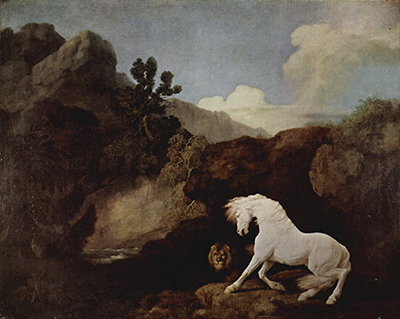
Stubbs made independent animal prints before the coordinated publication of 1788. The Cleveland Museum of Art's A Horse Frightened by a Lion is an etching and engraving of 1777, made by Stubbs and preserved in a condition the museum calls state I or II of III. [21] That cautious notation matters: the institution does not pretend to choose between two early conditions when the sheet lacks decisive evidence. It also establishes a direct Stubbs plate eleven years before the better-known later version.
The British Museum's Tygers at Play followed in 1780. It shows two leopards beneath rocks, is catalogued as etching “possibly with engraving”, and is described as a finished proof measuring 375 by 481 millimetres. [22] “Possibly” and “finished proof” should both remain attached to the record. The title's period use of tygers also warns that eighteenth-century animal names cannot be mapped automatically onto current species terminology.
Princeton University Art Museum states that Stubbs published twelve of his own prints in 1788. [23] That is a year-specific publication group, not a total for his career. Several sheets carry the 1 May date and an address at 24 Somerset Street, Portman Square. Their formal catalogue descriptions show that a coordinated issue need not employ one process, size or type of animal.
The smallest inspected example is the Metropolitan Museum of Art's Dog (A Foxhound Viewed from Behind). It measures just 10.5 by 12.7 centimetres, is dated 1 May 1788, and is recorded as roulette work with etching in a first and only state. [24] The Met's commentary considers stipple and possible mezzotint in discussing the tonal result, but its formal medium field remains the safer object label. In the high-resolution image, the hound stands in rear three-quarter view and turns its head to the right. A field of closely worked darkness isolates the pale body; the publication line sits below the image. Those visible relationships can be described without using the photograph to diagnose the plate.
Two different 1788 prints demonstrate why titles are never enough. The Met's A Tyger (A Recumbent Leopard by a Tree) is an etching with roulette, first and only state, measuring 25.4 by 33 centimetres. [25] Princeton's A Tyger (Sleeping Cheetah) is another matrix: a mezzotint whose inscription credits Stubbs with painting, engraving and publishing it on 1 May from Somerset Street. Princeton notes that “tyger” could then function as a loose name for large cats other than lions. [23] One title therefore covers two separate subjects, processes and plates. A catalogue search that merges them would erase the very evidence needed to identify either work.
The Met's A Lion (A Lion Resting on a Rock) offers a third arrangement. Dated to the same day, it is an etching with roulette known in a single state and measures 33.7 by 26 centimetres. [26] The current parenthetical titles supplied by museums—resting lion, recumbent leopard, sleeping cheetah—do useful identificatory work beside the historical inscriptions. They do not rewrite what was actually lettered on a plate.
A Horse Affrighted at a Lion, also dated 1 May, is an etching with roulette known in three states. The Met sheet belongs to the third and measures 25.1 by 30.5 centimetres. [27] The inspected image places a pale horse across most of the plate, recoiling with its mane thrown over the neck, while a lion sits to the right in a dark setting. The title supplies “affrighted”; no additional human emotion needs to be invented. This impression, the 1777 plate and George Townley's 1770 mezzotint are materially distinct episodes within the subject history mapped in Horse Frightened by a Lion.
These examples show why Stubbs's original prints cannot be reduced to monochrome versions of canvases. The plate offered a place to reconsider scale, background density, the balance of pale and dark forms, and the visibility of inscription space. Some matrices passed through several states; others are known in one. The same publication date joined the sheets commercially, but their animals remain observed bodies with different postures and spatial demands, not interchangeable emblems.
Their dimensions sharpen that difference. The little Dog is barely more than ten centimetres high, while the resting lion and recumbent leopard occupy plates roughly three times that span in one direction. [24] [25] [26] A viewer comparing digital files can easily lose this contrast because screens normalise images to similar display boxes. Catalogue measurements restore the physical encounter: an intimate study, a larger animal sheet and, later, a harvest scene nearly seventy centimetres wide are not equivalent formats merely because each fills a browser window.
Labourers, harvest sheets and self-publication
Stubbs's publishing activity also moved beyond isolated animals. A specialist catalogue drawing on the established print literature records that he issued work from his house at 24 Somerset Street and discusses a subscription notice dated 24 September 1788. [28] Such evidence points to advance organisation, advertising and direct sale. It does not reveal an edition size, nor does it permit every proposed sheet to be assigned the same publication history. Current holder records still control the date and state of each impression.
The National Gallery of Art catalogues Stubbs's Labourers as a mezzotint of 1789 and its impression as the third state of three. [29] Specialist writing describes more varied work in the plate, including etching, stipple, roulette and rocker, but that technical analysis should be identified as such rather than silently replacing the NGA's formal field. [28] The title names a rural subject; it does not establish that every print called Labourers came from this matrix.
The Met owns a different Labourers, published on 25 March 1790. Richard Earlom made it under the pseudonym Henry Birche, after designs credited to both George Stubbs and Amos Greene; Benjamin Beale Evans published it. This mezzotint is the second state of four, with a plate measuring 44.2 by 65.7 centimetres and a larger surviving sheet. [30] It is not another state of Stubbs's 1789 plate. Same title, approximate period and rural subject are outweighed by different maker roles, sources, dimensions, states and publisher. Few comparisons show more clearly why identification must proceed from the whole record.
The smaller A Sleeping Leopard was published on 1 January 1791. The Met calls it soft-ground etching with roulette, second state of two, and gives dimensions of 18.1 by 23.7 centimetres. [31] In the inspected file, the leopard curls tightly beneath a trunk or root, head at the left. Its spots interrupt a body assembled from the same close grain that darkens the sheltering setting, while a narrow publication inscription occupies the lower edge. The print is not the 1777 enamel discussed with Sleeping Leopard, however closely their subject histories may meet.
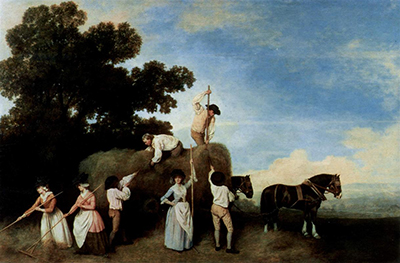
The rural sheets of 1791 are much larger. The British Museum's Hay-Makers is a 483-by-682-millimetre stipple print with roulette work made by Stubbs after the painting now at Tate. [32] That “after” does not introduce a second printmaker here: the museum identifies Stubbs himself as maker of the print and the painting as the source composition. The scale allowed a complex group, cart, horses and landscape to circulate as a substantial independent sheet. Their exact relationship is traced under Hay-Makers.
The National Gallery of Art's Reapers is likewise dated 1791, but its object record is more specific about the surviving condition. The impression is stipple and roulette on laid paper, state i/iii, and its 48.26-by-68.58-centimetre sheet has been trimmed to the plate mark. The inscription names Stubbs as painter, engraver and publisher and dates the issue to 1 January at 24 Somerset Street. [33] In the inspected high-resolution image, a mounted figure occupies the left edge as workers cut and bind grain across the field. A standing woman holds a sheaf near the centre; a dog, tools and vessels sit among the foreground bundles, and a slender spire appears in the distance. These are features of this impression, not proof that the painted version is identical. The version history and the relations among landowner, workers and display belong with Reapers.
Placed together, the 1789–91 sheets reveal a remarkable range: the compact darkness around a sleeping cat, the large rural compositions, and two unrelated matrices called Labourers. They also show that self-publication was not a single event. Addresses, dates, subscription proposals and publisher lines must be reconciled with the condition of each plate and sheet. “Published by George Stubbs” identifies commercial agency as well as authorship; it does not make every later impression an untouched product of the first issue.
The large rural plates also changed the proportion devoted to inscription. In Reapers, the title and publication line form a narrow printed register beneath the broad field scene; they are visible parts of the sheet, not metadata invented by a later catalogue. [33] If that lower edge were lost, the composition might remain legible while maker, address and issue evidence disappeared. Preserving margins is therefore not only an aesthetic concern. It can determine how securely an impression can be placed within a publication history.
Lettering, provenance and the modern catalogue
Printed and handwritten words are physical evidence, but they require classification. Scratched letters on George Townley's Horse and Lion belong to an early plate condition; engraved letters and title define a later one. [15] The separate inscription plate recorded for Stallion and Mare could be present or absent without changing the animal-image matrix. [17] By contrast, the graphite names on Dixon's A Tigress were supplied by a later hand. [13] Reading all three as equivalent “signatures” would collapse a plate state, a separately printed component and an owner's or dealer's annotation.
Trimming can remove exactly this kind of evidence. The NGA's Reapers reaches the plate mark; its Death of the Doe is cut within it. [33] [34] Woollett's checked 1771 Shooting sheet is also trimmed. [11] A missing publication line may therefore reflect lost paper rather than an unlettered state, just as a broad margin need not be original to the first printing. Condition is not a nuisance beside the image; it helps determine what the object can prove.
Provenance follows an impression, not an abstract composition. The NGA traces its A Tigress from the collection of Christopher Lennox-Boyd through a dealer to acquisition in 2001. [13] The British Museum bought The Horse and Lion from Lennox-Boyd in 2010 with support from several public and charitable funds. [15] The NGA's Reapers moved through recorded auction, private and dealer ownership before the museum purchased it in 2022. [33] These histories explain why particular states entered modern public collections and why institutions sometimes hold sheets valued chiefly as reference evidence.
The recurring “Lennox-Boyd” numbers in museum records refer to Christopher Lennox-Boyd, Rob Dixon and Timothy Clayton's 1989 George Stubbs: The Complete Engraved Works, whose bibliographic identity is preserved by the Rijksmuseum Research Library. [35] A catalogue number is a scholarly locator for a design or state, not a number printed in the eighteenth century and not an edition number. It is most useful when combined with accession, maker roles, dimensions and the holder's current description.
Cross-collection comparison should begin with those stable identifiers. Two institutions may modernise a title differently, measure a trimmed sheet rather than the plate, or expose unequal amounts of provenance online. If their catalogue numbers, inscriptions and maker roles converge, the records may describe impressions from one matrix; if the titles match but those fields diverge, as with Labourers, identity must remain separate. A search-result thumbnail is only the beginning of that comparison, because it suppresses the margins, scale and reverse that often carry decisive evidence.
Prints can also preserve evidence unavailable in a painting's present format. The Kimbell Art Museum's Lord Grosvenor's Arabian Stallion with a Groom is a circa-1765 oil on canvas, measuring 99.3 by 83.5 centimetres. Kimbell compares it with Peter Mazell's 1771 engraving, whose wider composition contributes to the question of whether the canvas was reduced at its sides. [36] The engraving is not the painting, but it is a historical witness to the design. That distinction is central to the Kimbell painting and Mazell print.
A disputed late mezzotint
Death of the Doe demonstrates the limit of even a detailed modern record. The National Gallery of Art dates the mezzotint to 1804, describes it as a proof before colour on wove paper, state i/ii, and measures its sheet at 39.7 by 49.4 centimetres after trimming within the plate mark. Yet the maker line reads “George Stubbs (and George Townley Stubbs?)”. [34] Precise medium, state and dimensions do not compel a precise attribution.
A specialist account assigns the plate to George Townley, gives an original publication date of 16 October 1804 and traces an Edward Orme reissue in 1817 under the later title The Death of the Doe. [37] That argument is relevant, but it does not erase the NGA's question mark. The safe conclusion is that George and George Townley's contributions remain disputed. The painting of Freeman, the changing title and the printed version are brought together in Freeman, Lord Clarendon's gamekeeper.
The uncertainty is instructive. A proof before colour tells us about the sheet's relation to a coloured issue; it does not tell us which hand completed every part of the matrix. A later publisher and title tell us about circulation; they do not retroactively decide original authorship. Responsible catalogue reading sometimes ends with a clearly bounded question rather than a confident name.
How to identify and explore a Stubbs print
Begin with the object, not a familiar composition. Record the full title and any parenthetical modern identification. Then read maker roles word for word: printmaker, engraver, etcher, “after”, publisher, printer. Note the date attached to the plate or issue, the formal process, and whether dimensions refer to image, plate or sheet. Read state and proof language separately. Check whether lettering is printed, scratched or handwritten, and whether the paper has been trimmed.
Next ask what kind of relationship the record establishes. Is the sheet an original plate worked by Stubbs, a reproductive print after a painting, an illustration from a book, or a later republication? Does the same title occur on another matrix? Is a source painting securely identified, or merely assumed because the subject resembles one? The links across this collection are most useful when they preserve those distinctions rather than offering a row of similar images.
For chronology, the George Stubbs overview and documented biography place the print campaigns beside his other work. From there, the individual print and subject pages can follow one design through its own evidence. A modern online image is invaluable for comparing margins, marks and inscriptions, but it remains a digital representation of a physical sheet. It cannot supply paper, pressure, scale or plate history on its own.
Stubbs's printed work ultimately has no single boundary marked “original” on one side and “copy” on the other. There are instead documented acts: observation, drawing, painting, translating, biting or cutting a plate, printing, lettering, publishing, reworking, trimming, collecting and cataloguing. Following those acts allows Stubbs's own inventiveness to come into focus while restoring Woollett, Green, Dixon, George Townley Stubbs and the publishers to the parts they actually played.
Videos on George Stubbs
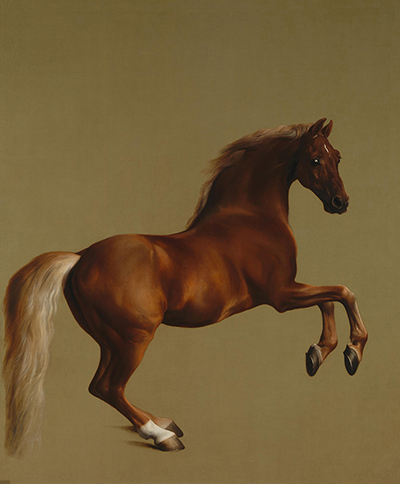
Explore Stubbs’s equestrian painting in its wider context, including two readings of Whistlejacket.
A Horse Lover’s Guide to the YCBA
A museum tour that places Stubbs alongside other artists who painted horses. It includes a look at Pumpkin with a Stable-lad.
Watch on YouTubeGeorge Stubbs artworks directory
Search works and related prints documented in this guide. Separate versions and printing matrices have separate entries; printmakers are named where known. Unidentified historical titles and untraced studio-sale material are discussed in the essays. A dash means that a date is not established here.
| Name | Date | Medium |
|---|---|---|
| A Bay Horse with a Groom | 1791 | Painting |
| A Bay Hunter with Two Playful Spaniels | 1777 | Painting |
| A Bay Hunter, a Springer Spaniel and a Sussex Spaniel in a wooded river Landscape | 1782 | Painting |
| A Cheetah and a Stag with Two Indian Attendants | about 1764 | Painting |
| A Couple of Fox Hounds (coloured print after Stubbs) | — | Print after Stubbs |
| A Couple of Foxhounds | 1792 | Painting |
| A Foxhound on the Scent | 1788 | Drawing |
| A Gentleman driving a Lady in a Phaeton | 1787 | Painting |
| A Grey Horse | 1793 | Painting |
| A Grey Horse (cantering companion) | 1793 | Painting |
| A Grey Stallion in a Landscape | — | Painting |
| A Horse Affrighted at a Lion | 1 May 1788 | |
| A Horse Belonging to the Rt. Honourable Lord Grosvenor called Bandy from his Crooked Leg | about 1763 | Painting |
| A Horse Frightened by a Lion | 1777 | |
| A Lion (A Lion Resting on a Rock) | 1 May 1788 | |
| A Lion Attacking a Horse | 1770 | Painting |
| A Lion Attacking a Horse (monumental Yale canvas) | 1762 | Painting |
| A lion attacking a horse (NGV) | about 1765 | Painting |
| A Lion Devouring a Horse (1788 print) | 1788 | |
| A lion devouring a horse (attribution disputed) | Proposed mid-1770s | Painting |
| A mare and foal with a bay horse | 1771 | Painting |
| A Monkey | 1799 | Painting |
| A Prancing Horse, Facing Right | c. 1790 | Drawing |
| A Rough Dog | 1790 | Painting |
| A Saddled Bay Hunter | 1786 | Painting |
| A Sleeping Leopard | 1 January 1791 | |
| A Tiger and a Sleeping Leopard | 1 May 1788 | |
| A Tigress (John Dixon after Stubbs) | 1772 | Print after Stubbs |
| A Tyger (A Recumbent Leopard by a Tree) | 1 May 1788 | |
| A Tyger (Sleeping Leopard) | 1 May 1788 | |
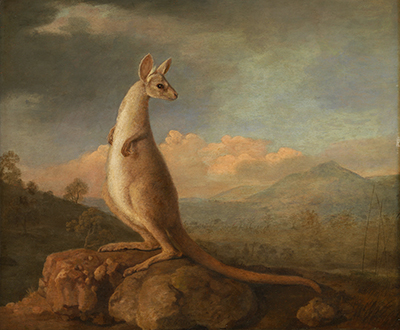
| An animal found on the coast of New Holland called kanguroo (after Stubbs) | 1773 | Print after Stubbs |
| An animal of a new species found on the coast of New South Wales (after Stubbs) | July 1773 | Print after Stubbs |
| Antinous and Jockey | — | Painting |
| Antinoüs, a chestnut racehorse, in a landscape | Undated | Painting |
| Bandy belonging to Lord Grosvenor (print after Stubbs) | — | Print after Stubbs |
| Baronet (George Townley Stubbs after Stubbs) | 20 February 1794 | Print after Stubbs |
| Baronet with Sam Chifney Up | 1791 | Painting |
| Baronet with Samuel Chifney up (Royal Collection) | 1791 | Painting |
| Bay Hunter by a Lake | 1787 | Painting |
| Brood Mares (Benjamin Green after Stubbs) | Issue 14 November 1776 | Print after Stubbs |
| Brood Mares and Foals | usually dated 1767 | Painting |
| Brown and White Norfolk or Water Spaniel | 1778 | Painting |
| Bulls Fighting | 1786 | Painting |
| Captain Samuel Sharpe Pocklington with His Wife, Pleasance, and possibly His Sister, Frances | 1769 | Painting |
| Death of the Doe (attribution disputed) | 1804 | |
| Der Englische Hühnerhund (Johann Wölfle after Stubbs) | about 1860 | Print after Stubbs |
| Dog (A Foxhound Viewed from Behind) | 1 May 1788 | |
| Dog [A Foxhound on the Scent] | 1788 | |
| Drill and albino baboon | before 1789 | Painting |
| Eclipse (Charles Hunt after Stubbs) | 12 November 1839 | Print after Stubbs |
| Eclipse (George Townley Stubbs after Stubbs) | 1796 | Print after Stubbs |
| Eclipse (oil study) | — | Painting |
| Eclipse (Thomas Burke after Stubbs) | First published 1772 | Print after Stubbs |
| Eclipse and John Wildman (Benjamin Green after Stubbs) | 1772 | Print after Stubbs |
| Eclipse at Newmarket (Jockey Club version) | Proposed early 1790s; often dated 1770 | Painting |
| Eclipse at Newmarket with a groom and jockey | 1770 | Painting |
| Eclipse with Mr Wildman and His Sons | 1769–71 | Painting |
| Eclipse, the Property of Capt.n O Kelly (anonymous print after Stubbs) | Imprint 4 June 1804; impression undated | Print after Stubbs |
| Euston | 1774 | Painting |
| Finished Study for the Seventh Anatomical Table of the Muscles of the Horse | 1756–58 | Drawing |
| Five Brood Mares at the Duke of Cumberland's Stud Farm in Windsor Great Park | 1765 | Painting |
| Fowl Body, Lateral View (Highly Finished Study for an Unpublished Table; Shows the Last Stage in Dissection) | — | Drawing |
| Fowl Body, Lateral View (Probably Prepared for Transfer to the Plate for Engraving of Table XV) | — | Drawing |
| Fowl Skeleton, Lateral View (Finished Study for Table V) | — | Drawing |
| Freeman, the Earl of Clarendon's Gamekeeper, with a Dying Doe and Hound (Yale) | 1800 | Painting |
| George Stubbs (enamel self-portrait) | 1781 | Enamel |
| Gimcrack (George Townley Stubbs after Stubbs) | 1775 | Print after Stubbs |
| Gimcrack on Newmarket Heath, with a trainer, a jockey and a stable lad | about 1765 | Painting |
| Gimcrack, with John Pratt up, on Newmarket Heath | about 1765 | Painting |
| Hambletonian, Rubbing Down | 1800 | Painting |
| Hay-Makers | 1791 | |
| Haycarting | 1795 | Enamel |
| Haymakers | 1785 | Painting |
| Haymakers (Lady Lever Art Gallery) | 1794 | Enamel |
| Hollyhock (with later additions by Vernet and Boucher) | about 1765–70 | Painting |
| Horse Attacked by a Lion (Episode C) | 1768–69 | Painting |
| Horse Attacked by a Lion (Tate enamel) | 1769 | Enamel |
| Horse Devoured by a Lion | Possibly exhibited 1763 | Painting |
| Horse Frightened by a Lion | 1770 | Painting |
| Horse Frightened by a Lion (Episode A; Wedgwood and Bentley after Stubbs) | — | Sculpture |
| Horse Frightened by a Lion (Tate) | Possibly exhibited 1763 | Painting |
| Horse Frightened by a Lion (Yale) | 1762–68 | Painting |
| Horse in the Shade of a Wood | 1780 | Painting |
| Hound Coursing a Stag | about 1762 | Painting |
| Human Figure, Anterior View (Intended for a Plate That was Never Published) | — | Drawing |
| Human Skeleton, Lateral View | 1795–1806 | Drawing |
| Hunt servants setting out (Southill commission) | 1767 | Painting |
| Hühnerhund (The Spanish Pointer) | about 1766 | Painting |
| John and Sophia Musters Riding at Colwick Hall | 1777 | Painting |
| John Musters on his hunter Pilgrim | 1777–78 | Painting |
| Labourers | 1789 | |
| Labourers (Richard Earlom after Stubbs and Amos Greene) | 25 March 1790 | Print after Stubbs |
| Laetitia, Lady Lade (d.1825) | 1793 | Painting |
| Lemon and White Water Spaniel | — | Painting |
| Lion Attacking a Stag | — | Painting |
| Lord Grosvenor's Arabian Stallion with a Groom | about 1765 | Painting |
| Lord Grosvenor's Arabian Stallion with a Groom (Peter Mazell after Stubbs) | 1771 | Print after Stubbs |
| Mambrino (Eaton Hall painting) | — | Painting |
| Mambrino (George Townley Stubbs after Stubbs) | 1794 | Print after Stubbs |
| Mares and Foals belonging to the 2nd Viscount Bolingbroke | about 1761–62 | Painting |
| Mares and foals beneath large oak trees | — | Painting |
| Mares and Foals by a stream | Exhibited 1764 | Painting |
| Mares and Foals in a River Landscape | about 1763–68 | Painting |
| Mares and Foals in an Extensive Landscape | about 1769 | Painting |
| Mares and Foals without a Background | 1762 | Painting |
| Moose Deer (after Stubbs) (Arctic Zoology plate VIII) | 1784–85 publication | Print after Stubbs |
| Newmarket Heath with a Rubbing-Down House | — | Painting |
| Otho (1796 print after Stubbs) | 1 December 1796 | Print after Stubbs |
| Otho, with John Larkin up | 1768 | Painting |
| Pangloss | about 1762 | Painting |
| Patch (Grafton commission) | 1759 | Painting |
| Phaeton and the Chariot of the Sun (enamel) | 1775 | Enamel |
| Phaeton with a Pair of Cream Ponies and a Stable-Lad | 1780–84 | Painting |
| Phillis | 1772 | Painting |
| Portrait of a Large Dog (Dingo) | 1772 | Painting |
| Pumpkin with a Stable-lad | 1774 | Painting |
| Racehorses Exercising at Goodwood | 1759–60 | Painting |
| Reapers (1791 print) | 1791 | |
| Reapers (Tate) | 1785 | Painting |
| Reapers (Yale) | 1795 | Enamel |
| Red Deer: A Stag and a Hind | 1792 | Painting |
| Richard Wedgwood | — | Enamel |
| Ringwood, a Brocklesby Foxhound | 1792 | Painting |
| Scrub, a bay horse belonging to the Marquess of Rockingham | about 1762 | Painting |
| Self Portrait on a White Hunter | 1782 | Enamel |
| Self-Portrait | about 1759 | Painting |
| Shooting (1770 Woollett plate after Stubbs) | 1770 | Print after Stubbs |
| Shooting (1771 Woollett plate after Stubbs) | 1771 | Print after Stubbs |
| Shooting at Goodwood | 1759–60 | Painting |
| Sir John Nelthorpe as a boy | 1756 | Painting |
| Sir John Nelthorpe partridge shooting with one pointer | — | Painting |
| Sir John Nelthorpe, 6th Baronet, out Shooting with His Dogs in Barton Field, Lincolnshire | 1776 | Painting |
| Sleeping Leopard | 1777 | Enamel |
| Soldiers of the 10th Light Dragoons | 1793 | Painting |
| Stallion and Mare (George Townley Stubbs after Stubbs) | 1776; reissued 1789 | Print after Stubbs |
| Steward and gamekeeper with dogs (Southill commission) | 1767 | Painting |
| Studies of a Lemur (Lemur murinus) in six different attitudes | 1773 | Drawing |
| Study for the Self-portrait in Enamel | c. 1781 | Drawing |
| Study of a Lemur | 1773 | Drawing |
| Study of a Racehorse in Action: Galloping to Left, a Semi-Anatomical Study, with Skin Flayed to Show Action of Muscles | — | Drawing |
| Study of the Legs of a Draught-Horse Pulling a Harrow (attributed to Stubbs) | Proposed about 1786 | Drawing |
| Sweet William (Grosvenor panel) | — | Painting |
| Sweet William (Turf Gallery canvas) | — | Painting |
| The Black Stallion Sampson, Portrayed from Three Angles (with landscape additions) | about 1764 | Painting |
| The Charlton Hunt | 1759–60 | Painting |
| The Fall of Phaeton | — | Sculpture |
| The Frightened Horse | 1780 | Sculpture |
| The Grosvenor Hunt | — | Painting |
| The Haymakers (Upton House) | 1783 | Painting |
| The Horse and Lion (George Townley Stubbs after George Stubbs) | 1770 | Print after Stubbs |
| The Kongouro from New Holland | 1772 | Painting |
| The Labourers | 1779 | Painting |
| The Labourers (Southill original) | 1767 | Painting |
| The lion and horse (Benjamin Green after Stubbs) | 1769; reissued 1777 | Print after Stubbs |
| The Milbanke and Melbourne Families | about 1769 | Painting |
| The Moose | 1770 | Painting |
| The Prince of Wales's Phaeton | 1793 | Painting |
| The Reapers (Upton House) | 1783 | Painting |
| The Sebra, or Wild Ass (George Townley Stubbs after Stubbs) | 1771 | Print after Stubbs |
| The Spanish Pointer (Bradford version) | about 1766–68 | Painting |
| The Spanish Pointer (William Woollett after Stubbs) | January 1768 | Print after Stubbs |
| The Third Duke of Dorset's Hunter with a Groom and a Dog | 1768 | Painting |
| Thomas Freeman, Lord Clarendon's gamekeeper, with a dog and a shot doe (with George Townly Stubbs) | 1803 | Painting |
| Turf, with Jockey up, at Newmarket | — | Painting |
| Turk and Crab | — | Painting |
| Two Bay Hunters Communing On The Bank Of A Lake | — | Painting |
| Tygers at Play | 1780 | |
| Viscount Gormanston's White Dog | 1781 | Painting |
| Viscount Gormanston's White Dog (canvas version) | — | Painting |
| Water Spaniel | 1769 | Painting |
| Wedgwood Family Portrait | 1780 | Painting |
| Whistlejacket | about 1762 | Painting |
| Whistlejacket with two other stallions and a groom | Recorded 1762 | Painting |
| White Poodle in a Punt | about 1780 | Painting |
| William Anderson with two Saddle-Horses | 1793 | Painting |
| Working Drawing for the Seventh Anatomical Table of the Muscles of the Horse | 1756–58 | Drawing |
| Zebra | 1763 | Painting |
Discussion
Look again at the images and ideas explored in George Stubbs Prints. These editorial prompts invite your observations.
Reader Insights
Which inscription or physical feature most helps you identify a print’s maker?
What changes when a painted design is translated into an etched or engraved plate?
How would knowing the state or edition change the questions you ask of an impression?
Join the Conversation
Share a detail, comparison or question about George Stubbs Prints below.
References
- British Museum, The Anatomy of the Horse, 1914,0228.3013.1–24. Accessed 30 August 2026. View source.
- Victoria and Albert Museum, “What is print?”. Accessed 30 August 2026. View source.
- Royal Academy of Arts, George Stubbs ARA. Accessed 30 August 2026. View source.
- Royal Academy of Arts, The Anatomy of the Horse, 03/2857. Accessed 30 August 2026. View source.
- British Museum, Comparative Anatomy, 1947,0618.1.1–30. Accessed 30 August 2026. View source.
- Royal Academy of Arts, A Comparative Anatomical Exposition, 03/1654. Accessed 30 August 2026. View source.
- Rijksmuseum, William Woollett, The Spanish Pointer, RP-P-OB-73.173. Accessed 30 August 2026. View source.
- Sotheby's, George Stubbs, The Spanish Pointer. Accessed 30 August 2026. View source.
- Christie's, William Woollett after George Stubbs, The Spanish Pointer, lot 6013167. Accessed 30 August 2026. View source.
- British Museum, William Woollett after George Stubbs, Shooting, 1842,1112.31. Accessed 30 August 2026. View source.
- British Museum, William Woollett after George Stubbs, Shooting, 1864,0714.121. Accessed 30 August 2026. View source.
- Government Art Collection, Brood Mares, 2319. Accessed 30 August 2026. View source.
- National Gallery of Art, John Dixon after George Stubbs, A Tigress, 2001.96.2. Accessed 30 August 2026. View source.
- National Portrait Gallery, George Townley Stubbs. Accessed 30 August 2026. View source.
- British Museum, The Horse and Lion, 2010,7081.5624. Accessed 30 August 2026. View source.
- British Museum, The Sebra, or Wild Ass, 1862,1011.557. Accessed 30 August 2026. View source.
- British Museum, Stallion and Mare, 2010,7081.5638. Accessed 30 August 2026. View source.
- British Museum, Mambrino, 1873,0712.572. Accessed 30 August 2026. View source.
- British Museum, Gimcrack, 2010,7081.2230. Accessed 30 August 2026. View source.
- British Museum, Eclipse, 2010,7081.5654. Accessed 30 August 2026. View source.
- Cleveland Museum of Art, A Horse Frightened by a Lion, 1985.38. Accessed 30 August 2026. View source.
- British Museum, Tygers at Play, 1865,0114.912. Accessed 30 August 2026. View source.
- Princeton University Art Museum, A Tyger (Sleeping Cheetah), 2010-165. Accessed 30 August 2026. View source.
- Metropolitan Museum of Art, Dog (A Foxhound Viewed from Behind), 49.49.6. Accessed 30 August 2026. View source.
- Metropolitan Museum of Art, A Tyger (A Recumbent Leopard by a Tree), 49.49.7. Accessed 30 August 2026. View source.
- Metropolitan Museum of Art, A Lion (A Lion Resting on a Rock), 49.49.4. Accessed 30 August 2026. View source.
- Metropolitan Museum of Art, A Horse Affrighted at a Lion, 1970.603.1. Accessed 30 August 2026. View source.
- Lowell Libson Ltd, 2012 catalogue: George Stubbs, Labourers. Accessed 30 August 2026. View source.
- National Gallery of Art, Labourers, 1981.14.3. Accessed 30 August 2026. View source.
- Metropolitan Museum of Art, Richard Earlom, Labourers, 1973.507.14. Accessed 30 August 2026. View source.
- Metropolitan Museum of Art, A Sleeping Leopard, 49.49.5. Accessed 30 August 2026. View source.
- British Museum, Hay-Makers, 1865,0114.907. Accessed 30 August 2026. View source.
- National Gallery of Art, Reapers, 2021.102.1. Accessed 30 August 2026. View source.
- National Gallery of Art, Death of the Doe, 2017.17.1. Accessed 30 August 2026. View source.
- Rijksmuseum Research Library, Christopher Lennox-Boyd, Rob Dixon and Timothy Clayton, George Stubbs: The Complete Engraved Works. Accessed 30 August 2026. View source.
- Kimbell Art Museum, Lord Grosvenor's Arabian Stallion with a Groom, AP 1981.03. Accessed 30 August 2026. View source.
- Christie's, Thomas Freeman, Lord Clarendon's Gamekeeper, with a Dog and a Shot Doe, lot 6217440. Accessed 30 August 2026. View source.
- Basic title, date and material metadata for Tate’s Reapers (T02257) and Otho (T02375) is adapted from the Tate collection dataset, October 2014, released under CC0. TheHistoryOfArt.org has reconciled labels and versions. This credit does not apply to Tate’s authored catalogue commentary or images.
- Data Source: Yale Center for British Art. Basic object fields are adapted and reconciled for this directory. Reuse is subject to the Center’s Open Data and Data Services Terms of Use. No museum endorsement is implied. This metadata credit does not relabel scholarly essays or images as open data.
- Basic object metadata for A Horse Frightened by a Lion, 1985.38, The Cleveland Museum of Art, John L. Severance Fund, is available under CC0. Titles and design-level grouping have been reconciled for this directory.