 by Tom Gurney
Tom Gurney BSc (Hons) is an art history expert with over 20 years experience
Email: tomgurney1@gmail.com / Phone: +44 7429 011000
A Couple of Foxhounds: Introduction
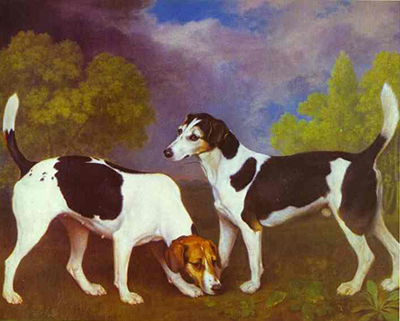
Stubbs's A Couple of Foxhounds, also known as Hound and Bitch in a Landscape, is dated 1792. The oil on canvas measures 101.6 × 127 cm and belongs to Tate, accession T01705. [1]
Two dogs occupy nearly the entire width of the foreground. The animal on the left lowers its head until its muzzle almost touches the earth. Its companion stands upright behind and beside it, looking towards the left. Their bodies run across the picture while their heads establish two different levels of attention. The encounter is quiet, but its arrangement is unusually forceful. [2]
The dark patches of their coats separate the two bodies without breaking the group apart. White legs register against the shaded ground; white-tipped tails rise at opposite ends. Between those outer accents, the lowered head draws the eye down towards the paws of the standing dog. Stubbs makes a pair out of unlike postures, allowing each animal to remain distinct. [2]
At a Glance
This work across George Stubbs’s career
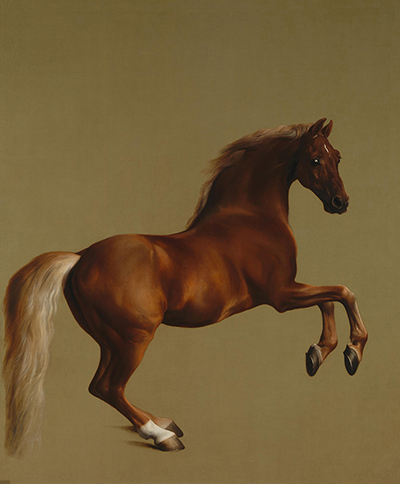
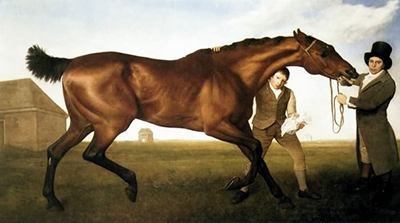
Whistlejacket
about 1762 [7]Contents
- Two animals, two kinds of attention
- A landscape built around the pair
- Foxhounds, harriers and a probable patron
- Australia, rediscovery and Tate
- A painting, a reproduction and an original print
- Why the pair continues to reward looking
- Videos on George Stubbs
Two animals, two kinds of attention
The left dog is shown obliquely. Its hindquarters stand closer to the picture's left edge, while its neck turns down and its face becomes more visible to us. The other animal offers a clearer lateral view of its torso. This difference matters: the picture alternates between a broad, readily legible silhouette and a body that bends away from that straightforward presentation. [2]
Look at the meeting of the heads and forelegs. The lowered muzzle sits beside a small, bright paw, immediately beneath the other dog's chest. The bodies overlap, yet the contour of the bending neck and the upright foreleg remain intelligible. Their closeness creates a concentrated centre of interest without requiring a dramatic action or the intervention of a human figure. [2]
The animals also divide the available space differently. The left dog's longer sweep of white flank carries the eye across a low horizontal band. On the right, a dark back and shoulder give the standing animal a more continuous upper contour. Small changes in the direction of the legs prevent these horizontal bodies from becoming rigid parallel shapes. [2]
The Frick Collection described the dogs as a life-size breeding pair when it exhibited the picture in 2007. Its interpretation placed the work within Stubbs's late simplification of composition: substantial forms carry the design, while minute description remains exacting. The scale gives an ordinary canine presence the visual authority of a major portrait. [16]
Seen in reproduction, it is easy to concentrate upon the dogs' faces and overlook how much of the painting is occupied by their bodies. The long backs, deep chests and extended legs organise the whole lower field. Their heads are relatively small elements within that structure. Attention to the animals therefore begins with stance and bodily relation, before any expression is read into an eye. [2]
The right dog's gaze does not complete a neat exchange of looks. Its companion faces down and partly towards us, while the upright head points across the picture. The group gains its coherence from proximity, overlapping outlines and shared ground rather than eye contact. That distinction leaves room for the dogs' separate activities within the carefully joined composition. [2]
A landscape built around the pair
Trees gather along both sides, leaving an opening above the animals. The left foliage forms a dense, rounded mass; on the right, smaller crowns rise behind the standing dog's back. A patch of blue appears between grey and lighter clouds. The open sky gives breathing space to a foreground in which the bodies almost touch the edges. [2]
Much of the ground remains dark. Against it, the white coat becomes a means of drawing: broad areas define the flanks, narrower strips separate a leg from the earth, and tiny bright points articulate the feet. The black patches have a different effect. Their large, relatively continuous shapes hold the torsos together and resist the scattering of attention into many small details. [2]
Brown around the heads brings a warmer note into this black-and-white arrangement. It also helps distinguish the lowered face from the white neck that leads into it. The repeated colours establish kinship between the animals, while the distribution of patches makes their individual appearances easy to follow. Similarity and difference are worked out through visible markings rather than an explanatory narrative. [2]
The landscape has enough depth to place the dogs outdoors, but the eye repeatedly returns to their immediate space. Dark foliage sits behind pale coats; the open sky clears the outline of the upright head. These relationships give the animals unusual prominence. Background and subject work together without a distant building or a recognisable human activity competing for attention. [2]
Foxhounds, harriers and a probable patron
Tate identifies the Reverend Thomas Vyner of north Lincolnshire as the probable patron. He knew Charles Anderson-Pelham and hunted at Brocklesby. The dogs' names remain unidentified. [1]
An anonymous family history, quoted by the Frick, praised Vyner's knowledge of breeding hounds and managing them in kennels and in the field. That description helps explain why a double animal portrait could have mattered to such a patron. The physical individuality of the dogs would have been meaningful within a world of attentive breeding and practical judgement. [16]
Tate's acquisition catalogue allows that these animals may be hare-hounds, or harriers, rather than foxhounds. The familiar title leaves that question open. [1]
Tate links the pair with Ringwood, a Brocklesby Foxhound, also dated 1792. Ringwood remains a separate named animal, rather than an identified member of this pair. [1]
The Frick's description of a breeding pair is an interpretation of the portrait's function as well as its subject. In that reading, the animals deserved commemoration as particular valued hounds. The painting's imposing presentation supports the exhibition's emphasis on their importance, while the actions themselves remain modest: a lowered muzzle, a standing body, two tails held high. [16] [2]
Australia, rediscovery and Tate
The picture's early ownership remains incomplete. A 1991 account in Lincolnshire Past & Present associated it with the Vyner family and suggested several possible circumstances in which it reached Australia. These included family emigration and a later shipment after an estate sale. The notice offered alternatives, preserving a family connection without establishing a single documented journey. [17]
Its return brought a new episode in its physical history. The same regional notice reported that a forklift truck tore the canvas after it reached England and that John Brealey repaired the damage. This is a published historical account of an accident and treatment, rather than a description of damage that can be diagnosed from a reproduction. [17]
Tate's catalogue traces the modern dealer chain through an Australian dealer, a London dealer and Spink. The painting appeared in Spink's exhibition in late 1972 and in Fanfare for Europe at Christie's in January 1973. Tate bought it in 1973 with public and Friends' assistance. [1]
An 1807 sale listed two hounds belonging to the Duke of Richmond, painted at Goodwood in 1791. Tate discusses that record without identifying it conclusively with this signed and dated 1792 canvas. [1]
A painting, a reproduction and an original print
The image acquired another life through reproduction. The National Trust records a coloured print after Stubbs at Belton House, catalogued as A Couple of Fox Hounds. Its description also preserves the older title A Hound and a Bitch in a Landscape. This is a separate paper object after the painting; the record does not supply a date for its production. [18]
In 1991, the painting reached a much wider everyday audience on a British postage stamp. The contemporary Lincolnshire notice identified it as the 31p value in the dog-painting issue released on 8 January. Under the title Two Hounds in a Landscape, the pair became an image that could circulate far beyond a gallery wall. [17] [19]
Stubbs also made canine images directly as prints. The Metropolitan Museum of Art owns Dog (A Foxhound Viewed from Behind), dated 1 May 1788, which it catalogues as roulette work with etching, in its first and only state. The museum stresses that Stubbs both designed and etched it himself. That small original print belongs to a different category from a later reproduction of this painting. [20]
The distinction matters when following Stubbs's animal painting across different forms. A familiar subject can survive in an oil painting, a print made by the artist and a reproduction made after his work, but those objects have different relationships to his hand. An image's popularity should sharpen attention to those differences rather than allow a shared dog subject to conceal them. [18] [20]
Why the pair continues to reward looking
That arrangement allows intimacy without a human observer entering the scene. We stand close enough to compare coat markings, follow the turn of a neck and see how one body partially masks the other. Yet the dogs' attention is directed elsewhere. The painting sustains a view of animals carrying on their own activities, even as its balanced design makes them available for prolonged scrutiny. [2]
Within Stubbs's paintings, the pair offers a particularly concentrated example of how much can be achieved with a limited cast. Its visual event is the conjunction itself: different postures brought into one substantial foreground group. The white tail tips at either side hold that group open, while the lowered head anchors it near the centre. The picture stays active through these small, exact relationships. [2]
Videos on George Stubbs
Explore Stubbs’s equestrian painting in its wider context, including two readings of Whistlejacket.
A Horse Lover’s Guide to the YCBA
A museum tour that places Stubbs alongside other artists who painted horses. It includes a look at Pumpkin with a Stable-lad.
Watch on YouTubeGeorge Stubbs artworks directory
Search works and related prints documented in this guide. Separate versions and printing matrices have separate entries; printmakers are named where known. Unidentified historical titles and untraced studio-sale material are discussed in the essays. A dash means that a date is not established here.
| Name | Date | Medium |
|---|---|---|
| A Bay Horse with a Groom | 1791 | Painting |
| A Bay Hunter with Two Playful Spaniels | 1777 | Painting |
| A Bay Hunter, a Springer Spaniel and a Sussex Spaniel in a wooded river Landscape | 1782 | Painting |
| A Cheetah and a Stag with Two Indian Attendants | about 1764 | Painting |
| A Couple of Fox Hounds (coloured print after Stubbs) | — | Print after Stubbs |
| A Couple of Foxhounds | 1792 | Painting |
| A Foxhound on the Scent | 1788 | Drawing |
| A Gentleman driving a Lady in a Phaeton | 1787 | Painting |
| A Grey Horse | 1793 | Painting |
| A Grey Horse (cantering companion) | 1793 | Painting |
| A Grey Stallion in a Landscape | — | Painting |
| A Horse Affrighted at a Lion | 1 May 1788 | |
| A Horse Belonging to the Rt. Honourable Lord Grosvenor called Bandy from his Crooked Leg | about 1763 | Painting |
| A Horse Frightened by a Lion | 1777 | |
| A Lion (A Lion Resting on a Rock) | 1 May 1788 | |
| A Lion Attacking a Horse | 1770 | Painting |
| A Lion Attacking a Horse (monumental Yale canvas) | 1762 | Painting |
| A lion attacking a horse (NGV) | about 1765 | Painting |
| A Lion Devouring a Horse (1788 print) | 1788 | |
| A lion devouring a horse (attribution disputed) | Proposed mid-1770s | Painting |
| A mare and foal with a bay horse | 1771 | Painting |
| A Monkey | 1799 | Painting |
| A Prancing Horse, Facing Right | c. 1790 | Drawing |
| A Rough Dog | 1790 | Painting |
| A Saddled Bay Hunter | 1786 | Painting |
| A Sleeping Leopard | 1 January 1791 | |
| A Tiger and a Sleeping Leopard | 1 May 1788 | |
| A Tigress (John Dixon after Stubbs) | 1772 | Print after Stubbs |
| A Tyger (A Recumbent Leopard by a Tree) | 1 May 1788 | |
| A Tyger (Sleeping Leopard) | 1 May 1788 | |
| An animal found on the coast of New Holland called kanguroo (after Stubbs) | 1773 | Print after Stubbs |
| An animal of a new species found on the coast of New South Wales (after Stubbs) | July 1773 | Print after Stubbs |
| Antinous and Jockey | — | Painting |
| Antinoüs, a chestnut racehorse, in a landscape | Undated | Painting |
| Bandy belonging to Lord Grosvenor (print after Stubbs) | — | Print after Stubbs |
| Baronet (George Townley Stubbs after Stubbs) | 20 February 1794 | Print after Stubbs |
| Baronet with Sam Chifney Up | 1791 | Painting |
| Baronet with Samuel Chifney up (Royal Collection) | 1791 | Painting |
| Bay Hunter by a Lake | 1787 | Painting |
| Brood Mares (Benjamin Green after Stubbs) | Issue 14 November 1776 | Print after Stubbs |
| Brood Mares and Foals | usually dated 1767 | Painting |
| Brown and White Norfolk or Water Spaniel | 1778 | Painting |
| Bulls Fighting | 1786 | Painting |
| Captain Samuel Sharpe Pocklington with His Wife, Pleasance, and possibly His Sister, Frances | 1769 | Painting |
| Death of the Doe (attribution disputed) | 1804 | |
| Der Englische Hühnerhund (Johann Wölfle after Stubbs) | about 1860 | Print after Stubbs |
| Dog (A Foxhound Viewed from Behind) | 1 May 1788 | |
| Dog [A Foxhound on the Scent] | 1788 | |
| Drill and albino baboon | before 1789 | Painting |
| Eclipse (Charles Hunt after Stubbs) | 12 November 1839 | Print after Stubbs |
| Eclipse (George Townley Stubbs after Stubbs) | 1796 | Print after Stubbs |
| Eclipse (oil study) | — | Painting |
| Eclipse (Thomas Burke after Stubbs) | First published 1772 | Print after Stubbs |
| Eclipse and John Wildman (Benjamin Green after Stubbs) | 1772 | Print after Stubbs |
| Eclipse at Newmarket (Jockey Club version) | Proposed early 1790s; often dated 1770 | Painting |
| Eclipse at Newmarket with a groom and jockey | 1770 | Painting |
| Eclipse with Mr Wildman and His Sons | 1769–71 | Painting |
| Eclipse, the Property of Capt.n O Kelly (anonymous print after Stubbs) | Imprint 4 June 1804; impression undated | Print after Stubbs |
| Euston | 1774 | Painting |
| Finished Study for the Seventh Anatomical Table of the Muscles of the Horse | 1756–58 | Drawing |
| Five Brood Mares at the Duke of Cumberland's Stud Farm in Windsor Great Park | 1765 | Painting |
| Fowl Body, Lateral View (Highly Finished Study for an Unpublished Table; Shows the Last Stage in Dissection) | — | Drawing |
| Fowl Body, Lateral View (Probably Prepared for Transfer to the Plate for Engraving of Table XV) | — | Drawing |
| Fowl Skeleton, Lateral View (Finished Study for Table V) | — | Drawing |
| Freeman, the Earl of Clarendon's Gamekeeper, with a Dying Doe and Hound (Yale) | 1800 | Painting |
| George Stubbs (enamel self-portrait) | 1781 | Enamel |
| Gimcrack (George Townley Stubbs after Stubbs) | 1775 | Print after Stubbs |
| Gimcrack on Newmarket Heath, with a trainer, a jockey and a stable lad | about 1765 | Painting |
| Gimcrack, with John Pratt up, on Newmarket Heath | about 1765 | Painting |
| Hambletonian, Rubbing Down | 1800 | Painting |
| Hay-Makers | 1791 | |
| Haycarting | 1795 | Enamel |
| Haymakers | 1785 | Painting |
| Haymakers (Lady Lever Art Gallery) | 1794 | Enamel |
| Hollyhock (with later additions by Vernet and Boucher) | about 1765–70 | Painting |
| Horse Attacked by a Lion (Episode C) | 1768–69 | Painting |
| Horse Attacked by a Lion (Tate enamel) | 1769 | Enamel |
| Horse Devoured by a Lion | Possibly exhibited 1763 | Painting |
| Horse Frightened by a Lion | 1770 | Painting |
| Horse Frightened by a Lion (Episode A; Wedgwood and Bentley after Stubbs) | — | Sculpture |
| Horse Frightened by a Lion (Tate) | Possibly exhibited 1763 | Painting |
| Horse Frightened by a Lion (Yale) | 1762–68 | Painting |
| Horse in the Shade of a Wood | 1780 | Painting |
| Hound Coursing a Stag | about 1762 | Painting |
| Human Figure, Anterior View (Intended for a Plate That was Never Published) | — | Drawing |
| Human Skeleton, Lateral View | 1795–1806 | Drawing |
| Hunt servants setting out (Southill commission) | 1767 | Painting |
| Hühnerhund (The Spanish Pointer) | about 1766 | Painting |
| John and Sophia Musters Riding at Colwick Hall | 1777 | Painting |
| John Musters on his hunter Pilgrim | 1777–78 | Painting |
| Labourers | 1789 | |
| Labourers (Richard Earlom after Stubbs and Amos Greene) | 25 March 1790 | Print after Stubbs |
| Laetitia, Lady Lade (d.1825) | 1793 | Painting |
| Lemon and White Water Spaniel | — | Painting |
| Lion Attacking a Stag | — | Painting |
| Lord Grosvenor's Arabian Stallion with a Groom | about 1765 | Painting |
| Lord Grosvenor's Arabian Stallion with a Groom (Peter Mazell after Stubbs) | 1771 | Print after Stubbs |
| Mambrino (Eaton Hall painting) | — | Painting |
| Mambrino (George Townley Stubbs after Stubbs) | 1794 | Print after Stubbs |
| Mares and Foals belonging to the 2nd Viscount Bolingbroke | about 1761–62 | Painting |
| Mares and foals beneath large oak trees | — | Painting |
| Mares and Foals by a stream | Exhibited 1764 | Painting |
| Mares and Foals in a River Landscape | about 1763–68 | Painting |
| Mares and Foals in an Extensive Landscape | about 1769 | Painting |
| Mares and Foals without a Background | 1762 | Painting |
| Moose Deer (after Stubbs) (Arctic Zoology plate VIII) | 1784–85 publication | Print after Stubbs |
| Newmarket Heath with a Rubbing-Down House | — | Painting |
| Otho (1796 print after Stubbs) | 1 December 1796 | Print after Stubbs |
| Otho, with John Larkin up | 1768 | Painting |
| Pangloss | about 1762 | Painting |
| Patch (Grafton commission) | 1759 | Painting |
| Phaeton and the Chariot of the Sun (enamel) | 1775 | Enamel |
| Phaeton with a Pair of Cream Ponies and a Stable-Lad | 1780–84 | Painting |
| Phillis | 1772 | Painting |
| Portrait of a Large Dog (Dingo) | 1772 | Painting |
| Pumpkin with a Stable-lad | 1774 | Painting |
| Racehorses Exercising at Goodwood | 1759–60 | Painting |
| Reapers (1791 print) | 1791 | |
| Reapers (Tate) | 1785 | Painting |
| Reapers (Yale) | 1795 | Enamel |
| Red Deer: A Stag and a Hind | 1792 | Painting |
| Richard Wedgwood | — | Enamel |
| Ringwood, a Brocklesby Foxhound | 1792 | Painting |
| Scrub, a bay horse belonging to the Marquess of Rockingham | about 1762 | Painting |
| Self Portrait on a White Hunter | 1782 | Enamel |
| Self-Portrait | about 1759 | Painting |
| Shooting (1770 Woollett plate after Stubbs) | 1770 | Print after Stubbs |
| Shooting (1771 Woollett plate after Stubbs) | 1771 | Print after Stubbs |
| Shooting at Goodwood | 1759–60 | Painting |
| Sir John Nelthorpe as a boy | 1756 | Painting |
| Sir John Nelthorpe partridge shooting with one pointer | — | Painting |
| Sir John Nelthorpe, 6th Baronet, out Shooting with His Dogs in Barton Field, Lincolnshire | 1776 | Painting |
| Sleeping Leopard | 1777 | Enamel |
| Soldiers of the 10th Light Dragoons | 1793 | Painting |
| Stallion and Mare (George Townley Stubbs after Stubbs) | 1776; reissued 1789 | Print after Stubbs |
| Steward and gamekeeper with dogs (Southill commission) | 1767 | Painting |
| Studies of a Lemur (Lemur murinus) in six different attitudes | 1773 | Drawing |
| Study for the Self-portrait in Enamel | c. 1781 | Drawing |
| Study of a Lemur | 1773 | Drawing |
| Study of a Racehorse in Action: Galloping to Left, a Semi-Anatomical Study, with Skin Flayed to Show Action of Muscles | — | Drawing |
| Study of the Legs of a Draught-Horse Pulling a Harrow (attributed to Stubbs) | Proposed about 1786 | Drawing |
| Sweet William (Grosvenor panel) | — | Painting |
| Sweet William (Turf Gallery canvas) | — | Painting |
| The Black Stallion Sampson, Portrayed from Three Angles (with landscape additions) | about 1764 | Painting |
| The Charlton Hunt | 1759–60 | Painting |
| The Fall of Phaeton | — | Sculpture |
| The Frightened Horse | 1780 | Sculpture |
| The Grosvenor Hunt | — | Painting |
| The Haymakers (Upton House) | 1783 | Painting |
| The Horse and Lion (George Townley Stubbs after George Stubbs) | 1770 | Print after Stubbs |
| The Kongouro from New Holland | 1772 | Painting |
| The Labourers | 1779 | Painting |
| The Labourers (Southill original) | 1767 | Painting |
| The lion and horse (Benjamin Green after Stubbs) | 1769; reissued 1777 | Print after Stubbs |
| The Milbanke and Melbourne Families | about 1769 | Painting |
| The Moose | 1770 | Painting |
| The Prince of Wales's Phaeton | 1793 | Painting |
| The Reapers (Upton House) | 1783 | Painting |
| The Sebra, or Wild Ass (George Townley Stubbs after Stubbs) | 1771 | Print after Stubbs |
| The Spanish Pointer (Bradford version) | about 1766–68 | Painting |
| The Spanish Pointer (William Woollett after Stubbs) | January 1768 | Print after Stubbs |
| The Third Duke of Dorset's Hunter with a Groom and a Dog | 1768 | Painting |
| Thomas Freeman, Lord Clarendon's gamekeeper, with a dog and a shot doe (with George Townly Stubbs) | 1803 | Painting |
| Turf, with Jockey up, at Newmarket | — | Painting |
| Turk and Crab | — | Painting |
| Two Bay Hunters Communing On The Bank Of A Lake | — | Painting |
| Tygers at Play | 1780 | |
| Viscount Gormanston's White Dog | 1781 | Painting |
| Viscount Gormanston's White Dog (canvas version) | — | Painting |
| Water Spaniel | 1769 | Painting |
| Wedgwood Family Portrait | 1780 | Painting |
| Whistlejacket | about 1762 | Painting |
| Whistlejacket with two other stallions and a groom | Recorded 1762 | Painting |
| White Poodle in a Punt | about 1780 | Painting |
| William Anderson with two Saddle-Horses | 1793 | Painting |
| Working Drawing for the Seventh Anatomical Table of the Muscles of the Horse | 1756–58 | Drawing |
| Zebra | 1763 | Painting |
Discussion
Look again at the images and ideas explored in A Couple of Foxhounds. These editorial prompts invite your observations.
Reader Insights
Which feature first makes the dogs seem like a pair: their similar coats, their closeness or the way their bodies balance each other?
Look again at the space between their heads and forelegs.
Does following those contours change how you read the relationship between the two animals?
Join the Conversation
Share a detail, comparison or question about A Couple of Foxhounds below.
References
- Tate, George Stubbs, A Couple of Foxhounds, 1792, T01705: current Details, Terry Riggs's collection text, December 1997, current caption and acquisition catalogue published in The Tate Gallery Report 1972–1974 (London, 1975). Accessed 4 November 2026. View source.
- Tate / Art UK, whole-image reproduction of A Couple of Foxhounds, 1,108 × 880 pixels, preserved on Wikimedia Commons. View image. Accessed 4 November 2026. View source.
- Goodwood, The Collection, Painting Collection modal, Racehorses Exercising at Goodwood; An exciting acquisition: a study by George Stubbs, 30 June 2023; History of the Estate Hounds, 4 October 2023; About Goodwood Racecourse. Accessed 4 November 2026. View source.
- Goodwood, The Collection, Painting Collection modal, Racehorses Exercising at Goodwood; An exciting acquisition: a study by George Stubbs, 30 June 2023; History of the Estate Hounds, 4 October 2023; About Goodwood Racecourse. Accessed 4 November 2026. View source.
- Goodwood, The Collection, Painting Collection modal, Racehorses Exercising at Goodwood; An exciting acquisition: a study by George Stubbs, 30 June 2023; History of the Estate Hounds, 4 October 2023; About Goodwood Racecourse. Accessed 4 November 2026. View source.
- Goodwood, The Collection, Painting Collection modal, Racehorses Exercising at Goodwood; An exciting acquisition: a study by George Stubbs, 30 June 2023; History of the Estate Hounds, 4 October 2023; About Goodwood Racecourse. Accessed 4 November 2026. View source.
- National Gallery, Whistlejacket, NG6569, current collection record, provenance, in-depth discussion and frame entry. View source.
- Yale Center for British Art, Zebra, B1981.25.617, current object metadata, gallery labels, Malcolm Warner’s 1998 catalogue entry and provenance supplied through the museum’s public collection record. View source.
- Christie’s, Gimcrack on Newmarket Heath, with a trainer, a jockey and a stable lad, London, 5 July 2011, lot 12; object details, essay, provenance, exhibitions and whole image. View source.
- Christie’s, Gimcrack on Newmarket Heath, with a trainer, a jockey and a stable lad, London, 5 July 2011, lot 12; object details, essay, provenance, exhibitions and whole image. View source.
- Yale University Art Gallery, A Lion Attacking a Horse, 1770, 1955.27.1, collection record. Accessed 4 November 2026. View source.
- Royal Museums Greenwich, ‘The Kongouro from New Holland’ (Kangaroo), ZBA5754. Accessed 4 November 2026. View source.
- Tate, George Stubbs, Haymakers, 1785, T02256; details, Terry Riggs’s collection text (January 1998), and online caption. Collection record. View source.
- Tate, George Stubbs, A Couple of Foxhounds, 1792, T01705: current Details, Terry Riggs's collection text, December 1997, current caption and acquisition catalogue published in The Tate Gallery Report 1972–1974 (London, 1975). View source. Accessed 4 November 2026. View source.
- Frances Bailey, ‘Hambletonian, Rubbing Down: A masterpiece by George Stubbs’, National Trust Cultural Heritage Magazine, Autumn/Winter 2024, pp. 22–33. Article. View source.
- The Frick Collection, George Stubbs (1724–1806): A Celebration, 2007, exhibition label for A Couple of Foxhounds, including an anonymous Vyner family history quoted by the exhibition. Accessed 4 November 2026. View source.
- Lincolnshire Past & Present, no. 3, Spring 1991, “Faces and Places”, edited by Terence Leach, “Two Hounds in a Landscape”, p. 27. Accessed 4 November 2026. View source.
- National Trust Collections, A Couple of Fox Hounds, after George Stubbs, coloured print, Belton House, NT 437659. Accessed 4 November 2026. View source.
- Collect GB Stamps, Dogs, paintings by George Stubbs, issue of 8 January 1991, 31p Two Hounds in a Landscape. Accessed 4 November 2026. View source.
- The Metropolitan Museum of Art, George Stubbs, Dog (A Foxhound Viewed from Behind), 1 May 1788, 49.49.6. Accessed 4 November 2026. View source.
- Basic title, date and material metadata for Tate’s Reapers (T02257) and Otho (T02375) is adapted from the Tate collection dataset, October 2014, released under CC0. TheHistoryOfArt.org has reconciled labels and versions. This credit does not apply to Tate’s authored catalogue commentary or images.
- Data Source: Yale Center for British Art. Basic object fields are adapted and reconciled for this directory. Reuse is subject to the Center’s Open Data and Data Services Terms of Use. No museum endorsement is implied. This metadata credit does not relabel scholarly essays or images as open data.
- Basic object metadata for A Horse Frightened by a Lion, 1985.38, The Cleveland Museum of Art, John L. Severance Fund, is available under CC0. Titles and design-level grouping have been reconciled for this directory.