 by Tom Gurney
Tom Gurney BSc (Hons) is an art history expert with over 20 years experience
Email: tomgurney1@gmail.com / Phone: +44 7429 011000
George Stubbs Paintings: Introduction
George Stubbs's paintings are often introduced through a few memorable horses, yet the surviving work is much less uniform than that suggests. He painted named racehorses and breeding stock, dogs, family groups, riders, grooms, agricultural workers and animals brought to Britain through international networks of collecting and empire. The securely mapped career runs from northern portrait practice and the Goodwood commissions of 1759–60 to racing and royal pictures of the 1790s and the immense Hambletonian, Rubbing Down of 1800. No confidently identified early northern canvas provides a simple starting masterpiece, so Goodwood is the first firm group from which to follow the development of the paintings. [1] [2]
Even a familiar title may identify a subject rather than one unchanging object. Stubbs returned to mares and foals, Gimcrack, Eclipse, harvest workers, and horses threatened by lions. Paintings were engraved; compositions were revised; supports and binding media changed; pictures passed through families, sales and museums. A useful account therefore has to keep the physical work—its present title, date, materials, dimensions, owner and accession—apart from related designs and later reproductions. It also needs to explain patterns across the paintings without becoming an abbreviated catalogue of every object.
At a Glance
- SubjectsHorses, other animals and people [1] [2]
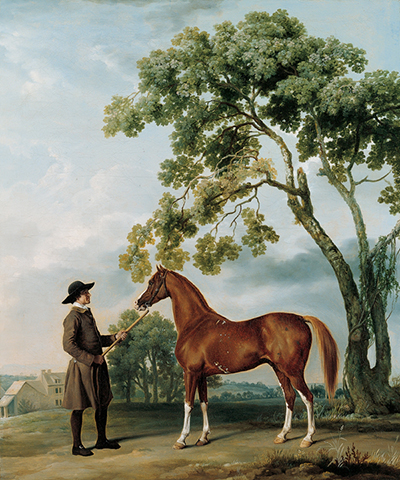
- Illustrated paintingLord Grosvenor’s Arabian Stallion with a Groom [3]
Contents
- What belongs to the painted corpus?
- A chronology through paintings, 1759–1800
- Patrons commissioned sets, not just isolated icons
- Six ways of making a horse painting
- Variant, version, companion and reproduction
- People, dogs and country work
- Animals carried into British collections
- A lion and horse: sequence rather than symbol
- Supports and binding media
- Exhibition and reproduction changed the audience
- Videos on George Stubbs
Explore George Stubbs’s paintings
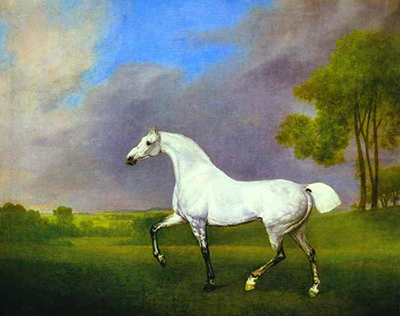
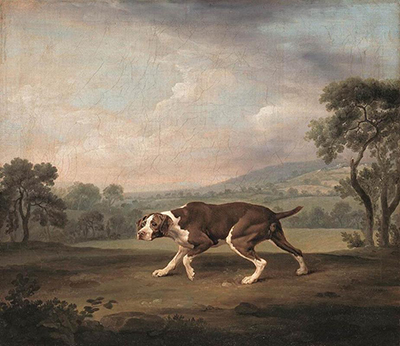
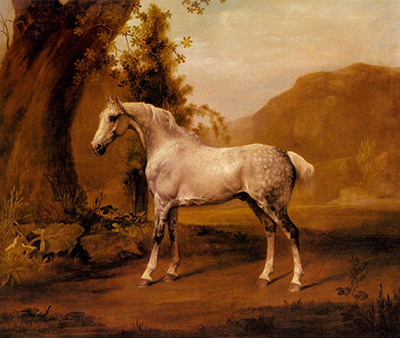
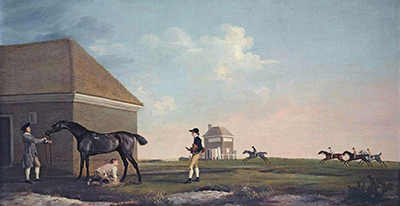
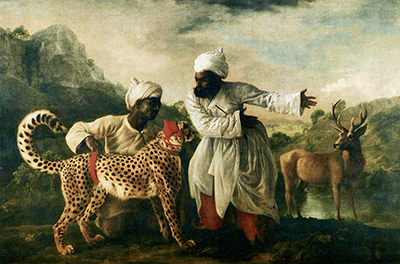
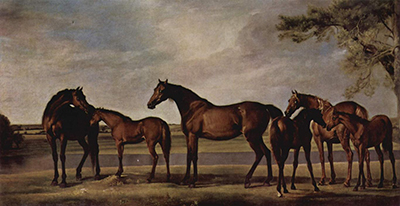
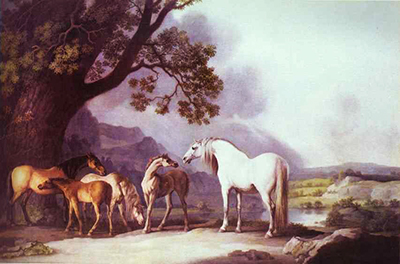
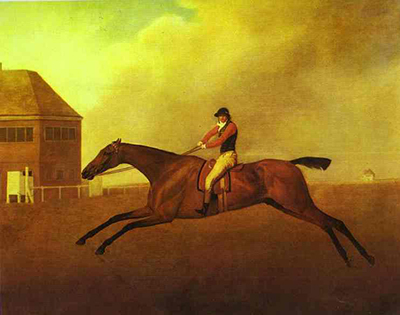
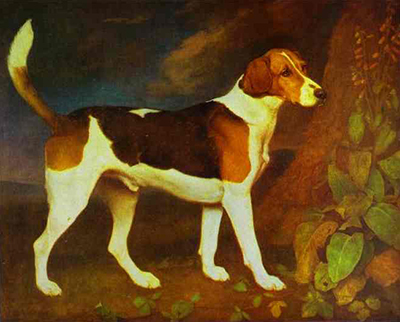
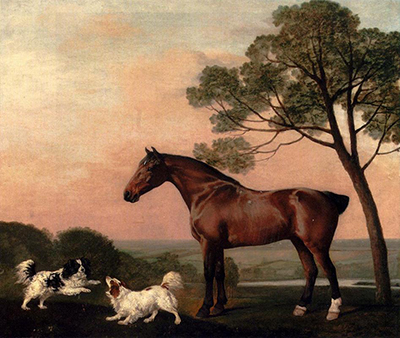
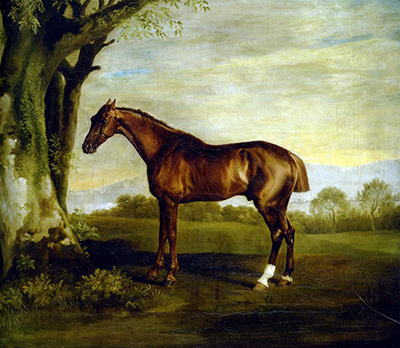
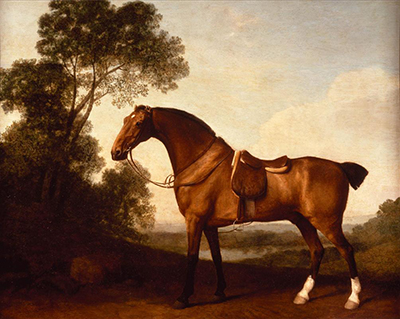
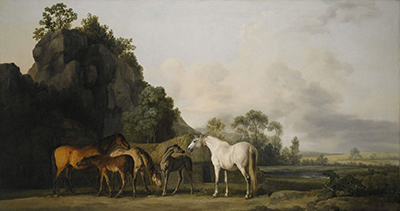
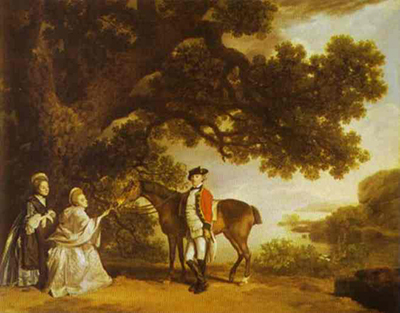
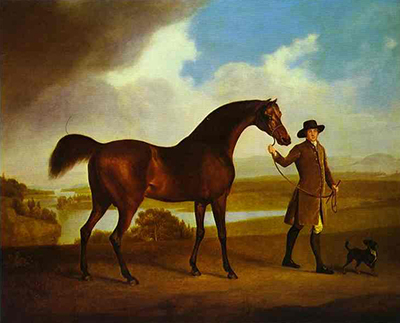
What belongs to the painted corpus?
There is no defensible one-line total for Stubbs's paintings. Some works remain in private collections, some are untraced, and some titles cover several related compositions. Attributions and dates can change when documentary, technical or provenance evidence is reconsidered. Judy Egerton's 2007 catalogue raisonne was the first full catalogue of the paintings and drawings; its 700 pages combine individual entries with an extended study of the career. [4] That scale is a warning against converting the results of a collection search, a website gallery or the number of pages in this guide into a supposedly complete count.
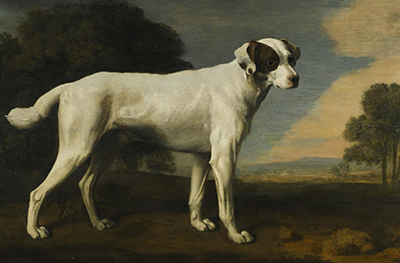
The practical boundary begins with the object. The painting used at the head of this page is the Kimbell Art Museum's Lord Grosvenor's Arabian Stallion with a Groom, painted about 1765 in oil on canvas and measuring 99.3 by 83.5 centimetres. Its accession number is AP 1981.03. The Kimbell notes that the canvas may have been reduced at the sides because a 1771 engraving after the design is wider, although the physical evidence is not conclusive. [3] The present canvas, the wider engraved design and the digital image are related, but they are not the same thing.
That distinction matters throughout Stubbs's work. A title such as Brood Mares and Foals needs a patron, arrangement and collection before it becomes an exact identification. A horse's name does not establish whether an image is a painting, an impression taken from a plate or a modern reproduction. “Oil” alone may conceal a canvas or rigid panel and says nothing about resins or waxes found by analysis. Conversely, the presence of beeswax does not by itself make every picture “encaustic”. Fired enamel on copper or a Wedgwood plaque belongs to another process, while a stipple impression on paper is a print. [5] [6]
Current titles and accession numbers are especially valuable where older labels have hardened into false certainty. The National Gallery of Art now calls its 1769 group Captain Samuel Sharpe Pocklington with His Wife, Pleasance, and possibly His Sister, Frances, not the older “Colonel Pocklington with his Sisters”. The cautious “possibly” is part of the institution's identification rather than an ambiguity to be edited away. [7] Similar care is needed with pictures described as “after” Stubbs, later copies of his compositions, and works known only through an engraving or sale record. These may be important evidence for a design, but they do not silently enlarge the body of autograph paintings.
A chronology through paintings, 1759–1800
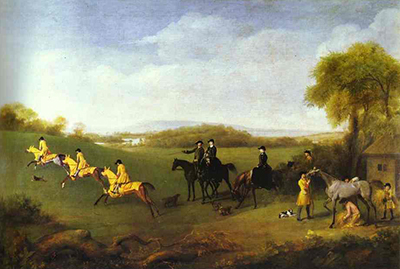
Stubbs worked as a portrait painter in Yorkshire and other northern centres during the late 1740s and early 1750s, but the uncertain survival and attribution of those pictures makes them an unstable opening chapter for a survey of the painted work. [1] The situation changes at Goodwood. The third Duke of Richmond employed him there for about nine months in 1759–60, and three large sporting scenes remain associated with that stay: Racehorses Exercising at Goodwood, Shooting at Goodwood and The Charlton Hunt. Goodwood's records and surviving studies make this the first securely connected group in which patrons, place, working process and finished canvases can be considered together. [8]
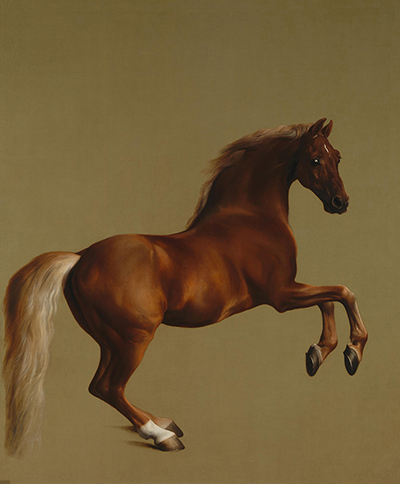
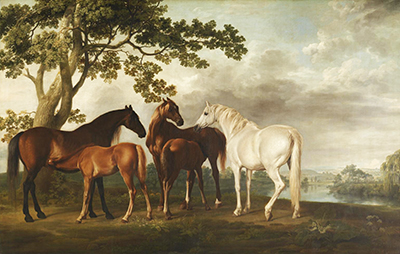
The early 1760s brought a rapid enlargement of scale and subject. Patron-specific groups of brood mares, racehorses, dogs and hunts appeared alongside the first monumental lion-and-horse compositions. Mares and Foals belonging to the 2nd Viscount Bolingbroke, about 1761–62, is a 99-by-187-centimetre canvas; the Kimbell regards it as one of the principal and probably earliest paintings of its kind. [9] At almost three metres high, the National Gallery's Whistlejacket asks a very different kind of attention even though it came from the same aristocratic world of breeding and racing. [10] The distinction between a frieze-like breeding group and a single life-size stallion shows how quickly Stubbs varied the pictorial work a horse painting could perform.
During the remainder of the 1760s, his commissions spread across mounted portraits, standing stallions, racecourse scenes, conversation pieces, dogs, wild animals and repeated narrative subjects. The paintings do not unfold as a tidy progress from “animal” to “human” or from observation to imagination. The 1765 Fitzwilliam Gimcrack is a mounted racing portrait; the wider Gimcrack composition from about the same year brings horse, trainer, jockey and stable lad into a multi-part view of Newmarket Heath. [11] [12] The Milbanke and Melbourne Families and the Pocklington group, both about 1769, integrate people, horses, landscape and social relations rather than treating one species as the only true subject. [7] [13]
The 1770s extend that range. The moose was associated with the Richmond circle; the kangaroo and dingo were commissioned by Joseph Banks; Pumpkin with a Stable-Lad was painted in 1774; and dog portraits continued beside experiments on rigid supports. [8] [14] [15] Stubbs also began exhibiting at the Royal Academy in 1775 after showing with the Society of Artists from 1762 to 1774. [16] Those exhibition dates provide a public chronology, not a sequence in which private commissions suddenly ceased.
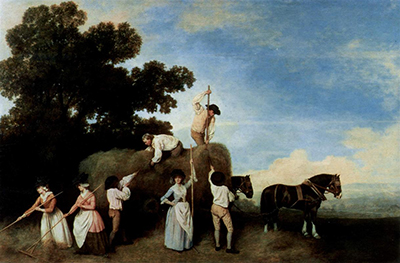
In the late 1770s and 1780s, estate labour, harvest scenes, carriages and family groups sit beside continuing animal subjects. The 1779 Labourers revisited a Southill commission of 1767 on an oak panel and was exhibited at the Academy. [17] The National Trust's 1783 Haymakers and Reapers use oil paint and enamel on oak; the later Tate versions followed in 1785. [18] [19] [20] [21] A Gentleman Driving a Lady in a Phaeton of 1787 is another oil-on-wood painting, but its unknown sitters and carriage setting give the rigid support a different purpose. [22]
The 1790s were not an afterword made only of fading repetitions. The Prince of Wales commissioned work, dogs remained prominent among Academy exhibits, and Stubbs proposed a larger Turf Review of celebrated racehorses. [23] [24] Baronet with Samuel Chifney Up dates from 1791, Soldiers of the 10th Light Dragoons from 1793, and Hambletonian, Rubbing Down from 1800. [23] [25] [26] This chronological arc belongs to the paintings, not to a theory that one subject replaced another. Horses persist, but their formats, patrons, settings, companions and material construction keep changing.
Patrons commissioned sets, not just isolated icons
The Goodwood paintings show how an estate commission could connect several kinds of knowledge. Stubbs prepared movable studies of individual horses, hounds and riders for the larger hunt composition. That is evidence of a working method in this particular project, not proof that every later canvas was assembled in precisely the same way. [8] The three finished scenes also divided sporting life into exercise, shooting and hunting rather than repeating one formula under different titles.
The fullest surviving commission evidence concerns the second Marquess of Rockingham. An August 1762 receipt records payment for a picture of five brood mares and two foals, another of three stallions and a figure, a mounted figure, five dogs, and a final picture of a single horse with a dog. [27] The list matters because it restores an ensemble of painted tasks. The works served a breeder, collector and householder: they distinguished particular animals, registered human-animal relationships and offered differently shaped pictures for display. Rockingham eventually commissioned twelve works, almost as many as Stubbs's sustained patron the first Earl Grosvenor. [27]
The documentation also limits what can safely be said about Whistlejacket. No clear commission entry for the great canvas survives in the extensive Wentworth papers. A December 1762 payment for a lion and a horse “Large as Life” probably concerns a different pair, rather than supplying conclusive evidence for Whistlejacket. [27] The familiar tale that a rider or George III was removed depends on later anecdote, not physical or archival proof. What is secure is the surviving object: an enormous chestnut stallion without rider, tack or developed landscape, commissioned by Rockingham and kept in the family line until the twentieth century. [10] [27]
Different patrons generated different kinds of picture. Richmond's Goodwood group joined estate sport to family and household participation. Bolingbroke, Rockingham, Grosvenor and Cumberland commissioned named racers, breeding stock or hunting animals. George Byng, fourth Viscount Torrington, commissioned a set about outdoor servants and workmen at Southill. Banks asked Stubbs to make paintings from the natural-history evidence carried back from the Endeavour voyage. [14] [15] [17] The Prince of Wales's late patronage included horses, carriages, dogs, military subjects and intended portraiture rather than one repeated royal type. [26] [24]
Ownership structured these opportunities. Patrons controlled studs, estates, collections and access to animals; the pictures could hang among family portraits and older art. Yet commission should not be mistaken for a complete explanation of form. The Kimbell's early mares group was made for Bolingbroke, while the National Trust's five brood mares belonged to the Duke of Cumberland's stud and Tate's mares occupy a river landscape. [9] [28] [29] Shared interests in breeding produced a subject family, but the animals, arrangement, setting, dimensions and later histories remain particular to each work.
The patron's account is only one archive within a painting. Named owners often dominate catalogues because their papers and property descended with the work. Jockeys, grooms, stable lads, attendants and labourers may be named less consistently even when their actions organise the scene. Reading a commission well therefore means holding two facts together: the patron made the painting possible, and the represented world depended on forms of expertise and labour the patron did not personally perform.
Six ways of making a horse painting
“Horse portrait” is too broad to describe the main pictorial jobs Stubbs gave to equine subjects. A standing horse with a groom joins conformation to handling and scale. In Lord Grosvenor's Arabian Stallion with a Groom, the upright format concentrates that relationship, even though evidence from the later engraving raises the possibility that the canvas was once wider. [3] The groom is not an interchangeable size marker: his posture and hold make the animal's managed stillness intelligible.
A mounted portrait asks different questions. The Fitzwilliam Museum's Gimcrack, with John Pratt up, on Newmarket Heath, about 1765, measures 100 by 124 centimetres. Its institutional image shows the mounted horse and jockey beside a rubbing house under an expansive sky. [11] Tate's Otho, with John Larkin up of 1768 similarly keeps the jockey in the title and places the pair near a Newmarket rubbing house. [30] Rider, horse, course architecture and open heath together identify a world of training and competition rather than an animal detached from use.
The much wider Gimcrack on Newmarket Heath, with a trainer, a jockey and a stable lad is about 102 by 193.6 centimetres and distributes several moments across its field. [12] It is neither a long title for the Fitzwilliam work nor merely the same portrait with extra figures. Its breadth allows racing labour to become sequential: preparation, mounted display and attendance coexist in one composition. The current private location and its distinct ownership history remain part of the identification.
Exercise scenes shift emphasis again. Racehorses Exercising at Goodwood places a string of animals, riders and watchers within the estate's sporting routine. [8] A breeding group such as the Bolingbroke mares with foals removes tack and racing action but remains tied to the patron's named stock and decisions about breeding. [9] [27] The seeming ease of mares and young horses in a landscape should not erase the practical and financial system that made the group significant to its first owner.
The isolated, life-size horse produces a sixth solution. Whistlejacket is oil on canvas measuring 296.1 by 248 centimetres in the National Gallery's current record. [10] The inspected institutional image shows the horse rearing alone in a notably tall, largely unoccupied field. That observation describes the encounter created by the surviving canvas; it cannot demonstrate an absent rider or cancelled background. Nor does the horse's fame on the wall mean he was Stubbs's greatest racing subject by results. The painting and the race record answer different questions. [27]
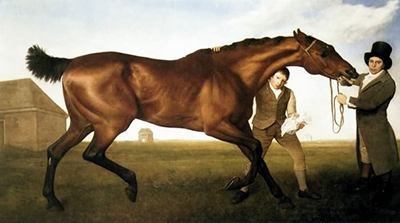
Finally, post-race action reverses the idea that a sporting picture must show victory at its most ceremonial. The National Trust's Hambletonian, Rubbing Down is more than 3.6 metres wide. It presents the horse after his 1799 match with two handlers: an adult described by the collection as trainer or groom, and a stable boy. [25] The effort occurs after competition, when care, fatigue and bodily heat matter. Between standing, mounted, exercising, breeding, racing and recovery, Stubbs built a varied pictorial language from the different states in which horses were known.
Named horses also generated families of images. A secure painted Eclipse anchor is the Baltimore Museum of Art's Eclipse with Mr. Wildman and His Sons, dated 1769–71, oil on canvas, 101.6 by 127 centimetres. [31] An image labelled only “Eclipse” cannot be assigned to that work on the horse's name alone. The same discipline applies to Gimcrack, Baronet and other racers: the people present, pose, measurements, holder and medium are identity evidence, not optional catalogue detail.
Variant, version, companion and reproduction
These terms describe different relationships and should not be exchanged for variety. The mares-and-foals paintings are usually best approached as thematic variants. Stubbs made at least ten arrangements, chiefly during the 1760s, for patrons who valued the individual animals in their own studs. [27] The Kimbell Bolingbroke group, Cumberland's five mares and Tate's river-landscape picture share a type while changing patron, horses, number, spacing and setting. [9] [28] [29] Calling them one image with several backgrounds would discard the reason they were commissioned.
A later version repeats more of an earlier design while remaining a separate object. The National Trust's The Labourers is signed and dated 1779, painted in oil on oak and measures 117.5 by 163.5 centimetres. Its record identifies it as a later version of a 1767 picture commissioned by Torrington for Southill, now in Philadelphia. [17] The earlier commission showed estate workers with a cart and an old hunter meaningful to the patron. According to Ozias Humphry's early account, Stubbs found his arrangement when the men disputed how to fit the cart's tailboard, then continued work with the people and animals accommodated nearby. [17] This documentary story supports a specific observed incident; it does not prove that every labour scene was made in the same manner.
Companions or pendants are works intended or preserved as a pair. The National Trust's 1783 Haymakers and Reapers form one such rural pairing, followed by the later Tate treatments of 1785. [18] [19] [20] [21] The kangaroo and dingo were commissioned, exhibited and retained together. [14] [15] Similar size alone is not enough to invent a pendant relationship, and a companion does not lose its own accession, support or provenance.
A reproduction translates a design into another medium and creates another object. Stubbs's 1791 Reapers is a stipple-and-roulette print on laid paper, not the 1783 or 1785 painting. The National Gallery of Art's impression carries its own dimensions, accession and state within the catalogue of engraved work. [32] Before photography, reproductive prints were a principal means by which paintings and drawings reached audiences who could not see the originals; the printmaker's choices, reversed direction, inscriptions and publication context affected that encounter. [33] Reproduction extended a composition's life, but it did not convert the source canvas into paper.
Physical alteration belongs to another category. The possible narrowing of the Kimbell stallion picture concerns the history of one canvas; the wider engraved design is comparative evidence. [3] By contrast, the two Gimcrack paintings are separate compositions, not pieces cut from one work. [11] [12] A later copy of Hambletonian is a distinct painting even when it follows the celebrated original. [25] Keeping alteration, version and copy apart prevents a change in one object's material history from being mistaken for a new autograph design.
Collaboration requires similar restraint. Egerton's National Gallery catalogue reports that in two later racehorse portraits for Rockingham another artist, possibly Benjamin Killingbeck, appears to have completed the backgrounds. [27] This qualified observation cannot be expanded into a general studio system or certainty about the collaborator. It does, however, unsettle the easy assumption that every square centimetre of every painting attributed to Stubbs must have been executed by one hand.
The lion-and-horse sequence combines several of these relations at once. It moves through narrative episodes and survives in oils, enamels, prints and a relief. Individual objects can be variants in subject, different moments in a sequence, or translations across media. “Another version” is only useful after the reader knows which of those relationships is meant.
People, dogs and country work
The painted corpus is broader than sporting-horse commissions. Stubbs's conversation and equestrian groups require the same exact language as his animal portraits. The Pocklington picture identifies a husband, wife and a woman who may be his sister. [7] The Milbanke and Melbourne Families, about 1769, combines people, horses and a dog; the National Gallery's present title reverses the family order found in older labels. [13] A Gentleman Driving a Lady in a Phaeton uses a deliberately neutral title because the sitters remain unidentified. [22] These works are social encounters structured by animals, vehicles and landscape, not animal pictures with incidental people.
People are also differentiated by the work they perform. John Pratt and John Larkin are named as jockeys in current titles; Samuel Chifney remains named with Baronet. [11] [30] [23] The Kimbell groom is not identified on the current object page, while the adult and boy attending Hambletonian remain unnamed. [3] [25] The responsible response is neither to manufacture identities nor to overlook action. Holding a stallion, riding at speed, preparing a racer and rubbing down a tired horse are forms of knowledge that shape the composition.
The dogs range from participants in hunting and estate life to individual studies. Yale's Water Spaniel of 1769 is an oil on canvas measuring 90.2 by 116.8 centimetres. Its Brown and White Norfolk or Water Spaniel of 1778 is beeswax and oil on panel, measuring 80.6 by 97.2 centimetres. [34] The “or” records uncertainty about breed and should remain. A current title can preserve the limits of knowledge as well as a positive identification.
Academy records also correct the impression that dogs were a minor sideline. By 1791, Stubbs had exhibited fourteen dog paintings at the Academy since his 1775 debut, compared with eleven works featuring horses. [24] That is a count of Academy exhibits over a defined period, not a total for the career. Its value is proportional: the public work seen in London included foxhounds, spaniels and dogs associated with royal or aristocratic owners in numbers that a horse-only summary would conceal.
Estate work expands the subject further. Torrington's original 1767 Southill commission comprised three paintings of outdoor servants and workmen, including labourers with a brick cart, a steward and gamekeeper with dogs, and hunt servants setting out. [17] The later Labourers preserves the cart dispute as a central event rather than a distant rustic accessory. Patronal memory is present too: the old hunter pulling the cart and the dog held personal value for Torrington. Work, ownership and affection occupy the same commission without becoming the same kind of relationship.
Agricultural labour introduced another group of developing designs. The 1783 National Trust Haymakers and Reapers are signed oak panels made with oil paint and enamel; Tate's later versions are oil on wood from 1785. [18] [19] [20] [21] In the harvest compositions, tools, grouped movements, carts, horses and shared tasks provide the structure. The National Trust cautions that the setting may be idealised even where figures appear drawn from life. [18] Reading the workers only as picturesque scenery would make labour disappear; treating the pictures as transparent documentary reportage would ignore their construction.
Animals carried into British collections
Several celebrated paintings began with animals moving through aristocratic households, colonial commerce and scientific collecting. Manchester Art Gallery's A Cheetah and a Stag with Two Indian Attendants, about 1764, records a cheetah called Miss Jenny. Current gallery research identifies one attendant as John Morgan. [35] Naming him changes the terms of attention: the men handle the animal within a staged encounter and should not be reduced to exotic decoration. The commission also joins an Indian hunting practice to a British estate and exhibition culture; those movements need object-specific history rather than a generic moral label.
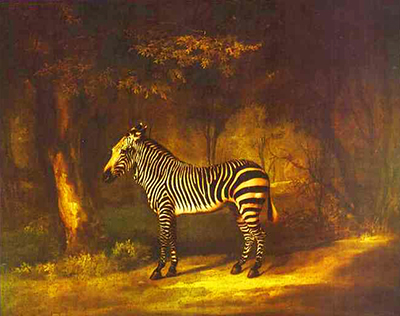
The 1763 Zebra at Yale and the Hunterian's The Moose of 1770 depict unfamiliar species displayed in Britain. [36] Goodwood records that the Duke of Richmond allowed Stubbs to paint the first male moose brought to England, which was kept on the estate. [8] Such works may demonstrate close looking, but they also document who could acquire, keep and display a rare animal. Observation occurred inside networks of possession.
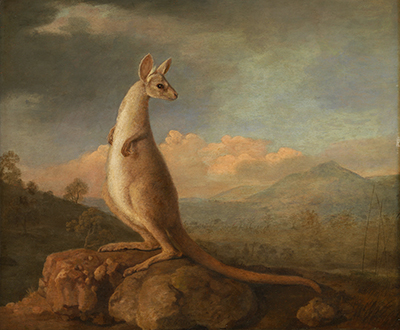
The paired Australian animals establish a sharper limit. Banks commissioned The Kongouro from New Holland and Portrait of a Large Dog (Dingo) after returning from the Endeavour voyage. Both are dated 1772 and catalogued by Royal Museums Greenwich as beeswax on mahogany panel. [14] [15] The kangaroo measures 605 by 715 millimetres; the dingo, 610 by 711 millimetres. They were exhibited together in 1773 and have remained paired. [14] [15]
Stubbs lacked living models for these paintings. The museum states that he worked from descriptions and, for the kangaroo, slight drawings by Sydney Parkinson and a stuffed or inflated pelt that is now lost. [14] The inspected museum images confirm two animals standing in separate landscape settings, but their apparent immediacy is a pictorial achievement rather than proof of direct encounter. The kangaroo design also appeared in a small 1773 engraving in the Gentleman's Magazine, demonstrating how a large painted commission could be detached, reduced and recirculated in print. [37] The kangaroo and dingo therefore reward being read together while retaining their separate evidence histories.
A lion and horse: sequence rather than symbol
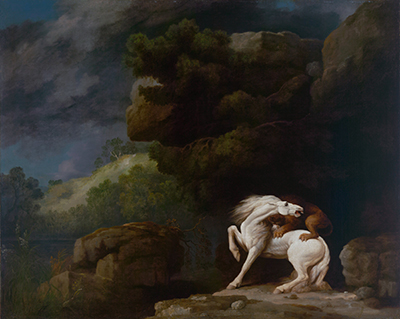
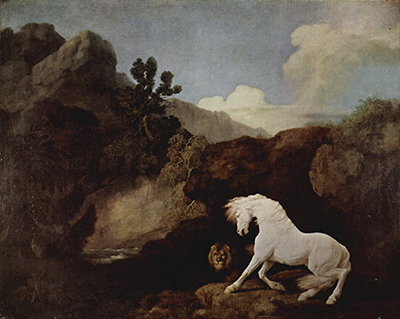
The lion-and-horse subject survives in more than oil paintings. The National Heritage Memorial Fund counts seventeen known works across oils, enamels, prints and a Wedgwood clay relief, organised into four broad episodes. [38] That evidence rules out treating every appearance as a copy of one canvas.
Yale's monumental A Lion Attacking a Horse of 1762 is oil on canvas and measures roughly 244 by 333 centimetres. [39] Tate's Horse Frightened by a Lion, possibly exhibited in 1763, is a much smaller oil on canvas, with unconfirmed dimensions of 70.5 by 101.9 centimetres, and belongs to an interval of fear before bodily contact. [40] Yale also holds Horse Attacked by a Lion (Episode C) of 1768–69, a beeswax-and-oil panel measuring only 25.7 by 29.5 centimetres. [36] Subject, episode, scale, support and medium all change.
It is reasonable to interpret the sequence as an investigation of anticipation, violence and vulnerability. It is not responsible to assign one generic symbolic message to every frightened, attacked or devoured horse. The progression is carried by bodily positions and narrative intervals, while each object has its own commission, material history and later reproductions. The dedicated lion-and-horse essay and object pages can follow that sequence without forcing this paintings hub to repeat their close readings.
Supports and binding media
Canvas dominates many early and large commissions, but it does not define Stubbs's painting. He used wood and mahogany panels, and rigid supports enabled experiments unlike the handling of an enormous stretched canvas. Analysis published by the National Gallery examined samples from ten paintings made between 1772 and 1800. Their constituents differed: some contained a drying oil, others a non-drying oil or fat, while beeswax and pine resin also appeared. The earliest three sampled works lacked drying oil; paintings from 1783 onwards included it with other materials. [5]
That is a chronology within a sample, not a universal recipe. The Greenwich pair can accurately be called beeswax on mahogany because that is how the museum catalogues those objects. [14] [15] The Yale lion panel is beeswax and oil on panel. [36] The 1783 harvest pictures combine oil paint and enamel on oak in the National Trust records, while their Tate successors are catalogued as oil on wood. [18] [19] [20] [21] Object records and analysis should be allowed to remain specific.
Nor should wax-bearing paint be confused with fired enamel. Stubbs's 1781 self-portrait on a Wedgwood plaque and Yale's 1777 Sleeping Leopard belong to that distinct boundary. [6] [41] The material changes are important because they affect what a painting is and how it was made, but a full account of recipes, firing, collaboration with Wedgwood and printmaking belongs to the materials essay. Here the governing point is simpler: support and binding medium are part of identity, and no single “Stubbs technique” fits the corpus.
Exhibition and reproduction changed the audience
Stubbs showed with the Society of Artists from 1762 to 1774 and at the Royal Academy from 1775 until 1803. [16] Those public venues placed works made for private patrons before paying viewers and critics, where a catalogue title could become an early documentary trace. Exhibited subjects were not limited to famous racers. Brood mares, dogs, transported animals, rural workers and narrative encounters all entered public discussion at different moments.
The 1779 Labourers is especially revealing because it brought a later version of a private 1767 estate commission to the Academy. [17] In 1791 the catalogue intended four Stubbs exhibits: a Pomeranian dog, the Prince of Wales, a shepherd's dog from southern France and a buffalo. The Prince's unfinished portrait did not occupy its planned frame and a hunting picture was substituted. [24] The empty-frame incident is less useful here than the range around it. Two dogs, a royal equestrian portrait, a transported animal and a hunting replacement demonstrate the mixed public identity of his late painting.
Prints multiplied that public beyond the exhibition room. An engraving could reverse a composition, alter its background, reduce its scale and add an inscription. It could also preserve evidence for a design or format no longer present in the source painting. The wider 1771 engraving after Lord Grosvenor's Arabian Stallion with a Groom informs the question of a narrowed canvas without settling it. [3] Stubbs's signed and published Reapers moved a harvest design from painted panel to reproducible paper. [32]
The National Gallery of Victoria describes reproductive prints as a principal means by which art circulated before photography and includes a Stubbs lion painting with the print it inspired. [33] That institutional comparison avoids two opposite mistakes: treating the print as a transparent duplicate or dismissing it as a merely secondary object. Reproduction changed access and sometimes changed appearance. For a modern reader moving between a museum painting, an engraved impression and a web image, the historical distinctions remain essential.
How the paintings became publicly visible
Many Stubbs paintings spent most of their history in the houses and families for which they were commissioned. Whistlejacket descended through Rockingham's heirs, was later lent to Kenwood and the National Gallery, appeared in the 1984–85 Tate retrospective, and was bought for the National Gallery in 1997 with public and private support. [27] Its current prominence is therefore recent relative to the painting's long life. A work can become an icon after more than two centuries in which access was restricted, intermittent or mediated by reproductions.
Museum collections were also shaped by individual taste. Paul Mellon's first painting purchase was Stubbs's Pumpkin with a Stable-Lad of 1774. He then collected the artist systematically across paintings, drawings, prints, enamels and The Anatomy of the Horse. [42] Yale's 1999 memorial exhibition, later shown in Virginia, brought that range together, and the Center now describes its paintings by Stubbs as a leading group in North America. [42] [43] This collection history helps explain why Yale can place horse portraits, dogs, transported animals, a lion sequence and experimental supports in direct relation.
Exhibitions have repeatedly reorganised the material. Tate's retrospective ran from October 1984 to January 1985. [44] The Kimbell's Stubbs and the Horse of 2004–05 gathered about forty paintings with thirty drawings and prints, from racehorse portraits to lion attacks, before travelling to Baltimore and London. [45] Its tight equine focus revealed variety within the horse subject, while the Yale Mellon display demonstrated range across media. Neither exhibition was a neutral transcript of the entire corpus; each made an argument through selection.
Scholarship and acquisition continue to change the visible map. Egerton's catalogue raisonne supplied the first full scholarly catalogue of paintings and drawings in 2007, supported by an archive containing more than 500 associated images. [2] [4] In June 2024 the Kimbell acquired the Bolingbroke mares picture from a private collection; it had remained with the family until 1943 and had appeared on loan in the museum's 2004–05 exhibition. [46] Its transfer does not change the eighteenth-century object, but it changes who can see, compare and research it. A paintings hub should therefore be read as a current evidence map rather than a final inventory.
Works to explore
Browse the paintings by subject. The final group connects to drawings, prints and enamel.
People, portraits and equestrian groups
- Self-Portraits and Portraits of the Artist
- the Pocklington family group
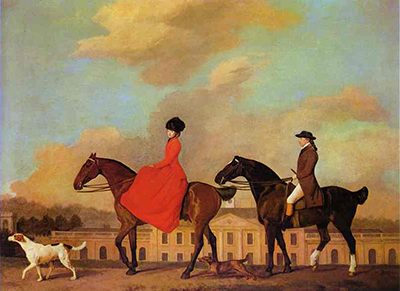
- John and Sophia Musters Riding at Colwick Hall
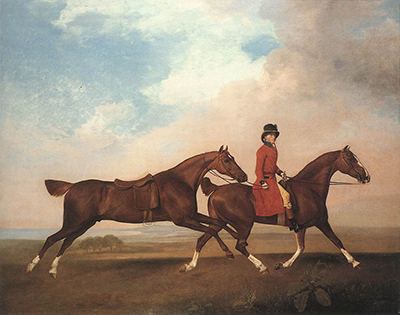
- William Anderson with Two Saddle-Horses
- Freeman and the dying doe
- Laetitia, Lady Lade
- A Gentleman Driving a Lady in a Phaeton
- The Milbanke and Melbourne Families
- Phaeton with a Pair of Cream Ponies and a Stable-Lad
- The Prince of Wales's Phaeton
- Sir John Nelthorpe, 6th Baronet, out Shooting with His Dogs
- Soldiers of the 10th Light Dragoons
The Royal Collection’s Soldiers of the 10th Light Dragoons is dated 1793. [26]
Named racehorses, hunters and stable life
- Whistlejacket
- Baronet with Samuel Chifney Up
- A Bay Hunter with Two Playful Spaniels
- A Chestnut Racehorse
- Earl Grosvenor's Bandy
- Gimcrack on Newmarket Heath
- A Grey Horse
- A Grey Stallion in a Landscape
- Lord Grosvenor's Arabian Stallion with a Groom
- Racehorses Exercising at Goodwood
- A Saddled Bay Hunter
- Eclipse
- Hambletonian, Rubbing Down
- Pumpkin with a Stable-Lad
- Otho, with John Larkin up
Mares and foals
Dogs and hunting animals
Lions and other animals
Country work across versions
Haymakers follows the painted designs, while Reapers distinguishes the Tate painting from Stubbs's printed treatment.
Boundaries beyond painting
A Comparative Anatomical Exposition brings together anatomical drawings and printed plates. [47] Sleeping Leopard centres on a 1777 enamel rather than an oil painting. [41] The drawings, prints, Anatomy of the Horse and materials essays carry those distinct practices further.
Taken together, these paintings resist the idea of Stubbs as an artist with one subject and one method. They reward a slower habit: establish which object is present, ask what pictorial job it performs, notice the people and animals acting within it, and then follow its versions and reproductions without erasing their differences.
Videos on George Stubbs
Explore Stubbs’s equestrian painting in its wider context, including two readings of Whistlejacket.
A Horse Lover’s Guide to the YCBA
A museum tour that places Stubbs alongside other artists who painted horses. It includes a look at Pumpkin with a Stable-lad.
Watch on YouTubeGeorge Stubbs artworks directory
Search works and related prints documented in this guide. Separate versions and printing matrices have separate entries; printmakers are named where known. Unidentified historical titles and untraced studio-sale material are discussed in the essays. A dash means that a date is not established here.
| Name | Date | Medium |
|---|---|---|
| A Bay Horse with a Groom | 1791 | Painting |
| A Bay Hunter with Two Playful Spaniels | 1777 | Painting |
| A Bay Hunter, a Springer Spaniel and a Sussex Spaniel in a wooded river Landscape | 1782 | Painting |
| A Cheetah and a Stag with Two Indian Attendants | about 1764 | Painting |
| A Couple of Fox Hounds (coloured print after Stubbs) | — | Print after Stubbs |
| A Couple of Foxhounds | 1792 | Painting |
| A Foxhound on the Scent | 1788 | Drawing |
| A Gentleman driving a Lady in a Phaeton | 1787 | Painting |
| A Grey Horse | 1793 | Painting |
| A Grey Horse (cantering companion) | 1793 | Painting |
| A Grey Stallion in a Landscape | — | Painting |
| A Horse Affrighted at a Lion | 1 May 1788 | |
| A Horse Belonging to the Rt. Honourable Lord Grosvenor called Bandy from his Crooked Leg | about 1763 | Painting |
| A Horse Frightened by a Lion | 1777 | |
| A Lion (A Lion Resting on a Rock) | 1 May 1788 | |
| A Lion Attacking a Horse | 1770 | Painting |
| A Lion Attacking a Horse (monumental Yale canvas) | 1762 | Painting |
| A lion attacking a horse (NGV) | about 1765 | Painting |
| A Lion Devouring a Horse (1788 print) | 1788 | |
| A lion devouring a horse (attribution disputed) | Proposed mid-1770s | Painting |
| A mare and foal with a bay horse | 1771 | Painting |
| A Monkey | 1799 | Painting |
| A Prancing Horse, Facing Right | c. 1790 | Drawing |
| A Rough Dog | 1790 | Painting |
| A Saddled Bay Hunter | 1786 | Painting |
| A Sleeping Leopard | 1 January 1791 | |
| A Tiger and a Sleeping Leopard | 1 May 1788 | |
| A Tigress (John Dixon after Stubbs) | 1772 | Print after Stubbs |
| A Tyger (A Recumbent Leopard by a Tree) | 1 May 1788 | |
| A Tyger (Sleeping Leopard) | 1 May 1788 | |
| An animal found on the coast of New Holland called kanguroo (after Stubbs) | 1773 | Print after Stubbs |
| An animal of a new species found on the coast of New South Wales (after Stubbs) | July 1773 | Print after Stubbs |
| Antinous and Jockey | — | Painting |
| Antinoüs, a chestnut racehorse, in a landscape | Undated | Painting |
| Bandy belonging to Lord Grosvenor (print after Stubbs) | — | Print after Stubbs |
| Baronet (George Townley Stubbs after Stubbs) | 20 February 1794 | Print after Stubbs |
| Baronet with Sam Chifney Up | 1791 | Painting |
| Baronet with Samuel Chifney up (Royal Collection) | 1791 | Painting |
| Bay Hunter by a Lake | 1787 | Painting |
| Brood Mares (Benjamin Green after Stubbs) | Issue 14 November 1776 | Print after Stubbs |
| Brood Mares and Foals | usually dated 1767 | Painting |
| Brown and White Norfolk or Water Spaniel | 1778 | Painting |
| Bulls Fighting | 1786 | Painting |
| Captain Samuel Sharpe Pocklington with His Wife, Pleasance, and possibly His Sister, Frances | 1769 | Painting |
| Death of the Doe (attribution disputed) | 1804 | |
| Der Englische Hühnerhund (Johann Wölfle after Stubbs) | about 1860 | Print after Stubbs |
| Dog (A Foxhound Viewed from Behind) | 1 May 1788 | |
| Dog [A Foxhound on the Scent] | 1788 | |
| Drill and albino baboon | before 1789 | Painting |
| Eclipse (Charles Hunt after Stubbs) | 12 November 1839 | Print after Stubbs |
| Eclipse (George Townley Stubbs after Stubbs) | 1796 | Print after Stubbs |
| Eclipse (oil study) | — | Painting |
| Eclipse (Thomas Burke after Stubbs) | First published 1772 | Print after Stubbs |
| Eclipse and John Wildman (Benjamin Green after Stubbs) | 1772 | Print after Stubbs |
| Eclipse at Newmarket (Jockey Club version) | Proposed early 1790s; often dated 1770 | Painting |
| Eclipse at Newmarket with a groom and jockey | 1770 | Painting |
| Eclipse with Mr Wildman and His Sons | 1769–71 | Painting |
| Eclipse, the Property of Capt.n O Kelly (anonymous print after Stubbs) | Imprint 4 June 1804; impression undated | Print after Stubbs |
| Euston | 1774 | Painting |
| Finished Study for the Seventh Anatomical Table of the Muscles of the Horse | 1756–58 | Drawing |
| Five Brood Mares at the Duke of Cumberland's Stud Farm in Windsor Great Park | 1765 | Painting |
| Fowl Body, Lateral View (Highly Finished Study for an Unpublished Table; Shows the Last Stage in Dissection) | — | Drawing |
| Fowl Body, Lateral View (Probably Prepared for Transfer to the Plate for Engraving of Table XV) | — | Drawing |
| Fowl Skeleton, Lateral View (Finished Study for Table V) | — | Drawing |
| Freeman, the Earl of Clarendon's Gamekeeper, with a Dying Doe and Hound (Yale) | 1800 | Painting |
| George Stubbs (enamel self-portrait) | 1781 | Enamel |
| Gimcrack (George Townley Stubbs after Stubbs) | 1775 | Print after Stubbs |
| Gimcrack on Newmarket Heath, with a trainer, a jockey and a stable lad | about 1765 | Painting |
| Gimcrack, with John Pratt up, on Newmarket Heath | about 1765 | Painting |
| Hambletonian, Rubbing Down | 1800 | Painting |
| Hay-Makers | 1791 | |
| Haycarting | 1795 | Enamel |
| Haymakers | 1785 | Painting |
| Haymakers (Lady Lever Art Gallery) | 1794 | Enamel |
| Hollyhock (with later additions by Vernet and Boucher) | about 1765–70 | Painting |
| Horse Attacked by a Lion (Episode C) | 1768–69 | Painting |
| Horse Attacked by a Lion (Tate enamel) | 1769 | Enamel |
| Horse Devoured by a Lion | Possibly exhibited 1763 | Painting |
| Horse Frightened by a Lion | 1770 | Painting |
| Horse Frightened by a Lion (Episode A; Wedgwood and Bentley after Stubbs) | — | Sculpture |
| Horse Frightened by a Lion (Tate) | Possibly exhibited 1763 | Painting |
| Horse Frightened by a Lion (Yale) | 1762–68 | Painting |
| Horse in the Shade of a Wood | 1780 | Painting |
| Hound Coursing a Stag | about 1762 | Painting |
| Human Figure, Anterior View (Intended for a Plate That was Never Published) | — | Drawing |
| Human Skeleton, Lateral View | 1795–1806 | Drawing |
| Hunt servants setting out (Southill commission) | 1767 | Painting |
| Hühnerhund (The Spanish Pointer) | about 1766 | Painting |
| John and Sophia Musters Riding at Colwick Hall | 1777 | Painting |
| John Musters on his hunter Pilgrim | 1777–78 | Painting |
| Labourers | 1789 | |
| Labourers (Richard Earlom after Stubbs and Amos Greene) | 25 March 1790 | Print after Stubbs |
| Laetitia, Lady Lade (d.1825) | 1793 | Painting |
| Lemon and White Water Spaniel | — | Painting |
| Lion Attacking a Stag | — | Painting |
| Lord Grosvenor's Arabian Stallion with a Groom | about 1765 | Painting |
| Lord Grosvenor's Arabian Stallion with a Groom (Peter Mazell after Stubbs) | 1771 | Print after Stubbs |
| Mambrino (Eaton Hall painting) | — | Painting |
| Mambrino (George Townley Stubbs after Stubbs) | 1794 | Print after Stubbs |
| Mares and Foals belonging to the 2nd Viscount Bolingbroke | about 1761–62 | Painting |
| Mares and foals beneath large oak trees | — | Painting |
| Mares and Foals by a stream | Exhibited 1764 | Painting |
| Mares and Foals in a River Landscape | about 1763–68 | Painting |
| Mares and Foals in an Extensive Landscape | about 1769 | Painting |
| Mares and Foals without a Background | 1762 | Painting |
| Moose Deer (after Stubbs) (Arctic Zoology plate VIII) | 1784–85 publication | Print after Stubbs |
| Newmarket Heath with a Rubbing-Down House | — | Painting |
| Otho (1796 print after Stubbs) | 1 December 1796 | Print after Stubbs |
| Otho, with John Larkin up | 1768 | Painting |
| Pangloss | about 1762 | Painting |
| Patch (Grafton commission) | 1759 | Painting |
| Phaeton and the Chariot of the Sun (enamel) | 1775 | Enamel |
| Phaeton with a Pair of Cream Ponies and a Stable-Lad | 1780–84 | Painting |
| Phillis | 1772 | Painting |
| Portrait of a Large Dog (Dingo) | 1772 | Painting |
| Pumpkin with a Stable-lad | 1774 | Painting |
| Racehorses Exercising at Goodwood | 1759–60 | Painting |
| Reapers (1791 print) | 1791 | |
| Reapers (Tate) | 1785 | Painting |
| Reapers (Yale) | 1795 | Enamel |
| Red Deer: A Stag and a Hind | 1792 | Painting |
| Richard Wedgwood | — | Enamel |
| Ringwood, a Brocklesby Foxhound | 1792 | Painting |
| Scrub, a bay horse belonging to the Marquess of Rockingham | about 1762 | Painting |
| Self Portrait on a White Hunter | 1782 | Enamel |
| Self-Portrait | about 1759 | Painting |
| Shooting (1770 Woollett plate after Stubbs) | 1770 | Print after Stubbs |
| Shooting (1771 Woollett plate after Stubbs) | 1771 | Print after Stubbs |
| Shooting at Goodwood | 1759–60 | Painting |
| Sir John Nelthorpe as a boy | 1756 | Painting |
| Sir John Nelthorpe partridge shooting with one pointer | — | Painting |
| Sir John Nelthorpe, 6th Baronet, out Shooting with His Dogs in Barton Field, Lincolnshire | 1776 | Painting |
| Sleeping Leopard | 1777 | Enamel |
| Soldiers of the 10th Light Dragoons | 1793 | Painting |
| Stallion and Mare (George Townley Stubbs after Stubbs) | 1776; reissued 1789 | Print after Stubbs |
| Steward and gamekeeper with dogs (Southill commission) | 1767 | Painting |
| Studies of a Lemur (Lemur murinus) in six different attitudes | 1773 | Drawing |
| Study for the Self-portrait in Enamel | c. 1781 | Drawing |
| Study of a Lemur | 1773 | Drawing |
| Study of a Racehorse in Action: Galloping to Left, a Semi-Anatomical Study, with Skin Flayed to Show Action of Muscles | — | Drawing |
| Study of the Legs of a Draught-Horse Pulling a Harrow (attributed to Stubbs) | Proposed about 1786 | Drawing |
| Sweet William (Grosvenor panel) | — | Painting |
| Sweet William (Turf Gallery canvas) | — | Painting |
| The Black Stallion Sampson, Portrayed from Three Angles (with landscape additions) | about 1764 | Painting |
| The Charlton Hunt | 1759–60 | Painting |
| The Fall of Phaeton | — | Sculpture |
| The Frightened Horse | 1780 | Sculpture |
| The Grosvenor Hunt | — | Painting |
| The Haymakers (Upton House) | 1783 | Painting |
| The Horse and Lion (George Townley Stubbs after George Stubbs) | 1770 | Print after Stubbs |
| The Kongouro from New Holland | 1772 | Painting |
| The Labourers | 1779 | Painting |
| The Labourers (Southill original) | 1767 | Painting |
| The lion and horse (Benjamin Green after Stubbs) | 1769; reissued 1777 | Print after Stubbs |
| The Milbanke and Melbourne Families | about 1769 | Painting |
| The Moose | 1770 | Painting |
| The Prince of Wales's Phaeton | 1793 | Painting |
| The Reapers (Upton House) | 1783 | Painting |
| The Sebra, or Wild Ass (George Townley Stubbs after Stubbs) | 1771 | Print after Stubbs |
| The Spanish Pointer (Bradford version) | about 1766–68 | Painting |
| The Spanish Pointer (William Woollett after Stubbs) | January 1768 | Print after Stubbs |
| The Third Duke of Dorset's Hunter with a Groom and a Dog | 1768 | Painting |
| Thomas Freeman, Lord Clarendon's gamekeeper, with a dog and a shot doe (with George Townly Stubbs) | 1803 | Painting |
| Turf, with Jockey up, at Newmarket | — | Painting |
| Turk and Crab | — | Painting |
| Two Bay Hunters Communing On The Bank Of A Lake | — | Painting |
| Tygers at Play | 1780 | |
| Viscount Gormanston's White Dog | 1781 | Painting |
| Viscount Gormanston's White Dog (canvas version) | — | Painting |
| Water Spaniel | 1769 | Painting |
| Wedgwood Family Portrait | 1780 | Painting |
| Whistlejacket | about 1762 | Painting |
| Whistlejacket with two other stallions and a groom | Recorded 1762 | Painting |
| White Poodle in a Punt | about 1780 | Painting |
| William Anderson with two Saddle-Horses | 1793 | Painting |
| Working Drawing for the Seventh Anatomical Table of the Muscles of the Horse | 1756–58 | Drawing |
| Zebra | 1763 | Painting |
Discussion
Look again at the images and ideas explored in George Stubbs Paintings. These editorial prompts invite your observations.
Reader Insights
Which comparison best shows Stubbs adapting a design across different materials?
What do the human figures contribute to the animal paintings discussed here?
Which painting would you choose to introduce someone to the range of Stubbs’s work, and why?
Join the Conversation
Share a detail, comparison or question about George Stubbs Paintings below.
References
- National Gallery of Art, “George Stubbs”, systematic catalogue biography. (accessed 2026-08-29). View source.
- Paul Mellon Centre, “Research George Stubbs at the Paul Mellon Centre”. (accessed 2026-08-29). View source.
- Kimbell Art Museum, George Stubbs, Lord Grosvenor's Arabian Stallion with a Groom, AP 1981.03. (accessed 2026-08-29). View source.
- Paul Mellon Centre, Judy Egerton, George Stubbs, Painter: Catalogue Raisonne. (accessed 2026-08-30). View source.
- John Mills and Raymond White, “The Mediums used by George Stubbs: Some Further Studies”, National Gallery Technical Bulletin 9 (1985). (accessed 2026-08-29). View source.
- National Portrait Gallery, George Stubbs, NPG 4575. (accessed 2026-08-29). View source.
- National Gallery of Art, George Stubbs, Captain Samuel Sharpe Pocklington with His Wife, Pleasance, and possibly His Sister, Frances, 1952.9.4. (accessed 2026-08-29). View source.
- Goodwood, “An exciting acquisition: a study by George Stubbs”. (accessed 2026-08-29). View source.
- Kimbell Art Museum, George Stubbs, Mares and Foals belonging to the 2nd Viscount Bolingbroke, AP 2024.01. (accessed 2026-08-29). View source.
- National Gallery, George Stubbs, Whistlejacket, NG6569. (accessed 2026-08-29). View source.
- Fitzwilliam Museum, George Stubbs, Gimcrack, with John Pratt up, on Newmarket Heath, PD.7-1982. (accessed 2026-08-29). View source.
- Christie's, George Stubbs, Gimcrack on Newmarket Heath, with a trainer, a jockey and a stable lad, lot 5460656. (accessed 2026-08-29). View source.
- National Gallery, George Stubbs, The Milbanke and Melbourne Families, NG6429. (accessed 2026-08-29). View source.
- Royal Museums Greenwich, George Stubbs, The Kongouro from New Holland (Kangaroo), ZBA5754. (accessed 2026-08-29). View source.
- Royal Museums Greenwich, George Stubbs, Portrait of a Large Dog (Dingo), ZBA5755. (accessed 2026-08-29). View source.
- National Portrait Gallery, “George Stubbs”, extended person record. (accessed 2026-08-30). View source.
- National Trust Collections, George Stubbs, The Labourers, NT 446710. (accessed 2026-08-30). View source.
- National Trust Collections, George Stubbs, The Haymakers, NT 446708. (accessed 2026-08-29). View source.
- National Trust Collections, George Stubbs, The Reapers, NT 446709. (accessed 2026-08-29). View source.
- Tate, George Stubbs, Haymakers, T02256. (accessed 2026-08-29). View source.
- Tate, George Stubbs, Reapers, T02257. (accessed 2026-08-29). View source.
- National Gallery, George Stubbs, A Gentleman Driving a Lady in a Phaeton, NG3529. (accessed 2026-08-29). View source.
- Huntington, George Stubbs, Baronet with Samuel Chifney Up, 58.8. (accessed 2026-08-29). View source.
- Martin Postle, “1791: George Stubbs and the Empty Picture Frame”, Chronicle 250/Paul Mellon Centre. (accessed 2026-08-30). View source.
- National Trust Collections, George Stubbs, Hambletonian, Rubbing Down, NT 1220985. (accessed 2026-08-29). View source.
- Royal Collection Trust, George Stubbs, Soldiers of the 10th Light Dragoons, RCIN 400512. (accessed 2026-08-29). View source.
- Judy Egerton, “Whistlejacket”, National Gallery catalogue entry, 2000. (accessed 2026-08-30). View source.
- National Trust Collections, George Stubbs, Five Brood Mares at the Duke of Cumberland's Stud Farm in Windsor Great Park, NT 1535163. (accessed 2026-08-29). View source.
- Tate, George Stubbs, Mares and Foals in a River Landscape, T00295. (accessed 2026-08-29). View source.
- Tate, George Stubbs, Otho, with John Larkin up, T02375. (accessed 2026-08-29). View source.
- Baltimore Museum of Art, “A Racehorse Named Eclipse”. (accessed 2026-08-29). View source.
- National Gallery of Art, George Stubbs, Reapers, 2021.102.1. (accessed 2026-08-29). View source.
- National Gallery of Victoria, “Picture to Print: Reproductive prints in the NGV Collection”. (accessed 2026-08-30). View source.
- Yale Center for British Art, George Stubbs, Water Spaniel, B1981.25.619, ; and Brown and White Norfolk or Water Spaniel, B2001.2.10, (accessed 2026-08-29). View source 1. View source 2.
- Manchester Art Gallery, Gallery 3 collection booklet. (accessed 2026-08-29). View source.
- Yale Center for British Art, fourth-floor collection guide, including Zebra and Horse Attacked by a Lion (Episode C), ; and Yale Center for British Art A&AePortal, George Stubbs, The Moose, Hunterian GLAHA 43823, (accessed 2026-08-29). View source 1. View source 2.
- National Gallery of Victoria, An animal of a new species found on the coast of New South Wales, 2013.741. (accessed 2026-08-30). View source.
- National Heritage Memorial Fund, “A Horse Frightened by a Lion by Stubbs”. (accessed 2026-08-29). View source.
- Yale Center for British Art, “A Lion Attacking a Horse”. (accessed 2026-08-29). View source.
- Tate, George Stubbs, Horse Frightened by a Lion, T06869. (accessed 2026-08-29). View source.
- Yale Center for British Art, George Stubbs, Sleeping Leopard, B2001.2.209. (accessed 2026-08-29). View source.
- Yale Center for British Art, “George Stubbs in the Collection of Paul Mellon: A Memorial Exhibition”. (accessed 2026-08-30). View source.
- Yale Center for British Art, “Paintings and Sculpture”. (accessed 2026-08-30). View source.
- Tate Archive, photographic collection list, George Stubbs 1724–1806, 18 October 1984–6 January 1985. (accessed 2026-08-30). View source.
- Kimbell Art Museum, “Stubbs and the Horse”. (accessed 2026-08-30). View source.
- Kimbell Art Museum, “Kimbell Acquires Masterpiece by George Stubbs”, 27 June 2024. (accessed 2026-08-30). View source.
- British Museum, George Stubbs, Comparative Anatomy, 1947,0618.1.1–30. (accessed 2026-08-29). View source.
- Basic title, date and material metadata for Tate’s Reapers (T02257) and Otho (T02375) is adapted from the Tate collection dataset, October 2014, released under CC0. TheHistoryOfArt.org has reconciled labels and versions. This credit does not apply to Tate’s authored catalogue commentary or images.
- Data Source: Yale Center for British Art. Basic object fields are adapted and reconciled for this directory. Reuse is subject to the Center’s Open Data and Data Services Terms of Use. No museum endorsement is implied. This metadata credit does not relabel scholarly essays or images as open data.
- Basic object metadata for A Horse Frightened by a Lion, 1985.38, The Cleveland Museum of Art, John L. Severance Fund, is available under CC0. Titles and design-level grouping have been reconciled for this directory.