



 by Tom Gurney
Tom Gurney BSc (Hons) is an art history expert with over 20 years experience
Email: tomgurney1@gmail.com / Phone: +44 7429 011000
Whistlejacket: Introduction
George Stubbs's Whistlejacket brings a named racehorse into the space usually occupied by a ruler, commander or full-length human sitter. The chestnut stallion rises almost at life size, his forelegs folded above the ground and his head turning towards us. There is no rider to explain the movement, no landscape to locate it and no inscription within the painted field to announce the animal's achievements.
The National Gallery dates the painting to about 1762 and records it as oil on canvas, 296.1 × 248 cm, accession NG6569. [1] Its enormous scale is essential to the encounter. In a small reproduction the horse can look like an illustration isolated for easy recognition. Before the original, that isolation becomes the organising principle of a surface nearly three metres high.
The picture has accumulated explanations almost as conspicuous as its absent background. Some concern Rockingham's taste for sculpture; others imagine a cancelled royal portrait or a patron choosing to preserve an intermediate stage of work. The horse has a separate history in racing records. Keeping those histories distinct makes the painting more interesting: it allows close observation, incomplete documentation and disagreement to coexist without turning Whistlejacket into a generic symbol of freedom.
At a Glance
This work across George Stubbs’s career
Whistlejacket (current article)
about 1762 [6]Contents
- The horse in the record
- Annotated details
- A large body within a larger field
- Weight, overlap and the lifted forelegs
- Head, markings and the texture of the coat
- Anatomy used for a portrait
- Rockingham's horses and sculpture
- What the receipts establish
- Why the plain field has competing explanations
- George III, Scrub and an unresolved account
- Material evidence and the limits of condition claims
- Videos on George Stubbs
The horse in the record
William Pick's Turf Register, published in 1803, calls Whistlejacket a chestnut foaled in 1749 and bred by Sir William Middleton of Belsay Castle, Northumberland. Pick names Mogul as sire. The dam is an unnamed mare by Sweepstakes; the following generation in the female line is a daughter of the Hampton Court Chestnut Arabian. [14] That sequence should not be shortened by making the latter horse the sire of Whistlejacket's own dam.
The register describes wins and defeats before Middleton sold him to Rockingham. Its Newmarket sequence includes a King's Plate victory and a Jockey Club Plate defeat in 1756. The celebrated final contest came at York in August 1759: a four-mile match against Mr Turner's Brutus for 2,000 guineas, each carrying 9 stone. John Singleton rode Whistlejacket and Thomas Jackson rode Brutus; Whistlejacket won by a length. Pick records no subsequent race and places him at Rockingham's stud. [14]
These particulars establish an animal with a career, owners and a rider. They do not supply the painting with an invisible jockey. Singleton belongs to the match record; no human figure appears in NG6569. Nor does the surviving portrait allow a trainer or groom to be identified simply because handling a valuable stallion required human work. The wider account of Stubbs's racehorses and Georgian racing follows those institutions and relationships across his pictures.
There is also a difference between a racing result and a reason for commissioning a portrait. A victory can make an animal valuable or memorable, but it does not prove that every later representation commemorated that event. Here Stubbs offers no winning post, course, rival or presentation of a prize. The horse's identity remains specific while the visible language of a race has disappeared.
The interval is worth retaining. A horse retired after the 1759 match would have been out of competition for approximately three years when the picture was probably painted. It is inaccurate to turn that interval into ten years at stud. More broadly, the painting's fame should not be projected backwards into an assumption that its subject dominated every race. A famous image and an exceptional sporting record are different kinds of achievement.
Annotated Details from Whistlejacket
Select a number on the painting to jump to a closer view.
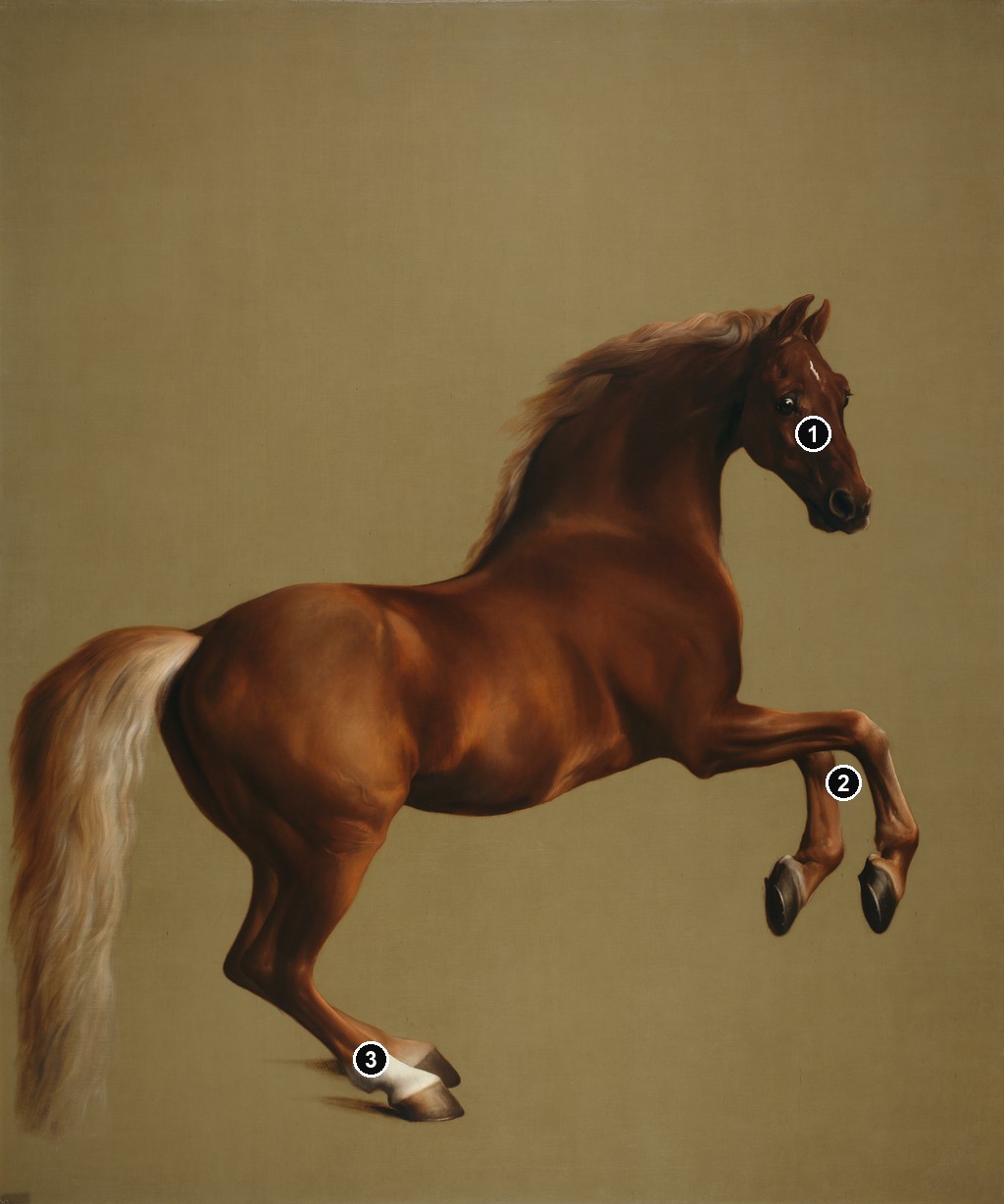
Details from WHISTLEJACKET
Each crop comes from the same reproduction shown above.
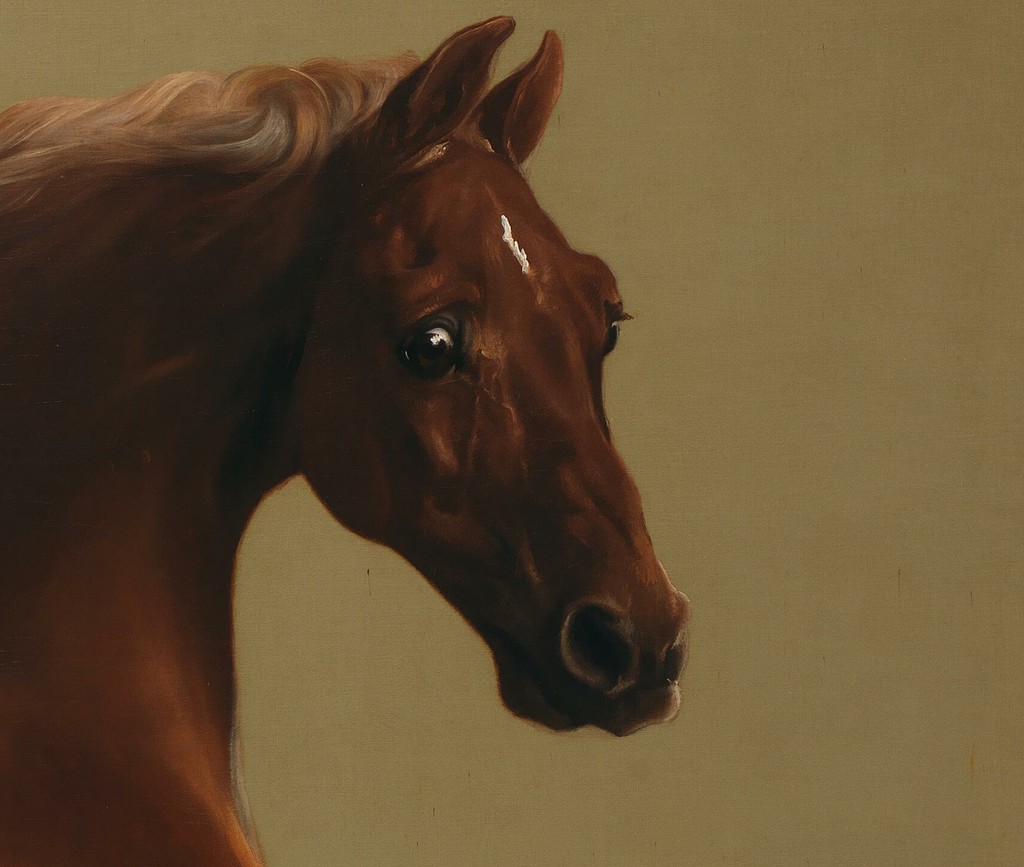
Eye and muzzle
The small highlight in the eye and the dark edge of the muzzle give the head a sharper focus than the broad, softly modelled neck.
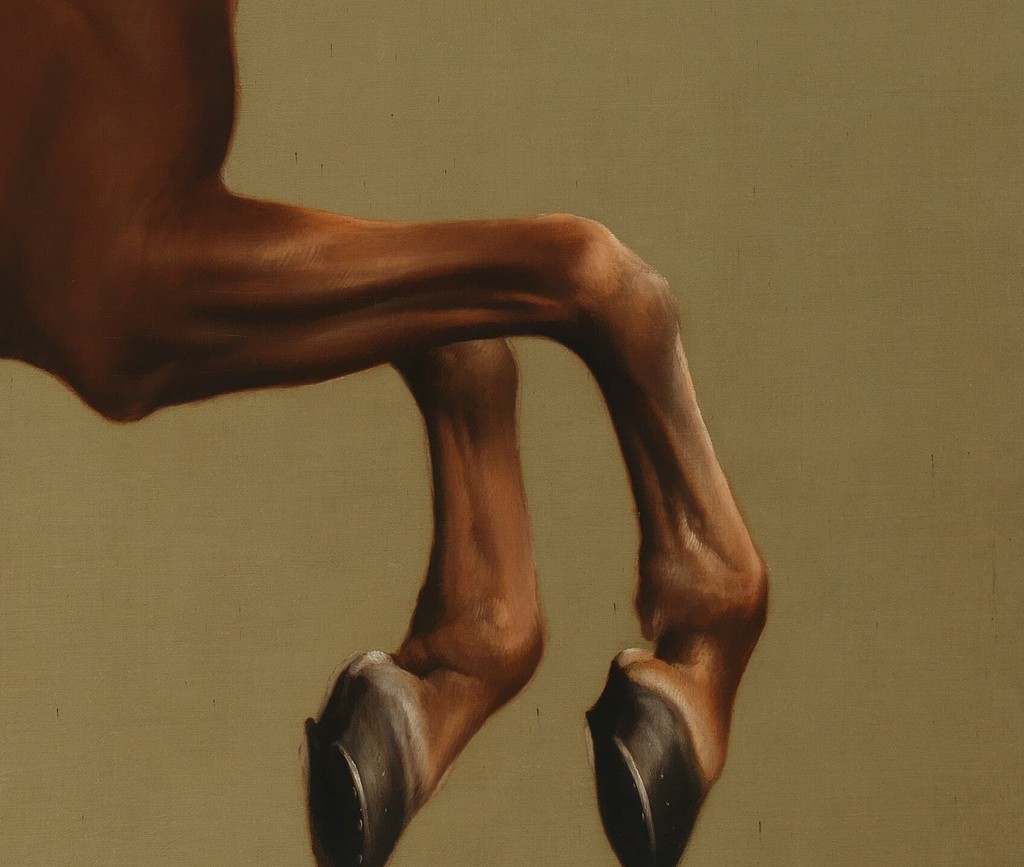
Raised forelegs
The two forelegs bend at different angles. Their overlapping contours keep the pose readable even against a plain ground.
Hind hooves
The hind hooves converge near the foot of the picture, where faint shadows give the horse its only visible contact with the ground.
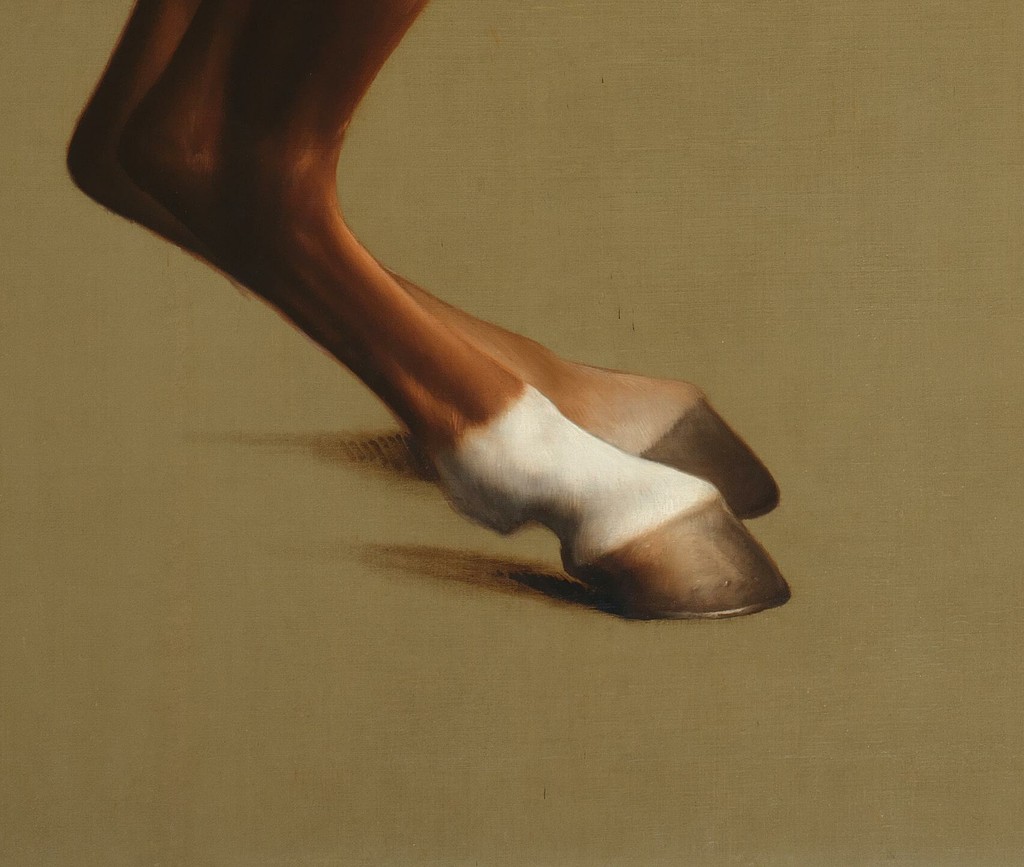
Image source: National Gallery, NG6569
A large body within a larger field
The first visual fact is the disproportion between the activity of the horse and the stillness around him. The background is not crowded with explanatory objects. It extends above the mane, behind the raised legs and around the falling tail, making each change of contour unusually clear. The horse is strongly present because the surrounding area remains so lightly specified.
Stubbs does not centre every part of the animal on a single vertical axis. The hindquarters occupy the lower left, the chest moves towards the right, and the neck climbs into the upper half. The head then turns out of that movement. The tail stretches down the left side as a long, loosely gathered counterweight to the more compact forelegs. These directions prevent the silhouette from becoming a heraldic emblem balanced identically on either side.
The largest open area lies above and behind the body. It is easy to treat this as space waiting for something to be added, especially when approaching the picture with a story about an absent rider. Yet as a visible arrangement it performs a positive task. It separates the arched neck from the edge, lets the light mane break into the field, and gives the upward movement somewhere to go. Filling that area would alter the pressures within the rectangle.
The pale colour is also less straightforward than a white sheet around a cut-out. In the inspected reproduction it varies subtly, with warmer and cooler passages surrounding the chestnut form. The horse is not outlined by a uniformly dark border. At the back and shoulder the transition is firm; along the mane and tail it becomes more porous. The surface thus alternates between a clearly bounded body and strands that loosen into the surrounding colour.
Near the rear feet, small shadowed marks provide a minimal indication of support. They do not develop into a road, stable floor or meadow. This restricted grounding matters because it answers one practical need without answering every question of location. We can understand where the weight seems to meet a surface while remaining unable to name the place.
The effect is therefore neither a conventional landscape portrait with scenery removed from our attention nor a wholly weightless apparition. Stubbs gives just enough spatial information to sustain the body. The large field continues to withhold the circumstances in which we might ordinarily encounter such a horse.
Weight, overlap and the lifted forelegs
Whistlejacket's pose is most convincing when followed through its unequal parts. The hindquarters are broad and rounded, but the support beneath them is narrow. The rear legs bend and overlap; their white markings help the eye separate one shape from another. A long passage of light across the haunch leads towards a darker joint and then the pale area above a hoof. Large volume ends in a very small apparent contact.
The two forelegs offer a different kind of difficulty. Both are lifted and folded, yet they do not repeat one another. One projects farther towards the right before turning down; the other crosses at a slightly different height and angle. Dark hoof undersides interrupt the warmer legs. Between them, the pale ground remains visible in a narrow opening, making the folds readable rather than merging them into one mass.
This is not simply an exercise in displaying every joint. The overlaps control how quickly the viewer can understand the movement. The shoulder and upper limbs read first as a broad action; the smaller distinctions emerge as we look. If every part were separated with equal clarity, the horse might become diagrammatic. If the overlaps were less carefully managed, the lifted legs would be difficult to distinguish.
The barrel of the body provides another stabilising element. Its lower curve moves from the hindquarters towards the chest without becoming a rigid horizontal line. Above it, the short back links the powerful rear of the horse to the rising neck. The body remains substantial even while the feet and head pull attention in different directions.
The National Gallery describes the stance as a levade, a term from formal horsemanship. [1] That label can help a viewer notice the bent hindlegs and raised forequarters. It should not become a claim that Stubbs has recorded a measured exercise at a particular angle or captured an exactly timed performance. The painting is a constructed image; its stability has to be understood within the canvas as well as in relation to a living animal.
Nor does the absence of a rider turn the movement into evidence of a particular emotion. A raised body can appear energetic without allowing us to decide that the horse feels defiance, pride or fear. The distinction preserves the force of the image while avoiding a story the painted limbs cannot independently tell.
Head, markings and the texture of the coat
The head changes the relationship between animal and spectator. Much of the torso remains in profile, directed towards the right, but the forehead and muzzle turn towards us. One eye catches light within a darker surround. The white forehead marking stands out against the chestnut face, while the nostril opens as a dark oval near the lower edge of the head.
The ears are not decorative points added to complete a silhouette. Their different orientations contribute to the sense of a responsive body. The mane follows the crest of the neck in pale locks that become less compact towards the left. The head is visually connected to that flowing material, yet it remains sharply differentiated through the darker muzzle, the eye and the small star.
Individual markings do important portrait work. The white areas above the rear hooves interrupt the leg colour at specific places. The forehead star gives the face an identifying feature without needing an accompanying nameplate. Such details make this a likeness of a particular animal rather than a perfected template to which the name Whistlejacket has merely been attached.
The coat is organised through broad changes of light. The haunch catches a warm glow; the belly and parts of the neck deepen into shadow. Across the shoulder, changes of tone turn the surface without reducing it to a collection of separate labelled muscles. Some transitions are soft, while edges around the legs and chest are more decisive. The smoothness of the body gives the looser hair an especially clear contrast.
The long tail is the most expansive passage of that hair. It descends through pale cream, auburn and darker strands, opening towards the bottom into separated strokes. It does not behave like a solid column supporting the animal. Its strands are visually light beside the compact haunch from which they fall. Looking between tail and body, we can see Stubbs varying the means of description according to what he depicts.
A close reading can register these distinctions without making a modern photograph stand for every property of the original. Colour changes with reproduction and illumination; a digital view cannot establish the current varnish, the precise translucency of a glaze or the depth of a brushmark. The reliable observations concern visible organisation, markings and the contrast between different kinds of painted surface. That attention to observed bodies extends through Stubbs's wider animal painting.
Anatomy used for a portrait
Stubbs's sustained anatomical work preceded this canvas. His horse dissections and drawings at Horkstow belong to 1756–58, while The Anatomy of the Horse appeared in 1766. [15] The order matters: the later publication date does not place the investigations after Whistlejacket. The full history of the drawings, plates and book is developed in Stubbs and The Anatomy of the Horse.
Here the value of that knowledge is not a row of anatomical labels. It can be followed in the relationship between a turning shoulder and the upper foreleg, in the structure that carries the belly, and in the differing contours around the joints. The skin remains a continuous surface even when the forms beneath it are strongly articulated. A viewer can sense the body's organisation without seeing it opened into a specimen.
At the same time, close study does not make the image optically neutral. The Gallery notes that Stubbs combines views of the rump and forehead, and of a knee and hoof underside, more generously than one fixed natural viewpoint would allow. [1] That observation helps explain why the horse can feel both coherent and unusually available to inspection. Its parts have been arranged for visibility within the picture.
The distinction between anatomical understanding and pictorial decision is particularly clear around the neck. The turn allows the face to address the spectator while the body preserves the long profile prized in an animal portrait. Stubbs does not have to choose between those two purposes. He constructs a body that carries both, adjusting the encounter rather than merely transcribing a moment.
This is why descriptions of the picture as photographically accurate are unhelpful. The painting's achievement includes selection, emphasis and combination. It shows how knowledge of an animal can support an invented but persuasive arrangement. Nothing requires us to imagine a mechanical transfer from an anatomical plate, and nothing in the visible result tells us that observation alone dictated every contour.
Rockingham's horses and sculpture
Charles Watson-Wentworth, 2nd Marquess of Rockingham, commissioned the picture. [1] His interest in horses belonged alongside an extensive engagement with sculpture. Nicholas Penny's study of the collection follows surviving correspondence from the Grand Tour: in 1749 the young patron reported acquiring a horse and another figure described as being by John da Bologna. The collection later included several bronze horses, some known through inventories and old photographs. [16]
This gives the sculptural comparison a firmer basis than a general assumption that aristocrats liked classical art. Rockingham had actually sought three-dimensional forms, including equine ones, and considered them within the spaces of his houses. It is reasonable to ask how such experience affected his response to a painted horse isolated from scenery.
The question should remain open at the correct level. An inventory of bronzes does not establish which sculpture Stubbs saw, if any, while planning NG6569. Later purchases cannot automatically be placed in the house in 1762. Nor does a broadly comparable pose prove the use of a particular model. The documentary collecting history creates a context for looking; it does not furnish a missing commission instruction.
The contrast between painting and sculpture is itself useful. A bronze horse occupies real space and can be viewed from changing positions. Stubbs's horse offers several aspects through one painted surface. The open field encourages us to read its contour almost as an independent form, but all its weight, light and movement remain made from paint. Its monumental presence does not abolish the distinction between those media.
Rockingham's patronage also helps explain why the picture cannot be reduced to a sporting souvenir. An owner could recognise an individual animal through its conformation and markings while valuing the work as a major object for an interior. The portrait joins those forms of attention. It describes a horse whose appearance mattered and creates a picture large enough to command architectural space.
The wider biography of George Stubbs follows his developing patronage. The important point here is the meeting between a painter able to make an animal's body carry a large canvas and a patron prepared to give that body an exceptional place.
What the receipts establish
A surviving receipt dated 15 August 1762 records £194 5s for five pictures: five brood mares with two foals; three stallions with a figure; a figure on horseback; five dogs; and a dog with a single horse. The document, signed by Stubbs, is reproduced by Wentworth Woodhouse from Sheffield City Archives. [17] It supplies direct evidence for an extensive group of work, rather than an exact fee for the monumental single horse.
The distinctions within the list are valuable. Animals appear in breeding groups, with a person, or beside another species. Stubbs's task was not one repeated formula. The plain-field three-stallion composition also includes Whistlejacket, although the groom's identification remains Joshua or Simon Cobb in Egerton's account. [18] That group is a separate painting, not a reduced version of NG6569.
The receipt does not securely identify the life-size standalone portrait. Egerton reports a December 1762 payment of 80 guineas for lion and horse pictures, probably the Yale pair; no clear NG6569 order was found. [18] Dividing the later sum into a forty-guinea price for Whistlejacket would turn a hypothesis about different works into a false invoice.
Absence of that document is not evidence that Stubbs went unpaid. It is a limit to what can be reconstructed about this commission. A date can be probable, a patron securely identified and a sequence of related works documented without every financial step surviving. The picture's history becomes less precise at that point, rather than collapsing altogether.
The receipts also resist a familiar tendency to make a celebrated work swallow every nearby piece of evidence. The five-picture payment deserves to remain attached to its five descriptions. A group of stallions, a mounted figure and a monumental riderless portrait belong to the same patronage relationship, but they are not interchangeable names for one object.
Why the plain field has competing explanations
The pale surrounding field is both a visible feature and a historical problem. As a visible feature it lets the horse's changing outline hold attention. As a historical problem it asks when artist and patron decided that scenery was unnecessary. Those questions are connected, but the present appearance cannot answer the second one by itself.
Egerton relates Rockingham's appreciation of isolated forms to his sculpture collecting. [18] David Pullins offers a different emphasis in his 2016 study of Stubbs's working methods. He proposes that highly finished animals could be developed before their surroundings, and that the monochrome Rockingham pictures preserve stages a patron elected to accept. In this reading, the pictures' unusual appearance grows from an ordinary sequence of production being stopped at an exceptional moment. [19]
Pullins's argument is a hypothesis about process and patronage. It does not mean that the picture should now be treated as a fragment awaiting correction. A stage in making can become a finished object through a decision to retain it. Conversely, admiring the result does not prove that every aspect of its appearance had been intended from the start.
That distinction helps with the word “unfinished”. It can refer to a material operation not performed, an abandoned decorative plan, a judgement about visual completeness, or the maker's decision to stop. These are not equivalent claims. A picture may lack a landscape without lacking an effective composition. It may have developed through changes that no surviving document records. One label cannot settle all those possibilities.
Pullins also places the stories surrounding the picture within questions of artistic authorship. His account discusses the possibility of different specialists contributing to an image and the later appeal of a narrative in which Stubbs's horse was sufficient in itself. [19] The famous tale of a horse recognising and attacking its painted likeness belongs to that reception history. It is not independently verified evidence of Whistlejacket's behaviour.
The useful outcome of comparing these interpretations is not a forced choice between sculpture and studio procedure. Collecting taste might have affected what a patron accepted; working practice might have made a particular stopping point available. The surviving evidence does not document their precise relationship. What remains available to us is the object and the carefully distinguished arguments around its making.
George III, Scrub and an unresolved account
The royal-rider story has a long afterlife. Egerton traces it through Walpole's 1772 visit and Humphry, treating the account sceptically. [18] The current National Gallery object text likewise argues against an intended rider, citing the short back and the absence of detected drawing for a mounted figure. [1]
The Gallery's 2026 exhibition account takes a different position. It presents Whistlejacket as the proposed basis for a portrait of George III, to accompany an equestrian image of George II. In that reconstruction, the horse proved so effective that it remained alone; Rockingham then sought another horse picture for the royal figure, and Stubbs began Scrub. The account connects abandonment of the larger royal project with Rockingham's political position in 1762. [15]
These are differing published positions from the same institution, not a disagreement that can be removed by using the newest date without explanation. The 2026 account states a positive sequence, while the object discussion and Egerton's catalogue emphasise absent or contrary evidence. The exhibition account does not reproduce a new commission document that would let the reader independently close the question. It is best understood as a dated curatorial reconstruction rather than silently adopted as an established fact.
Nor should scepticism become certainty in the opposite direction. A short painted back or a lack of detected rider drawing can bear on the design that survives without recording every preliminary conversation. The absence of a rider on the finished surface is secure. The history of every proposal made before that surface reached its present form is less secure.
Scrub must remain a distinct object within this debate. The National Gallery's exhibition ran from 12 March to 31 May 2026 and brought the privately held life-size horse into a focused presentation, with Whistlejacket available nearby. [15] This was a comparison between related works, not the discovery of a second version of the same animal. Frances Bailey's National Trust account also distinguishes Scrub's landscape setting from Whistlejacket's plain field. [20]
That difference sharpens a question we can actually answer through looking at NG6569: how much does the absence of place change the status of the body? A landscape can make a horse one presence within a larger world. Here the body must supply almost the entire visual event. The comparison is useful even while the proposed royal commission remains disputed.
Material evidence and the limits of condition claims
The sparse field is not evidence of an untouched or immaterial surface. Egerton’s 2000 technical note records lining, cleaning and restoration before acquisition, a seam 64 cm from the left edge, and original grey-brown background splashes. [18] These are dated examination statements. They should not be converted into a claim that the picture has just been examined or that its condition is unchanged in every respect.
The National Gallery separately catalogues a conservation dossier dated 28 May 1996, describing treatment and scientific examination with visible-light photographic material. [21] The existence of that file is useful evidence of the work's documented care. Its public catalogue description does not reveal every treatment decision or supply pigment results, and it cannot substitute for reading the dossier itself.
The distinction matters when interpreting technical language. A seam describes how a support is joined; it is not automatically an alteration to the composition. A splash may record the activity of painting without explaining whether a particular background scheme was planned. A later lining concerns the object's material history and does not by itself tell us what Stubbs intended in 1762.
The visible image offers a different, more limited kind of evidence. We can see small shadowed marks near the feet and a surrounding colour that participates in the composition. We cannot date every mark from a reproduction or decide which passage belongs to which intervention. Technical records and close looking therefore answer different questions. Their value increases when neither is asked to do the other's work.
A horse within an architectural frame
The current Gallery description identifies an eighteenth-century English Kent-style frame, carved and oil-gilded, with projecting corners and geometric ornament. [1] Its architectural character changes how the isolated animal meets the surrounding wall. The horse's open field sits inside a firm rectangle; curves of neck, haunch and tail are held against an emphatically constructed boundary.
That frame should not be assigned to a named maker or called an original 1762 commission without evidence. “Eighteenth-century” describes a period, while “Kent-style” describes a type. Neither expression proves that Stubbs selected the surviving frame at the moment he painted the horse.
Historic England preserves a photograph of the Whistlejacket Room at Wentworth Woodhouse, catalogued within the broad date range 1885–1930. The archive identifies the painting within the interior. [22] The view supplies a useful corrective to reproductions that show only a horse against an abstract field: the actual object occupied a furnished room, surrounded by architectural decoration and other possessions.
Waagen's Treasures of Art in Great Britain, published in 1854, offers a different witness. Under “Drawing-room” at Wentworth he lists Stubbs's life-size brown horse and praises its “great animation”. [23] The short entry does not name Whistlejacket, but its identification within the collection is supported by the painting's established history. Waagen's response records the impression of a large living presence, not an account of a racing achievement.
The difference between these witnesses is productive. The photograph locates a framed object in an interior; the critic records an effect on a viewer. Neither can tell us exactly how every eighteenth-century visitor responded. Together they show why the painting's scale should be considered in relation to a room as well as to the animal represented.
Descent, public display and acquisition
The current provenance traces the picture from Rockingham to the Fitzwilliam family and later settlement trustees, from whom the National Gallery purchased it in 1997. [1] Its history was therefore not one of continuous public museum display. Egerton records loans to Kenwood in 1971–81, Tate in 1984–85 and the National Gallery from April 1996. [18] Tate's library bibliography independently records the 1984–85 Stubbs exhibition and its catalogue. [24]
Those movements changed the conditions of access. A painting associated with one great house could become visible to audiences who knew neither its owner's horses nor the room for which it had acquired a place. Its identity as a public artwork did not require the viewer to reconstruct the entire stud, but the original animal and patronage remained part of what distinguished it from an anonymous rearing horse.
The Heritage Fund's project record gives an award of £8,268,750 on 22 July 1997 to the National Gallery. [25] That is a documented grant. It should not be confused with an independently established total purchase price. Keeping the distinction allows the funding history to be stated precisely without choosing between inconsistent figures repeated elsewhere.
Acquisition also made the painting part of a collection in which it could be compared with human portraiture, landscape and history painting. Its size no longer belonged only to a country-house arrangement. The riderless animal could confront viewers within a wider account of European painting, where the absence of the expected human protagonist remains one of its most striking features.
Whistlejacket after Whistlejacket
The horse's name circulated beyond the image. Goldsmith's She Stoops to Conquer uses Whistle-jacket as a comparison for speed in a plan involving a pair of horses. [26] The 1773 allusion does not prove that an audience had seen Stubbs's canvas. It shows why the name of the animal and the fame of its painted likeness should not be treated as identical histories.
Egerton records a reversed etching and stipple, tentatively assigned to Benjamin Killingbeck around 1781, which adds Wentworth House and cliffs behind the horse. [18] The later image gives the animal a place that the oil withholds. It demonstrates another maker's response to the open field; it cannot prove that Stubbs had intended the same scenery.
Later artists have worked directly with the image. In a 2019 interview, Mark Wallinger described considering a white-horse version, asking a friend to make a negative of Whistlejacket, and then adding a narwhal horn. He found the original's blank setting and replacement of a royal rider by the horse itself particularly radical. [27] His account explains the development of Ghost as a later artistic response. It does not establish Stubbs's intention or resolve the disputed royal scheme.
The transformation is revealing because it changes recognisable elements rather than simply supplying a missing setting. Reversing tone alters the relationship between animal and surrounding field. Adding a horn shifts the represented creature from an identifiable racehorse towards a mythical category. The contour remains sufficiently recognisable for the change to matter. Wallinger's response depends on the authority of Stubbs's image while making a new object with another purpose.
Wentworth's 2024 tercentenary exhibition similarly distinguished the original from its afterlife. The Trust stated that Whistlejacket would remain at the National Gallery, while the house's replica, the horse's appearance in the three-stallion group and contemporary responses brought its image into the exhibition. The account included Wallinger's Ghost and Hugo Wilson's State I. [28] A returned subject did not mean the original canvas had returned.
These distinctions are worth preserving in a world of familiar reproductions. The original painting, a replica in an historic room, a negative image and a contemporary reinterpretation can all transmit Whistlejacket's outline. They have different materials, dates, authors and relationships to their viewers. The endurance of the design lies partly in its capacity to remain recognisable through such changes.
The guide to Stubbs's paintings places this canvas among works with many other settings and purposes. Here its particular achievement remains the sustained attention given to one body: the specificity of coat and markings, the constructed movement, and the unusual amount of visual responsibility borne by a horse without a rider.
Videos on George Stubbs
Compare two National Gallery readings of the painting and explore Stubbs’s equestrian art in Yale’s collection.
George Stubbs: Portrait of the Horse Whistlejacket
Matthew Morgan looks closely at Whistlejacket and explains how its unusual format gives the horse such presence.
Watch on YouTubeGeorge Stubbs artworks directory
Search works and related prints documented in this guide. Separate versions and printing matrices have separate entries; printmakers are named where known. Unidentified historical titles and untraced studio-sale material are discussed in the essays. A dash means that a date is not established here.
| Name | Date | Medium |
|---|---|---|
| A Bay Horse with a Groom | 1791 | Painting |
| A Bay Hunter with Two Playful Spaniels | 1777 | Painting |
| A Bay Hunter, a Springer Spaniel and a Sussex Spaniel in a wooded river Landscape | 1782 | Painting |
| A Cheetah and a Stag with Two Indian Attendants | about 1764 | Painting |
| A Couple of Fox Hounds (coloured print after Stubbs) | — | Print after Stubbs |
| A Couple of Foxhounds | 1792 | Painting |
| A Foxhound on the Scent | 1788 | Drawing |
| A Gentleman driving a Lady in a Phaeton | 1787 | Painting |
| A Grey Horse | 1793 | Painting |
| A Grey Horse (cantering companion) | 1793 | Painting |
| A Grey Stallion in a Landscape | — | Painting |
| A Horse Affrighted at a Lion | 1 May 1788 | |
| A Horse Belonging to the Rt. Honourable Lord Grosvenor called Bandy from his Crooked Leg | about 1763 | Painting |
| A Horse Frightened by a Lion | 1777 | |
| A Lion (A Lion Resting on a Rock) | 1 May 1788 | |
| A Lion Attacking a Horse | 1770 | Painting |
| A Lion Attacking a Horse (monumental Yale canvas) | 1762 | Painting |
| A lion attacking a horse (NGV) | about 1765 | Painting |
| A Lion Devouring a Horse (1788 print) | 1788 | |
| A lion devouring a horse (attribution disputed) | Proposed mid-1770s | Painting |
| A mare and foal with a bay horse | 1771 | Painting |
| A Monkey | 1799 | Painting |
| A Prancing Horse, Facing Right | c. 1790 | Drawing |
| A Rough Dog | 1790 | Painting |
| A Saddled Bay Hunter | 1786 | Painting |
| A Sleeping Leopard | 1 January 1791 | |
| A Tiger and a Sleeping Leopard | 1 May 1788 | |
| A Tigress (John Dixon after Stubbs) | 1772 | Print after Stubbs |
| A Tyger (A Recumbent Leopard by a Tree) | 1 May 1788 | |
| A Tyger (Sleeping Leopard) | 1 May 1788 | |
| An animal found on the coast of New Holland called kanguroo (after Stubbs) | 1773 | Print after Stubbs |
| An animal of a new species found on the coast of New South Wales (after Stubbs) | July 1773 | Print after Stubbs |
| Antinous and Jockey | — | Painting |
| Antinoüs, a chestnut racehorse, in a landscape | Undated | Painting |
| Bandy belonging to Lord Grosvenor (print after Stubbs) | — | Print after Stubbs |
| Baronet (George Townley Stubbs after Stubbs) | 20 February 1794 | Print after Stubbs |
| Baronet with Sam Chifney Up | 1791 | Painting |
| Baronet with Samuel Chifney up (Royal Collection) | 1791 | Painting |
| Bay Hunter by a Lake | 1787 | Painting |
| Brood Mares (Benjamin Green after Stubbs) | Issue 14 November 1776 | Print after Stubbs |
| Brood Mares and Foals | usually dated 1767 | Painting |
| Brown and White Norfolk or Water Spaniel | 1778 | Painting |
| Bulls Fighting | 1786 | Painting |
| Captain Samuel Sharpe Pocklington with His Wife, Pleasance, and possibly His Sister, Frances | 1769 | Painting |
| Death of the Doe (attribution disputed) | 1804 | |
| Der Englische Hühnerhund (Johann Wölfle after Stubbs) | about 1860 | Print after Stubbs |
| Dog (A Foxhound Viewed from Behind) | 1 May 1788 | |
| Dog [A Foxhound on the Scent] | 1788 | |
| Drill and albino baboon | before 1789 | Painting |
| Eclipse (Charles Hunt after Stubbs) | 12 November 1839 | Print after Stubbs |
| Eclipse (George Townley Stubbs after Stubbs) | 1796 | Print after Stubbs |
| Eclipse (oil study) | — | Painting |
| Eclipse (Thomas Burke after Stubbs) | First published 1772 | Print after Stubbs |
| Eclipse and John Wildman (Benjamin Green after Stubbs) | 1772 | Print after Stubbs |
| Eclipse at Newmarket (Jockey Club version) | Proposed early 1790s; often dated 1770 | Painting |
| Eclipse at Newmarket with a groom and jockey | 1770 | Painting |
| Eclipse with Mr Wildman and His Sons | 1769–71 | Painting |
| Eclipse, the Property of Capt.n O Kelly (anonymous print after Stubbs) | Imprint 4 June 1804; impression undated | Print after Stubbs |
| Euston | 1774 | Painting |
| Finished Study for the Seventh Anatomical Table of the Muscles of the Horse | 1756–58 | Drawing |
| Five Brood Mares at the Duke of Cumberland's Stud Farm in Windsor Great Park | 1765 | Painting |
| Fowl Body, Lateral View (Highly Finished Study for an Unpublished Table; Shows the Last Stage in Dissection) | — | Drawing |
| Fowl Body, Lateral View (Probably Prepared for Transfer to the Plate for Engraving of Table XV) | — | Drawing |
| Fowl Skeleton, Lateral View (Finished Study for Table V) | — | Drawing |
| Freeman, the Earl of Clarendon's Gamekeeper, with a Dying Doe and Hound (Yale) | 1800 | Painting |
| George Stubbs (enamel self-portrait) | 1781 | Enamel |
| Gimcrack (George Townley Stubbs after Stubbs) | 1775 | Print after Stubbs |
| Gimcrack on Newmarket Heath, with a trainer, a jockey and a stable lad | about 1765 | Painting |
| Gimcrack, with John Pratt up, on Newmarket Heath | about 1765 | Painting |
| Hambletonian, Rubbing Down | 1800 | Painting |
| Hay-Makers | 1791 | |
| Haycarting | 1795 | Enamel |
| Haymakers | 1785 | Painting |
| Haymakers (Lady Lever Art Gallery) | 1794 | Enamel |
| Hollyhock (with later additions by Vernet and Boucher) | about 1765–70 | Painting |
| Horse Attacked by a Lion (Episode C) | 1768–69 | Painting |
| Horse Attacked by a Lion (Tate enamel) | 1769 | Enamel |
| Horse Devoured by a Lion | Possibly exhibited 1763 | Painting |
| Horse Frightened by a Lion | 1770 | Painting |
| Horse Frightened by a Lion (Episode A; Wedgwood and Bentley after Stubbs) | — | Sculpture |
| Horse Frightened by a Lion (Tate) | Possibly exhibited 1763 | Painting |
| Horse Frightened by a Lion (Yale) | 1762–68 | Painting |
| Horse in the Shade of a Wood | 1780 | Painting |
| Hound Coursing a Stag | about 1762 | Painting |
| Human Figure, Anterior View (Intended for a Plate That was Never Published) | — | Drawing |
| Human Skeleton, Lateral View | 1795–1806 | Drawing |
| Hunt servants setting out (Southill commission) | 1767 | Painting |
| Hühnerhund (The Spanish Pointer) | about 1766 | Painting |
| John and Sophia Musters Riding at Colwick Hall | 1777 | Painting |
| John Musters on his hunter Pilgrim | 1777–78 | Painting |
| Labourers | 1789 | |
| Labourers (Richard Earlom after Stubbs and Amos Greene) | 25 March 1790 | Print after Stubbs |
| Laetitia, Lady Lade (d.1825) | 1793 | Painting |
| Lemon and White Water Spaniel | — | Painting |
| Lion Attacking a Stag | — | Painting |
| Lord Grosvenor's Arabian Stallion with a Groom | about 1765 | Painting |
| Lord Grosvenor's Arabian Stallion with a Groom (Peter Mazell after Stubbs) | 1771 | Print after Stubbs |
| Mambrino (Eaton Hall painting) | — | Painting |
| Mambrino (George Townley Stubbs after Stubbs) | 1794 | Print after Stubbs |
| Mares and Foals belonging to the 2nd Viscount Bolingbroke | about 1761–62 | Painting |
| Mares and foals beneath large oak trees | — | Painting |
| Mares and Foals by a stream | Exhibited 1764 | Painting |
| Mares and Foals in a River Landscape | about 1763–68 | Painting |
| Mares and Foals in an Extensive Landscape | about 1769 | Painting |
| Mares and Foals without a Background | 1762 | Painting |
| Moose Deer (after Stubbs) (Arctic Zoology plate VIII) | 1784–85 publication | Print after Stubbs |
| Newmarket Heath with a Rubbing-Down House | — | Painting |
| Otho (1796 print after Stubbs) | 1 December 1796 | Print after Stubbs |
| Otho, with John Larkin up | 1768 | Painting |
| Pangloss | about 1762 | Painting |
| Patch (Grafton commission) | 1759 | Painting |
| Phaeton and the Chariot of the Sun (enamel) | 1775 | Enamel |
| Phaeton with a Pair of Cream Ponies and a Stable-Lad | 1780–84 | Painting |
| Phillis | 1772 | Painting |
| Portrait of a Large Dog (Dingo) | 1772 | Painting |
| Pumpkin with a Stable-lad | 1774 | Painting |
| Racehorses Exercising at Goodwood | 1759–60 | Painting |
| Reapers (1791 print) | 1791 | |
| Reapers (Tate) | 1785 | Painting |
| Reapers (Yale) | 1795 | Enamel |
| Red Deer: A Stag and a Hind | 1792 | Painting |
| Richard Wedgwood | — | Enamel |
| Ringwood, a Brocklesby Foxhound | 1792 | Painting |
| Scrub, a bay horse belonging to the Marquess of Rockingham | about 1762 | Painting |
| Self Portrait on a White Hunter | 1782 | Enamel |
| Self-Portrait | about 1759 | Painting |
| Shooting (1770 Woollett plate after Stubbs) | 1770 | Print after Stubbs |
| Shooting (1771 Woollett plate after Stubbs) | 1771 | Print after Stubbs |
| Shooting at Goodwood | 1759–60 | Painting |
| Sir John Nelthorpe as a boy | 1756 | Painting |
| Sir John Nelthorpe partridge shooting with one pointer | — | Painting |
| Sir John Nelthorpe, 6th Baronet, out Shooting with His Dogs in Barton Field, Lincolnshire | 1776 | Painting |
| Sleeping Leopard | 1777 | Enamel |
| Soldiers of the 10th Light Dragoons | 1793 | Painting |
| Stallion and Mare (George Townley Stubbs after Stubbs) | 1776; reissued 1789 | Print after Stubbs |
| Steward and gamekeeper with dogs (Southill commission) | 1767 | Painting |
| Studies of a Lemur (Lemur murinus) in six different attitudes | 1773 | Drawing |
| Study for the Self-portrait in Enamel | c. 1781 | Drawing |
| Study of a Lemur | 1773 | Drawing |
| Study of a Racehorse in Action: Galloping to Left, a Semi-Anatomical Study, with Skin Flayed to Show Action of Muscles | — | Drawing |
| Study of the Legs of a Draught-Horse Pulling a Harrow (attributed to Stubbs) | Proposed about 1786 | Drawing |
| Sweet William (Grosvenor panel) | — | Painting |
| Sweet William (Turf Gallery canvas) | — | Painting |
| The Black Stallion Sampson, Portrayed from Three Angles (with landscape additions) | about 1764 | Painting |
| The Charlton Hunt | 1759–60 | Painting |
| The Fall of Phaeton | — | Sculpture |
| The Frightened Horse | 1780 | Sculpture |
| The Grosvenor Hunt | — | Painting |
| The Haymakers (Upton House) | 1783 | Painting |
| The Horse and Lion (George Townley Stubbs after George Stubbs) | 1770 | Print after Stubbs |
| The Kongouro from New Holland | 1772 | Painting |
| The Labourers | 1779 | Painting |
| The Labourers (Southill original) | 1767 | Painting |
| The lion and horse (Benjamin Green after Stubbs) | 1769; reissued 1777 | Print after Stubbs |
| The Milbanke and Melbourne Families | about 1769 | Painting |
| The Moose | 1770 | Painting |
| The Prince of Wales's Phaeton | 1793 | Painting |
| The Reapers (Upton House) | 1783 | Painting |
| The Sebra, or Wild Ass (George Townley Stubbs after Stubbs) | 1771 | Print after Stubbs |
| The Spanish Pointer (Bradford version) | about 1766–68 | Painting |
| The Spanish Pointer (William Woollett after Stubbs) | January 1768 | Print after Stubbs |
| The Third Duke of Dorset's Hunter with a Groom and a Dog | 1768 | Painting |
| Thomas Freeman, Lord Clarendon's gamekeeper, with a dog and a shot doe (with George Townly Stubbs) | 1803 | Painting |
| Turf, with Jockey up, at Newmarket | — | Painting |
| Turk and Crab | — | Painting |
| Two Bay Hunters Communing On The Bank Of A Lake | — | Painting |
| Tygers at Play | 1780 | |
| Viscount Gormanston's White Dog | 1781 | Painting |
| Viscount Gormanston's White Dog (canvas version) | — | Painting |
| Water Spaniel | 1769 | Painting |
| Wedgwood Family Portrait | 1780 | Painting |
| Whistlejacket | about 1762 | Painting |
| Whistlejacket with two other stallions and a groom | Recorded 1762 | Painting |
| White Poodle in a Punt | about 1780 | Painting |
| William Anderson with two Saddle-Horses | 1793 | Painting |
| Working Drawing for the Seventh Anatomical Table of the Muscles of the Horse | 1756–58 | Drawing |
| Zebra | 1763 | Painting |
Questions about the painting
The most secure starting point is the historical pedigree rather than an unexplained modern label. Pick records the 1749 horse, Mogul and the maternal line through Sweepstakes. [14] Museum descriptions use Arabian terminology, but the portrait is of a particular stallion whose recorded ancestry should not be reduced to a generic breed ideal.
The surviving composition is visually effective, and the surrounding field has a documented material history. The point at which painter and patron decided to retain it remains debated. Egerton's sculptural context, Pullins's working-stage interpretation and the Gallery's later royal-portrait reconstruction address different parts of that problem. [18] [19] [15] None licenses the simple assertion that the canvas is waiting for scenery.
That is a published historical account, but it is disputed. The Gallery's current object discussion argues against it, while its 2026 exhibition account presents a sequence involving Whistlejacket and then Scrub. [1] [15] A reader should be shown those positions rather than given a confident answer that suppresses one of them.
The horse has a recorded name and history, while the painted coat, star, hind-leg markings and bodily form give the likeness individuality. The absence of a human sitter does not make the animal anonymous. Stubbs combines that specific identity with a composition whose scale and sparse field make the act of looking unusually concentrated.
Discussion
Look again at the images and ideas explored in Whistlejacket. These editorial prompts invite your observations.
Reader Insights
How does the absent landscape change your attention to the horse’s body?
Which explanation for the plain background seems best supported by the evidence?
Where does the horse’s scale matter most: in its relation to your body, the picture’s edges or the empty field?
Join the Conversation
Share a detail, comparison or question about Whistlejacket below.
References
- National Gallery, Whistlejacket, NG6569, current collection record, provenance, in-depth discussion and frame entry. Accessed 31 October 2026. View source.
- Goodwood, The Collection, Painting Collection modal, Racehorses Exercising at Goodwood; An exciting acquisition: a study by George Stubbs, 30 June 2023; History of the Estate Hounds, 4 October 2023; About Goodwood Racecourse. Accessed 4 November 2026. View source.
- Goodwood, The Collection, Painting Collection modal, Racehorses Exercising at Goodwood; An exciting acquisition: a study by George Stubbs, 30 June 2023; History of the Estate Hounds, 4 October 2023; About Goodwood Racecourse. Accessed 4 November 2026. View source.
- Goodwood, The Collection, Painting Collection modal, Racehorses Exercising at Goodwood; An exciting acquisition: a study by George Stubbs, 30 June 2023; History of the Estate Hounds, 4 October 2023; About Goodwood Racecourse. Accessed 4 November 2026. View source.
- Goodwood, The Collection, Painting Collection modal, Racehorses Exercising at Goodwood; An exciting acquisition: a study by George Stubbs, 30 June 2023; History of the Estate Hounds, 4 October 2023; About Goodwood Racecourse. Accessed 4 November 2026. View source.
- National Gallery, Whistlejacket, NG6569, current collection record, provenance, in-depth discussion and frame entry. View source.
- Yale Center for British Art, Zebra, B1981.25.617, current object metadata, gallery labels, Malcolm Warner’s 1998 catalogue entry and provenance supplied through the museum’s public collection record. View source.
- Christie’s, Gimcrack on Newmarket Heath, with a trainer, a jockey and a stable lad, London, 5 July 2011, lot 12; object details, essay, provenance, exhibitions and whole image. View source.
- Christie’s, Gimcrack on Newmarket Heath, with a trainer, a jockey and a stable lad, London, 5 July 2011, lot 12; object details, essay, provenance, exhibitions and whole image. View source.
- Yale University Art Gallery, A Lion Attacking a Horse, 1770, 1955.27.1, collection record. Accessed 4 November 2026. View source.
- Royal Museums Greenwich, ‘The Kongouro from New Holland’ (Kangaroo), ZBA5754. Accessed 4 November 2026. View source.
- Tate, George Stubbs, Haymakers, 1785, T02256; details, Terry Riggs’s collection text (January 1998), and online caption. Collection record. View source.
- Frances Bailey, ‘Hambletonian, Rubbing Down: A masterpiece by George Stubbs’, National Trust Cultural Heritage Magazine, Autumn/Winter 2024, pp. 22–33. Article. View source.
- William Pick, The Turf Register and Sportsman & Breeder's Stud-Book, vol.1 (York, 1803), pp.154–55. Accessed 31 October 2026. View source.
- National Gallery, “Stubbs: Portrait of a Horse”, 2026 exhibition press account. Accessed 31 October 2026. View source.
- Nicholas Penny, “Lord Rockingham's Sculpture Collection and The Judgment of Paris by Nollekens”, The J. Paul Getty Museum Journal19 (1991), pp.5–34, especially collecting correspondence and bronze-horse discussion. Accessed 31 October 2026. View source.
- Sheffield City Archives, receipt signed by George Stubbs, 15 August 1762, reproduced by Wentworth Woodhouse Preservation Trust. Accessed 31 October 2026. View source.
- Judy Egerton, Whistlejacket, in The British Paintings (2000), National Gallery scholarly catalogue, online version 3 (2025). Technical notes, discussion and notes. Accessed 31 October 2026. View source.
- David Pullins, “Stubbs, Vernet & Boucher Share a Canvas: Workshops, Authorship & the Status of Painting”, Journal18, 28 March 2016. Accessed 31 October 2026. View source.
- Frances Bailey, “Hambletonian”, Cultural Heritage Magazine, National Trust, Autumn/Winter 2024, especially pp.26–27. Accessed 31 October 2026. View source.
- National Gallery Archive, “Conservation dossier for George Stubbs, Whistlejacket”, NG4/6569, 28 May 1996, catalogue description. Accessed 31 October 2026. View source.
- Historic England Archive, “The interior of the Whistlejacket Room at Wentworth Woodhouse”, CC76/00483, dated 1885–1930. Accessed 31 October 2026. View source.
- Gustav Friedrich Waagen, Treasures of Art in Great Britain, vol.III (London: John Murray, 1854), p.339, Getty Research Institute digitisation. Accessed 31 October 2026. View source.
- Tate Library, Tate exhibition catalogues bibliography, 1980–1989, relevant 1984 entry for George Stubbs, 1724–1806. Accessed 31 October 2026. View source.
- National Lottery Heritage Fund, “Acquisition of ‘Whistlejacket’ by George Stubbs”, project record. Accessed 31 October 2026. View source.
- Oliver Goldsmith, She Stoops to Conquer (1773), Act IV, Project Gutenberg edition. Accessed 31 October 2026. View source.
- Mark Wallinger interviewed by Mariko Finch, “Mark Wallinger on Turning the Art World Upside Down”, Sotheby's, 19 September 2019. Accessed 31 October 2026. View source.
- Wentworth Woodhouse Preservation Trust, “George Stubbs Artwork Returns to Wentworth Woodhouse”, 2024 tercentenary exhibition account. Accessed 31 October 2026. View source.
- Basic title, date and material metadata for Tate’s Reapers (T02257) and Otho (T02375) is adapted from the Tate collection dataset, October 2014, released under CC0. TheHistoryOfArt.org has reconciled labels and versions. This credit does not apply to Tate’s authored catalogue commentary or images.
- Data Source: Yale Center for British Art. Basic object fields are adapted and reconciled for this directory. Reuse is subject to the Center’s Open Data and Data Services Terms of Use. No museum endorsement is implied. This metadata credit does not relabel scholarly essays or images as open data.
- Basic object metadata for A Horse Frightened by a Lion, 1985.38, The Cleveland Museum of Art, John L. Severance Fund, is available under CC0. Titles and design-level grouping have been reconciled for this directory.


