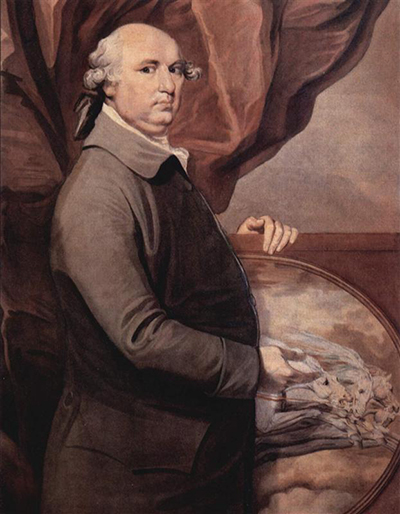
 by Tom Gurney
Tom Gurney BSc (Hons) is an art history expert with over 20 years experience
Email: tomgurney1@gmail.com / Phone: +44 7429 011000
George Stubbs Quotes: Introduction
George Stubbs left words worth reading, but the surviving evidence does not support a long anthology of polished sayings. His most substantial direct statements occur in the preface to The Anatomy of the Horse. A reply to the Dutch anatomist Petrus Camper preserves a more private explanation of the book's limits. Receipts and a will show Stubbs writing for practical and legal purposes. Other vivid judgements belong to a reviewer, Camper and the surgeon Henry Cline, while a familiar claim about Stubbs's career reaches us through a much later memoir.
Those differences matter. A sentence can be authentic without being an aphorism, direct without having been spoken, or historically useful without reproducing Stubbs's exact voice. The fourteen extracts below are therefore grouped by document and transmission. Nine are Stubbs's own written words: five from a printed preface, two from a letter, one from a receipt and one from a will. Four were written by informed contemporaries. The final passage is an explicitly retrospective report. None is a generic maxim attached to Stubbs because it sounds suitable for a painter of horses.
At a Glance
- Principal direct textThe Anatomy of the Horse, preface, 1766 [1]
- Read alongsideThe documented biography
Contents
- What makes a George Stubbs quotation reliable?
- Stubbs explains whom his anatomy book is for
- A private reply to Petrus Camper
- Receipts and a will: Stubbs in working documents
- What contemporaries wrote about Stubbs
- When recollection becomes reported quotation
- What the surviving record does not establish
- How to check a quotation attributed to Stubbs
- Videos on George Stubbs
What makes a George Stubbs quotation reliable?
Quotation marks establish wording; they do not establish authorship or documentary status. A reliable attribution should also identify who wrote the words, what kind of document contains them, when it was made, where it survives and how the wording reached the reader. A printed book inspected in facsimile presents a different chain from an autograph letter known through a curator's transcription. A signed note recalling a conversation is different again: it is the note-writer's testimony, not a stenographic record of the other person's speech.
Context is equally important. Stubbs's preface addresses several professional and practical audiences. His letter answers a particular anatomist's proposal. A receipt records payment, and a will disposes of property. Removing those functions can make period language look more philosophical, personal or universal than it is. Even an authentic phrase may be misleading if a later writer silently turns third-person report into first-person speech.
For the 1766 passages, typographical long s is rendered as modern s, words divided only by a printed line ending are reunited, and an ornamental opening capital is shown in ordinary sentence case. Spelling, grammatical capitalisation and punctuation otherwise remain. An extract ending before an original semicolon is identified as a continuous clause; no separate passages are stitched together and no omission is concealed. The letter, receipt, will and testimonial passages follow the identified transcriptions described with them. [1] [2] [3] [4]
Stubbs explains whom his anatomy book is for
The Anatomy of the Horse was printed in London by J. Purser for Stubbs in 1766. The title page identifies him as a painter and describes eighteen tables as all done from Nature. That phrase identifies the book and its contents; it is not a detached personal motto. The unpaginated leaf headed To the Reader is different. Here Stubbs writes as the author and sets out an ordered case for the work's audience, usefulness, evidential basis and proportional method. [1] [5]
His opening begins with people engaged in his own calling:
“When I first resolved to apply myself to the present work, I was flattered with the idea, that it might prove particularly useful to those of my own profession” [1]
This continuous clause ends at the original semicolon. The rest of the sentence broadens the readership to those responsible for a horse when medicine or surgery became necessary, students of comparative anatomy, and gentlemen who bred or kept many horses. Stubbs was not presenting anatomical knowledge as private preparation for his pictures. He imagined a book that might circulate among artists, practitioners and owners, although each group would use it differently.
The following paragraphs make those differences clearer. Stubbs says painters, sculptors and designers already know what help earlier books provide and can judge whether his work suits their purpose. He then turns to farriers and horse-doctors, comparing the place of their profession in Britain with the recently founded veterinary school in France. His hope for that readership culminates in a complete sentence:
“If what I have done may in any sort facilitate or promote so necessary a study amongst them, I shall think my labour well bestowed.” [1]
The modest phrasing is precise. The labour is justified if the book helps to advance anatomical study among equine practitioners. Stubbs does not claim to replace their medical knowledge, and the sentence is not a general declaration that effort always brings reward. Its meaning depends on the group named immediately before it.
Breeders receive their own sentence rather than an incidental mention:
“I will add, that I make no doubt, but Gentlemen who breed horses will find advantage, as well as amusement, by acquiring an accurate knowledge of the structure of this beautiful and useful animal.” [1]
The pairing of advantage and amusement is revealing. Knowledge of structure could serve practical decisions about horses while also deepening the informed pleasure of studying them. That is not the same purpose Stubbs assigns to an artist or farrier. It also helps explain why the book could matter within a culture of breeding and ownership without being reduced to a manual for the turf.
Only after defining these audiences does Stubbs state the principal claim made for the illustrations:
“But what I should principally observe to the Reader concerning this my performance, is, that all the figures in it are drawn from nature, for which purpose I dissected a great number of horses” [1]
This is another continuous clause, stopping before the semicolon. The original sentence continues by saying that he also consulted reputable treatises on anatomy. Observation and reading therefore appear together in his account. Drawn from nature is not a claim that books were irrelevant, nor does it by itself settle every stage by which a particular plate was designed and engraved. It records the basis Stubbs wanted readers to recognise: repeated dissection supported the figures, and established anatomical literature informed the wider undertaking.
The preface then becomes more specific about measurement:
“It is likewise necessary to acquaint him, that the proportions which I have mentioned in several places of the book, are estimated from the length of the head, as is usually done by those who have treated on the proportion of human figures” [1]
The sentence continues after the selected clause by defining the length from the top of the head to the cutting teeth, dividing it into four equal parts, and dividing each part into twelve minutes. This is working method, not a slogan about nature. It tells a reader how proportional statements elsewhere in the volume are scaled and places the procedure beside conventions used for the human figure.
Together, these five passages carry more information than one celebrated phrase could. They distinguish intended users, define possible benefits, state an observational claim and disclose a unit of proportion. They also show why the document should not be called a dedication: no separate dedication appears between the title material and To the Reader in the inspected sequence. The full history of the dissections, drawings, plates and publication belongs with George Stubbs and The Anatomy of the Horse; questions of oils, enamel and print processes belong with Stubbs's technique, enamel and printmaking.
A private reply to Petrus Camper
The book prompted interest beyond Britain. Petrus Camper, professor of medicine, anatomy and surgery at Groningen, wrote to Stubbs in 1771 praising the volume and asking whether he intended to continue into the horse's internal organs and diseases. Stubbs replied on 17 October. The National Gallery catalogue identifies his response as an autograph letter, publishes a transcription and locates the document at Leiden University Library. [2]
Stubbs first defined what he had intended the existing work to accomplish:
“What you have seen is all I meant to do, it being as much as I thought necessary for the study of Painting” [2]
The selected words are a continuous opening clause. Stubbs goes on to say that he was too fully employed in painting to spare the time, even had he been qualified. The reply is practical rather than defensive. It gives painting as the governing purpose of this particular investigation and declines Camper's proposed extension.
The next sentence sharpens the distinction between the structures Stubbs had pursued and the viscera Camper wanted him to address:
“but I look’d very little into the internal parts of a Horse, my search there being only a matter of curiosity” [2]
The lower-case opening follows the published transcription. Read alone, the sentence might be made to sound dismissive. Read after the first clause and beside the 1766 preface, it marks a boundary within anatomy. Stubbs had investigated the structures necessary for his pictorial study; he did not claim the comprehensive internal inquiry or medical authority Camper envisaged. Curiosity about internal parts was not the same as the systematic purpose that governed his published figures.
These are direct Stubbs words, but the access chain must remain visible. The online catalogue supplies a scholarly transcription of an identified autograph; it does not display the manuscript for letter-by-letter comparison here. That is still much stronger evidence than an unattributed quotation copied from site to site, but it is not identical to inspecting the sheet, shelfmark and handwriting oneself.
Receipts and a will: Stubbs in working documents
An artist's surviving words need not express an aesthetic belief. Patronage records can preserve his transactional language, and legal records can preserve a decision with no literary ambition. These documents are less quotable in the modern sense, yet they are direct evidence of Stubbs writing for a purpose.
The National Gallery catalogue transcribes receipts associated with the Marquess of Rockingham and identifies them in the Wentworth Woodhouse Muniments. A long receipt of 15 August 1762 lists paintings of brood mares and foals, stallions, mounted figures, dogs and a single horse. A shorter entry dated 30 December opens:
“Eighty guineas for one Picture of a Lion” [2]
The line is not Stubbs commenting on his art. The entry continues by listing another picture, a life-size horse, within the same price. It is useful here because its documentary authenticity does not guarantee the later interpretation attached to it. That horse has sometimes been linked to Whistlejacket, but the catalogue argues that the two items probably refer instead to the paired large lion pictures made for Rockingham's London house. [2] A real quotation can therefore be accurately transcribed and still be misapplied to the wrong object. Authentication requires both the words and a defensible account of what they denote.
Walter Gilbey's 1898 Life of George Stubbs, R.A. prints another kind of direct record: a will headed as extracted from the Principal Registry. It is dated 21 June 1794 and includes this continuous legal clause:
“I do hereby give and bequeath all the rest residue and remainder of my Estates and Effects of what kind soever unto Mary Spencer for ever” [4]
This is formulaic legal language, but the disposition within it is substantive. Stubbs names Mary Spencer as the recipient of the residue of his estate and effects, then appoints her and I. Saltonstall as joint executors. The accompanying probate testimony says that Stubbs read and acknowledged the will in July 1806 and that the document was in his handwriting and subscription. [4]
The manuscript itself has not been inspected for this account, so Gilbey's identified transcription and the record it reproduces form the transmission chain. The 1794 date of the will must also be kept separate from the circumstances of its witnessing and proof in 1806. Within those limits, the clause belongs to Stubbs more securely than any anonymous maxim: it is his legal wording, even though it was written to dispose of property rather than reveal a theory of painting.
What contemporaries wrote about Stubbs
Words by other people can illuminate how Stubbs's work was received, provided the speaker never disappears. The earliest extract here appeared anonymously in The Monthly Review, volume 36, in 1767, one year after the anatomy book. The notice begins:
“We have here a noble and useful work, indeed! a work which will not only reflect honour on its Author, but on the country in which it has been produced.” [6]
The enthusiasm belongs to the reviewer. The notice continues by stressing that a private person had borne the expense and years of labour, and it praises Stubbs for dissecting, drawing and engraving. It finally weighs the artist as dissector against the painter of animals. A later book expanded the abbreviated source as the Medical Review, but the original volume and page establish The Monthly Review. [6] [3] Even a small error in a periodical title can obstruct verification, which is why the primary page controls.
Camper's response was both more specialised and more personal. His letter from Groningen, dated 28 July 1771, compares Stubbs's treatment of the horse with advances in human anatomy and asks:
“How is it possible a single man can execute such a plan with so much accuracy and industry?” [3]
Camper was not merely admiring a painter's ability to describe a horse's surface. His question responds to the combination of anatomical preparation, drawing and engraving he believed the volume represented. In the same letter he asks whether Stubbs made the plates and explains that seeing the book caused him to abandon his own plan for a comparable publication. Mayer printed the correspondence in 1876, so this is Camper's letter as transmitted by a later edition rather than a directly inspected original. [3]
A second Camper letter, dated 27 July 1772, notes how few people in his region possessed the costly volume. Its most compact judgement joins abilities often separated in later accounts:
“I am amazed to meet in the same person so great an anatomist, so accurate a painter, and so excellent an engraver.” [3]
Both Camper passages are words addressed to Stubbs, not titles Stubbs gave himself. The last term also cannot be transferred indiscriminately to every print connected with his compositions. Stubbs worked plates himself, but his son George Townley Stubbs and other specialists also engraved after his designs. George Stubbs's prints separates those maker roles.
Henry Cline supplies a fourth contemporary voice and a different transmission problem. Gilbey reports that a copy of The Anatomy of the Horse carried a note in Cline's handwriting on its flyleaf, signed and dated 21 May 1788. Its first sentence reads:
“This work, which is executed with extraordinary accuracy, was begun and completed by the author without the assistance of any other person, as he informed me in a conversation with him on the subject.” [4]
The sentence tells the reader exactly where its layers divide. Extraordinary accuracy is Cline's assessment. The claim about unassisted execution is information he says Stubbs gave him in conversation. The remainder of the note records more details about injecting and dissecting horses, drawing and engraving, and the length of work on one injected specimen. [4] Those details may be valuable testimony, but quotation marks around Cline's note would not transform them into a verbatim monologue by Stubbs.
Cline's dated signature makes this much stronger than an untraceable anecdote. Yet the underlying flyleaf has not been viewed here, and the wording is available through Gilbey's publication more than a century later. The proper label is therefore a signed contemporary testimonial in later transcription. That precision preserves its value instead of diminishing it.
When recollection becomes reported quotation
The most familiar sayings associated with Stubbs often come from memoir rather than correspondence. Mayer's Early Exhibitions of Art in Liverpool, privately printed in 1876, includes notes towards a life of Stubbs nearly seventy years after the artist's death. Mayer says that William Upcott's notes derived from oral information given by the painter; modern publication history identifies Ozias Humphry's recorded conversations as the manuscript Mayer edited. [3] [7] The safest shorthand is the Humphry/Upcott notes as edited and printed by Mayer, not a transparent transcript with a single authorial layer.
One sentence is especially useful because its grammar displays that mediation:
“More than any other thing, the book tended to throw him into horse painting, and to this he ascribes entirely his being a horse painter.” [3]
Mayer prints the statement in the third person. It reports that Stubbs connected the anatomy book with the direction of his career, but it does not preserve an autograph sentence or guarantee his exact vocabulary. Calling it simply a Stubbs quotation would erase the very evidence that tells us how cautiously to read it.
The same problem affects the often repeated story of Stubbs's journey to Italy. Mayer narrates in the third person that Stubbs wished his motive to be noticed as a desire to convince himself of nature's superiority to art, ancient or modern. [3] Online versions have converted that report into polished first-person speech and added an ellipsis. The underlying anecdote can be considered within the documented biography of George Stubbs, but its altered form should not be presented as a direct quotation.
What the surviving record does not establish
A wider search produces tempting fragments but not a hidden treasury of Stubbs aphorisms. A specialist discussion mentions a 1787 letter to Daniel Daulby and gives the two words much mischief in relation to original frames. Its note supplies no shelfmark, manuscript image or complete transcription, so the fragment is too thin to display as an authenticated unit. Correspondence about Stubbs's frames also survives largely in letters written by Josiah Wedgwood to Thomas Bentley. Those passages can report Stubbs's preferences, but their sentences belong to Wedgwood, not Stubbs.
Imprints and inscriptions require similar restraint. Published by Geo. Stubbs records a publishing role; it is not personal prose. A cited endorsement on a frame-maker's invoice is formulaic and was not located in an inspectable image. The securely identified receipt already represents transactional wording without pretending that every signature, title or sales line is a meaningful quotation.
Names can introduce another error. George Townley Stubbs, born in 1756, was the artist's son and an engraver in his own right. [8] A statement or publication line connected with him cannot be assigned to George Stubbs by shortening the name. Terms such as by, after, published by and recorded from describe different relationships and should remain attached to the wording they qualify.
Modern catalogue prose also has its own value and its own voice. Museum accounts can provide authoritative document history, object identity and interpretation, but a present-day summary is not an eighteenth-century quotation merely because it appears on a trusted site. [9] Five blockquotes on the former local page failed this test: one technical statement lacked a locatable publication, one recast the Italy report, and three reproduced modern biographical or institutional prose. Searches also surfaced six unrelated sayings by other named authors. None belongs to Stubbs.
How to check a quotation attributed to Stubbs
Begin with the complete wording and search outwards. Locate a facsimile, manuscript description, scholarly transcription or dated contemporary printing. Record the writer, recipient if any, document type, date, repository or edition, and page or leaf. Then check whether the selection is a complete sentence, a continuous clause or fragments joined by an ellipsis. A quotation should never shift silently from third person to first person.
Next ask what the words are doing. The 1766 preface explains readers and method. The Camper reply answers a proposal. The Rockingham line records payment. The will makes a bequest. Camper and Cline assess or report; Mayer transmits recollection. Their documentary purposes prevent them from being collapsed into a single list of thoughts about art and nature.
Finally, preserve uncertainty at the point where it arises. An identified autograph known through a transcription is not the same as a manuscript viewed directly. A genuine receipt need not refer to the picture later writers chose. A witness can faithfully record a conversation without preserving its exact phrasing. The broad overview of George Stubbs can bring his pictures, anatomy, patrons and career together. A quotations page has a narrower but equally useful task: to let every surviving voice remain recognisably its own.
Videos on George Stubbs
Explore Stubbs’s equestrian painting in its wider context, including two readings of Whistlejacket.
A Horse Lover’s Guide to the YCBA
A museum tour that places Stubbs alongside other artists who painted horses. It includes a look at Pumpkin with a Stable-lad.
Watch on YouTubeGeorge Stubbs artworks directory
Search works and related prints documented in this guide. Separate versions and printing matrices have separate entries; printmakers are named where known. Unidentified historical titles and untraced studio-sale material are discussed in the essays. A dash means that a date is not established here.
| Name | Date | Medium |
|---|---|---|
| A Bay Horse with a Groom | 1791 | Painting |
| A Bay Hunter with Two Playful Spaniels | 1777 | Painting |
| A Bay Hunter, a Springer Spaniel and a Sussex Spaniel in a wooded river Landscape | 1782 | Painting |
| A Cheetah and a Stag with Two Indian Attendants | about 1764 | Painting |
| A Couple of Fox Hounds (coloured print after Stubbs) | — | Print after Stubbs |
| A Couple of Foxhounds | 1792 | Painting |
| A Foxhound on the Scent | 1788 | Drawing |
| A Gentleman driving a Lady in a Phaeton | 1787 | Painting |
| A Grey Horse | 1793 | Painting |
| A Grey Horse (cantering companion) | 1793 | Painting |
| A Grey Stallion in a Landscape | — | Painting |
| A Horse Affrighted at a Lion | 1 May 1788 | |
| A Horse Belonging to the Rt. Honourable Lord Grosvenor called Bandy from his Crooked Leg | about 1763 | Painting |
| A Horse Frightened by a Lion | 1777 | |
| A Lion (A Lion Resting on a Rock) | 1 May 1788 | |
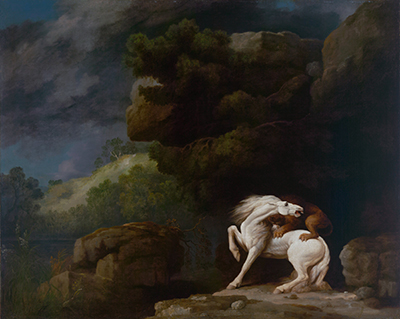
| A Lion Attacking a Horse | 1770 | Painting |
| A Lion Attacking a Horse (monumental Yale canvas) | 1762 | Painting |
| A lion attacking a horse (NGV) | about 1765 | Painting |
| A Lion Devouring a Horse (1788 print) | 1788 | |
| A lion devouring a horse (attribution disputed) | Proposed mid-1770s | Painting |
| A mare and foal with a bay horse | 1771 | Painting |
| A Monkey | 1799 | Painting |
| A Prancing Horse, Facing Right | c. 1790 | Drawing |
| A Rough Dog | 1790 | Painting |
| A Saddled Bay Hunter | 1786 | Painting |
| A Sleeping Leopard | 1 January 1791 | |
| A Tiger and a Sleeping Leopard | 1 May 1788 | |
| A Tigress (John Dixon after Stubbs) | 1772 | Print after Stubbs |
| A Tyger (A Recumbent Leopard by a Tree) | 1 May 1788 | |
| A Tyger (Sleeping Leopard) | 1 May 1788 | |
| An animal found on the coast of New Holland called kanguroo (after Stubbs) | 1773 | Print after Stubbs |
| An animal of a new species found on the coast of New South Wales (after Stubbs) | July 1773 | Print after Stubbs |
| Antinous and Jockey | — | Painting |
| Antinoüs, a chestnut racehorse, in a landscape | Undated | Painting |
| Bandy belonging to Lord Grosvenor (print after Stubbs) | — | Print after Stubbs |
| Baronet (George Townley Stubbs after Stubbs) | 20 February 1794 | Print after Stubbs |
| Baronet with Sam Chifney Up | 1791 | Painting |
| Baronet with Samuel Chifney up (Royal Collection) | 1791 | Painting |
| Bay Hunter by a Lake | 1787 | Painting |
| Brood Mares (Benjamin Green after Stubbs) | Issue 14 November 1776 | Print after Stubbs |
| Brood Mares and Foals | usually dated 1767 | Painting |
| Brown and White Norfolk or Water Spaniel | 1778 | Painting |
| Bulls Fighting | 1786 | Painting |
| Captain Samuel Sharpe Pocklington with His Wife, Pleasance, and possibly His Sister, Frances | 1769 | Painting |
| Death of the Doe (attribution disputed) | 1804 | |
| Der Englische Hühnerhund (Johann Wölfle after Stubbs) | about 1860 | Print after Stubbs |
| Dog (A Foxhound Viewed from Behind) | 1 May 1788 | |
| Dog [A Foxhound on the Scent] | 1788 | |
| Drill and albino baboon | before 1789 | Painting |
| Eclipse (Charles Hunt after Stubbs) | 12 November 1839 | Print after Stubbs |
| Eclipse (George Townley Stubbs after Stubbs) | 1796 | Print after Stubbs |
| Eclipse (oil study) | — | Painting |
| Eclipse (Thomas Burke after Stubbs) | First published 1772 | Print after Stubbs |
| Eclipse and John Wildman (Benjamin Green after Stubbs) | 1772 | Print after Stubbs |
| Eclipse at Newmarket (Jockey Club version) | Proposed early 1790s; often dated 1770 | Painting |
| Eclipse at Newmarket with a groom and jockey | 1770 | Painting |
| Eclipse with Mr Wildman and His Sons | 1769–71 | Painting |
| Eclipse, the Property of Capt.n O Kelly (anonymous print after Stubbs) | Imprint 4 June 1804; impression undated | Print after Stubbs |
| Euston | 1774 | Painting |
| Finished Study for the Seventh Anatomical Table of the Muscles of the Horse | 1756–58 | Drawing |
| Five Brood Mares at the Duke of Cumberland's Stud Farm in Windsor Great Park | 1765 | Painting |
| Fowl Body, Lateral View (Highly Finished Study for an Unpublished Table; Shows the Last Stage in Dissection) | — | Drawing |
| Fowl Body, Lateral View (Probably Prepared for Transfer to the Plate for Engraving of Table XV) | — | Drawing |
| Fowl Skeleton, Lateral View (Finished Study for Table V) | — | Drawing |
| Freeman, the Earl of Clarendon's Gamekeeper, with a Dying Doe and Hound (Yale) | 1800 | Painting |
| George Stubbs (enamel self-portrait) | 1781 | Enamel |
| Gimcrack (George Townley Stubbs after Stubbs) | 1775 | Print after Stubbs |
| Gimcrack on Newmarket Heath, with a trainer, a jockey and a stable lad | about 1765 | Painting |
| Gimcrack, with John Pratt up, on Newmarket Heath | about 1765 | Painting |
| Hambletonian, Rubbing Down | 1800 | Painting |
| Hay-Makers | 1791 | |
| Haycarting | 1795 | Enamel |
| Haymakers | 1785 | Painting |
| Haymakers (Lady Lever Art Gallery) | 1794 | Enamel |
| Hollyhock (with later additions by Vernet and Boucher) | about 1765–70 | Painting |
| Horse Attacked by a Lion (Episode C) | 1768–69 | Painting |
| Horse Attacked by a Lion (Tate enamel) | 1769 | Enamel |
| Horse Devoured by a Lion | Possibly exhibited 1763 | Painting |
| Horse Frightened by a Lion | 1770 | Painting |
| Horse Frightened by a Lion (Episode A; Wedgwood and Bentley after Stubbs) | — | Sculpture |
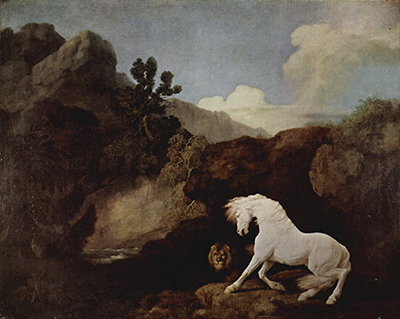
| Horse Frightened by a Lion (Tate) | Possibly exhibited 1763 | Painting |
| Horse Frightened by a Lion (Yale) | 1762–68 | Painting |
| Horse in the Shade of a Wood | 1780 | Painting |
| Hound Coursing a Stag | about 1762 | Painting |
| Human Figure, Anterior View (Intended for a Plate That was Never Published) | — | Drawing |
| Human Skeleton, Lateral View | 1795–1806 | Drawing |
| Hunt servants setting out (Southill commission) | 1767 | Painting |
| Hühnerhund (The Spanish Pointer) | about 1766 | Painting |
| John and Sophia Musters Riding at Colwick Hall | 1777 | Painting |
| John Musters on his hunter Pilgrim | 1777–78 | Painting |
| Labourers | 1789 | |
| Labourers (Richard Earlom after Stubbs and Amos Greene) | 25 March 1790 | Print after Stubbs |
| Laetitia, Lady Lade (d.1825) | 1793 | Painting |
| Lemon and White Water Spaniel | — | Painting |
| Lion Attacking a Stag | — | Painting |
| Lord Grosvenor's Arabian Stallion with a Groom | about 1765 | Painting |
| Lord Grosvenor's Arabian Stallion with a Groom (Peter Mazell after Stubbs) | 1771 | Print after Stubbs |
| Mambrino (Eaton Hall painting) | — | Painting |
| Mambrino (George Townley Stubbs after Stubbs) | 1794 | Print after Stubbs |
| Mares and Foals belonging to the 2nd Viscount Bolingbroke | about 1761–62 | Painting |
| Mares and foals beneath large oak trees | — | Painting |
| Mares and Foals by a stream | Exhibited 1764 | Painting |
| Mares and Foals in a River Landscape | about 1763–68 | Painting |
| Mares and Foals in an Extensive Landscape | about 1769 | Painting |
| Mares and Foals without a Background | 1762 | Painting |
| Moose Deer (after Stubbs) (Arctic Zoology plate VIII) | 1784–85 publication | Print after Stubbs |
| Newmarket Heath with a Rubbing-Down House | — | Painting |
| Otho (1796 print after Stubbs) | 1 December 1796 | Print after Stubbs |
| Otho, with John Larkin up | 1768 | Painting |
| Pangloss | about 1762 | Painting |
| Patch (Grafton commission) | 1759 | Painting |
| Phaeton and the Chariot of the Sun (enamel) | 1775 | Enamel |
| Phaeton with a Pair of Cream Ponies and a Stable-Lad | 1780–84 | Painting |
| Phillis | 1772 | Painting |
| Portrait of a Large Dog (Dingo) | 1772 | Painting |
| Pumpkin with a Stable-lad | 1774 | Painting |
| Racehorses Exercising at Goodwood | 1759–60 | Painting |
| Reapers (1791 print) | 1791 | |
| Reapers (Tate) | 1785 | Painting |
| Reapers (Yale) | 1795 | Enamel |
| Red Deer: A Stag and a Hind | 1792 | Painting |
| Richard Wedgwood | — | Enamel |
| Ringwood, a Brocklesby Foxhound | 1792 | Painting |
| Scrub, a bay horse belonging to the Marquess of Rockingham | about 1762 | Painting |
| Self Portrait on a White Hunter | 1782 | Enamel |
| Self-Portrait | about 1759 | Painting |
| Shooting (1770 Woollett plate after Stubbs) | 1770 | Print after Stubbs |
| Shooting (1771 Woollett plate after Stubbs) | 1771 | Print after Stubbs |
| Shooting at Goodwood | 1759–60 | Painting |
| Sir John Nelthorpe as a boy | 1756 | Painting |
| Sir John Nelthorpe partridge shooting with one pointer | — | Painting |
| Sir John Nelthorpe, 6th Baronet, out Shooting with His Dogs in Barton Field, Lincolnshire | 1776 | Painting |
| Sleeping Leopard | 1777 | Enamel |
| Soldiers of the 10th Light Dragoons | 1793 | Painting |
| Stallion and Mare (George Townley Stubbs after Stubbs) | 1776; reissued 1789 | Print after Stubbs |
| Steward and gamekeeper with dogs (Southill commission) | 1767 | Painting |
| Studies of a Lemur (Lemur murinus) in six different attitudes | 1773 | Drawing |
| Study for the Self-portrait in Enamel | c. 1781 | Drawing |
| Study of a Lemur | 1773 | Drawing |
| Study of a Racehorse in Action: Galloping to Left, a Semi-Anatomical Study, with Skin Flayed to Show Action of Muscles | — | Drawing |
| Study of the Legs of a Draught-Horse Pulling a Harrow (attributed to Stubbs) | Proposed about 1786 | Drawing |
| Sweet William (Grosvenor panel) | — | Painting |
| Sweet William (Turf Gallery canvas) | — | Painting |
| The Black Stallion Sampson, Portrayed from Three Angles (with landscape additions) | about 1764 | Painting |
| The Charlton Hunt | 1759–60 | Painting |
| The Fall of Phaeton | — | Sculpture |
| The Frightened Horse | 1780 | Sculpture |
| The Grosvenor Hunt | — | Painting |
| The Haymakers (Upton House) | 1783 | Painting |
| The Horse and Lion (George Townley Stubbs after George Stubbs) | 1770 | Print after Stubbs |
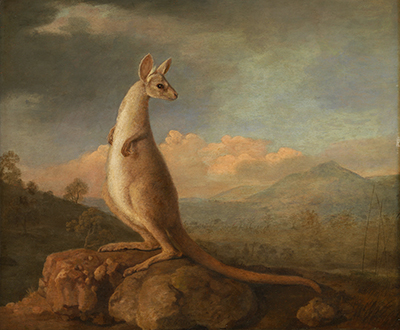
| The Kongouro from New Holland | 1772 | Painting |
| The Labourers | 1779 | Painting |
| The Labourers (Southill original) | 1767 | Painting |
| The lion and horse (Benjamin Green after Stubbs) | 1769; reissued 1777 | Print after Stubbs |
| The Milbanke and Melbourne Families | about 1769 | Painting |
| The Moose | 1770 | Painting |
| The Prince of Wales's Phaeton | 1793 | Painting |
| The Reapers (Upton House) | 1783 | Painting |
| The Sebra, or Wild Ass (George Townley Stubbs after Stubbs) | 1771 | Print after Stubbs |
| The Spanish Pointer (Bradford version) | about 1766–68 | Painting |
| The Spanish Pointer (William Woollett after Stubbs) | January 1768 | Print after Stubbs |
| The Third Duke of Dorset's Hunter with a Groom and a Dog | 1768 | Painting |
| Thomas Freeman, Lord Clarendon's gamekeeper, with a dog and a shot doe (with George Townly Stubbs) | 1803 | Painting |
| Turf, with Jockey up, at Newmarket | — | Painting |
| Turk and Crab | — | Painting |
| Two Bay Hunters Communing On The Bank Of A Lake | — | Painting |
| Tygers at Play | 1780 | |
| Viscount Gormanston's White Dog | 1781 | Painting |
| Viscount Gormanston's White Dog (canvas version) | — | Painting |
| Water Spaniel | 1769 | Painting |
| Wedgwood Family Portrait | 1780 | Painting |
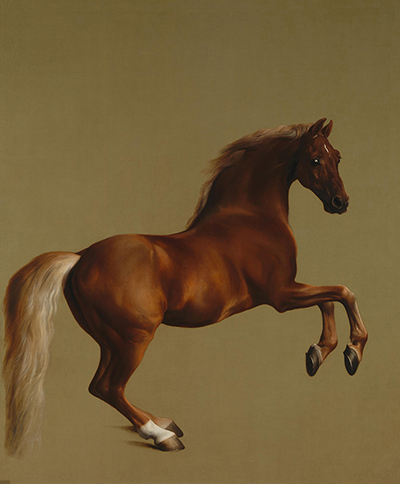
| Whistlejacket | about 1762 | Painting |
| Whistlejacket with two other stallions and a groom | Recorded 1762 | Painting |
| White Poodle in a Punt | about 1780 | Painting |
| William Anderson with two Saddle-Horses | 1793 | Painting |
| Working Drawing for the Seventh Anatomical Table of the Muscles of the Horse | 1756–58 | Drawing |
| Zebra | 1763 | Painting |
Discussion
Look again at the images and ideas explored in George Stubbs Quotes. These editorial prompts invite your observations.
Reader Insights
Which surviving statement most clearly explains Stubbs’s purpose?
How does the speaker or the way a statement was transmitted affect your confidence in it?
Which attributed saying would you most want to trace back to its earliest surviving record?
Join the Conversation
Share a detail, comparison or question about George Stubbs Quotes below.
References
- George Stubbs, The Anatomy of the Horse (London: J. Purser for the author, 1766), Biodiversity Heritage Library bibliographic record and copy note and Wellcome/Internet Archive facsimile via Wikimedia Commons, title page and complete unpaginated `To the Reader` leaf [p. iii]. Accessed 30 August 2026. View source 1. View source 2.
- Judy Egerton, “Whistlejacket”, The British Paintings, National Gallery, 2000: discussion and notes 1, 15 and 38; transcription of George Stubbs to Petrus Camper, 17 October 1771; transcriptions and archive identity of the Rockingham receipts. Accessed 30 August 2026. View source.
- Joseph Mayer, Early Exhibitions of Art in Liverpool: with some notes for a memoir of George Stubbs (Liverpool, 1876), Internet Archive record and facsimile and Wikimedia Commons PDF, printed pp. 95, 102, 105–07 and 110. Accessed 30 August 2026. View source 1. View source 2.
- Walter Gilbey, Life of George Stubbs, R.A. (London: Vinton, 1898), Getty Research Institute facsimile at Internet Archive, Henry Cline's flyleaf note at printed pp. 21–22 and extracted will/probate testimony at pp. 232–34. Accessed 30 August 2026. View source.
- British Museum, The Anatomy of the Horse, 1914,0228.3013.1–24, and Morgan Library & Museum, The Anatomy of the Horse, PML 79835. Accessed 30 August 2026. View source 1. View source 2.
- The Monthly Review, vol. 36 (1767), p. 160, “Monthly Catalogue”, article 28. Accessed 30 August 2026. View source.
- Pallas Athene/ACC Art Books, A Memoir of George Stubbs, publication-history description. Accessed 30 August 2026. View source.
- National Portrait Gallery, George Townley Stubbs (1756–1815). Accessed 30 August 2026. View source.
- National Gallery, George Stubbs, and Royal Academy of Arts, George Stubbs ARA, current institutional artist descriptions. Accessed 30 August 2026. View source 1. View source 2.
- Basic title, date and material metadata for Tate’s Reapers (T02257) and Otho (T02375) is adapted from the Tate collection dataset, October 2014, released under CC0. TheHistoryOfArt.org has reconciled labels and versions. This credit does not apply to Tate’s authored catalogue commentary or images.
- Data Source: Yale Center for British Art. Basic object fields are adapted and reconciled for this directory. Reuse is subject to the Center’s Open Data and Data Services Terms of Use. No museum endorsement is implied. This metadata credit does not relabel scholarly essays or images as open data.
- Basic object metadata for A Horse Frightened by a Lion, 1985.38, The Cleveland Museum of Art, John L. Severance Fund, is available under CC0. Titles and design-level grouping have been reconciled for this directory.