 by
Tom Gurney
Tom Gurney BSc (Hons) is an art history expert with over 20 years experience
Published on June 19, 2020 / Updated on October 22, 2026
Email:
tomgurney1@gmail.com
/ Phone:
+44 7429 011000
Paul Alexis Reading to Émile Zola: A Conversation in Paint: Introduction
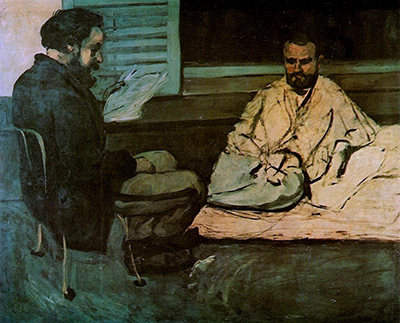
A man at the left raises a manuscript toward a man seated opposite him. The listener faces us; the reader turns in profile. Between them, the sheet of paper is a small, pale hinge in an otherwise broad arrangement of dark coat, shutter, wall, and white clothing. Paul Alexis Reading to Émile Zola presents literary work as an encounter between two bodies rather than a solitary author at a desk.
The Museu de Arte de São Paulo (MASP) dates this reading scene to 1869–70. [1]
At a Glance
- Artist Paul Cézanne (MASP); traditional attribution, unexamined and authenticity undetermined (FWN). [1] [2]
- Title Paul Alexis Reading to Émile Zola . [1]
- Date and medium 1869–70; oil on canvas. [1] [2]
- Collection MASP, São Paulo; inventory MASP.00086. [1]
- Size MASP records 133.5 × 163 × 3 cm; FWN records 130 × 160 cm. The records do not explain the difference. [1] [2]
- Catalogue concordance FWN 602-TA; Rewald 151; Venturi 117. [2]
This work across Paul Cézanne’s career
The Kiss of the Muse
c.1860The Artist’s Father, Reading L’Événement
autumn 1866The Hanged Man’s House
c.1873A Modern Olympia
1873–74Maincy Bridge
1879–80The Blue Vase
1889–90The Basket of Apples
c.1893Apples and Oranges
c.1899The Large Bathers (Philadelphia)
1900–1906 (Philadelphia Museum dating)Château Noir (MoMA)
1903–04Contents
- A reading held between two figures
- Shutters, darkness and an open edge
- Where the painting stops
- Two canvases and a debated history
- Conservation at MASP
A reading held between two figures
Zola does not mirror the reader's upright posture. He sits low, with his legs folded beneath or before him and a broad pale garment across his torso. The difference in height makes the exchange visually uneven without proving any personal hierarchy. Alexis's dark profile projects toward the right, while Zola's face looks outward from a recessed, nearly black opening. The listener is therefore both the subject of Alexis's attention and a face available to the viewer. That divided address keeps the scene from becoming a simple illustration of a text being read aloud.
The bright paper sits near the meeting point of those directions. Following its angle, the eye moves from Alexis's hands toward Zola's head; following the low edge of the pale clothing, it moves back across the picture. Neither path closes neatly. A dark gap separates the reader's knees from the listener's folded legs. Cézanne leaves physical room between the men even as their attention seems joined. The painting makes conversation legible through spacing and pose, although a still image cannot tell us what Alexis is saying or how Zola responds.
MASP notes that Alexis’s coat merges with the chair back. Its curved blue-green outline remains visible beside him, and marks below his arm suggest the seat and supports. Zola sits on a broader pale surface whose precise edge is harder to fix. The two seats give the bodies different outlines: one narrow and dark, the other expanding into the light cloth. [1]
Shutters, darkness and an open edge
Across the upper centre, green shutters make a crisp horizontal interruption. Their slats are clear enough to read as a constructed object, while the area to the right remains almost opaque. The left wall is lavender and grey, a cool field behind Alexis's head. These adjoining surfaces give the picture two sorts of backdrop: one catches light, and the other withholds detail. Zola's head emerges from the dark section, so a small warm face becomes prominent without elaborate modelling.
At the lower edge, a wide dark green band runs under both figures. It supplies a common base, but its brushwork is less descriptive than the chair or shutter. Near the middle, strokes of grey and green break its surface, and the transition into the pale cloth is uneven. The ground does not offer a secure horizon or an obvious pathway into depth. The picture instead stacks bodies, furniture and wall in shallow bands. That compression makes the small space between Alexis and Zola feel like the central opening of the composition.
The strongest contrast is not simply black against white. Alexis's coat contains blue and brown shifts; Zola's pale clothing moves from grey to cream and exposed light ground. The manuscript is cooler and sharper than much of the garment. In a reproduction, such differences can be easy to flatten into a story about two people, yet the painting asks us to notice how its materials carry the story. A lifted sheet, a chair back and a folded leg each become readable by a different kind of edge.
Where the painting stops
Zola's garment and seat include broad pale regions crossed by drawn lines. Some sections appear worked in colour, while others retain a sketch-like openness. The canvas gives us no reason for the interruption.
MASP suggests the Franco-Prussian War may explain why the painting remained unfinished; that is a hypothesis. [1]
Look at how the unfinished areas change the encounter. Zola's dark head is relatively definite, but his light body opens into lines and patches. The eye cannot settle on one final shape for his sleeves or the surface beneath him. Alexis is more compact, yet the dark coat partly merges with his chair. In both figures, clarity and uncertainty occupy adjacent passages. The reading remains intelligible even though the setting and clothing resist complete description. The painting's visible state thus affects how we experience the scene without supplying a documented account of its making.
That difference also makes the manuscript unusually decisive. It is a pale form that has a clear purpose, even though the pale areas around Zola have looser boundaries. A viewer may first take the largest white shape as the centre, then discover that the much smaller page sets the action in motion. The drama lies in the relationship between the paper and the listening face, while the unfinished cloth keeps drawing attention back to the act of painting. The two kinds of work, writing and picturing, meet on the canvas without becoming identical.
Two canvases and a debated history
The online Cézanne catalogue distinguishes this large MASP canvas, FWN 602-TA, from the private-collection Une lecture de Paul Alexis chez Zola , FWN 601, measuring 52 × 56 cm. [2]
The smaller picture shows an interior arrangement; the MASP picture places the two men by shutters and a dark opening. They share an interest in reading, but their dimensions, settings and histories differ. In the larger painting, the dark opening gives Zola's face a backdrop with little readable detail, whereas the reader's side is crowded by chair, wall and shutter. The visual difference between those two surrounds matters more than the similarity of their titles.
Alain Pagès proposes a sequence from drawings through the smaller interior to this larger scene, perhaps in spring 1870. It remains a reconstruction. The FWN catalogue questions whether the smaller painting's figure is Alexis at all. [3] [2]
MASP repeats a 1927 discovery story. Pagès questions it because Alexandrine Zola gave away the Médan house in 1905; his proposed 1903–05 sale remains unverified. FWN lists M. Helm, Paul Rosenberg and Wildenstein before MASP. [1] [3] [2]
Conservation at MASP
MASP's 2016 annual report says this painting had darkened and contained altered, resistant overpainting. The museum restored it with conservator Regina Costa Pinto Dias Moreira; a University of São Paulo team led by Marcia Rizzuto conducted infrared reflectography. The report says it had not been restored since entering MASP's collection in the early 1950s. [4]
Cézanne artworks directory
Browse 217 identified works in this researched selection, including paintings, drawings and watercolours. This is a bounded selection, not a complete catalogue of Cézanne’s surviving oeuvre. Unlinked titles have no confirmed article in this collection.
| Name | Date | Medium |
|---|---|---|
| A Head, a Cup, and a Bread Roll | 1891/1894 | Drawing |
| A Man seen from Behind | 1880/1883 | Drawing |
| A Modern Olympia | 1873–74 | Painting |
| A Nude and Foliage | 1879/1882 | Drawing |
| A Smoking Man | 1892–96 (catalogue); c.1890–92 (museum) | Drawing |
| Afternoon in Naples | 1876–77 | Painting |
| An Old Woman with a Rosary | about 1895–96 | Painting |
| Apples and Oranges | c.1899 | Painting |
| Auvers, Panoramic View | 1873–75 | Painting |
| Avenue at Chantilly | 1888 | Painting |
| Banks of the Marne | 1888–94 | Painting |
| Basket | 1877/1900 | Drawing |
| Bather with Outstretched Arms | 1877–78 | Painting |
| Bellows in Front of a Fireplace | 1887/1892 | Drawing |
| Bibémus Quarry | c.1895 | Painting |
| Boy in a Red Vest, Barnes Foundation | 1888–90 | Painting |
| Boy in a Red Vest, MoMA | 1888–90 | Painting |
| Boy in a Red Waistcoat, National Gallery of Art | 1888–90 | Painting |
| Branch in Flower | 1886/1889 | Drawing |
| Carnival Scene | 1885/1888 | Drawing |
| Chair and Dresser | 1880/1883 | Drawing |
| Chateau Noir | 1903–04 | Painting |
| Chestnut Trees and Farm at Jas de Bouffan | c.1885 | Painting |
| Chestnut Trees and Farm at Jas de Bouffan, Pushkin | c.1886 | Painting |
| Chestnut Trees at Jas de Bouffan in Winter | 1885–86 | Painting |
| Château Noir | 1900–04 | Painting |
| Cistern in the Park of Château Noir | c.1900 | Painting |
| Curtain, Jug and Fruit | 1893–94 | Painting |
| Cushion of an Armchair | 1886/1889 | Drawing |
| Draft Letter and Studies of Bathers | c.1878 | Drawing |
| Farmhouse and Chestnut Trees at Jas de Bouffan | 1884–85 | Painting |
| Figure Resting Head on Hand | c. 1889 | Drawing |
| Fireplace Tongs and Poker | 1887/1892 | Drawing |
| Forest Interior, San Francisco | c.1898–99 | Painting |
| Four Bathers | 1888–90 | Painting |
| Fruit and a Jug on a Table | 1893–94 | Painting |
| Gardanne | 1885–86 | Painting |
| Gardanne, Barnes Foundation | c.1885 | Painting |
| Hand and Shoulder of a Boy | c. 1885 | Drawing |
| Harlequin, National Gallery of Art | 1888–90 | Painting |
| Head of a Boy | 1887/1889 | Drawing |
| Head of a Boy Seen from Behind | c. 1885 | Drawing |
| Head of a Young Woman | c. 1880 | Drawing |
| Head of the Artist's Son | 1888/1889 | Drawing |
| Hillside in Provence | c.1890–92 | Painting |
| Horse Chestnut Trees at Jas de Bouffan | c.1885 | Painting |
| House and Farm at the Jas de Bouffan | c.1887 | Painting |
| House in a Park | 1883/1886 | Drawing |
| House in Provence | c.1885 | Painting |
| House of Père Lacroix | 1873 | Painting |
| House Surrounded by Vegetation | 1889/1892 | Drawing |
| Houses in Provence The Riaux Valley near L’Estaque | c.1883 | Painting |
| Jas de Bouffan, the Pool | c.1876 | Painting |
| Kerosene Lamp | 1878/1881 | Drawing |
| L'Estaque, Melting Snow | c.1870 | Painting |
| Lake Annecy | 1896 | Painting |
| Landscape in Provence, Pola Museum | 1879–82 | Painting |
| Landscape Near Aix-en-Provence | 1877/1880 | Drawing |
| Landscape Seen from the Inside of a Cave | 1889/1892 | Drawing |
| Landscape with Poplars | c.1885–87 | Painting |
| Landscape with Trees | 1895/1898 | Drawing |
| Leda and the Swan | c.1880 (possibly later) | Painting |
| Little Girl with a Doll | 1902–04 | Painting |
| Louis Guillaume | 1879–1890 | Painting |
| Madame Cezanne | 1888/1891 | Drawing |
| Madame Cezanne | 1886/1889 | Drawing |
| Madame Cezanne | 1882/1887 | Drawing |
| Madame Cezanne | 1897/1900 | Drawing |
| Madame Cezanne with her Head Lowered | 1893/1896 | Drawing |
| Madame Cézanne in a Red Armchair | c.1877 | Painting |
| Madame Cézanne in a Red Dress, Metropolitan Museum of Art | 1888–90 | Painting |
| Madame Cézanne in a Yellow Chair | 1888–90 | Painting |
| Madame Cézanne in a Yellow Chair, Fondation Beyeler | 1888–90 | Painting |
| Madame Cézanne in the Conservatory | 1891 | Painting |
| Maincy Bridge | 1879–80 | Painting |
| Maison Maria with a View of Château Noir | c.1895 | Painting |
| Man Bending Forward | 1883/1886 | Drawing |
| Man Smoking a Pipe, Pushkin | c.1891, possibly later | Painting |
| Man with a Pipe | 1891–96 | Painting |
| Man with a Pipe, Nelson-Atkins | 1890–92 | Painting |
| Man with a Straw Hat (Gustave Boyer) | c.1871 | Painting |
| Man with Crossed Arms | c.1899 | Painting |
| Man with Pipe, National Gallery of Art | 1892–96 | Painting |
| Mont Sainte-Victoire | c.1902–06 | Painting |
| Mont Sainte-Victoire | 1900–02 | Painting |
| Mont Sainte-Victoire (recto) | c.1895 | Watercolour |
| Mont Sainte-Victoire and the Viaduct of the Arc River Valley | 1882–85 | Painting |
| Mont Sainte-Victoire Seen beyond the Wall of the Jas de Bouffan | c.1885/1888 | Watercolour |
| Mont Sainte-Victoire Seen from Bibémus Quarry | c.1897 | Painting |
| Mont Sainte-Victoire, Barnes Foundation | 1892–95 | Painting |
| Near the Pool at Jas de Bouffan | 1883/1887 | Drawing |
| Pelicans | 1877/1880 | Drawing |
| Peonies | 1890/1893 | Drawing |
| Pierrot and Harlequin | 1888 | Painting |
| Pine Tree | 1882/1885 | Drawing |
| Pont des Trois Sautets | 1906 | Watercolour |
| Poplars | 1879–80 | Painting |
| Portrait of Ambroise Vollard | 1899 | Painting |
| Portrait of Gustave Geffroy | 1895–96 | Painting |
| Portrait of Madame Cezanne with Loosened Hair | 1885–86 | Painting |
| Portrait of the Artist Looking Over His Shoulder | 1883–84 | Painting |
| Portrait of the Gardener Vallier | 1906 | Painting |
| Portrait of Victor Chocquet | 1876–77 | Painting |
| Portrait Of Victor Chocquet Seated | 1877 | Painting |
| Provençal Manor | c.1885 | Painting |
| Pyramid of Skulls | 1898–1900 | Painting |
| Reclining Nude (Leda?) | c.1887 | Painting |
| Scipio | 1866–68 | Painting |
| Seated Man, Oslo | 1898–1900 | Painting |
| Seated Peasant | c.1892–96 | Painting |
| Seated Peasant, Hiroshima | c.1897 | Painting |
| Seated Peasant, Orsay | c.1900 | Painting |
| Self-Portrait | c. 1895 | Drawing |
| Self-Portrait in a Bowler Hat, Ny Carlsberg Glyptotek | 1885–86 | Painting |
| Self-Portrait in a Casquette | c.1875 | Painting |
| Self-Portrait with a Beret | 1898–1900 | Painting |
| Self-Portrait with a Hat, Artizon Museum | c.1890–94 | Painting |
| Self-Portrait with a Pink Background | c.1875 | Painting |
| Self-Portrait with Olive-Coloured Wallpaper | about 1880–81 | Painting |
| Self-Portrait with Palette | 1886–87 | Painting |
| Self-Portrait with White Turban | c.1878–80 | Painting |
| Self-Portrait, c.1895 | c.1895 | Painting |
| Self-Portrait, Pushkin Museum | c.1882 | Painting |
| Spanish Dancers | 1883/1886 | Drawing |
| Still Life with a Curtain | 1892–94 | Painting |
| Still Life with Apples | c.1890 | Painting |
| Still Life with Apples | 1893–94 | Painting |
| Still Life with Apples and a Pot of Primroses | about 1890 | Painting |
| Still Life with Milk Jug and Fruit | c.1900 | Painting |
| Still Life with Open Drawer | 1877–79 | Painting |
| Still Life with Plaster Cupid | about 1894 | Painting |
| Still Life with Skull | 1890–93 | Painting |
| Still Life with Soup Tureen | 1877 | Painting |
| Still Life, Pitcher and Fruit | 1893–94 | Painting |
| Studies Including a Straw Hat | 1895/1898 | Drawing |
| Studies Including Madame Cezanne | 1884/1887 | Drawing |
| Study for "The Judgement of Paris" or "The Amorous Shepherd" | 1883/1886 | Drawing |
| Study for Woman with a Coffee Pot | c.1895 | Painting |
| Study of "The Roman Orator (Germanicus)" | 1883/1886 | Drawing |
| Study of "Venus de Milo" | 1881/1884 | Drawing |
| Study of a Decorative Ornament | 1879/1882 | Drawing |
| Study of a Standing Male Figure after the Antique | c. 1895 | Drawing |
| Study of an Angel in Rubens' "The Prophet Elijah" | 1892/1895 | Drawing |
| Study of Desiderio da Settignano's "Bust of a Child" | c. 1895 | Drawing |
| Study of Houses | 1879/1882 | Drawing |
| Study of Puget's "Hercules Resting" | c. 1879 | Drawing |
| Study of Puget's "Milo of Crotona" | 1895/1898 | Drawing |
| Study of Puget's "Milo of Crotona" | 1880/1883 | Drawing |
| Study of the Allegorical Figure Bellona in Rubens' "The Apotheosis of Henri IV" | 1883/1886 | Drawing |
| Study of the Allegorical Figure Bellona in Rubens' "The Apotheosis of Henri IV" | 1879/1882 | Drawing |
| Study of the Allegorical Figure France in Rubens' "The Exchange of the Two Princesses" | 1882/1885 | Drawing |
| Study of the Allegorical Figure of Health in Rubens' "The Birth of Louis XIII" | 1880/1883 | Drawing |
| Study of the Allegorical Figure of the Genius of Health from Rubens' "The Birth of Louis XIII at Fontainbleau" | 1895/1898 | Drawing |
| Sugar Bowl, Pears and Blue Cup | 1865–66 | Painting |
| The Aqueduct, Pushkin Museum | Dating differs between museum records | Painting |
| The Artist's Father, Reading L'Evenement | autumn 1866 | Painting |
| The Artist's Son | c. 1887 | Drawing |
| The Artist's Son Leaning on his Elbow | c. 1887 | Drawing |
| The Artist's Son Reading | c. 1887 | Drawing |
| The Artist's Son Writing | c. 1887 | Drawing |
| The Artist’s Son, Paul | 1886–87 | Painting |
| The Avenue at Jas de Bouffan | 1868–70 (possibly later) | Painting |
| The Avenue at Jas de Bouffan, Geneva | c.1890 | Painting |
| The Basket of Apples | c.1893 | Painting |
| The Bather, Museum of Modern Art | c.1885 | Painting |
| The Bay of Marseille seen from L'Estaque | c.1885 | Painting |
| The Blue Vase | 1889–90 | Painting |
| The Boy in the Red Vest, Bührle | 1888–90 | Painting |
| The Buffet | 1877–79 | Painting |
| The Card Players, Barnes Foundation | 1890–92 | Painting |
| The Card Players, Courtauld Gallery | 1892–96 | Painting |
| The Card Players, Metropolitan Museum of Art | 1890–92 | Painting |
| The Card Players, Musée d’Orsay | 1893–96 | Painting |
| The Card Players, Qatar | 1892–96 | Painting |
| The Eternal Feminine | c.1877 | Painting |
| The Gardener Vallier | 1906 | Painting |
| The Gardener Vallier, Tate | 1905–06 | Painting |
| The Grounds of the Château Noir | c.1900–04 | Painting |
| The Gulf of Marseille Seen from L’Estaque | c.1885 | Painting |
| The Hanged Man's House in Auvers | c.1873 | Painting |
| The House of Doctor Gachet at Auvers | 1872–73 | Painting |
| The House with the Cracked Walls | 1892–94 | Painting |
| The Kiss of the Muse | c.1860 | Painting |
| The Large Bathers, Barnes Foundation | 1895–1906 | Painting |
| The Large Bathers, National Gallery | 1895–1905 | Painting |
| The Large Bathers, Philadelphia Museum of Art | 1900–06 | Painting |
| The Mill | 1889/1892 | Drawing |
| The Painter’s Father, Louis-Auguste Cézanne | c.1865 | Painting |
| The Peasant | 1890–92 | Painting |
| The Plaster Mill (La Moulin à plâtre) | 1889/1892 | Drawing |
| The Smoker, Hermitage | c.1891 | Painting |
| The Smoker, Mannheim | c.1891 | Painting |
| The Stove in the Studio | c.1865 | Painting |
| The Vase of Tulips | c.1890 | Painting |
| Thistle | 1893/1896 | Drawing |
| Three Heads, One of Madame Cezanne | 1882/1885 | Drawing |
| Three Skulls | c.1898 | Painting |
| Three Skulls on a Patterned Carpet | 1904 | Painting |
| Trees and Shrubs | 1883/1887 | Drawing |
| Turning Road at Montgeroult | 1898 | Painting |
| Two Bathers | 1884/1887 | Drawing |
| Two Heads | 1888 | Drawing |
| Two Heads | 1890/1896 | Drawing |
| Two Heads of Women | 1890/1894 | Drawing |
| Two Studies for "The Judgement of Paris" or "The Amorous Shepherd" | 1883/1886 | Drawing |
| Uncle Dominique in a Tasseled Cap | 1866 | Painting |
| Uncle Dominique in a Turban | 1866–67 | Painting |
| Victor Chocquet and an Angel for "The Apotheosis of Delacroix" | 1878/1880 | Drawing |
| Woman in Blue | c.1904 | Painting |
| Woman Leaning Forward | 1888/1891 | Drawing |
| Woman Leaning Forward | 1890/1894 | Drawing |
| Woman Leaning Forward | 1890/1894 | Drawing |
| Woman with a Coffee Pot | c.1895 | Painting |
| Women Bathers and a Roll of Paper | 1882/1885 | Drawing |
| Young Girl with a Doll | c.1895 | Painting |
| Young Italian Woman at a Table | c.1895–1900 | Painting |
| Young Man and Skull | 1896–98 | Painting |
Frequently Asked Questions
The angled manuscript connects their gestures. Its writing is not legible, but its direction leads the eye from the reader toward the listener.
His warm face emerges from the dark opening, while the pale garment spreads across the lower right.
Broad light areas around the listener retain drawn lines and unsettled edges, especially in the clothing and the surface beneath him.
Discussion
Look again at the images and ideas explored in Paul Alexis Reading to Émile Zola: A Conversation in Paint. These editorial prompts invite your observations.
Reader Insights
Begin at the manuscript and follow its angle toward Zola's face. Which painted edges make that exchange readable before either figure's clothing is fully understood?
Compare the detailed shutter with the dark opening beside it. How does each surface change the attention given to the two faces?
Look at the pale garment and the much smaller pale page. Which carries the action, and which keeps your eye moving around the canvas?
Join the Conversation
Share a detail, comparison or question about Paul Alexis Reading to Émile Zola: A Conversation in Paint below.
References
- Museu de Arte de São Paulo Assis Chateaubriand , “Paul Alexis lê um manuscrito a Zola,” collection record, inventory MASP.00086, including texts by Laura Cosendey, Felipe Martinez and Luciano Migliaccio. View source .
- Société Paul Cezanne , The Paintings, Watercolors and Drawings of Paul Cezanne: An Online Catalogue Raisonné , FWN 602-TA, FWN 601, and “Using the Catalogue”. View source 1 . View source 2 . View source 3 .
- Alain Pagès , “Zola, Cézanne et Paul Alexis,” Société Paul Cezanne, 6 October 2016. View source .
- MASP , Relatório anual de atividades 2016 , printed pp. 94–95 (PDF p. 48), “Restauros.”. View source .
- Le Baiser de la muse, d'après Frillié (FWN 572). View source.
- Louis-Auguste Cezanne, père de l'artiste, lisant L'Événement (FWN 402). View source.
- La Maison du pendu, Auvers-sur-Oise (FWN 81). View source.
- Une moderne Olympia (FWN 628). View source.
- Le Pont de Maincy (FWN 143). View source.
- La Montagne Sainte-Victoire vue de Montbriand (FWN 185). View source.
- Gardanne (vue horizontale) (FWN 224). View source.
- Le Vase bleu (FWN 823). View source.
- Les Joueurs de cartes (FWN 681). View source.
- La Montagne Sainte-Victoire (FWN 296). View source.
- La Corbeille de pommes (FWN 860). View source.
- Pommes et oranges (FWN 871). View source.
- Portrait d'Ambroise Vollard (FWN 531). View source.
- Philadelphia Museum of Art,The Large Bathers,W1937-1-1. View source.
- Château Noir (FWN 360). View source.
- Société Paul Cezanne,online catalogue structure and objectidentification. View source.
- National Gallery of Art,Cezanne Sketchbook,1992.51.9. View source.
- Splash image, Alexis reads while Zola listens.