Paul Cezanne.jpg)
 by
Tom Gurney
Tom Gurney BSc (Hons) is an art history expert with over 20 years experience
Published on June 19, 2020 / Updated on October 22, 2026
Email:
tomgurney1@gmail.com
/ Phone:
+44 7429 011000
Study of Houses: Cézanne’s Architecture in Pencil: Introduction
Paul Cézanne’s Study of Houses begins with a roofline that seems to travel across the page before the buildings below it have fully taken shape. The graphite grows darker as it descends into upright walls and openings, yet much of the paper remains bare. What first looks like a quick record of several houses becomes a careful test of how few lines a building needs before it begins to occupy space.
The National Gallery of Art dates this graphite drawing to 1879–82 and identifies it as a leaf from Cézanne’s Washington sketchbook. Its accession number is 1992.51.9.e. [1]
At a Glance
- Artist Paul Cézanne. [1]
- Work Study of Houses . [1]
- Date 1879–82. [1]
- Medium and size Graphite on wove paper, 15.2 × 23.7 cm. [1]
- Collection National Gallery of Art, Washington, accession 1992.51.9.e. [1]
This work across Paul Cézanne’s career
The Kiss of the Muse
c.1860The Artist’s Father, Reading L’Événement
autumn 1866The Hanged Man’s House
c.1873A Modern Olympia
1873–74Maincy Bridge
1879–80The Blue Vase
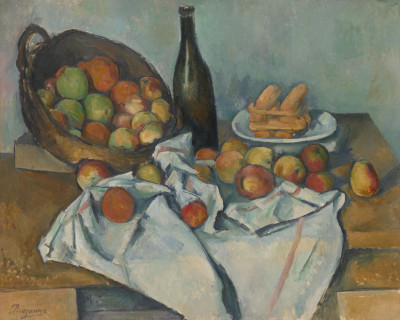
1889–90The Basket of Apples
c.1893Apples and Oranges
c.1899The Large Bathers (Philadelphia)
1900–1906 (Philadelphia Museum dating)Château Noir (MoMA)
1903–04Contents
- A Roofline That Does Not Settle
- Walls Made from Repeated Marks
- Space Without a Drawn Ground Plan
- The Pace of the Pencil
- Its Place in the Washington Sketchbook
- What the Title Can and Cannot Tell Us
A Roofline That Does Not Settle
The first roof is scarcely a closed shape. At the far left, short diagonal touches meet a thin, uneven line that rises towards the middle of the sheet. A longer slant follows, then breaks into smaller strokes. There is no confidently ruled edge to hold the houses together. The line has the wavering quality of a view being measured by hand, with interruptions where Cézanne either lost sight of an edge or chose to begin it again. Looking along it is like following a series of decisions rather than reading a finished architectural plan.
Near the centre, a higher roof or upper wall seems to overlap the lower run. Light marks continue across the top, where the outline could describe distant roofs, uneven ground or both. The drawing does not settle every junction. That uncertainty is productive: the eye moves between possible contours, testing which planes belong together. The houses feel observed from a particular position, but the sheet declines to supply the complete map that would fix their arrangement beyond doubt.
At the right, the profile changes direction more abruptly. An angled line descends towards the edge of the paper, while darker vertical strokes below it give the adjoining form greater weight. The visual movement is therefore uneven. The left side pulls the eye laterally across shallow roofs; the right side arrests it with a taller, more emphatic face. Between them lies a lighter passage in which the architecture seems to be assembled from gaps as much as marks.
Walls Made from Repeated Marks
Several almost parallel uprights descend from the roof area. Some are straight and single; others are built by repeatedly running the pencil down a narrow strip. These repetitions do not simply shade a wall. They show Cézanne testing its edge and its thickness. A wall that begins as a pale contour acquires weight where vertical lines gather, then dissolves again where the graphite stops. The paper’s unmarked surface becomes a possible plane of masonry without being uniformly filled.
In the left half, a group of longer downward strokes forms a relatively narrow façade. The marks bend and multiply near its foot. Beside it, a dark little opening stands almost alone. Because its interior is much more concentrated than the wall around it, the opening can read as a doorway, a window or a deep recess. The drawing makes its darkness certain while leaving its architectural label less secure. A viewer has to construct the building around that small accent.
The central and right-hand walls are less evenly described. One vertical band of short, closely set strokes is noticeably firmer than the pale surface next to it. Farther right, a tall narrow opening is drawn with only one side strongly stated. Rather than list every window or door, Cézanne distributes marks where they clarify a change in plane. The effect is not a complete inventory of the houses. It is an arrangement of clues that lets an otherwise open sheet carry a row of built forms.
Space Without a Drawn Ground Plan
A faint lower line runs beneath the façades, but it is broken, and it sits well above the bottom of the page. Below it the paper opens out. Small zigzags and short hatching near the centre indicate a boundary or patch of ground without describing a road, garden or pavement. This limited information matters. The houses do not stand on a carefully mapped stage; they appear where a few changes of direction convince the eye that wall and ground meet.
The open space below also alters the apparent scale. The main architectural marks occupy a band across the upper and middle parts of the sheet. The blank lower margin leaves room for the viewer’s eye to approach, while offering little evidence about the actual distance to the buildings. Their fronts can seem close because the uprights are visible, then remote because no path connects them to us. Cézanne holds both impressions in suspension.
The Pace of the Pencil
The strokes vary in density more than in color. Along the roofs they are slight, sometimes so pale that one must follow several segments to recover the contour. At selected wall edges the pencil presses or passes repeatedly, making a darker strip. Short crosswise marks punctuate the upper buildings; nearer the bottom, a run of small vertical dashes animates the boundary. The changes give the sheet a rhythm: approach a form lightly, return to its structural edge, then stop before every surface is completed.
MoMA’s overview of Cézanne’s drawings describes searching lines that repeat and transform across paper. The phrase helps place this small architectural sheet within his wider practice, although the overview does not analyze Study of Houses itself. [2]
Its Place in the Washington Sketchbook
The online catalogue raisonné identifies the work as FWN 3015-05a , page V of the sketchbook it calls CP III. It records the French title Etude de maisons , with Study of houses as an alternate title, and gives Chappuis number 808. Those concordances make this specific leaf distinguishable from other Cézanne drawings of houses. [3]
Charles S. Moffett’s original 1991 essay explains that Cézanne appears to have used this sketchbook without a chronological sequence. Page V locates the drawing in the bound object; it cannot by itself establish that the houses were drawn just after the image on page IV or just before the one on page VI. [4]
The National Gallery describes the book as containing 46 sheets and 71 drawings, with some blank sheets and others used for notes or calculations. This mixed use gives context to the restraint of the present leaf. The houses are a self-contained study, while remaining one small act of looking within a book also used for portraits, figures and other motifs. [5]
What the Title Can and Cannot Tell Us
Study of Houses names a subject, not an address. Neither the gallery’s object record nor the catalogue entry identifies a particular street or village for this leaf. [1] [3]
The drawing itself supplies roofs, openings, walls and a suggestion of ground. Its force lies in the way those ordinary parts become legible through uneven pressure and discontinuous lines. Looking longer brings out more relationships among the marks, without turning them into a complete architectural plan.
Cézanne artworks directory
Browse 217 identified works in this researched selection, including paintings, drawings and watercolours. This is a bounded selection, not a complete catalogue of Cézanne’s surviving oeuvre. Unlinked titles have no confirmed article in this collection.
| Name | Date | Medium |
|---|---|---|
| A Head, a Cup, and a Bread Roll | 1891/1894 | Drawing |
| A Man seen from Behind | 1880/1883 | Drawing |
| A Modern Olympia | 1873–74 | Painting |
| A Nude and Foliage | 1879/1882 | Drawing |
| A Smoking Man | 1892–96 (catalogue); c.1890–92 (museum) | Drawing |
| Afternoon in Naples | 1876–77 | Painting |
| An Old Woman with a Rosary | about 1895–96 | Painting |
| Apples and Oranges | c.1899 | Painting |
| Auvers, Panoramic View | 1873–75 | Painting |
| Avenue at Chantilly | 1888 | Painting |
| Banks of the Marne | 1888–94 | Painting |
| Basket | 1877/1900 | Drawing |
| Bather with Outstretched Arms | 1877–78 | Painting |
| Bellows in Front of a Fireplace | 1887/1892 | Drawing |
| Bibémus Quarry | c.1895 | Painting |
| Boy in a Red Vest, Barnes Foundation | 1888–90 | Painting |
| Boy in a Red Vest, MoMA | 1888–90 | Painting |
| Boy in a Red Waistcoat, National Gallery of Art | 1888–90 | Painting |
| Branch in Flower | 1886/1889 | Drawing |
| Carnival Scene | 1885/1888 | Drawing |
| Chair and Dresser | 1880/1883 | Drawing |
| Chateau Noir | 1903–04 | Painting |
| Chestnut Trees and Farm at Jas de Bouffan | c.1885 | Painting |
| Chestnut Trees and Farm at Jas de Bouffan, Pushkin | c.1886 | Painting |
| Chestnut Trees at Jas de Bouffan in Winter | 1885–86 | Painting |
| Château Noir | 1900–04 | Painting |
| Cistern in the Park of Château Noir | c.1900 | Painting |
| Curtain, Jug and Fruit | 1893–94 | Painting |
| Cushion of an Armchair | 1886/1889 | Drawing |
| Draft Letter and Studies of Bathers | c.1878 | Drawing |
| Farmhouse and Chestnut Trees at Jas de Bouffan | 1884–85 | Painting |
| Figure Resting Head on Hand | c. 1889 | Drawing |
| Fireplace Tongs and Poker | 1887/1892 | Drawing |
| Forest Interior, San Francisco | c.1898–99 | Painting |
| Four Bathers | 1888–90 | Painting |
| Fruit and a Jug on a Table | 1893–94 | Painting |
| Gardanne | 1885–86 | Painting |
| Gardanne, Barnes Foundation | c.1885 | Painting |
| Hand and Shoulder of a Boy | c. 1885 | Drawing |
| Harlequin, National Gallery of Art | 1888–90 | Painting |
| Head of a Boy | 1887/1889 | Drawing |
| Head of a Boy Seen from Behind | c. 1885 | Drawing |
| Head of a Young Woman | c. 1880 | Drawing |
| Head of the Artist's Son | 1888/1889 | Drawing |
| Hillside in Provence | c.1890–92 | Painting |
| Horse Chestnut Trees at Jas de Bouffan | c.1885 | Painting |
| House and Farm at the Jas de Bouffan | c.1887 | Painting |
| House in a Park | 1883/1886 | Drawing |
| House in Provence | c.1885 | Painting |
| House of Père Lacroix | 1873 | Painting |
| House Surrounded by Vegetation | 1889/1892 | Drawing |
| Houses in Provence The Riaux Valley near L’Estaque | c.1883 | Painting |
| Jas de Bouffan, the Pool | c.1876 | Painting |
| Kerosene Lamp | 1878/1881 | Drawing |
| L'Estaque, Melting Snow | c.1870 | Painting |
| Lake Annecy | 1896 | Painting |
| Landscape in Provence, Pola Museum | 1879–82 | Painting |
| Landscape Near Aix-en-Provence | 1877/1880 | Drawing |
| Landscape Seen from the Inside of a Cave | 1889/1892 | Drawing |
| Landscape with Poplars | c.1885–87 | Painting |
| Landscape with Trees | 1895/1898 | Drawing |
| Leda and the Swan | c.1880 (possibly later) | Painting |
| Little Girl with a Doll | 1902–04 | Painting |
| Louis Guillaume | 1879–1890 | Painting |
| Madame Cezanne | 1888/1891 | Drawing |
| Madame Cezanne | 1886/1889 | Drawing |
| Madame Cezanne | 1882/1887 | Drawing |
| Madame Cezanne | 1897/1900 | Drawing |
| Madame Cezanne with her Head Lowered | 1893/1896 | Drawing |
| Madame Cézanne in a Red Armchair | c.1877 | Painting |
| Madame Cézanne in a Red Dress, Metropolitan Museum of Art | 1888–90 | Painting |
| Madame Cézanne in a Yellow Chair | 1888–90 | Painting |
| Madame Cézanne in a Yellow Chair, Fondation Beyeler | 1888–90 | Painting |
| Madame Cézanne in the Conservatory | 1891 | Painting |
| Maincy Bridge | 1879–80 | Painting |
| Maison Maria with a View of Château Noir | c.1895 | Painting |
| Man Bending Forward | 1883/1886 | Drawing |
| Man Smoking a Pipe, Pushkin | c.1891, possibly later | Painting |
| Man with a Pipe | 1891–96 | Painting |
| Man with a Pipe, Nelson-Atkins | 1890–92 | Painting |
| Man with a Straw Hat (Gustave Boyer) | c.1871 | Painting |
| Man with Crossed Arms | c.1899 | Painting |
| Man with Pipe, National Gallery of Art | 1892–96 | Painting |
| Mont Sainte-Victoire | c.1902–06 | Painting |
| Mont Sainte-Victoire | 1900–02 | Painting |
| Mont Sainte-Victoire (recto) | c.1895 | Watercolour |
| Mont Sainte-Victoire and the Viaduct of the Arc River Valley | 1882–85 | Painting |
| Mont Sainte-Victoire Seen beyond the Wall of the Jas de Bouffan | c.1885/1888 | Watercolour |
| Mont Sainte-Victoire Seen from Bibémus Quarry | c.1897 | Painting |
| Mont Sainte-Victoire, Barnes Foundation | 1892–95 | Painting |
| Near the Pool at Jas de Bouffan | 1883/1887 | Drawing |
| Pelicans | 1877/1880 | Drawing |
| Peonies | 1890/1893 | Drawing |
| Pierrot and Harlequin | 1888 | Painting |
| Pine Tree | 1882/1885 | Drawing |
| Pont des Trois Sautets | 1906 | Watercolour |
| Poplars | 1879–80 | Painting |
| Portrait of Ambroise Vollard | 1899 | Painting |
| Portrait of Gustave Geffroy | 1895–96 | Painting |
| Portrait of Madame Cezanne with Loosened Hair | 1885–86 | Painting |
| Portrait of the Artist Looking Over His Shoulder | 1883–84 | Painting |
| Portrait of the Gardener Vallier | 1906 | Painting |
| Portrait of Victor Chocquet | 1876–77 | Painting |
| Portrait Of Victor Chocquet Seated | 1877 | Painting |
| Provençal Manor | c.1885 | Painting |
| Pyramid of Skulls | 1898–1900 | Painting |
| Reclining Nude (Leda?) | c.1887 | Painting |
| Scipio | 1866–68 | Painting |
| Seated Man, Oslo | 1898–1900 | Painting |
| Seated Peasant | c.1892–96 | Painting |
| Seated Peasant, Hiroshima | c.1897 | Painting |
| Seated Peasant, Orsay | c.1900 | Painting |
| Self-Portrait | c. 1895 | Drawing |
| Self-Portrait in a Bowler Hat, Ny Carlsberg Glyptotek | 1885–86 | Painting |
| Self-Portrait in a Casquette | c.1875 | Painting |
| Self-Portrait with a Beret | 1898–1900 | Painting |
| Self-Portrait with a Hat, Artizon Museum | c.1890–94 | Painting |
| Self-Portrait with a Pink Background | c.1875 | Painting |
| Self-Portrait with Olive-Coloured Wallpaper | about 1880–81 | Painting |
| Self-Portrait with Palette | 1886–87 | Painting |
| Self-Portrait with White Turban | c.1878–80 | Painting |
| Self-Portrait, c.1895 | c.1895 | Painting |
| Self-Portrait, Pushkin Museum | c.1882 | Painting |
| Spanish Dancers | 1883/1886 | Drawing |
| Still Life with a Curtain | 1892–94 | Painting |
| Still Life with Apples | c.1890 | Painting |
| Still Life with Apples | 1893–94 | Painting |
| Still Life with Apples and a Pot of Primroses | about 1890 | Painting |
| Still Life with Milk Jug and Fruit | c.1900 | Painting |
| Still Life with Open Drawer | 1877–79 | Painting |
| Still Life with Plaster Cupid | about 1894 | Painting |
| Still Life with Skull | 1890–93 | Painting |
| Still Life with Soup Tureen | 1877 | Painting |
| Still Life, Pitcher and Fruit | 1893–94 | Painting |
| Studies Including a Straw Hat | 1895/1898 | Drawing |
| Studies Including Madame Cezanne | 1884/1887 | Drawing |
| Study for "The Judgement of Paris" or "The Amorous Shepherd" | 1883/1886 | Drawing |
| Study for Woman with a Coffee Pot | c.1895 | Painting |
| Study of "The Roman Orator (Germanicus)" | 1883/1886 | Drawing |
| Study of "Venus de Milo" | 1881/1884 | Drawing |
| Study of a Decorative Ornament | 1879/1882 | Drawing |
| Study of a Standing Male Figure after the Antique | c. 1895 | Drawing |
| Study of an Angel in Rubens' "The Prophet Elijah" | 1892/1895 | Drawing |
| Study of Desiderio da Settignano's "Bust of a Child" | c. 1895 | Drawing |
| Study of Houses | 1879/1882 | Drawing |
| Study of Puget's "Hercules Resting" | c. 1879 | Drawing |
| Study of Puget's "Milo of Crotona" | 1895/1898 | Drawing |
| Study of Puget's "Milo of Crotona" | 1880/1883 | Drawing |
| Study of the Allegorical Figure Bellona in Rubens' "The Apotheosis of Henri IV" | 1883/1886 | Drawing |
| Study of the Allegorical Figure Bellona in Rubens' "The Apotheosis of Henri IV" | 1879/1882 | Drawing |
| Study of the Allegorical Figure France in Rubens' "The Exchange of the Two Princesses" | 1882/1885 | Drawing |
| Study of the Allegorical Figure of Health in Rubens' "The Birth of Louis XIII" | 1880/1883 | Drawing |
| Study of the Allegorical Figure of the Genius of Health from Rubens' "The Birth of Louis XIII at Fontainbleau" | 1895/1898 | Drawing |
| Sugar Bowl, Pears and Blue Cup | 1865–66 | Painting |
| The Aqueduct, Pushkin Museum | Dating differs between museum records | Painting |
| The Artist's Father, Reading L'Evenement | autumn 1866 | Painting |
| The Artist's Son | c. 1887 | Drawing |
| The Artist's Son Leaning on his Elbow | c. 1887 | Drawing |
| The Artist's Son Reading | c. 1887 | Drawing |
| The Artist's Son Writing | c. 1887 | Drawing |
| The Artist’s Son, Paul | 1886–87 | Painting |
| The Avenue at Jas de Bouffan | 1868–70 (possibly later) | Painting |
| The Avenue at Jas de Bouffan, Geneva | c.1890 | Painting |
| The Basket of Apples | c.1893 | Painting |
| The Bather, Museum of Modern Art | c.1885 | Painting |
| The Bay of Marseille seen from L'Estaque | c.1885 | Painting |
| The Blue Vase | 1889–90 | Painting |
| The Boy in the Red Vest, Bührle | 1888–90 | Painting |
| The Buffet | 1877–79 | Painting |
| The Card Players, Barnes Foundation | 1890–92 | Painting |
| The Card Players, Courtauld Gallery | 1892–96 | Painting |
| The Card Players, Metropolitan Museum of Art | 1890–92 | Painting |
| The Card Players, Musée d’Orsay | 1893–96 | Painting |
| The Card Players, Qatar | 1892–96 | Painting |
| The Eternal Feminine | c.1877 | Painting |
| The Gardener Vallier | 1906 | Painting |
| The Gardener Vallier, Tate | 1905–06 | Painting |
| The Grounds of the Château Noir | c.1900–04 | Painting |
| The Gulf of Marseille Seen from L’Estaque | c.1885 | Painting |
| The Hanged Man's House in Auvers | c.1873 | Painting |
| The House of Doctor Gachet at Auvers | 1872–73 | Painting |
| The House with the Cracked Walls | 1892–94 | Painting |
| The Kiss of the Muse | c.1860 | Painting |
| The Large Bathers, Barnes Foundation | 1895–1906 | Painting |
| The Large Bathers, National Gallery | 1895–1905 | Painting |
| The Large Bathers, Philadelphia Museum of Art | 1900–06 | Painting |
| The Mill | 1889/1892 | Drawing |
| The Painter’s Father, Louis-Auguste Cézanne | c.1865 | Painting |
| The Peasant | 1890–92 | Painting |
| The Plaster Mill (La Moulin à plâtre) | 1889/1892 | Drawing |
| The Smoker, Hermitage | c.1891 | Painting |
| The Smoker, Mannheim | c.1891 | Painting |
| The Stove in the Studio | c.1865 | Painting |
| The Vase of Tulips | c.1890 | Painting |
| Thistle | 1893/1896 | Drawing |
| Three Heads, One of Madame Cezanne | 1882/1885 | Drawing |
| Three Skulls | c.1898 | Painting |
| Three Skulls on a Patterned Carpet | 1904 | Painting |
| Trees and Shrubs | 1883/1887 | Drawing |
| Turning Road at Montgeroult | 1898 | Painting |
| Two Bathers | 1884/1887 | Drawing |
| Two Heads | 1888 | Drawing |
| Two Heads | 1890/1896 | Drawing |
| Two Heads of Women | 1890/1894 | Drawing |
| Two Studies for "The Judgement of Paris" or "The Amorous Shepherd" | 1883/1886 | Drawing |
| Uncle Dominique in a Tasseled Cap | 1866 | Painting |
| Uncle Dominique in a Turban | 1866–67 | Painting |
| Victor Chocquet and an Angel for "The Apotheosis of Delacroix" | 1878/1880 | Drawing |
| Woman in Blue | c.1904 | Painting |
| Woman Leaning Forward | 1888/1891 | Drawing |
| Woman Leaning Forward | 1890/1894 | Drawing |
| Woman Leaning Forward | 1890/1894 | Drawing |
| Woman with a Coffee Pot | c.1895 | Painting |
| Women Bathers and a Roll of Paper | 1882/1885 | Drawing |
| Young Girl with a Doll | c.1895 | Painting |
| Young Italian Woman at a Table | c.1895–1900 | Painting |
| Young Man and Skull | 1896–98 | Painting |
Frequently Asked Questions
No. It is a graphite drawing on wove paper in the National Gallery of Art, Washington. [1]
It is page V of the Washington or CP III sketchbook, catalogued FWN 3015-05a. [3]
The open paper lets the roof and wall marks carry the view; the exact reason Cézanne stopped at this stage is not documented.
Discussion
Look again at the images and ideas explored in Study of Houses: Cézanne’s Architecture in Pencil. These editorial prompts invite your observations.
Reader Insights
Trace the roofline from left to right. Where does a continuous contour give way to several possible ones?
Look at the small dark opening left of centre, then at the pale wall around it. How much architecture can that single accent persuade you to see?
Compare the almost empty lower margin with the closely worked uprights above. Does the space bring you towards the houses or keep them at a distance?
Join the Conversation
Share a detail, comparison or question about Study of Houses: Cézanne’s Architecture in Pencil below.
References
- National Gallery of Art , “Study of Houses,” object record, accession 1992.51.9.e. View source .
- Museum of Modern Art , “Cézanne Drawing,” exhibition overview, 2021. View source .
- Société Paul Cezanne , “Etude de maisons, 1879–82 (FWN 3015-05a),” online catalogue raisonné. View source .
- Charles S. Moffett , “Sketchbook,” in Art for the Nation: Gifts in Honor of the 50th Anniversary of the National Gallery of Art , National Gallery of Art, 1991, p. 176. View source .
- National Gallery of Art , “Cezanne Sketchbook,” aggregate object record. View source .
- Le Baiser de la muse, d'après Frillié (FWN 572). View source.
- Louis-Auguste Cezanne, père de l'artiste, lisant L'Événement (FWN 402). View source.
- La Maison du pendu, Auvers-sur-Oise (FWN 81). View source.
- Une moderne Olympia (FWN 628). View source.
- Le Pont de Maincy (FWN 143). View source.
- La Montagne Sainte-Victoire vue de Montbriand (FWN 185). View source.
- Gardanne (vue horizontale) (FWN 224). View source.
- Le Vase bleu (FWN 823). View source.
- Les Joueurs de cartes (FWN 681). View source.
- La Montagne Sainte-Victoire (FWN 296). View source.
- La Corbeille de pommes (FWN 860). View source.
- Pommes et oranges (FWN 871). View source.
- Portrait d'Ambroise Vollard (FWN 531). View source.
- Philadelphia Museum of Art,The Large Bathers,W1937-1-1. View source.
- Château Noir (FWN 360). View source.
- Société Paul Cezanne,online catalogue structure and objectidentification. View source.
- Splash image, Roofs and walls in searching graphite lines.