by
Tom Gurney
Tom Gurney BSc (Hons) is an art history expert with over 20 years experience
Published on June 19, 2020 / Updated on October 22, 2026
Email:
tomgurney1@gmail.com
/ Phone:
+44 7429 011000
Madame Cézanne with Loosened Hair: A Portrait in Tilt and Counterpoint: Introduction
Hortense Fiquet leans into the picture with her head tipped to one side. Her dark hair, freed from the severe arrangements seen in many of Paul Cézanne’s other portraits of her, falls beside her cheeks and shoulders. A high-necked blouse fills the lower half of the canvas, its long stripes pulling downward while her face turns diagonally across them. The portrait is close enough for us to follow the red on a cheek, the uneven weight of the eyelids and the dark edge of an ear. Yet the longer we look, the less its apparent intimacy resolves into a simple account of her mood.
This is the Philadelphia Museum of Art’s Portrait of Madame Cézanne , also catalogued as Madame Cezanne aux cheveux dénoués or Madame Cézanne with Loosened Hair . It is an oil on canvas measuring 61.9 by 51.1 centimetres, accession 1986-26-1 and catalogue number FWN 500. Those identifiers matter: Cézanne painted Hortense repeatedly, and several portraits share near-identical titles. The loosened hair, inclined head and striped bodice identify this particular painting. The current catalogue and museum date it to 1885–86; John Rewald’s catalogue placed it later, in 1890–92. The disagreement is part of the painting’s history, rather than a detail to smooth away. [1] [2]
At a Glance
- Artist Paul Cézanne (1839–1906). [2]
- Sitter Hortense Fiquet, later Madame Cézanne. [2]
- Work Portrait of Madame Cézanne / Madame Cezanne aux cheveux dénoués (FWN 500; Rewald 685; Venturi 527). [1]
- Date 1885–86 in the current catalogue and Philadelphia record; 1890–92 in Rewald’s earlier catalogue. [1] [2]
- Medium and size Oil on canvas, 61.9 × 51.1 cm. [1]
- Collection Philadelphia Museum of Art, The Henry P. McIlhenny Collection in memory of Frances P. McIlhenny, 1986-26-1. [1]
This work across Paul Cézanne’s career
The Kiss of the Muse
c.1860The Artist’s Father, Reading L’Événement
autumn 1866The Hanged Man’s House
c.1873A Modern Olympia
1873–74Maincy Bridge
1879–80The Blue Vase
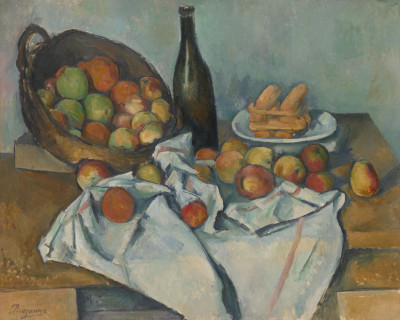
1889–90The Basket of Apples
c.1893Apples and Oranges
c.1899The Large Bathers (Philadelphia)
1900–1906 (Philadelphia Museum dating)Château Noir (MoMA)
1903–04Contents
- A face that changes the direction of the picture
- Stripes, bow and painted wall
- Hortense Fiquet and the limits of biography
- One sitter, several portraits
- How scholars have read the changing likeness
- A changing date and a visible public life
- Returning to the painting
- Annotated details
A face that changes the direction of the picture
The face makes the first claim on our attention. Hortense’s head tilts toward the viewer’s left, while the exposed ear on the right opens a narrow, rosy interval between cheek and hair. The dark mass above the forehead is remarkably compact; below it, locks run down either side of the neck. They do not make a loose, shining halo. Cézanne builds them from deep browns and blue-black passages that sometimes nearly merge with the clothing. A few small warm edges separate hair from skin, then disappear again. The arrangement gives the head both an unexpectedly informal outline and a firm, dark frame.
The face is neither evenly lit nor evenly modelled. Warm pink and red gather on the cheeks and lips, while cooler grey and greenish tones press around the nose, jaw and eyes. The viewer’s left eye sits lower in the sloping arrangement of the face. The gaze seems directed outward, but it does not lock into the steadiness of a commissioned likeness. The mouth is small, its contour assembled from red and brown marks rather than a neat line. A cheek can seem soft from a distance and distinctly worked when seen more closely. The museum describes an air of melancholy or introspection, an impression shaped as much by the colouring and inclination as by the features. [2]
The tilt is especially vivid because the rest of the painting keeps resisting it. A dark vertical band begins near the top behind her head. The blouse descends in broad, nearly upright stripes, and a dark central fastening anchors the torso. The raised collar or bow spreads outward beneath the face. Thus the face seems to move across a structure that otherwise wants to stand still. The shaded strip on the wall also cuts across the background without explaining the room. Cézanne offers just enough surrounding space to set the head against it, then refuses the furniture and domestic details that might turn the portrait into a scene.
Stripes, bow and painted wall
The blouse is more than a costume description. Its pale green-grey bands are irregular in width and value; some are broken by dark paint, and others brighten near the lower edge. At the centre, a column of near-black buttons is visible in the dark fabric. The large knot at the neck spreads horizontally, touching both the striped field and the loose hair. It creates a second, lower focus beneath the face. From there the stripes lead the eye down, while the arms and shoulders push outward beyond the frame. In a relatively small canvas, these oppositions make the bust feel expansive.
One can follow the painter’s decisions through the shifts of paint. In the facial passages, short strokes meet and overlap to make a cheek or brow. The blouse alternates longer, directional marks with blunt dark patches. The background is neither a smooth blank nor a fully described wall: beige, olive and grey touches sit alongside scraped or thin-looking areas, with visible changes of direction. The narrow dark division above the head could be a corner, edge or shadow. Its pictorial work is clear: it makes the head’s slant easier to feel and places the light face against a muted field. The Philadelphia museum likewise draws attention to the contrast between the face’s painted softness, the stripes and the shaded wall. [2]
The portrait shares a still life’s care for intervals, colour and shape. Its sitter nonetheless meets the painter’s and eventually our gaze. John Elderfield, considering Cézanne’s portraits more broadly, argues that repeated subjects became opportunities for comparison and experiment. The stripes organise this canvas while Hortense’s slanting head and outward gaze disturb their regularity. [3]
Annotated Details from Madame Cézanne
The numbered points identify visible features discussed in this article. Return from each detail to the whole composition. Paul Cézanne, Portrait of Madame Cézanne, 1885–86, oil on canvas, Philadelphia Museum of Art (1986-26-1; FWN500). Image source. CC0 / Public domain.
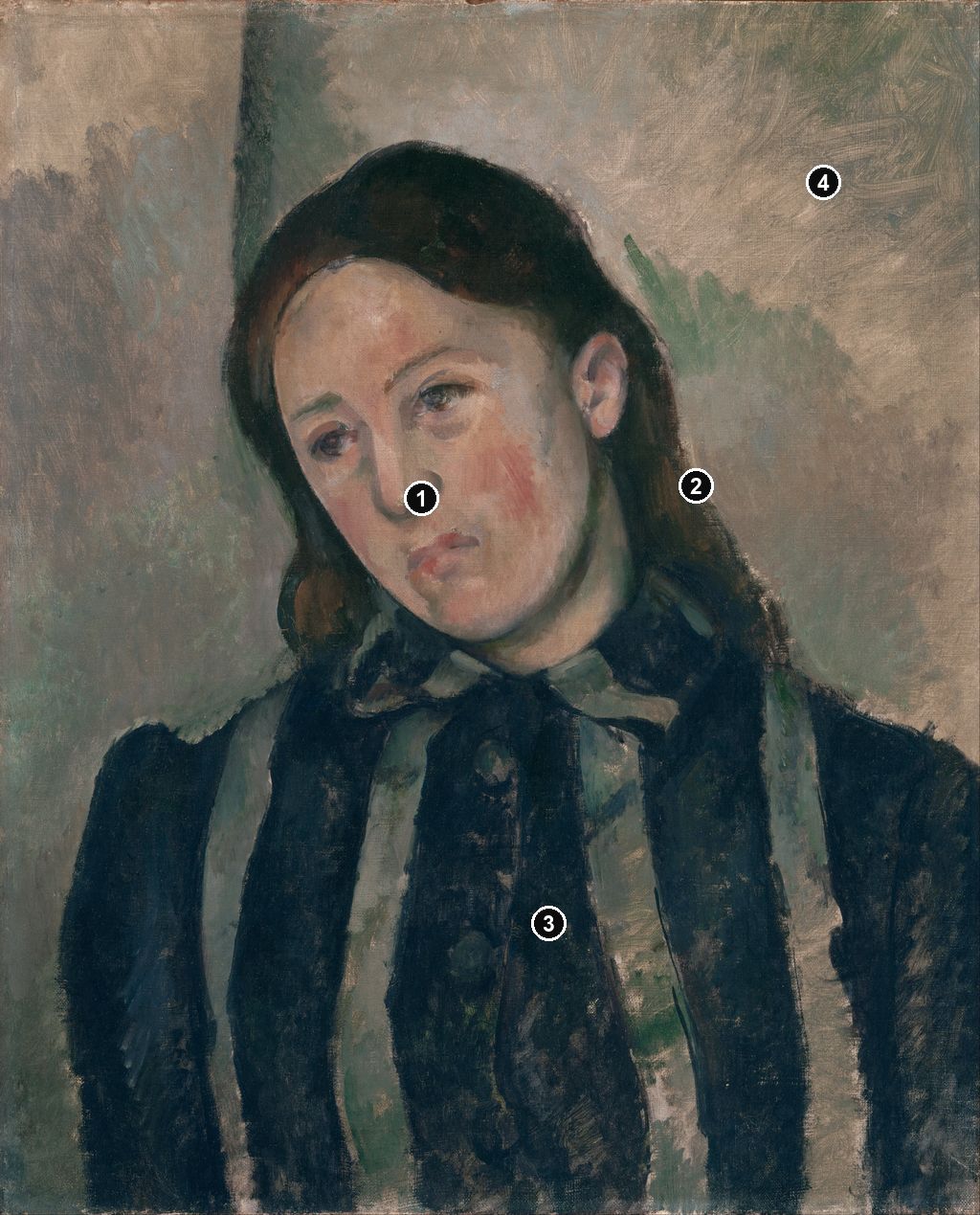
Details from MADAME CÉZANNE
Compare the cropped details with the complete images above. Notice how their colours, shapes and positions contribute to the larger compositions.
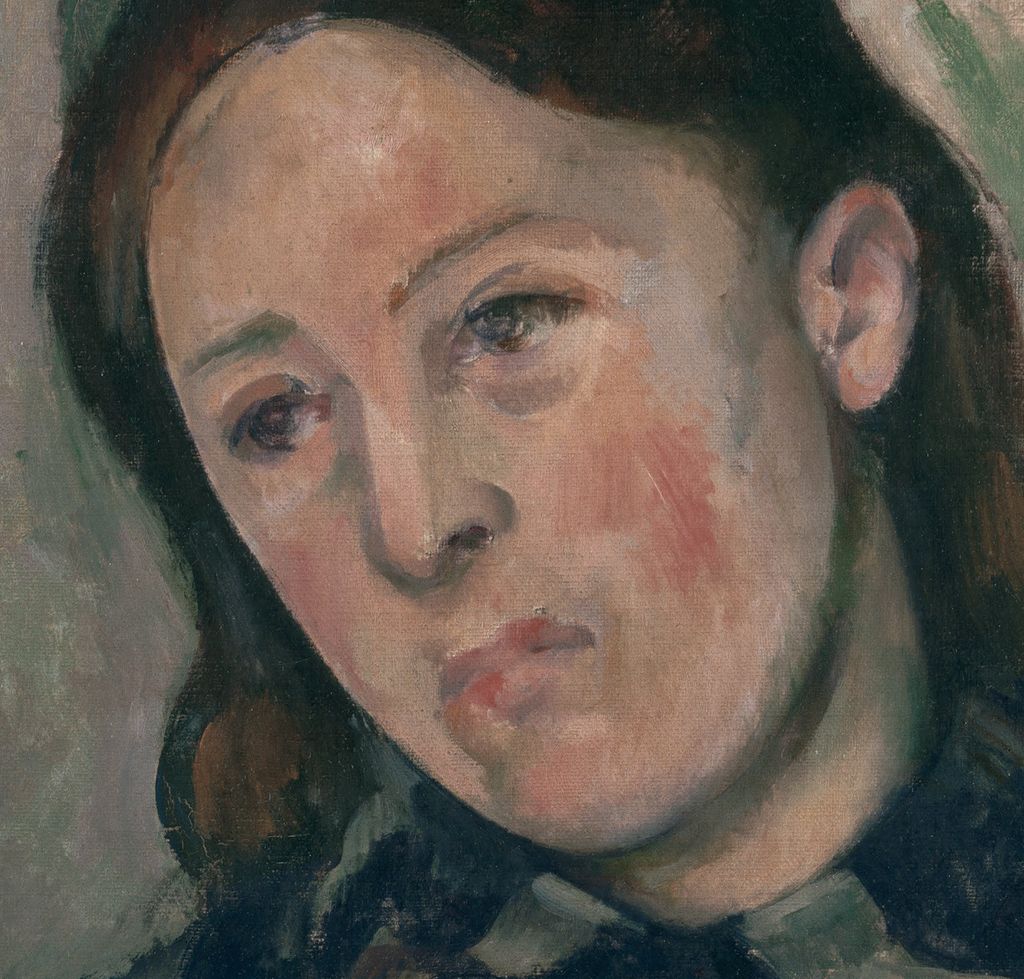
The tilted face
The head tilts to the left of the image. Warm pink and ochre areas sit beside cooler grey-green passages across the face.
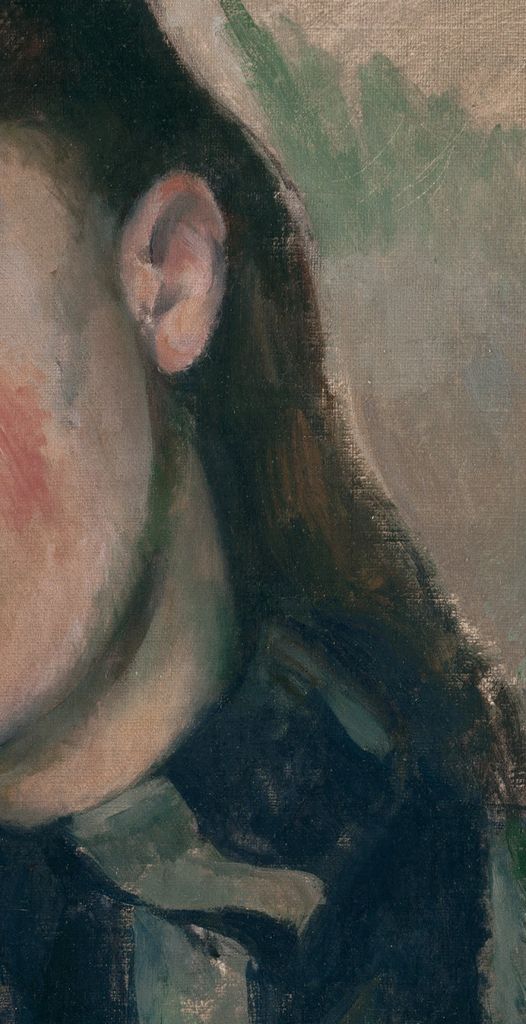
Loosened hair and the visible ear
Dark hair falls beside the visible ear and towards the shoulder. Its edge meets the lighter, unevenly painted background.
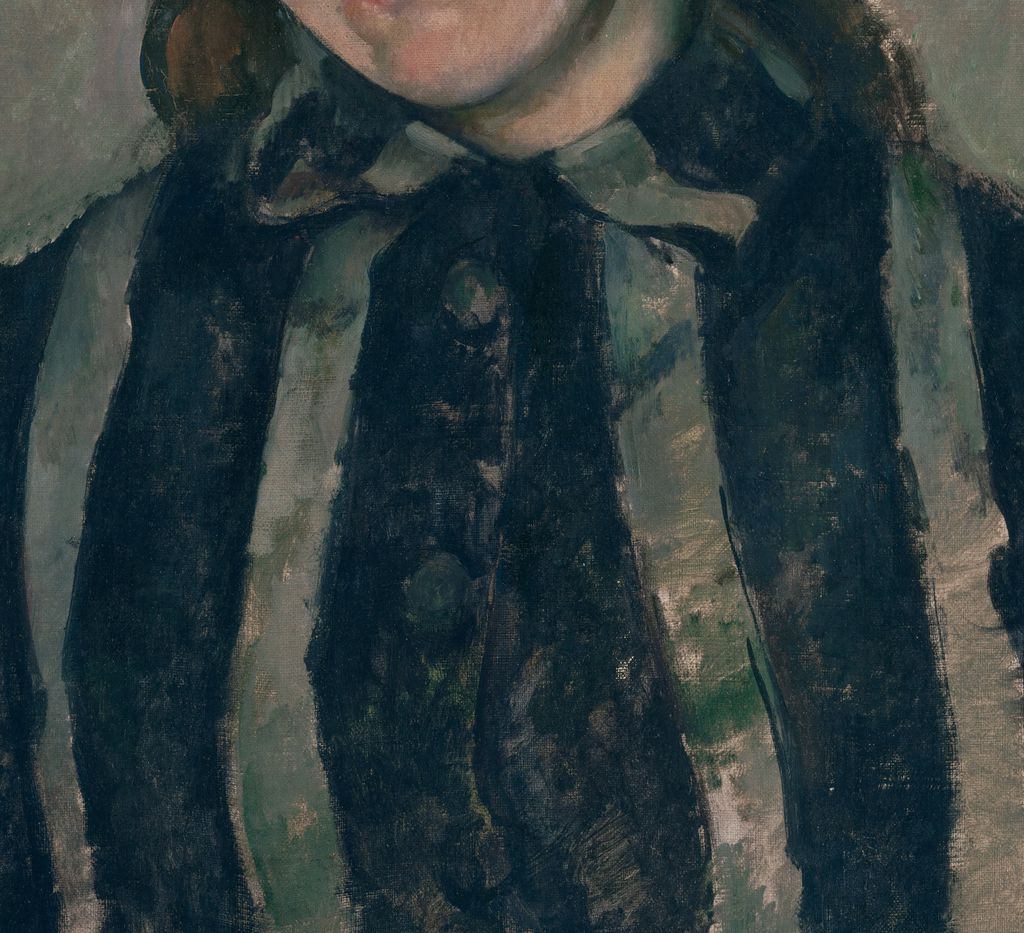
Bow and striped blouse
A dark bow gathers at the neck above broad pale and dark vertical bands. Short changes of colour remain visible within the blouse.
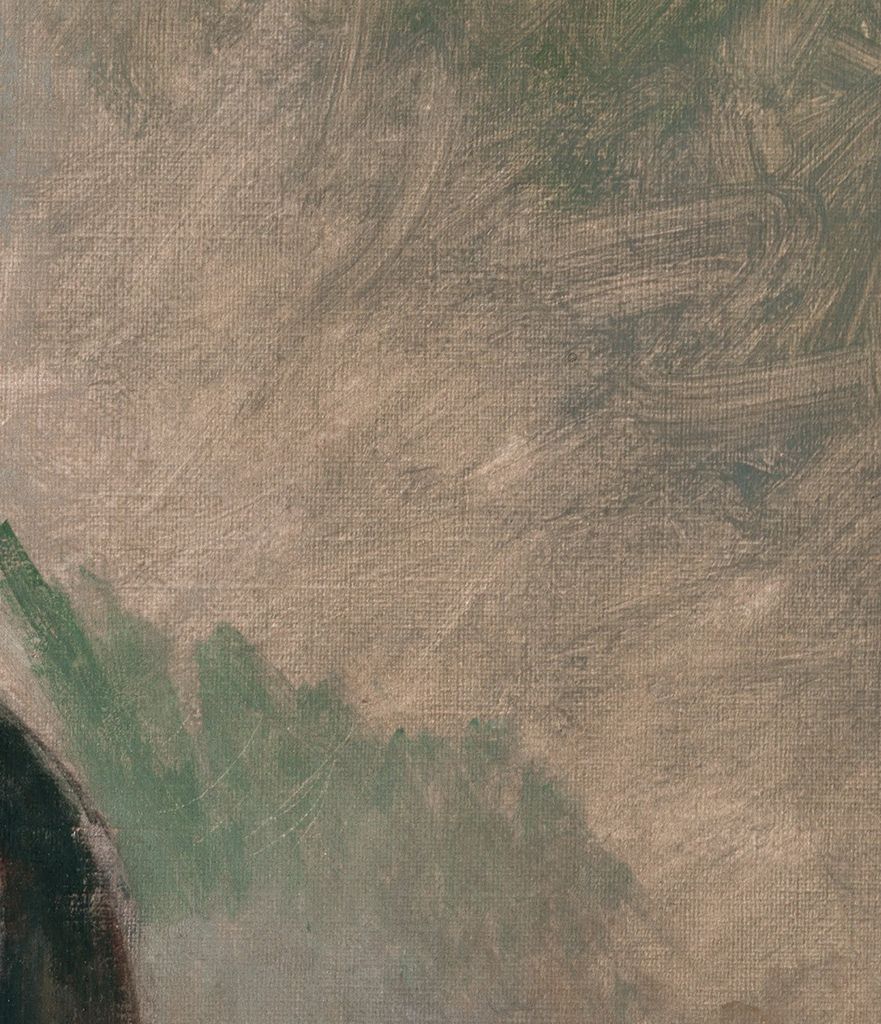
The painted background
Pale grey, beige and green strokes remain visible beside the head. Their directions vary across the open background.
Hortense Fiquet and the limits of biography
Hortense was Cézanne’s most frequently painted model. They met in Paris in 1869; their son Paul was born in 1872, and they married in Aix on 28 April 1886. She appears in as many as twenty-nine painted portraits, as well as drawings. Dita Amory, curator of the Metropolitan Museum of Art’s Madame Cézanne exhibition, notes both the extensive time these works imply in the studio and the scarcity of evidence about the couple’s domestic life. She reports that no letters from Cézanne to Hortense survive. [4] [5]
The marriage falls within the museum’s 1885–86 dating for this painting, though that range does not tell us whether Hortense sat before or after the ceremony. The Philadelphia museum identifies her as model, mother and later wife, and calls attention to the downturned lips and soft gaze. In the canvas, those features belong to a face that Cézanne built slowly through patches of colour and shifting contours. [2]
Hortense’s own words, though scarce, bring her out of the position of silent model. In a letter of 1 August 1890 to Madame Victor Chocquet, she described her husband’s persistence in seeking a landscape motif despite weeks of poor weather during the family’s travels. She was an observer and correspondent, describing a specific shared journey in her own voice. The letter belongs to 1890, whatever date one assigns to the Philadelphia canvas. [6]
The loosened hair can suggest a private moment, particularly beside portraits in which Hortense’s hair is pinned up and her dress carefully contained. Here the intimacy is visual: a close bust, a tilted head, a face large enough to study. The broad blouse and dark hair make a frame within the frame, drawing us repeatedly from fabric back to the face.
One sitter, several portraits
The Philadelphia portrait becomes clearer when placed among Cézanne’s different solutions to the same sitter. In Madame Cézanne in a Red Armchair (Museum of Fine Arts, Boston, FWN 443), Hortense is a seated figure in a blue jacket and striped skirt; the enveloping chair carries a saturated red that has no equivalent here. The full body, hands and large upholstery create a different balance of sitter and setting. The catalogue records the Boston painting as 72.4 × 55.9 centimetres. Its stripes belong to a skirt, not to the close-cropped blouse of FWN 500. The two pictures share a subject and an interest in patterned cloth, yet their scale and pose produce distinct encounters. [7] [8]
The Metropolitan Museum’s Madame Cézanne in a Red Dress is another separate work, FWN 493 and accession 62.45. There the red dress, near-frontal seated figure and much larger canvas, 116.5 × 89.5 centimetres, set Hortense within a more elaborate interior. It belongs to a group of red-dress portraits. By comparison, the Philadelphia canvas concentrates on the head and striped bodice, scarcely allowing the arms or room to develop. One painting asks us to negotiate an entire seated figure and surrounding space; the other holds us near a face and the crosscurrents immediately beneath it. [9] [10]
The Met’s Madame Cézanne in the Conservatory (FWN 509, accession 61.101.2) extends that spatial experiment in yet another direction. Hortense sits amid foliage in a larger, 92.1 × 73 centimetre canvas. The Met dates it 1891; the online catalogue uses 1891–92. Its surroundings are integral to the encounter, while the Philadelphia portrait presses wall and figure together. Susan Sidlauskas, comparing the many Hortense paintings, emphasises that the sitter’s face and bearing vary strikingly from one canvas to another. Her observation helps us see difference before forcing all the paintings into a single supposedly stable likeness or temperament. [11] [12] [8]
Two yellow-chair portraits offer further variations. In the Fondation Beyeler’s FWN 490, Hortense’s pale, unsettled face and the large chair make a striking contrast. At the Art Institute of Chicago, FWN 492 shows her in a red garment with her hands held together in her lap, surrounded by yellow upholstery. Both devote far more space to the seated body and chair than the Philadelphia close bust does. Their different arrangements make the Philadelphia head’s downward tilt and falling hair seem still more emphatic. [8] [13] [14]
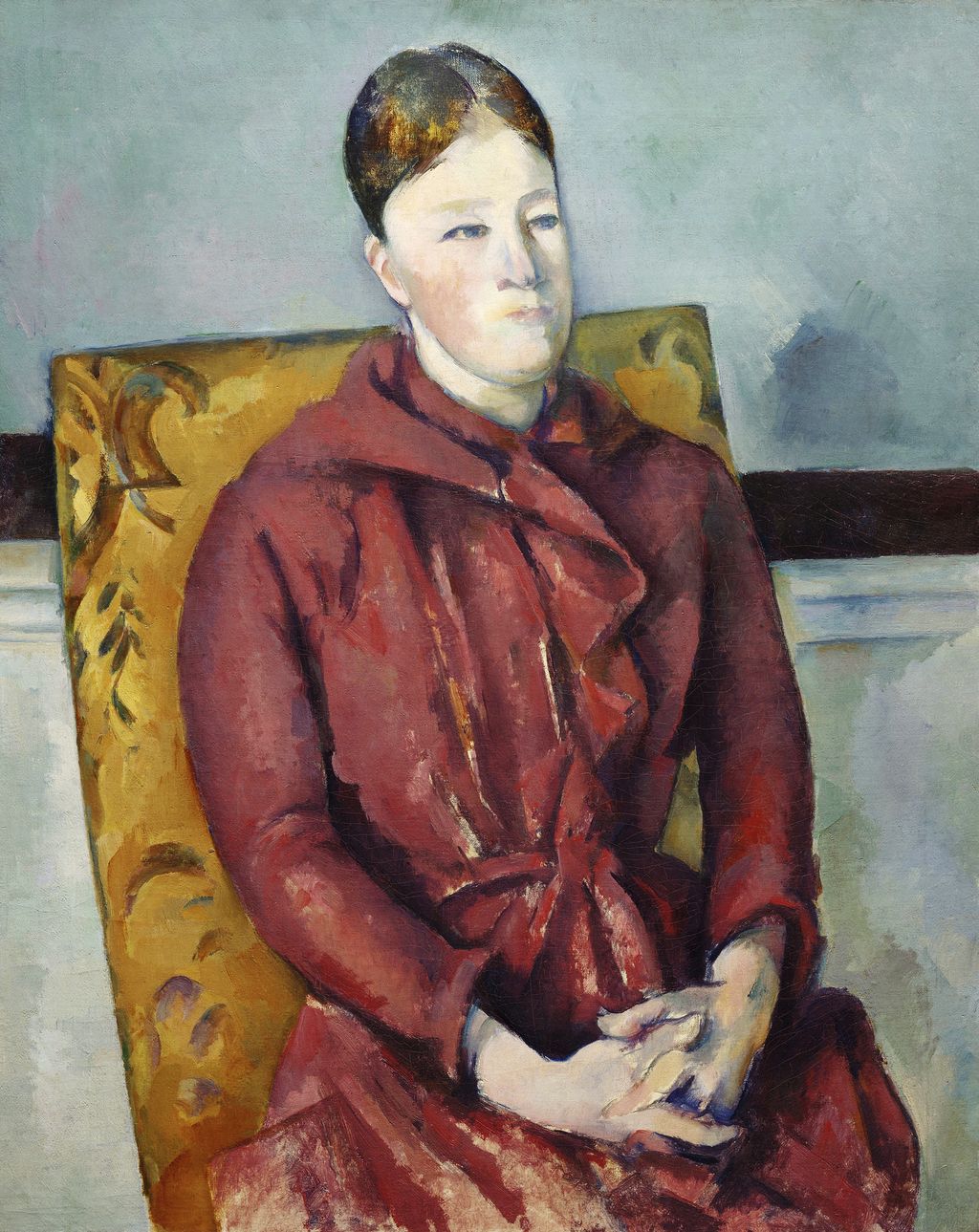
Paul Cézanne, Madame Cézanne in a Yellow Chair, 1888–90, oil on canvas, Art Institute of Chicago (1948.54; FWN492).
Image source
.
CC0 / Public domain
. Proportional web export only; master unchanged.
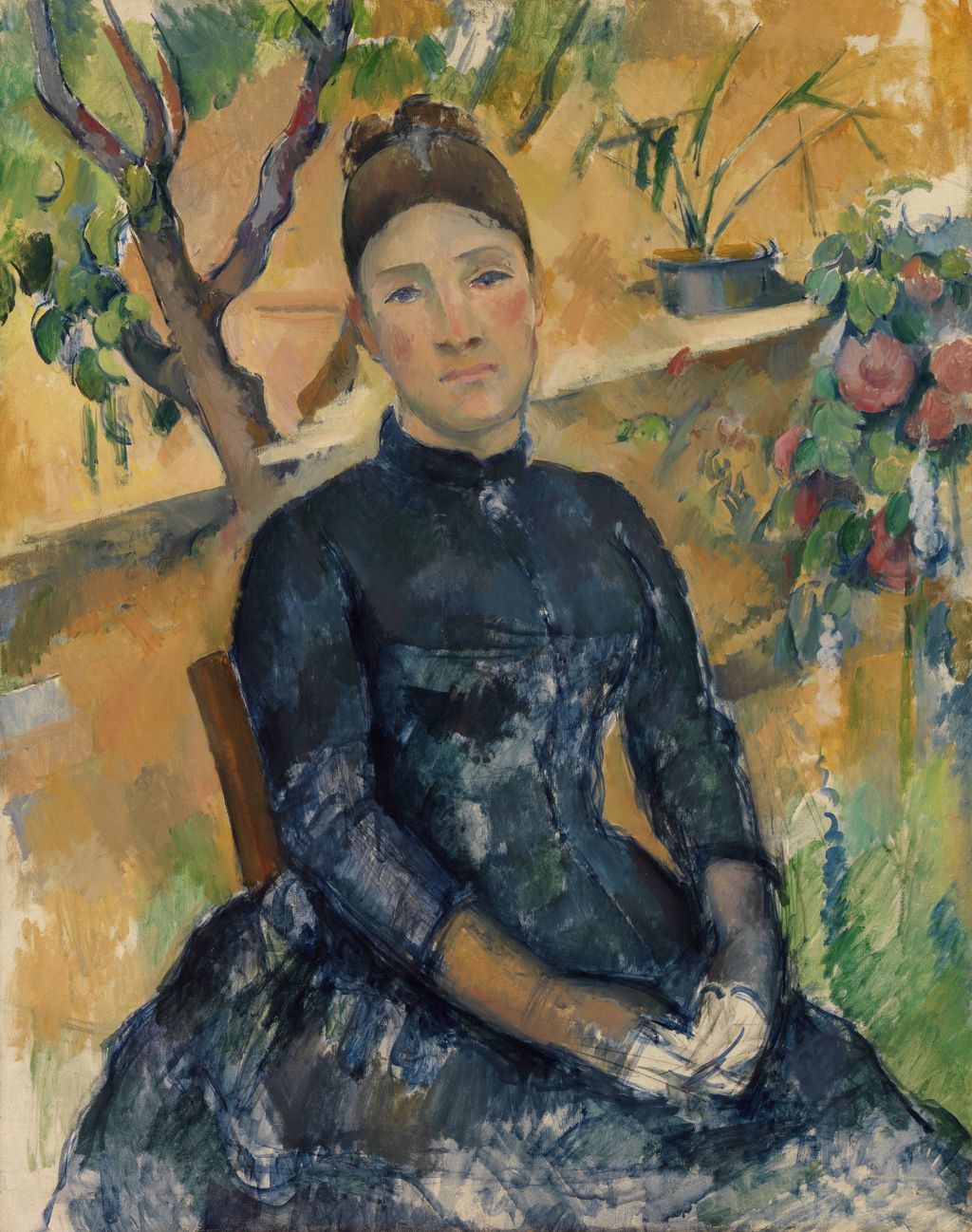
Paul Cézanne, Madame Cézanne in the Conservatory, 1891, oil on canvas, Metropolitan Museum of Art, New York (61.101.2; FWN509).
Image source
.
CC0 / Public domain
. Proportional web export only; master unchanged.
How scholars have read the changing likeness
Sidlauskas places these portraits within a broad question about how a painter represents another person. In the introduction to Cézanne’s Other , she points out that the repeated images of Hortense resist the usual expectation that a portrait series preserve one consistent, recognisable face. She proposes a relation of looking and response between painter and sitter, one in which each painting registers an encounter rather than fixes a final identity. This makes the Philadelphia face particular without separating its features from the colours and marks that produce them. Sidlauskas dated this canvas around 1890–92; the current Philadelphia and catalogue dates are earlier. [8] [1] [2]
Todd Cronan challenges a tendency in Sidlauskas’s account to merge painter, sitter, sensation and painted form too completely. In his 2011 review, he argues that meaningful contact in a portrait also depends on recognising distance: Hortense remains a person distinct from Cézanne and from the colour on the canvas. Here the red cheek is paint, a visible choice, and a representation of another person’s face. The painting asks us to keep all three in view. [15]
Elderfield proposes yet another emphasis. In his introduction to Cézanne Portraits , he describes a concentrated sequence of Hortense pictures in the later 1880s and argues that differences among the versions made portraiture a field of experiment. He finds apparent changes of expression in a group he dates 1885–86, without assigning a single emotion to each face. He also considers how the sitter might have presented herself within the painter’s arrangement. In the Philadelphia canvas, her outward gaze and inclined head give that question a vivid visual form. [3]
A changing date and a visible public life
The disagreement about date is unusually broad. The current online catalogue gives 1885–86, matching the Philadelphia museum. It preserves Rewald’s 1890–92 date, Venturi’s 1883–87 and revised 1883–86 ranges, and other earlier proposals. A photograph recorded in Vollard’s archive carries an annotation by Cézanne’s son giving 1888. None is a date inscribed on the painting. The loosened hair may look later or more informal than other portraits, but hairstyle is an uncertain clock in a group built on variation. The museum and current catalogue favour 1885–86; the older dates show why the painting can occupy different positions in histories of the series. [1]
Its recorded ownership takes the painting through major collections before Philadelphia. The catalogue lists Ambroise Vollard, Gottlieb Friedrich Reber, Paul Rosenberg and Samuel Courtauld; it then records a return through Rosenberg and ownership by Henry P. McIlhenny in Philadelphia. McIlhenny’s collection brought the picture into the museum in 1986. [1]
The exhibition trail shows how its names and dates shifted in public. In London in 1926 it appeared as Portrait de Mme Cézanne , dated 1885. Chicago and Philadelphia exhibitions in 1934 called attention to the striped blouse and dated it around 1880–85. It was included in the major 1995–96 Cézanne exhibition that travelled from Paris to London and Philadelphia; later it appeared in the Met’s Madame Cézanne exhibition of 2014–15 and the Cézanne Portraits tour of 2017–18. Over that long public life, the same small canvas has appeared both among Cézanne’s wider achievements and alongside the other images of Hortense. [1]
Returning to the painting
Start at the dark hair above the forehead, trace it down to the ear, then follow the face as it leans toward the viewer’s left. Drop to the bow and the long blouse stripes; look up again along the shadowed wall. A small change in the angle of a feature alters the face; a pale stripe makes a dark one more emphatic; a brushmark that seems to define a room also dissolves it. The portrait holds these shifts together around Hortense’s steady physical presence.
Cézanne artworks directory
Browse 217 identified works in this researched selection, including paintings, drawings and watercolours. This is a bounded selection, not a complete catalogue of Cézanne’s surviving oeuvre. Unlinked titles have no confirmed article in this collection.
| Name | Date | Medium |
|---|---|---|
| A Head, a Cup, and a Bread Roll | 1891/1894 | Drawing |
| A Man seen from Behind | 1880/1883 | Drawing |
| A Modern Olympia | 1873–74 | Painting |
| A Nude and Foliage | 1879/1882 | Drawing |
| A Smoking Man | 1892–96 (catalogue); c.1890–92 (museum) | Drawing |
| Afternoon in Naples | 1876–77 | Painting |
| An Old Woman with a Rosary | about 1895–96 | Painting |
| Apples and Oranges | c.1899 | Painting |
| Auvers, Panoramic View | 1873–75 | Painting |
| Avenue at Chantilly | 1888 | Painting |
| Banks of the Marne | 1888–94 | Painting |
| Basket | 1877/1900 | Drawing |
| Bather with Outstretched Arms | 1877–78 | Painting |
| Bellows in Front of a Fireplace | 1887/1892 | Drawing |
| Bibémus Quarry | c.1895 | Painting |
| Boy in a Red Vest, Barnes Foundation | 1888–90 | Painting |
| Boy in a Red Vest, MoMA | 1888–90 | Painting |
| Boy in a Red Waistcoat, National Gallery of Art | 1888–90 | Painting |
| Branch in Flower | 1886/1889 | Drawing |
| Carnival Scene | 1885/1888 | Drawing |
| Chair and Dresser | 1880/1883 | Drawing |
| Chateau Noir | 1903–04 | Painting |
| Chestnut Trees and Farm at Jas de Bouffan | c.1885 | Painting |
| Chestnut Trees and Farm at Jas de Bouffan, Pushkin | c.1886 | Painting |
| Chestnut Trees at Jas de Bouffan in Winter | 1885–86 | Painting |
| Château Noir | 1900–04 | Painting |
| Cistern in the Park of Château Noir | c.1900 | Painting |
| Curtain, Jug and Fruit | 1893–94 | Painting |
| Cushion of an Armchair | 1886/1889 | Drawing |
| Draft Letter and Studies of Bathers | c.1878 | Drawing |
| Farmhouse and Chestnut Trees at Jas de Bouffan | 1884–85 | Painting |
| Figure Resting Head on Hand | c. 1889 | Drawing |
| Fireplace Tongs and Poker | 1887/1892 | Drawing |
| Forest Interior, San Francisco | c.1898–99 | Painting |
| Four Bathers | 1888–90 | Painting |
| Fruit and a Jug on a Table | 1893–94 | Painting |
| Gardanne | 1885–86 | Painting |
| Gardanne, Barnes Foundation | c.1885 | Painting |
| Hand and Shoulder of a Boy | c. 1885 | Drawing |
| Harlequin, National Gallery of Art | 1888–90 | Painting |
| Head of a Boy | 1887/1889 | Drawing |
| Head of a Boy Seen from Behind | c. 1885 | Drawing |
| Head of a Young Woman | c. 1880 | Drawing |
| Head of the Artist's Son | 1888/1889 | Drawing |
| Hillside in Provence | c.1890–92 | Painting |
| Horse Chestnut Trees at Jas de Bouffan | c.1885 | Painting |
| House and Farm at the Jas de Bouffan | c.1887 | Painting |
| House in a Park | 1883/1886 | Drawing |
| House in Provence | c.1885 | Painting |
| House of Père Lacroix | 1873 | Painting |
| House Surrounded by Vegetation | 1889/1892 | Drawing |
| Houses in Provence The Riaux Valley near L’Estaque | c.1883 | Painting |
| Jas de Bouffan, the Pool | c.1876 | Painting |
| Kerosene Lamp | 1878/1881 | Drawing |
| L'Estaque, Melting Snow | c.1870 | Painting |
| Lake Annecy | 1896 | Painting |
| Landscape in Provence, Pola Museum | 1879–82 | Painting |
| Landscape Near Aix-en-Provence | 1877/1880 | Drawing |
| Landscape Seen from the Inside of a Cave | 1889/1892 | Drawing |
| Landscape with Poplars | c.1885–87 | Painting |
| Landscape with Trees | 1895/1898 | Drawing |
| Leda and the Swan | c.1880 (possibly later) | Painting |
| Little Girl with a Doll | 1902–04 | Painting |
| Louis Guillaume | 1879–1890 | Painting |
| Madame Cezanne | 1888/1891 | Drawing |
| Madame Cezanne | 1886/1889 | Drawing |
| Madame Cezanne | 1882/1887 | Drawing |
| Madame Cezanne | 1897/1900 | Drawing |
| Madame Cezanne with her Head Lowered | 1893/1896 | Drawing |
| Madame Cézanne in a Red Armchair | c.1877 | Painting |
| Madame Cézanne in a Red Dress, Metropolitan Museum of Art | 1888–90 | Painting |
| Madame Cézanne in a Yellow Chair | 1888–90 | Painting |
| Madame Cézanne in a Yellow Chair, Fondation Beyeler | 1888–90 | Painting |
| Madame Cézanne in the Conservatory | 1891 | Painting |
| Maincy Bridge | 1879–80 | Painting |
| Maison Maria with a View of Château Noir | c.1895 | Painting |
| Man Bending Forward | 1883/1886 | Drawing |
| Man Smoking a Pipe, Pushkin | c.1891, possibly later | Painting |
| Man with a Pipe | 1891–96 | Painting |
| Man with a Pipe, Nelson-Atkins | 1890–92 | Painting |
| Man with a Straw Hat (Gustave Boyer) | c.1871 | Painting |
| Man with Crossed Arms | c.1899 | Painting |
| Man with Pipe, National Gallery of Art | 1892–96 | Painting |
| Mont Sainte-Victoire | c.1902–06 | Painting |
| Mont Sainte-Victoire | 1900–02 | Painting |
| Mont Sainte-Victoire (recto) | c.1895 | Watercolour |
| Mont Sainte-Victoire and the Viaduct of the Arc River Valley | 1882–85 | Painting |
| Mont Sainte-Victoire Seen beyond the Wall of the Jas de Bouffan | c.1885/1888 | Watercolour |
| Mont Sainte-Victoire Seen from Bibémus Quarry | c.1897 | Painting |
| Mont Sainte-Victoire, Barnes Foundation | 1892–95 | Painting |
| Near the Pool at Jas de Bouffan | 1883/1887 | Drawing |
| Pelicans | 1877/1880 | Drawing |
| Peonies | 1890/1893 | Drawing |
| Pierrot and Harlequin | 1888 | Painting |
| Pine Tree | 1882/1885 | Drawing |
| Pont des Trois Sautets | 1906 | Watercolour |
| Poplars | 1879–80 | Painting |
| Portrait of Ambroise Vollard | 1899 | Painting |
| Portrait of Gustave Geffroy | 1895–96 | Painting |
| Portrait of Madame Cezanne with Loosened Hair | 1885–86 | Painting |
| Portrait of the Artist Looking Over His Shoulder | 1883–84 | Painting |
| Portrait of the Gardener Vallier | 1906 | Painting |
| Portrait of Victor Chocquet | 1876–77 | Painting |
| Portrait Of Victor Chocquet Seated | 1877 | Painting |
| Provençal Manor | c.1885 | Painting |
| Pyramid of Skulls | 1898–1900 | Painting |
| Reclining Nude (Leda?) | c.1887 | Painting |
| Scipio | 1866–68 | Painting |
| Seated Man, Oslo | 1898–1900 | Painting |
| Seated Peasant | c.1892–96 | Painting |
| Seated Peasant, Hiroshima | c.1897 | Painting |
| Seated Peasant, Orsay | c.1900 | Painting |
| Self-Portrait | c. 1895 | Drawing |
| Self-Portrait in a Bowler Hat, Ny Carlsberg Glyptotek | 1885–86 | Painting |
| Self-Portrait in a Casquette | c.1875 | Painting |
| Self-Portrait with a Beret | 1898–1900 | Painting |
| Self-Portrait with a Hat, Artizon Museum | c.1890–94 | Painting |
| Self-Portrait with a Pink Background | c.1875 | Painting |
| Self-Portrait with Olive-Coloured Wallpaper | about 1880–81 | Painting |
| Self-Portrait with Palette | 1886–87 | Painting |
| Self-Portrait with White Turban | c.1878–80 | Painting |
| Self-Portrait, c.1895 | c.1895 | Painting |
| Self-Portrait, Pushkin Museum | c.1882 | Painting |
| Spanish Dancers | 1883/1886 | Drawing |
| Still Life with a Curtain | 1892–94 | Painting |
| Still Life with Apples | c.1890 | Painting |
| Still Life with Apples | 1893–94 | Painting |
| Still Life with Apples and a Pot of Primroses | about 1890 | Painting |
| Still Life with Milk Jug and Fruit | c.1900 | Painting |
| Still Life with Open Drawer | 1877–79 | Painting |
| Still Life with Plaster Cupid | about 1894 | Painting |
| Still Life with Skull | 1890–93 | Painting |
| Still Life with Soup Tureen | 1877 | Painting |
| Still Life, Pitcher and Fruit | 1893–94 | Painting |
| Studies Including a Straw Hat | 1895/1898 | Drawing |
| Studies Including Madame Cezanne | 1884/1887 | Drawing |
| Study for "The Judgement of Paris" or "The Amorous Shepherd" | 1883/1886 | Drawing |
| Study for Woman with a Coffee Pot | c.1895 | Painting |
| Study of "The Roman Orator (Germanicus)" | 1883/1886 | Drawing |
| Study of "Venus de Milo" | 1881/1884 | Drawing |
| Study of a Decorative Ornament | 1879/1882 | Drawing |
| Study of a Standing Male Figure after the Antique | c. 1895 | Drawing |
| Study of an Angel in Rubens' "The Prophet Elijah" | 1892/1895 | Drawing |
| Study of Desiderio da Settignano's "Bust of a Child" | c. 1895 | Drawing |
| Study of Houses | 1879/1882 | Drawing |
| Study of Puget's "Hercules Resting" | c. 1879 | Drawing |
| Study of Puget's "Milo of Crotona" | 1895/1898 | Drawing |
| Study of Puget's "Milo of Crotona" | 1880/1883 | Drawing |
| Study of the Allegorical Figure Bellona in Rubens' "The Apotheosis of Henri IV" | 1883/1886 | Drawing |
| Study of the Allegorical Figure Bellona in Rubens' "The Apotheosis of Henri IV" | 1879/1882 | Drawing |
| Study of the Allegorical Figure France in Rubens' "The Exchange of the Two Princesses" | 1882/1885 | Drawing |
| Study of the Allegorical Figure of Health in Rubens' "The Birth of Louis XIII" | 1880/1883 | Drawing |
| Study of the Allegorical Figure of the Genius of Health from Rubens' "The Birth of Louis XIII at Fontainbleau" | 1895/1898 | Drawing |
| Sugar Bowl, Pears and Blue Cup | 1865–66 | Painting |
| The Aqueduct, Pushkin Museum | Dating differs between museum records | Painting |
| The Artist's Father, Reading L'Evenement | autumn 1866 | Painting |
| The Artist's Son | c. 1887 | Drawing |
| The Artist's Son Leaning on his Elbow | c. 1887 | Drawing |
| The Artist's Son Reading | c. 1887 | Drawing |
| The Artist's Son Writing | c. 1887 | Drawing |
| The Artist’s Son, Paul | 1886–87 | Painting |
| The Avenue at Jas de Bouffan | 1868–70 (possibly later) | Painting |
| The Avenue at Jas de Bouffan, Geneva | c.1890 | Painting |
| The Basket of Apples | c.1893 | Painting |
| The Bather, Museum of Modern Art | c.1885 | Painting |
| The Bay of Marseille seen from L'Estaque | c.1885 | Painting |
| The Blue Vase | 1889–90 | Painting |
| The Boy in the Red Vest, Bührle | 1888–90 | Painting |
| The Buffet | 1877–79 | Painting |
| The Card Players, Barnes Foundation | 1890–92 | Painting |
| The Card Players, Courtauld Gallery | 1892–96 | Painting |
| The Card Players, Metropolitan Museum of Art | 1890–92 | Painting |
| The Card Players, Musée d’Orsay | 1893–96 | Painting |
| The Card Players, Qatar | 1892–96 | Painting |
| The Eternal Feminine | c.1877 | Painting |
| The Gardener Vallier | 1906 | Painting |
| The Gardener Vallier, Tate | 1905–06 | Painting |
| The Grounds of the Château Noir | c.1900–04 | Painting |
| The Gulf of Marseille Seen from L’Estaque | c.1885 | Painting |
| The Hanged Man's House in Auvers | c.1873 | Painting |
| The House of Doctor Gachet at Auvers | 1872–73 | Painting |
| The House with the Cracked Walls | 1892–94 | Painting |
| The Kiss of the Muse | c.1860 | Painting |
| The Large Bathers, Barnes Foundation | 1895–1906 | Painting |
| The Large Bathers, National Gallery | 1895–1905 | Painting |
| The Large Bathers, Philadelphia Museum of Art | 1900–06 | Painting |
| The Mill | 1889/1892 | Drawing |
| The Painter’s Father, Louis-Auguste Cézanne | c.1865 | Painting |
| The Peasant | 1890–92 | Painting |
| The Plaster Mill (La Moulin à plâtre) | 1889/1892 | Drawing |
| The Smoker, Hermitage | c.1891 | Painting |
| The Smoker, Mannheim | c.1891 | Painting |
| The Stove in the Studio | c.1865 | Painting |
| The Vase of Tulips | c.1890 | Painting |
| Thistle | 1893/1896 | Drawing |
| Three Heads, One of Madame Cezanne | 1882/1885 | Drawing |
| Three Skulls | c.1898 | Painting |
| Three Skulls on a Patterned Carpet | 1904 | Painting |
| Trees and Shrubs | 1883/1887 | Drawing |
| Turning Road at Montgeroult | 1898 | Painting |
| Two Bathers | 1884/1887 | Drawing |
| Two Heads | 1888 | Drawing |
| Two Heads | 1890/1896 | Drawing |
| Two Heads of Women | 1890/1894 | Drawing |
| Two Studies for "The Judgement of Paris" or "The Amorous Shepherd" | 1883/1886 | Drawing |
| Uncle Dominique in a Tasseled Cap | 1866 | Painting |
| Uncle Dominique in a Turban | 1866–67 | Painting |
| Victor Chocquet and an Angel for "The Apotheosis of Delacroix" | 1878/1880 | Drawing |
| Woman in Blue | c.1904 | Painting |
| Woman Leaning Forward | 1888/1891 | Drawing |
| Woman Leaning Forward | 1890/1894 | Drawing |
| Woman Leaning Forward | 1890/1894 | Drawing |
| Woman with a Coffee Pot | c.1895 | Painting |
| Women Bathers and a Roll of Paper | 1882/1885 | Drawing |
| Young Girl with a Doll | c.1895 | Painting |
| Young Italian Woman at a Table | c.1895–1900 | Painting |
| Young Man and Skull | 1896–98 | Painting |
Frequently Asked Questions
It is the Philadelphia Museum of Art canvas 1986-26-1, catalogue FWN 500: a close bust with loosened dark hair, tilted head and striped blouse. Its French catalogue title is Madame Cezanne aux cheveux dénoués . It is separate from the red-armchair, red-dress, conservatory and yellow-chair portraits. [1]
No. The Philadelphia museum describes an impression of melancholy or introspection, but appearance in a painted portrait cannot establish the sitter’s private feelings or the state of a marriage. Historians have good reason to separate the studio record from the much thinner record of the couple’s domestic life. [2] [4]
Hortense posed for as many as twenty-nine painted portraits. Elderfield sees a concentrated series of comparisons through which Cézanne explored different visual and expressive possibilities. The number and variety show sustained work with this sitter; they do not establish a single reason for every canvas. [4] [3]
Discussion
Look again at the images and ideas explored in Madame Cézanne with Loosened Hair: A Portrait in Tilt and Counterpoint. These editorial prompts invite your observations.
Reader Insights
Begin with the ear and follow the edge of the loosened hair. Where does the boundary between dark hair, blouse and background become hard to trace?
Compare the leaning face with the upright blouse stripes. Which direction feels stronger at first, and does that change as you move your eye around the canvas?
Look at the expression once from a distance and once close enough to see separate colour marks. How much of the mood belongs to the sitter as pictured, and how much arises from the way the face is painted?
Join the Conversation
Share a detail, comparison or question about Madame Cézanne with Loosened Hair: A Portrait in Tilt and Counterpoint below.
References
- Société Paul Cezanne , “Madame Cezanne aux cheveux dénoués,” FWN 500, online catalogue raisonné. View source .
- Philadelphia Museum of Art , “Portrait of Madame Cézanne,” 1885–1886, accession 1986-26-1. View source .
- John Elderfield , “Introduction: The Reading of the Model,” in Cézanne Portraits (2017), pp. 11–39, publisher introduction. View source .
- The Metropolitan Museum of Art , Rachel High, “Interview with Dita Amory, Curator and Co-author of Madame Cézanne ,” 1 December 2014. View source .
- Société Paul Cezanne , “Biographie de Cezanne,” 7 October 2013 (in French). View source .
- Société Paul Cezanne , Philippe Cezanne, “Cezanne en Franche-Comté et en Suisse (en 1890),” 23 November 2013, with transcription of Hortense Fiquet’s letter of 1 August 1890 to Madame Victor Chocquet (in French). View source .
- Société Paul Cezanne , “Madame Cezanne à la jupe rayée,” FWN 443, online catalogue raisonné. View source .
- Susan Sidlauskas , “Introduction: Seeing Cézanne,” in Cézanne’s Other: The Portraits of Hortense (2009), pp. 1–22, publisher introduction. View source .
- Société Paul Cezanne , “Madame Cezanne en robe rouge,” FWN 493, online catalogue raisonné. View source .
- The Metropolitan Museum of Art , “Madame Cézanne in a Red Dress,” accession 62.45. View source .
- The Metropolitan Museum of Art , “Madame Cézanne in the Conservatory,” accession 61.101.2. View source .
- Société Paul Cezanne , “Madame Cezanne dans la serre,” FWN 509, online catalogue raisonné. View source .
- Fondation Beyeler , anniversary exhibition press dossier (2022), p. 4, portrait caption and reproduction for the Beyeler yellow-chair canvas (in French). View source .
- Art Institute of Chicago , “Madame Cézanne in a Yellow Chair,” accession 1948.54, distinct Chicago canvas. View source .
- Todd Cronan , “Mysterious Exchange: On Susan Sidlauskas’s Cézanne’s Other: The Portraits of Hortense ,” nonsite.org , 25 January 2011. View source .
- Le Baiser de la muse, d'après Frillié (FWN 572). View source.
- Louis-Auguste Cezanne, père de l'artiste, lisant L'Événement (FWN 402). View source.
- La Maison du pendu, Auvers-sur-Oise (FWN 81). View source.
- Une moderne Olympia (FWN 628). View source.
- Le Pont de Maincy (FWN 143). View source.
- La Montagne Sainte-Victoire vue de Montbriand (FWN 185). View source.
- Gardanne (vue horizontale) (FWN 224). View source.
- Le Vase bleu (FWN 823). View source.
- Les Joueurs de cartes (FWN 681). View source.
- La Montagne Sainte-Victoire (FWN 296). View source.
- La Corbeille de pommes (FWN 860). View source.
- Pommes et oranges (FWN 871). View source.
- Portrait d'Ambroise Vollard (FWN 531). View source.
- Philadelphia Museum of Art,The Large Bathers,W1937-1-1. View source.
- Château Noir (FWN 360). View source.
- Société Paul Cezanne,online catalogue structure and objectidentification. View source.
- National Gallery of Art,Cezanne Sketchbook,1992.51.9. View source.
- Splash image, Paul Cézanne, Portrait of Madame Cézanne (Madame Cézanne with Loosened Hair), 1885–86 in the current museum and catalogue records, oil on canvas, 61.9 × 51.1 cm, Philadelphia Museum of Art (1986-26-1; FWN 500).