by
Tom Gurney
Tom Gurney BSc (Hons) is an art history expert with over 20 years experience
Published on June 19, 2020 / Updated on October 22, 2026
Email:
tomgurney1@gmail.com
/ Phone:
+44 7429 011000
L’Estaque, Melting Snow: Cézanne’s Red Roofs in Winter: Introduction
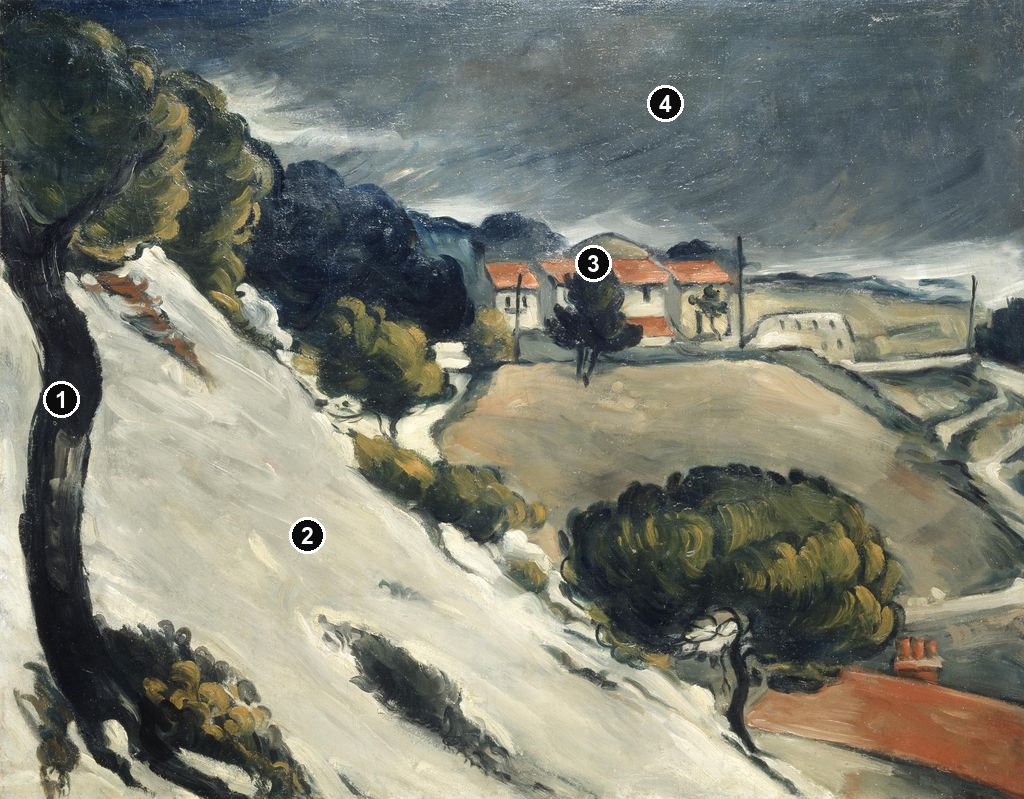
A white slope falls across the foreground of Paul Cézanne’s La Neige fondue à l’Estaque – Les Toits rouges . Behind it, three houses with red tiled roofs hold a narrow strip of ground beneath a heavy sky. The scene is recognisably a place, yet its parts seem to pull in different directions. Snow runs diagonally down the picture; clouds sweep above it; the roofs briefly arrest the eye between the two. The painting is a particularly forceful example of Cézanne making the arrangement of a landscape as consequential as the landscape itself. The current catalogue raisonné identifies this oil on canvas as FWN 53, dates it to about 1870, and records it in a private collection. [1]
Both parts of the French title name visible facts, though neither prepares us for the severity of their setting. A dark tree crowds the left edge; low grey clouds press above the roofs. Pavel Machotka, who studied the site, reads the houses as an anchor in an unsettled composition. [2]
At a Glance
- Artist Paul Cézanne. [1]
- Title La Neige fondue à l’Estaque – Les Toits rouges ; also catalogued under variants including Melting Snow at L’Estaque and The Thaw in L’Estaque or The Red Roofs . [1]
- Date About 1870 in the current catalogue; earlier writers and an archival annotation give other dates. [1]
- Medium and size Oil on canvas, 73 × 92 cm. [1]
- Identification FWN 53; Rewald 157; Venturi 51. [1]
- Current holding Private collection. [1]
This work across Paul Cézanne’s career
The Kiss of the Muse
c.1860The Artist’s Father, Reading L’Événement
autumn 1866The Hanged Man’s House
c.1873A Modern Olympia
1873–74Maincy Bridge
1879–80The Blue Vase
1889–90The Basket of Apples
c.1893Apples and Oranges
c.1899The Large Bathers (Philadelphia)
1900–1906 (Philadelphia Museum dating)Château Noir (MoMA)
1903–04Contents
- A hillside that refuses to settle
- Houses between earth and sky
- An unusually sombre L’Estaque
- The date and the many names of one canvas
- From dealers and collectors to public view
- Looking again
- Annotated details
A hillside that refuses to settle
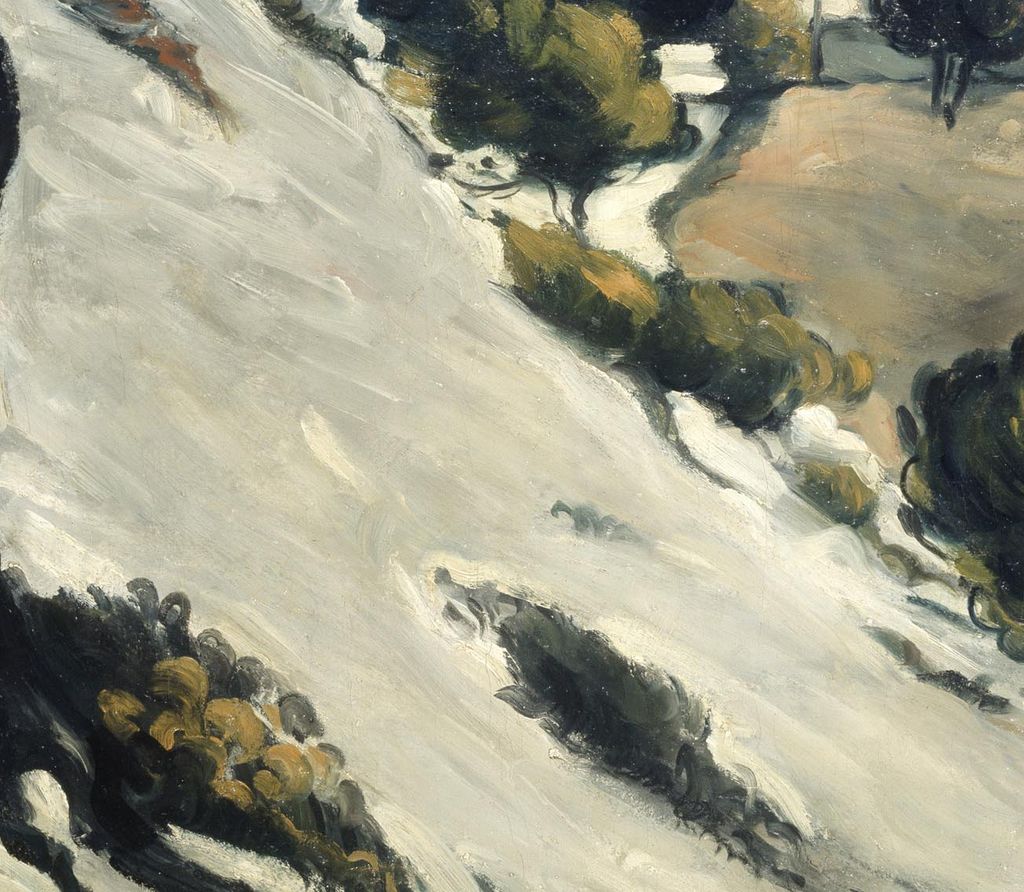
The first movement is downward. From just below the upper left tree, a broad area of white cuts to the lower edge. It is neither an evenly blank field nor a tidy illustration of winter. Brown marks break through near its top; olive and black bushes emerge along its inner boundary; strokes of grey and cream run within the white. The lower part occupies a remarkable share of the canvas. Its width makes the viewer feel the pitch of the ground before there is time to place the houses. The brushwork gives the snow weight and direction, while the interruptions keep it from becoming a decorative band.
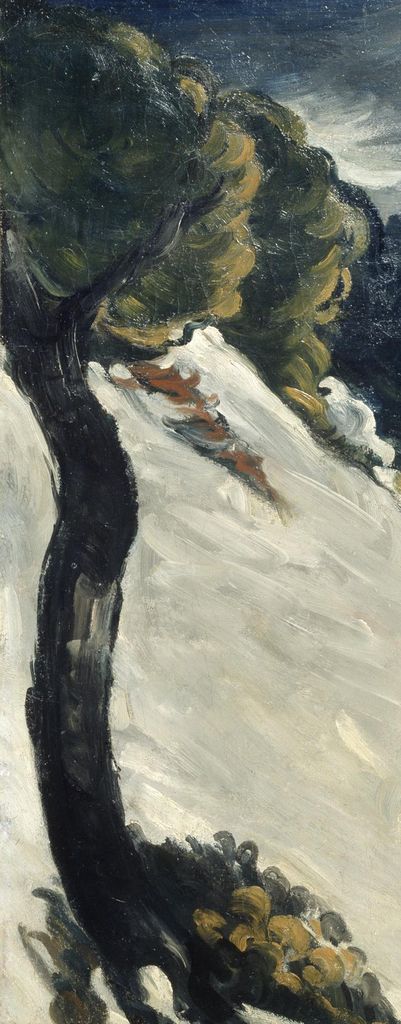
A near-black trunk rises from the lower left and forks into a dense canopy. Its contour presses against the snow, making the white look brighter and the drop more abrupt. Farther into the picture, a chain of dark trees and shrubs runs behind the slope. Cézanne allows their forms to merge in places; individual foliage matters less than the mass they build. The alternation of white, black-green and ochre is unusually stark. Even the small orange-brown marks on the snow slope feel sharp because they are surrounded by such broad pale passages.
The hillside does not simply descend to an open view. A rounded ochre-brown field in the middle ground swells upward toward the houses. To the right, a winding dark-edged route or channel bends down past the field and out of sight. At the bottom edge a cropped red roof enters from the right. These forms prevent the eye from following the snow smoothly away. It slides downward and then encounters another rising surface, a turn, and a near object that has been cut by the frame. The picture is full of crossings rather than a single easy path into depth.
The brushstrokes also change character as the eye moves. Pale paint is dragged broadly across the snow. The foliage collects in curved, repeated marks, especially in the rounded tree at lower right. Shorter passages articulate the buildings and their little dark windows. Above them, long grey sweeps spread through the sky. This variation lets each area retain its material presence: the houses are small in scale but firm in outline, while the snow is physically expansive and the sky seems less fixed.
Houses between earth and sky
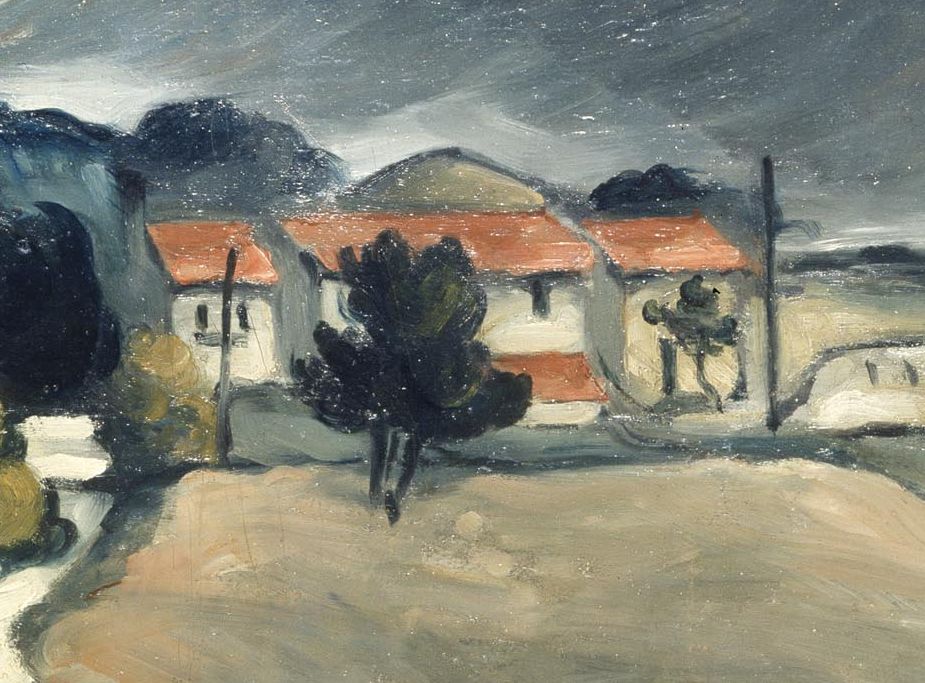
The central buildings provide the painting’s most legible architecture. Light walls, several dark openings and connected terracotta roofs stand just below the horizon line. A dark tree partly covers their fronts. Upright poles or bare trunks near them punctuate the horizontal roofline. A low pale structure extends to their right. The houses are modest, and their placement makes their steadiness striking: they form a narrow red-orange measure between the large descending hillside and the broad storm-coloured sky.
Machotka identifies three houses and a glimpse of a viaduct in the site Cézanne portrayed. In his reading, the painter’s hillside position was precarious, and the houses offered the principal visual anchor. He also notes that the viaduct was narrower at the time and only partly visible behind the snowy slope. The right-hand pale structure in the painting can be read in light of that site account, although its visible shape should not be made to carry more architectural detail than Cézanne provides. Machotka credits Xavier Prati and Georges Reynaud with identifying the location. [2]
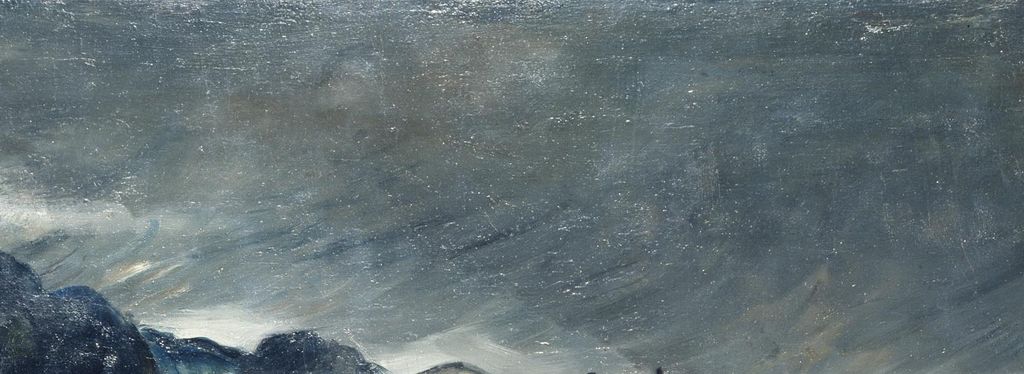
The sky supplies a second directional force. Dark cloud stretches across nearly the full width of the canvas, with slanting lighter streaks around and above the roofs. Its marks sweep in a direction that appears to resist the snow’s descent. Machotka makes this opposition central to his reading: the sky’s movement partly checks the compositional slide, even as the picture retains an uneasy imbalance. [2]
This is why the roofs do more than provide a dash of colour. Their warm orange holds against the yellow-white snow, while the near-black foliage makes them appear isolated. Their repeated low shapes make a pause across the centre of the composition. The distant line of ground to the right is comparatively thin, so the buildings seem to occupy a small foothold between forces much larger than themselves. The contrast gives the work a tension quite unlike a relaxed view of the Mediterranean coast.
Annotated Details from L’Estaque, Melting Snow
The numbered points identify visible features discussed in this article. Return from each detail to the whole composition. Paul Cézanne, L’Estaque, Melting Snow (The Red Roofs), c.1870, oil on canvas, private collection (FWN53). Image source. Public domain.
Details from L’ESTAQUE, MELTING SNOW
Compare the cropped details with the complete images above. Notice how their colours, shapes and positions contribute to the larger compositions.
The dark foreground tree
A heavy trunk rises along the left edge. Rounded dark foliage overlaps the bright snow and the pale streaks in the sky.
The diagonal snow bank
A broad white slope cuts across the foreground. Dark shrubs and warmer exposed patches interrupt its sweeping diagonal.
Red roofs and pale buildings
Orange-red roofs form a band across the middle distance. Pale walls and narrow dark windows sit behind the central tree.
The streaked sky
Long pale and dark strokes sweep across the blue-grey sky. Their direction changes around the dark trees at the horizon.
An unusually sombre L’Estaque
L’Estaque is often associated with Cézanne’s later coastal views, but this painting stays close to a hillside, a few houses and a narrow glimpse of built terrain. Its winter subject and near-black foliage make a different impression from a sunlit panorama of the bay. The title’s “thaw” is visible where earth and vegetation break through the broad white slope.
Machotka calls the picture one of Cézanne’s most unsettled landscapes and suggests that its emotional effect was calculated. He relates its sombre colour and shifting space to other works made around 1870. That mood is his critical reading of the painted arrangement; the houses and viaduct belong to his account of the located site. [2]
Machotka also discusses Paysage provençal — Rochers à l’Estaque — Masures sous la neige (FWN 52). It is another snow landscape, distinct from the present canvas, FWN 53. The comparison places Cézanne’s red-roofed houses among the dark landscapes of the period without losing this painting’s particular structure. [2]
The date and the many names of one canvas
The current catalogue gives the painting a date of about 1870. It also preserves the varied dates assigned in earlier literature: a circa 1865 date appears in a later Vollard account, 1870–71 in a Bührle-related attribution, and “beginning of 1870” in another assessment. A photograph in the Vollard archives was annotated “1868” by Cézanne’s son. That number belongs to the photograph’s later documentation; it is not a date written by Cézanne on the painting. [1]
The titles have varied even more than the proposed dates. The catalogue lists French forms using neige fondue and neige fondante , German titles centred on the red roofs or the thaw, and English “winter landscape” or “melting snow” titles. Vollard’s stockbooks record descriptions combining snow, a red house and dark landscape with roofs in the distance. Those archival phrases show how different observers located the painting’s identifying features. The present catalogue title brings the two strongest features together: the descending snowy ground and the small red roofs above it. [1]
“Winter landscape” frames the canvas by season, “red roofs” by architecture, and “melting snow” by change. The successive names are part of its reception: each singles out a different feature of the same painting.
From dealers and collectors to public view
The documented ownership begins with the dealer Ambroise Vollard. The catalogue then places the canvas with Galerie Bernheim-Jeune on 7 February 1911 and Auguste Pellerin on 8 February, followed by Jean-Victor Pellerin and Wildenstein Galleries. Emil Georg Bührle acquired it on 10 September 1953; it passed to Hortense Anda-Bührle in 1960 and is recorded as in a private collection in 2014. [1]
The work appeared in a succession of public exhibitions. The Pellerins lent it to exhibitions in Brussels in 1935 and Paris in 1936, and it appeared in further European exhibitions before the war. Under Wildenstein it was shown in New York in 1947 and in a 1952 loan exhibition beginning at the Art Institute of Chicago and travelling to the Metropolitan Museum of Art. Later Bührle collection displays took it through Zurich, Berlin, Munich, Edinburgh and London. [1]
The painting appeared in The Passionate Eye , a 1990 Washington exhibition of works from the Bührle collection that travelled to Montreal, Yokohama and London. Most recently in the catalogue’s exhibition list, it was lent from a private collection as number 15 in the Fondation Pierre Gianadda’s Paul Cézanne: le chant de la terre at Martigny, 16 June–19 November 2017. [1]
A painting called La Neige fondante passed in an exchange between Victor Chocquet and Count Armand Doria and was sold at the Doria auction in 1899. The Société Paul Cezanne identifies that work as a Fontainebleau scene, FWN 145 (Rewald 413), distinct from this L’Estaque canvas, FWN 53. [3]
Looking again
The cropped red roof at the lower right makes the viewer aware of a world continuing beyond the frame. Behind it, the dark rounded tree interrupts the painted slope without quite stopping its descent. Those small near forms give the far houses a scale: they occupy only a thin ledge in a landscape dominated by snow, foliage and sky. Cézanne makes the place both specific and precarious through the way these forms meet.
Cézanne artworks directory
Browse 217 identified works in this researched selection, including paintings, drawings and watercolours. This is a bounded selection, not a complete catalogue of Cézanne’s surviving oeuvre. Unlinked titles have no confirmed article in this collection.
| Name | Date | Medium |
|---|---|---|
| A Head, a Cup, and a Bread Roll | 1891/1894 | Drawing |
| A Man seen from Behind | 1880/1883 | Drawing |
| A Modern Olympia | 1873–74 | Painting |
| A Nude and Foliage | 1879/1882 | Drawing |
| A Smoking Man | 1892–96 (catalogue); c.1890–92 (museum) | Drawing |
| Afternoon in Naples | 1876–77 | Painting |
| An Old Woman with a Rosary | about 1895–96 | Painting |
| Apples and Oranges | c.1899 | Painting |
| Auvers, Panoramic View | 1873–75 | Painting |
| Avenue at Chantilly | 1888 | Painting |
| Banks of the Marne | 1888–94 | Painting |
| Basket | 1877/1900 | Drawing |
| Bather with Outstretched Arms | 1877–78 | Painting |
| Bellows in Front of a Fireplace | 1887/1892 | Drawing |
| Bibémus Quarry | c.1895 | Painting |
| Boy in a Red Vest, Barnes Foundation | 1888–90 | Painting |
| Boy in a Red Vest, MoMA | 1888–90 | Painting |
| Boy in a Red Waistcoat, National Gallery of Art | 1888–90 | Painting |
| Branch in Flower | 1886/1889 | Drawing |
| Carnival Scene | 1885/1888 | Drawing |
| Chair and Dresser | 1880/1883 | Drawing |
| Chateau Noir | 1903–04 | Painting |
| Chestnut Trees and Farm at Jas de Bouffan | c.1885 | Painting |
| Chestnut Trees and Farm at Jas de Bouffan, Pushkin | c.1886 | Painting |
| Chestnut Trees at Jas de Bouffan in Winter | 1885–86 | Painting |
| Château Noir | 1900–04 | Painting |
| Cistern in the Park of Château Noir | c.1900 | Painting |
| Curtain, Jug and Fruit | 1893–94 | Painting |
| Cushion of an Armchair | 1886/1889 | Drawing |
| Draft Letter and Studies of Bathers | c.1878 | Drawing |
| Farmhouse and Chestnut Trees at Jas de Bouffan | 1884–85 | Painting |
| Figure Resting Head on Hand | c. 1889 | Drawing |
| Fireplace Tongs and Poker | 1887/1892 | Drawing |
| Forest Interior, San Francisco | c.1898–99 | Painting |
| Four Bathers | 1888–90 | Painting |
| Fruit and a Jug on a Table | 1893–94 | Painting |
| Gardanne | 1885–86 | Painting |
| Gardanne, Barnes Foundation | c.1885 | Painting |
| Hand and Shoulder of a Boy | c. 1885 | Drawing |
| Harlequin, National Gallery of Art | 1888–90 | Painting |
| Head of a Boy | 1887/1889 | Drawing |
| Head of a Boy Seen from Behind | c. 1885 | Drawing |
| Head of a Young Woman | c. 1880 | Drawing |
| Head of the Artist's Son | 1888/1889 | Drawing |
| Hillside in Provence | c.1890–92 | Painting |
| Horse Chestnut Trees at Jas de Bouffan | c.1885 | Painting |
| House and Farm at the Jas de Bouffan | c.1887 | Painting |
| House in a Park | 1883/1886 | Drawing |
| House in Provence | c.1885 | Painting |
| House of Père Lacroix | 1873 | Painting |
| House Surrounded by Vegetation | 1889/1892 | Drawing |
| Houses in Provence The Riaux Valley near L’Estaque | c.1883 | Painting |
| Jas de Bouffan, the Pool | c.1876 | Painting |
| Kerosene Lamp | 1878/1881 | Drawing |
| L'Estaque, Melting Snow | c.1870 | Painting |
| Lake Annecy | 1896 | Painting |
| Landscape in Provence, Pola Museum | 1879–82 | Painting |
| Landscape Near Aix-en-Provence | 1877/1880 | Drawing |
| Landscape Seen from the Inside of a Cave | 1889/1892 | Drawing |
| Landscape with Poplars | c.1885–87 | Painting |
| Landscape with Trees | 1895/1898 | Drawing |
| Leda and the Swan | c.1880 (possibly later) | Painting |
| Little Girl with a Doll | 1902–04 | Painting |
| Louis Guillaume | 1879–1890 | Painting |
| Madame Cezanne | 1888/1891 | Drawing |
| Madame Cezanne | 1886/1889 | Drawing |
| Madame Cezanne | 1882/1887 | Drawing |
| Madame Cezanne | 1897/1900 | Drawing |
| Madame Cezanne with her Head Lowered | 1893/1896 | Drawing |
| Madame Cézanne in a Red Armchair | c.1877 | Painting |
| Madame Cézanne in a Red Dress, Metropolitan Museum of Art | 1888–90 | Painting |
| Madame Cézanne in a Yellow Chair | 1888–90 | Painting |
| Madame Cézanne in a Yellow Chair, Fondation Beyeler | 1888–90 | Painting |
| Madame Cézanne in the Conservatory | 1891 | Painting |
| Maincy Bridge | 1879–80 | Painting |
| Maison Maria with a View of Château Noir | c.1895 | Painting |
| Man Bending Forward | 1883/1886 | Drawing |
| Man Smoking a Pipe, Pushkin | c.1891, possibly later | Painting |
| Man with a Pipe | 1891–96 | Painting |
| Man with a Pipe, Nelson-Atkins | 1890–92 | Painting |
| Man with a Straw Hat (Gustave Boyer) | c.1871 | Painting |
| Man with Crossed Arms | c.1899 | Painting |
| Man with Pipe, National Gallery of Art | 1892–96 | Painting |
| Mont Sainte-Victoire | c.1902–06 | Painting |
| Mont Sainte-Victoire | 1900–02 | Painting |
| Mont Sainte-Victoire (recto) | c.1895 | Watercolour |
| Mont Sainte-Victoire and the Viaduct of the Arc River Valley | 1882–85 | Painting |
| Mont Sainte-Victoire Seen beyond the Wall of the Jas de Bouffan | c.1885/1888 | Watercolour |
| Mont Sainte-Victoire Seen from Bibémus Quarry | c.1897 | Painting |
| Mont Sainte-Victoire, Barnes Foundation | 1892–95 | Painting |
| Near the Pool at Jas de Bouffan | 1883/1887 | Drawing |
| Pelicans | 1877/1880 | Drawing |
| Peonies | 1890/1893 | Drawing |
| Pierrot and Harlequin | 1888 | Painting |
| Pine Tree | 1882/1885 | Drawing |
| Pont des Trois Sautets | 1906 | Watercolour |
| Poplars | 1879–80 | Painting |
| Portrait of Ambroise Vollard | 1899 | Painting |
| Portrait of Gustave Geffroy | 1895–96 | Painting |
| Portrait of Madame Cezanne with Loosened Hair | 1885–86 | Painting |
| Portrait of the Artist Looking Over His Shoulder | 1883–84 | Painting |
| Portrait of the Gardener Vallier | 1906 | Painting |
| Portrait of Victor Chocquet | 1876–77 | Painting |
| Portrait Of Victor Chocquet Seated | 1877 | Painting |
| Provençal Manor | c.1885 | Painting |
| Pyramid of Skulls | 1898–1900 | Painting |
| Reclining Nude (Leda?) | c.1887 | Painting |
| Scipio | 1866–68 | Painting |
| Seated Man, Oslo | 1898–1900 | Painting |
| Seated Peasant | c.1892–96 | Painting |
| Seated Peasant, Hiroshima | c.1897 | Painting |
| Seated Peasant, Orsay | c.1900 | Painting |
| Self-Portrait | c. 1895 | Drawing |
| Self-Portrait in a Bowler Hat, Ny Carlsberg Glyptotek | 1885–86 | Painting |
| Self-Portrait in a Casquette | c.1875 | Painting |
| Self-Portrait with a Beret | 1898–1900 | Painting |
| Self-Portrait with a Hat, Artizon Museum | c.1890–94 | Painting |
| Self-Portrait with a Pink Background | c.1875 | Painting |
| Self-Portrait with Olive-Coloured Wallpaper | about 1880–81 | Painting |
| Self-Portrait with Palette | 1886–87 | Painting |
| Self-Portrait with White Turban | c.1878–80 | Painting |
| Self-Portrait, c.1895 | c.1895 | Painting |
| Self-Portrait, Pushkin Museum | c.1882 | Painting |
| Spanish Dancers | 1883/1886 | Drawing |
| Still Life with a Curtain | 1892–94 | Painting |
| Still Life with Apples | c.1890 | Painting |
| Still Life with Apples | 1893–94 | Painting |
| Still Life with Apples and a Pot of Primroses | about 1890 | Painting |
| Still Life with Milk Jug and Fruit | c.1900 | Painting |
| Still Life with Open Drawer | 1877–79 | Painting |
| Still Life with Plaster Cupid | about 1894 | Painting |
| Still Life with Skull | 1890–93 | Painting |
| Still Life with Soup Tureen | 1877 | Painting |
| Still Life, Pitcher and Fruit | 1893–94 | Painting |
| Studies Including a Straw Hat | 1895/1898 | Drawing |
| Studies Including Madame Cezanne | 1884/1887 | Drawing |
| Study for "The Judgement of Paris" or "The Amorous Shepherd" | 1883/1886 | Drawing |
| Study for Woman with a Coffee Pot | c.1895 | Painting |
| Study of "The Roman Orator (Germanicus)" | 1883/1886 | Drawing |
| Study of "Venus de Milo" | 1881/1884 | Drawing |
| Study of a Decorative Ornament | 1879/1882 | Drawing |
| Study of a Standing Male Figure after the Antique | c. 1895 | Drawing |
| Study of an Angel in Rubens' "The Prophet Elijah" | 1892/1895 | Drawing |
| Study of Desiderio da Settignano's "Bust of a Child" | c. 1895 | Drawing |
| Study of Houses | 1879/1882 | Drawing |
| Study of Puget's "Hercules Resting" | c. 1879 | Drawing |
| Study of Puget's "Milo of Crotona" | 1895/1898 | Drawing |
| Study of Puget's "Milo of Crotona" | 1880/1883 | Drawing |
| Study of the Allegorical Figure Bellona in Rubens' "The Apotheosis of Henri IV" | 1883/1886 | Drawing |
| Study of the Allegorical Figure Bellona in Rubens' "The Apotheosis of Henri IV" | 1879/1882 | Drawing |
| Study of the Allegorical Figure France in Rubens' "The Exchange of the Two Princesses" | 1882/1885 | Drawing |
| Study of the Allegorical Figure of Health in Rubens' "The Birth of Louis XIII" | 1880/1883 | Drawing |
| Study of the Allegorical Figure of the Genius of Health from Rubens' "The Birth of Louis XIII at Fontainbleau" | 1895/1898 | Drawing |
| Sugar Bowl, Pears and Blue Cup | 1865–66 | Painting |
| The Aqueduct, Pushkin Museum | Dating differs between museum records | Painting |
| The Artist's Father, Reading L'Evenement | autumn 1866 | Painting |
| The Artist's Son | c. 1887 | Drawing |
| The Artist's Son Leaning on his Elbow | c. 1887 | Drawing |
| The Artist's Son Reading | c. 1887 | Drawing |
| The Artist's Son Writing | c. 1887 | Drawing |
| The Artist’s Son, Paul | 1886–87 | Painting |
| The Avenue at Jas de Bouffan | 1868–70 (possibly later) | Painting |
| The Avenue at Jas de Bouffan, Geneva | c.1890 | Painting |
| The Basket of Apples | c.1893 | Painting |
| The Bather, Museum of Modern Art | c.1885 | Painting |
| The Bay of Marseille seen from L'Estaque | c.1885 | Painting |
| The Blue Vase | 1889–90 | Painting |
| The Boy in the Red Vest, Bührle | 1888–90 | Painting |
| The Buffet | 1877–79 | Painting |
| The Card Players, Barnes Foundation | 1890–92 | Painting |
| The Card Players, Courtauld Gallery | 1892–96 | Painting |
| The Card Players, Metropolitan Museum of Art | 1890–92 | Painting |
| The Card Players, Musée d’Orsay | 1893–96 | Painting |
| The Card Players, Qatar | 1892–96 | Painting |
| The Eternal Feminine | c.1877 | Painting |
| The Gardener Vallier | 1906 | Painting |
| The Gardener Vallier, Tate | 1905–06 | Painting |
| The Grounds of the Château Noir | c.1900–04 | Painting |
| The Gulf of Marseille Seen from L’Estaque | c.1885 | Painting |
| The Hanged Man's House in Auvers | c.1873 | Painting |
| The House of Doctor Gachet at Auvers | 1872–73 | Painting |
| The House with the Cracked Walls | 1892–94 | Painting |
| The Kiss of the Muse | c.1860 | Painting |
| The Large Bathers, Barnes Foundation | 1895–1906 | Painting |
| The Large Bathers, National Gallery | 1895–1905 | Painting |
| The Large Bathers, Philadelphia Museum of Art | 1900–06 | Painting |
| The Mill | 1889/1892 | Drawing |
| The Painter’s Father, Louis-Auguste Cézanne | c.1865 | Painting |
| The Peasant | 1890–92 | Painting |
| The Plaster Mill (La Moulin à plâtre) | 1889/1892 | Drawing |
| The Smoker, Hermitage | c.1891 | Painting |
| The Smoker, Mannheim | c.1891 | Painting |
| The Stove in the Studio | c.1865 | Painting |
| The Vase of Tulips | c.1890 | Painting |
| Thistle | 1893/1896 | Drawing |
| Three Heads, One of Madame Cezanne | 1882/1885 | Drawing |
| Three Skulls | c.1898 | Painting |
| Three Skulls on a Patterned Carpet | 1904 | Painting |
| Trees and Shrubs | 1883/1887 | Drawing |
| Turning Road at Montgeroult | 1898 | Painting |
| Two Bathers | 1884/1887 | Drawing |
| Two Heads | 1888 | Drawing |
| Two Heads | 1890/1896 | Drawing |
| Two Heads of Women | 1890/1894 | Drawing |
| Two Studies for "The Judgement of Paris" or "The Amorous Shepherd" | 1883/1886 | Drawing |
| Uncle Dominique in a Tasseled Cap | 1866 | Painting |
| Uncle Dominique in a Turban | 1866–67 | Painting |
| Victor Chocquet and an Angel for "The Apotheosis of Delacroix" | 1878/1880 | Drawing |
| Woman in Blue | c.1904 | Painting |
| Woman Leaning Forward | 1888/1891 | Drawing |
| Woman Leaning Forward | 1890/1894 | Drawing |
| Woman Leaning Forward | 1890/1894 | Drawing |
| Woman with a Coffee Pot | c.1895 | Painting |
| Women Bathers and a Roll of Paper | 1882/1885 | Drawing |
| Young Girl with a Doll | c.1895 | Painting |
| Young Italian Woman at a Table | c.1895–1900 | Painting |
| Young Man and Skull | 1896–98 | Painting |
Frequently Asked Questions
The current online catalogue dates La Neige fondue à l’Estaque – Les Toits rouges to about 1870. Earlier attributions vary, and Cézanne’s son wrote “1868” on an archival photograph. That annotation is not an artist’s date on the canvas. [1]
It is recorded in a private collection. The online catalogue lists its earlier owners and temporary exhibitions, including the Fondation Pierre Gianadda display in 2017. [1]
The small central group of red-roofed houses interrupts the long descent of the snowbank. Machotka reads them as the composition’s visual anchor, with sweeping sky strokes partly countering the downward movement below. [2]
Discussion
Look again at the images and ideas explored in L’Estaque, Melting Snow: Cézanne’s Red Roofs in Winter. These editorial prompts invite your observations.
Reader Insights
Begin with the snowbank: how does its diagonal change your sense of where the painted ground is secure?
Then look at the houses. Do their roofs steady the scene, or does their smallness make the surrounding slope and sky feel stronger?
Finally compare the title’s two emphases, thaw and red roofs. Which one leads you into the painting, and which one stays with you after looking?
Join the Conversation
Share a detail, comparison or question about L’Estaque, Melting Snow: Cézanne’s Red Roofs in Winter below.
References
- The Paintings, Watercolors and Drawings of Paul Cezanne: An Online Catalogue Raisonné. “La Neige fondue à l’Estaque – Les Toits rouges,” FWN 53, current online entry. View source .
- Société Paul Cezanne / Pavel Machotka. “L’Estaque et autres paysages provençaux,” posted 1 December 2016; includes Machotka’s commentary adapted from Cézanne: Landscape into Art (2nd ed., 2014). (in French, with an English excerpt). View source .
- Société Paul Cezanne. “1899,” chronology, section for 4–5 May and the Doria sale. (in French). View source .
- Le Baiser de la muse, d'après Frillié (FWN 572). View source.
- Louis-Auguste Cezanne, père de l'artiste, lisant L'Événement (FWN 402). View source.
- La Maison du pendu, Auvers-sur-Oise (FWN 81). View source.
- Une moderne Olympia (FWN 628). View source.
- Le Pont de Maincy (FWN 143). View source.
- La Montagne Sainte-Victoire vue de Montbriand (FWN 185). View source.
- Gardanne (vue horizontale) (FWN 224). View source.
- Le Vase bleu (FWN 823). View source.
- Les Joueurs de cartes (FWN 681). View source.
- La Montagne Sainte-Victoire (FWN 296). View source.
- La Corbeille de pommes (FWN 860). View source.
- Pommes et oranges (FWN 871). View source.
- Portrait d'Ambroise Vollard (FWN 531). View source.
- Philadelphia Museum of Art,The Large Bathers,W1937-1-1. View source.
- Château Noir (FWN 360). View source.
- Société Paul Cezanne,online catalogue structure and objectidentification. View source.
- National Gallery of Art,Cezanne Sketchbook,1992.51.9. View source.
- Splash image, Paul Cézanne, Melting Snow at L’Estaque (The Red Roofs), about 1870, oil on canvas, 73 × 92 cm, private collection (FWN 53).