by
Tom Gurney
Tom Gurney BSc (Hons) is an art history expert with over 20 years experience
Published on June 19, 2020 / Updated on October 22, 2026
Email:
tomgurney1@gmail.com
/ Phone:
+44 7429 011000
Pyramid of Skulls by Paul Cézanne: Introduction
Four skulls fill a small canvas. One rises above the others; two press toward the front edge; a darker fourth is partly concealed behind the skull at lower right. A strip of white cloth beneath them catches the light, while the background closes around the group. Cézanne gives the arrangement the compact shape of a pyramid, but its parts resist becoming a single, settled monument. Each skull has its own angle, openings and passage from light into shadow.
Pyramid of Skulls ( Pyramide de crânes ) is an oil painting that the current Société Paul Cezanne catalogue dates to 1898–1900. It measures only 39 by 46.5 centimetres and is recorded in a private collection. Its subject belongs to a wider group of Cézanne skull pictures, but the four-head arrangement is specific to this canvas. That difference matters: the painting's force comes as much from the way the forms are piled together as from the fact that they are skulls. [1]
At a Glance
- Artist Paul Cézanne. [1]
- Work Pyramid of Skulls ( Pyramide de crânes ), FWN 874; Rewald 822; Venturi 753. [1]
- Date 1898–1900 in the current online catalogue; older dating proposals vary. [1]
- Medium and size Oil on canvas, 39 × 46.5 cm. [1]
- Collection Private collection. [1]
This work across Paul Cézanne’s career
The Kiss of the Muse
c.1860The Artist’s Father, Reading L’Événement
autumn 1866The Hanged Man’s House
c.1873A Modern Olympia
1873–74Maincy Bridge
1879–80The Blue Vase
1889–90The Basket of Apples
c.1893Apples and Oranges
c.1899The Large Bathers (Philadelphia)
1900–1906 (Philadelphia Museum dating)Château Noir (MoMA)
1903–04Contents
- A group held together by pressure
- Colour in a nearly colourless subject
- Mortality and the work of looking
- Which skull painting are we seeing?
- Date, ownership and changing settings
- Annotated details
A group held together by pressure
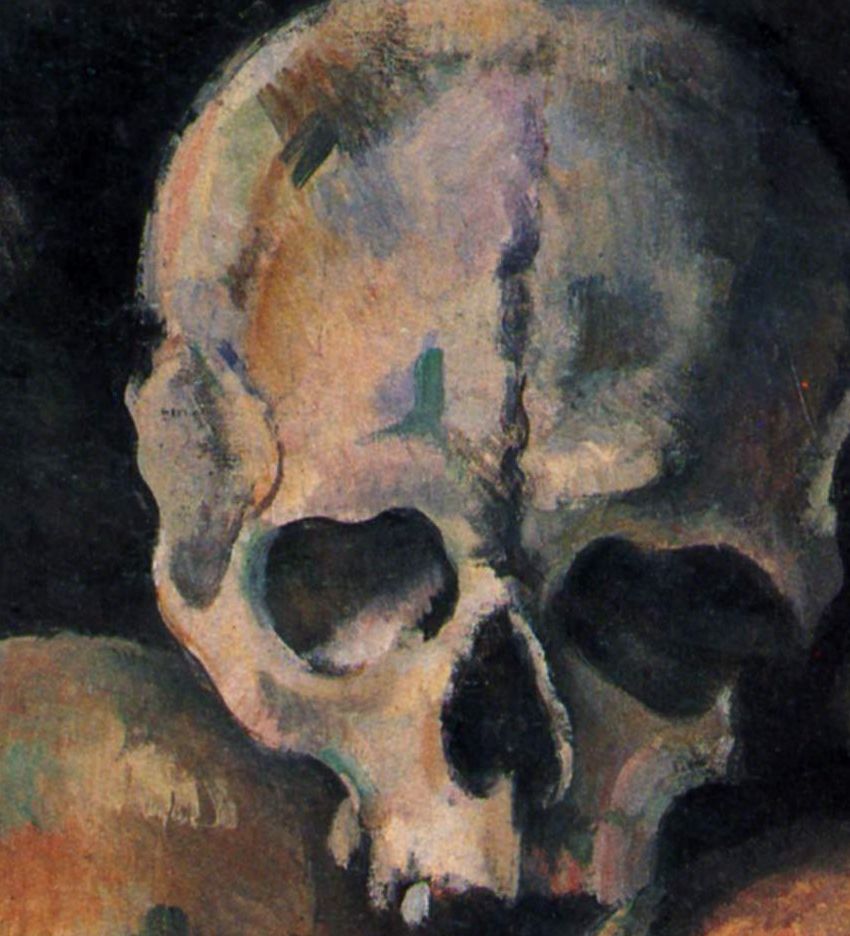
Begin at the top. The highest skull presents its face almost squarely to the viewer. Its pale dome rises into the dark ground, and a broken vertical line of cool grey and blue marks runs down its forehead. The eye sockets are deep, but they are not identical black holes. One opens more broadly; the other is pinched by the surrounding bone and the angle of the head. Beneath them, the nasal opening becomes another dark, irregular shape. It is the most direct face in the painting and the point from which the rest of the cluster seems to descend.
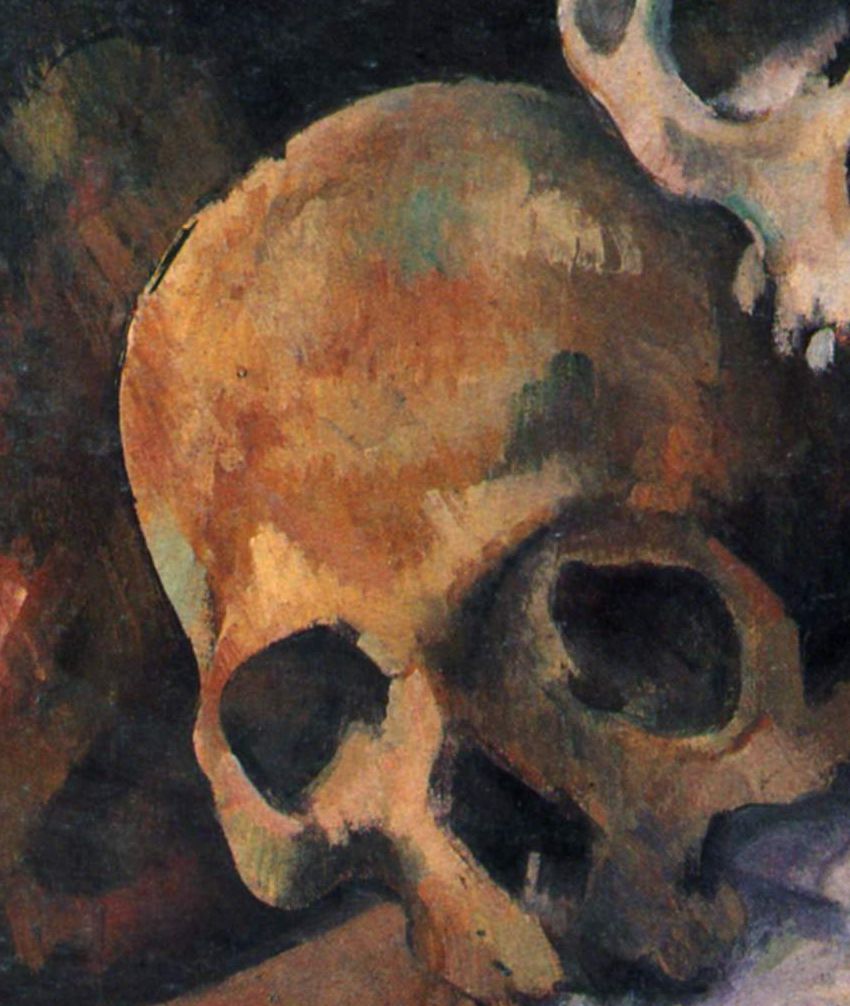
The two skulls below it are larger in the foreground. At left, the cranium tilts and warms to ochre and orange. Its eye openings sit under a sweeping brow; the lower jaw area merges uneasily with the cloth and the neighbouring skull. At right, the nearest head turns slightly. Light strikes its broad brow and cheek, while its sockets and nose make a compact pattern of darkness near the canvas's lower edge. The heads appear close enough to touch, but their contours are neither mechanical outlines nor neatly separated silhouettes. Dark strokes, light patches and overlapping curves make us work out where one ends and another begins.
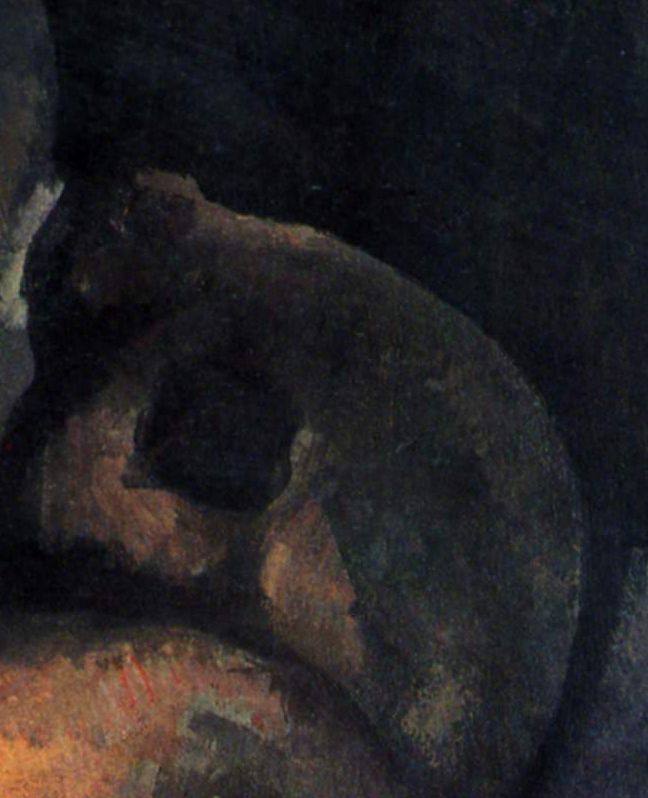
The fourth skull requires a second look. It sits behind the right-hand foreground head, largely in shadow. Its darker surface forms a rounded mass between the top skull and the lower one. Once noticed, it changes the group: what first reads as a triangle of three faces is a more crowded stack with a hidden depth. The title's “pyramid” therefore names a visual arrangement, not a tidy geometric diagram. Cézanne lets one head obscure another while still keeping the rear form present in the composition. Pavel Machotka, writing specifically about this picture, distinguishes its four piled skulls from the three set in a row in a separate painting. [2]
The white cloth is narrow and bright compared with the dark field above. It appears in broken passages at the bottom rather than unfurling as a broad domestic drapery. At the left edge, warm brown and red strokes make a rough boundary beside the group. These margins matter because they stop the skulls from floating in an abstract darkness: there is a support, a cloth and a surrounding space, even if Cézanne gives us little room to explore it. The catalogue identifies a white cloth and a table or wooden surface, but the painting makes those everyday elements subordinate to the heads. [1]
Look back from the cloth to the upper skull and the composition seems almost vertical. Look from one lower skull to the other and it spreads laterally. Those two movements pull against each other. The tallest head gives the pile an apex; the front pair gives it weight and width. The concealed skull complicates both movements by pushing into the space behind. A small canvas can hold considerable tension when its objects sit this close to its edges.
Colour in a nearly colourless subject
A skull might appear to offer Cézanne less colour than fruit or flowers. Machotka makes just this comparison with apples: the cranial surface has little strong colour of its own, so shifts in illumination and angle become especially important. He sees Cézanne modelling the heads through minute changes of hue and plane. [2]
Across the domes, creamy whites turn to yellow, blue-grey and greenish shadow. The upper skull is pale at its crown but darkens sharply around the sockets. The left head holds warmer earth colours; the lower right alternates gold and cooler grey around its hollows. The rear skull sinks into brown-green shadow. These differences let the four forms stay distinct within a tight cluster. They also make a skull seem less like a fixed emblem and more like a surface responding to a particular light and a painter's changing touch.
The openings are crucial to that modelling. A cranium is a rounded solid interrupted by cavities. In this canvas, eye sockets can appear almost as dark disks from a distance, then resolve into uneven hollows bordered by changing colour. The nasal openings make smaller cuts through the faces. Cézanne has to describe bone, missing flesh and the depth behind a hollow on the same shallow canvas. His darks do not merely label the anatomy; they organize how the eye moves among the four skulls.
Machotka goes further, finding different apparent expressions in the eye sockets. He likens the pile to skulls in an ossuary and imagines one head as dominant, others as troubled, pleading or ingenuous. The reading captures the unnerving effect of a dead object seeming to look back at us. Its proposed moods and ossuary remain Machotka's interpretation of the unequal angles and openings. [2]
Annotated Details from Pyramid of Skulls
The numbered points identify visible features discussed in this article. Return from each detail to the whole composition. Paul Cézanne, Pyramid of Skulls Image source. Public domain.
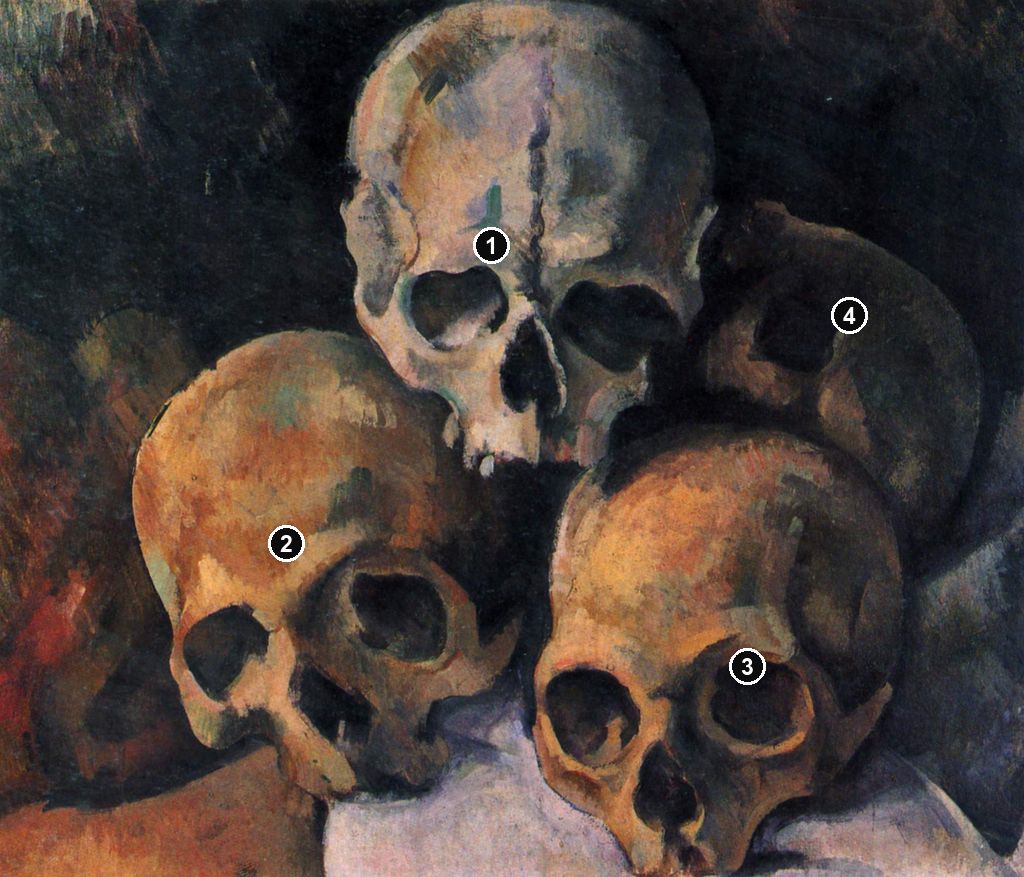
Details from PYRAMID OF SKULLS
Compare the cropped details with the complete images above. Notice how their colours, shapes and positions contribute to the larger compositions.
The pale upper skull
Cool light crosses the upper skull’s forehead while the sockets and nasal cavity remain dark. Its narrow base overlaps the two warmer skulls below.
The warm skull at left
Ochre and reddish strokes model the rounded forehead. The dark eye sockets interrupt that warm surface.
The foreground skull
The lower-right skull turns toward us, with a strong dark contour beside the nasal opening. Its warm colour contrasts with the pale cloth.
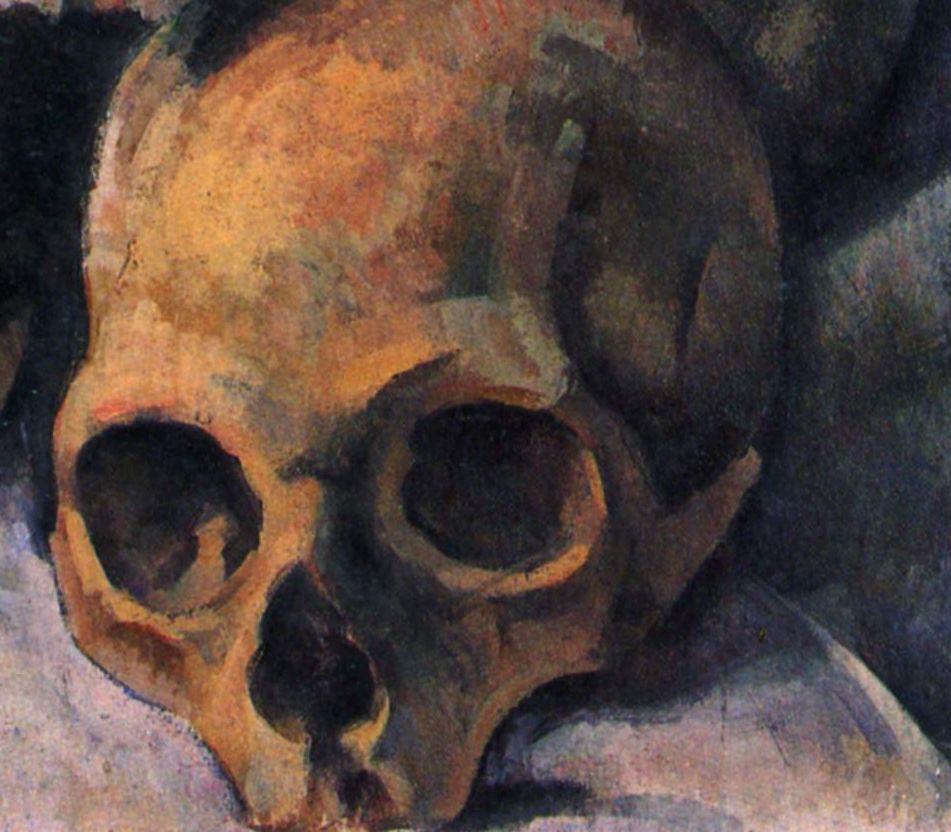
The fourth skull in shadow
A darker fourth skull sits behind the front group at upper right. Its partially hidden outline complicates the apparently simple triangular arrangement.
Mortality and the work of looking
Skulls bring a longstanding vanitas association into still life: they can remind a viewer that bodily life ends. That association is hard to set aside here, especially when there are no flowers, fruit or vessels to soften the encounter. The canvas leaves its personal meaning open. [3]
The painting offers something more complex than a choice between symbolic subject and formal exercise. Its skulls are anatomical remnants with face-like openings. They are also four rounded masses whose positions create a difficult balance. We cannot forget what they are while comparing their colours and contours. Equally, the painting does not stop asking us to compare those contours when we recognize its theme. The structure makes the subject persistent: every attempt to read the cluster as one pyramid runs into four separate faces.
Carol Armstrong's discussion of Cézanne's Three Skulls watercolor at the Art Institute of Chicago provides a useful neighbouring argument. She considers its vanitas charge alongside the way Cézanne groups skulls rather like apples, and argues that their bodily associations trouble the boundary between still life and the human figure. Her immediate example is a later watercolor with graphite and touches of gouache on paper, not this oil. Her account helps explain why the pyramid can feel at once like a composed still life and an encounter with the remains of people. [3]
There is a productive limit to the apple analogy. Both apples and skulls can be repeated, rotated and gathered into a heap. A painter can search for the transition from light to shadow on either kind of rounded object. But apples do not have eye sockets that suggest an absent gaze, or cranial seams that once belonged to a body. The painterly problem and the human association are inseparable in this particular group. Its compactness intensifies both: there is no decorative field or open tabletop to draw attention far away from the heads.
Which skull painting are we seeing?
Cézanne returned to skulls in several distinct works, and titles that differ by only a word can conceal substantial changes. Detroit's Three Skulls ( Trois crânes , FWN 873) is an oil on canvas dated about 1898 by the current catalogue. Its three heads extend horizontally along a pale surface, in a canvas much wider than it is high. The Detroit Institute of Arts identifies it as accession 70.163. Machotka sets it directly beside the pyramid and stresses the shift from a row to a pile. [4] [5] [2]
Another oil, Three Skulls on a Patterned Carpet ( Trois crânes sur un tapis d’Orient , FWN 875), belongs to 1904 and is held by Kunstmuseum Solothurn. Its patterned support and three-head group give it a different pictorial setting. The Chicago Three Skulls discussed by Armstrong is a watercolor, not either of these oils. And the Barnes Foundation's Still Life with Skull (FWN 838, BF329) places a single skull among fruit, a plate and a white cloth. These works can illuminate Cézanne's return to the motif while keeping each object's medium, arrangement and history separate. [6] [3] [7]
The distinction also protects the painting from a misleading piece of arithmetic. Four painted skulls do not prove that Cézanne owned or placed four different physical skulls before him. Machotka says there is no evidence he had more than three skull props, while Paul Smith's later study offers a more specific comparison among depicted and surviving examples. These statements invite careful attention to repeated features, but they do not establish a count of props for this canvas or allow every painted head to be matched to an individual object. [2] [8]
Smith discusses a damaged skull depicted at the back of the Solothurn painting. He notes that its outer cheekbone was missing and, in a note, points to partly unfused cranial sutures visible in Pyramid of Skulls . He dates the pyramid approximately 1901, whereas the current online catalogue gives 1898–1900. His comparison of the partly fused suture is grounded in his examination of a surviving studio skull; it does not identify all four heads in the pyramid. [8] [1]
Such comparisons change the way we look at repetition. A recurring skull could offer fresh relations of angle, light, overlap and scale in each arrangement. In Detroit, a row allows the heads to be compared side by side. In the pyramid, overlap hides much of the rear skull and lifts another above the group. In the Solothurn work, patterned fabric gives a much more active surrounding field. The differences are visible before any theory of why Cézanne returned to the subject.
Date, ownership and changing settings
The current catalogue dates the canvas 1898–1900; it also records Venturi's circa 1900 dating and his revised 1900–04 range. Smith labels it circa 1901. These differences in dating leave its precise place among Cézanne's late skull paintings open. [1] [8]
The ownership record begins with the Paris dealer Ambroise Vollard and then his estate. It next names Walter and Marianne Feilchenfeldt in Zurich, with 1953 in parentheses, before listing a private collection. The catalogue does not publish every transaction or identify the current private owner. A Vollard archival photograph, numbered 354 in the catalogue, is another trace of the work's early documentation. [1]
Exhibitions give a fuller view of its public life. The catalogue lists it in Zurich in 1950 under the German title Totenköpfe and again in 1956. It appeared at Recklinghausen in 1957 and in Vienna and Aix-en-Provence in 1961. These records show a privately held canvas appearing in several institutional settings under different titles. [1]
Later exhibitions placed the work in sharply different frames. The painting appeared in MoMA's Cézanne: The Late Work in New York in 1977–78, then in the exhibition's Houston and Paris presentations in 1978. The Phillips Collection and Museum of Fine Arts, Boston, included it in Impressionist Still Life in 2001–02, where its subject could be considered within a broader genre. The National Gallery of Art's Cézanne in Provence showed it in Washington in 2006, and subsequent listings include Louisiana Museum of Modern Art in 2008, the Philadelphia Museum of Art in 2009 and Karlsruhe in 2017–18. [1]
Cézanne artworks directory
Browse 217 identified works in this researched selection, including paintings, drawings and watercolours. This is a bounded selection, not a complete catalogue of Cézanne’s surviving oeuvre. Unlinked titles have no confirmed article in this collection.
| Name | Date | Medium |
|---|---|---|
| A Head, a Cup, and a Bread Roll | 1891/1894 | Drawing |
| A Man seen from Behind | 1880/1883 | Drawing |
| A Modern Olympia | 1873–74 | Painting |
| A Nude and Foliage | 1879/1882 | Drawing |
| A Smoking Man | 1892–96 (catalogue); c.1890–92 (museum) | Drawing |
| Afternoon in Naples | 1876–77 | Painting |
| An Old Woman with a Rosary | about 1895–96 | Painting |
| Apples and Oranges | c.1899 | Painting |
| Auvers, Panoramic View | 1873–75 | Painting |
| Avenue at Chantilly | 1888 | Painting |
| Banks of the Marne | 1888–94 | Painting |
| Basket | 1877/1900 | Drawing |
| Bather with Outstretched Arms | 1877–78 | Painting |
| Bellows in Front of a Fireplace | 1887/1892 | Drawing |
| Bibémus Quarry | c.1895 | Painting |
| Boy in a Red Vest, Barnes Foundation | 1888–90 | Painting |
| Boy in a Red Vest, MoMA | 1888–90 | Painting |
| Boy in a Red Waistcoat, National Gallery of Art | 1888–90 | Painting |
| Branch in Flower | 1886/1889 | Drawing |
| Carnival Scene | 1885/1888 | Drawing |
| Chair and Dresser | 1880/1883 | Drawing |
| Chateau Noir | 1903–04 | Painting |
| Chestnut Trees and Farm at Jas de Bouffan | c.1885 | Painting |
| Chestnut Trees and Farm at Jas de Bouffan, Pushkin | c.1886 | Painting |
| Chestnut Trees at Jas de Bouffan in Winter | 1885–86 | Painting |
| Château Noir | 1900–04 | Painting |
| Cistern in the Park of Château Noir | c.1900 | Painting |
| Curtain, Jug and Fruit | 1893–94 | Painting |
| Cushion of an Armchair | 1886/1889 | Drawing |
| Draft Letter and Studies of Bathers | c.1878 | Drawing |
| Farmhouse and Chestnut Trees at Jas de Bouffan | 1884–85 | Painting |
| Figure Resting Head on Hand | c. 1889 | Drawing |
| Fireplace Tongs and Poker | 1887/1892 | Drawing |
| Forest Interior, San Francisco | c.1898–99 | Painting |
| Four Bathers | 1888–90 | Painting |
| Fruit and a Jug on a Table | 1893–94 | Painting |
| Gardanne | 1885–86 | Painting |
| Gardanne, Barnes Foundation | c.1885 | Painting |
| Hand and Shoulder of a Boy | c. 1885 | Drawing |
| Harlequin, National Gallery of Art | 1888–90 | Painting |
| Head of a Boy | 1887/1889 | Drawing |
| Head of a Boy Seen from Behind | c. 1885 | Drawing |
| Head of a Young Woman | c. 1880 | Drawing |
| Head of the Artist's Son | 1888/1889 | Drawing |
| Hillside in Provence | c.1890–92 | Painting |
| Horse Chestnut Trees at Jas de Bouffan | c.1885 | Painting |
| House and Farm at the Jas de Bouffan | c.1887 | Painting |
| House in a Park | 1883/1886 | Drawing |
| House in Provence | c.1885 | Painting |
| House of Père Lacroix | 1873 | Painting |
| House Surrounded by Vegetation | 1889/1892 | Drawing |
| Houses in Provence The Riaux Valley near L’Estaque | c.1883 | Painting |
| Jas de Bouffan, the Pool | c.1876 | Painting |
| Kerosene Lamp | 1878/1881 | Drawing |
| L'Estaque, Melting Snow | c.1870 | Painting |
| Lake Annecy | 1896 | Painting |
| Landscape in Provence, Pola Museum | 1879–82 | Painting |
| Landscape Near Aix-en-Provence | 1877/1880 | Drawing |
| Landscape Seen from the Inside of a Cave | 1889/1892 | Drawing |
| Landscape with Poplars | c.1885–87 | Painting |
| Landscape with Trees | 1895/1898 | Drawing |
| Leda and the Swan | c.1880 (possibly later) | Painting |
| Little Girl with a Doll | 1902–04 | Painting |
| Louis Guillaume | 1879–1890 | Painting |
| Madame Cezanne | 1888/1891 | Drawing |
| Madame Cezanne | 1886/1889 | Drawing |
| Madame Cezanne | 1882/1887 | Drawing |
| Madame Cezanne | 1897/1900 | Drawing |
| Madame Cezanne with her Head Lowered | 1893/1896 | Drawing |
| Madame Cézanne in a Red Armchair | c.1877 | Painting |
| Madame Cézanne in a Red Dress, Metropolitan Museum of Art | 1888–90 | Painting |
| Madame Cézanne in a Yellow Chair | 1888–90 | Painting |
| Madame Cézanne in a Yellow Chair, Fondation Beyeler | 1888–90 | Painting |
| Madame Cézanne in the Conservatory | 1891 | Painting |
| Maincy Bridge | 1879–80 | Painting |
| Maison Maria with a View of Château Noir | c.1895 | Painting |
| Man Bending Forward | 1883/1886 | Drawing |
| Man Smoking a Pipe, Pushkin | c.1891, possibly later | Painting |
| Man with a Pipe | 1891–96 | Painting |
| Man with a Pipe, Nelson-Atkins | 1890–92 | Painting |
| Man with a Straw Hat (Gustave Boyer) | c.1871 | Painting |
| Man with Crossed Arms | c.1899 | Painting |
| Man with Pipe, National Gallery of Art | 1892–96 | Painting |
| Mont Sainte-Victoire | c.1902–06 | Painting |
| Mont Sainte-Victoire | 1900–02 | Painting |
| Mont Sainte-Victoire (recto) | c.1895 | Watercolour |
| Mont Sainte-Victoire and the Viaduct of the Arc River Valley | 1882–85 | Painting |
| Mont Sainte-Victoire Seen beyond the Wall of the Jas de Bouffan | c.1885/1888 | Watercolour |
| Mont Sainte-Victoire Seen from Bibémus Quarry | c.1897 | Painting |
| Mont Sainte-Victoire, Barnes Foundation | 1892–95 | Painting |
| Near the Pool at Jas de Bouffan | 1883/1887 | Drawing |
| Pelicans | 1877/1880 | Drawing |
| Peonies | 1890/1893 | Drawing |
| Pierrot and Harlequin | 1888 | Painting |
| Pine Tree | 1882/1885 | Drawing |
| Pont des Trois Sautets | 1906 | Watercolour |
| Poplars | 1879–80 | Painting |
| Portrait of Ambroise Vollard | 1899 | Painting |
| Portrait of Gustave Geffroy | 1895–96 | Painting |
| Portrait of Madame Cezanne with Loosened Hair | 1885–86 | Painting |
| Portrait of the Artist Looking Over His Shoulder | 1883–84 | Painting |
| Portrait of the Gardener Vallier | 1906 | Painting |
| Portrait of Victor Chocquet | 1876–77 | Painting |
| Portrait Of Victor Chocquet Seated | 1877 | Painting |
| Provençal Manor | c.1885 | Painting |
| Pyramid of Skulls | 1898–1900 | Painting |
| Reclining Nude (Leda?) | c.1887 | Painting |
| Scipio | 1866–68 | Painting |
| Seated Man, Oslo | 1898–1900 | Painting |
| Seated Peasant | c.1892–96 | Painting |
| Seated Peasant, Hiroshima | c.1897 | Painting |
| Seated Peasant, Orsay | c.1900 | Painting |
| Self-Portrait | c. 1895 | Drawing |
| Self-Portrait in a Bowler Hat, Ny Carlsberg Glyptotek | 1885–86 | Painting |
| Self-Portrait in a Casquette | c.1875 | Painting |
| Self-Portrait with a Beret | 1898–1900 | Painting |
| Self-Portrait with a Hat, Artizon Museum | c.1890–94 | Painting |
| Self-Portrait with a Pink Background | c.1875 | Painting |
| Self-Portrait with Olive-Coloured Wallpaper | about 1880–81 | Painting |
| Self-Portrait with Palette | 1886–87 | Painting |
| Self-Portrait with White Turban | c.1878–80 | Painting |
| Self-Portrait, c.1895 | c.1895 | Painting |
| Self-Portrait, Pushkin Museum | c.1882 | Painting |
| Spanish Dancers | 1883/1886 | Drawing |
| Still Life with a Curtain | 1892–94 | Painting |
| Still Life with Apples | c.1890 | Painting |
| Still Life with Apples | 1893–94 | Painting |
| Still Life with Apples and a Pot of Primroses | about 1890 | Painting |
| Still Life with Milk Jug and Fruit | c.1900 | Painting |
| Still Life with Open Drawer | 1877–79 | Painting |
| Still Life with Plaster Cupid | about 1894 | Painting |
| Still Life with Skull | 1890–93 | Painting |
| Still Life with Soup Tureen | 1877 | Painting |
| Still Life, Pitcher and Fruit | 1893–94 | Painting |
| Studies Including a Straw Hat | 1895/1898 | Drawing |
| Studies Including Madame Cezanne | 1884/1887 | Drawing |
| Study for "The Judgement of Paris" or "The Amorous Shepherd" | 1883/1886 | Drawing |
| Study for Woman with a Coffee Pot | c.1895 | Painting |
| Study of "The Roman Orator (Germanicus)" | 1883/1886 | Drawing |
| Study of "Venus de Milo" | 1881/1884 | Drawing |
| Study of a Decorative Ornament | 1879/1882 | Drawing |
| Study of a Standing Male Figure after the Antique | c. 1895 | Drawing |
| Study of an Angel in Rubens' "The Prophet Elijah" | 1892/1895 | Drawing |
| Study of Desiderio da Settignano's "Bust of a Child" | c. 1895 | Drawing |
| Study of Houses | 1879/1882 | Drawing |
| Study of Puget's "Hercules Resting" | c. 1879 | Drawing |
| Study of Puget's "Milo of Crotona" | 1895/1898 | Drawing |
| Study of Puget's "Milo of Crotona" | 1880/1883 | Drawing |
| Study of the Allegorical Figure Bellona in Rubens' "The Apotheosis of Henri IV" | 1883/1886 | Drawing |
| Study of the Allegorical Figure Bellona in Rubens' "The Apotheosis of Henri IV" | 1879/1882 | Drawing |
| Study of the Allegorical Figure France in Rubens' "The Exchange of the Two Princesses" | 1882/1885 | Drawing |
| Study of the Allegorical Figure of Health in Rubens' "The Birth of Louis XIII" | 1880/1883 | Drawing |
| Study of the Allegorical Figure of the Genius of Health from Rubens' "The Birth of Louis XIII at Fontainbleau" | 1895/1898 | Drawing |
| Sugar Bowl, Pears and Blue Cup | 1865–66 | Painting |
| The Aqueduct, Pushkin Museum | Dating differs between museum records | Painting |
| The Artist's Father, Reading L'Evenement | autumn 1866 | Painting |
| The Artist's Son | c. 1887 | Drawing |
| The Artist's Son Leaning on his Elbow | c. 1887 | Drawing |
| The Artist's Son Reading | c. 1887 | Drawing |
| The Artist's Son Writing | c. 1887 | Drawing |
| The Artist’s Son, Paul | 1886–87 | Painting |
| The Avenue at Jas de Bouffan | 1868–70 (possibly later) | Painting |
| The Avenue at Jas de Bouffan, Geneva | c.1890 | Painting |
| The Basket of Apples | c.1893 | Painting |
| The Bather, Museum of Modern Art | c.1885 | Painting |
| The Bay of Marseille seen from L'Estaque | c.1885 | Painting |
| The Blue Vase | 1889–90 | Painting |
| The Boy in the Red Vest, Bührle | 1888–90 | Painting |
| The Buffet | 1877–79 | Painting |
| The Card Players, Barnes Foundation | 1890–92 | Painting |
| The Card Players, Courtauld Gallery | 1892–96 | Painting |
| The Card Players, Metropolitan Museum of Art | 1890–92 | Painting |
| The Card Players, Musée d’Orsay | 1893–96 | Painting |
| The Card Players, Qatar | 1892–96 | Painting |
| The Eternal Feminine | c.1877 | Painting |
| The Gardener Vallier | 1906 | Painting |
| The Gardener Vallier, Tate | 1905–06 | Painting |
| The Grounds of the Château Noir | c.1900–04 | Painting |
| The Gulf of Marseille Seen from L’Estaque | c.1885 | Painting |
| The Hanged Man's House in Auvers | c.1873 | Painting |
| The House of Doctor Gachet at Auvers | 1872–73 | Painting |
| The House with the Cracked Walls | 1892–94 | Painting |
| The Kiss of the Muse | c.1860 | Painting |
| The Large Bathers, Barnes Foundation | 1895–1906 | Painting |
| The Large Bathers, National Gallery | 1895–1905 | Painting |
| The Large Bathers, Philadelphia Museum of Art | 1900–06 | Painting |
| The Mill | 1889/1892 | Drawing |
| The Painter’s Father, Louis-Auguste Cézanne | c.1865 | Painting |
| The Peasant | 1890–92 | Painting |
| The Plaster Mill (La Moulin à plâtre) | 1889/1892 | Drawing |
| The Smoker, Hermitage | c.1891 | Painting |
| The Smoker, Mannheim | c.1891 | Painting |
| The Stove in the Studio | c.1865 | Painting |
| The Vase of Tulips | c.1890 | Painting |
| Thistle | 1893/1896 | Drawing |
| Three Heads, One of Madame Cezanne | 1882/1885 | Drawing |
| Three Skulls | c.1898 | Painting |
| Three Skulls on a Patterned Carpet | 1904 | Painting |
| Trees and Shrubs | 1883/1887 | Drawing |
| Turning Road at Montgeroult | 1898 | Painting |
| Two Bathers | 1884/1887 | Drawing |
| Two Heads | 1888 | Drawing |
| Two Heads | 1890/1896 | Drawing |
| Two Heads of Women | 1890/1894 | Drawing |
| Two Studies for "The Judgement of Paris" or "The Amorous Shepherd" | 1883/1886 | Drawing |
| Uncle Dominique in a Tasseled Cap | 1866 | Painting |
| Uncle Dominique in a Turban | 1866–67 | Painting |
| Victor Chocquet and an Angel for "The Apotheosis of Delacroix" | 1878/1880 | Drawing |
| Woman in Blue | c.1904 | Painting |
| Woman Leaning Forward | 1888/1891 | Drawing |
| Woman Leaning Forward | 1890/1894 | Drawing |
| Woman Leaning Forward | 1890/1894 | Drawing |
| Woman with a Coffee Pot | c.1895 | Painting |
| Women Bathers and a Roll of Paper | 1882/1885 | Drawing |
| Young Girl with a Doll | c.1895 | Painting |
| Young Italian Woman at a Table | c.1895–1900 | Painting |
| Young Man and Skull | 1896–98 | Painting |
Frequently Asked Questions
Four are painted: an upper skull, two prominent lower skulls and a darker one partly hidden at the right rear. This is the four-head arrangement Machotka distinguishes from Detroit's three-head row. The painted count does not establish how many physical skulls Cézanne used. [2]
The catalogue records Pyramid of Skulls in a private collection. It gives no current owner's name or public location. Its exhibition history shows that a privately owned painting has nevertheless been displayed in many museums. [1]
Discussion
Look again at the images and ideas explored in Pyramid of Skulls by Paul Cézanne. These editorial prompts invite your observations.
Reader Insights
Find the darker fourth skull before looking at the other three again. Does its partial concealment make the arrangement feel deeper or more crowded?
Compare the upper skull's pale forehead with the warmer lower heads. Which changes of colour make each cranium seem solid?
Think of the skulls as a still-life group, then as remnants of bodies. Where does the painting make it hardest to keep those readings apart?
Join the Conversation
Share a detail, comparison or question about Pyramid of Skulls by Paul Cézanne below.
References
- Société Paul Cezanne , “Pyramide de crânes, 1898–1900 (FWN 874),” The Paintings, Watercolors and Drawings of Paul Cezanne: An Online Catalogue Raisonné , current online entry. View source .
- Société Paul Cezanne , Pavel Machotka, “Pyramide de crânes, 1898–1900 (R822 – FWN874),” 21 January 2017 (in French). View source .
- J. Paul Getty Museum , Carol Armstrong, Cézanne in the Studio: Still Life in Watercolors (2004), pp. 64–66, discussing the separate Chicago watercolor Three Skulls . View source .
- Société Paul Cezanne , “Trois crânes, c. 1898 (FWN 873),” The Paintings, Watercolors and Drawings of Paul Cezanne: An Online Catalogue Raisonné , current online entry. View source .
- Detroit Institute of Arts , “The Three Skulls,” institutional collection record, accession 70.163. View source .
- Société Paul Cezanne , “Trois crânes sur un tapis d’Orient, 1904 (FWN 875),” The Paintings, Watercolors and Drawings of Paul Cezanne: An Online Catalogue Raisonné , current online entry. View source .
- Société Paul Cezanne , “Nature morte au crâne, 1890–93 (FWN 838),” The Paintings, Watercolors and Drawings of Paul Cezanne: An Online Catalogue Raisonné , current online entry. View source .
- The Burlington Magazine , Paul Smith, “Looking Slowly with Cezanne,” vol. 165, no. 1441 (April 2023), pp. 422–435, especially pp. 434–435 and note 55. View source .
- Le Baiser de la muse, d'après Frillié (FWN 572). View source.
- Louis-Auguste Cezanne, père de l'artiste, lisant L'Événement (FWN 402). View source.
- La Maison du pendu, Auvers-sur-Oise (FWN 81). View source.
- Une moderne Olympia (FWN 628). View source.
- Le Pont de Maincy (FWN 143). View source.
- La Montagne Sainte-Victoire vue de Montbriand (FWN 185). View source.
- Gardanne (vue horizontale) (FWN 224). View source.
- Le Vase bleu (FWN 823). View source.
- Les Joueurs de cartes (FWN 681). View source.
- La Montagne Sainte-Victoire (FWN 296). View source.
- La Corbeille de pommes (FWN 860). View source.
- Pommes et oranges (FWN 871). View source.
- Portrait d'Ambroise Vollard (FWN 531). View source.
- Philadelphia Museum of Art,The Large Bathers,W1937-1-1. View source.
- Château Noir (FWN 360). View source.
- Société Paul Cezanne,online catalogue structure and objectidentification. View source.
- National Gallery of Art,Cezanne Sketchbook,1992.51.9. View source.
- Splash image, Paul Cézanne, Pyramid of Skulls (Pyramide de crânes), 1898–1900, oil on canvas, 39 × 46.5 cm, private collection (FWN 874).