 by
Tom Gurney
Tom Gurney BSc (Hons) is an art history expert with over 20 years experience
Published on June 19, 2020 / Updated on October 22, 2026
Email:
tomgurney1@gmail.com
/ Phone:
+44 7429 011000
Study of Puget’s “Hercules Resting” by Paul Cézanne: Introduction
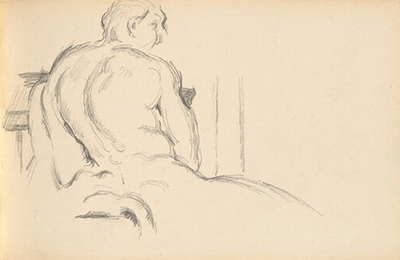
A great stone hero occupies surprisingly little of Cézanne’s page. Seen from behind, Hercules turns his head over one shoulder while his back, arm and long thigh form a loose chain of curves. Much of the sheet remains open. The drawing asks us to follow how a few graphite lines can make a heavy, seated body felt without enclosing every part of it.
The National Gallery of Art dates this particular study to about 1879 and identifies its model as Pierre Puget’s Hercules Resting . [1]
The title points to a famous sculpture, yet the pleasure of the drawing lies in the distance between marble and pencil. Cézanne selects a rear view that makes the hero less an emblem of strength than a problem of turning surfaces. One can see the shifts of attention in the drawing itself: the shoulder is reinforced, the lower body thins into the paper, and the head remains small and alert above a broad back.
At a Glance
- Artist Paul Cézanne. [1]
- Date c. 1879. [1]
- Medium Graphite on wove paper. [1]
- Size 15.2 × 23.7 cm (6 × 9 5/16 in.). [1]
- Collection National Gallery of Art, Washington; accession 1992.51.9.mm. [1]
- Original sculpture Pierre Puget, Hercule au repos , 1661–62, marble, Musée du Louvre. [2]
This work across Paul Cézanne’s career
The Kiss of the Muse
c.1860The Artist’s Father, Reading L’Événement
autumn 1866The Hanged Man’s House
c.1873A Modern Olympia
1873–74Maincy Bridge
1879–80The Blue Vase
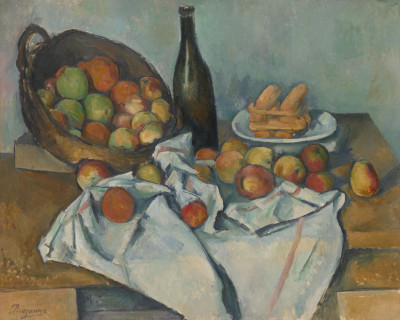
1889–90The Basket of Apples
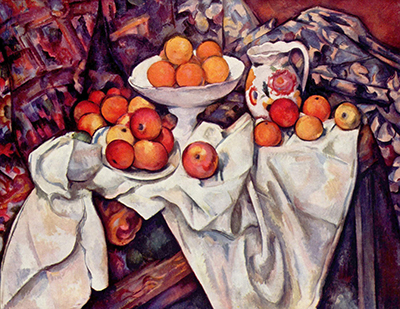
c.1893Apples and Oranges
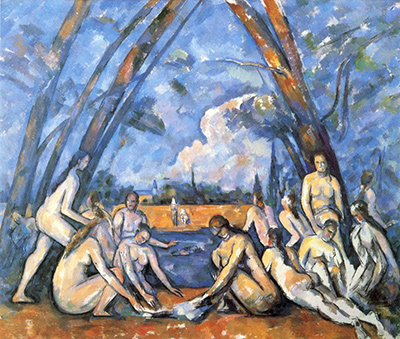
c.1899The Large Bathers (Philadelphia)
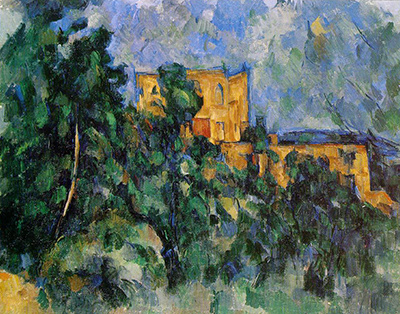
1900–1906 (Philadelphia Museum dating)Château Noir (MoMA)
1903–04Contents
- A body built from changes of direction
- The marble behind the sketch
- One page in a long sketchbook practice
- Date, collection and what the drawing can tell us
A body built from changes of direction
Begin at the head. Its profile is lightly suggested: a nose, a cheek, and locks of hair that curl against the otherwise bare paper. The face is turned away from the body’s main direction, giving the pose a twist before the eye reaches the torso. From the neck, a long contour descends around the left side of the back; another line travels across the shoulder and down the right arm. The figure feels broad because these strokes sit far apart, even though there is little shading between them.
Several lines take another run at the same form. The outer shoulder has a hesitant, doubled edge. Curved strokes inside the back do not simply fill in an anatomical diagram; they make its surface seem to roll away from us. Near the waist, the marks crowd and change direction. That compressed knot makes a hinge between the upright torso and the reclining lower body. The eye has to complete the turn where the graphite becomes less certain.
The thigh then sweeps towards the right edge of the sheet in a long, almost unbroken movement. Its outline is comparatively pale. Underneath, a few short, darker marks anchor the body, while the leg itself seems to taper into blank space. This contrast of dense and spare marking matters more than any single muscle. Cézanne gives weight to one area and lets another remain provisional; the two kinds of line keep the body in motion even as Hercules rests.
There is also a small, blocklike indication to the left of the torso, and two faint verticals appear near the right arm. They are enough to suggest that the pose has a setting and supports, but too slight to turn the drawing into an inventory of the statue. No elaborate architectural space competes with the body. What reads as empty background is active: it separates the projecting shoulder from the bent arm and allows the thigh’s horizontal reach to register.
The page is wider than it is tall. Cézanne uses that shape to give the lower body room to extend, while the torso rises abruptly into the upper left. If the sheet were cropped tightly around the upper figure, the drawing would become a study of a back. With the long empty run beside the thigh, it becomes a study of the whole pose: one form rising, another receding, and a head turning across them both.
The marble behind the sketch
Puget’s original is a large marble statue, about 1.8 metres high, carved in 1661–62. The Louvre also lists it under the name Gallic Hercules . Its collection record identifies a seated Hercules and the attributes of his mythic identity, including a club, lion skin and apples. The sculpture had entered the Louvre by 1849, decades before Cézanne made this drawing. [2]
Those attributes help explain the title, but Cézanne’s sketch does not ask the viewer to read the myth through them. At this angle, the shoulder and spine take priority. The man is recognizable as the figure from Puget’s statue because of the documented model and the distinctive pose; the sketch alone presents a more open image. Its few marks allow the hero’s body to feel both massive and unfinished. That is a useful tension when looking at an artist translating an object of carved stone into a quick succession of drawn decisions.
Sculpture offers a draughtsman more than an outline. A viewer can move around it, letting a bent arm align differently with the trunk and letting a leg either project or flatten into a silhouette. Cézanne’s chosen viewpoint makes Hercules’s back face us and places the face at the upper edge, almost in profile. The visible result is less like the front of a monument than a record of what changes when one looks from the side and rear. The drawing does not disclose precisely where Cézanne stood or whether he adjusted his view as he worked.
The contrast between the two media becomes particularly sharp at the thigh. In stone, a projecting limb has a measurable depth. On paper, the line describing its upper edge can nearly vanish. Cézanne makes that weak edge work by setting it against the dark knot beneath the waist. Our eye supplies continuity between a strong local anchor and an incomplete outer contour. The drawing is a study of how to carry volume across a flat page as much as a study of Hercules.
One page in a long sketchbook practice
This is page XXV of the sketchbook commonly called Chappuis III, or the Washington sketchbook. The National Gallery describes the surviving book as containing 46 sheets and 71 drawings in graphite, pen and brown ink, and watercolor, made across a span it dates approximately 1877–1900. Its contents range beyond copies of sculpture. [3]
A sketchbook sheet has a physical other side. The verso bears a study after Rubens’s Bellona from The Apotheosis of Henri IV , dated 1879–82 in the catalogue raisonné. A seventeenth-century sculpture and a seventeenth-century painting thus share the same sheet, though the two studies need not have been made together. [4]
Other drawings after Puget’s Hercules survive from different moments of Cézanne’s career. A catalogue entry for a much larger, later sheet traces groups of studies from the early 1870s through the 1890s, made from several viewpoints. This recurrence makes the sculpture a sustained subject in his drawing, although it does not establish a direct route from the Washington page to any finished painting. [5]
The range also guards against treating every Hercules Resting drawing as the same object. Some are large independent sheets; this one is a small sketchbook page. The portable format changes the encounter. Its marks can be brief, the edge of the page can interrupt a form, and a second subject can occupy the reverse. Those conditions make its economy meaningful. Cézanne is recording enough to keep an experience of a pose alive, rather than producing an exhaustive copy of Puget’s marble.
Date, collection and what the drawing can tell us
The online catalogue raisonné identifies this sheet as FWN 3015-25a and aligns it with Chappuis catalogue number 576. Those numbers distinguish it from related copies of Puget’s sculpture. [6]
Dating Cézanne’s copies from sculpture can be difficult. François Chédeville has argued that broad stylistic ranges should be checked against periods when Cézanne could have seen works in Paris, while acknowledging that style and location do not always settle a precise year. That caution applies to the general practice of dating these copies; it does not replace the circa 1879 date assigned to this sheet by its holder and catalogue. [7]
After the artist, the drawing passed through his son Paul, the dealer Paul Guillaume and Adrien Chappuis, then to Paul Mellon before the National Gallery received it. The Gallery records the graphite numerals on the sheet as additions by later hands. [1]
Its small scale can be easy to miss in a reproduction. The great back is carried by marks on a page only 15.2 centimetres high. [1]
The force of the sketch comes from allocation: which lines press into the paper, which contours are tested twice, and where the paper stays untouched. At the waist, marks gather until the body seems to pivot. Along the thigh, they loosen just when a literal copy might insist on a full edge. The change asks us to look, then to complete the form ourselves.
Cézanne artworks directory
Browse 217 identified works in this researched selection, including paintings, drawings and watercolours. This is a bounded selection, not a complete catalogue of Cézanne’s surviving oeuvre. Unlinked titles have no confirmed article in this collection.
| Name | Date | Medium |
|---|---|---|
| A Head, a Cup, and a Bread Roll | 1891/1894 | Drawing |
| A Man seen from Behind | 1880/1883 | Drawing |
| A Modern Olympia | 1873–74 | Painting |
| A Nude and Foliage | 1879/1882 | Drawing |
| A Smoking Man | 1892–96 (catalogue); c.1890–92 (museum) | Drawing |
| Afternoon in Naples | 1876–77 | Painting |
| An Old Woman with a Rosary | about 1895–96 | Painting |
| Apples and Oranges | c.1899 | Painting |
| Auvers, Panoramic View | 1873–75 | Painting |
| Avenue at Chantilly | 1888 | Painting |
| Banks of the Marne | 1888–94 | Painting |
| Basket | 1877/1900 | Drawing |
| Bather with Outstretched Arms | 1877–78 | Painting |
| Bellows in Front of a Fireplace | 1887/1892 | Drawing |
| Bibémus Quarry | c.1895 | Painting |
| Boy in a Red Vest, Barnes Foundation | 1888–90 | Painting |
| Boy in a Red Vest, MoMA | 1888–90 | Painting |
| Boy in a Red Waistcoat, National Gallery of Art | 1888–90 | Painting |
| Branch in Flower | 1886/1889 | Drawing |
| Carnival Scene | 1885/1888 | Drawing |
| Chair and Dresser | 1880/1883 | Drawing |
| Chateau Noir | 1903–04 | Painting |
| Chestnut Trees and Farm at Jas de Bouffan | c.1885 | Painting |
| Chestnut Trees and Farm at Jas de Bouffan, Pushkin | c.1886 | Painting |
| Chestnut Trees at Jas de Bouffan in Winter | 1885–86 | Painting |
| Château Noir | 1900–04 | Painting |
| Cistern in the Park of Château Noir | c.1900 | Painting |
| Curtain, Jug and Fruit | 1893–94 | Painting |
| Cushion of an Armchair | 1886/1889 | Drawing |
| Draft Letter and Studies of Bathers | c.1878 | Drawing |
| Farmhouse and Chestnut Trees at Jas de Bouffan | 1884–85 | Painting |
| Figure Resting Head on Hand | c. 1889 | Drawing |
| Fireplace Tongs and Poker | 1887/1892 | Drawing |
| Forest Interior, San Francisco | c.1898–99 | Painting |
| Four Bathers | 1888–90 | Painting |
| Fruit and a Jug on a Table | 1893–94 | Painting |
| Gardanne | 1885–86 | Painting |
| Gardanne, Barnes Foundation | c.1885 | Painting |
| Hand and Shoulder of a Boy | c. 1885 | Drawing |
| Harlequin, National Gallery of Art | 1888–90 | Painting |
| Head of a Boy | 1887/1889 | Drawing |
| Head of a Boy Seen from Behind | c. 1885 | Drawing |
| Head of a Young Woman | c. 1880 | Drawing |
| Head of the Artist's Son | 1888/1889 | Drawing |
| Hillside in Provence | c.1890–92 | Painting |
| Horse Chestnut Trees at Jas de Bouffan | c.1885 | Painting |
| House and Farm at the Jas de Bouffan | c.1887 | Painting |
| House in a Park | 1883/1886 | Drawing |
| House in Provence | c.1885 | Painting |
| House of Père Lacroix | 1873 | Painting |
| House Surrounded by Vegetation | 1889/1892 | Drawing |
| Houses in Provence The Riaux Valley near L’Estaque | c.1883 | Painting |
| Jas de Bouffan, the Pool | c.1876 | Painting |
| Kerosene Lamp | 1878/1881 | Drawing |
| L'Estaque, Melting Snow | c.1870 | Painting |
| Lake Annecy | 1896 | Painting |
| Landscape in Provence, Pola Museum | 1879–82 | Painting |
| Landscape Near Aix-en-Provence | 1877/1880 | Drawing |
| Landscape Seen from the Inside of a Cave | 1889/1892 | Drawing |
| Landscape with Poplars | c.1885–87 | Painting |
| Landscape with Trees | 1895/1898 | Drawing |
| Leda and the Swan | c.1880 (possibly later) | Painting |
| Little Girl with a Doll | 1902–04 | Painting |
| Louis Guillaume | 1879–1890 | Painting |
| Madame Cezanne | 1888/1891 | Drawing |
| Madame Cezanne | 1886/1889 | Drawing |
| Madame Cezanne | 1882/1887 | Drawing |
| Madame Cezanne | 1897/1900 | Drawing |
| Madame Cezanne with her Head Lowered | 1893/1896 | Drawing |
| Madame Cézanne in a Red Armchair | c.1877 | Painting |
| Madame Cézanne in a Red Dress, Metropolitan Museum of Art | 1888–90 | Painting |
| Madame Cézanne in a Yellow Chair | 1888–90 | Painting |
| Madame Cézanne in a Yellow Chair, Fondation Beyeler | 1888–90 | Painting |
| Madame Cézanne in the Conservatory | 1891 | Painting |
| Maincy Bridge | 1879–80 | Painting |
| Maison Maria with a View of Château Noir | c.1895 | Painting |
| Man Bending Forward | 1883/1886 | Drawing |
| Man Smoking a Pipe, Pushkin | c.1891, possibly later | Painting |
| Man with a Pipe | 1891–96 | Painting |
| Man with a Pipe, Nelson-Atkins | 1890–92 | Painting |
| Man with a Straw Hat (Gustave Boyer) | c.1871 | Painting |
| Man with Crossed Arms | c.1899 | Painting |
| Man with Pipe, National Gallery of Art | 1892–96 | Painting |
| Mont Sainte-Victoire | c.1902–06 | Painting |
| Mont Sainte-Victoire | 1900–02 | Painting |
| Mont Sainte-Victoire (recto) | c.1895 | Watercolour |
| Mont Sainte-Victoire and the Viaduct of the Arc River Valley | 1882–85 | Painting |
| Mont Sainte-Victoire Seen beyond the Wall of the Jas de Bouffan | c.1885/1888 | Watercolour |
| Mont Sainte-Victoire Seen from Bibémus Quarry | c.1897 | Painting |
| Mont Sainte-Victoire, Barnes Foundation | 1892–95 | Painting |
| Near the Pool at Jas de Bouffan | 1883/1887 | Drawing |
| Pelicans | 1877/1880 | Drawing |
| Peonies | 1890/1893 | Drawing |
| Pierrot and Harlequin | 1888 | Painting |
| Pine Tree | 1882/1885 | Drawing |
| Pont des Trois Sautets | 1906 | Watercolour |
| Poplars | 1879–80 | Painting |
| Portrait of Ambroise Vollard | 1899 | Painting |
| Portrait of Gustave Geffroy | 1895–96 | Painting |
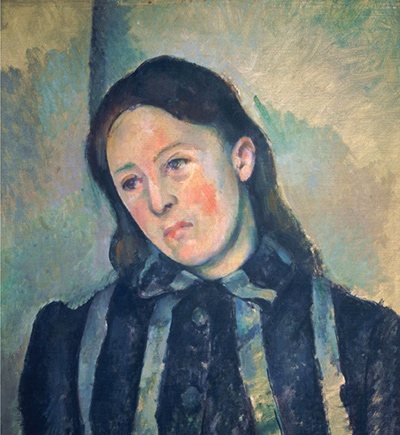
| Portrait of Madame Cezanne with Loosened Hair | 1885–86 | Painting |
| Portrait of the Artist Looking Over His Shoulder | 1883–84 | Painting |
| Portrait of the Gardener Vallier | 1906 | Painting |
| Portrait of Victor Chocquet | 1876–77 | Painting |
| Portrait Of Victor Chocquet Seated | 1877 | Painting |
| Provençal Manor | c.1885 | Painting |
| Pyramid of Skulls | 1898–1900 | Painting |
| Reclining Nude (Leda?) | c.1887 | Painting |
| Scipio | 1866–68 | Painting |
| Seated Man, Oslo | 1898–1900 | Painting |
| Seated Peasant | c.1892–96 | Painting |
| Seated Peasant, Hiroshima | c.1897 | Painting |
| Seated Peasant, Orsay | c.1900 | Painting |
| Self-Portrait | c. 1895 | Drawing |
| Self-Portrait in a Bowler Hat, Ny Carlsberg Glyptotek | 1885–86 | Painting |
| Self-Portrait in a Casquette | c.1875 | Painting |
| Self-Portrait with a Beret | 1898–1900 | Painting |
| Self-Portrait with a Hat, Artizon Museum | c.1890–94 | Painting |
| Self-Portrait with a Pink Background | c.1875 | Painting |
| Self-Portrait with Olive-Coloured Wallpaper | about 1880–81 | Painting |
| Self-Portrait with Palette | 1886–87 | Painting |
| Self-Portrait with White Turban | c.1878–80 | Painting |
| Self-Portrait, c.1895 | c.1895 | Painting |
| Self-Portrait, Pushkin Museum | c.1882 | Painting |
| Spanish Dancers | 1883/1886 | Drawing |
| Still Life with a Curtain | 1892–94 | Painting |
| Still Life with Apples | c.1890 | Painting |
| Still Life with Apples | 1893–94 | Painting |
| Still Life with Apples and a Pot of Primroses | about 1890 | Painting |
| Still Life with Milk Jug and Fruit | c.1900 | Painting |
| Still Life with Open Drawer | 1877–79 | Painting |
| Still Life with Plaster Cupid | about 1894 | Painting |
| Still Life with Skull | 1890–93 | Painting |
| Still Life with Soup Tureen | 1877 | Painting |
| Still Life, Pitcher and Fruit | 1893–94 | Painting |
| Studies Including a Straw Hat | 1895/1898 | Drawing |
| Studies Including Madame Cezanne | 1884/1887 | Drawing |
| Study for "The Judgement of Paris" or "The Amorous Shepherd" | 1883/1886 | Drawing |
| Study for Woman with a Coffee Pot | c.1895 | Painting |
| Study of "The Roman Orator (Germanicus)" | 1883/1886 | Drawing |
| Study of "Venus de Milo" | 1881/1884 | Drawing |
| Study of a Decorative Ornament | 1879/1882 | Drawing |
| Study of a Standing Male Figure after the Antique | c. 1895 | Drawing |
| Study of an Angel in Rubens' "The Prophet Elijah" | 1892/1895 | Drawing |
| Study of Desiderio da Settignano's "Bust of a Child" | c. 1895 | Drawing |
| Study of Houses | 1879/1882 | Drawing |
| Study of Puget's "Hercules Resting" | c. 1879 | Drawing |
| Study of Puget's "Milo of Crotona" | 1895/1898 | Drawing |
| Study of Puget's "Milo of Crotona" | 1880/1883 | Drawing |
| Study of the Allegorical Figure Bellona in Rubens' "The Apotheosis of Henri IV" | 1883/1886 | Drawing |
| Study of the Allegorical Figure Bellona in Rubens' "The Apotheosis of Henri IV" | 1879/1882 | Drawing |
| Study of the Allegorical Figure France in Rubens' "The Exchange of the Two Princesses" | 1882/1885 | Drawing |
| Study of the Allegorical Figure of Health in Rubens' "The Birth of Louis XIII" | 1880/1883 | Drawing |
| Study of the Allegorical Figure of the Genius of Health from Rubens' "The Birth of Louis XIII at Fontainbleau" | 1895/1898 | Drawing |
| Sugar Bowl, Pears and Blue Cup | 1865–66 | Painting |
| The Aqueduct, Pushkin Museum | Dating differs between museum records | Painting |
| The Artist's Father, Reading L'Evenement | autumn 1866 | Painting |
| The Artist's Son | c. 1887 | Drawing |
| The Artist's Son Leaning on his Elbow | c. 1887 | Drawing |
| The Artist's Son Reading | c. 1887 | Drawing |
| The Artist's Son Writing | c. 1887 | Drawing |
| The Artist’s Son, Paul | 1886–87 | Painting |
| The Avenue at Jas de Bouffan | 1868–70 (possibly later) | Painting |
| The Avenue at Jas de Bouffan, Geneva | c.1890 | Painting |
| The Basket of Apples | c.1893 | Painting |
| The Bather, Museum of Modern Art | c.1885 | Painting |
| The Bay of Marseille seen from L'Estaque | c.1885 | Painting |
| The Blue Vase | 1889–90 | Painting |
| The Boy in the Red Vest, Bührle | 1888–90 | Painting |
| The Buffet | 1877–79 | Painting |
| The Card Players, Barnes Foundation | 1890–92 | Painting |
| The Card Players, Courtauld Gallery | 1892–96 | Painting |
| The Card Players, Metropolitan Museum of Art | 1890–92 | Painting |
| The Card Players, Musée d’Orsay | 1893–96 | Painting |
| The Card Players, Qatar | 1892–96 | Painting |
| The Eternal Feminine | c.1877 | Painting |
| The Gardener Vallier | 1906 | Painting |
| The Gardener Vallier, Tate | 1905–06 | Painting |
| The Grounds of the Château Noir | c.1900–04 | Painting |
| The Gulf of Marseille Seen from L’Estaque | c.1885 | Painting |
| The Hanged Man's House in Auvers | c.1873 | Painting |
| The House of Doctor Gachet at Auvers | 1872–73 | Painting |
| The House with the Cracked Walls | 1892–94 | Painting |
| The Kiss of the Muse | c.1860 | Painting |
| The Large Bathers, Barnes Foundation | 1895–1906 | Painting |
| The Large Bathers, National Gallery | 1895–1905 | Painting |
| The Large Bathers, Philadelphia Museum of Art | 1900–06 | Painting |
| The Mill | 1889/1892 | Drawing |
| The Painter’s Father, Louis-Auguste Cézanne | c.1865 | Painting |
| The Peasant | 1890–92 | Painting |
| The Plaster Mill (La Moulin à plâtre) | 1889/1892 | Drawing |
| The Smoker, Hermitage | c.1891 | Painting |
| The Smoker, Mannheim | c.1891 | Painting |
| The Stove in the Studio | c.1865 | Painting |
| The Vase of Tulips | c.1890 | Painting |
| Thistle | 1893/1896 | Drawing |
| Three Heads, One of Madame Cezanne | 1882/1885 | Drawing |
| Three Skulls | c.1898 | Painting |
| Three Skulls on a Patterned Carpet | 1904 | Painting |
| Trees and Shrubs | 1883/1887 | Drawing |
| Turning Road at Montgeroult | 1898 | Painting |
| Two Bathers | 1884/1887 | Drawing |
| Two Heads | 1888 | Drawing |
| Two Heads | 1890/1896 | Drawing |
| Two Heads of Women | 1890/1894 | Drawing |
| Two Studies for "The Judgement of Paris" or "The Amorous Shepherd" | 1883/1886 | Drawing |
| Uncle Dominique in a Tasseled Cap | 1866 | Painting |
| Uncle Dominique in a Turban | 1866–67 | Painting |
| Victor Chocquet and an Angel for "The Apotheosis of Delacroix" | 1878/1880 | Drawing |
| Woman in Blue | c.1904 | Painting |
| Woman Leaning Forward | 1888/1891 | Drawing |
| Woman Leaning Forward | 1890/1894 | Drawing |
| Woman Leaning Forward | 1890/1894 | Drawing |
| Woman with a Coffee Pot | c.1895 | Painting |
| Women Bathers and a Roll of Paper | 1882/1885 | Drawing |
| Young Girl with a Doll | c.1895 | Painting |
| Young Italian Woman at a Table | c.1895–1900 | Painting |
| Young Man and Skull | 1896–98 | Painting |
Frequently Asked Questions
It is Hercules. The catalogue raisonné records this specific sheet as D’après Puget: Hercule au repos , FWN 3015-25a. [6]
The catalogue identifies it as a study after Puget’s sculpture and names no finished painting as its destination. [6]
The verso holds a study after Rubens’s Bellona from The Apotheosis of Henri IV . [4]
Discussion
Look again at the images and ideas explored in Study of Puget’s “Hercules Resting” by Paul Cézanne. These editorial prompts invite your observations.
Reader Insights
Follow the line around the shoulder, then try to locate the point where it becomes the arm. How much of that turn does Cézanne leave for your eye to construct?
Compare the dark marks beneath the waist with the faint contour of the thigh. Which area gives you the greater sense of weight?
If you first knew the figure as a mythic hero, does the rear view change what you attend to in the pose?
Join the Conversation
Share a detail, comparison or question about Study of Puget’s “Hercules Resting” by Paul Cézanne below.
References
- National Gallery of Art , “Study of Puget’s ‘Hercules Resting’,” object record, accession 1992.51.9.mm. View source .
- Musée du Louvre , “Hercule au repos,” collections record, inv. N 15345, updated 19 May 2022 (in French). View source .
- National Gallery of Art , “Cezanne Sketchbook,” object record, accession 1992.51.9.a-zz. View source .
- Société Paul Cezanne , “D’après Rubens: Bellone, 1879–82 (FWN 3015-25b),” The Paintings, Watercolors and Drawings of Paul Cezanne: An Online Catalogue Raisonné . View source .
- Christie’s , “Paul Cézanne, Après Puget (Hercules au repos),” lot essay for a separate drawing. View source .
- Société Paul Cezanne , “D’après Puget: Hercule au repos, c.1879 (FWN 3015-25a),” The Paintings, Watercolors and Drawings of Paul Cezanne: An Online Catalogue Raisonné . View source .
- François Chédeville / Société Cezanne , “Datation des copies de sculptures réalisées par Cezanne (I),” 22 March 2018 (in French). View source .
- Le Baiser de la muse, d'après Frillié (FWN 572). View source.
- Louis-Auguste Cezanne, père de l'artiste, lisant L'Événement (FWN 402). View source.
- La Maison du pendu, Auvers-sur-Oise (FWN 81). View source.
- Une moderne Olympia (FWN 628). View source.
- Le Pont de Maincy (FWN 143). View source.
- La Montagne Sainte-Victoire vue de Montbriand (FWN 185). View source.
- Gardanne (vue horizontale) (FWN 224). View source.
- Le Vase bleu (FWN 823). View source.
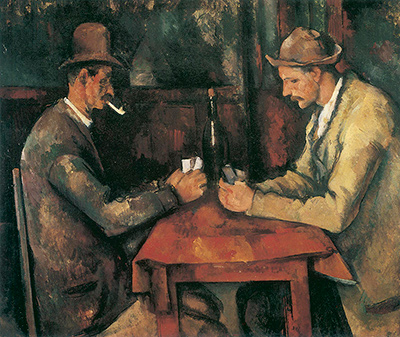
- Les Joueurs de cartes (FWN 681). View source.
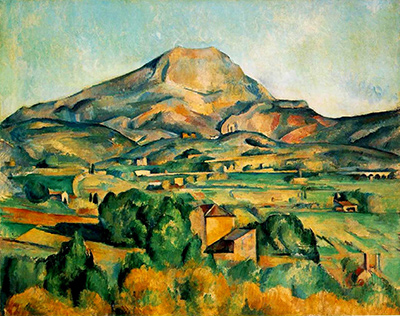
- La Montagne Sainte-Victoire (FWN 296). View source.
- La Corbeille de pommes (FWN 860). View source.
- Pommes et oranges (FWN 871). View source.
- Portrait d'Ambroise Vollard (FWN 531). View source.
- Philadelphia Museum of Art,The Large Bathers,W1937-1-1. View source.
- Château Noir (FWN 360). View source.
- Société Paul Cezanne,online catalogue structure and objectidentification. View source.
- Splash image, Paul Cézanne, Study of Puget’s “Hercules Resting,” c. 1879. Graphite on wove paper.