by
Tom Gurney
Tom Gurney BSc (Hons) is an art history expert with over 20 years experience
Published on June 19, 2020 / Updated on October 22, 2026
Email:
tomgurney1@gmail.com
/ Phone:
+44 7429 011000
Study of a Decorative Ornament: Cézanne’s Ornament in Pencil: Introduction
Paul Cézanne’s Study of a Decorative Ornament fills its narrow visible field with a single rising form. A pointed top gives way to paired scrolls, bulbous curves and leaf-like projections. The arrangement is nearly balanced about a central axis, but the two sides never become mechanical mirror images. That difference is especially clear where the outer edges swell and curl at different heights.
The National Gallery of Art records this graphite drawing as Study of a Decorative Ornament , dated 1879/1882, accession 1992.51.9.q. [1] The online catalogue raisonné places it on page XII verso and identifies it as FWN 3015-12b. [2]
At a Glance
- Artist Paul Cézanne. [2]
- Work Study of a Decorative Ornament ; catalogue title Étude d’un ornement décoratif . [2]
- Date 1879–82. [2]
- Medium Graphite on wove paper. [2]
- Page and collection XII verso, Washington sketchbook, National Gallery of Art; accession 1992.51.9.q. [1] [2]
This work across Paul Cézanne’s career
The Kiss of the Muse
c.1860The Artist’s Father, Reading L’Événement
autumn 1866The Hanged Man’s House
c.1873A Modern Olympia
1873–74Maincy Bridge
1879–80The Blue Vase
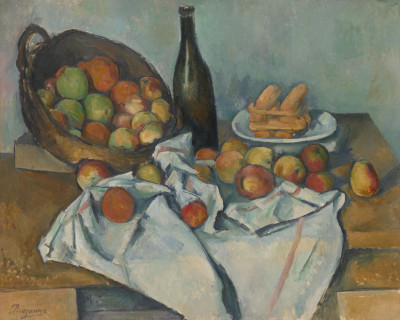
1889–90The Basket of Apples
c.1893Apples and Oranges
c.1899The Large Bathers (Philadelphia)
1900–1906 (Philadelphia Museum dating)Château Noir (MoMA)
1903–04Contents
- A Shape That Climbs the Page
- Scrolls, Hollows and Leaves
- What the Pencil Does
- One Leaf in a Varied Sketchbook
- A Historical Label, Not a Proven Origin
A Shape That Climbs the Page
At the top, several close sloping lines make a tapering hood. A small loop hangs just beneath its peak. Below it, rounded contours multiply and interrupt one another, as though the narrow point is opening into a broader, layered surface. The eye can follow the central descent, but it must keep changing course: one curved edge disappears behind another, then returns farther down. The ornamental form is therefore easier to grasp as an upward surge than as a set of individually named components.
The outer border widens abruptly below the pointed crown. On the left, a projecting lobe bends outward before curling back. On the right, another cluster pushes into the blank paper in a more broken sequence. These uneven extensions keep the design from feeling like a diagram. They also establish its scale within the sheet: the spread is broad through the middle, tight at the top, and broad again near the lower edge.
There is no surrounding architecture, furniture or pedestal in the drawing. Cézanne has isolated the ornament from any setting that would tell us its use. It may be tempting to call it a wall fitting or a piece of carved furniture, but neither identification follows from the visible marks. What the drawing gives us is a decorative surface, seen frontally enough for its vertical organization to hold together. Its original material, size and location require evidence beyond this leaf.
Scrolls, Hollows and Leaves
Paired oval recesses sit high in the central mass. They look darker along their inner edges, where nested pencil curves make the hollows seem to turn away from the light. Between and below them, a rounded swelling leads into a paler central zone. The drawing does not describe that zone by filling it evenly. Instead, short arcs, partly repeated outlines and changes in pressure suggest that one raised passage passes in front of another.
The flanks are more restless. Leaf-like blades and rolled tips emerge from a larger scroll on each side. Some edges are smooth and continuous, while others are made of several short strokes whose joins remain visible. At the left, a broad outer curve encloses smaller curls; at the right, pointed projections break up the silhouette. The contrasts make the margins active rather than merely decorative borders. Looking along either edge reveals more movement than a quick glance at the balanced whole might suggest.
Near the bottom, curling ends turn back toward the centre. They seem to form a wide base for the column of forms above, but their precise connection to the lowest central shape is unresolved. The image ends while these curves are still continuing. That visible limit is a property of the reproduction we can inspect; it does not prove that Cézanne stopped because he ran out of paper. Even without an entirely closed lower outline, the draft remains legible through its repeated curves and its strong central rise.
What the Pencil Does
The graphite is light across much of the design. It grows darker in selected seams: beneath the peak, beside the central ovals and under several rolled edges. Those accents help separate forms that would otherwise merge into one intricate silhouette. Cézanne does not shade every recess to the same value. A pale cavity can sit beside a firmer dark edge, allowing the viewer to infer a turn in the surface from relatively few marks.
Several contours are doubled. Around the central swells, a faint path runs close to a stronger one; elsewhere short strokes cross a curve before it settles into a clearer edge. The visible repetitions need not be read as errors or corrections. They record the difficulty of translating an elaborate relief into lines on a flat sheet. A pencil can follow a contour, hesitate, and follow it again without declaring a single final boundary.
The untouched paper is just as important. Large pale areas flank the object, and open spaces remain inside its busy middle. The eye moves between the light interior and darker seams rather than through a continuous tonal model. This gives the ornament a kind of porous volume: the drawing suggests protrusions and hollows, yet never turns them into a fully shaded sculptural rendering. Its economy makes each dark passage work harder.
MoMA’s 2021 Cézanne Drawing overview describes the artist’s drawn lines as searching and repeating. [3] Here that quality can be located in the tight clusters of arcs around the central ovals and the more tentative outlines at the fringes. The comparison helps name a visible feature of this drawing; it does not establish the speed of Cézanne’s hand or the number of sittings.
One Leaf in a Varied Sketchbook
The ornament belongs to the bound Washington sketchbook, also called Chappuis III. The National Gallery counts 46 sheets and 71 drawings, with some blank leaves and other surfaces used for notes, lists or calculations. Its materials extend beyond this graphite page to pen, brown ink and watercolor. [4] A sheet within that book is therefore part of a wider practice of looking, marking and returning to subjects, rather than an isolated display drawing.
Roman numerals mark the recto sides of this bound book. Page XII verso locates the ornament without establishing when Cézanne used that leaf. [5] The facing study of Madame Cézanne has a later catalogue date, so proximity cannot date this ornament. [2]
Charles S. Moffett’s 1991 essay describes the same sketchbook as a place where Cézanne used pages without a regular chronological sequence. He places decorative details among portraits, landscapes, bathers, architectural subjects and studies after sculpture. [6] The variety frames the ornament as one of many subjects Cézanne translated into drawing.
A Historical Label, Not a Proven Origin
The catalogue preserves an earlier title describing sculpted ornament in a Louis XIV style, without identifying a model or location. [2]
The image itself resembles carved relief: overlapping curls seem to project, while darker seams suggest hollows. These are visible effects rather than proof of a particular historical source.
The tight little loop beneath the peak and the much wider curls below it give the eye different scales of movement to follow. Returning from the margins to the centre reveals how Cézanne connects those small and large curves through overlapping pencil marks.
Cézanne artworks directory
Browse 217 identified works in this researched selection, including paintings, drawings and watercolours. This is a bounded selection, not a complete catalogue of Cézanne’s surviving oeuvre. Unlinked titles have no confirmed article in this collection.
| Name | Date | Medium |
|---|---|---|
| A Head, a Cup, and a Bread Roll | 1891/1894 | Drawing |
| A Man seen from Behind | 1880/1883 | Drawing |
| A Modern Olympia | 1873–74 | Painting |
| A Nude and Foliage | 1879/1882 | Drawing |
| A Smoking Man | 1892–96 (catalogue); c.1890–92 (museum) | Drawing |
| Afternoon in Naples | 1876–77 | Painting |
| An Old Woman with a Rosary | about 1895–96 | Painting |
| Apples and Oranges | c.1899 | Painting |
| Auvers, Panoramic View | 1873–75 | Painting |
| Avenue at Chantilly | 1888 | Painting |
| Banks of the Marne | 1888–94 | Painting |
| Basket | 1877/1900 | Drawing |
| Bather with Outstretched Arms | 1877–78 | Painting |
| Bellows in Front of a Fireplace | 1887/1892 | Drawing |
| Bibémus Quarry | c.1895 | Painting |
| Boy in a Red Vest, Barnes Foundation | 1888–90 | Painting |
| Boy in a Red Vest, MoMA | 1888–90 | Painting |
| Boy in a Red Waistcoat, National Gallery of Art | 1888–90 | Painting |
| Branch in Flower | 1886/1889 | Drawing |
| Carnival Scene | 1885/1888 | Drawing |
| Chair and Dresser | 1880/1883 | Drawing |
| Chateau Noir | 1903–04 | Painting |
| Chestnut Trees and Farm at Jas de Bouffan | c.1885 | Painting |
| Chestnut Trees and Farm at Jas de Bouffan, Pushkin | c.1886 | Painting |
| Chestnut Trees at Jas de Bouffan in Winter | 1885–86 | Painting |
| Château Noir | 1900–04 | Painting |
| Cistern in the Park of Château Noir | c.1900 | Painting |
| Curtain, Jug and Fruit | 1893–94 | Painting |
| Cushion of an Armchair | 1886/1889 | Drawing |
| Draft Letter and Studies of Bathers | c.1878 | Drawing |
| Farmhouse and Chestnut Trees at Jas de Bouffan | 1884–85 | Painting |
| Figure Resting Head on Hand | c. 1889 | Drawing |
| Fireplace Tongs and Poker | 1887/1892 | Drawing |
| Forest Interior, San Francisco | c.1898–99 | Painting |
| Four Bathers | 1888–90 | Painting |
| Fruit and a Jug on a Table | 1893–94 | Painting |
| Gardanne | 1885–86 | Painting |
| Gardanne, Barnes Foundation | c.1885 | Painting |
| Hand and Shoulder of a Boy | c. 1885 | Drawing |
| Harlequin, National Gallery of Art | 1888–90 | Painting |
| Head of a Boy | 1887/1889 | Drawing |
| Head of a Boy Seen from Behind | c. 1885 | Drawing |
| Head of a Young Woman | c. 1880 | Drawing |
| Head of the Artist's Son | 1888/1889 | Drawing |
| Hillside in Provence | c.1890–92 | Painting |
| Horse Chestnut Trees at Jas de Bouffan | c.1885 | Painting |
| House and Farm at the Jas de Bouffan | c.1887 | Painting |
| House in a Park | 1883/1886 | Drawing |
| House in Provence | c.1885 | Painting |
| House of Père Lacroix | 1873 | Painting |
| House Surrounded by Vegetation | 1889/1892 | Drawing |
| Houses in Provence The Riaux Valley near L’Estaque | c.1883 | Painting |
| Jas de Bouffan, the Pool | c.1876 | Painting |
| Kerosene Lamp | 1878/1881 | Drawing |
| L'Estaque, Melting Snow | c.1870 | Painting |
| Lake Annecy | 1896 | Painting |
| Landscape in Provence, Pola Museum | 1879–82 | Painting |
| Landscape Near Aix-en-Provence | 1877/1880 | Drawing |
| Landscape Seen from the Inside of a Cave | 1889/1892 | Drawing |
| Landscape with Poplars | c.1885–87 | Painting |
| Landscape with Trees | 1895/1898 | Drawing |
| Leda and the Swan | c.1880 (possibly later) | Painting |
| Little Girl with a Doll | 1902–04 | Painting |
| Louis Guillaume | 1879–1890 | Painting |
| Madame Cezanne | 1888/1891 | Drawing |
| Madame Cezanne | 1886/1889 | Drawing |
| Madame Cezanne | 1882/1887 | Drawing |
| Madame Cezanne | 1897/1900 | Drawing |
| Madame Cezanne with her Head Lowered | 1893/1896 | Drawing |
| Madame Cézanne in a Red Armchair | c.1877 | Painting |
| Madame Cézanne in a Red Dress, Metropolitan Museum of Art | 1888–90 | Painting |
| Madame Cézanne in a Yellow Chair | 1888–90 | Painting |
| Madame Cézanne in a Yellow Chair, Fondation Beyeler | 1888–90 | Painting |
| Madame Cézanne in the Conservatory | 1891 | Painting |
| Maincy Bridge | 1879–80 | Painting |
| Maison Maria with a View of Château Noir | c.1895 | Painting |
| Man Bending Forward | 1883/1886 | Drawing |
| Man Smoking a Pipe, Pushkin | c.1891, possibly later | Painting |
| Man with a Pipe | 1891–96 | Painting |
| Man with a Pipe, Nelson-Atkins | 1890–92 | Painting |
| Man with a Straw Hat (Gustave Boyer) | c.1871 | Painting |
| Man with Crossed Arms | c.1899 | Painting |
| Man with Pipe, National Gallery of Art | 1892–96 | Painting |
| Mont Sainte-Victoire | c.1902–06 | Painting |
| Mont Sainte-Victoire | 1900–02 | Painting |
| Mont Sainte-Victoire (recto) | c.1895 | Watercolour |
| Mont Sainte-Victoire and the Viaduct of the Arc River Valley | 1882–85 | Painting |
| Mont Sainte-Victoire Seen beyond the Wall of the Jas de Bouffan | c.1885/1888 | Watercolour |
| Mont Sainte-Victoire Seen from Bibémus Quarry | c.1897 | Painting |
| Mont Sainte-Victoire, Barnes Foundation | 1892–95 | Painting |
| Near the Pool at Jas de Bouffan | 1883/1887 | Drawing |
| Pelicans | 1877/1880 | Drawing |
| Peonies | 1890/1893 | Drawing |
| Pierrot and Harlequin | 1888 | Painting |
| Pine Tree | 1882/1885 | Drawing |
| Pont des Trois Sautets | 1906 | Watercolour |
| Poplars | 1879–80 | Painting |
| Portrait of Ambroise Vollard | 1899 | Painting |
| Portrait of Gustave Geffroy | 1895–96 | Painting |
| Portrait of Madame Cezanne with Loosened Hair | 1885–86 | Painting |
| Portrait of the Artist Looking Over His Shoulder | 1883–84 | Painting |
| Portrait of the Gardener Vallier | 1906 | Painting |
| Portrait of Victor Chocquet | 1876–77 | Painting |
| Portrait Of Victor Chocquet Seated | 1877 | Painting |
| Provençal Manor | c.1885 | Painting |
| Pyramid of Skulls | 1898–1900 | Painting |
| Reclining Nude (Leda?) | c.1887 | Painting |
| Scipio | 1866–68 | Painting |
| Seated Man, Oslo | 1898–1900 | Painting |
| Seated Peasant | c.1892–96 | Painting |
| Seated Peasant, Hiroshima | c.1897 | Painting |
| Seated Peasant, Orsay | c.1900 | Painting |
| Self-Portrait | c. 1895 | Drawing |
| Self-Portrait in a Bowler Hat, Ny Carlsberg Glyptotek | 1885–86 | Painting |
| Self-Portrait in a Casquette | c.1875 | Painting |
| Self-Portrait with a Beret | 1898–1900 | Painting |
| Self-Portrait with a Hat, Artizon Museum | c.1890–94 | Painting |
| Self-Portrait with a Pink Background | c.1875 | Painting |
| Self-Portrait with Olive-Coloured Wallpaper | about 1880–81 | Painting |
| Self-Portrait with Palette | 1886–87 | Painting |
| Self-Portrait with White Turban | c.1878–80 | Painting |
| Self-Portrait, c.1895 | c.1895 | Painting |
| Self-Portrait, Pushkin Museum | c.1882 | Painting |
| Spanish Dancers | 1883/1886 | Drawing |
| Still Life with a Curtain | 1892–94 | Painting |
| Still Life with Apples | c.1890 | Painting |
| Still Life with Apples | 1893–94 | Painting |
| Still Life with Apples and a Pot of Primroses | about 1890 | Painting |
| Still Life with Milk Jug and Fruit | c.1900 | Painting |
| Still Life with Open Drawer | 1877–79 | Painting |
| Still Life with Plaster Cupid | about 1894 | Painting |
| Still Life with Skull | 1890–93 | Painting |
| Still Life with Soup Tureen | 1877 | Painting |
| Still Life, Pitcher and Fruit | 1893–94 | Painting |
| Studies Including a Straw Hat | 1895/1898 | Drawing |
| Studies Including Madame Cezanne | 1884/1887 | Drawing |
| Study for "The Judgement of Paris" or "The Amorous Shepherd" | 1883/1886 | Drawing |
| Study for Woman with a Coffee Pot | c.1895 | Painting |
| Study of "The Roman Orator (Germanicus)" | 1883/1886 | Drawing |
| Study of "Venus de Milo" | 1881/1884 | Drawing |
| Study of a Decorative Ornament | 1879/1882 | Drawing |
| Study of a Standing Male Figure after the Antique | c. 1895 | Drawing |
| Study of an Angel in Rubens' "The Prophet Elijah" | 1892/1895 | Drawing |
| Study of Desiderio da Settignano's "Bust of a Child" | c. 1895 | Drawing |
| Study of Houses | 1879/1882 | Drawing |
| Study of Puget's "Hercules Resting" | c. 1879 | Drawing |
| Study of Puget's "Milo of Crotona" | 1895/1898 | Drawing |
| Study of Puget's "Milo of Crotona" | 1880/1883 | Drawing |
| Study of the Allegorical Figure Bellona in Rubens' "The Apotheosis of Henri IV" | 1883/1886 | Drawing |
| Study of the Allegorical Figure Bellona in Rubens' "The Apotheosis of Henri IV" | 1879/1882 | Drawing |
| Study of the Allegorical Figure France in Rubens' "The Exchange of the Two Princesses" | 1882/1885 | Drawing |
| Study of the Allegorical Figure of Health in Rubens' "The Birth of Louis XIII" | 1880/1883 | Drawing |
| Study of the Allegorical Figure of the Genius of Health from Rubens' "The Birth of Louis XIII at Fontainbleau" | 1895/1898 | Drawing |
| Sugar Bowl, Pears and Blue Cup | 1865–66 | Painting |
| The Aqueduct, Pushkin Museum | Dating differs between museum records | Painting |
| The Artist's Father, Reading L'Evenement | autumn 1866 | Painting |
| The Artist's Son | c. 1887 | Drawing |
| The Artist's Son Leaning on his Elbow | c. 1887 | Drawing |
| The Artist's Son Reading | c. 1887 | Drawing |
| The Artist's Son Writing | c. 1887 | Drawing |
| The Artist’s Son, Paul | 1886–87 | Painting |
| The Avenue at Jas de Bouffan | 1868–70 (possibly later) | Painting |
| The Avenue at Jas de Bouffan, Geneva | c.1890 | Painting |
| The Basket of Apples | c.1893 | Painting |
| The Bather, Museum of Modern Art | c.1885 | Painting |
| The Bay of Marseille seen from L'Estaque | c.1885 | Painting |
| The Blue Vase | 1889–90 | Painting |
| The Boy in the Red Vest, Bührle | 1888–90 | Painting |
| The Buffet | 1877–79 | Painting |
| The Card Players, Barnes Foundation | 1890–92 | Painting |
| The Card Players, Courtauld Gallery | 1892–96 | Painting |
| The Card Players, Metropolitan Museum of Art | 1890–92 | Painting |
| The Card Players, Musée d’Orsay | 1893–96 | Painting |
| The Card Players, Qatar | 1892–96 | Painting |
| The Eternal Feminine | c.1877 | Painting |
| The Gardener Vallier | 1906 | Painting |
| The Gardener Vallier, Tate | 1905–06 | Painting |
| The Grounds of the Château Noir | c.1900–04 | Painting |
| The Gulf of Marseille Seen from L’Estaque | c.1885 | Painting |
| The Hanged Man's House in Auvers | c.1873 | Painting |
| The House of Doctor Gachet at Auvers | 1872–73 | Painting |
| The House with the Cracked Walls | 1892–94 | Painting |
| The Kiss of the Muse | c.1860 | Painting |
| The Large Bathers, Barnes Foundation | 1895–1906 | Painting |
| The Large Bathers, National Gallery | 1895–1905 | Painting |
| The Large Bathers, Philadelphia Museum of Art | 1900–06 | Painting |
| The Mill | 1889/1892 | Drawing |
| The Painter’s Father, Louis-Auguste Cézanne | c.1865 | Painting |
| The Peasant | 1890–92 | Painting |
| The Plaster Mill (La Moulin à plâtre) | 1889/1892 | Drawing |
| The Smoker, Hermitage | c.1891 | Painting |
| The Smoker, Mannheim | c.1891 | Painting |
| The Stove in the Studio | c.1865 | Painting |
| The Vase of Tulips | c.1890 | Painting |
| Thistle | 1893/1896 | Drawing |
| Three Heads, One of Madame Cezanne | 1882/1885 | Drawing |
| Three Skulls | c.1898 | Painting |
| Three Skulls on a Patterned Carpet | 1904 | Painting |
| Trees and Shrubs | 1883/1887 | Drawing |
| Turning Road at Montgeroult | 1898 | Painting |
| Two Bathers | 1884/1887 | Drawing |
| Two Heads | 1888 | Drawing |
| Two Heads | 1890/1896 | Drawing |
| Two Heads of Women | 1890/1894 | Drawing |
| Two Studies for "The Judgement of Paris" or "The Amorous Shepherd" | 1883/1886 | Drawing |
| Uncle Dominique in a Tasseled Cap | 1866 | Painting |
| Uncle Dominique in a Turban | 1866–67 | Painting |
| Victor Chocquet and an Angel for "The Apotheosis of Delacroix" | 1878/1880 | Drawing |
| Woman in Blue | c.1904 | Painting |
| Woman Leaning Forward | 1888/1891 | Drawing |
| Woman Leaning Forward | 1890/1894 | Drawing |
| Woman Leaning Forward | 1890/1894 | Drawing |
| Woman with a Coffee Pot | c.1895 | Painting |
| Women Bathers and a Roll of Paper | 1882/1885 | Drawing |
| Young Girl with a Doll | c.1895 | Painting |
| Young Italian Woman at a Table | c.1895–1900 | Painting |
| Young Man and Skull | 1896–98 | Painting |
Frequently Asked Questions
It is a graphite study on page XII verso of the Washington sketchbook, FWN 3015-12b. [2]
The catalogue gives no exact model or location for the ornament. [2]
Discussion
Look again at the images and ideas explored in Study of a Decorative Ornament: Cézanne’s Ornament in Pencil. These editorial prompts invite your observations.
Reader Insights
Begin at the little loop beneath the peak, then move down through the pair of oval forms. Which dark pencil marks make the shapes seem recessed, and which marks make them project?
Trace the left and right silhouettes separately. Their different curls and interruptions show how an apparently balanced ornament can remain irregular and lively.
Look at the pale paper within and around the motif. How much of the apparent relief comes from what Cézanne leaves open rather than what he shades?
Join the Conversation
Share a detail, comparison or question about Study of a Decorative Ornament: Cézanne’s Ornament in Pencil below.
References
- National Gallery of Art , Open Data Program , object 76236, accession 1992.51.9.q. View source .
- Société Paul Cezanne , “Étude d’un ornement décoratif, 1879–82 (FWN 3015-12b),” The Paintings, Watercolors and Drawings of Paul Cezanne: An Online Catalogue Raisonné . View source .
- Museum of Modern Art , “Cézanne Drawing,” exhibition overview, 2021. View source .
- National Gallery of Art , “Cezanne Sketchbook,” aggregate object record. View source .
- Société Paul Cezanne , “Sketchbook Washington, c. 1877–1900 (FWN 3015),” online catalogue raisonné. View source .
- Charles S. Moffett , “Sketchbook,” in Art for the Nation: Gifts in Honor of the 50th Anniversary of the National Gallery of Art , National Gallery of Art, 1991, p. 176. View source .
- Le Baiser de la muse, d'après Frillié (FWN 572). View source.
- Louis-Auguste Cezanne, père de l'artiste, lisant L'Événement (FWN 402). View source.
- La Maison du pendu, Auvers-sur-Oise (FWN 81). View source.
- Une moderne Olympia (FWN 628). View source.
- Le Pont de Maincy (FWN 143). View source.
- La Montagne Sainte-Victoire vue de Montbriand (FWN 185). View source.
- Gardanne (vue horizontale) (FWN 224). View source.
- Le Vase bleu (FWN 823). View source.
- Les Joueurs de cartes (FWN 681). View source.
- La Montagne Sainte-Victoire (FWN 296). View source.
- La Corbeille de pommes (FWN 860). View source.
- Pommes et oranges (FWN 871). View source.
- Portrait d'Ambroise Vollard (FWN 531). View source.
- Philadelphia Museum of Art,The Large Bathers,W1937-1-1. View source.
- Château Noir (FWN 360). View source.
- Société Paul Cezanne,online catalogue structure and objectidentification. View source.
- Splash image, Pointed crown above curling graphite forms.