by
Tom Gurney
Tom Gurney BSc (Hons) is an art history expert with over 20 years experience
Published on June 19, 2020 / Updated on October 22, 2026
Email:
tomgurney1@gmail.com
/ Phone:
+44 7429 011000
Woman with a Coffee Pot by Paul Cézanne: Introduction
A woman sits in a blue dress, her hands resting low in her lap. A white cup and a tall metal coffee pot stand on the table beside her. Nothing is being poured, and no one appears to be waiting for a drink. Cézanne has made the pause itself the subject: a seated figure held between the broad planes of a panelled door and the objects whose upright shapes echo her own. The painting is at once a portrait, an interior and a close study of how bodies and things occupy space. [1]
The Musée d’Orsay dates La Femme à la cafetière to around 1895. At 130 by 97 centimetres, it is close to the scale of a person seated before us, considerably larger than a casual domestic sketch. The sitter's name is unknown; the museum considers her possibly one of the employees of the Cézanne family's Jas de Bouffan estate near Aix-en-Provence. Her presence anchors the picture. [1]
At a Glance
- Artist Paul Cézanne. [1]
- Title La Femme à la cafetière ( Woman with a Coffee Pot ). [1]
- Date About 1895; earlier cataloguers proposed other dates in the late 1880s and 1890s. [2]
- Medium and size Oil on canvas, 130 × 97 cm. [1]
- Collection Musée d’Orsay, Paris, RF 1956 13. [1]
- Sitter Unidentified; possibly a Jas de Bouffan employee. [1]
This work across Paul Cézanne’s career
The Kiss of the Muse
c.1860The Artist’s Father, Reading L’Événement
autumn 1866The Hanged Man’s House
c.1873A Modern Olympia
1873–74Maincy Bridge
1879–80The Blue Vase
1889–90The Basket of Apples
c.1893Apples and Oranges
c.1899The Large Bathers (Philadelphia)
1900–1906 (Philadelphia Museum dating)Château Noir (MoMA)
1903–04Contents
- A figure given the whole canvas
- The cup, pot and tilted table
- A room made of panels and colour
- Who was the woman?
- A related head study and the question of making
- A portrait in a changing practice
- From private collections to the Musée d’Orsay
- Looking again
- Annotated details
A figure given the whole canvas
The woman's dress occupies most of the lower picture. Its blue spreads from narrow shoulders through a tightly gathered waist into a wide skirt that nearly meets the bottom edge. Her head, comparatively small, sits above the high collar. The effect is monumental without any heroic gesture. She neither stands nor performs a task. The weight of the skirt, the compact torso and the still hands give a quiet seated pose the scale of a formal portrait.
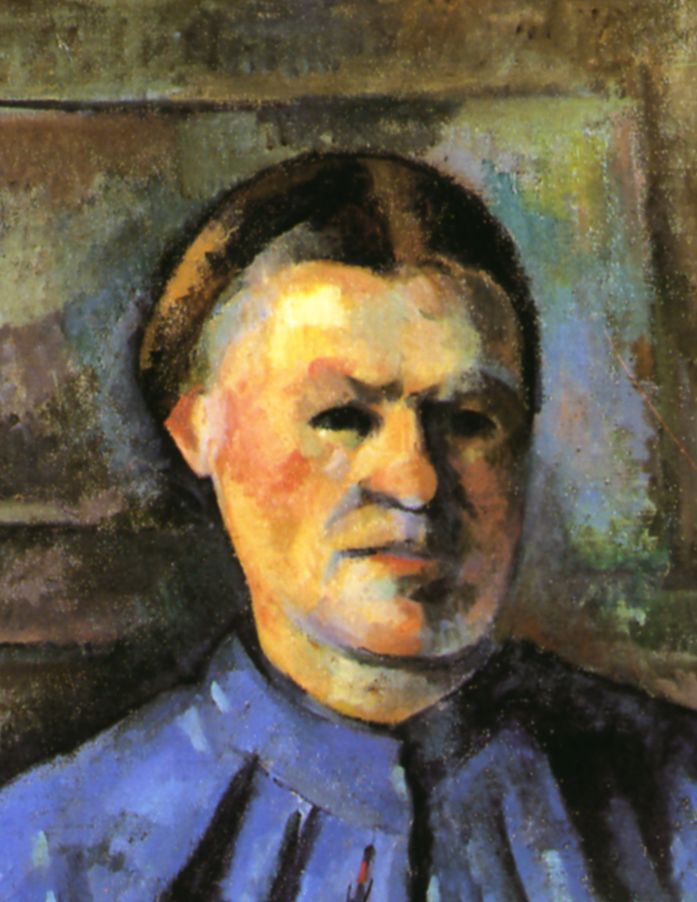
Dark eyes look slightly to one side; the mouth stays closed. Cézanne's patches of warm yellow and red across the face resist a smooth, polished likeness. Her parted hair, heavy brow and firm lower face are particular. Angled lights and shadows make the face feel worked over and observed, while leaving her thoughts beyond the viewer's reach. [1]
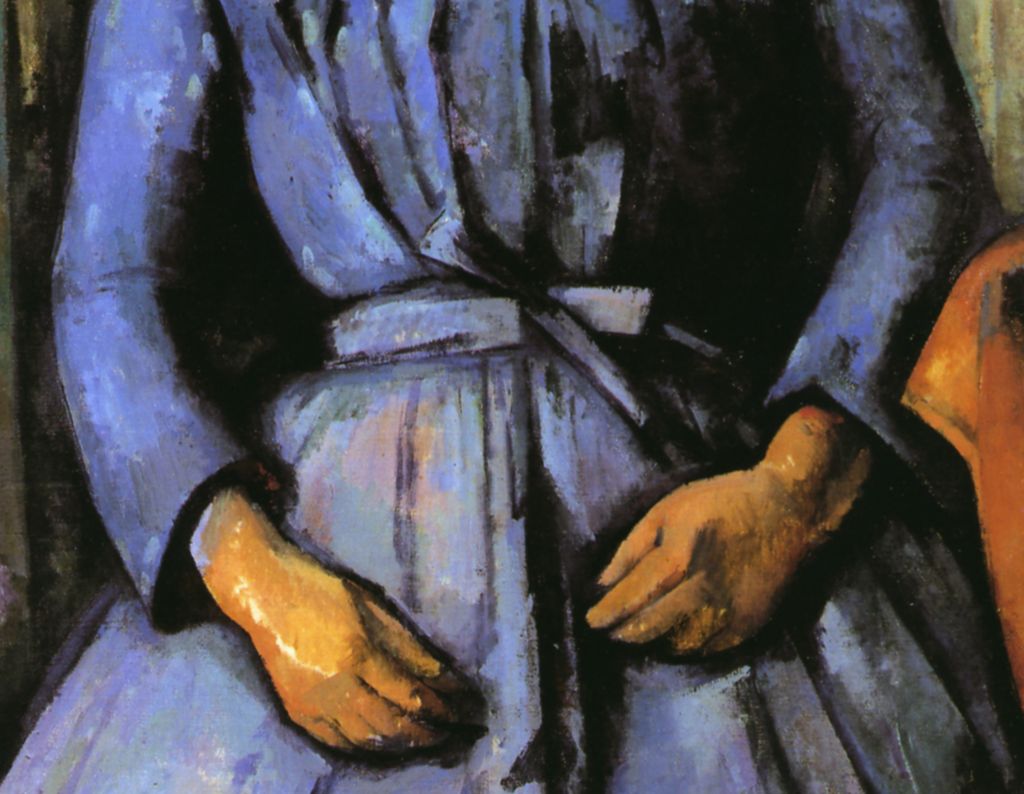
Her hands matter as much as her face. On the viewer's left, one rests across the skirt with fingers angled inward; on the right, the other lies nearer her waist. They are broad, warmly coloured shapes set against cool fabric. The Orsay's account associates them with work and reads dignity in the sitter's bearing. Their present stillness gives that reading poignancy. [1]
An upright seam runs down the skirt, repeated by the collar and the falls of fabric from shoulder to waist. These verticals reinforce the figure's steadiness. At the same time, the right forearm slants toward the table, and the skirt swells asymmetrically around the chair. Cézanne has not reduced the woman to a diagram. The painting's force comes from the give between its strong order and its uneven, observed forms.
The cup, pot and tilted table
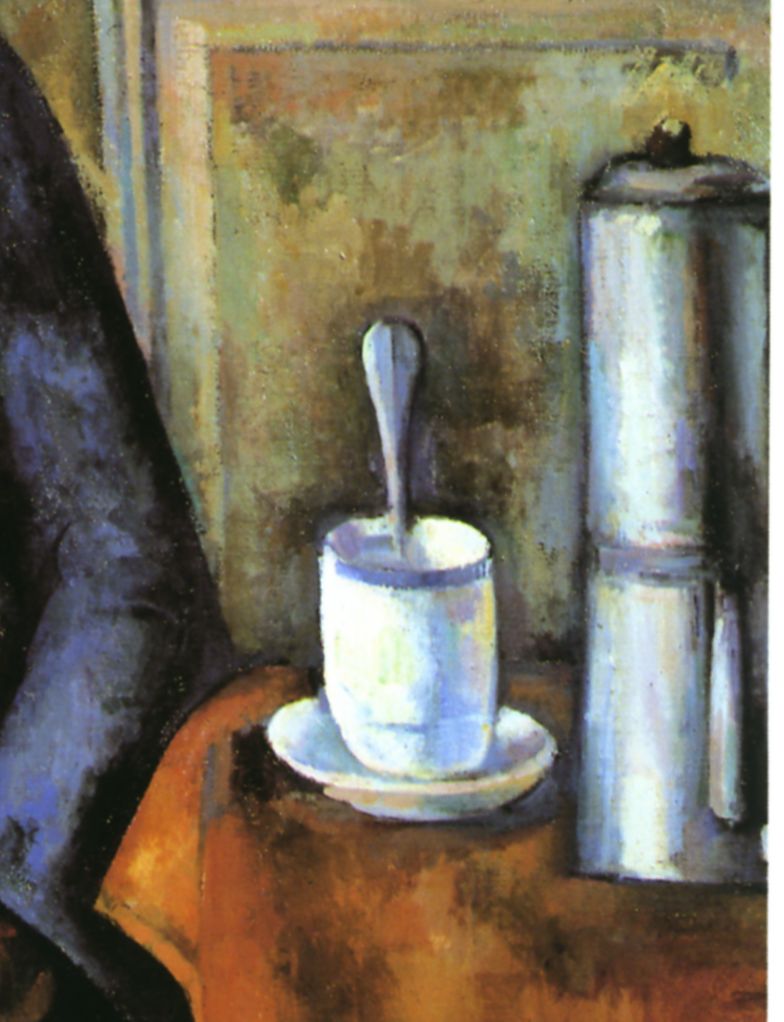
To the sitter's right, a white cup stands on a saucer. A spoon rises from it; a narrow metal pot stands farther right. The cup looks small beside the woman, but its whiteness draws the eye across the dark dress. The taller pot responds to the vertical of her torso, so the objects become more than accessories. John Elderfield has observed that its emphatic uprightness answers the figure's stiff pose. The comparison helps explain why the vessel seems almost like a second presence in the room, although it remains unmistakably a coffee pot. [3]
The table is more disconcerting than the pot. Its rust-coloured top turns up towards us, exposing a wide plane, while the cup and vessel appear much closer to a frontal view. The viewer cannot settle on a single comfortable eye level for the whole arrangement. The saucer seems to hold its position at the edge even as the surface below it pitches forward. Orsay's interpretation identifies this difference in viewpoints as central to the painting's organisation. [1]
Colour binds the small still life to the portrait. Cool white and steel grey interrupt the blue and violet dress; orange and umber in the table reappear in the sitter's hands and face. The pale cup is ringed by darker contours that keep it distinct from the busy wall. Its spoon, a slim upright mark, repeats the pot's narrow profile on a smaller scale. The table's corner, by contrast, cuts a steep diagonal into the lower right. That sudden angle gives motion to a painting otherwise full of verticals.
The rounded cup, cylindrical pot, hands and body invite comparison through their shapes and placement. The sitter's face and hands nonetheless hold a different kind of attention from the vessels. Elderfield cautions against taking stillness in Cézanne's portraits as proof of indifference to the sitters. Here the table receives equal compositional care, while the human presence stays compelling. [3]
Annotated Details from Woman with a Coffee Pot
The numbered points identify visible features discussed in this article. Return from each detail to the whole composition. Paul Cézanne, Woman with a Coffee Pot, c.1895, oil on canvas, Musée d’Orsay, Paris (RF1956-13; FWN514). Image source. Public domain.
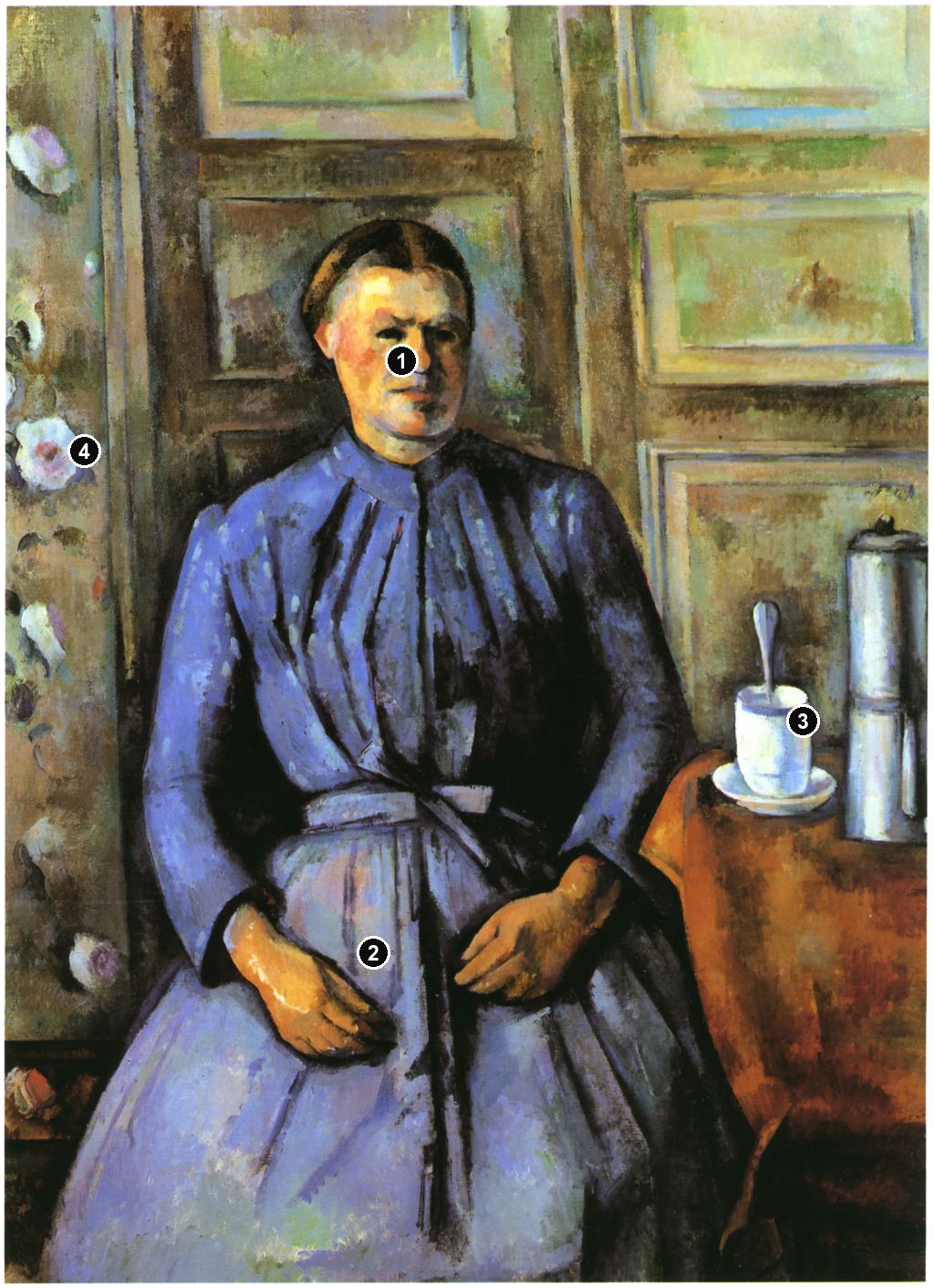
Details from WOMAN WITH A COFFEE POT
Compare the cropped details with the complete images above. Notice how their colours, shapes and positions contribute to the larger compositions.
The sitter’s face
Warm pink and yellow patches meet cooler shadows across the face. The dark hair and collar contain its broad outline.
Hands and blue dress
The lowered hands rest separately against the dress. Dark folds run between broad blue passages towards the bottom edge.
Cup, spoon and coffee pot
The pale cup and tall metal pot stand on the small table. The upright spoon rises above the cup beside the pot’s dark lid.
Floral strip and door
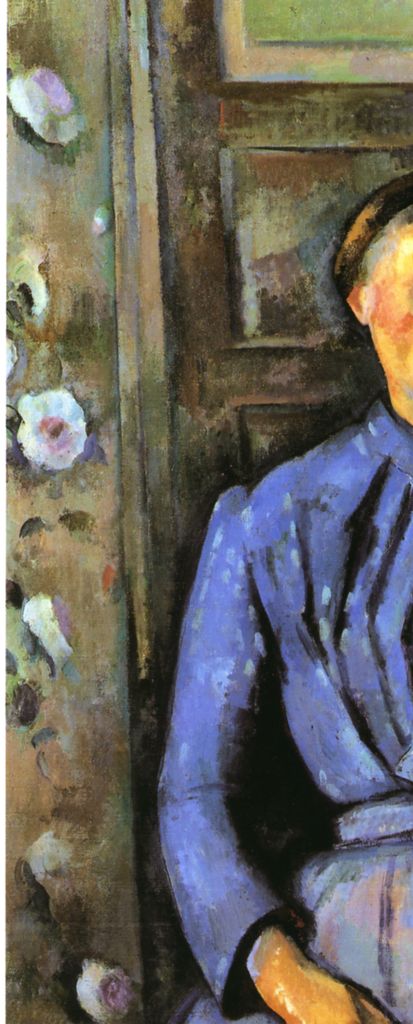
Soft flower shapes run down the narrow strip at the left. Beside them, the door’s straight borders divide the background into rectangles.
A room made of panels and colour
Behind the woman, the broad door or panelled surface is divided into rectangles. Its dark vertical divisions run behind her shoulders and flank the face. A narrow strip of flowered decoration appears at the far left, a softer and more delicate pattern than the heavy carpentry. The vase-like pale blossoms there are easy to overlook at first, but they keep the interior from feeling like an empty geometric backdrop.
The wall is neither a fully described household room nor a neutral portrait ground. Its framed panels are worked in muted green, ochre, cream and brown, with edges that are firm in some places and blurred in others. The sitter's dark hair and collar read against these changing tones. Her blue sleeve almost touches the table's orange edge. Cézanne makes figure, furnishing and setting meet through colour contrasts as well as through outlines.
Look again at the two large panels above and beside the head. Their upper and side divisions seem to shift as the eye crosses the canvas. Elderfield places this work among a small group of Cézanne portraits in which the whole interior is as active as the sitter. He compares it with the portraits of Hortense Fiquet and the critic Gustave Geffroy, where the surrounding room or its contents become integral to the portrait's design. [3]
The patterned strip also matters to the picture's mood. It is a sign of a lived-in interior, but the person has been placed before it for a prolonged, still encounter. Cézanne offers no narrative about the cup being prepared or the sitter taking a break. The ordinary materials of the room are made unusually deliberate: each edge and colour patch helps hold the large figure in place.
Who was the woman?
The online catalogue raisonné includes La Domestique among the painting's alternative titles, reflecting an association with household work. [2]
Elderfield describes a shift in Cézanne's portrait subjects after about 1890. Alongside relatives and named friends, he increasingly painted local workers and people employed by or connected to the Jas household. Many of these sitters entered the catalogue without names. Around the same years he pursued the Card Players paintings, which also drew on local models. This portrait belongs to that widening range of subjects. [3]
The visible dress is plain, high-necked and practical. It fits the proposed domestic setting, yet she sits beside the coffee service rather than using it. The portrait allows the pause, the person and the household objects to coexist without turning them into a scene of service.
The portrait grants a person whose name was not preserved the format and scale often accorded to better documented subjects. Its attention to her particular face and physical presence supports the viewer's sense of dignity, alongside the picture's size.
A related head study and the question of making
The online catalogue raisonné lists a separate oil study, Étude pour la Femme à la cafetière (FWN 513), close to the Orsay canvas in date but much smaller, at 36 by 38.5 centimetres. It is in a private collection in New England. Its title and catalogue placement relate it to this portrait, while the museum-scale canvas remains a distinct work, FWN 514. In the small painting, the head becomes a subject apart from the full seated figure and room. [4] [2]
Elderfield describes drawings, painted studies, photographs and memory as varied parts of Cézanne's wider portrait practice. The Orsay canvas itself shows dark, repeated strokes in the dress, more open colour in the panels, and strong outlines around cup and pot. Those differences make the figure, room and vessels feel separately encountered yet deliberately joined. [3]
Both Orsay and the current catalogue date the painting to about 1895. The catalogue also preserves earlier proposals, ranging from the late 1880s to the early 1890s, and notes a 1893 date written by Cézanne's son on an archival photograph. The differing dates explain why the current label remains approximate. [2]
A portrait in a changing practice
By the middle of the 1890s, Cézanne had long since developed painting far beyond the light effects associated with his Impressionist period. The Orsay describes this portrait's simplification of volume and its shifting viewpoints as part of the history leading towards Cubism. That retrospective connection is intelligible when looking at the turned-up tabletop, the almost cylindrical pot and the forceful panels. Yet the painting remains a particular encounter with a person and room, rather than a set of shapes made only for a later movement. [1]
Comparison with the portrait of Ambroise Vollard clarifies what is unusual here. Vollard, the art dealer, is named and placed within Cézanne's Paris art world. This sitter is anonymous, and the coffee service and domestic interior give her a different setting. Both portraits depend on long looking, large seated forms and tense relations between body and surroundings. But the pot, cup and tipped plane make Woman with a Coffee Pot particularly close to Cézanne's still-life experiments. [3]
Elderfield also pairs this painting with the portrait of Gustave Geffroy from roughly the same period. Geffroy's bookshelves organise the composition around a writer and his profession; the panels and coffee service here supply a far less specific account of the woman's identity. The comparison illuminates the difference between a portrait equipped with a public name and occupational cues and one that remains stubbornly open. In both, the room has enough pictorial energy to complicate an easy reading of the face alone. [3]
These connections should not erase the human scale of the painting. The upright pot may rhyme with the sitter's torso, but its metal surface catches light differently from her skin. The tabletop may pull the eye forward, but the figure's blue mass stops it. The painting keeps testing likenesses between unlike things. Each return to the face and hands restores a sense of the person who gave Cézanne those forms to look at.
From private collections to the Musée d’Orsay
Orsay records that Ambroise Vollard and Bernheim-Jeune bought the painting jointly on 16 April 1904. The work then passed through Jos Hessel and was bought by Auguste Pellerin in July that year. It remained with the Pellerin family; M. and Mme Jean-Victor Pellerin gave it to the French state in 1956. The painting was associated with the Louvre and displayed at the Jeu de Paume before its allocation to the Musée d’Orsay in 1986. [1]
The catalogue raisonné identifies the 1936 Cézanne exhibition at the Musée de l'Orangerie as the painting's first exhibition. It later appeared at Aix-en-Provence in the 1956 commemoration of Cézanne's death and in the major Paris, London and Philadelphia exhibitions of 1995–96. More recently, it travelled in the 2017–18 Cézanne Portraits exhibition and returned to Aix for the 2025 Cezanne au Jas de Bouffan exhibition. Its circulation has let successive audiences encounter the same large, quiet portrait in exhibitions devoted to Cézanne's life, portraiture and modern painting. [2]
The work's public visibility also changes the experience of its scale. Reproductions can make it seem like a modest image of a woman beside a table. In front of the canvas, the skirt fills a broad field and the pot rises nearly to shoulder height. The portrait asks viewers to move their attention slowly between the sitter and the room that holds her, resisting a single detail as the painting's whole explanation.
Looking again
Begin at the face, then follow the long blue front of the dress to the hands. Cross to the cup and rise along the pot. Only then return to the door panels. This route reveals how much of the painting depends on repetition: collars, seams, spoon, pot and panelling keep setting vertical lines against the table's abrupt diagonal. Even the floral strip, apparently marginal, gives a contrasting rhythm to the broad rectangles.
Viewed as a whole again, the pot seems to stand at attention beside the seated woman, while the table rises towards us. The eye shuttles between them, testing the painting's uneasy balance.
Cézanne artworks directory
Browse 217 identified works in this researched selection, including paintings, drawings and watercolours. This is a bounded selection, not a complete catalogue of Cézanne’s surviving oeuvre. Unlinked titles have no confirmed article in this collection.
| Name | Date | Medium |
|---|---|---|
| A Head, a Cup, and a Bread Roll | 1891/1894 | Drawing |
| A Man seen from Behind | 1880/1883 | Drawing |
| A Modern Olympia | 1873–74 | Painting |
| A Nude and Foliage | 1879/1882 | Drawing |
| A Smoking Man | 1892–96 (catalogue); c.1890–92 (museum) | Drawing |
| Afternoon in Naples | 1876–77 | Painting |
| An Old Woman with a Rosary | about 1895–96 | Painting |
| Apples and Oranges | c.1899 | Painting |
| Auvers, Panoramic View | 1873–75 | Painting |
| Avenue at Chantilly | 1888 | Painting |
| Banks of the Marne | 1888–94 | Painting |
| Basket | 1877/1900 | Drawing |
| Bather with Outstretched Arms | 1877–78 | Painting |
| Bellows in Front of a Fireplace | 1887/1892 | Drawing |
| Bibémus Quarry | c.1895 | Painting |
| Boy in a Red Vest, Barnes Foundation | 1888–90 | Painting |
| Boy in a Red Vest, MoMA | 1888–90 | Painting |
| Boy in a Red Waistcoat, National Gallery of Art | 1888–90 | Painting |
| Branch in Flower | 1886/1889 | Drawing |
| Carnival Scene | 1885/1888 | Drawing |
| Chair and Dresser | 1880/1883 | Drawing |
| Chateau Noir | 1903–04 | Painting |
| Chestnut Trees and Farm at Jas de Bouffan | c.1885 | Painting |
| Chestnut Trees and Farm at Jas de Bouffan, Pushkin | c.1886 | Painting |
| Chestnut Trees at Jas de Bouffan in Winter | 1885–86 | Painting |
| Château Noir | 1900–04 | Painting |
| Cistern in the Park of Château Noir | c.1900 | Painting |
| Curtain, Jug and Fruit | 1893–94 | Painting |
| Cushion of an Armchair | 1886/1889 | Drawing |
| Draft Letter and Studies of Bathers | c.1878 | Drawing |
| Farmhouse and Chestnut Trees at Jas de Bouffan | 1884–85 | Painting |
| Figure Resting Head on Hand | c. 1889 | Drawing |
| Fireplace Tongs and Poker | 1887/1892 | Drawing |
| Forest Interior, San Francisco | c.1898–99 | Painting |
| Four Bathers | 1888–90 | Painting |
| Fruit and a Jug on a Table | 1893–94 | Painting |
| Gardanne | 1885–86 | Painting |
| Gardanne, Barnes Foundation | c.1885 | Painting |
| Hand and Shoulder of a Boy | c. 1885 | Drawing |
| Harlequin, National Gallery of Art | 1888–90 | Painting |
| Head of a Boy | 1887/1889 | Drawing |
| Head of a Boy Seen from Behind | c. 1885 | Drawing |
| Head of a Young Woman | c. 1880 | Drawing |
| Head of the Artist's Son | 1888/1889 | Drawing |
| Hillside in Provence | c.1890–92 | Painting |
| Horse Chestnut Trees at Jas de Bouffan | c.1885 | Painting |
| House and Farm at the Jas de Bouffan | c.1887 | Painting |
| House in a Park | 1883/1886 | Drawing |
| House in Provence | c.1885 | Painting |
| House of Père Lacroix | 1873 | Painting |
| House Surrounded by Vegetation | 1889/1892 | Drawing |
| Houses in Provence The Riaux Valley near L’Estaque | c.1883 | Painting |
| Jas de Bouffan, the Pool | c.1876 | Painting |
| Kerosene Lamp | 1878/1881 | Drawing |
| L'Estaque, Melting Snow | c.1870 | Painting |
| Lake Annecy | 1896 | Painting |
| Landscape in Provence, Pola Museum | 1879–82 | Painting |
| Landscape Near Aix-en-Provence | 1877/1880 | Drawing |
| Landscape Seen from the Inside of a Cave | 1889/1892 | Drawing |
| Landscape with Poplars | c.1885–87 | Painting |
| Landscape with Trees | 1895/1898 | Drawing |
| Leda and the Swan | c.1880 (possibly later) | Painting |
| Little Girl with a Doll | 1902–04 | Painting |
| Louis Guillaume | 1879–1890 | Painting |
| Madame Cezanne | 1888/1891 | Drawing |
| Madame Cezanne | 1886/1889 | Drawing |
| Madame Cezanne | 1882/1887 | Drawing |
| Madame Cezanne | 1897/1900 | Drawing |
| Madame Cezanne with her Head Lowered | 1893/1896 | Drawing |
| Madame Cézanne in a Red Armchair | c.1877 | Painting |
| Madame Cézanne in a Red Dress, Metropolitan Museum of Art | 1888–90 | Painting |
| Madame Cézanne in a Yellow Chair | 1888–90 | Painting |
| Madame Cézanne in a Yellow Chair, Fondation Beyeler | 1888–90 | Painting |
| Madame Cézanne in the Conservatory | 1891 | Painting |
| Maincy Bridge | 1879–80 | Painting |
| Maison Maria with a View of Château Noir | c.1895 | Painting |
| Man Bending Forward | 1883/1886 | Drawing |
| Man Smoking a Pipe, Pushkin | c.1891, possibly later | Painting |
| Man with a Pipe | 1891–96 | Painting |
| Man with a Pipe, Nelson-Atkins | 1890–92 | Painting |
| Man with a Straw Hat (Gustave Boyer) | c.1871 | Painting |
| Man with Crossed Arms | c.1899 | Painting |
| Man with Pipe, National Gallery of Art | 1892–96 | Painting |
| Mont Sainte-Victoire | c.1902–06 | Painting |
| Mont Sainte-Victoire | 1900–02 | Painting |
| Mont Sainte-Victoire (recto) | c.1895 | Watercolour |
| Mont Sainte-Victoire and the Viaduct of the Arc River Valley | 1882–85 | Painting |
| Mont Sainte-Victoire Seen beyond the Wall of the Jas de Bouffan | c.1885/1888 | Watercolour |
| Mont Sainte-Victoire Seen from Bibémus Quarry | c.1897 | Painting |
| Mont Sainte-Victoire, Barnes Foundation | 1892–95 | Painting |
| Near the Pool at Jas de Bouffan | 1883/1887 | Drawing |
| Pelicans | 1877/1880 | Drawing |
| Peonies | 1890/1893 | Drawing |
| Pierrot and Harlequin | 1888 | Painting |
| Pine Tree | 1882/1885 | Drawing |
| Pont des Trois Sautets | 1906 | Watercolour |
| Poplars | 1879–80 | Painting |
| Portrait of Ambroise Vollard | 1899 | Painting |
| Portrait of Gustave Geffroy | 1895–96 | Painting |
| Portrait of Madame Cezanne with Loosened Hair | 1885–86 | Painting |
| Portrait of the Artist Looking Over His Shoulder | 1883–84 | Painting |
| Portrait of the Gardener Vallier | 1906 | Painting |
| Portrait of Victor Chocquet | 1876–77 | Painting |
| Portrait Of Victor Chocquet Seated | 1877 | Painting |
| Provençal Manor | c.1885 | Painting |
| Pyramid of Skulls | 1898–1900 | Painting |
| Reclining Nude (Leda?) | c.1887 | Painting |
| Scipio | 1866–68 | Painting |
| Seated Man, Oslo | 1898–1900 | Painting |
| Seated Peasant | c.1892–96 | Painting |
| Seated Peasant, Hiroshima | c.1897 | Painting |
| Seated Peasant, Orsay | c.1900 | Painting |
| Self-Portrait | c. 1895 | Drawing |
| Self-Portrait in a Bowler Hat, Ny Carlsberg Glyptotek | 1885–86 | Painting |
| Self-Portrait in a Casquette | c.1875 | Painting |
| Self-Portrait with a Beret | 1898–1900 | Painting |
| Self-Portrait with a Hat, Artizon Museum | c.1890–94 | Painting |
| Self-Portrait with a Pink Background | c.1875 | Painting |
| Self-Portrait with Olive-Coloured Wallpaper | about 1880–81 | Painting |
| Self-Portrait with Palette | 1886–87 | Painting |
| Self-Portrait with White Turban | c.1878–80 | Painting |
| Self-Portrait, c.1895 | c.1895 | Painting |
| Self-Portrait, Pushkin Museum | c.1882 | Painting |
| Spanish Dancers | 1883/1886 | Drawing |
| Still Life with a Curtain | 1892–94 | Painting |
| Still Life with Apples | c.1890 | Painting |
| Still Life with Apples | 1893–94 | Painting |
| Still Life with Apples and a Pot of Primroses | about 1890 | Painting |
| Still Life with Milk Jug and Fruit | c.1900 | Painting |
| Still Life with Open Drawer | 1877–79 | Painting |
| Still Life with Plaster Cupid | about 1894 | Painting |
| Still Life with Skull | 1890–93 | Painting |
| Still Life with Soup Tureen | 1877 | Painting |
| Still Life, Pitcher and Fruit | 1893–94 | Painting |
| Studies Including a Straw Hat | 1895/1898 | Drawing |
| Studies Including Madame Cezanne | 1884/1887 | Drawing |
| Study for "The Judgement of Paris" or "The Amorous Shepherd" | 1883/1886 | Drawing |
| Study for Woman with a Coffee Pot | c.1895 | Painting |
| Study of "The Roman Orator (Germanicus)" | 1883/1886 | Drawing |
| Study of "Venus de Milo" | 1881/1884 | Drawing |
| Study of a Decorative Ornament | 1879/1882 | Drawing |
| Study of a Standing Male Figure after the Antique | c. 1895 | Drawing |
| Study of an Angel in Rubens' "The Prophet Elijah" | 1892/1895 | Drawing |
| Study of Desiderio da Settignano's "Bust of a Child" | c. 1895 | Drawing |
| Study of Houses | 1879/1882 | Drawing |
| Study of Puget's "Hercules Resting" | c. 1879 | Drawing |
| Study of Puget's "Milo of Crotona" | 1895/1898 | Drawing |
| Study of Puget's "Milo of Crotona" | 1880/1883 | Drawing |
| Study of the Allegorical Figure Bellona in Rubens' "The Apotheosis of Henri IV" | 1883/1886 | Drawing |
| Study of the Allegorical Figure Bellona in Rubens' "The Apotheosis of Henri IV" | 1879/1882 | Drawing |
| Study of the Allegorical Figure France in Rubens' "The Exchange of the Two Princesses" | 1882/1885 | Drawing |
| Study of the Allegorical Figure of Health in Rubens' "The Birth of Louis XIII" | 1880/1883 | Drawing |
| Study of the Allegorical Figure of the Genius of Health from Rubens' "The Birth of Louis XIII at Fontainbleau" | 1895/1898 | Drawing |
| Sugar Bowl, Pears and Blue Cup | 1865–66 | Painting |
| The Aqueduct, Pushkin Museum | Dating differs between museum records | Painting |
| The Artist's Father, Reading L'Evenement | autumn 1866 | Painting |
| The Artist's Son | c. 1887 | Drawing |
| The Artist's Son Leaning on his Elbow | c. 1887 | Drawing |
| The Artist's Son Reading | c. 1887 | Drawing |
| The Artist's Son Writing | c. 1887 | Drawing |
| The Artist’s Son, Paul | 1886–87 | Painting |
| The Avenue at Jas de Bouffan | 1868–70 (possibly later) | Painting |
| The Avenue at Jas de Bouffan, Geneva | c.1890 | Painting |
| The Basket of Apples | c.1893 | Painting |
| The Bather, Museum of Modern Art | c.1885 | Painting |
| The Bay of Marseille seen from L'Estaque | c.1885 | Painting |
| The Blue Vase | 1889–90 | Painting |
| The Boy in the Red Vest, Bührle | 1888–90 | Painting |
| The Buffet | 1877–79 | Painting |
| The Card Players, Barnes Foundation | 1890–92 | Painting |
| The Card Players, Courtauld Gallery | 1892–96 | Painting |
| The Card Players, Metropolitan Museum of Art | 1890–92 | Painting |
| The Card Players, Musée d’Orsay | 1893–96 | Painting |
| The Card Players, Qatar | 1892–96 | Painting |
| The Eternal Feminine | c.1877 | Painting |
| The Gardener Vallier | 1906 | Painting |
| The Gardener Vallier, Tate | 1905–06 | Painting |
| The Grounds of the Château Noir | c.1900–04 | Painting |
| The Gulf of Marseille Seen from L’Estaque | c.1885 | Painting |
| The Hanged Man's House in Auvers | c.1873 | Painting |
| The House of Doctor Gachet at Auvers | 1872–73 | Painting |
| The House with the Cracked Walls | 1892–94 | Painting |
| The Kiss of the Muse | c.1860 | Painting |
| The Large Bathers, Barnes Foundation | 1895–1906 | Painting |
| The Large Bathers, National Gallery | 1895–1905 | Painting |
| The Large Bathers, Philadelphia Museum of Art | 1900–06 | Painting |
| The Mill | 1889/1892 | Drawing |
| The Painter’s Father, Louis-Auguste Cézanne | c.1865 | Painting |
| The Peasant | 1890–92 | Painting |
| The Plaster Mill (La Moulin à plâtre) | 1889/1892 | Drawing |
| The Smoker, Hermitage | c.1891 | Painting |
| The Smoker, Mannheim | c.1891 | Painting |
| The Stove in the Studio | c.1865 | Painting |
| The Vase of Tulips | c.1890 | Painting |
| Thistle | 1893/1896 | Drawing |
| Three Heads, One of Madame Cezanne | 1882/1885 | Drawing |
| Three Skulls | c.1898 | Painting |
| Three Skulls on a Patterned Carpet | 1904 | Painting |
| Trees and Shrubs | 1883/1887 | Drawing |
| Turning Road at Montgeroult | 1898 | Painting |
| Two Bathers | 1884/1887 | Drawing |
| Two Heads | 1888 | Drawing |
| Two Heads | 1890/1896 | Drawing |
| Two Heads of Women | 1890/1894 | Drawing |
| Two Studies for "The Judgement of Paris" or "The Amorous Shepherd" | 1883/1886 | Drawing |
| Uncle Dominique in a Tasseled Cap | 1866 | Painting |
| Uncle Dominique in a Turban | 1866–67 | Painting |
| Victor Chocquet and an Angel for "The Apotheosis of Delacroix" | 1878/1880 | Drawing |
| Woman in Blue | c.1904 | Painting |
| Woman Leaning Forward | 1888/1891 | Drawing |
| Woman Leaning Forward | 1890/1894 | Drawing |
| Woman Leaning Forward | 1890/1894 | Drawing |
| Woman with a Coffee Pot | c.1895 | Painting |
| Women Bathers and a Roll of Paper | 1882/1885 | Drawing |
| Young Girl with a Doll | c.1895 | Painting |
| Young Italian Woman at a Table | c.1895–1900 | Painting |
| Young Man and Skull | 1896–98 | Painting |
Frequently Asked Questions
It belongs to the Musée d’Orsay in Paris, under inventory number RF 1956 13. [1]
The tabletop is shown from a higher viewpoint than the cup and coffee pot. Orsay sees the resulting mismatch as part of Cézanne's simplified, strongly organised approach to space. [1]
Discussion
Look again at the images and ideas explored in Woman with a Coffee Pot by Paul Cézanne. These editorial prompts invite your observations.
Reader Insights
The woman's hands are at rest, while the cup and coffee pot suggest tasks that might happen before or after this moment. What changes when the objects are treated as part of the portrait rather than clues to a story?
Try covering the right side of the image, then the left. How do the sloping tabletop and small floral strip each alter the apparent steadiness of the large blue figure?
The sitter remains unnamed in the historical record. Does knowing that change how you look at the precision of her face, hands and dress?
Join the Conversation
Share a detail, comparison or question about Woman with a Coffee Pot by Paul Cézanne below.
References
- Musée d’Orsay. “La Femme à la cafetière,” collection record, including description, object data, provenance and exhibitions. (in French). View source .
- Société Paul Cézanne. “Femme à la cafetière, c.1895 (FWN 514),” The Paintings, Watercolors and Drawings of Paul Cezanne: An Online Catalogue Raisonné . View source .
- John Elderfield. “Introduction: The Reading of the Model,” in Cézanne Portraits (2017), pp. 11–39, especially pp. 26–28, 30–31 and 34–36. View source .
- Société Paul Cézanne. “Étude pour la Femme à la cafetière, c.1895 (FWN 513),” The Paintings, Watercolors and Drawings of Paul Cezanne: An Online Catalogue Raisonné . View source .
- Le Baiser de la muse, d'après Frillié (FWN 572). View source.
- Louis-Auguste Cezanne, père de l'artiste, lisant L'Événement (FWN 402). View source.
- La Maison du pendu, Auvers-sur-Oise (FWN 81). View source.
- Une moderne Olympia (FWN 628). View source.
- Le Pont de Maincy (FWN 143). View source.
- La Montagne Sainte-Victoire vue de Montbriand (FWN 185). View source.
- Gardanne (vue horizontale) (FWN 224). View source.
- Le Vase bleu (FWN 823). View source.
- Les Joueurs de cartes (FWN 681). View source.
- La Montagne Sainte-Victoire (FWN 296). View source.
- La Corbeille de pommes (FWN 860). View source.
- Pommes et oranges (FWN 871). View source.
- Portrait d'Ambroise Vollard (FWN 531). View source.
- Philadelphia Museum of Art,The Large Bathers,W1937-1-1. View source.
- Château Noir (FWN 360). View source.
- Société Paul Cezanne,online catalogue structure and objectidentification. View source.
- National Gallery of Art,Cezanne Sketchbook,1992.51.9. View source.
- Splash image, Paul Cézanne, Woman with a Coffee Pot, about1895, oil on canvas,130×97cm,Musée d’Orsay,RF1956-13.