by
Tom Gurney
Tom Gurney BSc (Hons) is an art history expert with over 20 years experience
Published on June 19, 2020 / Updated on October 22, 2026
Email:
tomgurney1@gmail.com
/ Phone:
+44 7429 011000
The Stove in the Studio: Cézanne’s Room for Painting: Introduction
A squat iron stove occupies the centre of Paul Cézanne’s The Stove in the Studio . Its pipe climbs almost to the top of the narrow picture. Behind it, a large canvas faces the wall, showing the wooden braces on its reverse. The arrangement makes a working room into a subject: the appliance, the hidden picture and the scattered things around them are what the painter has chosen to examine.
The National Gallery dates the oil painting to about 1865; the online Cézanne catalogue identifies it as FWN 703. [1] [2]
The little red opening near the stove’s base provides one of the few bright notes in a largely black, brown and grey interior. A pale rectangle behind the appliance holds the eye in place even as the dark pipe interrupts it. This is a painting about how ordinary, awkwardly positioned things can form a picture.
Technical research places its subdued palette in a particular early phase of Cézanne’s work, before the lighter colours of many later paintings. [3]
At a Glance
- Artist Paul Cézanne. [1]
- Date About 1865, with some earlier catalogues proposing later dates. [1] [2]
- Medium Oil on canvas. [1]
- Size 41 × 30 cm according to the National Gallery; the online catalogue gives 42 × 30 cm. [1] [2]
- Collection National Gallery, London, NG6509; catalogue number FWN 703. [1] [2]
This work across Paul Cézanne’s career
The Kiss of the Muse
c.1860The Artist’s Father, Reading L’Événement
autumn 1866The Hanged Man’s House
c.1873A Modern Olympia
1873–74Maincy Bridge
1879–80The Blue Vase
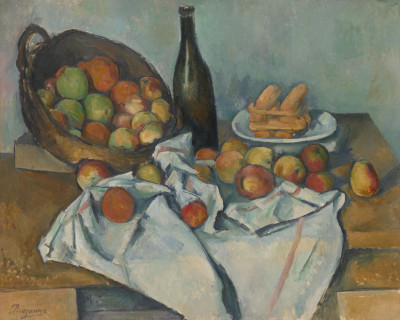
1889–90The Basket of Apples
c.1893Apples and Oranges
c.1899The Large Bathers (Philadelphia)
1900–1906 (Philadelphia Museum dating)Château Noir (MoMA)
1903–04Contents
- A stove at the centre of the room
- A picture turned away
- An early Paris interior
- What examination of the canvas reveals
- From Zola’s collection to London
A stove at the centre of the room
The stove is low and wide, resting on four curved feet. A round, lidded vessel with a loop handle sits on top; below it, the stove front is a compact collection of smaller openings and edges. A pale heap touches the floor beneath. Because the vertical pipe divides the picture, the stove first appears almost symmetrical. A longer look finds the imbalance: another vessel sits low on the left, while a small table and vase withdraw into the right-hand darkness. These unequal side notes keep the central structure from becoming a diagram.
The National Gallery suggests that Cézanne rearranged the studio objects and viewed them from above, perhaps from his easel. Its account identifies the canvas on its stretcher behind the stove and a palette at upper left; it describes a single flower in a vase on the right. [1]
The painting offers different degrees of visibility. The pale back of the canvas is readily legible, with diagonal braces at its corners. Yet the painting on its other side is withheld. The hanging objects on the dark wall are much less secure in their outlines. At upper left, warm and cool marks gather around a suspended shape; below it is a bright, nearly horizontal patch. At upper right, a small white shape seems to float against the black. The viewer can inventory some equipment without being given a complete explanation of the room.
Light works differently across those objects. It picks out the edges of the reversed canvas, glances off the vessel’s lid and catches the bottle or vase at left. The wall absorbs far more than it reveals. Where the ground meets it, a band of grey paint makes just enough floor to support the stove. The room remains compressed. One can sense an interior around the objects, but there is little open space in which to imagine walking. That compression helps the plain stove command a portrait’s share of attention.
A picture turned away
The reversed canvas is nearly as striking as the stove. Its light surface forms a backdrop, and its struts angle inward toward the chimney pipe. As a result, the structure for a painting becomes a shape in another painting. The back of the canvas is bare in a practical sense, yet it brings a question into the composition: what would be visible if it were turned around? Cézanne supplies no answer. The absence gives the painted room an especially strong sense of work paused or withheld.
The edges of the backing canvas are not treated as a neat architectural frame. They lean and narrow unevenly around the stove. The left upright is clearer than some of the crowded right side, where pale wood, dark stove and dark wall come close together. The diagonal brace at upper right appears to point toward the pipe, while the matching left brace points inward from the opposite side. A utilitarian stretcher thus gives direction to the entire arrangement. The image holds together through alignments among humble things rather than through a grand backdrop.
This choice also complicates the usual idea of a studio picture. There is no figure posed before an easel and no finished work displayed for admiration. The strongest visual evidence of painting is the reverse of a canvas. The palette and the smaller marks on the wall sit at the edge of perception. One can read the work as a view of an artist’s environment, but its subject is equally the act of selecting and organising forms. The stove, useful for warmth, becomes the commanding shape because Cézanne paints it that way.
An early Paris interior
The National Gallery considers Paris the probable setting and compares Cézanne’s scrutiny of everyday objects with Chardin’s. The catalogue identifies a studio at 22 rue Beautreillis. [1] [2]
Cézanne’s room has a terse balance. The dark wall is broad and resistant, the outlines of objects sometimes blunt, and the few pale passages must do a great deal of structural work. The stove does not merely sit among accessories. Its pipe measures the height of the picture; the round vessel on top presses against the rectangular canvas; the stove’s feet meet the grey floor. Each part tests a different shape against another: circle against rectangle, vertical against diagonal, weight against the uncertain space behind it.
Zola, Cézanne’s friend from their youth in Aix, was the painting’s first recorded owner. [2]
Jean Colrat’s account of Zola’s early writing notes that the writer named Cézanne in the dedication of his 1865 novel La Confession de Claude . [4]
What examination of the canvas reveals
Technical examination changes how we understand the painting’s present rectangle. Elisabeth Reissner reports that The Stove in the Studio has been cut down. The absence of cusping at the edges and an X-radiograph showing the canvas weave out of alignment with the stretcher support that finding. Its signature, however, aligns with the present stretcher bars. Reissner therefore concludes that Cézanne signed the painting at its current dimensions, while leaving open why it was reduced. [3]
Reissner’s pigment study identified red earth and Prussian blue in this particular work, as well as a charcoal black that may correspond to a pigment later mentioned in an account of Cézanne’s palette. She also notes straight-edged deposits of paint here that suggest local use of a palette knife. In her comparison of National Gallery pictures, this early interior has an earthy, subdued range beside later, brighter works. [3]
The dark wall is not a featureless void: small shifts of cool and warm colour help its hanging objects emerge. The brown and grey of the stove and floor stay close in tone, making the red opening at the base more telling. Paint also feels handled as matter. Thick-looking contours and dragged edges make the iron appliance seem assembled on the canvas stroke by stroke, just as the stretcher behind it is assembled from lengths of wood.
From Zola’s collection to London
After Zola, the painting moved through a sequence of dealers and collectors including Ambroise Vollard, Egisto Fabbri and Paul Rosenberg. Mrs Edith Chester Beatty bought it in 1935; the National Gallery acquired it from the family estate in 1992. [1]
The online catalogue documents exhibition titles including Le Poêle and Un Coin d’atelier : the same canvas could be presented as the stove or as a corner of the studio. [2]
At the picture’s bottom edge, the stove’s feet meet a narrow patch of floor. The eye then rises across the dark body and along the pipe, before moving outward to the pale stretcher and the small objects near the walls. That route through the image gives a domestic appliance the authority usually reserved for a person or a finished painting. The canvas facing away supplies an answering presence: making art is visible here through equipment and arrangement, even while the art on that canvas remains unseen.
Cézanne artworks directory
Browse 217 identified works in this researched selection, including paintings, drawings and watercolours. This is a bounded selection, not a complete catalogue of Cézanne’s surviving oeuvre. Unlinked titles have no confirmed article in this collection.
| Name | Date | Medium |
|---|---|---|
| A Head, a Cup, and a Bread Roll | 1891/1894 | Drawing |
| A Man seen from Behind | 1880/1883 | Drawing |
| A Modern Olympia | 1873–74 | Painting |
| A Nude and Foliage | 1879/1882 | Drawing |
| A Smoking Man | 1892–96 (catalogue); c.1890–92 (museum) | Drawing |
| Afternoon in Naples | 1876–77 | Painting |
| An Old Woman with a Rosary | about 1895–96 | Painting |
| Apples and Oranges | c.1899 | Painting |
| Auvers, Panoramic View | 1873–75 | Painting |
| Avenue at Chantilly | 1888 | Painting |
| Banks of the Marne | 1888–94 | Painting |
| Basket | 1877/1900 | Drawing |
| Bather with Outstretched Arms | 1877–78 | Painting |
| Bellows in Front of a Fireplace | 1887/1892 | Drawing |
| Bibémus Quarry | c.1895 | Painting |
| Boy in a Red Vest, Barnes Foundation | 1888–90 | Painting |
| Boy in a Red Vest, MoMA | 1888–90 | Painting |
| Boy in a Red Waistcoat, National Gallery of Art | 1888–90 | Painting |
| Branch in Flower | 1886/1889 | Drawing |
| Carnival Scene | 1885/1888 | Drawing |
| Chair and Dresser | 1880/1883 | Drawing |
| Chateau Noir | 1903–04 | Painting |
| Chestnut Trees and Farm at Jas de Bouffan | c.1885 | Painting |
| Chestnut Trees and Farm at Jas de Bouffan, Pushkin | c.1886 | Painting |
| Chestnut Trees at Jas de Bouffan in Winter | 1885–86 | Painting |
| Château Noir | 1900–04 | Painting |
| Cistern in the Park of Château Noir | c.1900 | Painting |
| Curtain, Jug and Fruit | 1893–94 | Painting |
| Cushion of an Armchair | 1886/1889 | Drawing |
| Draft Letter and Studies of Bathers | c.1878 | Drawing |
| Farmhouse and Chestnut Trees at Jas de Bouffan | 1884–85 | Painting |
| Figure Resting Head on Hand | c. 1889 | Drawing |
| Fireplace Tongs and Poker | 1887/1892 | Drawing |
| Forest Interior, San Francisco | c.1898–99 | Painting |
| Four Bathers | 1888–90 | Painting |
| Fruit and a Jug on a Table | 1893–94 | Painting |
| Gardanne | 1885–86 | Painting |
| Gardanne, Barnes Foundation | c.1885 | Painting |
| Hand and Shoulder of a Boy | c. 1885 | Drawing |
| Harlequin, National Gallery of Art | 1888–90 | Painting |
| Head of a Boy | 1887/1889 | Drawing |
| Head of a Boy Seen from Behind | c. 1885 | Drawing |
| Head of a Young Woman | c. 1880 | Drawing |
| Head of the Artist's Son | 1888/1889 | Drawing |
| Hillside in Provence | c.1890–92 | Painting |
| Horse Chestnut Trees at Jas de Bouffan | c.1885 | Painting |
| House and Farm at the Jas de Bouffan | c.1887 | Painting |
| House in a Park | 1883/1886 | Drawing |
| House in Provence | c.1885 | Painting |
| House of Père Lacroix | 1873 | Painting |
| House Surrounded by Vegetation | 1889/1892 | Drawing |
| Houses in Provence The Riaux Valley near L’Estaque | c.1883 | Painting |
| Jas de Bouffan, the Pool | c.1876 | Painting |
| Kerosene Lamp | 1878/1881 | Drawing |
| L'Estaque, Melting Snow | c.1870 | Painting |
| Lake Annecy | 1896 | Painting |
| Landscape in Provence, Pola Museum | 1879–82 | Painting |
| Landscape Near Aix-en-Provence | 1877/1880 | Drawing |
| Landscape Seen from the Inside of a Cave | 1889/1892 | Drawing |
| Landscape with Poplars | c.1885–87 | Painting |
| Landscape with Trees | 1895/1898 | Drawing |
| Leda and the Swan | c.1880 (possibly later) | Painting |
| Little Girl with a Doll | 1902–04 | Painting |
| Louis Guillaume | 1879–1890 | Painting |
| Madame Cezanne | 1888/1891 | Drawing |
| Madame Cezanne | 1886/1889 | Drawing |
| Madame Cezanne | 1882/1887 | Drawing |
| Madame Cezanne | 1897/1900 | Drawing |
| Madame Cezanne with her Head Lowered | 1893/1896 | Drawing |
| Madame Cézanne in a Red Armchair | c.1877 | Painting |
| Madame Cézanne in a Red Dress, Metropolitan Museum of Art | 1888–90 | Painting |
| Madame Cézanne in a Yellow Chair | 1888–90 | Painting |
| Madame Cézanne in a Yellow Chair, Fondation Beyeler | 1888–90 | Painting |
| Madame Cézanne in the Conservatory | 1891 | Painting |
| Maincy Bridge | 1879–80 | Painting |
| Maison Maria with a View of Château Noir | c.1895 | Painting |
| Man Bending Forward | 1883/1886 | Drawing |
| Man Smoking a Pipe, Pushkin | c.1891, possibly later | Painting |
| Man with a Pipe | 1891–96 | Painting |
| Man with a Pipe, Nelson-Atkins | 1890–92 | Painting |
| Man with a Straw Hat (Gustave Boyer) | c.1871 | Painting |
| Man with Crossed Arms | c.1899 | Painting |
| Man with Pipe, National Gallery of Art | 1892–96 | Painting |
| Mont Sainte-Victoire | c.1902–06 | Painting |
| Mont Sainte-Victoire | 1900–02 | Painting |
| Mont Sainte-Victoire (recto) | c.1895 | Watercolour |
| Mont Sainte-Victoire and the Viaduct of the Arc River Valley | 1882–85 | Painting |
| Mont Sainte-Victoire Seen beyond the Wall of the Jas de Bouffan | c.1885/1888 | Watercolour |
| Mont Sainte-Victoire Seen from Bibémus Quarry | c.1897 | Painting |
| Mont Sainte-Victoire, Barnes Foundation | 1892–95 | Painting |
| Near the Pool at Jas de Bouffan | 1883/1887 | Drawing |
| Pelicans | 1877/1880 | Drawing |
| Peonies | 1890/1893 | Drawing |
| Pierrot and Harlequin | 1888 | Painting |
| Pine Tree | 1882/1885 | Drawing |
| Pont des Trois Sautets | 1906 | Watercolour |
| Poplars | 1879–80 | Painting |
| Portrait of Ambroise Vollard | 1899 | Painting |
| Portrait of Gustave Geffroy | 1895–96 | Painting |
| Portrait of Madame Cezanne with Loosened Hair | 1885–86 | Painting |
| Portrait of the Artist Looking Over His Shoulder | 1883–84 | Painting |
| Portrait of the Gardener Vallier | 1906 | Painting |
| Portrait of Victor Chocquet | 1876–77 | Painting |
| Portrait Of Victor Chocquet Seated | 1877 | Painting |
| Provençal Manor | c.1885 | Painting |
| Pyramid of Skulls | 1898–1900 | Painting |
| Reclining Nude (Leda?) | c.1887 | Painting |
| Scipio | 1866–68 | Painting |
| Seated Man, Oslo | 1898–1900 | Painting |
| Seated Peasant | c.1892–96 | Painting |
| Seated Peasant, Hiroshima | c.1897 | Painting |
| Seated Peasant, Orsay | c.1900 | Painting |
| Self-Portrait | c. 1895 | Drawing |
| Self-Portrait in a Bowler Hat, Ny Carlsberg Glyptotek | 1885–86 | Painting |
| Self-Portrait in a Casquette | c.1875 | Painting |
| Self-Portrait with a Beret | 1898–1900 | Painting |
| Self-Portrait with a Hat, Artizon Museum | c.1890–94 | Painting |
| Self-Portrait with a Pink Background | c.1875 | Painting |
| Self-Portrait with Olive-Coloured Wallpaper | about 1880–81 | Painting |
| Self-Portrait with Palette | 1886–87 | Painting |
| Self-Portrait with White Turban | c.1878–80 | Painting |
| Self-Portrait, c.1895 | c.1895 | Painting |
| Self-Portrait, Pushkin Museum | c.1882 | Painting |
| Spanish Dancers | 1883/1886 | Drawing |
| Still Life with a Curtain | 1892–94 | Painting |
| Still Life with Apples | c.1890 | Painting |
| Still Life with Apples | 1893–94 | Painting |
| Still Life with Apples and a Pot of Primroses | about 1890 | Painting |
| Still Life with Milk Jug and Fruit | c.1900 | Painting |
| Still Life with Open Drawer | 1877–79 | Painting |
| Still Life with Plaster Cupid | about 1894 | Painting |
| Still Life with Skull | 1890–93 | Painting |
| Still Life with Soup Tureen | 1877 | Painting |
| Still Life, Pitcher and Fruit | 1893–94 | Painting |
| Studies Including a Straw Hat | 1895/1898 | Drawing |
| Studies Including Madame Cezanne | 1884/1887 | Drawing |
| Study for "The Judgement of Paris" or "The Amorous Shepherd" | 1883/1886 | Drawing |
| Study for Woman with a Coffee Pot | c.1895 | Painting |
| Study of "The Roman Orator (Germanicus)" | 1883/1886 | Drawing |
| Study of "Venus de Milo" | 1881/1884 | Drawing |
| Study of a Decorative Ornament | 1879/1882 | Drawing |
| Study of a Standing Male Figure after the Antique | c. 1895 | Drawing |
| Study of an Angel in Rubens' "The Prophet Elijah" | 1892/1895 | Drawing |
| Study of Desiderio da Settignano's "Bust of a Child" | c. 1895 | Drawing |
| Study of Houses | 1879/1882 | Drawing |
| Study of Puget's "Hercules Resting" | c. 1879 | Drawing |
| Study of Puget's "Milo of Crotona" | 1895/1898 | Drawing |
| Study of Puget's "Milo of Crotona" | 1880/1883 | Drawing |
| Study of the Allegorical Figure Bellona in Rubens' "The Apotheosis of Henri IV" | 1883/1886 | Drawing |
| Study of the Allegorical Figure Bellona in Rubens' "The Apotheosis of Henri IV" | 1879/1882 | Drawing |
| Study of the Allegorical Figure France in Rubens' "The Exchange of the Two Princesses" | 1882/1885 | Drawing |
| Study of the Allegorical Figure of Health in Rubens' "The Birth of Louis XIII" | 1880/1883 | Drawing |
| Study of the Allegorical Figure of the Genius of Health from Rubens' "The Birth of Louis XIII at Fontainbleau" | 1895/1898 | Drawing |
| Sugar Bowl, Pears and Blue Cup | 1865–66 | Painting |
| The Aqueduct, Pushkin Museum | Dating differs between museum records | Painting |
| The Artist's Father, Reading L'Evenement | autumn 1866 | Painting |
| The Artist's Son | c. 1887 | Drawing |
| The Artist's Son Leaning on his Elbow | c. 1887 | Drawing |
| The Artist's Son Reading | c. 1887 | Drawing |
| The Artist's Son Writing | c. 1887 | Drawing |
| The Artist’s Son, Paul | 1886–87 | Painting |
| The Avenue at Jas de Bouffan | 1868–70 (possibly later) | Painting |
| The Avenue at Jas de Bouffan, Geneva | c.1890 | Painting |
| The Basket of Apples | c.1893 | Painting |
| The Bather, Museum of Modern Art | c.1885 | Painting |
| The Bay of Marseille seen from L'Estaque | c.1885 | Painting |
| The Blue Vase | 1889–90 | Painting |
| The Boy in the Red Vest, Bührle | 1888–90 | Painting |
| The Buffet | 1877–79 | Painting |
| The Card Players, Barnes Foundation | 1890–92 | Painting |
| The Card Players, Courtauld Gallery | 1892–96 | Painting |
| The Card Players, Metropolitan Museum of Art | 1890–92 | Painting |
| The Card Players, Musée d’Orsay | 1893–96 | Painting |
| The Card Players, Qatar | 1892–96 | Painting |
| The Eternal Feminine | c.1877 | Painting |
| The Gardener Vallier | 1906 | Painting |
| The Gardener Vallier, Tate | 1905–06 | Painting |
| The Grounds of the Château Noir | c.1900–04 | Painting |
| The Gulf of Marseille Seen from L’Estaque | c.1885 | Painting |
| The Hanged Man's House in Auvers | c.1873 | Painting |
| The House of Doctor Gachet at Auvers | 1872–73 | Painting |
| The House with the Cracked Walls | 1892–94 | Painting |
| The Kiss of the Muse | c.1860 | Painting |
| The Large Bathers, Barnes Foundation | 1895–1906 | Painting |
| The Large Bathers, National Gallery | 1895–1905 | Painting |
| The Large Bathers, Philadelphia Museum of Art | 1900–06 | Painting |
| The Mill | 1889/1892 | Drawing |
| The Painter’s Father, Louis-Auguste Cézanne | c.1865 | Painting |
| The Peasant | 1890–92 | Painting |
| The Plaster Mill (La Moulin à plâtre) | 1889/1892 | Drawing |
| The Smoker, Hermitage | c.1891 | Painting |
| The Smoker, Mannheim | c.1891 | Painting |
| The Stove in the Studio | c.1865 | Painting |
| The Vase of Tulips | c.1890 | Painting |
| Thistle | 1893/1896 | Drawing |
| Three Heads, One of Madame Cezanne | 1882/1885 | Drawing |
| Three Skulls | c.1898 | Painting |
| Three Skulls on a Patterned Carpet | 1904 | Painting |
| Trees and Shrubs | 1883/1887 | Drawing |
| Turning Road at Montgeroult | 1898 | Painting |
| Two Bathers | 1884/1887 | Drawing |
| Two Heads | 1888 | Drawing |
| Two Heads | 1890/1896 | Drawing |
| Two Heads of Women | 1890/1894 | Drawing |
| Two Studies for "The Judgement of Paris" or "The Amorous Shepherd" | 1883/1886 | Drawing |
| Uncle Dominique in a Tasseled Cap | 1866 | Painting |
| Uncle Dominique in a Turban | 1866–67 | Painting |
| Victor Chocquet and an Angel for "The Apotheosis of Delacroix" | 1878/1880 | Drawing |
| Woman in Blue | c.1904 | Painting |
| Woman Leaning Forward | 1888/1891 | Drawing |
| Woman Leaning Forward | 1890/1894 | Drawing |
| Woman Leaning Forward | 1890/1894 | Drawing |
| Woman with a Coffee Pot | c.1895 | Painting |
| Women Bathers and a Roll of Paper | 1882/1885 | Drawing |
| Young Girl with a Doll | c.1895 | Painting |
| Young Italian Woman at a Table | c.1895–1900 | Painting |
| Young Man and Skull | 1896–98 | Painting |
Frequently Asked Questions
The online catalogue currently dates it to about 1865 but records several historical proposals, including 1866–68, so the exact year is not established. [2]
It is the back of a canvas on its stretcher, turned so that its painted face is hidden.
Yes. National Gallery technical research found physical evidence of reduction, but could not establish why it happened. [3]
Discussion
Look again at the images and ideas explored in The Stove in the Studio: Cézanne’s Room for Painting. These editorial prompts invite your observations.
Reader Insights
Look first at the stove and then at the turned canvas. How does the canvas change the kind of room you think you are seeing?
Follow the pipe from behind the lidded vessel to the top edge. Which smaller objects interrupt that strong vertical movement?
Imagine the pale stretcher removed. Would the stove feel more isolated, or would the dark wall become the main subject?
Join the Conversation
Share a detail, comparison or question about The Stove in the Studio: Cézanne’s Room for Painting below.
References
- The National Gallery, London. “Paul Cezanne: The Stove in the Studio,” collection record, including overview, facts and provenance. View source .
- Société Paul Cezanne. “Le Poêle de l’atelier,” FWN 703, The Paintings, Watercolors and Drawings of Paul Cezanne: An Online Catalogue Raisonné . View source .
- Elisabeth Reissner, National Gallery Technical Bulletin. “Ways of Making: Practice and Innovation in Cézanne’s Paintings in the National Gallery,” vol. 29 (2008), especially pp. 7–10 and 22–23. View source .
- Jean Colrat, Société Cézanne. “Le roman de Cézanne,” 2019 (in French). View source .
- Le Baiser de la muse, d'après Frillié (FWN 572). View source.
- Louis-Auguste Cezanne, père de l'artiste, lisant L'Événement (FWN 402). View source.
- La Maison du pendu, Auvers-sur-Oise (FWN 81). View source.
- Une moderne Olympia (FWN 628). View source.
- Le Pont de Maincy (FWN 143). View source.
- La Montagne Sainte-Victoire vue de Montbriand (FWN 185). View source.
- Gardanne (vue horizontale) (FWN 224). View source.
- Le Vase bleu (FWN 823). View source.
- Les Joueurs de cartes (FWN 681). View source.
- La Montagne Sainte-Victoire (FWN 296). View source.
- La Corbeille de pommes (FWN 860). View source.
- Pommes et oranges (FWN 871). View source.
- Portrait d'Ambroise Vollard (FWN 531). View source.
- Philadelphia Museum of Art,The Large Bathers,W1937-1-1. View source.
- Château Noir (FWN 360). View source.
- Société Paul Cezanne,online catalogue structure and objectidentification. View source.
- National Gallery of Art,Cezanne Sketchbook,1992.51.9. View source.
- Splash image, Paul Cézanne, The Stove in the Studio, about 1865.