by
Tom Gurney
Tom Gurney BSc (Hons) is an art history expert with over 20 years experience
Published on June 19, 2020 / Updated on October 22, 2026
Email:
tomgurney1@gmail.com
/ Phone:
+44 7429 011000
Paul Cézanne: A Life in Painting: Introduction
Paul Cézanne was born in Aix-en-Provence in 1839 and died there in 1906. Between those points he crossed France repeatedly: Paris supplied museums, artists, dealers and exhibitions; Provence supplied the family estate, seacoast, villages and mountain that he returned to paint. His life was neither a simple retreat from society nor a steady rise through its institutions. He sought the company and judgment of other painters, exhibited with the Impressionists, sustained a family, worked for decades without broad approval, and lived long enough to see a substantial change in his reputation. The record of these movements helps explain why his pictures can feel at once so closely observed and so deliberately made. [1]
A still life by Cézanne asks the eye to follow a rim, an apple or a fold as colour and line adjust their relations across the whole canvas. His landscapes require a comparable attention to the interval between near trees, houses and distant ground. These were persistent working problems across changing subjects, places and decades. The dark, forceful pictures of the 1860s, the outdoor paintings made near Pissarro in the 1870s and the late Aix watercolours do not share a single recipe. They show an artist returning to observation while revising how a picture might hold together. [1]
At a Glance
- Born 19 January 1839, Aix-en-Provence; his birth declaration names his father, Louis-Auguste Cezanne, as a hatter. [2]
- Died In the night of 22–23 October 1906, Aix-en-Provence. [3]
- Family Partner and later husband of Hortense Fiquet; their son Paul was born in 1872. [3]
- Working places Aix and the Jas de Bouffan; Paris and its environs; L’Estaque, Gardanne, Bibémus, Château Noir and the Lauves studio. [3]
- Public milestones First and third Impressionist exhibitions in 1874 and 1877; official Salon appearance in 1882; first solo show with Ambroise Vollard in 1895; posthumous Paris exhibitions in 1907. [1]
Paul Cézanne in context
Impressionist exhibitions
1874–1886: eight independent exhibitionsCubism
1907–1914: early developmentPaul Cézanne
1839–1906 (lifespan)Paul Gauguin
1848–1903 (lifespan)Georges Seurat
1859–1891 (lifespan)Vincent van Gogh
1853–1890 (lifespan)The Kiss of the Muse
c.1860The Artist’s Father, Reading L’Événement
autumn 1866The Hanged Man’s House
c.1873A Modern Olympia
1873–74Maincy Bridge
1879–80The Blue Vase
1889–90The Basket of Apples
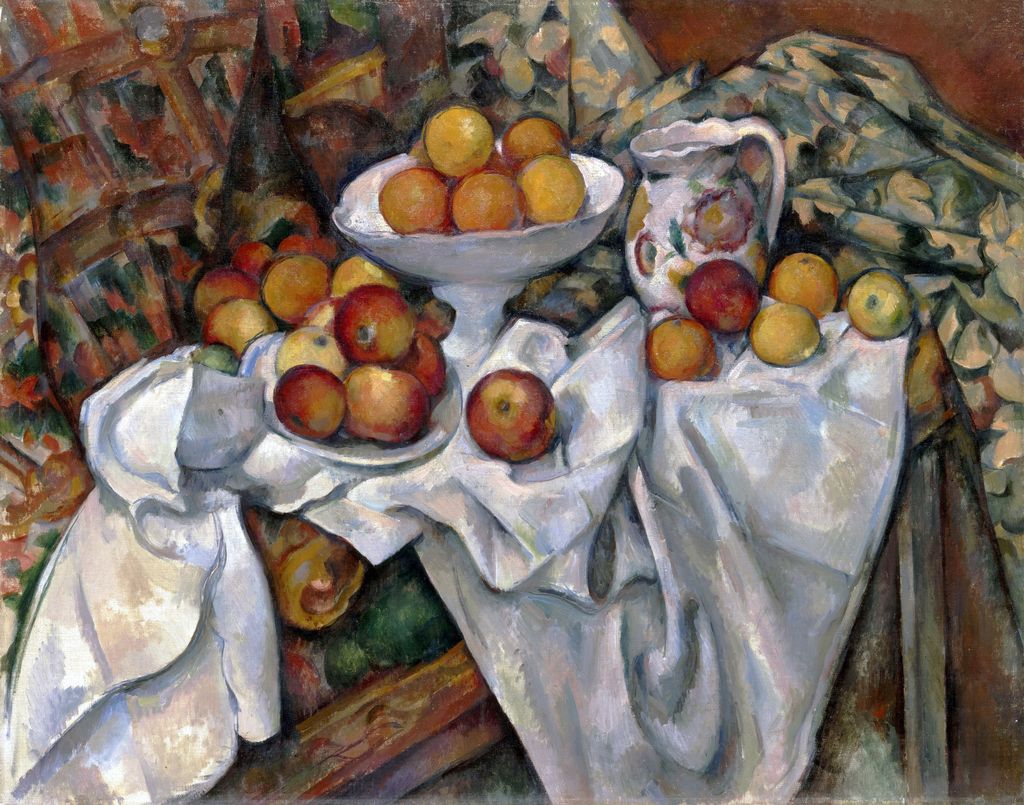
c.1893Apples and Oranges
c.1899The Large Bathers (Philadelphia)
1900–1906 (Philadelphia Museum dating)Château Noir (MoMA)
1903–04Four stages of Paul Cézanne’s career
These periods group related developments; painting, travel and local work overlap across their boundaries.
Training and early experiments
Drawing study in Aix and visits to Paris established a practice that included portraits, imagined scenes and landscape. [4]
Working with Pissarro and exhibiting independently
Work with Pissarro and participation in the exhibitions of 1874 and 1877 accompanied continuing movement between Paris and Provence. [4]

Landscape, portraiture and still life
Gardanne, L’Estaque and Mont Sainte-Victoire joined portraits, card players and still lifes among recurring subjects. [4]
Exhibitions and work around Aix
Vollard’s 1895 exhibition increased visibility. Cézanne continued painting around Aix, where landscape, still life and bathers remained important. [4]

Contents
- 1839–1861: An Aix childhood and a changing family world
- 1861–1871: Paris, return journeys and the forceful early pictures
- 1872–1877: Working beside Pissarro and exhibiting independently
- 1878–1887: Family, Provence and a new pictorial structure
- 1888–1899: Extended work, family movement and widening recognition
- 1899–1906: The Lauves studio and a late career still in motion
- What changed after his death
1839–1861: An Aix childhood and a changing family world
Cézanne’s civil birth record places him in a working household, not a banking dynasty already established at his birth. Louis-Auguste was a hatter and Anne-Élisabeth-Honorine Aubert also worked in the trade. They married in 1844, five years after Paul’s birth. His father later moved into banking and acquired the Jas de Bouffan estate outside Aix in 1859. This change in the family’s means mattered materially: the house and its grounds eventually provided Cézanne with subjects and working space over nearly forty years. It did not make his decision to paint easy or remove the tensions between a father’s business expectations and a son’s chosen work. [2] [3]
At the Collège Bourbon, Cézanne became close to Émile Zola and Baptistin Baille. The friendship with Zola would carry into adult correspondence, periods in Paris and a shared interest in literature and art. The familiar story that Zola repaid young Cézanne’s defence with a basket of apples comes from Joachim Gasquet’s much later account; it is an anecdote about how the friendship was remembered, not a contemporary record of a childhood exchange. Their documented schooling and later letters give the relationship a firmer footing than that charming scene. [3]
Cézanne entered the free drawing school in Aix in 1857. Training there belonged to a nineteenth-century culture in which drawing from models, copies and geometric forms could serve artisans as well as aspiring artists. He also encountered the Musée Granet’s collections. Such study complicates the idea of an untaught provincial genius: he learned by looking, drawing and copying before any long stay in Paris. It would be tempting to trace his famous late words about cylinders, spheres and cones directly back to this school. The curriculum establishes a possible continuity of concerns, but no surviving evidence makes it a proven source of the 1904 letter. [5]
The Jas de Bouffan was another classroom, though one created through experiment rather than a course of study. Cézanne painted on the walls of the family house, testing ambitious figure subjects as well as portraits and landscape. Nine mural panels have long been associated with the site. Research around a fragment rediscovered in 2023 has reopened questions about their exact order and development. That uncertainty is useful: the house was a working place over time, not a single early project that can be neatly dated from beginning to end. [6]
For a closer account of the family records, Aix training and first paintings, see Cézanne’s early years .
1861–1871: Paris, return journeys and the forceful early pictures
In 1861 Cézanne made his first extended journey to Paris, where Zola was already living. He visited the Louvre, encountered the official Salon and worked among students at the Académie Suisse. He returned to Aix, spent time in his father’s bank, and went north again. The repeated movement matters more than a fictitious date when he left Provence for good. Through the 1860s he learned in museums, informal studios and artists’ company, without following a completed course at the École des Beaux-Arts. [3]
The Louvre gave him historical painting at first hand: classical figure arrangements, Venetian colour and the expressive possibilities of Romantic painting could all be studied in the galleries. Research on his copies shows that he looked to paintings by earlier masters as active material for his own work. His Paris experience also placed him near Pissarro and Armand Guillaumin at the Académie Suisse and among a generation testing the authority of Salon taste. Interest in the Salon des Refusés did not mean that he stopped submitting to official exhibitions. Rather, rejection and renewed attempts coexisted with his need to find other viewers. [3] [7]
Early Cézanne is often compressed into the word “dark.” The Met’s account of the 1860s pictures identifies dramatic light and shade, thick pigment and paint sometimes pushed with a knife. Portraits of his uncle Dominique Aubert in changing costume show how strongly he could assert a head and body through dense passages of paint. He also worked on imaginary, literary and violent subjects. These pictures were various in subject and scale; their physical force was a way of testing what paint could do, rather than evidence that the later landscapes were waiting fully formed beneath them. [1]
At the Jas, the portraits and wall paintings had a different setting from a Paris Salon canvas. They were made within the family property and could be revisited. A wall panel is not interchangeable with a portable oil painting: it fixes an experiment in the architecture where he lived. That continuity between place and practice became increasingly important in his career, even as the subjects and handling altered. The recently recovered mural fragment is a reminder that surviving objects can still change the chronology that biographers thought they knew. [6]
In 1869 Cézanne met Hortense Fiquet, who would become his partner, the mother of his son and one of his most frequently painted sitters. They were together at L’Estaque during the Franco-Prussian War. Their son Paul was born in Paris on 4 January 1872. His father did not initially know about Hortense and the child. These facts explain some of the practical complexity of travel and household arrangements in the following decades, but the surviving evidence is too thin to turn them into a confident account of either partner’s inner life. [8] [3]
1872–1877: Working beside Pissarro and exhibiting independently
The period around Pontoise and Auvers brought a striking change in Cézanne’s painting. He and Camille Pissarro worked near one another in 1872–73, looking at roads, fields, houses and hillsides in changing light. Outdoor work encouraged a lighter palette and a more sustained attention to observed colour. It would be too simple to call Pissarro the source of every change: Cézanne had his own subjects and questions, and their professional friendship continued beyond these years. Yet the evidence of shared painting places this transformation within a working relationship rather than a solitary revelation. [1] [9]
At Auvers, the village provided steep paths and buildings packed together on rising ground. In The Hanged Man’s House , made around 1873, the roof lines and road pull the viewer into a scene that remains stubbornly constructed. The title has generated stories about the house; the painting’s biography is more securely connected to the place Cézanne painted and the exhibition in which it appeared. Compared with his earlier heavy, high-contrast work, outdoor colour now carries more of the composition. The picture is still markedly different from an easy shorthand of Impressionism as flickering, momentary sensation. [1] [10]
Hortense and young Paul lived at Auvers in 1873. Dr Paul Gachet and other sympathisers formed part of a network around the artists. Such connections mattered before Cézanne had a dealer capable of mounting a large solo show. They gave him places to work, people who would look closely, and occasional buyers. The career was shaped by these small circles as much as by the better-known public confrontations of 1874 and 1877. [3] [10]
From 15 April to 15 May 1874, Cézanne exhibited three works at the first independent exhibition in Paris, including The Hanged Man’s House and A Modern Olympia . The latter picture, with its pointed treatment of a modern nude and onlookers, was bound to challenge expectations in a different way from the Auvers landscape. Contemporary responses were mixed. The Société’s year chronology gathers satire and hostile reviews, but also favourable notice and the purchase of The Hanged Man’s House by Count Doria. A story of universal rejection erases the beginning of a real, if narrow, audience. [10]
He did not participate in the second independent exhibition of 1876. A later explanation by Georges Rivière links his absence to reservations about the premises, but it cannot stand as a direct record of his private reason. He returned for the third exhibition in April 1877, where sixteen works were catalogued and another was shown without a catalogue entry. The breadth of that display placed landscapes, portraits and still lifes before viewers together. The reviews again exposed a gap between what some contemporaries thought painting should look like and the insistent, sometimes awkward relations Cézanne was making on canvas. [11]
One reason the Impressionist years matter is that they widened the kinds of subject Cézanne could sustain. Landscape was no longer only a setting for a figure or a display of bravura handling. A steep road, pale wall and bank of foliage could become the main event. Yet he did not simply trade thick paint for quick notation. In the Auvers pictures, a building can feel almost wedged into the terrain, and strokes laid side by side can give solidity to a scene caught in daylight. The work is about duration as much as passing light: he had to stay with the motif long enough to make its parts cohere. [1] [9]
The contrast with A Modern Olympia also prevents the 1874 exhibition from being turned into a single episode in the history of landscape. That canvas belongs to Cézanne’s sustained interest in figures, staged looking and the art of his contemporaries. It was shown next to a picture of ordinary houses and a road. Viewers thus encountered a painter whose subjects could appear to pull in opposite directions: outdoor topography and provocative studio composition. The later bathers and figure groups would continue that double investment in observed place and constructed bodies. [1] [10]
The 1877 show was his last with the Impressionist group. That fact does not mark a clean stylistic divorce. He kept exchanging ideas and letters with Pissarro; colour, outdoor looking and a freedom from Salon finish remained important. At the same time, his pictures increasingly held objects and terrain through calibrated relationships of colour and contour, often with a slower, more cumulative surface. The Pissarro and Impressionism chapter follows the exhibitions and the paintings in greater detail. [1]
1878–1887: Family, Provence and a new pictorial structure
After 1877 Cézanne continued to move between Provence and the Paris region. A draft letter to his parents from about 1874 had already stressed the freedom he needed to work in both places; because it survives as a draft, it cannot prove that he sent those words. His later itinerary nevertheless shows why a one-way tale of “returning to Aix” is misleading. The city and the countryside around it became more central in the 1880s, but the Paris art world and northern relationships remained in view. [3] [12]
The Jas acquired a roof studio in the early 1880s. From there and from sites reached on foot or by travel, Cézanne could reconsider familiar motifs under changing conditions. The family property was both a resource and a place shaped by other lives: his parents, sister, Hortense and son all had their own arrangements around it. Treating the house only as a private retreat misses that domestic and practical setting. It also misses the value of repeated access to trees, architecture and a distant mountain when a painter worked slowly. [3] [6]
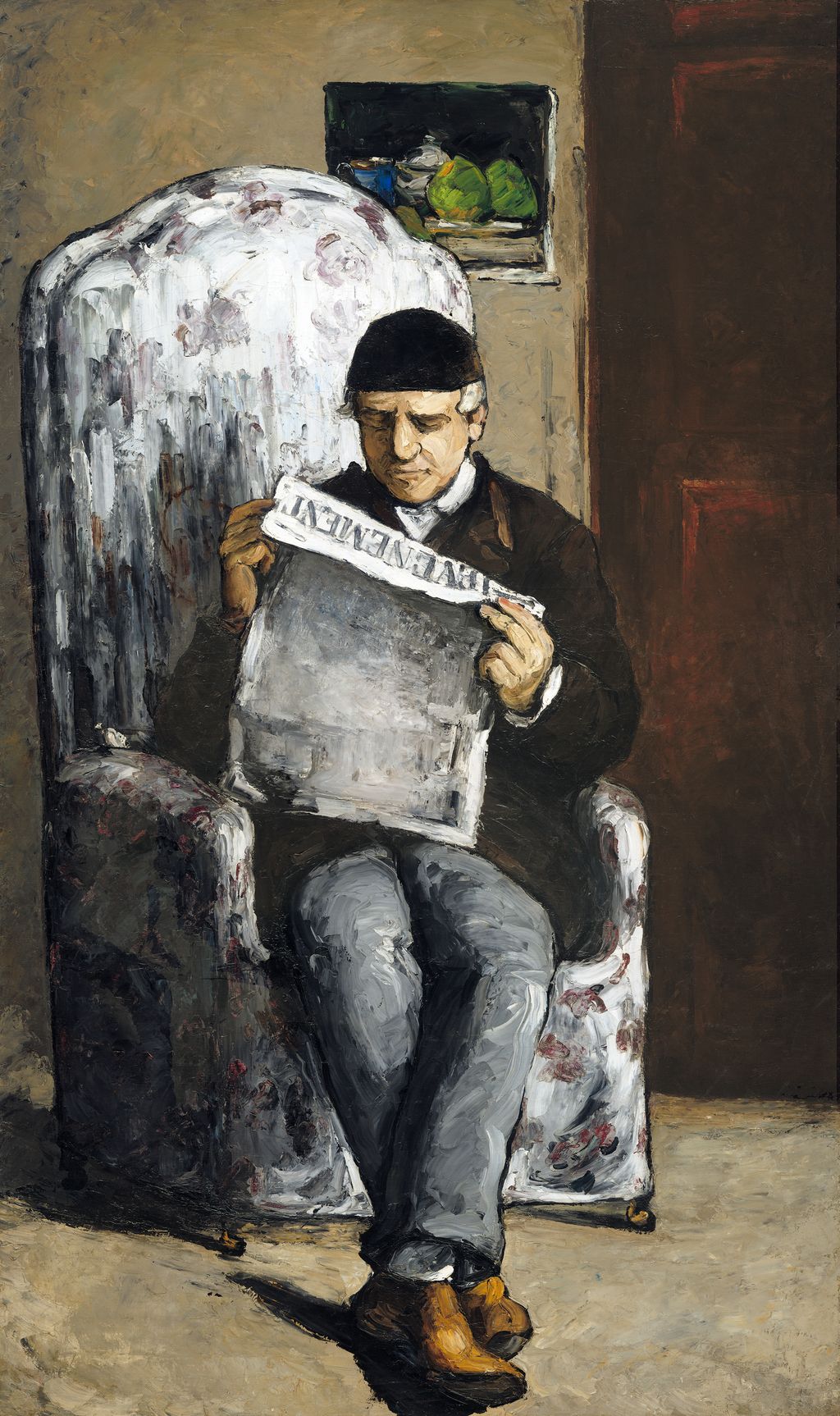
Cézanne made his only appearance at the official Salon in 1882. Its catalogue lists Portrait de M. L. A... ; the National Gallery of Art identifies that entry with his 1866 portrait of his father as probable, rather than certain. Either way, this brief appearance shows that his involvement with public institutions did not end with the Impressionist exhibitions. The likely exhibited canvas had been painted sixteen years earlier, so the Salon date should not be mistaken for the date of the family portrait. [3] [13]
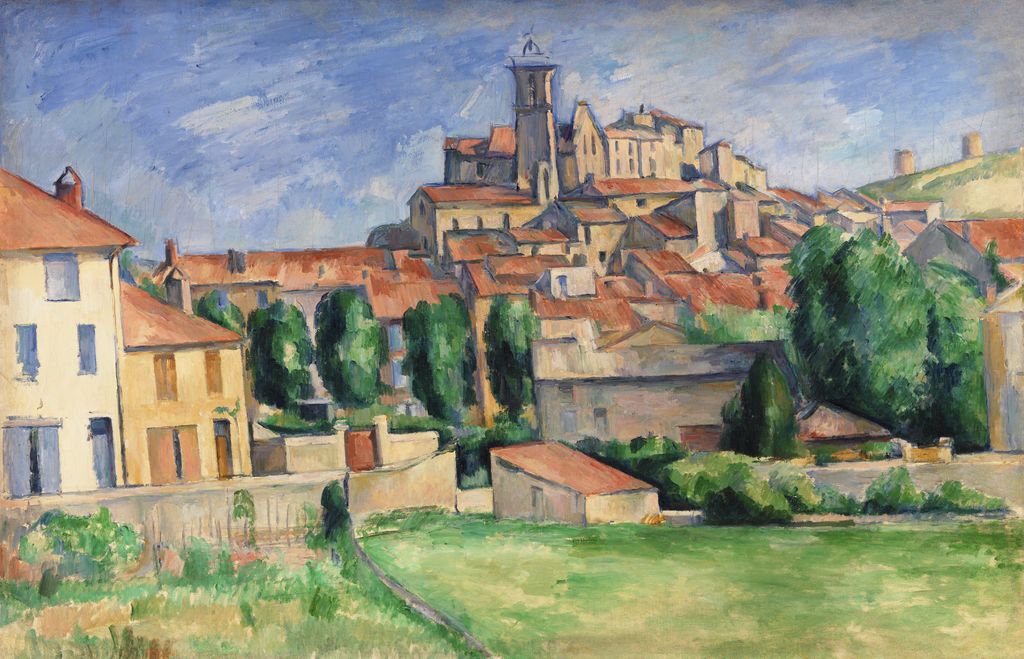
L’Estaque, near Marseille, offered another kind of sustained looking. In paintings of its bay, shoreline, roofs and distant hills, Cézanne arranged broad zones of sea and land while keeping the weight of individual buildings. The Met’s Gulf of Marseille Seen from L’Estaque , dated around 1885, provides a useful example: recession develops through adjoining planes, with the small town and the bay made to answer one another. Around Gardanne, painted in 1885–86, the clustered houses become a set of rising, interlocking masses. The village is recognisable, but the composition requires its own balance as an arrangement of colour and shape. [1]
Mont Sainte-Victoire entered an expanding body of landscapes in these years. In the Met’s Mont Sainte-Victoire and the Viaduct of the Arc River Valley , dated 1882–85, the bridge and mountain make two very different kinds of measure. The built line crosses the valley while the mountain settles into the distance; trees and fields mediate between them. This is a picture of a particular place, and also a study of how planes and intervals can make distance credible on a flat surface. Later paintings would approach the mountain from different viewpoints and with different degrees of openness. No single Sainte-Victoire canvas can stand for the whole series. [1]
Cézanne married Hortense on 28 April 1886. His father died in October, leaving resources that changed the artist’s material circumstances. Their son was already fourteen. The sequence establishes neither a financial explanation for the marriage nor a later family estrangement. The Met’s Dita Amory notes that Hortense posed for as many as twenty-nine paintings and many drawings: extensive shared studio time is documented, while evidence for their private relationship outside it remains scarce. [3] [8]
Her seated figure could anchor a large composition while the relation of face, dress, chair and background changed from canvas to canvas. In the Met’s Madame Cézanne in a Red Dress , dated around 1888–90, broad areas of the garment’s colour hold the body in space. The picture offers evidence of sustained looking and painterly revision; its hard-to-read expression does not establish Hortense’s character or the emotional course of the marriage. [8]
Zola’s novel L’Œuvre appeared in 1886, and for many years biographies made it the moment of a final rupture: Cézanne supposedly recognised himself in the failed painter Claude Lantier and broke off their friendship forever. The documentary sequence is less tidy. Cézanne acknowledged the book in April 1886. A letter written in November 1887 thanks Zola for La Terre and says he will come to shake his hand when Zola returns. That letter disproves the claim of a documented, permanent break in 1886. It does not establish that the proposed meeting took place, or tell us exactly how their friendship later changed. The Zola scholar Alain Pagès has pressed this distinction against the older, influential rupture story. [14] [15]
1888–1899: Extended work, family movement and widening recognition
The later 1880s and 1890s were years of movement rather than a decade spent motionless at the Jas. The Société’s broad chronology places much of 1888–95 in Paris or its environs, interrupted by travels that included Franche-Comté and Switzerland in 1890. Back in Provence, Cézanne returned to the estate and nearby motifs. The shifting pattern allowed him to work among art-world contacts while repeatedly testing pictures against the landscapes and people he knew. It also meant that his family’s residences could vary from season to season; no single address captures their whole arrangement. [16]
Hortense’s own letter of 1 August 1890 to Madame Victor Chocquet gives a rare view from within this movement. Writing during the family’s stay in Franche-Comté, she reported that poor weather had interrupted her husband’s work, but that he continued going out to the landscape. The letter is valuable because it documents travel, practical conditions and her observation in her own voice. It cannot authorize speculative identification of every picture painted on the journey. It also resists a biography that allows Hortense to appear only as a mute figure in portraits. [17]
Around 1890 Cézanne began the project that became The Card Players . The subject grew through studies of men at the Jas and several painted arrangements, including multi-figure groups and pairs facing one another across a table. Their exact order remains debated. The Met dates its multi-figure canvas to 1890–92. This was no simple report of an afternoon game. Hats, arms, chairs and tabletop carry a carefully negotiated architecture; the encounter between players holds attention without requiring an invented dramatic narrative. The series belongs to his long engagement with local people, repetition and revision. It also shows that figure painting remained central while the landscapes and still lifes were changing. [1]
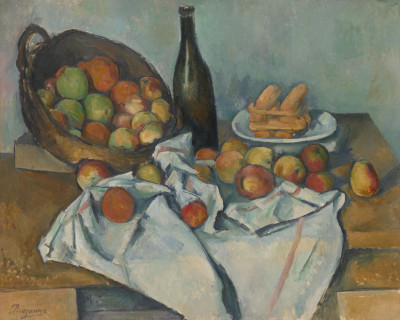
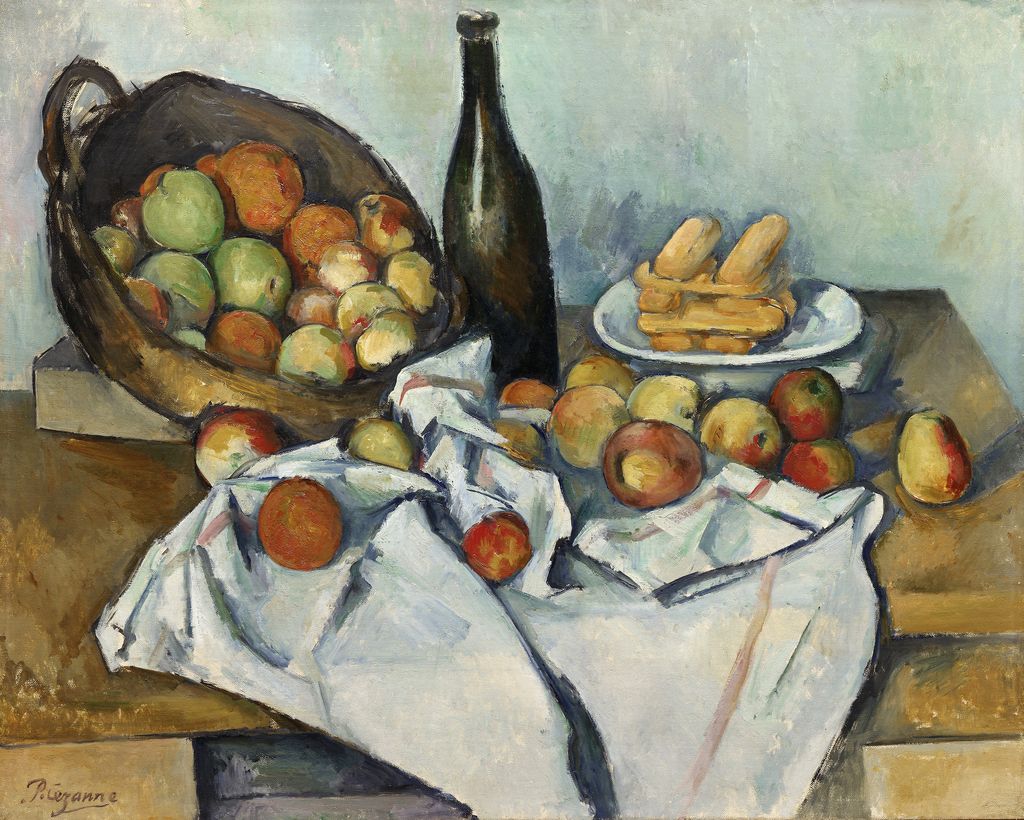
Still lifes of these years moved familiar things through equally demanding arrangements. In the Met’s Still Life with Apples and a Pot of Primroses , dated about 1890, fruit, vessel, flowers and cloth are related by subtle differences of colour and angle. A table edge may seem to change direction; an apple’s roundness develops through neighbouring patches rather than a single dark outline. Looking at such pictures as deliberate experiments is more useful than treating their departures from textbook perspective as failures or as a code to be decoded. They ask how objects can be distinct yet held in a coherent painted field. [1]
Before Vollard’s exhibition, collectors and fellow artists had already supported Cézanne. Count Doria bought The Hanged Man’s House in 1874; Victor Chocquet collected his work; and an 1887 account of Eugène Murer’s collection lists several Cézannes alongside paintings by his independent contemporaries. Such circles were small, but they gave his pictures a life beyond the studio and the exhibition reviews. [10] [15]
Ambroise Vollard’s first solo exhibition of Cézanne in Paris in 1895 enlarged that audience. Cézanne remained in Aix beside his ill mother, yet the Granet chronology also records him showing two landscapes at an Aix artists’ exhibition that year. Vollard’s stockbooks document an active market in different media: in December, for example, the Count of Camondo bought five watercolours for 600 francs. Press and private responses were mixed; a show and sales made the work more visible without producing unanimous approval. The Met traces the widening circle through artists and collectors including Mary Cassatt and the Havemeyers. [3] [18] [1]
His mother died in 1897. He rented a cabin in the Bibémus quarry that year, and the stone faces and pines around Aix supplied further sites for study. The Jas de Bouffan was sold in 1899. Its loss ended an unusually long relationship between one working place and a family’s property, but it did not end Cézanne’s work in Provence. He used other accommodation, settled at rue Boulegon in 1900, and soon began planning a purpose-built studio above Aix. These changes are important to the pictures: the environment remained familiar, while routes to motifs and the facilities for large canvases changed. [3] [6]
1899–1906: The Lauves studio and a late career still in motion
In November 1901 Cézanne bought land at Les Lauves; the studio was completed late the following year. It offered controlled light, space for canvases and a place to arrange still lifes and figures. Yet a studio address cannot account for the whole late oeuvre. Cézanne went to sites around Aix, including Bibémus, Château Noir and viewpoints toward Sainte-Victoire. He worked in oils, watercolour and drawing, sometimes treating the same kind of motif differently across media. [3] [16]
The late bathers made an especially ambitious demand. Figures invented and reworked from drawing had to inhabit a landscape credible on its own terms. In the large compositions, bodies and trees can create a kind of architectural span, even as their exact relations resist conventional perspective. Cézanne had treated bathers since the 1870s, so the late canvases should be seen as an extended return to a difficult problem rather than a sudden final subject. The Philadelphia Large Bathers is one monumental version; the Barnes and National Gallery canvases are distinct works with their own sizes, dates and histories. [1]
Visitors and correspondents complicate the image of a man wholly cut off in a studio. Young artists and critics sought him out. His letters to Émile Bernard in 1904 and 1905 show a painter explaining and questioning his practice, not issuing a finished doctrine. On 15 April 1904, writing to Bernard, he proposed treating nature through cylinder, sphere and cone, then immediately discussed perspective, the horizon, depth and the role of blue in making air palpable. The famous three shapes are therefore part of a practical problem about painting what is seen. In July he resisted being right merely in theory, insisting on work from nature. These are his dated written words; later reported conversations by Bernard or Gasquet have a different evidentiary status. [19]
The same correspondence returns to the old masters and to the Louvre. For Cézanne, museum study and direct observation were connected practices across a lifetime: copies and figure compositions did not disappear when landscape became central. That combination also helps explain why his pictures could appeal to later artists with quite different aims. Some saw structure, some colour, some a refusal of inherited finish. It does not follow that Cézanne designed Cubism in advance. His statements concern the work he was trying to do before nature, and any account of later influence must preserve the difference between his questions and others’ answers. [19] [1]
Watercolour remained one part of this late work. Pencil lines, translucent colour and unpainted paper could share the task of describing a mountain, tree or still life. The exposed sheet is unlike a heavily revised oil surface, and its openness should not be used as a simple measure of whether Cézanne considered a work finished. The letters give a more useful account of his concern: how colour, depth and sensation could be made visible through continued practice. [19]
The late career was public as well as local. Works appeared at the Salon d’Automne, and Vollard and other dealers continued to move paintings. The Société’s 1906 chronology records London exhibition and press discussion within Cézanne’s lifetime, alongside reactions that were still divided. Some writers praised his contribution to a more open exhibition culture; others dismissed his painting as incomplete or incomprehensible. Recognition had expanded decisively, but there was no single verdict shared by every contemporary viewer. [20]
Illness made the final years harder, and letters document both his effort and everyday practical needs. In October 1906 he wrote to his son that he continued to work with difficulty. Correspondence with a paint supplier nearby in date shows a painter still attending to materials. On 15 October he collapsed after painting outside during a storm. He developed pneumonia and died at his rue Boulegon apartment in the night of 22–23 October; he was buried in Aix. The chronology is moving enough without claiming that a single final canvas, brushstroke or journey can be identified with certainty as the cause or symbol of his death. [20] [3]
For a closer account of the changing Aix studios, nearby sites, visitors and last letters, see Cézanne’s late years in Aix .
What changed after his death
Paris exhibitions at Galerie Bernheim-Jeune and the 1907 Salon d’Automne put Cézanne’s work before a still larger audience. They accelerated a reputation that the 1895 Vollard show, collectors and later lifetime exhibitions had already begun to build. Rainer Maria Rilke’s letters on seeing the 1907 work are testimony to one unusually attentive viewer. They tell us about reception after Cézanne’s death, not about the painter’s private intention when a canvas was made. Other critics responded differently, and later artists selected different lessons from the pictures. [1] [21]
The 1907 audience could view the work across several decades at once. That changed the scale of comparison. A picture that had once seemed an isolated provocation could now be considered alongside earlier portraits, still lifes and landscapes, revealing both continuity and alteration. Rilke’s response is especially valuable because he wrote as someone confronting the pictures in exhibition, rather than as a later historian looking back through an already settled reputation. Even so, his is one account among many. The record of sales, hostile notices, sympathetic painters and posthumous displays shows reception being made through successive encounters, not conferred by a single exhibition or by posterity alone. [21] [18]
The influence of Cézanne’s painting likewise needs a plural account. A later painter could study the compressed planes of Gardanne, the shifting edge of a still life, or the relation of figure and landscape in the bathers and carry away different possibilities. Calling Cézanne a “father” of twentieth-century art can obscure those differences and flatten the decades of work that made them possible. The biography offers a clearer explanation: repeated subjects, exacting observation, changing techniques, periods of shared practice and sustained public debate gave later artists an unusually rich body of pictures to argue with. [1]
The full life resists a neat progression from youthful rebellion to mature certainty. Cézanne returned to Aix yet kept Paris relationships; painted outdoors yet valued the Louvre; sought a public yet kept testing works that could frustrate it. He could make a portrait, a still life or a mountain view into a prolonged inquiry without reducing the subject to an abstract formula. The surviving documents show where he worked, whom he met, what he exhibited and, occasionally, what he wrote about painting. The pictures add the harder evidence of decisions made in paint. Reading both together offers a richer biography than the familiar legend of a solitary genius discovered too late. [3] [1]
Cézanne artworks directory
Browse 217 identified works in this researched selection, including paintings, drawings and watercolours. This is a bounded selection, not a complete catalogue of Cézanne’s surviving oeuvre. Unlinked titles have no confirmed article in this collection.
| Name | Date | Medium |
|---|---|---|
| A Head, a Cup, and a Bread Roll | 1891/1894 | Drawing |
| A Man seen from Behind | 1880/1883 | Drawing |
| A Modern Olympia | 1873–74 | Painting |
| A Nude and Foliage | 1879/1882 | Drawing |
| A Smoking Man | 1892–96 (catalogue); c.1890–92 (museum) | Drawing |
| Afternoon in Naples | 1876–77 | Painting |
| An Old Woman with a Rosary | about 1895–96 | Painting |
| Apples and Oranges | c.1899 | Painting |
| Auvers, Panoramic View | 1873–75 | Painting |
| Avenue at Chantilly | 1888 | Painting |
| Banks of the Marne | 1888–94 | Painting |
| Basket | 1877/1900 | Drawing |
| Bather with Outstretched Arms | 1877–78 | Painting |
| Bellows in Front of a Fireplace | 1887/1892 | Drawing |
| Bibémus Quarry | c.1895 | Painting |
| Boy in a Red Vest, Barnes Foundation | 1888–90 | Painting |
| Boy in a Red Vest, MoMA | 1888–90 | Painting |
| Boy in a Red Waistcoat, National Gallery of Art | 1888–90 | Painting |
| Branch in Flower | 1886/1889 | Drawing |
| Carnival Scene | 1885/1888 | Drawing |
| Chair and Dresser | 1880/1883 | Drawing |
| Chateau Noir | 1903–04 | Painting |
| Chestnut Trees and Farm at Jas de Bouffan | c.1885 | Painting |
| Chestnut Trees and Farm at Jas de Bouffan, Pushkin | c.1886 | Painting |
| Chestnut Trees at Jas de Bouffan in Winter | 1885–86 | Painting |
| Château Noir | 1900–04 | Painting |
| Cistern in the Park of Château Noir | c.1900 | Painting |
| Curtain, Jug and Fruit | 1893–94 | Painting |
| Cushion of an Armchair | 1886/1889 | Drawing |
| Draft Letter and Studies of Bathers | c.1878 | Drawing |
| Farmhouse and Chestnut Trees at Jas de Bouffan | 1884–85 | Painting |
| Figure Resting Head on Hand | c. 1889 | Drawing |
| Fireplace Tongs and Poker | 1887/1892 | Drawing |
| Forest Interior, San Francisco | c.1898–99 | Painting |
| Four Bathers | 1888–90 | Painting |
| Fruit and a Jug on a Table | 1893–94 | Painting |
| Gardanne | 1885–86 | Painting |
| Gardanne, Barnes Foundation | c.1885 | Painting |
| Hand and Shoulder of a Boy | c. 1885 | Drawing |
| Harlequin, National Gallery of Art | 1888–90 | Painting |
| Head of a Boy | 1887/1889 | Drawing |
| Head of a Boy Seen from Behind | c. 1885 | Drawing |
| Head of a Young Woman | c. 1880 | Drawing |
| Head of the Artist's Son | 1888/1889 | Drawing |
| Hillside in Provence | c.1890–92 | Painting |
| Horse Chestnut Trees at Jas de Bouffan | c.1885 | Painting |
| House and Farm at the Jas de Bouffan | c.1887 | Painting |
| House in a Park | 1883/1886 | Drawing |
| House in Provence | c.1885 | Painting |
| House of Père Lacroix | 1873 | Painting |
| House Surrounded by Vegetation | 1889/1892 | Drawing |
| Houses in Provence The Riaux Valley near L’Estaque | c.1883 | Painting |
| Jas de Bouffan, the Pool | c.1876 | Painting |
| Kerosene Lamp | 1878/1881 | Drawing |
| L'Estaque, Melting Snow | c.1870 | Painting |
| Lake Annecy | 1896 | Painting |
| Landscape in Provence, Pola Museum | 1879–82 | Painting |
| Landscape Near Aix-en-Provence | 1877/1880 | Drawing |
| Landscape Seen from the Inside of a Cave | 1889/1892 | Drawing |
| Landscape with Poplars | c.1885–87 | Painting |
| Landscape with Trees | 1895/1898 | Drawing |
| Leda and the Swan | c.1880 (possibly later) | Painting |
| Little Girl with a Doll | 1902–04 | Painting |
| Louis Guillaume | 1879–1890 | Painting |
| Madame Cezanne | 1888/1891 | Drawing |
| Madame Cezanne | 1886/1889 | Drawing |
| Madame Cezanne | 1882/1887 | Drawing |
| Madame Cezanne | 1897/1900 | Drawing |
| Madame Cezanne with her Head Lowered | 1893/1896 | Drawing |
| Madame Cézanne in a Red Armchair | c.1877 | Painting |
| Madame Cézanne in a Red Dress, Metropolitan Museum of Art | 1888–90 | Painting |
| Madame Cézanne in a Yellow Chair | 1888–90 | Painting |
| Madame Cézanne in a Yellow Chair, Fondation Beyeler | 1888–90 | Painting |
| Madame Cézanne in the Conservatory | 1891 | Painting |
| Maincy Bridge | 1879–80 | Painting |
| Maison Maria with a View of Château Noir | c.1895 | Painting |
| Man Bending Forward | 1883/1886 | Drawing |
| Man Smoking a Pipe, Pushkin | c.1891, possibly later | Painting |
| Man with a Pipe | 1891–96 | Painting |
| Man with a Pipe, Nelson-Atkins | 1890–92 | Painting |
| Man with a Straw Hat (Gustave Boyer) | c.1871 | Painting |
| Man with Crossed Arms | c.1899 | Painting |
| Man with Pipe, National Gallery of Art | 1892–96 | Painting |
| Mont Sainte-Victoire | c.1902–06 | Painting |
| Mont Sainte-Victoire | 1900–02 | Painting |
| Mont Sainte-Victoire (recto) | c.1895 | Watercolour |
| Mont Sainte-Victoire and the Viaduct of the Arc River Valley | 1882–85 | Painting |
| Mont Sainte-Victoire Seen beyond the Wall of the Jas de Bouffan | c.1885/1888 | Watercolour |
| Mont Sainte-Victoire Seen from Bibémus Quarry | c.1897 | Painting |
| Mont Sainte-Victoire, Barnes Foundation | 1892–95 | Painting |
| Near the Pool at Jas de Bouffan | 1883/1887 | Drawing |
| Pelicans | 1877/1880 | Drawing |
| Peonies | 1890/1893 | Drawing |
| Pierrot and Harlequin | 1888 | Painting |
| Pine Tree | 1882/1885 | Drawing |
| Pont des Trois Sautets | 1906 | Watercolour |
| Poplars | 1879–80 | Painting |
| Portrait of Ambroise Vollard | 1899 | Painting |
| Portrait of Gustave Geffroy | 1895–96 | Painting |
| Portrait of Madame Cezanne with Loosened Hair | 1885–86 | Painting |
| Portrait of the Artist Looking Over His Shoulder | 1883–84 | Painting |
| Portrait of the Gardener Vallier | 1906 | Painting |
| Portrait of Victor Chocquet | 1876–77 | Painting |
| Portrait Of Victor Chocquet Seated | 1877 | Painting |
| Provençal Manor | c.1885 | Painting |
| Pyramid of Skulls | 1898–1900 | Painting |
| Reclining Nude (Leda?) | c.1887 | Painting |
| Scipio | 1866–68 | Painting |
| Seated Man, Oslo | 1898–1900 | Painting |
| Seated Peasant | c.1892–96 | Painting |
| Seated Peasant, Hiroshima | c.1897 | Painting |
| Seated Peasant, Orsay | c.1900 | Painting |
| Self-Portrait | c. 1895 | Drawing |
| Self-Portrait in a Bowler Hat, Ny Carlsberg Glyptotek | 1885–86 | Painting |
| Self-Portrait in a Casquette | c.1875 | Painting |
| Self-Portrait with a Beret | 1898–1900 | Painting |
| Self-Portrait with a Hat, Artizon Museum | c.1890–94 | Painting |
| Self-Portrait with a Pink Background | c.1875 | Painting |
| Self-Portrait with Olive-Coloured Wallpaper | about 1880–81 | Painting |
| Self-Portrait with Palette | 1886–87 | Painting |
| Self-Portrait with White Turban | c.1878–80 | Painting |
| Self-Portrait, c.1895 | c.1895 | Painting |
| Self-Portrait, Pushkin Museum | c.1882 | Painting |
| Spanish Dancers | 1883/1886 | Drawing |
| Still Life with a Curtain | 1892–94 | Painting |
| Still Life with Apples | c.1890 | Painting |
| Still Life with Apples | 1893–94 | Painting |
| Still Life with Apples and a Pot of Primroses | about 1890 | Painting |
| Still Life with Milk Jug and Fruit | c.1900 | Painting |
| Still Life with Open Drawer | 1877–79 | Painting |
| Still Life with Plaster Cupid | about 1894 | Painting |
| Still Life with Skull | 1890–93 | Painting |
| Still Life with Soup Tureen | 1877 | Painting |
| Still Life, Pitcher and Fruit | 1893–94 | Painting |
| Studies Including a Straw Hat | 1895/1898 | Drawing |
| Studies Including Madame Cezanne | 1884/1887 | Drawing |
| Study for "The Judgement of Paris" or "The Amorous Shepherd" | 1883/1886 | Drawing |
| Study for Woman with a Coffee Pot | c.1895 | Painting |
| Study of "The Roman Orator (Germanicus)" | 1883/1886 | Drawing |
| Study of "Venus de Milo" | 1881/1884 | Drawing |
| Study of a Decorative Ornament | 1879/1882 | Drawing |
| Study of a Standing Male Figure after the Antique | c. 1895 | Drawing |
| Study of an Angel in Rubens' "The Prophet Elijah" | 1892/1895 | Drawing |
| Study of Desiderio da Settignano's "Bust of a Child" | c. 1895 | Drawing |
| Study of Houses | 1879/1882 | Drawing |
| Study of Puget's "Hercules Resting" | c. 1879 | Drawing |
| Study of Puget's "Milo of Crotona" | 1895/1898 | Drawing |
| Study of Puget's "Milo of Crotona" | 1880/1883 | Drawing |
| Study of the Allegorical Figure Bellona in Rubens' "The Apotheosis of Henri IV" | 1883/1886 | Drawing |
| Study of the Allegorical Figure Bellona in Rubens' "The Apotheosis of Henri IV" | 1879/1882 | Drawing |
| Study of the Allegorical Figure France in Rubens' "The Exchange of the Two Princesses" | 1882/1885 | Drawing |
| Study of the Allegorical Figure of Health in Rubens' "The Birth of Louis XIII" | 1880/1883 | Drawing |
| Study of the Allegorical Figure of the Genius of Health from Rubens' "The Birth of Louis XIII at Fontainbleau" | 1895/1898 | Drawing |
| Sugar Bowl, Pears and Blue Cup | 1865–66 | Painting |
| The Aqueduct, Pushkin Museum | Dating differs between museum records | Painting |
| The Artist's Father, Reading L'Evenement | autumn 1866 | Painting |
| The Artist's Son | c. 1887 | Drawing |
| The Artist's Son Leaning on his Elbow | c. 1887 | Drawing |
| The Artist's Son Reading | c. 1887 | Drawing |
| The Artist's Son Writing | c. 1887 | Drawing |
| The Artist’s Son, Paul | 1886–87 | Painting |
| The Avenue at Jas de Bouffan | 1868–70 (possibly later) | Painting |
| The Avenue at Jas de Bouffan, Geneva | c.1890 | Painting |
| The Basket of Apples | c.1893 | Painting |
| The Bather, Museum of Modern Art | c.1885 | Painting |
| The Bay of Marseille seen from L'Estaque | c.1885 | Painting |
| The Blue Vase | 1889–90 | Painting |
| The Boy in the Red Vest, Bührle | 1888–90 | Painting |
| The Buffet | 1877–79 | Painting |
| The Card Players, Barnes Foundation | 1890–92 | Painting |
| The Card Players, Courtauld Gallery | 1892–96 | Painting |
| The Card Players, Metropolitan Museum of Art | 1890–92 | Painting |
| The Card Players, Musée d’Orsay | 1893–96 | Painting |
| The Card Players, Qatar | 1892–96 | Painting |
| The Eternal Feminine | c.1877 | Painting |
| The Gardener Vallier | 1906 | Painting |
| The Gardener Vallier, Tate | 1905–06 | Painting |
| The Grounds of the Château Noir | c.1900–04 | Painting |
| The Gulf of Marseille Seen from L’Estaque | c.1885 | Painting |
| The Hanged Man's House in Auvers | c.1873 | Painting |
| The House of Doctor Gachet at Auvers | 1872–73 | Painting |
| The House with the Cracked Walls | 1892–94 | Painting |
| The Kiss of the Muse | c.1860 | Painting |
| The Large Bathers, Barnes Foundation | 1895–1906 | Painting |
| The Large Bathers, National Gallery | 1895–1905 | Painting |
| The Large Bathers, Philadelphia Museum of Art | 1900–06 | Painting |
| The Mill | 1889/1892 | Drawing |
| The Painter’s Father, Louis-Auguste Cézanne | c.1865 | Painting |
| The Peasant | 1890–92 | Painting |
| The Plaster Mill (La Moulin à plâtre) | 1889/1892 | Drawing |
| The Smoker, Hermitage | c.1891 | Painting |
| The Smoker, Mannheim | c.1891 | Painting |
| The Stove in the Studio | c.1865 | Painting |
| The Vase of Tulips | c.1890 | Painting |
| Thistle | 1893/1896 | Drawing |
| Three Heads, One of Madame Cezanne | 1882/1885 | Drawing |
| Three Skulls | c.1898 | Painting |
| Three Skulls on a Patterned Carpet | 1904 | Painting |
| Trees and Shrubs | 1883/1887 | Drawing |
| Turning Road at Montgeroult | 1898 | Painting |
| Two Bathers | 1884/1887 | Drawing |
| Two Heads | 1888 | Drawing |
| Two Heads | 1890/1896 | Drawing |
| Two Heads of Women | 1890/1894 | Drawing |
| Two Studies for "The Judgement of Paris" or "The Amorous Shepherd" | 1883/1886 | Drawing |
| Uncle Dominique in a Tasseled Cap | 1866 | Painting |
| Uncle Dominique in a Turban | 1866–67 | Painting |
| Victor Chocquet and an Angel for "The Apotheosis of Delacroix" | 1878/1880 | Drawing |
| Woman in Blue | c.1904 | Painting |
| Woman Leaning Forward | 1888/1891 | Drawing |
| Woman Leaning Forward | 1890/1894 | Drawing |
| Woman Leaning Forward | 1890/1894 | Drawing |
| Woman with a Coffee Pot | c.1895 | Painting |
| Women Bathers and a Roll of Paper | 1882/1885 | Drawing |
| Young Girl with a Doll | c.1895 | Painting |
| Young Italian Woman at a Table | c.1895–1900 | Painting |
| Young Man and Skull | 1896–98 | Painting |
Frequently Asked Questions
He exhibited with the independent artists in 1874 and 1877 and worked closely with Pissarro in the early 1870s. Their outdoor practice helped change his palette. His paintings were never identical in method to those of his colleagues, and leaving the group exhibitions did not end his engagement with colour and observation. [10] [11] [1]
Discussion
Look again at the images and ideas explored in Paul Cézanne: A Life in Painting. These editorial prompts invite your observations.
Reader Insights
What changes in an Auvers landscape when you look for the weight of roads and roofs as well as the effects of light?
Compare a portrait of Hortense with one of Cézanne’s still lifes. How do pose, contour and neighbouring colours keep your eye moving?
In a late Sainte-Victoire view, where do you sense the painter recording a place, and where do you sense him arranging a picture?
Join the Conversation
Share a detail, comparison or question about Paul Cézanne: A Life in Painting below.
References
- The Metropolitan Museum of Art , James Voorhies, “Paul Cézanne (1839–1906),” 2004. View source .
- Société Paul Cezanne , François Chédeville, “1839,” chronology with transcription of the Aix birth declaration, 2016. (in French). View source .
- Musée Granet , Cézanne au Jas de Bouffan , bilingual exhibition visitor guide, 2025, especially pp. 17–23. View source .
- Musée Granet, Cézanne au Jas de Bouffan visitor guide, 2025, chronology pp. 17–23. View source.
- Société Paul Cezanne , François Chédeville, “1857,” chronology and drawing-school account, 2016. (in French). View source .
- Musée Granet , Cezanne 2025 press pack, 2025, especially pp. 27–29 on Jas de Bouffan and the recovered wall painting. View source .
- Société Paul Cezanne , François Chédeville, “Cezanne copiste sous le Second Empire – Chapitre II: Les pratiques concrètes de Cezanne copiste,” 2023. (in French). View source .
- The Metropolitan Museum of Art , Rachel High, “Interview with Dita Amory, Curator and Co-author of Madame Cézanne ,” 2014. View source .
- National Gallery of Art , “House of Père Lacroix,” 1873, collection record with Auvers and Pissarro context. View source .
- Société Paul Cezanne , François Chédeville, “1874,” chronology with exhibition catalogue and contemporary reviews, 2016. (in French). View source .
- Société Paul Cezanne , François Chédeville, “1877,” chronology with third-exhibition catalogue and reviews, 2016. (in French). View source .
- The Cézanne Catalogue , entry FWN 3017-04a, draft letter to Cézanne’s parents, circa 1874. (in French). View source .
- National Gallery of Art , “The Artist’s Father, Reading ‘L’Événement’,” 1866, collection record and exhibition history. View source .
- Société Paul Cezanne , François Chédeville and Alain Pagès, “Cezanne et Zola, la fin d’une amitié?”, 2016. (in French). View source .
- Société Paul Cezanne , François Chédeville, “1887,” chronology with Cézanne’s November 1887 letter to Zola, 2016. (in French). View source .
- Société Paul Cezanne , Denis Coutagne, “Biographie de Cézanne,” 2013, corrected in later chronology entries. (in French). View source .
- Société Paul Cezanne , “Cezanne en Franche-Comté et en Suisse (en 1890),” including Hortense Cézanne’s letter of 1 August 1890, 2013. (in French). View source .
- Société Paul Cezanne , François Chédeville, “1895,” chronology with contemporary press and Vollard stockbook records, 2016. (in French). View source .
- Société Paul Cezanne , François Chédeville, “1904,” chronology with Cézanne’s letters to Émile Bernard, 2016. (in French). View source .
- Société Paul Cezanne , François Chédeville, “1906,” chronology with correspondence and contemporary press, 2016. (in French). View source .
- Société Paul Cezanne , Denis Coutagne, “Rainer Maria Rilke regarde Cezanne,” reception essay, 2013. (in French). View source .
- Margaret Samu, Impressionism: Art and Modernity, Metropolitan Museum of Art, October 2004. View source.
- James Voorhies, Post-Impressionism, Metropolitan Museum of Art, October 2004. View source.
- Sabine Rewald, Cubism, Metropolitan Museum of Art, October 2004. View source.
- Le Baiser de la muse, d'après Frillié (FWN 572). View source.
- Louis-Auguste Cezanne, père de l'artiste, lisant L'Événement (FWN 402). View source.
- La Maison du pendu, Auvers-sur-Oise (FWN 81). View source.
- Une moderne Olympia (FWN 628). View source.
- Le Pont de Maincy (FWN 143). View source.
- La Montagne Sainte-Victoire vue de Montbriand (FWN 185). View source.
- Gardanne (vue horizontale) (FWN 224). View source.
- Le Vase bleu (FWN 823). View source.
- Les Joueurs de cartes (FWN 681). View source.
- La Montagne Sainte-Victoire (FWN 296). View source.
- La Corbeille de pommes (FWN 860). View source.
- Pommes et oranges (FWN 871). View source.
- Portrait d'Ambroise Vollard (FWN 531). View source.
- Philadelphia Museum of Art,The Large Bathers,W1937-1-1. View source.
- Château Noir (FWN 360). View source.
- Société Paul Cezanne,online catalogue structure and objectidentification. View source.
- National Gallery of Art,Cezanne Sketchbook,1992.51.9. View source.
- Splash image, Paul Cézanne, Mont Sainte-Victoire, 1892–95, oil on canvas, Barnes Foundation, BF13; FWN 296.