 by
Tom Gurney
Tom Gurney BSc (Hons) is an art history expert with over 20 years experience
Published on June 19, 2020 / Updated on October 22, 2026
Email:
tomgurney1@gmail.com
/ Phone:
+44 7429 011000
Self-Portrait with a Pink Background by Paul Cézanne: Introduction
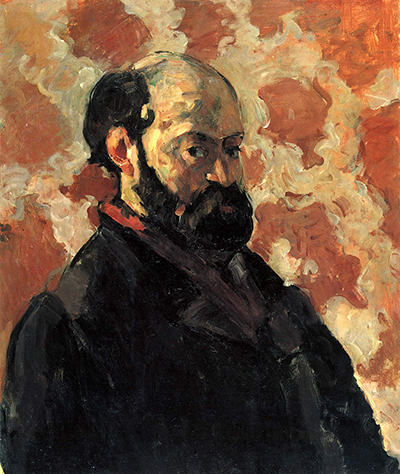
Cézanne turns towards us from a field of restless pink, cream and rust. His dark coat fills the lower half of the canvas; above it, the closely worked face meets the viewer with a look that is alert but difficult to name. The background seems to press forward, while the figure remains unmistakably solid. This tension makes Self-Portrait with a Pink Background rewarding to examine slowly.
The Musée d’Orsay dates this oil painting around 1875 and calls it Portrait de l’artiste au fond rose . It measures 66 by 55.2 centimetres. [1]
At a Glance
- Artist Paul Cézanne. [1]
- Date About 1875; scholars have proposed a wider range. [2]
- Medium and size Oil on canvas, 66 × 55.2 cm. [1]
- Collection Musée d’Orsay, Paris; inventory number RF 2000 14. [1]
- Catalogue identity FWN 436; formerly Rewald 274 and Venturi 286. [2]
This work across Paul Cézanne’s career
The Kiss of the Muse
c.1860The Artist’s Father, Reading L’Événement
autumn 1866The Hanged Man’s House
c.1873A Modern Olympia
1873–74Maincy Bridge
1879–80The Blue Vase
1889–90The Basket of Apples
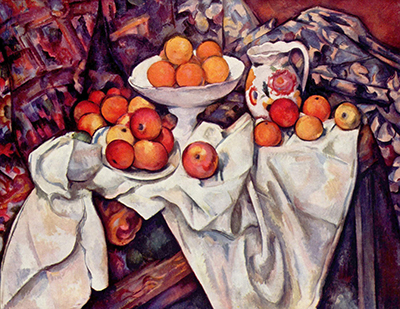
c.1893Apples and Oranges
c.1899The Large Bathers (Philadelphia)
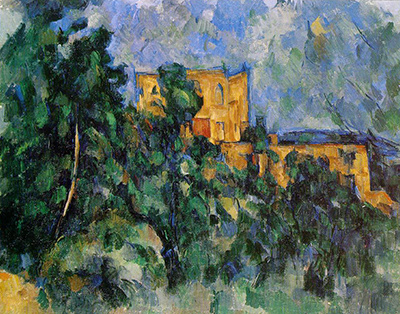
1900–1906 (Philadelphia Museum dating)Château Noir (MoMA)
1903–04Contents
- A face made from separate decisions
- The wall is part of the portrait
- Why the date remains approximate
- Seen by artists, critics and a poet
- From private collections to the Musée d’Orsay
A face made from separate decisions
Start at the scalp. A broad light area describes its dome, yet the outline is firm enough to hold against the busy wall. Dark hair collects behind the ear, and the ear itself flashes red and orange. Across the brow and bridge of the nose, short changes of colour interrupt any easy sense of a smooth complexion. The face feels built from adjoining patches that are visible even at the scale of the modest reproduction.
His head turns enough to show the long plane of the nose and the projecting beard, but one eye still addresses us. That eye is small within the mass of the head. It does not settle the mood of the portrait. A viewer might read scrutiny, concentration, reserve or simple attention into it; the paint provides the gaze, while the feeling remains open. The pronounced eyebrow and dark moustache give the upper and lower halves of the face different rhythms.
There is an especially sharp transition where the lit forehead gives way to the dark side of the cheek. At first, the shadow appears almost black. Look again and the surface breaks into brown, olive and muted red. The beard is similarly varied: its mass has a clear silhouette, yet its edges are neither perfectly even nor mechanically separated from the face. Those changes keep the likeness active rather than fixed like an emblem.
The coat works at a different pace. Its broad black shapes gather at the shoulders and slope down towards the lower edge, with few details to distract from the face. A reddish scarf or collar at the neck provides a small hinge between the warm skin, the patterned backdrop and the heavy garment. The body seems to anchor the composition, even though the eye continually returns to the many small events around the head.
The wall is part of the portrait
The title calls the setting pink, but this is no continuous flat pink surface. Red-brown islands sit among cream-coloured passages; greyish strokes curl and cross them. Near the top, the marks approach the artist’s hair and scalp so closely that the boundary between figure and surroundings takes work to follow. The wall has its own motion, and the head acquires force by resisting that motion.
Pavel Machotka describes the background as wallpaper and stresses the mixed browns and warm reds within its pink. He also notices grey-greens in the modelling of the face and traces warmer colour into the dark coat. His reading makes the portrait a coordinated colour arrangement rather than a dark figure simply placed against a bright ground. [3]
The picture itself lets us test that account. A pale stroke beside the head can make the adjacent flesh seem denser; a rusty patch behind the ear recalls the red at the neck. Light cream shapes are large near the upper left, but narrow and break apart near the right shoulder. The pattern varies enough that the head never looks pasted onto an interchangeable decorative field. It belongs to this particular surround.
The lower right corner shows another useful imbalance. The shoulder falls in a dark diagonal, yet the wall remains bright and intricate beside it. On the other side, the coat expands almost to the edge of the canvas. These unequal margins stop the portrait from becoming a neatly centred bust. They also send the viewer’s attention back towards the face, where the opposite pulls of solid contour and broken colour are concentrated.
Why the date remains approximate
The Musée d’Orsay and the current online catalogue place the painting around 1875, but the catalogue records different historical datings, from roughly 1873–74 to about 1880. This is a reminder that the date is a scholarly judgement, rather than an inscription supplied by the painting. [2]
Lawrence Gowing argued in 1956 for an earlier position within the mid-1870s sequence than the 1875–76 date proposed by Douglas Cooper. He compared this self-portrait’s broad, rhythmic handling and subdued colour with other works of 1873–74, while distinguishing it from a later portrait of Victor Chocquet with smaller, more square touches. His comparison remains a useful explanation of why apparently modest differences in brushwork matter to dating. [4]
The catalogue also notes possible connections with Camille Pissarro’s 1873 self-portrait, his 1874 portrait of Cézanne and an etching of Cézanne. These are proposed visual relationships, not evidence that Cézanne copied one of them. [2]
Seen by artists, critics and a poet
The portrait belonged to the collector Auguste Pellerin when it appeared at the 1907 Salon d’Automne in Paris. It was also shown in London in 1914. Later owners included the Lecomte family, a Swiss private collection, Galerie Beyeler and Philippe Meyer. [1]
At the 1907 exhibition, André Pératé singled out this self-portrait in a review that was otherwise deeply divided about Cézanne. He evoked its red scarf and salmon-rust backdrop and compared the artist’s self-depiction to Tintoretto. In the same article he disparaged other Cézanne paintings. His response shows that admiration for this particular image could coexist with discomfort about the painter’s broader practice. [5]
Rainer Maria Rilke, writing to Clara Rilke on 23 October 1907, paid close attention to a different issue: how the portrait’s restrained range of orange, ochre, violet and dark brown still makes room for small accents of green and blue. In the following day’s letter, he returned to the wall and reconsidered what he had called grey. His account records a viewer revising a colour judgement after further looking. [6]
Pératé was struck by the commanding image of the painter; Rilke attended to the transitions among colours. Both reactions point back to things one can still test in the picture. The red at the neck really is small but decisive. The wall really refuses a single colour name. The face remains legible even where it is assembled from strokes that appear surprisingly free up close.
From private collections to the Musée d’Orsay
Philippe Meyer donated the painting to the French state in 2000 while retaining a reserved right of use, or usufruct . It was allocated to the Musée d’Orsay that year; Meyer gave up the right in 2007. The two dates mark different stages of one donation. [1]
Its exhibition history did not end with that transfer. The catalogue records its appearance in the Cézanne portrait exhibitions in Paris, London and Washington in 2017–18. It also makes a careful distinction about a 1952 Cézanne exhibition: the portrait was included in the catalogue but was not actually exhibited. [2]
Cézanne artworks directory
Browse 217 identified works in this researched selection, including paintings, drawings and watercolours. This is a bounded selection, not a complete catalogue of Cézanne’s surviving oeuvre. Unlinked titles have no confirmed article in this collection.
| Name | Date | Medium |
|---|---|---|
| A Head, a Cup, and a Bread Roll | 1891/1894 | Drawing |
| A Man seen from Behind | 1880/1883 | Drawing |
| A Modern Olympia | 1873–74 | Painting |
| A Nude and Foliage | 1879/1882 | Drawing |
| A Smoking Man | 1892–96 (catalogue); c.1890–92 (museum) | Drawing |
| Afternoon in Naples | 1876–77 | Painting |
| An Old Woman with a Rosary | about 1895–96 | Painting |
| Apples and Oranges | c.1899 | Painting |
| Auvers, Panoramic View | 1873–75 | Painting |
| Avenue at Chantilly | 1888 | Painting |
| Banks of the Marne | 1888–94 | Painting |
| Basket | 1877/1900 | Drawing |
| Bather with Outstretched Arms | 1877–78 | Painting |
| Bellows in Front of a Fireplace | 1887/1892 | Drawing |
| Bibémus Quarry | c.1895 | Painting |
| Boy in a Red Vest, Barnes Foundation | 1888–90 | Painting |
| Boy in a Red Vest, MoMA | 1888–90 | Painting |
| Boy in a Red Waistcoat, National Gallery of Art | 1888–90 | Painting |
| Branch in Flower | 1886/1889 | Drawing |
| Carnival Scene | 1885/1888 | Drawing |
| Chair and Dresser | 1880/1883 | Drawing |
| Chateau Noir | 1903–04 | Painting |
| Chestnut Trees and Farm at Jas de Bouffan | c.1885 | Painting |
| Chestnut Trees and Farm at Jas de Bouffan, Pushkin | c.1886 | Painting |
| Chestnut Trees at Jas de Bouffan in Winter | 1885–86 | Painting |
| Château Noir | 1900–04 | Painting |
| Cistern in the Park of Château Noir | c.1900 | Painting |
| Curtain, Jug and Fruit | 1893–94 | Painting |
| Cushion of an Armchair | 1886/1889 | Drawing |
| Draft Letter and Studies of Bathers | c.1878 | Drawing |
| Farmhouse and Chestnut Trees at Jas de Bouffan | 1884–85 | Painting |
| Figure Resting Head on Hand | c. 1889 | Drawing |
| Fireplace Tongs and Poker | 1887/1892 | Drawing |
| Forest Interior, San Francisco | c.1898–99 | Painting |
| Four Bathers | 1888–90 | Painting |
| Fruit and a Jug on a Table | 1893–94 | Painting |
| Gardanne | 1885–86 | Painting |
| Gardanne, Barnes Foundation | c.1885 | Painting |
| Hand and Shoulder of a Boy | c. 1885 | Drawing |
| Harlequin, National Gallery of Art | 1888–90 | Painting |
| Head of a Boy | 1887/1889 | Drawing |
| Head of a Boy Seen from Behind | c. 1885 | Drawing |
| Head of a Young Woman | c. 1880 | Drawing |
| Head of the Artist's Son | 1888/1889 | Drawing |
| Hillside in Provence | c.1890–92 | Painting |
| Horse Chestnut Trees at Jas de Bouffan | c.1885 | Painting |
| House and Farm at the Jas de Bouffan | c.1887 | Painting |
| House in a Park | 1883/1886 | Drawing |
| House in Provence | c.1885 | Painting |
| House of Père Lacroix | 1873 | Painting |
| House Surrounded by Vegetation | 1889/1892 | Drawing |
| Houses in Provence The Riaux Valley near L’Estaque | c.1883 | Painting |
| Jas de Bouffan, the Pool | c.1876 | Painting |
| Kerosene Lamp | 1878/1881 | Drawing |
| L'Estaque, Melting Snow | c.1870 | Painting |
| Lake Annecy | 1896 | Painting |
| Landscape in Provence, Pola Museum | 1879–82 | Painting |
| Landscape Near Aix-en-Provence | 1877/1880 | Drawing |
| Landscape Seen from the Inside of a Cave | 1889/1892 | Drawing |
| Landscape with Poplars | c.1885–87 | Painting |
| Landscape with Trees | 1895/1898 | Drawing |
| Leda and the Swan | c.1880 (possibly later) | Painting |
| Little Girl with a Doll | 1902–04 | Painting |
| Louis Guillaume | 1879–1890 | Painting |
| Madame Cezanne | 1888/1891 | Drawing |
| Madame Cezanne | 1886/1889 | Drawing |
| Madame Cezanne | 1882/1887 | Drawing |
| Madame Cezanne | 1897/1900 | Drawing |
| Madame Cezanne with her Head Lowered | 1893/1896 | Drawing |
| Madame Cézanne in a Red Armchair | c.1877 | Painting |
| Madame Cézanne in a Red Dress, Metropolitan Museum of Art | 1888–90 | Painting |
| Madame Cézanne in a Yellow Chair | 1888–90 | Painting |
| Madame Cézanne in a Yellow Chair, Fondation Beyeler | 1888–90 | Painting |
| Madame Cézanne in the Conservatory | 1891 | Painting |
| Maincy Bridge | 1879–80 | Painting |
| Maison Maria with a View of Château Noir | c.1895 | Painting |
| Man Bending Forward | 1883/1886 | Drawing |
| Man Smoking a Pipe, Pushkin | c.1891, possibly later | Painting |
| Man with a Pipe | 1891–96 | Painting |
| Man with a Pipe, Nelson-Atkins | 1890–92 | Painting |
| Man with a Straw Hat (Gustave Boyer) | c.1871 | Painting |
| Man with Crossed Arms | c.1899 | Painting |
| Man with Pipe, National Gallery of Art | 1892–96 | Painting |
| Mont Sainte-Victoire | c.1902–06 | Painting |
| Mont Sainte-Victoire | 1900–02 | Painting |
| Mont Sainte-Victoire (recto) | c.1895 | Watercolour |
| Mont Sainte-Victoire and the Viaduct of the Arc River Valley | 1882–85 | Painting |
| Mont Sainte-Victoire Seen beyond the Wall of the Jas de Bouffan | c.1885/1888 | Watercolour |
| Mont Sainte-Victoire Seen from Bibémus Quarry | c.1897 | Painting |
| Mont Sainte-Victoire, Barnes Foundation | 1892–95 | Painting |
| Near the Pool at Jas de Bouffan | 1883/1887 | Drawing |
| Pelicans | 1877/1880 | Drawing |
| Peonies | 1890/1893 | Drawing |
| Pierrot and Harlequin | 1888 | Painting |
| Pine Tree | 1882/1885 | Drawing |
| Pont des Trois Sautets | 1906 | Watercolour |
| Poplars | 1879–80 | Painting |
| Portrait of Ambroise Vollard | 1899 | Painting |
| Portrait of Gustave Geffroy | 1895–96 | Painting |
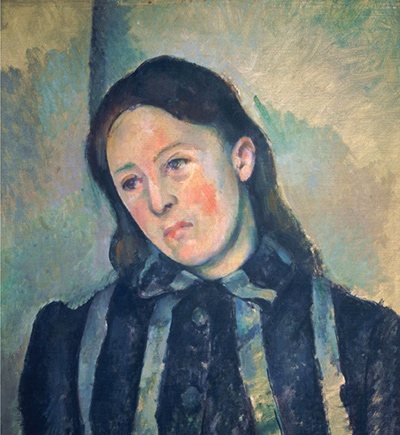
| Portrait of Madame Cezanne with Loosened Hair | 1885–86 | Painting |
| Portrait of the Artist Looking Over His Shoulder | 1883–84 | Painting |
| Portrait of the Gardener Vallier | 1906 | Painting |
| Portrait of Victor Chocquet | 1876–77 | Painting |
| Portrait Of Victor Chocquet Seated | 1877 | Painting |
| Provençal Manor | c.1885 | Painting |
| Pyramid of Skulls | 1898–1900 | Painting |
| Reclining Nude (Leda?) | c.1887 | Painting |
| Scipio | 1866–68 | Painting |
| Seated Man, Oslo | 1898–1900 | Painting |
| Seated Peasant | c.1892–96 | Painting |
| Seated Peasant, Hiroshima | c.1897 | Painting |
| Seated Peasant, Orsay | c.1900 | Painting |
| Self-Portrait | c. 1895 | Drawing |
| Self-Portrait in a Bowler Hat, Ny Carlsberg Glyptotek | 1885–86 | Painting |
| Self-Portrait in a Casquette | c.1875 | Painting |
| Self-Portrait with a Beret | 1898–1900 | Painting |
| Self-Portrait with a Hat, Artizon Museum | c.1890–94 | Painting |
| Self-Portrait with a Pink Background | c.1875 | Painting |
| Self-Portrait with Olive-Coloured Wallpaper | about 1880–81 | Painting |
| Self-Portrait with Palette | 1886–87 | Painting |
| Self-Portrait with White Turban | c.1878–80 | Painting |
| Self-Portrait, c.1895 | c.1895 | Painting |
| Self-Portrait, Pushkin Museum | c.1882 | Painting |
| Spanish Dancers | 1883/1886 | Drawing |
| Still Life with a Curtain | 1892–94 | Painting |
| Still Life with Apples | c.1890 | Painting |
| Still Life with Apples | 1893–94 | Painting |
| Still Life with Apples and a Pot of Primroses | about 1890 | Painting |
| Still Life with Milk Jug and Fruit | c.1900 | Painting |
| Still Life with Open Drawer | 1877–79 | Painting |
| Still Life with Plaster Cupid | about 1894 | Painting |
| Still Life with Skull | 1890–93 | Painting |
| Still Life with Soup Tureen | 1877 | Painting |
| Still Life, Pitcher and Fruit | 1893–94 | Painting |
| Studies Including a Straw Hat | 1895/1898 | Drawing |
| Studies Including Madame Cezanne | 1884/1887 | Drawing |
| Study for "The Judgement of Paris" or "The Amorous Shepherd" | 1883/1886 | Drawing |
| Study for Woman with a Coffee Pot | c.1895 | Painting |
| Study of "The Roman Orator (Germanicus)" | 1883/1886 | Drawing |
| Study of "Venus de Milo" | 1881/1884 | Drawing |
| Study of a Decorative Ornament | 1879/1882 | Drawing |
| Study of a Standing Male Figure after the Antique | c. 1895 | Drawing |
| Study of an Angel in Rubens' "The Prophet Elijah" | 1892/1895 | Drawing |
| Study of Desiderio da Settignano's "Bust of a Child" | c. 1895 | Drawing |
| Study of Houses | 1879/1882 | Drawing |
| Study of Puget's "Hercules Resting" | c. 1879 | Drawing |
| Study of Puget's "Milo of Crotona" | 1895/1898 | Drawing |
| Study of Puget's "Milo of Crotona" | 1880/1883 | Drawing |
| Study of the Allegorical Figure Bellona in Rubens' "The Apotheosis of Henri IV" | 1883/1886 | Drawing |
| Study of the Allegorical Figure Bellona in Rubens' "The Apotheosis of Henri IV" | 1879/1882 | Drawing |
| Study of the Allegorical Figure France in Rubens' "The Exchange of the Two Princesses" | 1882/1885 | Drawing |
| Study of the Allegorical Figure of Health in Rubens' "The Birth of Louis XIII" | 1880/1883 | Drawing |
| Study of the Allegorical Figure of the Genius of Health from Rubens' "The Birth of Louis XIII at Fontainbleau" | 1895/1898 | Drawing |
| Sugar Bowl, Pears and Blue Cup | 1865–66 | Painting |
| The Aqueduct, Pushkin Museum | Dating differs between museum records | Painting |
| The Artist's Father, Reading L'Evenement | autumn 1866 | Painting |
| The Artist's Son | c. 1887 | Drawing |
| The Artist's Son Leaning on his Elbow | c. 1887 | Drawing |
| The Artist's Son Reading | c. 1887 | Drawing |
| The Artist's Son Writing | c. 1887 | Drawing |
| The Artist’s Son, Paul | 1886–87 | Painting |
| The Avenue at Jas de Bouffan | 1868–70 (possibly later) | Painting |
| The Avenue at Jas de Bouffan, Geneva | c.1890 | Painting |
| The Basket of Apples | c.1893 | Painting |
| The Bather, Museum of Modern Art | c.1885 | Painting |
| The Bay of Marseille seen from L'Estaque | c.1885 | Painting |
| The Blue Vase | 1889–90 | Painting |
| The Boy in the Red Vest, Bührle | 1888–90 | Painting |
| The Buffet | 1877–79 | Painting |
| The Card Players, Barnes Foundation | 1890–92 | Painting |
| The Card Players, Courtauld Gallery | 1892–96 | Painting |
| The Card Players, Metropolitan Museum of Art | 1890–92 | Painting |
| The Card Players, Musée d’Orsay | 1893–96 | Painting |
| The Card Players, Qatar | 1892–96 | Painting |
| The Eternal Feminine | c.1877 | Painting |
| The Gardener Vallier | 1906 | Painting |
| The Gardener Vallier, Tate | 1905–06 | Painting |
| The Grounds of the Château Noir | c.1900–04 | Painting |
| The Gulf of Marseille Seen from L’Estaque | c.1885 | Painting |
| The Hanged Man's House in Auvers | c.1873 | Painting |
| The House of Doctor Gachet at Auvers | 1872–73 | Painting |
| The House with the Cracked Walls | 1892–94 | Painting |
| The Kiss of the Muse | c.1860 | Painting |
| The Large Bathers, Barnes Foundation | 1895–1906 | Painting |
| The Large Bathers, National Gallery | 1895–1905 | Painting |
| The Large Bathers, Philadelphia Museum of Art | 1900–06 | Painting |
| The Mill | 1889/1892 | Drawing |
| The Painter’s Father, Louis-Auguste Cézanne | c.1865 | Painting |
| The Peasant | 1890–92 | Painting |
| The Plaster Mill (La Moulin à plâtre) | 1889/1892 | Drawing |
| The Smoker, Hermitage | c.1891 | Painting |
| The Smoker, Mannheim | c.1891 | Painting |
| The Stove in the Studio | c.1865 | Painting |
| The Vase of Tulips | c.1890 | Painting |
| Thistle | 1893/1896 | Drawing |
| Three Heads, One of Madame Cezanne | 1882/1885 | Drawing |
| Three Skulls | c.1898 | Painting |
| Three Skulls on a Patterned Carpet | 1904 | Painting |
| Trees and Shrubs | 1883/1887 | Drawing |
| Turning Road at Montgeroult | 1898 | Painting |
| Two Bathers | 1884/1887 | Drawing |
| Two Heads | 1888 | Drawing |
| Two Heads | 1890/1896 | Drawing |
| Two Heads of Women | 1890/1894 | Drawing |
| Two Studies for "The Judgement of Paris" or "The Amorous Shepherd" | 1883/1886 | Drawing |
| Uncle Dominique in a Tasseled Cap | 1866 | Painting |
| Uncle Dominique in a Turban | 1866–67 | Painting |
| Victor Chocquet and an Angel for "The Apotheosis of Delacroix" | 1878/1880 | Drawing |
| Woman in Blue | c.1904 | Painting |
| Woman Leaning Forward | 1888/1891 | Drawing |
| Woman Leaning Forward | 1890/1894 | Drawing |
| Woman Leaning Forward | 1890/1894 | Drawing |
| Woman with a Coffee Pot | c.1895 | Painting |
| Women Bathers and a Roll of Paper | 1882/1885 | Drawing |
| Young Girl with a Doll | c.1895 | Painting |
| Young Italian Woman at a Table | c.1895–1900 | Painting |
| Young Man and Skull | 1896–98 | Painting |
Frequently Asked Questions
It is in the collection of the Musée d’Orsay, Paris, with inventory number RF 2000 14. [1]
The donation was accepted and assigned to the museum in 2000, subject to Philippe Meyer’s reserved right of use. That right ended in 2007. [1]
It reads as a patterned wall rather than an even pink field. The colours include rust, cream and greyer accents as well as pink; the irregular marks are important to the image’s energy. Machotka identifies the setting as wallpaper. [3]
Discussion
Look again at the images and ideas explored in Self-Portrait with a Pink Background by Paul Cézanne. These editorial prompts invite your observations.
Reader Insights
Find the point where the scalp meets the background. Does the contrast make the head seem firmer, or do the surrounding strokes pull it back into the wall?
Look at the narrow red passage near the neck, then at the larger warm areas behind the figure. How much of the picture’s unity depends on that small echo?
Finally, cover the wall and consider the face alone. When you uncover it, does the sitter’s expression change for you?
Join the Conversation
Share a detail, comparison or question about Self-Portrait with a Pink Background by Paul Cézanne below.
References
- Musée d’Orsay , “Portrait de l’artiste au fond rose,” collection record, inventory RF 2000 14. View source .
- The Paintings, Watercolors and Drawings of Paul Cezanne: An Online Catalogue Raisonné , “Portrait de l’artiste au fond rose,” FWN 436, catalogue entry. View source .
- Pavel Machotka , “Portrait de l’artiste au fond rose, vers 1875,” commentary from Cézanne: The Eye and the Mind (2008), reproduced by Société Paul Cezanne, 2017. View source .
- Lawrence Gowing , “Notes on the Development of Cézanne,” The Burlington Magazine 98, no. 639 (June 1956), pp. 185–92. View source .
- André Pératé , “Le Salon d’Automne,” Gazette des beaux-arts 38 (November 1907), pp. 385–407, as transcribed by Société Paul Cezanne in “André Pératé et le 5e Salon d’automne de 1907” (2017; in French). View source .
- Rainer Maria Rilke , letters to Clara Rilke, 23 and 24 October 1907, English translation reproduced in “Rilke: Letters on Paul Cézanne,” Anthologia, 2020. View source .
- Le Baiser de la muse, d'après Frillié (FWN 572). View source.
- Louis-Auguste Cezanne, père de l'artiste, lisant L'Événement (FWN 402). View source.
- La Maison du pendu, Auvers-sur-Oise (FWN 81). View source.
- Une moderne Olympia (FWN 628). View source.
- Le Pont de Maincy (FWN 143). View source.
- La Montagne Sainte-Victoire vue de Montbriand (FWN 185). View source.
- Gardanne (vue horizontale) (FWN 224). View source.
- Le Vase bleu (FWN 823). View source.
- Les Joueurs de cartes (FWN 681). View source.
- La Montagne Sainte-Victoire (FWN 296). View source.
- La Corbeille de pommes (FWN 860). View source.
- Pommes et oranges (FWN 871). View source.
- Portrait d'Ambroise Vollard (FWN 531). View source.
- Philadelphia Museum of Art,The Large Bathers,W1937-1-1. View source.
- Château Noir (FWN 360). View source.
- Société Paul Cezanne,online catalogue structure and objectidentification. View source.
- National Gallery of Art,Cezanne Sketchbook,1992.51.9. View source.
- Splash image, A narrow red passage at the neck links the dark coat to the warm, patterned background.