by
Tom Gurney
Tom Gurney BSc (Hons) is an art history expert with over 20 years experience
Published on June 19, 2020 / Updated on October 22, 2026
Email:
tomgurney1@gmail.com
/ Phone:
+44 7429 011000
Portrait of Gustave Geffroy by Paul Cézanne: Introduction
Gustave Geffroy sits at a desk, dressed in a dark coat, with shelves of books rising behind him and open volumes spreading across the foreground. The room tells us that he is a writer, but Cézanne makes its contents unusually active. Books tip, the desktop projects towards us, and the figure holds his place amid a crowded arrangement of rectangles and diagonals. This is the oil painting now called Gustave Geffroy at the Musée d’Orsay, dated 1895–96 by the museum. [1]
The portrait began as a meeting between a painter and a critic who had publicly defended him. It ended with the canvas in Geffroy’s possession, its face and hands left less resolved than much of the surrounding room. Cézanne’s letters establish his dissatisfaction and his promise to return. Later witnesses disagreed about why he stopped. The picture offers a richer question than an unsolved quarrel: how can a painted interior make a person present while still leaving his likeness open? [2] [3]
At a Glance
- Artist and sitter Paul Cézanne and the critic, journalist and writer Gustave Geffroy. [1]
- Date and medium 1895–96; oil on canvas. [1]
- Collection Musée d’Orsay, Paris; inventory RF 1969 29. [1]
- Catalogue identity FWN 516 in the online catalogue raisonné. [2]
- Size The museum gives 117 × 89.5 cm; the catalogue raisonné gives 116 × 89 cm. [1] [2]
This work across Paul Cézanne’s career
The Kiss of the Muse
c.1860The Artist’s Father, Reading L’Événement
autumn 1866The Hanged Man’s House
c.1873A Modern Olympia
1873–74Maincy Bridge
1879–80The Blue Vase
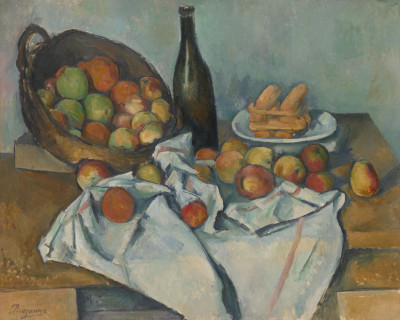
1889–90The Basket of Apples
c.1893Apples and Oranges
c.1899The Large Bathers (Philadelphia)
1900–1906 (Philadelphia Museum dating)Château Noir (MoMA)
1903–04Contents
- A critic whom Cézanne wanted to paint
- Looking through the library
- The face, hands and question of finish
- Why the sittings stopped remains disputed
- From Geffroy’s possession to the Musée d’Orsay
A critic whom Cézanne wanted to paint
On 25 March 1894 Geffroy published an article on Cézanne in Le Journal . He described an artist whose paintings were difficult to see, even as other painters and collectors increasingly discussed them. Looking back over works he had been able to examine, Geffroy argued that Cézanne’s importance rested on his sustained effort to translate what he saw, rather than on a ready-made theory. His account was admiring but specific: it joined the work’s apparent irregularity to patient observation. This was a public defence at a moment when the painter’s reputation was growing among specialists but remained uncertain for a wider audience. [4]
Cézanne thanked Geffroy in a letter dated the next day. In January 1895 he wrote again after reading Geffroy’s Le Cœur et l’Esprit . Then, on 4 April, he proposed visiting the critic in Belleville to discuss a project that he had considered, set aside and taken up again. The letter does not spell out the proposal, but the portrait followed shortly afterwards. [5]
According to Geffroy’s 1922 account, Cézanne came to his Belleville home almost daily for nearly three months. The setting was the writer’s own library, rather than a neutral studio. Geffroy remembered lunches with his mother and sister as well as the work itself. That recollection gives the arrangement in the painting a domestic setting: its books and papers belonged to a space in which the sitter worked and received a guest. [3]
The portrait also belongs to a broader nineteenth-century practice of showing writers with the tools and rooms of their profession. The Orsay compares it with Manet’s Émile Zola and Degas’s portrait of the critic Edmond Duranty. In each case, the surroundings do more than decorate a recognizable face. They make the sitter’s activity legible. Here, however, Cézanne gives the interior so much pictorial weight that the bookshelves and desktop compete with the man at their centre. The result feels less like a list of Geffroy’s possessions than a sustained examination of how person, chair, table and room occupy one painted surface. [1] [6]
Looking through the library
The first strong shape is Geffroy’s dark figure. His shoulders spread broadly, while the coat narrows towards his hands and the papers below. Behind him, a reddish chair back creates another angled enclosure. The nearly black jacket gathers the centre of the canvas, yet it is full of blue, brown and green changes. It prevents the shelves from becoming a flat backdrop and gives the bright paper in front of him something substantial to push against.
The shelves do not form one quiet grid. At the top, spines are mostly upright; on the shelf behind the head, a run of warm orange and blue books leans emphatically to the right. Other verticals reappear at the far side. The shifts pull the eye across the image, then return it to the sitter’s head. Their rhythm also makes the room seem slightly unsettled. A reader may recognize a library without being able to reconstruct every shelf as an exact plan of Geffroy’s apartment. Scholar John Elderfield makes precisely this distinction: the portrait looks rooted in an actual room, but its sequence of book angles is a pictorial arrangement, not necessarily a record of how the owner stacked his volumes. [6]
The desk produces a different kind of movement. A dark rim stretches across the width just below Geffroy’s hands. In front of it, opened books and papers tilt in several directions, their pale leaves catching the available light. One opened volume in the near foreground makes a broad V; another at the right lies at a sharper angle, close to the canvas edge. The table’s near boundary is difficult to settle into a single tidy perspective. Follow the books individually and they are plausible objects. Follow them together and their edges create a restless network that seems to come forward and turn sideways at once.
Small things punctuate that network. A white statuette appears at the far left, a flower rises near the sitter’s arm, and dark desk objects sit among the papers. Geffroy identified the sculpture as a small plaster by Rodin and said that Cézanne brought the artificial rose when the sittings began. A present-day label can name those objects; the eye sees them first as interruptions of white and colour within the brown and blue room. Their scale keeps the painting from becoming only an exercise in large shapes. They suggest a lived environment, while each also helps distribute light around the figure. [3]
Cézanne’s June 1895 letter to Monet provides a striking check on this looking. He said that when Geffroy was absent for a few days, he worked on the still-life objects surrounding the model. That contemporary statement gives the books and other things a place in the painting’s making, rather than treating them as details added after a completed likeness. It also helps explain why the room can seem so fully considered beside features the painter did not take to the same finish. [5]
The face, hands and question of finish
Geffroy’s head is firmly situated under the horizontal shelf, and the eyes meet the viewer from a face built out of small shifts of tone. Yet the features are less emphatically settled than the coat, chair or some of the papers. The hands, resting over the material on the desk, look more tentative still. Their different degrees of finish show where Cézanne had concentrated his effort and where further decisions might have been made.
Geffroy recalled that Cézanne planned to attend to the face at the end. In his memoir he admired the painting despite its incomplete state, singling out the library, papers, plaster and rose. His judgement matters because he was both subject and owner, but it remains his view of a work that Cézanne assessed differently. In a letter to Monet from Aix dated 6 July 1895, the painter described the result as meagre after many sessions and alternating enthusiasm and discouragement. He called the work an “étude” and said that the interruption was temporary, promising to continue it when he returned to Paris. The promise was not fulfilled. [3] [5]
The gap between those responses is part of the painting’s interest. Geffroy saw a work whose arrangement and colour already held together. Cézanne saw unfinished work and a failure to reach the point he wanted. Art historian Jean-Claude Lebensztejn observes how surprising the painter’s own language can be beside a canvas that looks so elaborately worked. He reads “study” as a serious term in Cézanne’s practice, while acknowledging that the portrait was never resumed. That argument need not make every part equally finished. It helps us see that a dense, coherent image and an artist’s dissatisfaction could coexist. [7]
Elderfield suggests another reason to attend to this imbalance. He places Geffroy among Cézanne’s unusual portraits in which the room is as important as its occupant, and links it to the established image of a man of letters in his own surroundings. Such a format asks the face and hands to carry conventional information about identity, temperament and work, even while the whole composition has its own demands. [6]
Why the sittings stopped remains disputed
On 12 June 1895 Cézanne wrote to Geffroy that he could not bring the work to a satisfactory end and asked to have his equipment collected. Geffroy later said he persuaded the painter to come back for about another week. On 6 July Cézanne wrote to Monet from Aix that he had had to leave Paris, was with his elderly and unwell mother, and intended to resume the study on a future visit. [5] [3]
Later accounts supply sharper explanations, but disagree with one another. Dealer Ambroise Vollard recalled Cézanne saying that Geffroy spoke continually about Georges Clemenceau, a figure whose politics and outlook made the painter uncomfortable. Joachim Gasquet, writing after Cézanne’s death, alleged an inexplicable hostility towards Geffroy. Geffroy rejected both explanations in his 1922 account and cited later correspondence as evidence that relations remained cordial. A later Orsay text adds a Dreyfus-related explanation for a refusal in 1898. None of these retrospective accounts establishes why Cézanne first stopped painting in 1895; his dated letters describe difficulty with the work and an intended return. [8] [3] [9] [5]
From Geffroy’s possession to the Musée d’Orsay
The portrait stayed with Geffroy after the sittings. The catalogue raisonné records it in a 1903 Paris exhibition under the title La bibliothèque , lent by Geffroy himself. That earlier title shifted attention towards the room that still dominates much of a viewer’s first impression. In 1907, after Cézanne’s death, it appeared as Portrait de Gustave Geffroy in the Salon d’Automne retrospective. These documented appearances show that an image left unfinished in the painter’s judgement could nevertheless circulate publicly as a work worth seeing. [2]
Its collection history then passed through the dealer Bernheim-Jeune to Auguste Pellerin in January 1907 and later to Pellerin’s family. The Orsay’s record gives the eventual gift to the French state as a 1969 donation with a retained life interest; the museum lists 2000 as the end of that interest and the year it entered its present museum location. [1] [2]
Seen now, the portrait asks us to hold two experiences together. It is a carefully balanced image of a man surrounded by the evidence of his profession, and it is a record of a painting process Cézanne chose to leave open. The leaning books, projecting papers and weighty dark coat give Geffroy an unmistakable setting. The quieter face and hands keep the sitter from becoming wholly fixed by that setting. Whatever the final reason for the painter’s departure, the picture’s force lies in this tension between a room intensely worked out and a human presence still being sought.
Cézanne artworks directory
Browse 217 identified works in this researched selection, including paintings, drawings and watercolours. This is a bounded selection, not a complete catalogue of Cézanne’s surviving oeuvre. Unlinked titles have no confirmed article in this collection.
| Name | Date | Medium |
|---|---|---|
| A Head, a Cup, and a Bread Roll | 1891/1894 | Drawing |
| A Man seen from Behind | 1880/1883 | Drawing |
| A Modern Olympia | 1873–74 | Painting |
| A Nude and Foliage | 1879/1882 | Drawing |
| A Smoking Man | 1892–96 (catalogue); c.1890–92 (museum) | Drawing |
| Afternoon in Naples | 1876–77 | Painting |
| An Old Woman with a Rosary | about 1895–96 | Painting |
| Apples and Oranges | c.1899 | Painting |
| Auvers, Panoramic View | 1873–75 | Painting |
| Avenue at Chantilly | 1888 | Painting |
| Banks of the Marne | 1888–94 | Painting |
| Basket | 1877/1900 | Drawing |
| Bather with Outstretched Arms | 1877–78 | Painting |
| Bellows in Front of a Fireplace | 1887/1892 | Drawing |
| Bibémus Quarry | c.1895 | Painting |
| Boy in a Red Vest, Barnes Foundation | 1888–90 | Painting |
| Boy in a Red Vest, MoMA | 1888–90 | Painting |
| Boy in a Red Waistcoat, National Gallery of Art | 1888–90 | Painting |
| Branch in Flower | 1886/1889 | Drawing |
| Carnival Scene | 1885/1888 | Drawing |
| Chair and Dresser | 1880/1883 | Drawing |
| Chateau Noir | 1903–04 | Painting |
| Chestnut Trees and Farm at Jas de Bouffan | c.1885 | Painting |
| Chestnut Trees and Farm at Jas de Bouffan, Pushkin | c.1886 | Painting |
| Chestnut Trees at Jas de Bouffan in Winter | 1885–86 | Painting |
| Château Noir | 1900–04 | Painting |
| Cistern in the Park of Château Noir | c.1900 | Painting |
| Curtain, Jug and Fruit | 1893–94 | Painting |
| Cushion of an Armchair | 1886/1889 | Drawing |
| Draft Letter and Studies of Bathers | c.1878 | Drawing |
| Farmhouse and Chestnut Trees at Jas de Bouffan | 1884–85 | Painting |
| Figure Resting Head on Hand | c. 1889 | Drawing |
| Fireplace Tongs and Poker | 1887/1892 | Drawing |
| Forest Interior, San Francisco | c.1898–99 | Painting |
| Four Bathers | 1888–90 | Painting |
| Fruit and a Jug on a Table | 1893–94 | Painting |
| Gardanne | 1885–86 | Painting |
| Gardanne, Barnes Foundation | c.1885 | Painting |
| Hand and Shoulder of a Boy | c. 1885 | Drawing |
| Harlequin, National Gallery of Art | 1888–90 | Painting |
| Head of a Boy | 1887/1889 | Drawing |
| Head of a Boy Seen from Behind | c. 1885 | Drawing |
| Head of a Young Woman | c. 1880 | Drawing |
| Head of the Artist's Son | 1888/1889 | Drawing |
| Hillside in Provence | c.1890–92 | Painting |
| Horse Chestnut Trees at Jas de Bouffan | c.1885 | Painting |
| House and Farm at the Jas de Bouffan | c.1887 | Painting |
| House in a Park | 1883/1886 | Drawing |
| House in Provence | c.1885 | Painting |
| House of Père Lacroix | 1873 | Painting |
| House Surrounded by Vegetation | 1889/1892 | Drawing |
| Houses in Provence The Riaux Valley near L’Estaque | c.1883 | Painting |
| Jas de Bouffan, the Pool | c.1876 | Painting |
| Kerosene Lamp | 1878/1881 | Drawing |
| L'Estaque, Melting Snow | c.1870 | Painting |
| Lake Annecy | 1896 | Painting |
| Landscape in Provence, Pola Museum | 1879–82 | Painting |
| Landscape Near Aix-en-Provence | 1877/1880 | Drawing |
| Landscape Seen from the Inside of a Cave | 1889/1892 | Drawing |
| Landscape with Poplars | c.1885–87 | Painting |
| Landscape with Trees | 1895/1898 | Drawing |
| Leda and the Swan | c.1880 (possibly later) | Painting |
| Little Girl with a Doll | 1902–04 | Painting |
| Louis Guillaume | 1879–1890 | Painting |
| Madame Cezanne | 1888/1891 | Drawing |
| Madame Cezanne | 1886/1889 | Drawing |
| Madame Cezanne | 1882/1887 | Drawing |
| Madame Cezanne | 1897/1900 | Drawing |
| Madame Cezanne with her Head Lowered | 1893/1896 | Drawing |
| Madame Cézanne in a Red Armchair | c.1877 | Painting |
| Madame Cézanne in a Red Dress, Metropolitan Museum of Art | 1888–90 | Painting |
| Madame Cézanne in a Yellow Chair | 1888–90 | Painting |
| Madame Cézanne in a Yellow Chair, Fondation Beyeler | 1888–90 | Painting |
| Madame Cézanne in the Conservatory | 1891 | Painting |
| Maincy Bridge | 1879–80 | Painting |
| Maison Maria with a View of Château Noir | c.1895 | Painting |
| Man Bending Forward | 1883/1886 | Drawing |
| Man Smoking a Pipe, Pushkin | c.1891, possibly later | Painting |
| Man with a Pipe | 1891–96 | Painting |
| Man with a Pipe, Nelson-Atkins | 1890–92 | Painting |
| Man with a Straw Hat (Gustave Boyer) | c.1871 | Painting |
| Man with Crossed Arms | c.1899 | Painting |
| Man with Pipe, National Gallery of Art | 1892–96 | Painting |
| Mont Sainte-Victoire | c.1902–06 | Painting |
| Mont Sainte-Victoire | 1900–02 | Painting |
| Mont Sainte-Victoire (recto) | c.1895 | Watercolour |
| Mont Sainte-Victoire and the Viaduct of the Arc River Valley | 1882–85 | Painting |
| Mont Sainte-Victoire Seen beyond the Wall of the Jas de Bouffan | c.1885/1888 | Watercolour |
| Mont Sainte-Victoire Seen from Bibémus Quarry | c.1897 | Painting |
| Mont Sainte-Victoire, Barnes Foundation | 1892–95 | Painting |
| Near the Pool at Jas de Bouffan | 1883/1887 | Drawing |
| Pelicans | 1877/1880 | Drawing |
| Peonies | 1890/1893 | Drawing |
| Pierrot and Harlequin | 1888 | Painting |
| Pine Tree | 1882/1885 | Drawing |
| Pont des Trois Sautets | 1906 | Watercolour |
| Poplars | 1879–80 | Painting |
| Portrait of Ambroise Vollard | 1899 | Painting |
| Portrait of Gustave Geffroy | 1895–96 | Painting |
| Portrait of Madame Cezanne with Loosened Hair | 1885–86 | Painting |
| Portrait of the Artist Looking Over His Shoulder | 1883–84 | Painting |
| Portrait of the Gardener Vallier | 1906 | Painting |
| Portrait of Victor Chocquet | 1876–77 | Painting |
| Portrait Of Victor Chocquet Seated | 1877 | Painting |
| Provençal Manor | c.1885 | Painting |
| Pyramid of Skulls | 1898–1900 | Painting |
| Reclining Nude (Leda?) | c.1887 | Painting |
| Scipio | 1866–68 | Painting |
| Seated Man, Oslo | 1898–1900 | Painting |
| Seated Peasant | c.1892–96 | Painting |
| Seated Peasant, Hiroshima | c.1897 | Painting |
| Seated Peasant, Orsay | c.1900 | Painting |
| Self-Portrait | c. 1895 | Drawing |
| Self-Portrait in a Bowler Hat, Ny Carlsberg Glyptotek | 1885–86 | Painting |
| Self-Portrait in a Casquette | c.1875 | Painting |
| Self-Portrait with a Beret | 1898–1900 | Painting |
| Self-Portrait with a Hat, Artizon Museum | c.1890–94 | Painting |
| Self-Portrait with a Pink Background | c.1875 | Painting |
| Self-Portrait with Olive-Coloured Wallpaper | about 1880–81 | Painting |
| Self-Portrait with Palette | 1886–87 | Painting |
| Self-Portrait with White Turban | c.1878–80 | Painting |
| Self-Portrait, c.1895 | c.1895 | Painting |
| Self-Portrait, Pushkin Museum | c.1882 | Painting |
| Spanish Dancers | 1883/1886 | Drawing |
| Still Life with a Curtain | 1892–94 | Painting |
| Still Life with Apples | c.1890 | Painting |
| Still Life with Apples | 1893–94 | Painting |
| Still Life with Apples and a Pot of Primroses | about 1890 | Painting |
| Still Life with Milk Jug and Fruit | c.1900 | Painting |
| Still Life with Open Drawer | 1877–79 | Painting |
| Still Life with Plaster Cupid | about 1894 | Painting |
| Still Life with Skull | 1890–93 | Painting |
| Still Life with Soup Tureen | 1877 | Painting |
| Still Life, Pitcher and Fruit | 1893–94 | Painting |
| Studies Including a Straw Hat | 1895/1898 | Drawing |
| Studies Including Madame Cezanne | 1884/1887 | Drawing |
| Study for "The Judgement of Paris" or "The Amorous Shepherd" | 1883/1886 | Drawing |
| Study for Woman with a Coffee Pot | c.1895 | Painting |
| Study of "The Roman Orator (Germanicus)" | 1883/1886 | Drawing |
| Study of "Venus de Milo" | 1881/1884 | Drawing |
| Study of a Decorative Ornament | 1879/1882 | Drawing |
| Study of a Standing Male Figure after the Antique | c. 1895 | Drawing |
| Study of an Angel in Rubens' "The Prophet Elijah" | 1892/1895 | Drawing |
| Study of Desiderio da Settignano's "Bust of a Child" | c. 1895 | Drawing |
| Study of Houses | 1879/1882 | Drawing |
| Study of Puget's "Hercules Resting" | c. 1879 | Drawing |
| Study of Puget's "Milo of Crotona" | 1895/1898 | Drawing |
| Study of Puget's "Milo of Crotona" | 1880/1883 | Drawing |
| Study of the Allegorical Figure Bellona in Rubens' "The Apotheosis of Henri IV" | 1883/1886 | Drawing |
| Study of the Allegorical Figure Bellona in Rubens' "The Apotheosis of Henri IV" | 1879/1882 | Drawing |
| Study of the Allegorical Figure France in Rubens' "The Exchange of the Two Princesses" | 1882/1885 | Drawing |
| Study of the Allegorical Figure of Health in Rubens' "The Birth of Louis XIII" | 1880/1883 | Drawing |
| Study of the Allegorical Figure of the Genius of Health from Rubens' "The Birth of Louis XIII at Fontainbleau" | 1895/1898 | Drawing |
| Sugar Bowl, Pears and Blue Cup | 1865–66 | Painting |
| The Aqueduct, Pushkin Museum | Dating differs between museum records | Painting |
| The Artist's Father, Reading L'Evenement | autumn 1866 | Painting |
| The Artist's Son | c. 1887 | Drawing |
| The Artist's Son Leaning on his Elbow | c. 1887 | Drawing |
| The Artist's Son Reading | c. 1887 | Drawing |
| The Artist's Son Writing | c. 1887 | Drawing |
| The Artist’s Son, Paul | 1886–87 | Painting |
| The Avenue at Jas de Bouffan | 1868–70 (possibly later) | Painting |
| The Avenue at Jas de Bouffan, Geneva | c.1890 | Painting |
| The Basket of Apples | c.1893 | Painting |
| The Bather, Museum of Modern Art | c.1885 | Painting |
| The Bay of Marseille seen from L'Estaque | c.1885 | Painting |
| The Blue Vase | 1889–90 | Painting |
| The Boy in the Red Vest, Bührle | 1888–90 | Painting |
| The Buffet | 1877–79 | Painting |
| The Card Players, Barnes Foundation | 1890–92 | Painting |
| The Card Players, Courtauld Gallery | 1892–96 | Painting |
| The Card Players, Metropolitan Museum of Art | 1890–92 | Painting |
| The Card Players, Musée d’Orsay | 1893–96 | Painting |
| The Card Players, Qatar | 1892–96 | Painting |
| The Eternal Feminine | c.1877 | Painting |
| The Gardener Vallier | 1906 | Painting |
| The Gardener Vallier, Tate | 1905–06 | Painting |
| The Grounds of the Château Noir | c.1900–04 | Painting |
| The Gulf of Marseille Seen from L’Estaque | c.1885 | Painting |
| The Hanged Man's House in Auvers | c.1873 | Painting |
| The House of Doctor Gachet at Auvers | 1872–73 | Painting |
| The House with the Cracked Walls | 1892–94 | Painting |
| The Kiss of the Muse | c.1860 | Painting |
| The Large Bathers, Barnes Foundation | 1895–1906 | Painting |
| The Large Bathers, National Gallery | 1895–1905 | Painting |
| The Large Bathers, Philadelphia Museum of Art | 1900–06 | Painting |
| The Mill | 1889/1892 | Drawing |
| The Painter’s Father, Louis-Auguste Cézanne | c.1865 | Painting |
| The Peasant | 1890–92 | Painting |
| The Plaster Mill (La Moulin à plâtre) | 1889/1892 | Drawing |
| The Smoker, Hermitage | c.1891 | Painting |
| The Smoker, Mannheim | c.1891 | Painting |
| The Stove in the Studio | c.1865 | Painting |
| The Vase of Tulips | c.1890 | Painting |
| Thistle | 1893/1896 | Drawing |
| Three Heads, One of Madame Cezanne | 1882/1885 | Drawing |
| Three Skulls | c.1898 | Painting |
| Three Skulls on a Patterned Carpet | 1904 | Painting |
| Trees and Shrubs | 1883/1887 | Drawing |
| Turning Road at Montgeroult | 1898 | Painting |
| Two Bathers | 1884/1887 | Drawing |
| Two Heads | 1888 | Drawing |
| Two Heads | 1890/1896 | Drawing |
| Two Heads of Women | 1890/1894 | Drawing |
| Two Studies for "The Judgement of Paris" or "The Amorous Shepherd" | 1883/1886 | Drawing |
| Uncle Dominique in a Tasseled Cap | 1866 | Painting |
| Uncle Dominique in a Turban | 1866–67 | Painting |
| Victor Chocquet and an Angel for "The Apotheosis of Delacroix" | 1878/1880 | Drawing |
| Woman in Blue | c.1904 | Painting |
| Woman Leaning Forward | 1888/1891 | Drawing |
| Woman Leaning Forward | 1890/1894 | Drawing |
| Woman Leaning Forward | 1890/1894 | Drawing |
| Woman with a Coffee Pot | c.1895 | Painting |
| Women Bathers and a Roll of Paper | 1882/1885 | Drawing |
| Young Girl with a Doll | c.1895 | Painting |
| Young Italian Woman at a Table | c.1895–1900 | Painting |
| Young Man and Skull | 1896–98 | Painting |
Frequently Asked Questions
It belongs to the Musée d’Orsay in Paris, under inventory number RF 1969 29. [1]
Discussion
Look again at the images and ideas explored in Portrait of Gustave Geffroy by Paul Cézanne. These editorial prompts invite your observations.
Reader Insights
Which part of the picture tells you most about Geffroy: his face, his posture, or the objects that surround him?
Trace the shelf lines and the open books. Where does the room feel stable, and where does it begin to move?
Does knowing that Cézanne intended to return change how you see the less resolved hands and face?
Join the Conversation
Share a detail, comparison or question about Portrait of Gustave Geffroy by Paul Cézanne below.
References
- Musée d’Orsay , “Gustave Geffroy,” collection record and object essay, inventory RF 1969 29. (in French). View source .
- The Paintings, Watercolors and Drawings of Paul Cezanne: An Online Catalogue Raisonné , “Portrait de Gustave Geffroy,” FWN 516, catalogue entry. View source .
- Gustave Geffroy , Claude Monet: sa vie, son temps, son œuvre (1922), pp. 197–201, passages transcribed in Société Cézanne’s 1895 chronology. (in French). View source .
- Gustave Geffroy , “L’art d’aujourd’hui: Paul Cezanne,” Le Journal , 25 March 1894, p. 1, transcribed in Société Cézanne’s 1894 chronology. (in French). View source .
- Paul Cézanne , letters to Geffroy (26 March 1894; 31 January, 4 April and 12 June 1895) and Monet (9 June and 6 July 1895), transcribed in Société Cézanne’s 1894 chronology and 1895 chronology (in French). View source 1 . View source 2 .
- John Elderfield , introduction to Cézanne Portraits (2017), pp. 27–28, Princeton University Press preview. View source .
- Jean-Claude Lebensztejn , extract from Études cézanniennes (2006), reproduced by Société Cézanne. (in French). View source .
- Ambroise Vollard , recollection in Paul Cezanne (1914; cited 1924 edition), transcribed in Société Cézanne’s 1895 chronology; compare Geffroy’s 1922 response and the Musée d’Orsay essay for Gasquet’s separate allegation. (in French). View source .
- Musée d’Orsay , “Parcours: Autour de l’affaire Dreyfus,” museum article, 26 March 2025. (in French). View source .
- Le Baiser de la muse, d'après Frillié (FWN 572). View source.
- Louis-Auguste Cezanne, père de l'artiste, lisant L'Événement (FWN 402). View source.
- La Maison du pendu, Auvers-sur-Oise (FWN 81). View source.
- Une moderne Olympia (FWN 628). View source.
- Le Pont de Maincy (FWN 143). View source.
- La Montagne Sainte-Victoire vue de Montbriand (FWN 185). View source.
- Gardanne (vue horizontale) (FWN 224). View source.
- Le Vase bleu (FWN 823). View source.
- Les Joueurs de cartes (FWN 681). View source.
- La Montagne Sainte-Victoire (FWN 296). View source.
- La Corbeille de pommes (FWN 860). View source.
- Pommes et oranges (FWN 871). View source.
- Portrait d'Ambroise Vollard (FWN 531). View source.
- Philadelphia Museum of Art,The Large Bathers,W1937-1-1. View source.
- Château Noir (FWN 360). View source.
- Société Paul Cezanne,online catalogue structure and objectidentification. View source.
- National Gallery of Art,Cezanne Sketchbook,1992.51.9. View source.
- Splash image, Paul Cézanne, Portrait of Gustave Geffroy, 1895–96. Musée d’Orsay, RF 1969 29.