by
Tom Gurney
Tom Gurney BSc (Hons) is an art history expert with over 20 years experience
Published on June 19, 2020 / Updated on October 22, 2026
Email:
tomgurney1@gmail.com
/ Phone:
+44 7429 011000
Boy in a Red Waistcoat: Cézanne’s Barnes Foundation Portrait: Introduction
The young sitter fills this painting almost from edge to edge. His eyes turn sideways although his shoulders face us, and the red waistcoat, pale sleeves and blue neckcloth make a compact set of colour contrasts.
This is the Barnes Foundation portrait FWN 494, dated 1888–90 in the current catalogue. [1]
The close framing makes a slight movement of the eyes feel consequential. Yet much of the painting’s energy lies outside the face. Dark cloth gathers behind the boy at left; at right, a cool blue wall is crossed by a deep brown horizontal band. Between these unequal sides, the red vest gives his torso weight and warmth. The portrait asks us to consider a person and a carefully balanced arrangement at the same time.
At a Glance
- Artist Paul Cézanne. [1]
- Work Le Garçon au gilet rouge (FWN 494; BF20). [1]
- Date 1888–90. [1]
- Medium Oil on canvas, 66 × 55 cm. [1]
- Sitter Michelangelo de Rosa. [1]
- Collection Barnes Foundation, Philadelphia. [1]
This work across Paul Cézanne’s career
The Kiss of the Muse
c.1860The Artist’s Father, Reading L’Événement
autumn 1866The Hanged Man’s House
c.1873A Modern Olympia
1873–74Maincy Bridge
1879–80The Blue Vase
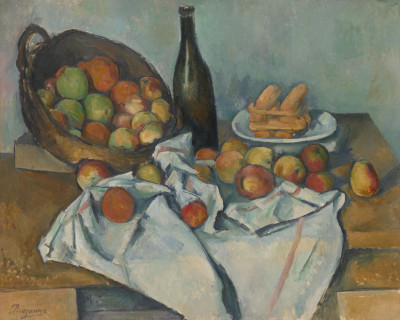
1889–90The Basket of Apples
c.1893Apples and Oranges
c.1899The Large Bathers (Philadelphia)
1900–1906 (Philadelphia Museum dating)Château Noir (MoMA)
1903–04Contents
- A face within a tight frame
- Red against blue, white and green
- One sitter, several paintings
- What the record preserves
A face within a tight frame
The figure is presented from the front, cut off near the hands at the bottom edge. We can see the upper body without the complete pose. He does not meet the viewer’s gaze: both pupils are directed towards the left side of the picture, while his nose and the central blue knot remain close to its vertical axis. That small disagreement between head and glance stops the image becoming a formal, symmetrical likeness.
His dark hair forms a broad cap over the forehead and falls in long shapes beside the face. Cézanne has made the ears conspicuous, and he has set the eyes in different mixtures of brown, blue and warm pink. The features are legible, but their contours are not uniformly finished. A pale sweep across the bridge of the nose meets cooler touches on the cheek; the mouth is a narrow change in colour rather than a firmly drawn line. The face holds our attention through these shifts, not through a stated expression. It is possible to read the lowered mouth as seriousness, but the painting gives no secure account of the boy’s thoughts.
The vest creates a second centre. Its two red sides descend around the blue neckcloth, then broaden into an almost triangular mass below. Dark seams and fastenings keep that mass from becoming a flat emblem. On either side, the loose sleeves swell outward before narrowing towards the lower edge. The cut of the canvas prevents us from resolving exactly how the hands rest. That truncation matters: attention returns to the relationship of face, collar and torso instead of following an action outside the frame.
Red against blue, white and green
The waistcoat’s red is forceful, but it is rarely left alone. Thin dark edges, warm browns and small blue or green touches interrupt it. The neckcloth is blue with deep folds, and the shirt sleeves are built from pale cream, yellow, turquoise and greenish strokes. The model’s clothing therefore does more than identify him across the series. It supplies Cézanne with neighbouring areas that can temper or intensify the red.
Pavel Machotka, writing specifically about the four portraits, points to this colour problem: he sees the pale shirt and its green modelling as a buffer between the saturated waistcoat and its surroundings. In the Barnes canvas that relationship can be followed visibly from the neckcloth down each side of the vest. The red never simply meets an equally strong blue wall; a sleeve, a dark contour or a change of tone intervenes. Machotka also regards this group as unusually attentive to the adolescent model’s loose, unforced bearing. His observation helps explain why the picture can feel immediate even while its colour relationships are exacting. [2]
The background participates in the same calculation. On the left, the dark hanging fabric makes the nearby sleeve appear bright. On the right, the blue-grey field receives a brown horizontal bar and a narrow pale strip above it. The boy’s dark hair crosses both sides, joining them at head height, while the sleeves connect the figure to the outer edges. No single contour encloses him completely. Cézanne instead lets adjacent patches hold him in place. The apparent simplicity of a person seated against a wall depends on these many local transitions.
One sitter, several paintings
The recurring clothes can make the red-vest pictures easy to confuse. MoMA identifies the Italian model as Michelangelo di Rosa and counts four oil portraits and two watercolours of him. [3]
The catalogue numbers are FWN 494 (Barnes), 495 (MoMA), 496 (Bührle) and 497 (Washington). [1]
The Barnes portrait’s frontal crop asks for a different kind of attention from a full figure. Much of the model’s action is left outside the frame; the viewer stays with small shifts in the eyes and mouth. That is a choice visible in this canvas, not an account of how the sitter behaved. A red vest may identify the group from a distance, but the experience of each painting depends on where its frame lets the body end and its surrounding space begin.
John Elderfield places the red-waistcoat group alongside Cézanne’s repeated portraits of Hortense Fiquet in the late 1880s. His account of serial portraiture describes a painter returning to one subject through changed arrangements, with each canvas testing something the previous one could not settle. That framework is useful here without requiring the four portraits to be stages of a single finished image. In the Barnes version, the face comes very near, but the narrow crop also gives the surrounding colours unusually concentrated force. The same costume elsewhere serves a different pose and different space. [4]
The catalogue tentatively links this canvas to Vollard’s 1910 Figures de Cézanne , listed as Portrait d’un jeune italien . [1]
What the record preserves
Ambroise Vollard’s stockbook A describes a frontal child with blue tie and red vest. [5]
A later stockbook calls it a bust of a young Italian. An archive photo annotated by Cézanne’s son says “circa 1889”; the catalogue adopts 1888–90. [1]
The recorded route runs from Vollard through Galerie Barbazanges to Barnes in July 1923. A Reber step is uncertain. The catalogue records relining and a non-original support. [1]
It later travelled with Great French Paintings from the Barnes Foundation during the 1993–95 renovation of the Merion galleries. That international tour carried a close, intimate portrait into very different viewing spaces and introduced many visitors to the Barnes collection. [6]
The painting also had a life as something to study. A Delaware Historical Society account of artist Edward Loper Sr. says that, while taking classes with Violette de Mazia at the Barnes in 1963, his study of Cézanne’s Boy in the Red Vest prompted him to reconsider colour in his own work. It is a later account of Loper’s development, not testimony from Cézanne’s time. Yet it gives this canvas a concrete afterlife beyond exhibition lists: another painter paid close attention to the colour structure that makes the red waistcoat compelling. [7]
Cézanne artworks directory
Browse 217 identified works in this researched selection, including paintings, drawings and watercolours. This is a bounded selection, not a complete catalogue of Cézanne’s surviving oeuvre. Unlinked titles have no confirmed article in this collection.
| Name | Date | Medium |
|---|---|---|
| A Head, a Cup, and a Bread Roll | 1891/1894 | Drawing |
| A Man seen from Behind | 1880/1883 | Drawing |
| A Modern Olympia | 1873–74 | Painting |
| A Nude and Foliage | 1879/1882 | Drawing |
| A Smoking Man | 1892–96 (catalogue); c.1890–92 (museum) | Drawing |
| Afternoon in Naples | 1876–77 | Painting |
| An Old Woman with a Rosary | about 1895–96 | Painting |
| Apples and Oranges | c.1899 | Painting |
| Auvers, Panoramic View | 1873–75 | Painting |
| Avenue at Chantilly | 1888 | Painting |
| Banks of the Marne | 1888–94 | Painting |
| Basket | 1877/1900 | Drawing |
| Bather with Outstretched Arms | 1877–78 | Painting |
| Bellows in Front of a Fireplace | 1887/1892 | Drawing |
| Bibémus Quarry | c.1895 | Painting |
| Boy in a Red Vest, Barnes Foundation | 1888–90 | Painting |
| Boy in a Red Vest, MoMA | 1888–90 | Painting |
| Boy in a Red Waistcoat, National Gallery of Art | 1888–90 | Painting |
| Branch in Flower | 1886/1889 | Drawing |
| Carnival Scene | 1885/1888 | Drawing |
| Chair and Dresser | 1880/1883 | Drawing |
| Chateau Noir | 1903–04 | Painting |
| Chestnut Trees and Farm at Jas de Bouffan | c.1885 | Painting |
| Chestnut Trees and Farm at Jas de Bouffan, Pushkin | c.1886 | Painting |
| Chestnut Trees at Jas de Bouffan in Winter | 1885–86 | Painting |
| Château Noir | 1900–04 | Painting |
| Cistern in the Park of Château Noir | c.1900 | Painting |
| Curtain, Jug and Fruit | 1893–94 | Painting |
| Cushion of an Armchair | 1886/1889 | Drawing |
| Draft Letter and Studies of Bathers | c.1878 | Drawing |
| Farmhouse and Chestnut Trees at Jas de Bouffan | 1884–85 | Painting |
| Figure Resting Head on Hand | c. 1889 | Drawing |
| Fireplace Tongs and Poker | 1887/1892 | Drawing |
| Forest Interior, San Francisco | c.1898–99 | Painting |
| Four Bathers | 1888–90 | Painting |
| Fruit and a Jug on a Table | 1893–94 | Painting |
| Gardanne | 1885–86 | Painting |
| Gardanne, Barnes Foundation | c.1885 | Painting |
| Hand and Shoulder of a Boy | c. 1885 | Drawing |
| Harlequin, National Gallery of Art | 1888–90 | Painting |
| Head of a Boy | 1887/1889 | Drawing |
| Head of a Boy Seen from Behind | c. 1885 | Drawing |
| Head of a Young Woman | c. 1880 | Drawing |
| Head of the Artist's Son | 1888/1889 | Drawing |
| Hillside in Provence | c.1890–92 | Painting |
| Horse Chestnut Trees at Jas de Bouffan | c.1885 | Painting |
| House and Farm at the Jas de Bouffan | c.1887 | Painting |
| House in a Park | 1883/1886 | Drawing |
| House in Provence | c.1885 | Painting |
| House of Père Lacroix | 1873 | Painting |
| House Surrounded by Vegetation | 1889/1892 | Drawing |
| Houses in Provence The Riaux Valley near L’Estaque | c.1883 | Painting |
| Jas de Bouffan, the Pool | c.1876 | Painting |
| Kerosene Lamp | 1878/1881 | Drawing |
| L'Estaque, Melting Snow | c.1870 | Painting |
| Lake Annecy | 1896 | Painting |
| Landscape in Provence, Pola Museum | 1879–82 | Painting |
| Landscape Near Aix-en-Provence | 1877/1880 | Drawing |
| Landscape Seen from the Inside of a Cave | 1889/1892 | Drawing |
| Landscape with Poplars | c.1885–87 | Painting |
| Landscape with Trees | 1895/1898 | Drawing |
| Leda and the Swan | c.1880 (possibly later) | Painting |
| Little Girl with a Doll | 1902–04 | Painting |
| Louis Guillaume | 1879–1890 | Painting |
| Madame Cezanne | 1888/1891 | Drawing |
| Madame Cezanne | 1886/1889 | Drawing |
| Madame Cezanne | 1882/1887 | Drawing |
| Madame Cezanne | 1897/1900 | Drawing |
| Madame Cezanne with her Head Lowered | 1893/1896 | Drawing |
| Madame Cézanne in a Red Armchair | c.1877 | Painting |
| Madame Cézanne in a Red Dress, Metropolitan Museum of Art | 1888–90 | Painting |
| Madame Cézanne in a Yellow Chair | 1888–90 | Painting |
| Madame Cézanne in a Yellow Chair, Fondation Beyeler | 1888–90 | Painting |
| Madame Cézanne in the Conservatory | 1891 | Painting |
| Maincy Bridge | 1879–80 | Painting |
| Maison Maria with a View of Château Noir | c.1895 | Painting |
| Man Bending Forward | 1883/1886 | Drawing |
| Man Smoking a Pipe, Pushkin | c.1891, possibly later | Painting |
| Man with a Pipe | 1891–96 | Painting |
| Man with a Pipe, Nelson-Atkins | 1890–92 | Painting |
| Man with a Straw Hat (Gustave Boyer) | c.1871 | Painting |
| Man with Crossed Arms | c.1899 | Painting |
| Man with Pipe, National Gallery of Art | 1892–96 | Painting |
| Mont Sainte-Victoire | c.1902–06 | Painting |
| Mont Sainte-Victoire | 1900–02 | Painting |
| Mont Sainte-Victoire (recto) | c.1895 | Watercolour |
| Mont Sainte-Victoire and the Viaduct of the Arc River Valley | 1882–85 | Painting |
| Mont Sainte-Victoire Seen beyond the Wall of the Jas de Bouffan | c.1885/1888 | Watercolour |
| Mont Sainte-Victoire Seen from Bibémus Quarry | c.1897 | Painting |
| Mont Sainte-Victoire, Barnes Foundation | 1892–95 | Painting |
| Near the Pool at Jas de Bouffan | 1883/1887 | Drawing |
| Pelicans | 1877/1880 | Drawing |
| Peonies | 1890/1893 | Drawing |
| Pierrot and Harlequin | 1888 | Painting |
| Pine Tree | 1882/1885 | Drawing |
| Pont des Trois Sautets | 1906 | Watercolour |
| Poplars | 1879–80 | Painting |
| Portrait of Ambroise Vollard | 1899 | Painting |
| Portrait of Gustave Geffroy | 1895–96 | Painting |
| Portrait of Madame Cezanne with Loosened Hair | 1885–86 | Painting |
| Portrait of the Artist Looking Over His Shoulder | 1883–84 | Painting |
| Portrait of the Gardener Vallier | 1906 | Painting |
| Portrait of Victor Chocquet | 1876–77 | Painting |
| Portrait Of Victor Chocquet Seated | 1877 | Painting |
| Provençal Manor | c.1885 | Painting |
| Pyramid of Skulls | 1898–1900 | Painting |
| Reclining Nude (Leda?) | c.1887 | Painting |
| Scipio | 1866–68 | Painting |
| Seated Man, Oslo | 1898–1900 | Painting |
| Seated Peasant | c.1892–96 | Painting |
| Seated Peasant, Hiroshima | c.1897 | Painting |
| Seated Peasant, Orsay | c.1900 | Painting |
| Self-Portrait | c. 1895 | Drawing |
| Self-Portrait in a Bowler Hat, Ny Carlsberg Glyptotek | 1885–86 | Painting |
| Self-Portrait in a Casquette | c.1875 | Painting |
| Self-Portrait with a Beret | 1898–1900 | Painting |
| Self-Portrait with a Hat, Artizon Museum | c.1890–94 | Painting |
| Self-Portrait with a Pink Background | c.1875 | Painting |
| Self-Portrait with Olive-Coloured Wallpaper | about 1880–81 | Painting |
| Self-Portrait with Palette | 1886–87 | Painting |
| Self-Portrait with White Turban | c.1878–80 | Painting |
| Self-Portrait, c.1895 | c.1895 | Painting |
| Self-Portrait, Pushkin Museum | c.1882 | Painting |
| Spanish Dancers | 1883/1886 | Drawing |
| Still Life with a Curtain | 1892–94 | Painting |
| Still Life with Apples | c.1890 | Painting |
| Still Life with Apples | 1893–94 | Painting |
| Still Life with Apples and a Pot of Primroses | about 1890 | Painting |
| Still Life with Milk Jug and Fruit | c.1900 | Painting |
| Still Life with Open Drawer | 1877–79 | Painting |
| Still Life with Plaster Cupid | about 1894 | Painting |
| Still Life with Skull | 1890–93 | Painting |
| Still Life with Soup Tureen | 1877 | Painting |
| Still Life, Pitcher and Fruit | 1893–94 | Painting |
| Studies Including a Straw Hat | 1895/1898 | Drawing |
| Studies Including Madame Cezanne | 1884/1887 | Drawing |
| Study for "The Judgement of Paris" or "The Amorous Shepherd" | 1883/1886 | Drawing |
| Study for Woman with a Coffee Pot | c.1895 | Painting |
| Study of "The Roman Orator (Germanicus)" | 1883/1886 | Drawing |
| Study of "Venus de Milo" | 1881/1884 | Drawing |
| Study of a Decorative Ornament | 1879/1882 | Drawing |
| Study of a Standing Male Figure after the Antique | c. 1895 | Drawing |
| Study of an Angel in Rubens' "The Prophet Elijah" | 1892/1895 | Drawing |
| Study of Desiderio da Settignano's "Bust of a Child" | c. 1895 | Drawing |
| Study of Houses | 1879/1882 | Drawing |
| Study of Puget's "Hercules Resting" | c. 1879 | Drawing |
| Study of Puget's "Milo of Crotona" | 1895/1898 | Drawing |
| Study of Puget's "Milo of Crotona" | 1880/1883 | Drawing |
| Study of the Allegorical Figure Bellona in Rubens' "The Apotheosis of Henri IV" | 1883/1886 | Drawing |
| Study of the Allegorical Figure Bellona in Rubens' "The Apotheosis of Henri IV" | 1879/1882 | Drawing |
| Study of the Allegorical Figure France in Rubens' "The Exchange of the Two Princesses" | 1882/1885 | Drawing |
| Study of the Allegorical Figure of Health in Rubens' "The Birth of Louis XIII" | 1880/1883 | Drawing |
| Study of the Allegorical Figure of the Genius of Health from Rubens' "The Birth of Louis XIII at Fontainbleau" | 1895/1898 | Drawing |
| Sugar Bowl, Pears and Blue Cup | 1865–66 | Painting |
| The Aqueduct, Pushkin Museum | Dating differs between museum records | Painting |
| The Artist's Father, Reading L'Evenement | autumn 1866 | Painting |
| The Artist's Son | c. 1887 | Drawing |
| The Artist's Son Leaning on his Elbow | c. 1887 | Drawing |
| The Artist's Son Reading | c. 1887 | Drawing |
| The Artist's Son Writing | c. 1887 | Drawing |
| The Artist’s Son, Paul | 1886–87 | Painting |
| The Avenue at Jas de Bouffan | 1868–70 (possibly later) | Painting |
| The Avenue at Jas de Bouffan, Geneva | c.1890 | Painting |
| The Basket of Apples | c.1893 | Painting |
| The Bather, Museum of Modern Art | c.1885 | Painting |
| The Bay of Marseille seen from L'Estaque | c.1885 | Painting |
| The Blue Vase | 1889–90 | Painting |
| The Boy in the Red Vest, Bührle | 1888–90 | Painting |
| The Buffet | 1877–79 | Painting |
| The Card Players, Barnes Foundation | 1890–92 | Painting |
| The Card Players, Courtauld Gallery | 1892–96 | Painting |
| The Card Players, Metropolitan Museum of Art | 1890–92 | Painting |
| The Card Players, Musée d’Orsay | 1893–96 | Painting |
| The Card Players, Qatar | 1892–96 | Painting |
| The Eternal Feminine | c.1877 | Painting |
| The Gardener Vallier | 1906 | Painting |
| The Gardener Vallier, Tate | 1905–06 | Painting |
| The Grounds of the Château Noir | c.1900–04 | Painting |
| The Gulf of Marseille Seen from L’Estaque | c.1885 | Painting |
| The Hanged Man's House in Auvers | c.1873 | Painting |
| The House of Doctor Gachet at Auvers | 1872–73 | Painting |
| The House with the Cracked Walls | 1892–94 | Painting |
| The Kiss of the Muse | c.1860 | Painting |
| The Large Bathers, Barnes Foundation | 1895–1906 | Painting |
| The Large Bathers, National Gallery | 1895–1905 | Painting |
| The Large Bathers, Philadelphia Museum of Art | 1900–06 | Painting |
| The Mill | 1889/1892 | Drawing |
| The Painter’s Father, Louis-Auguste Cézanne | c.1865 | Painting |
| The Peasant | 1890–92 | Painting |
| The Plaster Mill (La Moulin à plâtre) | 1889/1892 | Drawing |
| The Smoker, Hermitage | c.1891 | Painting |
| The Smoker, Mannheim | c.1891 | Painting |
| The Stove in the Studio | c.1865 | Painting |
| The Vase of Tulips | c.1890 | Painting |
| Thistle | 1893/1896 | Drawing |
| Three Heads, One of Madame Cezanne | 1882/1885 | Drawing |
| Three Skulls | c.1898 | Painting |
| Three Skulls on a Patterned Carpet | 1904 | Painting |
| Trees and Shrubs | 1883/1887 | Drawing |
| Turning Road at Montgeroult | 1898 | Painting |
| Two Bathers | 1884/1887 | Drawing |
| Two Heads | 1888 | Drawing |
| Two Heads | 1890/1896 | Drawing |
| Two Heads of Women | 1890/1894 | Drawing |
| Two Studies for "The Judgement of Paris" or "The Amorous Shepherd" | 1883/1886 | Drawing |
| Uncle Dominique in a Tasseled Cap | 1866 | Painting |
| Uncle Dominique in a Turban | 1866–67 | Painting |
| Victor Chocquet and an Angel for "The Apotheosis of Delacroix" | 1878/1880 | Drawing |
| Woman in Blue | c.1904 | Painting |
| Woman Leaning Forward | 1888/1891 | Drawing |
| Woman Leaning Forward | 1890/1894 | Drawing |
| Woman Leaning Forward | 1890/1894 | Drawing |
| Woman with a Coffee Pot | c.1895 | Painting |
| Women Bathers and a Roll of Paper | 1882/1885 | Drawing |
| Young Girl with a Doll | c.1895 | Painting |
| Young Italian Woman at a Table | c.1895–1900 | Painting |
| Young Man and Skull | 1896–98 | Painting |
Frequently Asked Questions
No. That pose belongs to the Bührle canvas; Barnes has the frontal bust. [1]
MoMA identifies him as Michelangelo di Rosa, an Italian model. The Barnes picture cannot establish his feelings. [3]
The current catalogue dates it 1888–90. [1]
Discussion
Look again at the images and ideas explored in Boy in a Red Waistcoat: Cézanne’s Barnes Foundation Portrait. These editorial prompts invite your observations.
Reader Insights
Follow the edge of the red vest: where does Cézanne place a pale, green or dark colour before it meets the background?
Look at the eyes, nose and shoulders separately. Which part makes the boy seem most directly present, and which turns him away?
Compare this close crop with another red-vest portrait. What changes when more of the model’s pose and room becomes visible?
Join the Conversation
Share a detail, comparison or question about Boy in a Red Waistcoat: Cézanne’s Barnes Foundation Portrait below.
References
- Société Paul Cezanne , “Le Garçon au gilet rouge, 1888–90 (FWN 494),” The Paintings, Watercolors and Drawings of Paul Cezanne: An Online Catalogue Raisonné . View source .
- Pavel Machotka / Société Cezanne , “Cézanne’s portraits: The human face of masterly painting,” 17 October 2016. View source .
- The Museum of Modern Art , “Paul Cézanne, Boy in a Red Vest, 1888–90,” collection record and 2022 gallery label. View source .
- John Elderfield , “Introduction: The Reading of the Model,” in Cézanne Portraits (National Portrait Gallery / Princeton University Press, 2017), especially pp. 23–24 and note 41. View source .
- Ambroise Vollard Archives / Société Paul Cezanne , Stockbook A , no. 3373, transcribed in the online Vollard Archives. View source .
- Barnes Foundation , “Great French Paintings from the Barnes Foundation: Impressionist, Post-Impressionist, and Early Modern,” exhibition history, 1993–95. View source .
- Delaware Historical Society , “The Vibrant World of Edward Loper Sr.: Wilmington’s Visionary Artist,” descriptive transcript, 2022, p. 1. View source .
- Le Baiser de la muse, d'après Frillié (FWN 572). View source.
- Louis-Auguste Cezanne, père de l'artiste, lisant L'Événement (FWN 402). View source.
- La Maison du pendu, Auvers-sur-Oise (FWN 81). View source.
- Une moderne Olympia (FWN 628). View source.
- Le Pont de Maincy (FWN 143). View source.
- La Montagne Sainte-Victoire vue de Montbriand (FWN 185). View source.
- Gardanne (vue horizontale) (FWN 224). View source.
- Le Vase bleu (FWN 823). View source.
- Les Joueurs de cartes (FWN 681). View source.
- La Montagne Sainte-Victoire (FWN 296). View source.
- La Corbeille de pommes (FWN 860). View source.
- Pommes et oranges (FWN 871). View source.
- Portrait d'Ambroise Vollard (FWN 531). View source.
- Philadelphia Museum of Art,The Large Bathers,W1937-1-1. View source.
- Château Noir (FWN 360). View source.
- Société Paul Cezanne,online catalogue structure and objectidentification. View source.
- National Gallery of Art,Cezanne Sketchbook,1992.51.9. View source.
- Splash image, Paul Cézanne, Boy in a Red Waistcoat (Le Garçon au gilet rouge), 1888–90, oil on canvas, 66 × 55 cm, Barnes Foundation (BF20; FWN 494).