 by Tom Gurney
Tom Gurney BSc (Hons) is an art history expert with over 20 years experience
Published on June 19, 2020 / Updated on October 12, 2026
Email: tomgurney1@gmail.com / Phone: +44 7429 011000
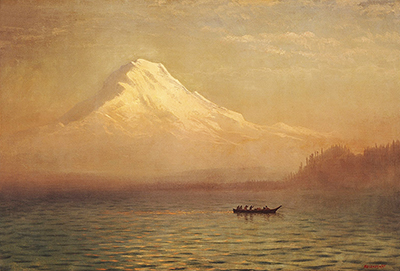
Sunrise on Mount Tacoma by Albert Bierstadt
A snow-covered mountain rises above a band of haze, while a small boat crosses the darker water below. In Albert Bierstadt's Sunrise on Mount Tacoma, the peak catches warm light long before the foreground becomes equally clear. The picture draws its strength from this separation: a luminous summit appears remote, while the boat gives the water a human scale.
Bridgeman Images catalogues this composition as Sunrise on Mount Tacoma, image CH401706: oil on canvas, measuring 76.2 × 111.5 centimetres. Its current entry gives no precise date, labels the location ‘Private Collection’ and credits Christie's Images.[1] That anonymous label does not establish a present owner or a verified auction history. The matching reproduction supports the catalogue connection, while its visible composition offers a firmer starting point than an unsupported year or studio location.
At a Glance
Where this painting sits in Bierstadt’s career
Dates refer to the paintings, rather than to the journeys behind them. Approximate dates and ranges retain the qualifications in the collection records.
Lake Lucerne
1858Mountain Brook
1863Street in Nassau
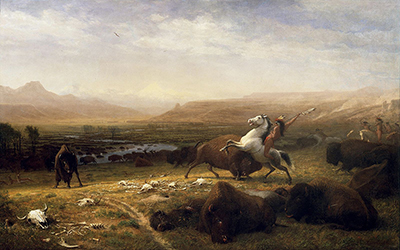
c. 1877–1880The Last of the Buffalo
1888–1889The Golden Gate
1900Sunrise on Mount Tacoma
Undated (precise year unconfirmed)Contents
The mountain emerges through colour
The principal peak stands left of centre, its upper slopes described in pale gold and cream. One face catches strong light, while another falls into a cooler shadow. Darker divisions cut across the snow-covered mass, preventing it from becoming a flat white triangle.
Its lower slopes are much less definite. Warm haze veils their bases, and the nearer land becomes a subdued horizontal band. The mountain consequently appears to emerge above the atmosphere rather than sit on a fully exposed foundation.
The broad descending ridge on the right helps distribute its weight. The summit remains the highest point, but the eye can follow its slope towards lesser pale forms and the wooded shore. This movement connects the solitary-looking peak with the rest of the composition without giving every distant feature an equally sharp outline.
Water changes the rhythm of the view
The foreground is filled with short, uneven horizontal marks. Some are dark green-grey; others catch copper and yellow highlights. Their repeated intervals make the surface appear mobile, although no towering wave disturbs the scene.
These small divisions contrast with the great sloping planes of the mountain. The summit can be apprehended as a single large form, while the water encourages the eye to move among many separate reflections. Distance and closeness are expressed through different kinds of visible detail.
A loose path of warm colour runs through the water near the centre. It does not reproduce the mountain as an intact mirror image. Instead, light breaks into fragments along the surface, carrying the atmosphere's warmth towards the viewer.
The shoreline on the right is darker still. A wooded rise enters from the edge, and its trees form an irregular silhouette above the haze. Their compressed shapes establish land between the boat and the mountain, helping the eye distinguish successive distances.
A boat beneath the summit
The narrow craft lies to the right of centre, low in the picture. Its raised bow and dark hull are clearly separated from the lighter water. Small figures sit within it, with individual heads and upper bodies visible against the surrounding glow.
The boat is large enough to reward attention but small enough to preserve the mountain's dominance. It draws the eye towards the foreground, then gives the viewer a measure with which to reconsider the summit. The scene contains human activity even though the greater part of the canvas is devoted to land, water and atmosphere.
The reproduction does not securely identify the occupants, their destination or the purpose of their journey. A precise tribal identity cannot be assigned from these small silhouettes. Likewise, the craft's position does not establish an encounter that Bierstadt personally witnessed.
Those limits leave room for the boat's visible role. Its sharp dark contour interrupts the water's repeated marks, while the seated figures introduce a compact gathering beneath the broad mountain. The relationship makes the landscape inhabited without supplying a complete narrative.
The names carried by the title
Mount Tacoma is associated with the mountain now widely called Mount Rainier. Naming it involves more than choosing between two interchangeable English labels. A 2025 announcement by the Puyallup Tribe describes research by Lushootseed language consultant Zalmai ʔəswəli Zahir into numerous mountain names across several Tribal languages.[2]
The announcement explains that the city of Tacoma takes its name from a Lushootseed mountain name, while the commonly used Tahoma descends through a Yakama-language variation. This linguistic history cautions against attaching a single convenient translation to every form. The underlying journal article was not consulted for this account.
The title therefore brings a regional history into the painting's interpretation. It connects the pictured peak with a landscape that was named and understood by Indigenous peoples before European charting. That context does not prove which language, speaker or written source supplied Bierstadt's title, but it makes the name itself worth considering.
A landscape with long human connections
The National Park Service describes seasonal journeys to the mountain for hunting, plant gathering, fishing and the collection of cedar bark. It also recognises continuing Indigenous relationships with the area.[3] These histories complicate the idea of an empty wilderness awaiting discovery.
The boat already prevents such an empty reading within the image. Beyond that visible presence, regional history reminds us that a distant wooded shore could belong to established routes and practices even when the painting shows no settlement. A picturesque view does not inventory all the lives connected with a place.
This distinction keeps historical context proportionate to the evidence. The occupants cannot be linked to a documented journey or community, and the picture's quiet atmosphere does not reveal the artist's position on every contemporary dispute. The painting presents a selected scene within a much larger inhabited region.
Snow above a volcanic mountain
The United States Geological Survey explains that modern Mount Rainier was built through successive lava flows over roughly half a million years. Its geological history also includes older volcanic formations beneath the present mountain.[4] The luminous snow surface consequently lies over a landform with a history very different from its apparently still appearance.
This background helps separate pictorial calm from geological permanence. The painting makes the summit look stable above the water, yet the mountain belongs to a landscape shaped by construction, erosion and change. Its warm illumination describes an appearance at a moment, not a complete account of the processes within and around it.
Nothing in the reproduced scene establishes a particular eruption. Pale clouds and haze should not be treated as volcanic emissions simply because the subject is a volcano. Nor does the image provide the evidence needed to identify individual glaciers or calculate their historical extent.
What the uncertain record leaves open
The catalogue's lack of a firm date affects the kind of history that can be written. This painting cannot securely be assigned to a particular western expedition, a documented exhibition or the aftermath of a studio fire. Such episodes may belong to Bierstadt's career, but attaching them here would require evidence specific to this canvas.
The image metadata also includes geographical labels that are not a verified viewpoint study. A precise lake or bay location remains unresolved. Discussing the water, wooded bank and snow-covered peak as painted relationships offers more than repeating an uncertain site identification.
Begin with the summit's brightest face, follow its descending slope towards the wooded right-hand rise, and then look for the boat. The water's broken highlights lead back towards the centre. Through that circuit, Bierstadt joins the mountain's apparent immensity to a small, legible human presence within the morning light.
Watch: Albert Bierstadt
Five perspectives on his paintings and their historical setting.
American Landscape Painting: Albert Bierstadt and the American Land
A Museum of Fine Arts, Boston presentation on American Landscape Painting: Albert Bierstadt and the American Land.
Explore Bierstadt’s artworks
Discussion
A warmly lit summit rises above darker water and a small boat. How does this separation shape your sense of distance?
Reader Insights
How do warm snow, cool shadows and intervening haze distinguish the mountain from the water below?
Which details give the narrow craft a human scale without identifying the figures’ names or destination?
How does the Puyallup language research change the questions you bring to the mountain name in the title?
Join the Conversation
Share a specific observation, documented connection or comparison from Sunrise on Mount Tacoma.
References
- Bridgeman Images. Sunrise on Mount Tacoma (oil on canvas), CH401706. Exact catalogue record and visually matched reproduction: material, dimensions, anonymous collection label and photographic credit; precise date, viewpoint and present owner unconfirmed. View source text
- Puyallup Tribe. Puyallup Tribal language consultant publishes first comprehensive analysis of the many Native names for Mount Rainier, 24 February 2025. Announcement read; underlying research paper not consulted. View source text
- National Park Service. Mount Rainier History. Regional Indigenous use and continuing relationships; no identification of the painted boat's occupants. View source text
- United States Geological Survey. Geology and History Summary for Mount Rainier, 8 November 2023. Regional volcanic history, distinct from evidence of any painted event. View source text