 by Tom Gurney
Tom Gurney BSc (Hons) is an art history expert with over 20 years experience
Published on June 19, 2020 / Updated on October 12, 2026
Email: tomgurney1@gmail.com / Phone: +44 7429 011000
The Shore of the Turquoise Sea by Albert Bierstadt
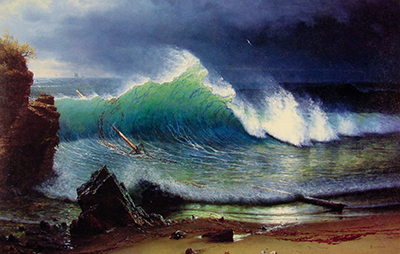
A green wave lifts out of a dark sea, its thin crest catching the light just before it breaks. Behind it, storm clouds almost extinguish the sky. Albert Bierstadt’s The Shore of the Turquoise Sea makes the water beautiful at the moment it becomes dangerous: light passes through the rising wall, while broken timbers show what that wall can destroy.
Campo Rosillo’s figure 6 identifies this 1878 oil on canvas, measuring 108 × 163.8 cm, with the Manoogian Collection, Detroit.[1] The Haggin Museum describes its larger After a Norther, Bahamas as a later version.[2] The green breaking wave connects these pictures, but the objects around it change the encounter with the sea.
At a Glance
Where this painting sits in Bierstadt’s career
Dates refer to the paintings, rather than to the journeys behind them. Approximate dates and ranges retain the qualifications in the collection records.
Lake Lucerne
1858Mountain Brook
1863Street in Nassau
c. 1877–1880The Last of the Buffalo
1888–1889The Golden Gate
1900Contents
Looking into the wave
The title promises turquoise, and Bierstadt gives the colour a physical role. The wave changes from deep blue at its base to clear green along its raised face. Thin threads of foam describe its curve. Along the top, white spray blows back towards the left, while the wave itself collapses into a brilliant burst at the right. Water seems to move in opposing directions at once: up into the crest, down into the breaking surf and backwards into the wind.
The viewpoint makes this movement unusually close. We look across the wave from near the shore, rather than observing a storm from a distant headland. Its crest rises well above the sea’s horizon. The dark strip of open water behind it helps separate the swelling form from its surroundings, so that one wave assumes the weight of a much larger event.
Light makes that separation more emphatic. A pale opening in the sky occupies the upper left, above a narrow glimpse of distant water. Towards the right, the cloud mass becomes blue-black. Against this darkness, the lit crest and breaking foam stand out sharply. The green is brightest where the water appears thinnest; at the base, its transparency gives way to dense blue. Bierstadt lets us see both the shape of the wave and the light within it.
The shore provides a second sequence of contrasts. At the left, a rocky ledge rises into the picture, with a small patch of vegetation above it. Beneath the wave, foam spreads into shallower water. Closer still, a low band of surf runs across the beach, and wet sand catches pale and warm reflections. The arrangement moves from hard rock through turbulent water to a shoreline that looks briefly accessible. Yet the breaking wave dominates all three zones.
Wreckage on the beach
Small seabirds appear against the lighter distance at the left. Their scale makes the water more imposing, but the strongest measure of its force is the wreckage. A broken section of dark hull lies in the foreground. Slanting spars or timbers project into the sea, and a longer piece rests near the advancing edge of the surf. These angular fragments interrupt the curved lines of water.
Campo Rosillo places the wreckage within the sublime tradition of nature overwhelming the viewer.[1] Here the danger has already left material evidence. The fragments give the wave a history beyond the suspended instant of its crest. A vessel has broken apart, while the sea continues to rise and fall around what remains.
There is no visible rescue or human figure to direct the story. The viewer must look between the luminous water and the damaged objects on the beach. Beauty and destruction occupy the same field of vision. Even the dark hull helps intensify the colour, setting its rough silhouette against the pale wash of the shallows.
The Bahamas and Rosalie Bierstadt
Nancy K. Anderson records Rosalie’s first winter journey to Nassau in autumn 1876, following advice to seek warmth for her consumption. Bierstadt visited while continuing his New York studio work and other travel.[3] The Haggin Museum dates his first Bahamian visit to 1877 and reports an exhibition of The Shore of the Turquoise Sea in 1878.[2]
The journeys placed him in a landscape that offered different subjects. Roads and harbours could give island life a human scale, while a large wave fills the viewer’s immediate field of vision. In this painting, the clearest colour belongs to moving water rather than a stable stretch of land. The shore becomes the edge of an event, with little space in which to withdraw from it.
The Bahamian climate’s attraction to visitors also forms part of this contrast. The islands offered winter travellers the prospect of warmth and recuperation. The Shore of the Turquoise Sea presents an unsettled coast, where the clearest colour belongs to a dangerous wave. Knowing why the Bierstadts travelled there can sharpen our sense of the difference between a hoped-for refuge and an exposed shoreline.
Rosalie’s illness gives the painting a poignant biographical context. The sources do not establish the wreck or wave as a coded account of her condition. The composition’s drama can be followed through the visible relationship between light, water and broken objects, without supplying an unrecorded personal meaning.
A wave study and a finished painting
Mary Terence McKay discusses an oil sketch titled Wave, dated 1878, in her essay For Bierstadt’s Eyes Alone. She describes its coloured, translucent breaker and identifies it as preceding The Shore of the Turquoise Sea, citing Gerald L. Carr’s 1983 Alexander Gallery catalogue, number 21.[4] That relationship is consulted through McKay; the original catalogue and sketch have not been inspected here.
Her account adds a practical dimension to the wave’s recurrence. A small study could concentrate on the contour and colour of moving water before the finished painting brought that observation into a larger coastal arrangement. This does not establish a complete sequence of preparatory work. It gives a documented scholarly account of one related study, alongside the later versions.
In the finished image, the wave’s colour alone does not carry the effect. The hull, spars, beach and cloud extend its implications. They locate the bright water within a field of damage and uncertainty, making the crest both a visual focus and a force acting on its surroundings.
A composition revisited
Bierstadt’s interest in crashing surf preceded the Bahamian journeys. The Haggin Museum records his May 1872 visit to California’s Farallon Islands, where he studied rugged rocks, waves and seals, and relates those observations and studies of Seal Rocks near San Francisco to four wave paintings.[2] The Bahamas gave him fresh material for an existing marine interest.
The Haggin Museum dates After a Norther, Bahamas to after 1878 and gives its dimensions as 54¾ × 84¾ inches. It records the painting in London’s Colonial and Indian Exhibition in 1886.[2] That exhibition history belongs to the larger Haggin canvas.
The museum contrasts the later painting’s rushing wave with a slow-moving turtle on the shore.[2] In the 1878 work, broken ship parts make destruction explicit. Their angular edges look different from the flowing contours of water, and their proximity gives the viewer something solid against which to judge the crest. A comparison of versions therefore involves the surrounding objects as much as the wave itself.
Campo Rosillo also identifies this Bahamian wave in The Golden Gate of 1900, a composition with boats and a rainbow.[1] A repeated form can take on new emphasis when its surroundings change. Here, the dark cloud and broken vessel keep attention close to the threatened shore.
The resemblance also cautions against treating The Shore of the Turquoise Sea as a record of one precisely identifiable beach. Its wave became a compositional resource, capable of sustaining several pictures. The 1878 canvas gives that resource its particularly stark arrangement: green water under a blackening sky, with the remains of a vessel lying close to the viewer.
Reception and a later public exhibition
Anderson records an 1880 showing at the National Academy of Design and describes a mixed response: admiration accompanied by criticism of Bierstadt’s dramatic effects.[3] The Haggin account’s 1878 exhibition notice and Anderson’s named 1880 venue should remain distinct. Neither account inspected here provides a complete early exhibition itinerary.
This mixed reception helps situate the marine picture within his career. A new region and a luminous wave could attract attention while leaving familiar questions about his scenic drama unresolved. The image makes its effects readily visible: brilliant green water beside near-black cloud, a close crest above a low horizon, and wreckage set against moving foam. Those relationships explain what a viewer could find compelling, whether or not they shared contemporary admiration.
A much later museum record gives the painting another setting. The National Gallery’s February 1989 announcement names The Shore of the Turquoise Sea among the landscapes in American Paintings from the Manoogian Collection, pairing its geographical range with William Bradford’s Arctic subject.[5] The Gallery’s exhibition history records the Washington showing from 4 June to 4 September 1989, followed by venues in San Francisco, New York and Detroit.[6]
In this context, the Bahamian seascape contributed to a broad presentation of nineteenth-century American painting. Its place beside other regions shifts attention from an isolated storm to the range of environments artists represented. That documented museum history develops the Manoogian association without turning a past loan exhibition into evidence of current public display.
The recorded collection
Campo Rosillo’s 2022 figure 6 and note 37 give the Manoogian association.[1] This published identification does not establish a present owner or display location. It should also remain separate from the Haggin Museum’s record for its larger canvas.[2]
Watch: Albert Bierstadt
Five perspectives on his paintings and their historical setting.
American Landscape Painting: Albert Bierstadt and the American Land
A Museum of Fine Arts, Boston presentation on American Landscape Painting: Albert Bierstadt and the American Land.
Explore Bierstadt’s artworks
Discussion
How do the glowing wave and broken timbers make the sea’s beauty and force visible together?
Reader Insights
Follow the rising crest, falling surf and windblown spray. Which direction of movement is strongest when you first look?
Compare the curved water with the angular fragments on the shore. How do the timbers change your sense of what has happened beyond the moment shown?
Compare this composition with After a Norther, Bahamas. Which changes matter when a marine subject is developed in another painting?
Join the Conversation
Share a specific observation, documented connection or comparison from The Shore of the Turquoise Sea.
References
- Alba Campo Rosillo. “Bierstadt’s view of a street in Nassau: a painting about becoming,” Open Windows 11 (2022), pp. 9–10, fig. 6; p. 25, n. 37. Identity, wreckage interpretation and repeated wave. View source text
- Haggin Museum. “After a Norther, Bahamas.” Object entry: versions, Pacific studies, date, dimensions, London exhibition and wave/turtle comparison. View source text
- Nancy K. Anderson / National Gallery of Art. “Albert Bierstadt,” American Paintings of the Nineteenth Century, Part I (1996), pp. 31–33. Nassau journeys and the 1880 National Academy reception. View source text
- Mary Terence McKay. “For Bierstadt’s Eyes Alone,” Resource Library Magazine (2002), discussion of Wave, plate 16, and note 36; Gerald L. Carr’s 1983 Alexander Gallery catalogue, no. 21, consulted through this essay. View source text
- National Gallery of Art. “American Paintings from the Manoogian Collection,” news release, 15 February 1989, p. 2. Specific inclusion of the 1878 Bierstadt and geographical comparison. View source text
- National Gallery of Art. “American Paintings from the Manoogian Collection,” historical exhibition record. Washington dates, collection scope and other venues. View source text