



 by Tom Gurney
Tom Gurney BSc (Hons) is an art history expert with over 20 years experience
Published on June 19, 2020 / Updated on October 12, 2026
Email: tomgurney1@gmail.com / Phone: +44 7429 011000
California Spring by Albert Bierstadt
In California Spring, the sky gives a quiet pasture the scale of a spectacle. Cattle graze and rest among flowers, a river catches the light below, and great banks of cloud rise above the plain. Painted in 1875, this oil on canvas belongs to the Fine Arts Museums of San Francisco. It measures 137.8 × 214 cm and carries the credit “Presented to the City and County of San Francisco by Gordon Blanding,” accession 1941.6. The museum identifies the subject as the Sacramento River Valley.[1]
The painting's breadth comes from the meeting of two different kinds of space. Close to the viewer, flowers, cattle and trees make a hillside tangible and approachable. Beyond them, the land recedes into a distant plain beneath an immense, changing sky. California appears fertile and hospitable, yet the details place this apparently timeless pastoral scene within a particular season and an inhabited landscape.
At a Glance
Annotated Details from California Spring
Use the numbered details to explore how Bierstadt builds this scene from light, scale and overlapping forms. Image: Fine Arts Museums of San Francisco, Presented to the City and County of San Francisco by Gordon Blanding. Image source.
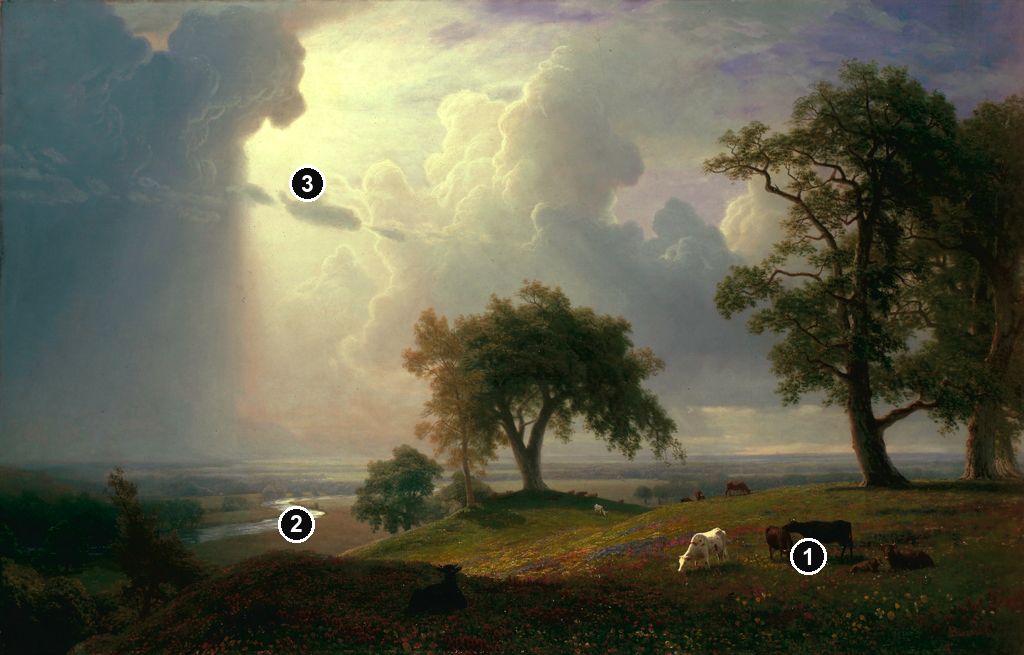
Details from CALIFORNIA SPRING
Compare these enlarged passages with their positions in the full painting.
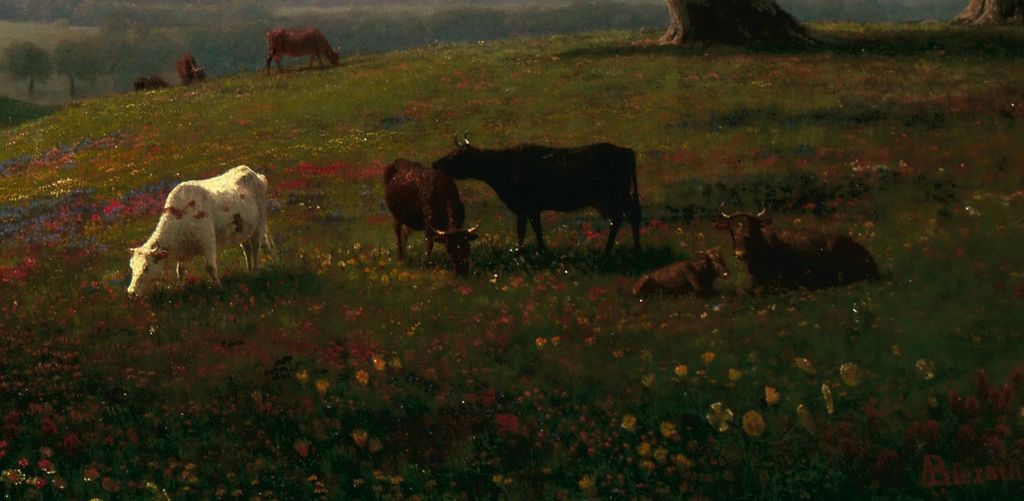
Cattle in the foreground
Compare the cattle with the broad stretches of grass around them. The herd gives scale and activity to the open foreground.
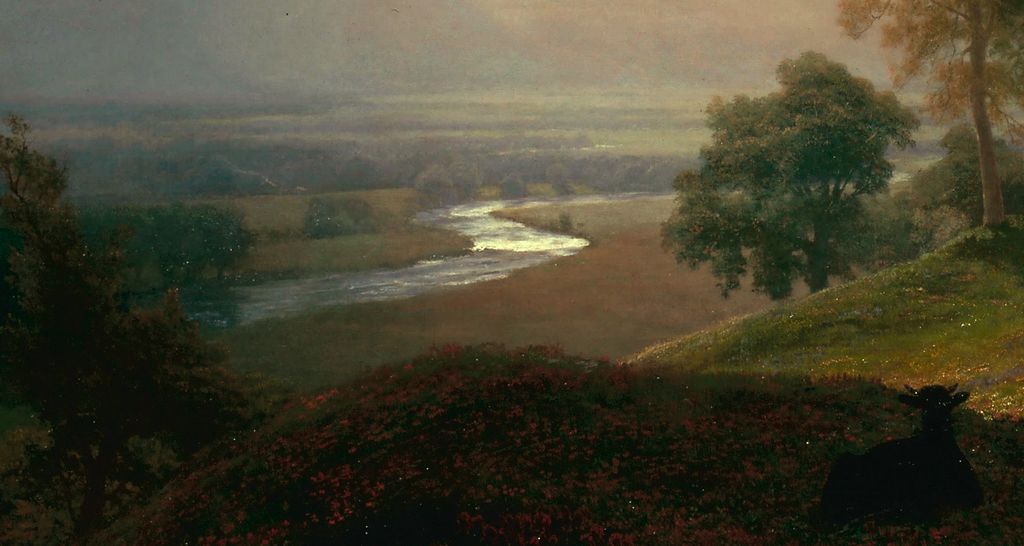
Water winding through the grass
Trace the bright water as it bends through the meadow. Its changing direction leads the eye across the otherwise broad horizontal landscape.
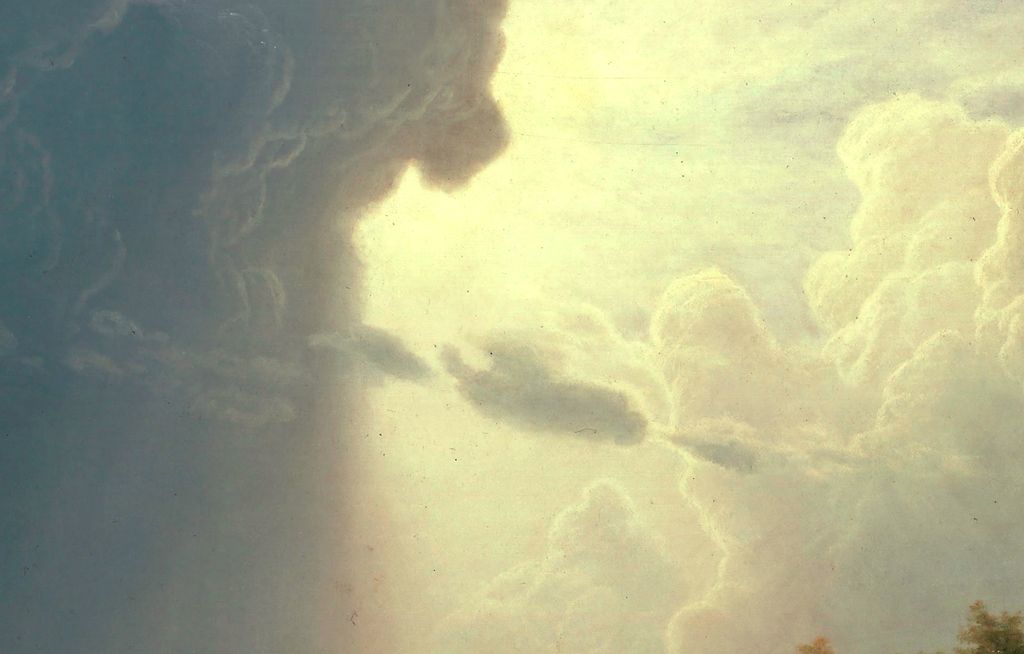
Sunlight and cloud shadows
Look at the transitions between luminous clouds and darker passages. These changes in the sky echo the patches of light and shade on the land.
Where this painting sits in Bierstadt’s career
Dates refer to the paintings, rather than to the journeys behind them. Approximate dates and ranges retain the qualifications in the collection records.
Lake Lucerne
1858Mountain Brook
1863Street in Nassau
c. 1877–1880The Last of the Buffalo
1888–1889The Golden Gate
1900Contents
A pasture beneath a vast sky
The foreground slopes gently towards the left. Its red, yellow and blue-violet flowers give the grass a varied surface; farther away, bright particulars merge into broad bands of green and muted earth colours. A white cow, its head lowered to feed, stands out against the sunlit ground. Darker cattle beside it are less sharply separated from the pasture, while a resting animal nearer the lower left forms a compact silhouette against the flowers. The cattle's different positions make grazing seem unhurried and continuous.
Their distribution also measures distance. The foreground animals have bodies and postures that can be individually read. Others near the central trees and along the rise become smaller accents, guiding attention across the slope. The hillside looks spacious because the same familiar activity continues at several scales. Bierstadt supplies a way to imagine entering the landscape before its distant reaches dissolve into haze.
The trees give that movement a framework. A rounded canopy near the centre shades a rise in the ground; taller, branching trees at the right anchor the edge of the picture. Their trunks and spreading limbs interrupt the horizontal sweep of the land without closing it off. Between them, the eye can move towards a low horizon whose features become increasingly indistinct.
At the left, a silver passage of water winds through the distance. Its brilliance draws attention away from the dark lower corner and offers a route into the valley. Although the river occupies relatively little of the canvas, its bends make the flat country legible. Where the cattle suggest successive intervals across the hillside, the river carries the eye farther into the plain.
Above this accessible landscape, clouds occupy most of the canvas. Their grey-green and lavender shadows deepen at the left and along the upper edges, surrounding a pale opening through which light descends. Illuminated rims and swelling forms give the sky volume. Below, a diagonal band of brightness passes across the grass, bringing the white cow and patches of flowers into prominence. The light connects the smallest visible details with the enormous space overhead.
The clouds could make the scene ominous, but the animals remain settled. Their calm changes the emotional force of the sky: its towering forms become a spectacle contemplated from sheltered ground. The picture allows atmospheric drama and rural ease to coexist. Much of its attraction lies in that balance between a world large enough to inspire wonder and a foreground comfortable enough to inhabit.
The journey and the distant Capitol
The museum relates the picture to studies from Bierstadt's third western journey, made with his wife, Rosalie, by transcontinental railroad.[1] The Smithsonian American Art Museum dates his return to California to 1871 and records a stay of two years, during which he painted Sierra Nevada and Yosemite views.[2] The finished canvas of 1875 therefore follows that visit. The journey supplies a context for the work, without establishing that the completed composition records one observed moment or an identifiable ranch.
The pastoral foreground can initially seem remote from urban life. A much smaller feature complicates that impression. The Fine Arts Museums' description on Google Arts & Culture identifies the Sacramento State Capitol dome on the horizon between oak trees.[3] Its scale matters: a major civic building can become a minute mark within Bierstadt's encompassing view. Recognizing it changes the plain from a generalized expanse of green into country connected with California's capital.
The Capitol's history also clarifies the date. According to the California State Capitol Museum, construction began in 1860, state government occupied the building in 1869, and completion came in 1874. The project weathered problems involving funding, flooding, labour, supplies and politics.[4] Thus 1874 marks completion after a prolonged building campaign, rather than the whole period of construction. The painting followed the completed building by a year.
These dates do not verify an exact vantage point or demonstrate that every feature shares a single surveyed location. They do establish why the dome is more than decorative distance. Beside the cattle, it supplies a second sign of organized human life. Husbandry is immediate and visible; government is distant and almost absorbed into the horizon. Their unequal prominence lets the picture feel spacious without making the country empty.
What the cattle add to the landscape
Cattle alter the meaning of the flowers and fresh grass. The pasture is a source of sustenance for domesticated animals, and its beauty has a practical dimension. Yet husbandry appears here without conspicuous labour. No foreground figure directs the herd or repairs a fence. Feeding and resting become the chief visible activities, so productive use and scenic peace seem compatible.
A regional history of livestock production makes that ease more consequential. In her University of California account, Stephanie Larson-Praplan describes the expansion of demand for meat during the Gold Rush and the importance of Sacramento and San Joaquin valley pasturage. She also recounts the destructive sequence of the 1861–62 floods and subsequent drought, ranchers' losses, and the acquisition of land by financially stronger companies.[5] This is regional economic history, rather than evidence about ownership or events on the pictured hillside.
The pasture's calm takes on a different meaning against this history. Seasonal water could nourish grass or threaten grazing land, and a herd's survival depended on more than an attractive setting. The luminous river is therefore open to two readings: a path into pictorial space, and part of the environmental uncertainty that husbandry had to accommodate. The scene brings one prosperous-looking interval into view while leaving those pressures outside the frame.
The Fine Arts Museums interprets this inviting pasture as an American Eden appealing to prospective settlers.[1] The distant Capitol also places that vision of abundance within land already in human use.
Spring seen beside Bret Harte's satire
The title names a season, and that qualification deserves attention. Fresh grass and flowers do not describe the valley at every point in the year. The picture fixes an inviting phase of growth and gives the viewer time to linger in it. Its broad format and richly differentiated foreground can make a seasonal condition feel expansive and enduring.
The museum's Art on Demand interpretation places Bret Harte's California Madrigal (On the Approach of Spring) beside the painting.[6] Harte's poem repeatedly interrupts a lover's pastoral invitation with less romantic particulars: an overflowed ranch, a damaged levee, mud, a highwayman, travel dust and the approach of heat that will dry the grass.[7] The humour depends on the friction between an elevated invitation into nature and the awkward conditions the invitation must accommodate.
The comparison sharpens the question of selection. Bierstadt sustains an atmosphere of ease; Harte repeatedly makes ease precarious and the desired spring interval brief. His satire challenges pastoral conventions rather than supplying a literal weather report for the painted day. It does not establish that he wrote in response to this 1875 canvas. Read beside the poem, the flowers remain beautiful but suggest a moment of renewal whose conditions can change.
A different California season
The Crocker Art Museum's separate A Golden Summer Day Near Oakland, circa 1873, is oil on paper on Masonite, measuring 15¼ × 21¼ inches.[8] Neither its title nor its record establishes it as a study for California Spring.
In the Crocker painting, branching trunks at the left shelter a picnic group above a golden field and rolling hills. Two further figures appear near the lower right, with small animals in the middle distance. Human leisure becomes visible beneath the canopy.
Both pictures invite entry through foreground shelter and contrast dark trees with brighter land. Their seasons give those arrangements different effects. Spring flowers and grazing cattle lie beneath monumental clouds; the summer painting opens towards golden country and a quieter sky. Bierstadt's California could accommodate both pasture in bloom and leisure in a dry-looking landscape. Comparing them makes the particular appeal of spring greenness easier to see.
Watch: Albert Bierstadt
Five perspectives on his paintings and their historical setting.
American Landscape Painting: Albert Bierstadt and the American Land
A Museum of Fine Arts, Boston presentation on American Landscape Painting: Albert Bierstadt and the American Land.
Explore Bierstadt’s artworks
Discussion
How do the grazing cattle and enormous sky work together in California Spring?
Reader Insights
Follow the foreground flowers as their colours merge into the more distant pasture. How does the level of detail change your sense of space?
Compare the scale of the cattle with the clouds above them. Which part of the painting most strongly creates its impression of abundance?
Compare the spring pasture with the separate Golden Summer Day Near Oakland discussed in the article. How do season and human activity change the invitation to enter each landscape?
Join the Conversation
Share a specific observation, documented connection or comparison from California Spring.
References
- Fine Arts Museums of San Francisco. “California Spring,” accession 1941.6; object fields and “Can you imagine the California of the past?” interpretation. View source text
- Smithsonian American Art Museum. “Albert Bierstadt”; “More Information — Artist Biography,” 1871 California return and two-year stay. View source text
- Fine Arts Museums of San Francisco, via Google Arts & Culture. “California Spring”; paragraph identifying the Capitol dome. View source text
- California State Capitol Museum. “Construction”; 1860 groundbreaking, 1869 occupation and 1874 completion. View source text
- Stephanie Larson-Praplan. “History of Range Livestock Production,” University of California Agriculture and Natural Resources, publication 8543 (2020), pp. 2–4; regional cattle demand, floods, drought and land consolidation. View source text
- Fine Arts Museums of San Francisco. “California Spring, 1875,” Art on Demand; “About the Artwork,” Harte comparison. View source text
- Bret Harte. “California Madrigal (On the Approach of Spring),” complete poem, reproduced by Telelib in East and West Poems. View source text
- Crocker Art Museum. “A Golden Summer Day Near Oakland,” circa 1873, accession 2026.2.1; current object record and reproduction. View source text


