 by Tom Gurney
Tom Gurney BSc (Hons) is an art history expert with over 20 years experience
Published on June 19, 2020 / Updated on October 12, 2026
Email: tomgurney1@gmail.com / Phone: +44 7429 011000
Portico of Octavia, Rome by Albert Bierstadt
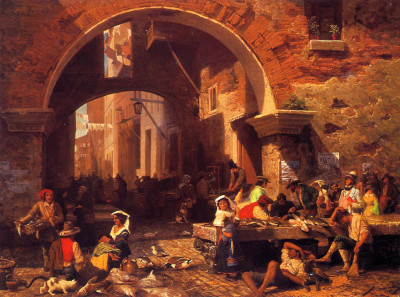
A broad brick arch encloses a busy fish market. Sunlight strikes the masonry and the people in the foreground, while a second arch opens onto a narrow street beyond. Albert Bierstadt’s Portico of Octavia, Rome brings ancient architecture into contact with buying, selling, resting and sightseeing. Rome’s past supplies the setting, but its living inhabitants give the picture its activity and its tensions.
The Fine Arts Museums of San Francisco catalogue the painting as Roman Fish Market. Arch of Octavius, dated 1858. It is oil on canvas, measuring 70.2 × 94.9 centimetres, and entered the collection as a gift of Mr. and Mrs. John D. Rockefeller 3rd.[1] The subject is the Portico of Octavia, a monument named for Augustus’s sister, whose surviving structures acquired other uses over many centuries.[2]
At a Glance
Where this painting sits in Bierstadt’s career
Dates refer to the paintings, rather than to the journeys behind them. Approximate dates and ranges retain the qualifications in the collection records.
Lake Lucerne
1858Mountain Brook
1863Street in Nassau
c. 1877–1880The Last of the Buffalo
1888–1889The Golden Gate
1900Contents
Looking through the arches
The foremost arch almost reaches the upper edge of the canvas. Its curve gives the crowded scene below a firm boundary, as if we are looking into a stage. The brickwork is warm brown and orange, with worn surfaces and patches of irregular masonry. Bierstadt gives it considerable visual weight: the structure dominates the scene even though most of the individual actions occur beneath it.
Inside that frame, another arch repeats the curve on a smaller scale. Between the two, the space narrows and darkens. Beyond the second opening, tall buildings crowd around a bright strip of street. The succession of arches allows us to follow the market into the city without losing sight of the enclosing monument.
The picture’s depth depends on contrasts of light as much as on the architecture. The nearer right-hand wall catches strong sun, while the space beneath the inner arch remains dark. Pale facades beyond it then brighten the view again. The eye moves through light, shade and light, crossing separate zones rather than encountering an evenly illuminated street.
A long stall extends across the right. Its slab interrupts the verticals of the wall and the curve overhead, keeping the market’s practical activity close to the viewer. At the left, standing and seated figures occupy the ground beneath the other side of the arch. Baskets, scattered goods and animals make the lower edge irregular. These details prevent the monument from becoming an isolated architectural study.
An ancient monument with changing uses
The Portico of Octavia belonged to a much larger complex than the surviving entrance suggests. Rome’s municipal account describes Augustus’s rebuilding of an earlier portico between 27 and 23 BCE and a later reconstruction under Septimius Severus in 203 CE. Most of the visible remains belong to that later phase.[2] The architecture therefore carries several periods of Roman history within its damaged fabric.
The same account records the use of the porticoed spaces for selling fish and the incorporation of ancient structures into the church of Sant’Angelo in Pescheria during the eighth century.[2] The market in Bierstadt’s painting grew from a long history of reuse. It was part of the monument’s life, rather than an activity newly imposed by the painter.
That history changes how we read the worn walls. The building can be admired as a remnant of antiquity, but it also provides shelter, passage and a place to trade. The fish sellers occupy a useful urban space. From their point of view, a market beneath an old arch need not mean that the site has ceased to matter.
For a visitor seeking the greatness of ancient Rome, however, the same use might appear incongruous. A structure associated with imperial building and classical culture now surrounds everyday commerce. Bierstadt places those ways of valuing the city within a single view, allowing the impressive scale of the arch to coexist with the modest activities below.
Tourists among the workers
The museum identifies the couple at centre right as American tourists, with a red guidebook carried by the man.[1] That small object introduces a different purpose for entering the market. The visitors have come to look at Rome; the workers depend on what takes place there.
The guidebook also brings a second means of interpreting the city into the painting. It suggests an itinerary, a named monument and an account of its importance. Yet the tourists must walk through a populated street to reach the architectural past. The people and goods cannot be removed from their experience of the site.
The contrast is visible in the figures’ clothing and posture. The couple stands relatively upright amid the seated, bending and reclining people around them. Their position near the right-hand stall brings them close to ordinary market activity, while their formal appearance sets them apart. Bierstadt makes them participants in the crowd and observers of it at the same time.
The red book is especially pointed in a painting that itself could be viewed far from Rome. The tourists carry a representation of the city through its streets; the painting carries a representation of that experience to another audience. Both encourage looking, but neither is a transparent substitute for the place and its inhabitants.
Classical figures in an everyday scene
Art historian Paul A. Manoguerra identifies echoes of Endymion Asleep and the Barberini Faun in the resting men at the lower right.[3] On this reading, classical art reappears through the bodies of contemporary workers, extending the relationship between antiquity and present life beyond the architecture.
The reclining figures are conspicuous because they lie so close to the viewer. Their horizontal positions contrast with the standing visitors and the upright supports of the arch. Rest becomes one of the actions through which the scene is organised, alongside trading and passing through.
Recognising a classical pose makes the juxtaposition more complex. A familiar form associated with a celebrated sculpture appears within a workaday setting. The viewer might find that transformation witty, picturesque or belittling, depending on how the relationship between the ancient model and the contemporary person is understood.
The comparison does not oblige us to treat the people as failures to live up to antiquity. It draws attention to a choice made in representing them. A pose can help give a figure elegance and recognisability while also exposing that figure to a judgement formed elsewhere. Looking at the painting involves considering who gets to make such comparisons and what they imply.
The painting and its American audience
Manoguerra records an 1858 sale to the Boston Athenaeum for $400 and fourteen appearances in its annual exhibitions between 1858 and 1879.[3] The scene therefore reached an audience for whom Rome’s ancient culture and contemporary population could carry associations beyond an Italian journey.
His interpretation connects the contrast between tourists, damaged monuments and market life with Protestant anti-Catholic prejudice and anxiety about Irish immigration in nineteenth-century New England. He treats the Italian scene as a means of expressing American concerns. He also notes the absence of explicit documentation establishing Bierstadt’s personal intentions or a contemporary interpretation of the painting.[3]
That qualification is essential. The argument explains how the picture could operate within a particular culture of viewing; it does not turn every mark of wear into a declared political statement by Bierstadt. Nor should prejudiced descriptions of Rome be repeated as an objective account of its people.
The composition gives the interpretation something concrete to address. Visitors and workers share the same light and enclosure, yet remain visibly differentiated. The commanding architecture makes the scale of the human activity seem small, while the near foreground brings individual bodies and objects forward for inspection. Those relationships can produce admiration for the monument and scrutiny of the people simultaneously.
An awareness of that unequal scrutiny makes the painting more demanding to look at. A lively market can be enjoyed for its movement, colour and detail, but it can also become a spectacle for outsiders. The tourists within the canvas remind us that the act of looking is already part of its subject.
Another view of the same portico
The site had attracted artists long before Bierstadt. The Metropolitan Museum of Art holds Piranesi’s Internal View of the Atrium of the Portico of Octavia, an etching it dates to 1760. Its account describes fish stalls along a wall and continuing into the distance, as well as the print’s strong sunlight and attention to stone.[4]
That comparison places Bierstadt’s market within a longer artistic interest in the coexistence of monumental architecture and ordinary use. The ancient setting and the stalls were available to both artists as subjects. Light could reveal surfaces and organise depth in an etching as well as an oil painting.
Bierstadt’s colour introduces another dimension. Warm masonry surrounds brighter clothing and pale areas of fish and pavement, making the foreground a sequence of small accents within the larger architectural mass. The street beyond stays connected to that near activity through the repeating arches. The market is both a gathering of individual incidents and a passage into Rome.
An early work beyond the western landscapes
Bierstadt returned to New Bedford from Europe in 1857, before the 1859 western journey that would become central to his reputation.[5] The Roman painting belongs to the period when European subjects remained important to his work. Its densely populated urban space broadens a career often encountered through mountain panoramas.
The difference is substantial. Here, buildings control the routes through the picture, and people occupy much of the foreground. There is no distant summit to dominate the view. Yet the succession of near detail, shaded middle space and luminous distance shows his ability to direct attention through a complicated setting.
Portico of Octavia, Rome brings together architectural survival, everyday labour, tourism and the interpretation of another society. Its strongest effect comes from keeping these subjects in contact. The arch provides a common frame, while the activities underneath it reveal that the same place can mean different things to its workers, visitors and viewers.
Watch: Albert Bierstadt
Five perspectives on his paintings and their historical setting.
American Landscape Painting: Albert Bierstadt and the American Land
A Museum of Fine Arts, Boston presentation on American Landscape Painting: Albert Bierstadt and the American Land.
Explore Bierstadt’s artworks
Discussion
An ancient arch shelters a populated Roman scene. How does the painting bring monumental history and everyday activity into the same space?
Reader Insights
Which figures draw your attention away from the large arch, and how does their scale return you to the building?
Compare the painting with the Piranesi view discussed above. How does each image make the site’s working life visible?
What does the red guidebook add to a scene that includes both visiting and resting figures?
Join the Conversation
Share a specific observation, documented connection or comparison from Portico of Octavia, Rome.
References
- Fine Arts Museums of San Francisco. Roman Fish Market. Arch of Octavius, 1858, accession 1979.7.12. Collection metadata and interpretation of the tourist couple. View source text
- Roma Capitale Turismo Roma. “The Portico of Octavia.” Monument history, rebuilding, fish-market use and Sant’Angelo in Pescheria. View source text
- Paul A. Manoguerra. “Anti-Catholicism in Albert Bierstadt’s Roman Fish Market, Arch of Octavius,” Nineteenth-Century Art Worldwide 2, no. 1, winter 2003. Classical comparisons, early ownership and exhibition history, interpretation and documentary qualifications. View source text
- The Metropolitan Museum of Art. Giovanni Battista Piranesi, Internal View of the Atrium of the Portico of Octavia, 1760, accession 64.521.2. Collection entry and interpretation. View source text
- National Park Service. “Albert Bierstadt,” New Bedford Whaling National Historical Park. Return from Europe and first western journey. View source text