 by Tom Gurney
Tom Gurney BSc (Hons) is an art history expert with over 20 years experience
Published on June 19, 2020 / Updated on October 12, 2026
Email: tomgurney1@gmail.com / Phone: +44 7429 011000
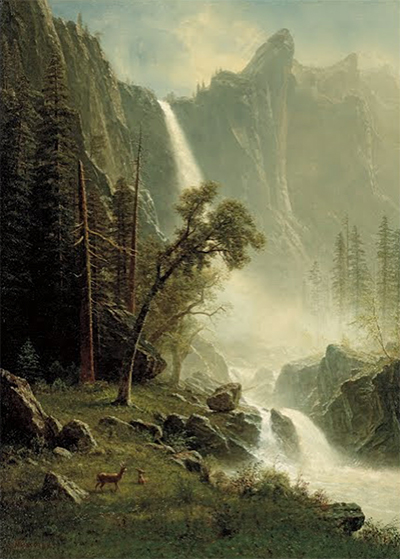
Bridal Veil Falls, Yosemite by Albert Bierstadt
Water falls through a narrow opening high above the trees, dissolves into luminous spray and reappears among the foreground rocks. In Albert Bierstadt's Bridal Veil Falls, Yosemite, this descending movement connects an imposing cliff landscape with two deer on a small patch of grass.
The North Carolina Museum of Art dates the painting to circa 1871–1873. It is oil on canvas, measuring 91.8 by 67 centimetres, and entered the museum in 1987 as accession 87.9.[1]
At a Glance
Where this painting sits in Bierstadt’s career
Dates refer to the paintings, rather than to the journeys behind them. Approximate dates and ranges retain the qualifications in the collection records.
Lake Lucerne
1858Mountain Brook
1863Bridal Veil Falls, Yosemite
Circa 1871–1873Street in Nassau
c. 1877–1880The Last of the Buffalo
1888–1889The Golden Gate
1900Contents
A landscape built upwards
The tall format makes the waterfall's height central to the experience. The eye travels from the dark ground at the bottom, through trees and suspended mist, to the pale rock formations above. Each level introduces a different kind of visibility.
At the left, a cliff and dense conifers form a heavy, shaded wall. Their proximity is suggested by the comparatively strong contrasts between trunks, foliage and rock. Across the picture, distant cliffs lose their sharpness in the illuminated atmosphere. Their peaks remain visible, but their lower faces seem to dissolve into the spray.
Between these extremes stands a leafy tree leaning towards the right. Its curved trunk crosses the downward movement of the waterfall, and its irregular crown occupies the middle of the picture. It gives the viewer a form that can be followed branch by branch before attention passes into the less distinct distance.
The tree also complicates a simple division between foreground darkness and distant light. Its upper leaves catch illumination, while its lower trunk emerges from shadow. Light moves into the nearer world rather than remaining an unreachable glow behind it.
Three appearances of water
The upper fall is a bright, relatively narrow band. It begins near a break in the cliff and expands as it descends. Its whiteness separates it from the greyer rock behind, making this distant feature legible despite the intervening atmosphere.
Lower down, water becomes a broad cloud of spray. Here Bierstadt gives less attention to a defined edge and more to the way mist conceals the landscape. Rock, trees and falling water overlap in a pale interval where their boundaries become difficult to distinguish.
In the lower right, the stream becomes visible again as it passes around substantial boulders. A shorter cascade introduces clearer changes in direction and texture. The viewer can compare water dropping from a great height with water negotiating the smaller obstacles close at hand.
These passages prevent the waterfall from becoming an isolated white stripe. Its effects continue through the setting: suspended moisture alters visibility, and the stream joins the rocky ground beside the deer. The picture's movement is both vertical and outward towards the viewer.
Wind and a changing fall
The National Park Service gives Bridalveil Fall's height as 620 feet, or 189 metres. It describes water flowing throughout the year, with a forceful spring volume and lighter flow that can sway in the wind at other times.[2]
That changing behaviour helps explain why spray matters as much as the falling column in Bierstadt's image. A waterfall is continuously reshaped by its flow and the surrounding air. The painting preserves one arrangement of water and atmosphere without establishing the exact season or weather of an observed moment.
Galen Clark's The Yosemite Valley, published in 1910, likewise emphasises the fall's changing appearance under wind. His waterfall chapter describes its shifting form and the rainbows visible in afternoon sunlight. This is a later observer's account, rather than a record of the conditions under which Bierstadt painted.[3]
Read beside the picture, Clark's description directs attention to movement within the apparent stillness. Bierstadt's luminous spray suggests an unstable substance suspended among forms that seem much more enduring. The contrast makes the cliffs look weightier while making the air between them seem active.
The deer and the nearby ground
Two deer occupy the lower left, one standing and the other resting nearby. Their small bodies make the tree trunks and rocks seem larger, but they also establish a quieter scale of experience within the landscape.
The grass around them is interrupted by low stones and darker vegetation. A large angular boulder farther back helps separate this sheltered patch from the watercourse. The animals therefore occupy a particular place within the composition, rather than simply appearing as tiny marks against the distant cliffs.
Their presence changes the viewer's relationship to the scene. Looking at the high waterfall involves distance and upward movement; looking at the deer involves noticing a small clearing close to the picture's lower edge. Bierstadt allows both kinds of attention to coexist.
No conspicuous human figure occupies this view. That pictorial choice makes the animals and vegetation especially noticeable, but it does not establish that Yosemite lacked a human history.
Beauty and a contested homeland
The museum's interpretation connects Bierstadt's first Yosemite visit in 1863 with his presentation of apparently unoccupied natural beauty. It sets that vision against the Ahwahnechee homeland and the violence and dispossession beginning in 1851.[1]
NCMA's educational account explains the tension further: Bierstadt's Yosemite landscapes encouraged appreciation and preservation while romanticising land from which Indigenous people had been violently displaced.[4]
This changes the significance of the picture's apparent seclusion. The scene gives no visual account of those events. Its deer, trees and luminous water can make the valley seem removed from human conflict, even though the museum's history places conflict within the setting represented.
Preservation and dispossession are therefore both relevant to interpreting the work. Admiration for the scenery does not explain who belonged to the valley, whose presence became less visible, or whose account of the place shaped later understanding. The painting's peacefulness is a powerful artistic effect within that more difficult history.[4]
An afterlife in contemporary art
In a 2009 Brooklyn Museum article, Shelley Bernstein identifies this North Carolina painting as the inspiration for Valerie Hegarty's Fallen Bierstadt. Her account records the connection between the two works and the use of an NCMA reproduction in the museum's accompanying video.[5]
Hegarty's 2007 work is a sculpture made with materials including foamcore, paper, canvas and wood. Brooklyn's collection account explains that she created and distressed her own version of a Bierstadt landscape. It interprets the apparent decay as a challenge to the heroic landscape tradition and its association with Manifest Destiny.[6]
The damage belongs to Hegarty's constructed work. Bierstadt's original was not destroyed to make it. The distinction is essential: the contemporary artist transforms the image's promise of enduring grandeur through a separate object.[6]
The painting in Nature's Nation
The two works acquired another context in Nature's Nation: American Art and Environment, which opened at Princeton University Art Museum in October 2018. The introductory gallery placed Bierstadt's Bridal Veil Falls alongside Hegarty's work, as well as landscapes by Thomas Moran and Jaune Quick-to-See Smith. The university's account describes these comparisons as complicating earlier ideas of a pristine American environment.[7]
That presentation made interpretation part of the painting's continuing history. A viewer could appreciate Bierstadt's intricate construction of light and distance while also considering how later artists questioned the assumptions attached to such scenery.
The exhibition did not erase the waterfall's visual appeal. It asked viewers to examine what that appeal makes visible and what may remain outside the frame.[7]
Returning to the stream
After considering these later responses, the foreground water offers a useful point of return. It passes between rocks whose surfaces are much more clearly defined than the distant cliffs. Nearby deer, grass and tree trunks give the landscape a tangible scale before the eye rises once more into mist.
Bierstadt holds those different distances together through the fall's descent. The scene can feel sheltered at its lower edge and immense above, with the illuminated spray joining the two experiences. Its persuasive beauty is also what has made the painting available to successive, sometimes challenging, interpretations.
Watch: Albert Bierstadt
Five perspectives on his paintings and their historical setting.
American Landscape Painting: Albert Bierstadt and the American Land
A Museum of Fine Arts, Boston presentation on American Landscape Painting: Albert Bierstadt and the American Land.
Explore Bierstadt’s artworks
Discussion
How does water connect the distant cliff with the two deer on the near ground?
Reader Insights
Trace the fall into mist and then into the rocky stream. Where does the water become most difficult to see as a continuous body?
Read the seasonal and wind conditions beside the painted spray. How does that context complicate the impression of a fixed scene?
Consider Hegarty’s Fallen Bierstadt and the Nature’s Nation pairing. Which convention of landscape becomes more visible when another artist changes or damages its image?
Join the Conversation
Share a specific observation, documented connection or comparison from Bridal Veil Falls, Yosemite.
References
- North Carolina Museum of Art. Bridal Veil Falls, Yosemite, accession 87.9. Object record, provenance and collection interpretation. View source text
- National Park Service. “Bridalveil Fall Trail.” Waterfall height, flow and wind effects. View source text
- Galen Clark. The Yosemite Valley, 1910, “Waterfalls in Yosemite Valley.” Hosted transcription of the historical account. View source text
- North Carolina Museum of Art / NCMALearn. “Bridal Veil Falls, Yosemite.” Educational interpretation of landscape preservation and Indigenous dispossession. View source text
- Shelley Bernstein / Brooklyn Museum. “An Adventurous Painting,” 14 May 2009. Identifies Hegarty's North Carolina source painting. View source text
- Brooklyn Museum. Valerie Hegarty, Fallen Bierstadt, 2007, accession 2008.9a-b. Object record and interpretation. View source text
- Jamie Saxon / Princeton University. “Art museum exhibition 'Nature's Nation' opens Oct. 13; related events probe environmental issues,” 10 October 2018. View source text