 by Tom Gurney
Tom Gurney BSc (Hons) is an art history expert with over 20 years experience
Published on June 19, 2020 / Updated on October 12, 2026
Email: tomgurney1@gmail.com / Phone: +44 7429 011000
Fishing Boats at Capri by Albert Bierstadt
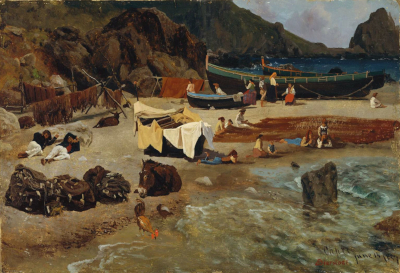
Boats, nets, cloth and resting figures fill a small beach beneath dark rocks. The sea enters at the right, breaking around a stone close to the viewer, but much of the activity belongs to the shore. In Fishing Boats at Capri, Albert Bierstadt makes the space between fishing trips a subject in its own right.
The Museum of Fine Arts, Boston contributed the painting’s record to the AMICA Library. That record dates it to 1857 and describes oil on paper mounted on canvas, measuring 33.97 × 49.85 centimetres. It credits the gift of Martha C. Karolik for the M. and M. Karolik Collection of American Paintings, 1815–1865, and identifies the work as accession 47.1264.[1] The Smithsonian’s inventory independently records the same date, medium, collection and accession number.[2]
At a Glance
Where this painting sits in Bierstadt’s career
Dates refer to the paintings, rather than to the journeys behind them. Approximate dates and ranges retain the qualifications in the collection records.
Lake Lucerne
1858Mountain Brook
1863Street in Nassau
c. 1877–1880The Last of the Buffalo
1888–1889The Golden Gate
1900Contents
A shore occupied by people and equipment
The beach is enclosed by rocks at the left and a rising coastal slope beyond. Large dark boats stand across the back of the sandy space. Their curved hulls create a boundary between the figures and the blue sea, while a smaller boat closer to the centre introduces another layer of activity.
The foreground is more scattered. Fishing equipment occupies the lower left, beside a resting pack animal. Two reclining figures lie farther back against pale rocks. Another stretches out near the central boat. At the right, seated figures gather near a large reddish net spread over the beach. The scene gives rest a visible place alongside the handling and storage of equipment.
Light-coloured cloth hangs over the central hull. Its broad shapes are among the brightest passages in the painting, making that boat conspicuous despite its relatively small size. Nearby, reddish and brown nets produce a different texture. Draped along poles at the left and spread horizontally on the sand, they connect the standing equipment to the occupied ground.
The arrangement is informal without being shapeless. The large boats run across the upper beach; the nets repeat that horizontal direction at a lower level. The hanging cloth forms a central interruption, while the isolated rock in the water balances the heavier group of equipment at the left. We can look among separate incidents while retaining a sense of the whole cove.
The Smithsonian describes the subject as fishermen relaxing or attending to their catch.[2] That provides a useful general identification. The individual gestures remain small, however, and the picture does not disclose the names or relationships of those represented. Assigning every group to a particular family, or describing an exact sequence of preparing nets for a departure, would give the scene a narrative its details do not establish.
The Italian journey of 1857
The painting belongs to Bierstadt’s early European period. Nancy K. Anderson’s National Gallery of Art biography records his departure for Europe in 1853, his time in Düsseldorf, and subsequent travel through Germany, Switzerland and Italy. Following a winter in Rome and a sketching journey to Naples and Capri, he returned to New Bedford in autumn 1857.[3]
Capri was therefore part of a sustained education through travel. Bierstadt encountered scenery, other artists and subjects for paintings during the same period. Its rocky shore offered a place where coastal forms and the everyday uses of a beach could be observed together.
Paul A. Manoguerra’s exhibition essay Classic Ground describes Bierstadt travelling through southern Italy with Sanford Robinson Gifford in spring 1857, walking, camping and sketching. It also notes that Bierstadt continued to develop Italian subjects from his sketches after returning to Massachusetts.[4] This account places the beach painting within an artistic journey, while leaving its exact sequence of execution open.
The inscription visible at the lower right names Capri and gives the date June 14, 1857. It is a valuable detail within the picture itself. A dated inscription connects the work to a specific moment more closely than a general career chronology can, although it does not prove that every part of the painting was completed that day.
Another surviving work strengthens the evidence for activity on the island that month. Christie’s catalogued a separate Capri painting inscribed June 11, 1857, in oil on paper laid down on panel. Its accompanying essay places Bierstadt and Gifford on Capri between late May and late June.[5] The differently dated and supported works should remain distinct: the auction painting is evidence of the island visit, not a preparatory study for Fishing Boats at Capri unless a further connection can be demonstrated.
Rest within a working landscape
The reclining people are conspicuous because they occupy areas nearest the viewer. Their positions contrast with the upright figures around the boats farther back. The painting contains several bodily rhythms: lying, sitting, standing and bending towards equipment. Fishing appears through that range of activity, rather than through a single dramatic moment offshore.
The resting animal belongs to the same arrangement. Its body is folded beneath its head and shoulders, close to the gear at the lower left. The old suggestion that Bierstadt left a horse unfinished mistakes the animal’s resting position for missing anatomy. The reproduction gives no basis for calling the painting incomplete on that account.
Rest should also be distinguished from an outsider’s judgement about work. A pause on the beach does not tell us how long a person has laboured, what tasks remain or how difficult the next voyage will be. Nets and boats surround the figures, keeping the practical circumstances of their presence visible even when they are still.
Manoguerra’s broader discussion of American painting in Italy asks how visiting artists represented the inhabitants of places already surrounded by cultural expectations. He stresses that such images could reflect the interests and values of their American makers and audiences.[4] That is a useful question to bring to this beach, rather than a documented statement of Bierstadt’s intentions for this particular painting.
We are looking at a selected arrangement of people within an attractive coastal setting. Its apparent ease belongs partly to the representation: the painter brings rest, colour and scenery into a composition that can be enjoyed far from the work itself. Attending to the nets and heavy hulls helps keep the beach’s practical use within that enjoyment.
Light at the water’s edge
The sea occupies less of the picture than the beach, but its movement changes the character of the foreground. Pale foam curls around the isolated rock and reaches towards the sand. The water breaks the broad horizontal ordering of boats and nets with short, irregular lines.
Farther away, blue water lies between the hulls and the distant rocks. Nearer to us, green and grey tones make the shallows a more complicated surface. Light appears as small broken accents around the rock, while the hanging cloth offers larger, more solid areas of brightness on land.
The contrast makes the centre and right respond to each other. The cloth attracts us to the boat; the foam leads us back towards the shoreline. These pale passages relieve the dark weight of the enclosing rocks and large hulls without making the entire scene equally bright.
Colour in the figures participates in the same structure. Small areas of red, blue and white distinguish people from the sand and equipment. The marks give the groups visual presence while leaving most faces and gestures lightly described. Their scale allows the beach to hold many incidents without turning into a collection of separate portraits.
Paper and later support
The recorded medium matters because this is not simply an oil painting on canvas. The painted paper is mounted on canvas.[1] The distinction identifies the object more accurately and connects it with the varied supports found among Bierstadt’s smaller works.
It does not, by itself, establish that the painting was made entirely outdoors. Nor does the record give a mounting date, explain who carried out the mounting or document every stage between sketch and finished work. The June inscription and travel evidence provide context; the object’s material description supplies another kind of fact. Neither should be made to stand for a complete working history.
The small format allows a surprisingly full description of the cove. Bierstadt includes the large coastal forms, boats of different sizes, groups of people and foreground equipment. The variation between broadly painted surroundings and more distinct small accents lets those subjects coexist within the paper’s limited area.
Capri beyond this small beach
Bierstadt returned to the island’s subject in The Marina Piccola, Capri, dated 1859 and now in the Buffalo AKG Art Museum. At 106.68 × 182.88 centimetres, that oil on canvas is much larger. The museum relates it to preparatory drawings from the visit and records Bierstadt’s gift of the painting in 1863.[6]
The comparison demonstrates that Capri supplied material for works of different scale and purpose. It does not establish that the Boston painting was a study for the Buffalo canvas. A small, populated beach view can have its own compositional interest while a larger work develops another experience of the coast.
Fishing Boats at Capri gives particular attention to what accumulates on shore: people between tasks, resting animals, nets, cloth and vessels pulled beyond the water. Its coastal setting remains essential, but the beach is occupied throughout. The painting’s appeal lies in the close connection between that human presence and the rocky place that contains it.
Watch: Albert Bierstadt
Five perspectives on his paintings and their historical setting.
American Landscape Painting: Albert Bierstadt and the American Land
A Museum of Fine Arts, Boston presentation on American Landscape Painting: Albert Bierstadt and the American Land.
Explore Bierstadt’s artworks
Discussion
How do boats, equipment and resting figures make the shore a place of work between fishing trips?
Reader Insights
Compare the reclining people with the standing and bending figures farther back. How do their poses give the beach its rhythm?
Follow the foam around the near rock into the sand. How does that small passage of water affect a composition dominated by the shore?
Keep the paper mounted on canvas distinct from the much larger Marina Piccola painting. What changes when a related subject is developed at another size?
Join the Conversation
Share a specific observation, documented connection or comparison from Fishing Boats at Capri.
References
- Museum of Fine Arts, Boston, AMICA contribution. Fishing Boats at Capri, 1857, accession 47.1264. Archived museum-contributed object record, AMICA Library year 1998: medium, dimensions and gift credit. View source text
- Smithsonian American Art Museum. Fishing Boats at Capri, Inventories of American Painting and Sculpture, record siris_ari_263907. Object identification and subject description. View source text
- Nancy K. Anderson. Albert Bierstadt biography in American Paintings of the Nineteenth Century, Part I. National Gallery of Art, 1996, p. 31. European education, Italian journey and return. View source text
- Paul A. Manoguerra. “Classic Ground,” Georgia Museum of Art exhibition catalogue introduction, 2004, reprinted in Resource Library. Italian travel and the interpretation of American images of Italy. View source text
- Christie’s. Albert Bierstadt, Capri, lot 230. Dated June 11, 1857; object details and island-visit chronology. View source text
- Buffalo AKG Art Museum. The Marina Piccola, Capri, 1859, accession 1863:1. Dimensions, preparatory drawings and artist’s 1863 gift. View source text