 by Tom Gurney
Tom Gurney BSc (Hons) is an art history expert with over 20 years experience
Published on June 19, 2020 / Updated on October 12, 2026
Email: tomgurney1@gmail.com / Phone: +44 7429 011000
Albert Bierstadt Quotes
Albert Bierstadt’s letters show an artist comparing unfamiliar mountains with places he already knew, moving between sketching and photography, and worrying about the physical survival of his paintings. They also reveal the assumptions he brought to Indigenous people and their lands. Reading his words in their documentary setting gives a more complicated picture than a collection of inspirational sayings.
The extracts here come from his published western correspondence of 1859 and letters reproduced by museum and conservation scholars. The July letter appeared in The Crayon in September; the buffalo passage is transmitted separately through the National Gallery of Art. Keeping those documents distinct matters as much as preserving the wording of each quotation.
Contents
Looking at America through Europe, July 1859
“the Italy of America in a primitive condition”
This phrase appears in Bierstadt’s letter headed Rocky Mountains, 10 July 1859, printed on page 287 of the September issue of The Crayon. It follows his description of the Wahsatch range, prairie vegetation, willow-lined streams and beaver dams. The comparison concerns the colour of the mountains, plains and surrounding country.[1]
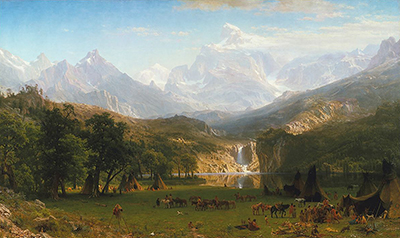
Elsewhere in the same letter, he compares the mountains seen from the plains with the Bernese Alps. Lower hills, streams and wooded valleys recall New Hampshire and the Catskills, before the height of the cliffs forces him to reconsider the comparison. His descriptions move between recognition and surprise: familiar landscapes provide a vocabulary, but the scale of the western mountains exceeds it.
That sequence helps explain the Italy phrase. He was describing a new experience through a store of European and eastern American impressions. It shows how comparison entered his account before a finished painting reached an exhibition. It does not establish that a particular canvas copies an Italian landscape, or that every western picture illustrates this letter.
The word primitive carries another assumption. Bierstadt described scenery through a distinction between nature and what he understood as civilisation, even while recording Indigenous hunting grounds, travellers and people watching him work. His terminology belongs to that viewpoint. The land he admired was already inhabited, known and used.
The camera and its unwilling subjects, July 1859
“without the knowledge of the parties”
In the July letter, Bierstadt says that the party had made stereoscopic views, although difficulties with the process limited its mountain photography. He then turns to photographs of Indigenous people. He acknowledges their reluctance to face the camera, describes their surprise at pictures for which they had not posed, and praises photographs made without their knowledge as his best portraits.[1]
The passage records a conflict between his desire for an image and the wishes of the people represented. His approval of the result does not erase their resistance. Nor does a photograph become a freely agreed encounter simply because the sitter was unaware of the exposure. His account lets us ask whose intentions governed the making of the picture, rather than treating the camera as an impartial witness.
Painting prompted a different interaction in his telling. People watched his colour studies, but some avoided standing in front of him because they did not want their likenesses taken. The letter thus describes both curiosity about his work and limits on participation. Those details are more informative than a general claim that Indigenous people welcomed his presence.
He also presents Indigenous figures as attractive additions to landscape and predicts that their customs and people will soon pass into history. His proposed role for the artist was to preserve a portion of that history. Yet the prediction narrows living communities into subjects for an outsider’s record. It should be read as his assertion, not as a reliable forecast.
The Eastern Shoshone Tribe’s own historical account offers a necessary perspective from the Wind River region. It describes enduring homelands, Chief Washakie’s leadership, treaty negotiations and subsequent losses of reservation land.[2] This history concerns people making decisions and maintaining a community through change. It also prevents Bierstadt’s generalised language from becoming our description of the region. His letter alone does not identify every person he photographed or watched, so it cannot assign all those encounters to one tribe.
Enjoying camp life, July 1859
“I enjoy camp-life exceedingly”
Near the end of the July letter, Bierstadt describes a party reduced to three people, a spring wagon and six mules. His days included journeys in the saddle or on an Indigenous pony. Game supplied part of their food; tea, coffee, dried fruit and beans accompanied it. He links his pleasure in outdoor living with feeling well, then explains that the short season and approaching autumn rains would soon send them home.[1]
The sentence expresses enthusiasm within a practical account of travel. Animals, provisions and another person’s labour made his mobility possible. Hunting and painting occupied the same journey, and weather set limits on it. Read alongside the biography, these details help place the artist’s fieldwork within daily routines, rather than imagining uninterrupted contemplation of scenery.
Camp pleasure and concern about difficult roads sit close together in the letter. That combination is useful when considering his western subjects: admiration did not remove discomfort, logistical work or the need to return. The document supplies this travel context without locating a particular painted camp.
Between the rifle and the sketchbook, 1859
“I felt half inclined to lay down my rifle and take up my sketchbook”
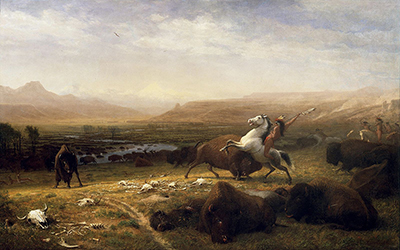
Bierstadt described a buffalo crossing a river. He left his vehicle and took cover behind a bluff with his rifle. The splashing animal prompted a wish to draw; admiration briefly left him unable to do either. The National Gallery of Art reproduces the passage with Buffalo Trail: The Impending Storm (1869), dating the letter to 3 September 1859 and connecting it with his western expedition alongside Frederick W. Lander.[3]
The hesitation gives the extract its force: hunter and artist briefly compete for his attention. It does not say that he permanently gave up hunting. The Gallery connects the episode with the later painting’s subject; the passage does not identify the canvas as an exact record of that encounter. This account is separate from the July letter in The Crayon.
Paint and changing canvas tension, 1877
“The colors we use are not elastic like rubber”
Conservator Dare Myers Hartwell transcribes this sentence from Bierstadt’s letter of 27 June 1877, tentatively addressed to Corcoran curator William MacLeod. Colors here means paints. Bierstadt feared that weather changed canvas tension and would eventually crack the less flexible paint.[4]
What the panel back protected, 1877
“The panel back does the same”
Immediately before this sentence in the same letter, Bierstadt reported another man’s description of cloth coverings behind stretcher frames in Berlin and Vienna galleries. The panel back similarly protected canvas from moisture and dust. He also described coating both sides of his panels with shellac to limit moisture absorption.[4] This was practical concern for paintings as layered objects, extending beyond their painted faces. Hartwell’s transcription documents historical practice; it supplies no present-day treatment advice.
The Yosemite letter: paraphrase and quotation
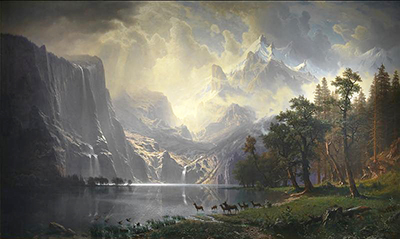
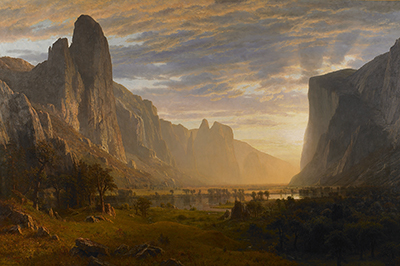
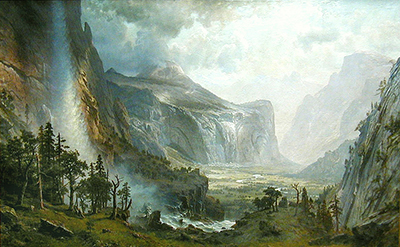
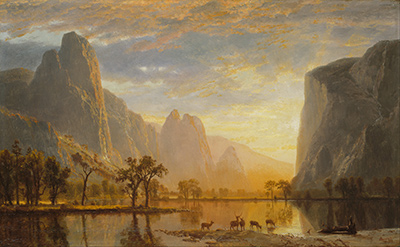
The Museum of Fine Arts, Boston, describes Bierstadt’s enthusiasm for Yosemite. Its account of Valley of the Yosemite says that he told John Hay he had found the Garden of Eden, citing a letter of 22 August 1863 in note 2. The museum presents this as a paraphrase, without reproducing the letter’s exact wording.[5]
That distinction matters when quoting Bierstadt. An account of what he expressed cannot supply the wording of a longer inspirational saying. A paraphrase can still illuminate his response to a place, provided it remains visibly a paraphrase. The extracts above preserve brief passages with their document contexts; their surrounding explanations are interpretation. Reading the letters at greater length reveals why this separation matters: admiration for scenery, the desire to obtain images, assumptions about other people and concern for materials all coexist in his correspondence.
Watch: Albert Bierstadt
Five perspectives on his paintings and their historical setting.
American Landscape Painting: Albert Bierstadt and the American Land
A Museum of Fine Arts, Boston presentation on American Landscape Painting: Albert Bierstadt and the American Land.
Explore Bierstadt’s artworks
Discussion
How does reading a letter extract in its documented context change what Bierstadt’s words communicate?
Reader Insights
Consider the passage about the rifle and sketchbook. How does the surrounding incident complicate a simple statement of admiration for wildlife?
Read the statements about canvas tension and panel backs together. What concern about the survival of paintings connects them?
How does Bierstadt’s account of photographing people without their knowledge change your understanding of the images he sought?
Join the Conversation
Share a specific observation, documented connection or comparison from Albert Bierstadt Quotes.
References
- Albert Bierstadt. Letter headed “Rocky Mountains, July 10, 1859,” signed B., Country Correspondence, The Crayon 6 (September 1859), p. 287. Original published page, digitised in the article catalogued as “Sketchings”; PDF p. 9. View source text
- Eastern Shoshone Tribe. “About the Shoshone Tribe,” sections “The Reservation” and “Chief Washakie.” Tribal account of enduring homelands, leadership and reservation history. View source text
- National Gallery of Art. Buffalo Trail: The Impending Storm, 1869, accession 2014.79.3. Interpretive text reproducing the buffalo passage and dating its letter to 3 September 1859. View source text
- Dare Myers Hartwell. “Bierstadt’s Late Paintings: Methods, Materials, and Madness.” Journal of the American Institute for Conservation 38, no. 1 (1999): 33–44. Section 2, letter transcription; References, Bierstadt’s letter of 27 June 1877 to William MacLeod [?]. View source text
- Museum of Fine Arts, Boston. Valley of the Yosemite, 1864, accession 47.1236. Curatorial text and note 2, citing Bierstadt’s letter to John Hay of 22 August 1863; text adapted from American Painting, MFA Highlights (2003). View source text