 by Tom Gurney
Tom Gurney BSc (Hons) is an art history expert with over 20 years experience
Published on June 19, 2020 / Updated on October 12, 2026
Email: tomgurney1@gmail.com / Phone: +44 7429 011000
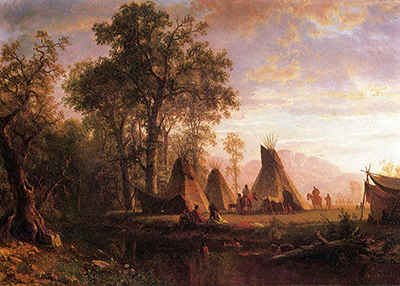
Indian Encampment, Late Afternoon by Albert Bierstadt
Tipis stand at the edge of a wooded clearing, their surfaces catching warm light while the foreground water remains partly in shadow. People sit beside the lodges, riders cross the open ground, and a pale mountain range recedes behind them. Albert Bierstadt's Indian Encampment, Late Afternoon brings a busy settlement into a luminous landscape.
Crystal Bridges Museum of American Art calls the painting Indian Encampment and dates it to 1862. It is oil on canvas, accession 2010.69, in the museum's collection in Bentonville, Arkansas.[1] The longer title remains useful for describing its treatment of light, but the composition deserves attention beyond its apparent calm.
At a Glance
Where this painting sits in Bierstadt’s career
Dates refer to the paintings, rather than to the journeys behind them. Approximate dates and ranges retain the qualifications in the collection records.
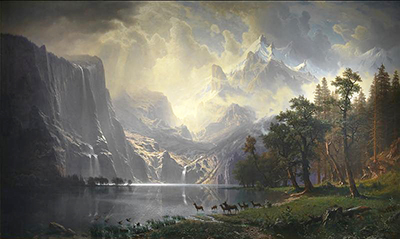
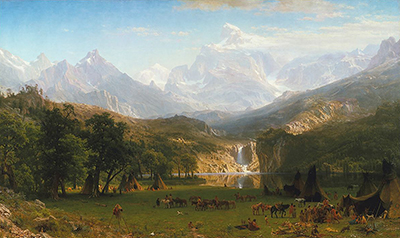
Lake Lucerne
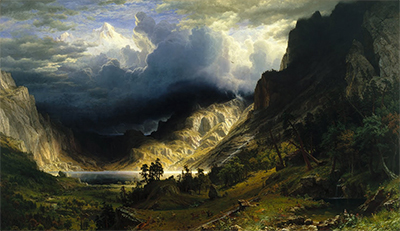
1858Mountain Brook
1863Street in Nassau
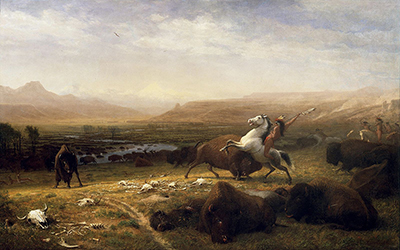
c. 1877–1880The Last of the Buffalo
1888–1889The Golden Gate
1900Contents
A clearing with several kinds of activity
The largest tipi stands just right of centre, with poles projecting above its covering. Two smaller lodges rise nearer the trees, while a lower shelter extends along the left side of the camp. Another shelter enters from the right edge, partly cut off by the frame.
These structures occupy different depths. Their overlapping edges and varying sizes make the settlement more than a row of shapes against the mountains. The tallest lodge provides a strong vertical accent without overpowering the trees, which spread far higher into the sky.
A small group sits on the ground in front of the nearer lodges. Farther back, mounted and standing figures appear near the large tipi and along the open space towards the right. The riders are conspicuous through their height and their position against the pale distance, while the seated group belongs to the darker foreground.
Two small figures are visible in the water below the camp. Their presence makes the stream part of the inhabited setting, connecting the bank above with the lower edge of the picture. The painting does not supply enough detail to name them or establish their precise activity.
The viewer can move between these groups without finding a single incident that explains them all. The settlement contains several centres of attention: beside a shelter, near a horse, along the bank and in the water. That distribution makes the scene feel occupied over a broad area.
The work behind the tipi forms
The National Museum of the American Indian's teaching sheet Tipis at Fort Laramie, Wyoming, 2016 describes their construction from peeled poles covered with bison hides or canvas. Their form suits strong Plains winds, while their portability and adaptable interiors serve different needs.[2]
This practical account adds another way of looking at the pointed structures. The poles rising above the coverings belong to a framework, and the broad lower portions enclose usable space. Their shapes have functions as well as providing repeated triangular accents in the composition.
The reproduction does not establish the exact material of every painted covering. Nor does a group of tipis identify a particular nation or prove that the settlement occupied a specific location. The architectural context helps explain a visible form without turning the painting into a complete record of construction or community life.
The museum's Oceti Sakowin kinship resource describes tipi-making, erection and dismantling as work usually undertaken by women. It also presents Dakota writer Ella Cara Deloria's account of the camp circle and tiyospaye: extended families connected through blood and marriage.[3]
That account places homes within relationships among people. It encourages attention to the spaces between lodges and the activities gathered around them, as well as to their outlines. The arrangement in Bierstadt's painting is not enough to identify its inhabitants as Oceti Sakowin or to establish a documented ceremonial camp circle; Deloria's account supplies a distinct community perspective rather than a label for the painted figures.
Trees, water and the movement of light
The large tree left of centre divides the composition unevenly. Its broad crown spreads through the upper sky, and its trunk stands between the shadowed wood and the brighter camp. Smaller trees behind the lodges continue this transition, with their leaves becoming less distinct against the distance.
At the far left, a heavy trunk and broken branches create an irregular boundary. The darker woodland beyond it contrasts with the open space around the largest tipi. Bierstadt leads the eye from thick vegetation towards the settlement, then towards the mountains and pale horizon.
Warm light touches the tipi coverings, grass and foliage, while the stream carries muted reflections of the scene above. A fallen trunk lies along its right bank, introducing a low diagonal beneath the more upright lodge poles and trees. Nearer plants and patches of exposed soil give the viewer smaller forms to inspect before following the light farther back.
The mountains occupy relatively little of the canvas. Their subdued pink-grey shapes supply a distant limit behind the camp, but their softened edges leave the closer trees and lodges more prominent. Here the landscape's breadth comes from a sequence of near water, inhabited ground and hazier rock.
The warm colouring contributes to a sense of ease. That effect belongs to the painted arrangement: it cannot by itself tell us how secure the inhabitants were, what events surrounded them or how their lives would change.
Travel experience and studio invention
Crystal Bridges explains that Bierstadt encountered Plains tribes on his first western journey in 1859, but completed this painting later in his New York studio. Its interpretation identifies the finished scene as an imagined composition, shaped by contemporary cultural attitudes, rather than an event he witnessed firsthand.[1]
The account distinguishes travel experience from a finished composition. Its carefully rendered details do not prove that the entire clearing was observed together.
Bierstadt's Indian Encampment, Shoshone Village, dated 1860, offers a comparison. The New York Historical records oil on millboard and an inscription locating that scene on the Sweetwater River, with the Wind River Mountains in the distance. Its account connects the work with studies and photographs made on the 1859 Lander expedition.[4]
The vertical painting encloses its lodges between large trees on both sides, reserving an opening for sky and distant mountains. The 1862 canvas gives the camp a wider, more open area towards the right. Both place settlement within a wooded landscape, but their formats direct attention differently.
The documented place and Shoshone identification of the earlier work should remain with that painting. Similar trees, tipis and light do not establish that the Crystal Bridges scene shows the same community or location.
Reading the sunset interpretation
Crystal Bridges places the painting within a widespread nineteenth-century image of Plains peoples illuminated by sunset. The museum argues that such imagery conveyed the false belief that Native Americans were disappearing, a misconception that persists.[1]
The National Museum of the American Indian's Do All Indians Live in Tipis? resource distinguishes traditional Plains dwellings from the many other forms of Indigenous housing, and from contemporary homes. It also explains that Native peoples generally prefer identification by their particular community's name where that is known.[5]
That distinction matters here. The historical title does not make the camp representative of all Indigenous peoples, and the image's nineteenth-century setting should not confine living communities to the past. A fuller reading holds the painting's beautiful light alongside the limits of the identities and histories it presents.
Return to the water at the bottom of the canvas. Its small figures and interrupted reflections require a closer look than the bright tipi and distant riders. Following those differences in scale reveals a composition full of activity, while the wider research helps explain what the attractive view leaves unresolved.
Watch: Albert Bierstadt
Five perspectives on his paintings and their historical setting.
American Landscape Painting: Albert Bierstadt and the American Land
A Museum of Fine Arts, Boston presentation on American Landscape Painting: Albert Bierstadt and the American Land.
Explore Bierstadt’s artworks
Discussion
How do the lodges, riders and seated figures make the clearing an active place?
Reader Insights
Follow the activities between the shelters. Which figure or grouping resists treating the camp merely as a measure of mountain scale?
Read the NMAI tipi explanation beside the painted forms. What can it clarify without proving the construction of every lodge in this image?
Consider Crystal Bridges’ critique of disappearance imagery. How does that interpretation change your response to the painting’s warm light?
Join the Conversation
Share a specific observation, documented connection or comparison from Indian Encampment, Late Afternoon.
References
- Crystal Bridges Museum of American Art. Albert Bierstadt, Indian Encampment, 1862, oil on canvas, 2010.69. Current owner record and interpretation of studio composition and sunset imagery. View source text
- National Museum of the American Indian. Tipis at Fort Laramie, Wyoming, 2016. Native Knowledge 360°, Northern Plains History and Cultures. Teaching sheet on construction and adaptation. View source text
- National Museum of the American Indian. Oceti Sakowin Kinship. Native Knowledge 360°. Tipi-making and selected excerpts from Ella Cara Deloria's Speaking of Indians concerning extended families and camp circles. View source text
- The New York Historical. Albert Bierstadt, Indian Encampment, Shoshone Village, 1860, oil on millboard, S-52. Owner record, inscription and account of 1859 studies and photographs. View source text
- National Museum of the American Indian. Excerpts from Do All Indians Live in Tipis? Native Knowledge 360°. Selected terminology and housing sections. View source text