 by Tom Gurney
Tom Gurney BSc (Hons) is an art history expert with over 20 years experience
Published on June 19, 2020 / Updated on October 12, 2026
Email: tomgurney1@gmail.com / Phone: +44 7429 011000
Nassau Harbor by Albert Bierstadt
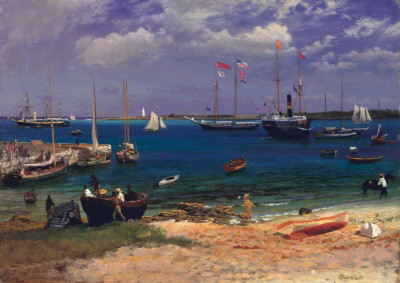
Small boats gather along a sunlit beach, while larger vessels occupy the blue water beyond. Figures stand beside the hulls and a horse waits near the shallows. Albert Bierstadt’s Nassau Harbor turns the waterfront into a meeting place between land and sea, local activity and a wider world of maritime travel.
The Fine Arts Museums of San Francisco date the painting to about 1877. It measures 37.5 × 50.8 centimetres and is painted in oil on paper mounted on paperboard. The museum acquired it through the Mildred Anna Williams Collection; its accession number is 1961.22.[1] Those modest dimensions place its many incidents within a picture considerably smaller than Bierstadt’s celebrated western panoramas.
At a Glance
Where this painting sits in Bierstadt’s career
Dates refer to the paintings, rather than to the journeys behind them. Approximate dates and ranges retain the qualifications in the collection records.
Lake Lucerne
1858Mountain Brook
1863Nassau Harbor
About 1877Street in Nassau
c. 1877–1880The Last of the Buffalo
1888–1889The Golden Gate
1900Contents
From the beach to the harbour
The shore does more than provide a foreground. It establishes the point from which the harbour becomes intelligible. Close to us, overturned and beached boats expose their interiors or undersides. Farther out, small craft sit on the water, then larger vessels rise against the distant shoreline. We move from objects within reach to ships that belong to another scale of movement.
A stone landing projects from the left. Its pale, irregular masonry contrasts with the dark boats gathered beside it, while the masts extend upwards through the sky. The landing brings people, hulls and water into contact. It also gives the composition a firm edge against which the scattered craft farther out appear freer and less tightly grouped.
The beach slopes across the lower part of the picture. At the right, a pale overturned hull with a reddish underside catches the light. At the left, dark upright hulls make a heavier cluster around the figures. Between them, a small figure stands near rocks at the water’s edge. The alternation of crowded and open spaces keeps the shore from reading as an evenly spaced procession.
Beyond it, the harbour spreads almost horizontally. The low distant land leaves room for tall masts, rigging and a steamer’s funnel. These details bring vertical accents into the broad bands of beach, water and sky. The clouds repeat the arrangement on a looser scale: large pale masses cross the upper part of the painting without obscuring the vessels below.
A different setting for Bierstadt
The Bahamas became part of Bierstadt’s life through his wife, Rosalie. The National Gallery of Art’s biography records her first journey to Nassau in autumn 1876, seeking a warmer climate because she had tuberculosis. Bierstadt visited her while maintaining other travel and work commitments.[2] The circumstances help explain his engagement with Nassau, without making every island picture a direct record of her experience.
The painting’s approximate date should remain approximate. William H. Gerdts, writing for the Carmen Thyssen-Bornemisza Collection, notes that the artist’s visits are less fully documented than Rosalie’s extended stays. He identifies Nassau Harbor among the smaller Bahamian works concerned with the town and its inhabitants, and describes a mixture of fishing and sponge boats, sailing vessels and steamers.[3]
That account broadens the painting’s subject beyond a pleasant beach. The harbour contains different kinds of maritime activity within one field of vision. At the same time, the picture does not supply a complete register of vessels, passengers or occupations. We can follow its contrasts in size and position without assigning an exact trade or cargo to every boat.
Blue water and pale accents
The water changes colour across the view. Near the beach, greenish shallows meet the sand in narrow broken lines. Farther out, deeper blue surrounds the larger craft, while a bright turquoise strip runs towards the distant land. These changes help separate the zones of the harbour, giving the flat expanse an internal structure.
White connects those zones. It appears in clothing on the beach, in sails over the water and in the clouds overhead. Small bright marks can draw attention to a figure or a moving boat; the much larger cloud shapes keep the same colour active across the sky. The viewer is encouraged to look between near activity and distant atmosphere.
Alba Campo Rosillo draws attention to this relationship in her study of Bierstadt’s Bahamian painting. She describes Nassau Harbor through its horizontal organisation, blue and orange colours and scattered white accents, linking those accents to its presentation of everyday life.[4] Her reading directs attention to the way colour joins the human incidents to the surrounding scene.
Warm sand and reddish hulls give the blue and green water a strong counterpart. The dark vessels also matter: without their weight, the pale shore and bright sea might become an undifferentiated display of sunshine. Their silhouettes hold attention close to the people and interrupt the brilliance of the water.
Looking closely at the working shore
The foreground figures are small, yet they prevent the harbour from becoming empty scenery. Some gather around boats, others occupy the landing, and the horse and its handler stand apart at the right. Their positions make the waterfront feel used. Boats can be approached from land, moved into the shallows or reached from the landing.
There is a limit to what those positions tell us. A person beside a hull might be handling it, waiting, conversing or resting. The painting does not reveal each individual’s name or occupation. Its activity is visible through groups, gestures and relationships to the vessels; a detailed narrative about a particular catch or departure would go beyond the evidence.
Nor does sunshine establish that work was easy. Bierstadt’s colour makes the waterfront inviting to look at, but the people inhabit a place of practical movement and exchange. Keeping their presence in view gives the painting a different emphasis from treating the beach simply as a setting for recreation.
The maritime economy behind the view
James H. Stark’s History and Guide to the Bahama Islands, first published in 1891, describes Nassau as a centre for the sponge trade. The digitised copy contains later revisions, so its account cannot be treated as a precise inventory of the harbour in 1877. It nevertheless provides useful historical context for the relationship between small boats, larger sailing craft and shore facilities.[5]
Stark describes locally built schooners and sloops carrying smaller open boats to the sponge grounds. The smaller craft allowed workers to gather sponges and return their catches to an anchored vessel. He also describes the stages of cleaning and preparing the material before it was brought to Nassau for sale. Maritime work linked distant gathering places with processing and exchange ashore.[5]
The account helps explain why a harbour could contain several scales of boat serving connected purposes. A small open craft and a larger sailing vessel need not represent unrelated worlds. Their different capacities could form parts of the same undertaking. This is context for the variety Bierstadt shows, rather than proof that any particular painted boat carried sponges.
Stark also distinguishes the position of the workers from that of owners, brokers and shippers. He describes Black Bahamians undertaking much of the gathering and preparation, with earnings from voyages divided into shares. His guide addresses visitors and uses racial language and assumptions that require critical reading. Even with those limitations, it makes clear that a picturesque harbour belonged to an economy with unequal roles and rewards.[5]
That history gives the dark foreground boats and small groups of people greater significance. The shore was a connection between the island’s inhabitants, its waters and markets elsewhere. Bierstadt shows the connection in operation, but compresses its economic relationships into a bright, accessible view.
Paper, paint and the question of working outdoors
The museum suggests that Bierstadt probably carried out most of the work on site, describing long strokes in the sea and quicker touches in the sand.[1] This is a qualified interpretation. The paper support and lively handling do not establish that he completed the entire painting in a single outdoor sitting.
The reproduction allows us to see differences in the handling of the scene. Broad passages carry the sky and water, while much smaller marks indicate people, ropes and flags. The artist gives us enough detail to recognise a populated harbour without describing every incident to the same degree.
The mounted paper is part of the object’s recorded material history. It should not be confused with the board support of another Bahamian painting, or used to infer an undocumented sequence of fieldwork and studio revision. What the picture does demonstrate is Bierstadt’s ability to make a small work accommodate a wide view and numerous points of interest.
Nassau by water and by road
Gerdts treats Street in Nassau as a complement to the harbour scene.[3] The road painting leads the eye inland through a long receding route; Nassau Harbor spreads activity across the shore and bay. One organises movement through depth, the other through a wide expanse punctuated by boats and masts.
The comparison also changes the emphasis of the light. In the street scene, foliage casts shade across the route and its figures. Here, open water carries much of the colour, while the boats and people make dark or pale interruptions within it. Both paintings attend to inhabited places, but each finds its rhythm in a different kind of passage.
Nassau Harbor offers more than a change of climate from Bierstadt’s mountain pictures. Its interest rests in the proximity of people, boats, shore and open water. The brilliant colour makes that relationship immediately attractive; looking longer reveals the variety of activity contained within it.
Watch: Albert Bierstadt
Five perspectives on his paintings and their historical setting.
American Landscape Painting: Albert Bierstadt and the American Land
A Museum of Fine Arts, Boston presentation on American Landscape Painting: Albert Bierstadt and the American Land.
Explore Bierstadt’s artworks
Discussion
The bright harbour contains boats of several sizes and people close to the shore. How do these separate incidents become one connected scene?
Reader Insights
Follow the white clothing, sails and clouds. Which accents connect near activity with the wider expanse of water?
How does the historical account of the sponge trade help explain different scales of craft without identifying the cargo of a particular painted vessel?
Which gestures and positions make the waterfront feel used, and which details leave the figures’ precise occupations uncertain?
Join the Conversation
Share a specific observation, documented connection or comparison from Nassau Harbor.
References
- Fine Arts Museums of San Francisco. Nassau Harbor, ca. 1877, accession 1961.22. Object metadata and qualified interpretation of on-site work. View source text
- Nancy K. Anderson. Albert Bierstadt biography in American Paintings of the Nineteenth Century, Part I. National Gallery of Art, 1996, pp. 31–33. Rosalie’s 1876 journey and Bierstadt’s work and visits. View source text
- William H. Gerdts. Expert report on Street in Nassau. Carmen Thyssen-Bornemisza Collection. Bahamian chronology, harbour activity and comparison of the two works. View source text
- Alba Campo Rosillo. “Bierstadt’s view of a street in Nassau: a painting about becoming,” Open Windows 11, 2022, p. 11 and fig. 7. Colour and composition of Nassau Harbor. View source text
- James H. Stark. Stark’s History and Guide to the Bahama Islands, first published 1891; digitised copy containing later revisions. Chapter XX, pp. 216–219. Boats, sponge gathering, preparation and economic relationships; used as later historical context. View source text