 by Tom Gurney
Tom Gurney BSc (Hons) is an art history expert with over 20 years experience
Published on June 19, 2020 / Updated on October 12, 2026
Email: tomgurney1@gmail.com / Phone: +44 7429 011000
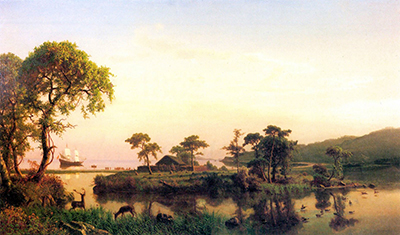
Gosnold at Cuttyhunk by Albert Bierstadt
Deer gather beside still water while a sailing ship appears beyond the trees. Near the centre, a low building occupies an island, its roof and surrounding vegetation reflected in the pond. In Gosnold at Cuttyhunk, Albert Bierstadt gives an episode of English exploration the spaciousness and calm of a landscape painting. The human encounter is small; the apparent promise of the place fills the canvas.
The New Bedford Whaling Museum dates the oil painting to 1858 and records its unframed size as 30 × 50½ inches. Its subject is Bartholomew Gosnold's arrival at Cuttyhunk in 1602, reconstructed more than two centuries later.[1] The distinction matters: this is an image of how the past could be imagined in nineteenth-century New England, rather than an eyewitness record of the landing.
At a Glance
Where this painting sits in Bierstadt’s career
Dates refer to the paintings, rather than to the journeys behind them. Approximate dates and ranges retain the qualifications in the collection records.
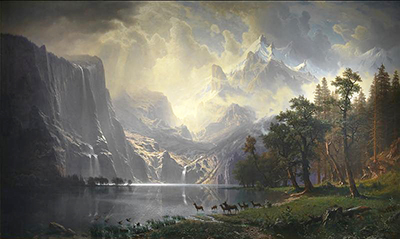
Lake Lucerne
1858Mountain Brook
1863Street in Nassau
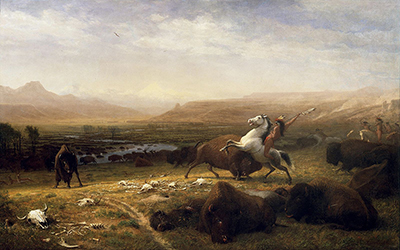
c. 1877–1880The Last of the Buffalo
1888–1889The Golden Gate
1900Contents
A landing seen through the landscape
Bierstadt sets the nearest animals against a dark bank at the lower left. Their slender legs and lowered heads bring the eye down to the water before it travels towards the distant ship. Behind them, a tall tree spreads branches across the pale sky. Smaller trees stand on the central ground, with more open spaces between their crowns. The foreground feels close enough to enter, while the historical action remains well beyond it.
The pond is essential to that arrangement. Reflections give the trees a second, inverted presence, joining the dark shapes of the land to the broad surface below. The water also separates the viewer from the small island and its building. We look across to the settlement, with the deer occupying our side of the scene. This layered arrangement makes arrival seem gradual and unhurried.
The largest ship lies towards the left, beyond the foreground tree. Its pale sails are visible against a luminous horizon, but its hull occupies only a narrow strip of the picture. A smaller craft and tiny shore figures belong to the same distant zone. Bierstadt could have concentrated attention on the captain, a greeting or a planted flag. Instead, the scale of the setting asks us to consider what the newcomers believed they were approaching.
On the right, a gently rising wooded shore closes the view. It balances the tall tree without matching its sharp silhouette. Across the middle, low ground and scattered trees create a long horizontal interval. The eye can move easily from ship to settlement to hillside, following the uninterrupted warmth of the light.
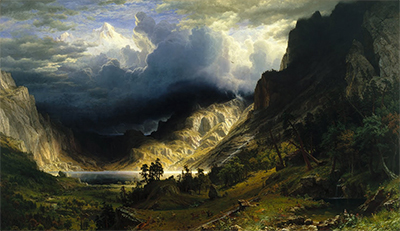
That light is brighter near the horizon and softer over the water. It gives the air a golden cast without producing the violent contrasts of Storm in the Rocky Mountains. The mood depends on sustained visibility: we can see the animals, the shelter, the water and the routes between them. Apparent ease is built into the composition.
The voyage behind the scene
Gosnold's party crossed the Atlantic aboard the Concord in 1602. James W. Mavor Jr.'s historical study, published by the Woods Hole Historical Museum during the voyage's four-hundredth anniversary, identifies John Brereton's account, Gabriel Archer's account and Gosnold's letter as central surviving testimony.[2] The painting belongs to a much later stage in the telling of that voyage.
Brereton describes a freshwater lake containing a small wooded island. He records waterfowl and turtles, followed by the decision to build a house there, roofed with sedge, and to fortify the position.[3] These details make the water, wildlife and central building particularly significant when looking at Bierstadt's composition. They are subjects present in the voyage literature as well as attractive elements of a landscape.
The correspondence between text and image does not turn the painting into a measured reconstruction. The literary account can explain why an island within a pond offered such a useful historical motif, while the painted arrangement determines how we experience it. Bierstadt brings a foreground refuge, a central dwelling and an ocean-going vessel into a single coherent view. Their positions make the place readable as both a protected interior and an accessible coast.
Brereton’s decision to fortify the dwelling introduces vulnerability into this history: a small visiting party had to choose a position it could defend. Bierstadt’s enclosure occupies a peaceful setting, with no conspicuous confrontation. The contrast concerns the different ways a narrative and a painting can present arrival; it does not establish the identity of every painted structure.
Brereton also records exchanges with Indigenous visitors and the loading of sassafras, cedar, furs and skins. When too few adequately supplied men were willing to remain, the party returned to England in June.[3] The voyage's outcome complicates the landscape's apparent promise. Shelter and abundant vegetation did not ensure that the proposed settlement would continue.
Abundance and the purposes of exploration
The deer, leafy trees and quiet water are more than decorative additions around a historical event. Together they suggest that the newcomers have reached a place capable of sustaining life. The protected pond answers a need for water and shelter; the animals and vegetation make resources visible.
Brereton's published account repeatedly evaluates the coast through its usefulness. His descriptions of timber, food and commodities address what prospective English visitors might obtain there. George Parker Winship's introduction to the account in Sailors Narratives explains its role in encouraging support for another expedition.[3] Its enthusiasm belongs to the economic purposes of exploration, as well as to the pleasure of encountering an unfamiliar landscape.
Reading the account beside the painting brings that interest into focus. A bright coast could be admired as scenery and assessed as a place for occupation or trade. Bierstadt's view makes those attractions appear compatible: the ship enters a landscape whose wildlife continues undisturbed, and a building finds room among the trees.
Yet the landscape's invitation comes from a particular perspective. The picture gives the viewer a comfortable position from which to contemplate arrival. It does not require us to share the uncertainty of an Atlantic crossing, the work of construction or the negotiations involved in living and trading on another people's coast. Its serenity is an artistic choice with historical consequences.
Indigenous presence and the peaceful image
The museum’s interpretation identifies a Native village within Bierstadt’s idealised account of settlement and contrasts the scene’s peace with the violence of colonisation.[1] That reading makes the calm central to the painting's historical meaning. The picture can acknowledge human presence on the shore while making the encounter seem easily absorbed into the order of nature.
Brereton's narrative offers a more complicated relationship. His party met people who travelled by canoe, exchanged goods and maintained their own relationships with the mainland. His descriptions are the observations of an English participant, shaped by his interests and assumptions.[3] They should be read as one side of an encounter, rather than as a complete account of the people whose coast the expedition visited.
Mavor's study also recounts growing distrust during the visit, including Gosnold's taking of a canoe.[2] Against that history, the untroubled water and animals become especially striking. The painting contains little visual urgency. Its tiny figures cannot readily convey the negotiations, disagreements or changing expectations that developed during the stay.
New Bedford before the western journeys
Bierstadt's choice of subject also belongs to his early career in New Bedford. The National Park Service records that his family settled there when he was a child, that he taught drawing before going to Germany in 1853, and that he returned in 1857. He organised an art exhibition in the city in 1858.[4] The Gosnold canvas was made during this return to a familiar coastal community.
Its chronology precedes the 1859 journey with Frederick Lander's expedition. The painting therefore cannot be explained as a memory of travelling in the Rocky Mountains or as an illustration of western settlement. Its low coast, sheltered water and sailing vessel locate a different history of arrival within the region where Bierstadt grew up.
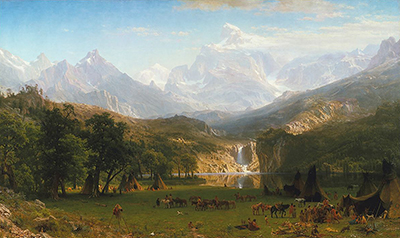
At the same time, the canvas shows an approach that would remain important in his landscapes: a detailed foreground introduces a much larger scene, light connects separate distances, and human activity gains significance through its place within the land. Comparing it with The Rocky Mountains, Lander's Peak reveals changes in scale and terrain without erasing this continuity of construction. In the later work, mountains dominate the distance; here, the luminous opening towards the sea supplies the expansive element.
The Massachusetts Historical Commission's 1984 survey records a history of timber removal and livestock grazing in the Elizabeth Islands, with much of the vegetation reduced to shrubs by the middle of the nineteenth century.[5] Bierstadt's rich woodland should consequently be approached as part of his evocation of an earlier coast. This regional land-use history helps distinguish an imagined historical landscape from a straightforward record of the islands in 1858.
A painting within local historical memory
The museum traces ownership from Bierstadt to Thomas Nye Jr., then through Nye's family to his granddaughter Emma B. Hathaway, who gave it to the museum in 1904. Its recorded exhibition history includes the Boston Athenaeum in 1859 and the travelling Albert Bierstadt: Art & Enterprise exhibition in 1991–92.[1] Those settings connect the picture's early public life with its later reassessment within Bierstadt's career.
The 1904 gift also belongs to a period of active Gosnold commemoration. The Old Dartmouth Historical Society's annual proceedings describe the connection between its formation and the effort to erect a Gosnold memorial on Cuttyhunk. They record the dedication in September 1903 and the transfer of the monument and islet to the society.[6] The place represented in Bierstadt's painting was becoming a site around which regional history was organised.
The same proceedings identify a Gosnold painting by William Wall among the museum's earliest gifts.[6] This is a separate work, but its presence shows that the subject had a place in the new collection beyond Bierstadt's canvas. Images, local histories and a physical memorial offered different ways to preserve and present the voyage.
Seen in that setting, Gosnold at Cuttyhunk carries two histories together. It imagines an English expedition arriving on a resource-rich coast in 1602, and it reveals how nineteenth-century painting could turn that arrival into a composed scene of promise. Its beauty remains inseparable from that act of historical interpretation.
Watch: Albert Bierstadt
Five perspectives on his paintings and their historical setting.
American Landscape Painting: Albert Bierstadt and the American Land
A Museum of Fine Arts, Boston presentation on American Landscape Painting: Albert Bierstadt and the American Land.
Explore Bierstadt’s artworks
Discussion
How does the calm landscape shape the historical encounter represented in Gosnold at Cuttyhunk?
Reader Insights
Follow the deer, reflected building and vessel in sequence. How does the arrangement make exploration part of an apparently peaceful place?
Read the surviving voyage accounts discussed in the article beside Bierstadt’s much later painting. What different questions can those forms of evidence answer?
Consider the picture’s New Bedford origins and museum history. How might those settings affect the way a seventeenth-century voyage is remembered?
Join the Conversation
Share a specific observation, documented connection or comparison from Gosnold at Cuttyhunk.
References
- New Bedford Whaling Museum. Bartholomew Gosnold at Cuttyhunk, 1858, object 1904.63. Collection metadata, interpretation, ownership and exhibition record. View source text
- James W. Mavor Jr. “Bartholomew Gosnold's 1602 Voyage to Cape Cod: In Verrazzano's Wake,” Spritsail, vol. 16, no. 2, Woods Hole Historical Museum, 2002, opening historical discussion. View source text
- John Brereton. A Briefe and true Relation of the Discouerie of the North part of Virginia, 1602, reprinted with an editorial introduction in George Parker Winship, ed., Sailors Narratives of Voyages Along the New England Coast, 1524–1624, 1905. Lake, dwelling, exchanges, cargo and return passages. View source text
- National Park Service. “Albert Bierstadt,” New Bedford Whaling National Historical Park. Early New Bedford career and return from Europe. View source text
- Massachusetts Historical Commission. Reconnaissance Survey Town Report: Gosnold, 1984, topography and historical overview, PDF pp. 2–3. Regional vegetation and land-use history. View source text
- Old Dartmouth Historical Society. Historical Sketch No. 5, proceedings of the annual meeting, 31 March 1904. Society formation, Gosnold memorial and early museum gifts. View source text