 by Tom Gurney
Tom Gurney BSc (Hons) is an art history expert with over 20 years experience
Published on June 19, 2020 / Updated on October 12, 2026
Email: tomgurney1@gmail.com / Phone: +44 7429 011000
Rocky Mountain Landscape by Albert Bierstadt
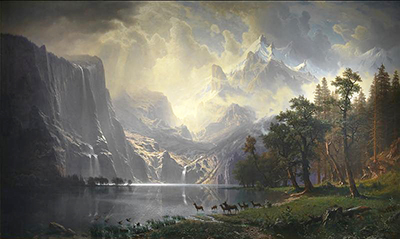
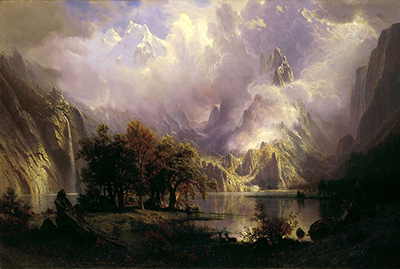
A dark lakeshore opens towards mountains illuminated through towering clouds in Albert Bierstadt's Rocky Mountain Landscape. Trees, rocks and deer occupy the foreground, while a narrow waterfall descends the cliff on the left. Across the lake, sharply projecting rock faces catch golden light. Higher, snow-covered peaks emerge from pale cloud, giving the scene several distinct levels of distance and scale.
The White House Historical Association records the painting as an 1870 oil on canvas measuring 93 × 139.1 centimetres, given by the Barra Foundation in 1981.[1] Its published account explains that Bierstadt worked from studies made during his 1863 western journey. The image therefore brings earlier observations into a later composition; it was not created entirely from unaided memory.
At a Glance
Where this painting sits in Bierstadt’s career
Dates refer to the paintings, rather than to the journeys behind them. Approximate dates and ranges retain the qualifications in the collection records.
Lake Lucerne
1858Mountain Brook
1863Street in Nassau
c. 1877–1880The Last of the Buffalo
1888–1889The Golden Gate
1900Contents
- The dark foreground opens towards light
- Deer beside the water
- Mountains revealed by clouds
- Reflections and the left-hand waterfall
- Studies transformed into a composed view
- Bierstadt and stereoscopic photography
- Comparing an imagined mountain lake
- A later setting in the White House
- Looking across the successive distances
The dark foreground opens towards light
The nearest ground contains some of the painting's deepest shadows. Angular rocks rise on the left, while reddish vegetation and low shrubs spread along the lower edge. On the right, the hillside merges into a dense dark band of trees beside the water.
These darker forms surround a brighter interior. The lake reflects pale sky and illuminated cliffs, and a central group of trees receives light along parts of its trunks and upper foliage. This contrast makes the viewer feel close to substantial objects while looking beyond them into a much larger space.
The landscape does not open evenly across its width. A wooded projection interrupts the water left of centre, while the right-hand shore reaches into the distance. Between them, the lake offers a pale passage towards the mountains. The banks both frame and divide that passage, so the eye encounters successive openings rather than a single unobstructed prospect.
Deer beside the water
A group of deer stands near the lower centre-right. The antlers of one animal rise against a lighter area behind it, making its small silhouette especially legible. The animals occupy a shaded bank rather than the centre of the illuminated lake.
Their placement gives the immense landscape a familiar scale. The nearby shrubs and rocks can be understood in relation to the deer; the mountain walls then seem larger by comparison. Yet the animals remain small enough that they do not turn the painting into a detailed wildlife portrait.
There is also a difference in the kinds of attention the image invites. The deer reward looking closely at the foreground, while the clouds and peaks draw attention upwards and outwards. Moving between them changes the scale at which the picture is read, from individual living forms to an entire mountain enclosure.
The reproduction supports recognition of deer, but does not establish a precise species or a narrative involving a particular observed herd.
Mountains revealed by clouds
Across the water, the central rock formations rise in broken stages. Illuminated faces sit beside cooler recesses, giving their steep surfaces a strongly faceted appearance. A narrow pinnacle projects into the clouds near the upper centre-right, while snow-covered summits appear farther back on the left.
The clouds separate these forms as well as surround them. Some ridges are sharply outlined; others dissolve into pale violet and grey atmosphere. The distant snow receives a softer light than the yellow-green rock faces nearer the lake, making the upper mountains seem farther away even where their contours remain visible.
The sky contains both darker masses and bright openings. Light appears to pass through the cloud structure, reaching selected slopes and leaving other areas subdued. The painting's drama depends on this uneven visibility: the viewer can see certain surfaces clearly while much of the mountainous space remains veiled.
Such effects create convincing depth without providing a weather forecast or a secure identification of every summit. The title names a mountain region; the painted arrangement should not be treated as a surveyed view of a single known lake.
Reflections and the left-hand waterfall
A thin waterfall descends the cliff on the left. Its pale vertical line contrasts with the broader horizontal surface below. Near its base, reflected light connects the cliff to the lake, while the shadowed trees in front interrupt parts of that connection.
Elsewhere, the water repeats the shapes and colours of the illuminated mountains in elongated, softened passages. The reflections are not as sharply defined as the rock faces above them. They translate those steep forms into a quieter surface, allowing the lake to hold together areas that appear more fragmented in the clouds.
Small rocks and vegetation along the near shore break the water's edge. These interruptions keep the foreground particular, while the smoother passages farther back provide visual rest. Bierstadt balances the steep upward movement of cliffs and trees with a lake that spreads across the lower part of the scene.
Studies transformed into a composed view
The Association's published interpretation, drawn from William Kloss and colleagues' Art in the White House, compares the picture's dark framing and bright interior to theatrical presentation. This is a useful account of how the image directs attention: the nearest shadows make the distant light more emphatic.
Using studies allowed observations to enter a later design. The convincing detail of rock, foliage and water works within that arrangement. It should not be confused with a photograph or treated as proof that every depicted feature was visible together from one position.
Bierstadt and stereoscopic photography
Bierstadt's engagement with photography has documentary substance. The Metropolitan Museum of Art holds Stereoscopic Views among the White Mountains in New Hampshire, a book copyrighted by Edward and Charles Bierstadt in 1860. The museum identifies Albert as a collaborator in composing its pictures.[2]
The volume incorporated prismatic lenses so that the photographs could produce a three-dimensional effect within the book itself. The Met also notes production difficulties, including the cost of salted paper prints and the arrangement of the lenses. This was a practical experiment in how an audience might experience landscape through a viewing device.
The example concerns New Hampshire, not the mountains in this canvas. It establishes a connection between Bierstadt's painting practice and photographic work without identifying a particular photograph as the source of Rocky Mountain Landscape. The picture's successive layers can be examined in that wider context of creating persuasive spatial experience.
Comparing an imagined mountain lake
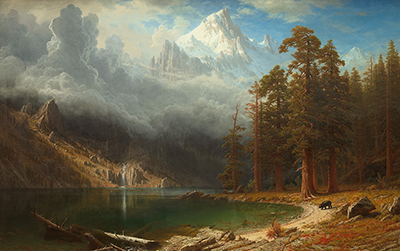
The National Gallery of Art describes Bierstadt's Mount Corcoran, circa 1876–1877, as an imagined scene derived from his western experience.[3] Originally exhibited as Mountain Lake, it was renamed before Corcoran purchased it in 1878.
Its reproduction brings another lake, forested shore, waterfall and snowy mountain into a coherent composition. The near trees gather on the right, with a bear walking beside the water; in Rocky Mountain Landscape, deer occupy the foreground and the main tree group stands farther left. The comparison shows how recurring kinds of subject could support different spatial arrangements.
The Gallery's documented account belongs specifically to Mount Corcoran. It helps distinguish landscape invention from invented catalogue facts: a painting can depict a composed setting while still possessing a verifiable title history, date range and collection record.
A later setting in the White House
A White House Historical Association photograph dated 2010 shows Rocky Mountain Landscape hanging in the Red Room.[4] The framed canvas appears above a sofa against a red wall, providing a documented view of its later presentation within a furnished interior.
That photograph records one historical arrangement. It does not establish the painting's current room or present visitor access. It does, however, add a second setting to the work's history: a nineteenth-century mountain landscape seen within the White House collection more than a century after its creation.
Looking across the successive distances
Begin with the antlered deer, then move across the bank towards the illuminated trunks. The pale lake leads beyond them to the bright rock faces, and the clouds carry attention towards the distant snow.
Returning to the foreground reveals how much the larger spectacle depends on its quieter details. Trees, reflections, shrubs and animals provide successive points of orientation. Bierstadt makes an immense mountain space accessible through these small changes in scale, light and visibility.
Watch: Albert Bierstadt
Five perspectives on his paintings and their historical setting.
American Landscape Painting: Albert Bierstadt and the American Land
A Museum of Fine Arts, Boston presentation on American Landscape Painting: Albert Bierstadt and the American Land.
Explore Bierstadt’s artworks
Discussion
A shaded lakeshore opens towards bright mountains and cloud. How does the painting move attention through its successive distances?
Reader Insights
What role do the small deer and the antlered silhouette play in establishing the scale of the brighter landscape beyond?
Where do clouds reveal the rock faces, and where do they prevent the peaks from becoming a single clear outline?
How does the documented Red Room presentation change the way you imagine encountering this broad mountain view?
Join the Conversation
Share a specific observation, documented connection or comparison from Rocky Mountain Landscape.
References
- White House Historical Association. Treasures of the White House: Rocky Mountain Landscape. Date, medium, dimensions, 1981 gift and interpretation reproduced from William Kloss and colleagues, Art in the White House, 1992. View source text
- The Metropolitan Museum of Art. Stereoscopic Views among the White Mountains in New Hampshire. New Bedford, MA, 1860, 2022.145. Bierstadt brothers' collaboration, salted paper prints and built-in viewing lenses. View source text
- National Gallery of Art. Mount Corcoran, circa 1876–1877, 2014.79.4. Imagined landscape, title history, 1878 purchase and visually inspected reproduction of a separate work. View source text
- White House Historical Association. Foreword; White House History (Number 34)—Photo 2. Photograph documenting the painting in the Red Room in 2010. View source text